
Phonic Workshop for parents of children in Reception
- Slides: 26
Phonic Workshop for parents of children in Reception and Year One Supporting your child to progress through the phonic phases and be successful in the phonic screening check
Aims To understand the importance of phonics. To get an idea of how phonics is taught in school. To learn how children progress through the phonic phases and how to support and develop children’s learning. To understand the Year One phonic screening and what this involves for your child
Phonics is all about using … skills for reading and spelling + knowledge of the alphabet Learning phonics will help your child to become a good reader and writer.
Phonic terms explained • Phonemes: The smallest units of sound that are found within a word (you hear a phoneme) • Grapheme: The spelling of the sound e. g. Th (you see a grapheme) • Diagraph: Two letters that make one sound when read • Trigraphs: Three letters that make one sound • CVC: Stands for consonant, vowel, consonant (this applies to sounds NOT letters) • Segmenting: is breaking up a word into its sounds to spell • Blending : Putting the sounds together to read a word • Tricky words: Words that cannot easily be decoded.
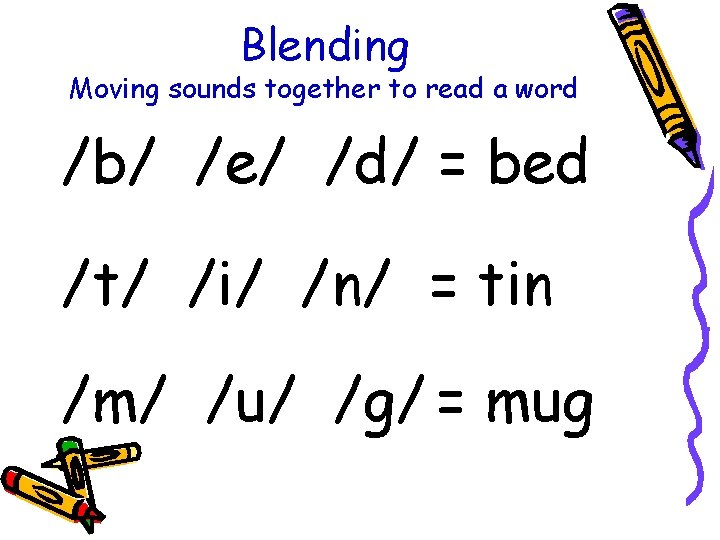
Blending Moving sounds together to read a word /b/ /e/ /d/ = bed /t/ /i/ /n/ = tin /m/ /u/ /g/ = mug
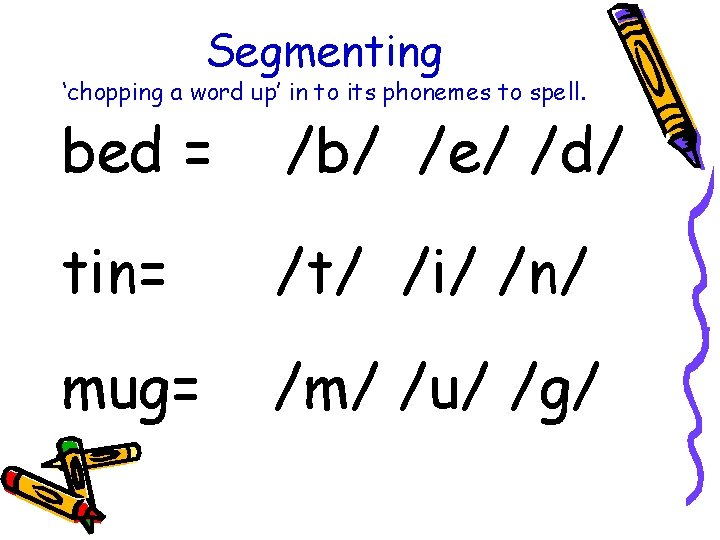
Segmenting ‘chopping a word up’ in to its phonemes to spell. bed = /b/ /e/ /d/ tin= /t/ /i/ /n/ mug= /m/ /u/ /g/
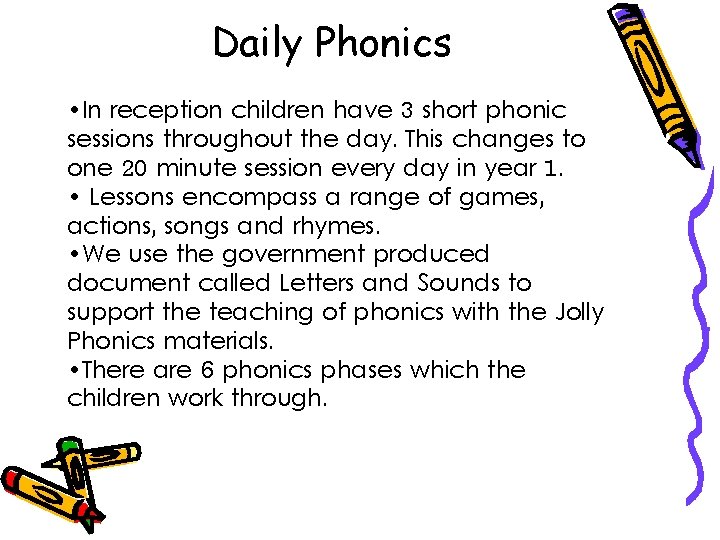
Daily Phonics • In reception children have 3 short phonic sessions throughout the day. This changes to one 20 minute session every day in year 1. • Lessons encompass a range of games, actions, songs and rhymes. • We use the government produced document called Letters and Sounds to support the teaching of phonics with the Jolly Phonics materials. • There are 6 phonics phases which the children work through.
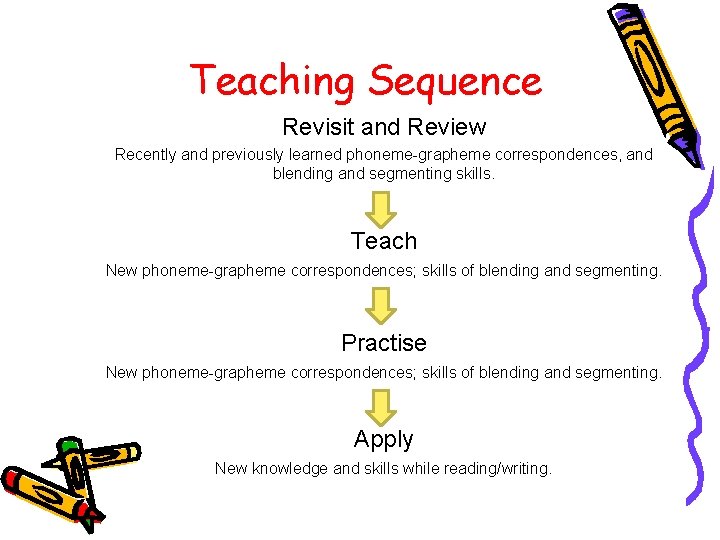
Teaching Sequence Revisit and Review Recently and previously learned phoneme-grapheme correspondences, and blending and segmenting skills. Teach New phoneme-grapheme correspondences; skills of blending and segmenting. Practise New phoneme-grapheme correspondences; skills of blending and segmenting. Apply New knowledge and skills while reading/writing.
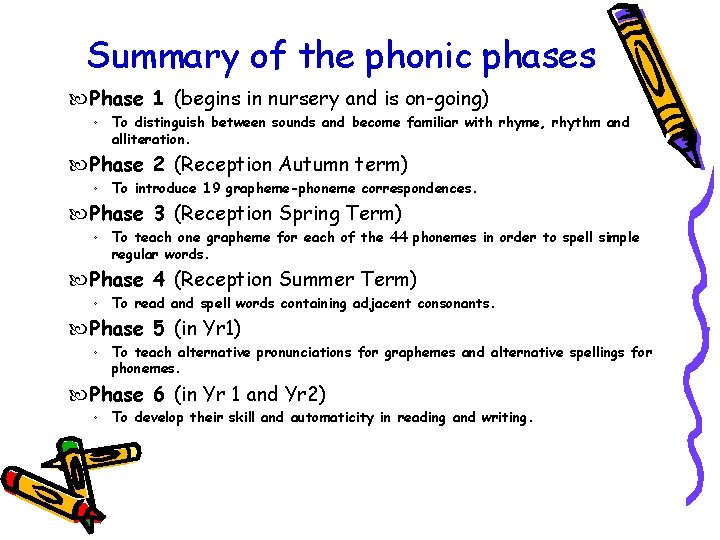
Summary of the phonic phases Phase 1 (begins in nursery and is on-going) ◦ To distinguish between sounds and become familiar with rhyme, rhythm and alliteration. Phase 2 (Reception Autumn term) ◦ To introduce 19 grapheme-phoneme correspondences. Phase 3 (Reception Spring Term) ◦ To teach one grapheme for each of the 44 phonemes in order to spell simple regular words. Phase 4 (Reception Summer Term) ◦ To read and spell words containing adjacent consonants. Phase 5 (in Yr 1) ◦ To teach alternative pronunciations for graphemes and alternative spellings for phonemes. Phase 6 (in Yr 1 and Yr 2) ◦ To develop their skill and automaticity in reading and writing.
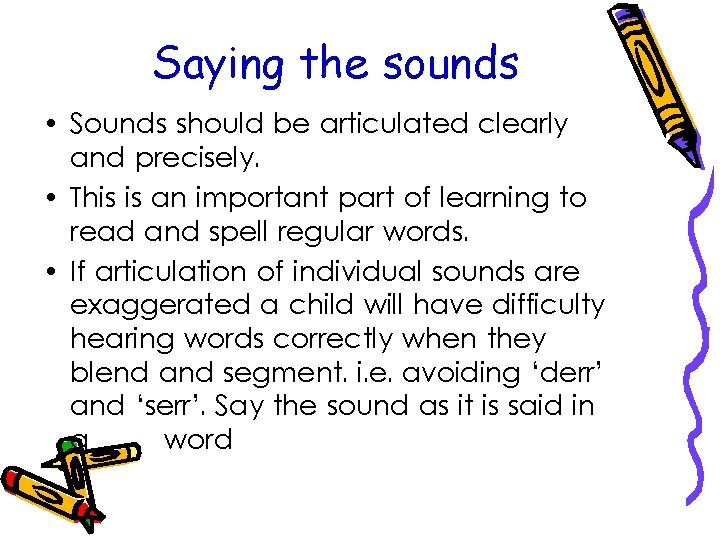
Saying the sounds • Sounds should be articulated clearly and precisely. • This is an important part of learning to read and spell regular words. • If articulation of individual sounds are exaggerated a child will have difficulty hearing words correctly when they blend and segment. i. e. avoiding ‘derr’ and ‘serr’. Say the sound as it is said in a word
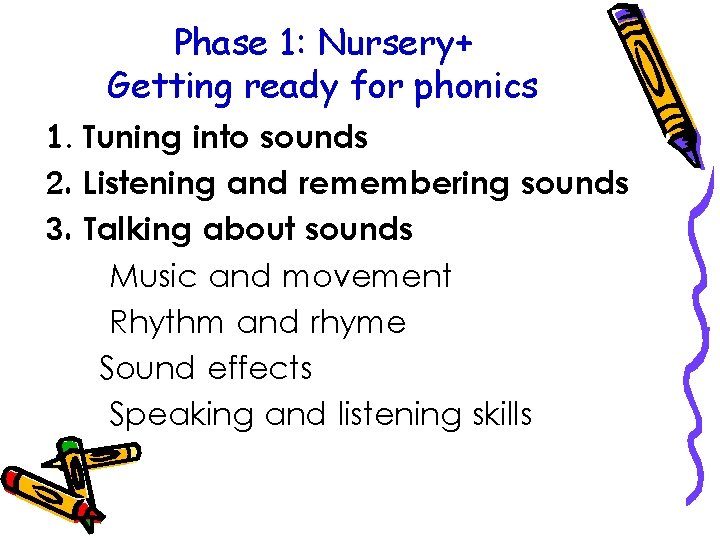
Phase 1: Nursery+ Getting ready for phonics 1. Tuning into sounds 2. Listening and remembering sounds 3. Talking about sounds Music and movement Rhythm and rhyme Sound effects Speaking and listening skills
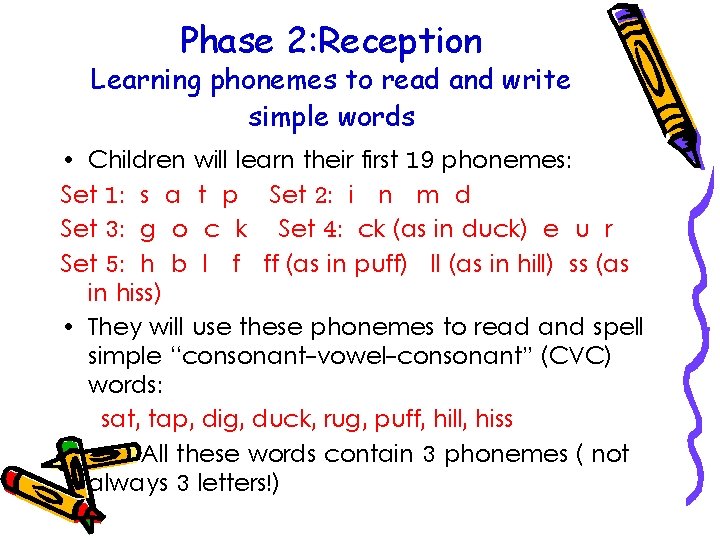
Phase 2: Reception Learning phonemes to read and write simple words • Children will learn their first 19 phonemes: Set 1: s a t p Set 2: i n m d Set 3: g o c k Set 4: ck (as in duck) e u r Set 5: h b l f ff (as in puff) ll (as in hill) ss (as in hiss) • They will use these phonemes to read and spell simple “consonant-vowel-consonant” (CVC) words: sat, tap, dig, duck, rug, puff, hill, hiss All these words contain 3 phonemes ( not always 3 letters!)
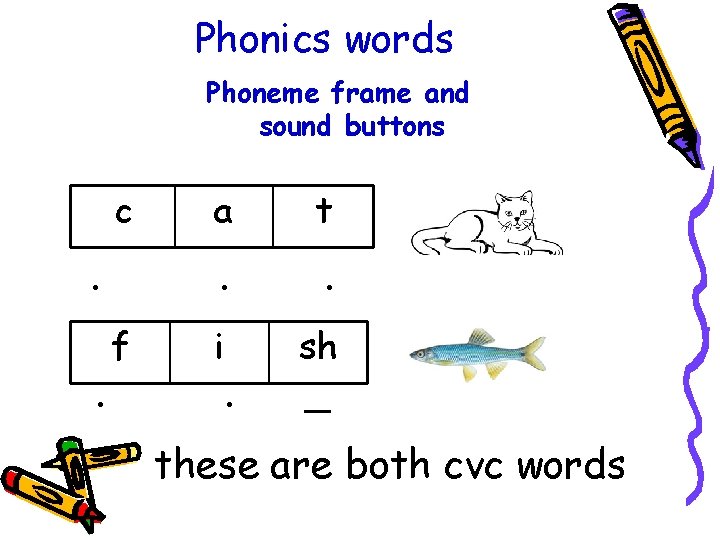
Phonics words Phoneme frame and sound buttons c . . f a t . . i sh . _ these are both cvc words
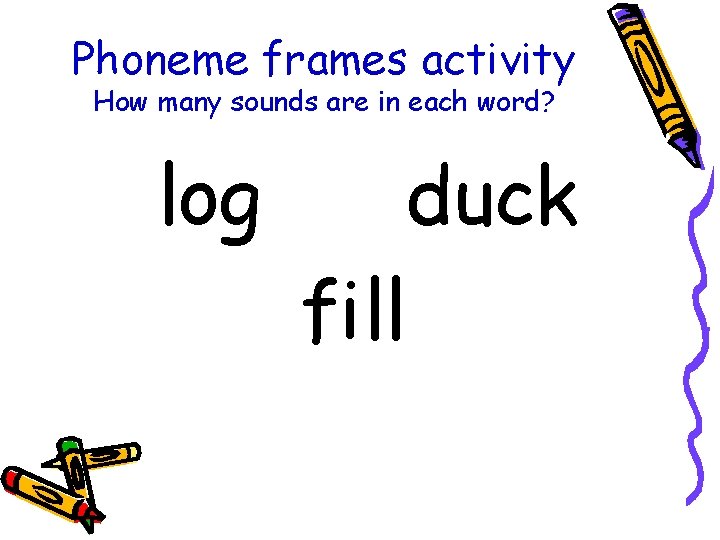
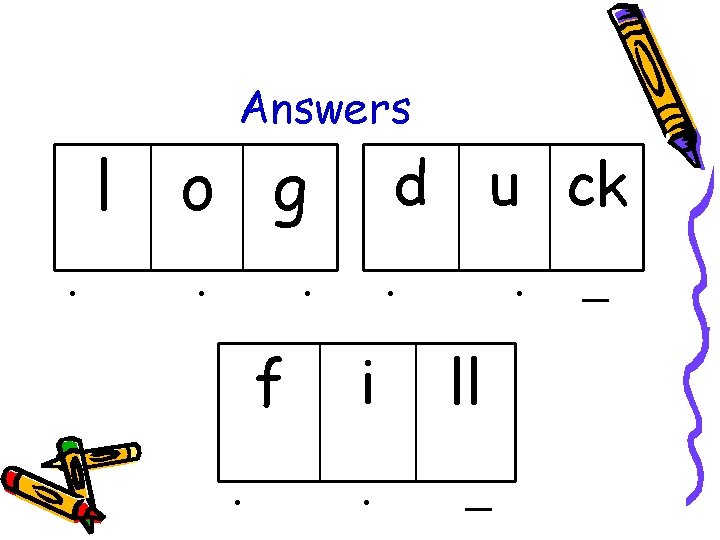
Phoneme frames activity How many sounds are in each word? log duck fill
Answers l. o g. d . f. u ck . . i ll . _ _
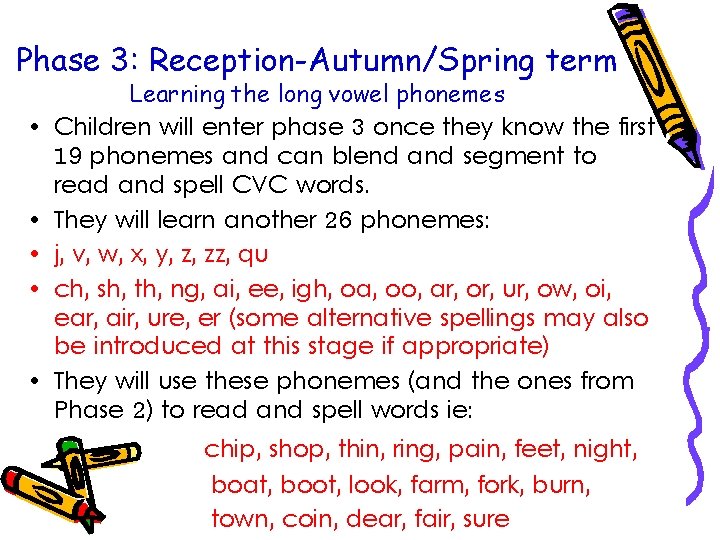
Phase 3: Reception-Autumn/Spring term • • • Learning the long vowel phonemes Children will enter phase 3 once they know the first 19 phonemes and can blend and segment to read and spell CVC words. They will learn another 26 phonemes: j, v, w, x, y, z, zz, qu ch, sh, th, ng, ai, ee, igh, oa, oo, ar, or, ur, ow, oi, ear, air, ure, er (some alternative spellings may also be introduced at this stage if appropriate) They will use these phonemes (and the ones from Phase 2) to read and spell words ie: chip, shop, thin, ring, pain, feet, night, boat, boot, look, farm, fork, burn, town, coin, dear, fair, sure
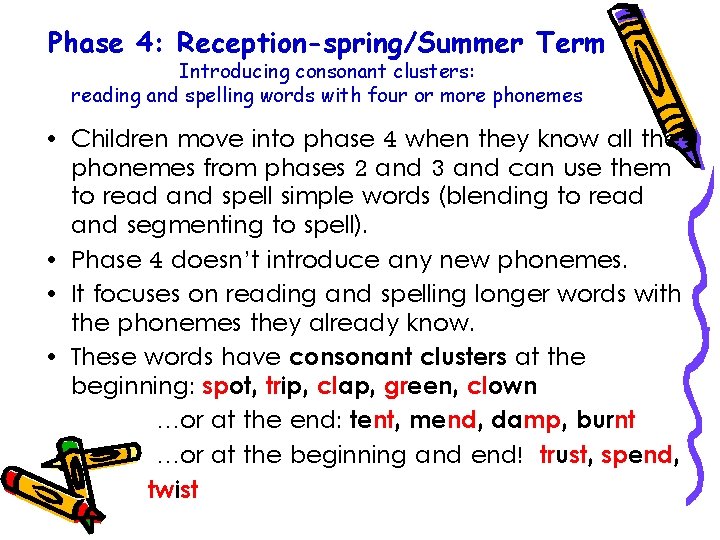
Phase 4: Reception-spring/Summer Term Introducing consonant clusters: reading and spelling words with four or more phonemes • Children move into phase 4 when they know all the phonemes from phases 2 and 3 and can use them to read and spell simple words (blending to read and segmenting to spell). • Phase 4 doesn’t introduce any new phonemes. • It focuses on reading and spelling longer words with the phonemes they already know. • These words have consonant clusters at the beginning: spot, trip, clap, green, clown …or at the end: tent, mend, damp, burnt …or at the beginning and end! trust, spend, twist
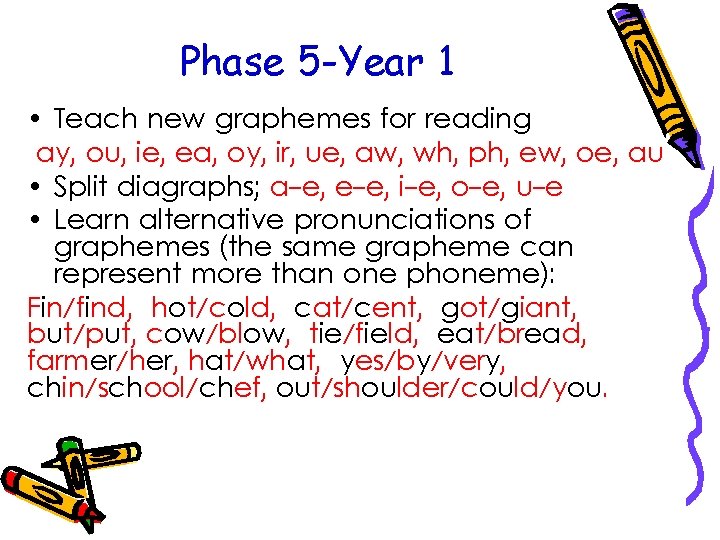
Phase 5 -Year 1 • Teach new graphemes for reading ay, ou, ie, ea, oy, ir, ue, aw, wh, ph, ew, oe, au • Split diagraphs; a-e, e-e, i-e, o-e, u-e • Learn alternative pronunciations of graphemes (the same grapheme can represent more than one phoneme): Fin/find, hot/cold, cat/cent, got/giant, but/put, cow/blow, tie/field, eat/bread, farmer/her, hat/what, yes/by/very, chin/school/chef, out/shoulder/could/you.
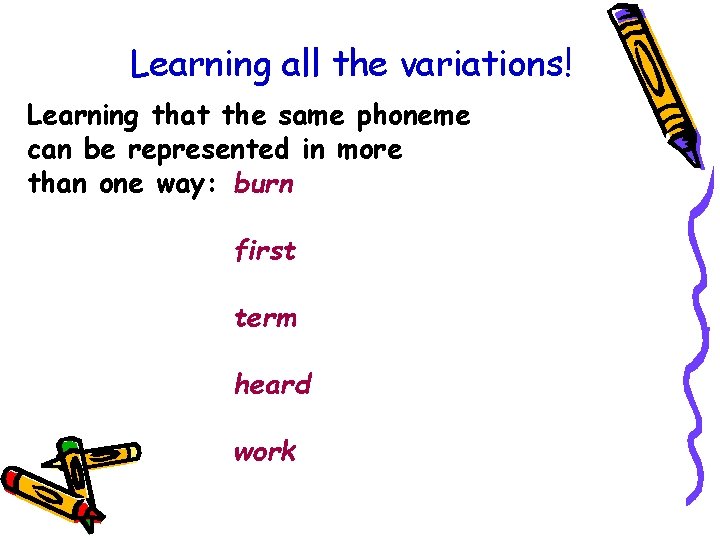
Learning all the variations! Learning that the same phoneme can be represented in more than one way: burn first term heard work
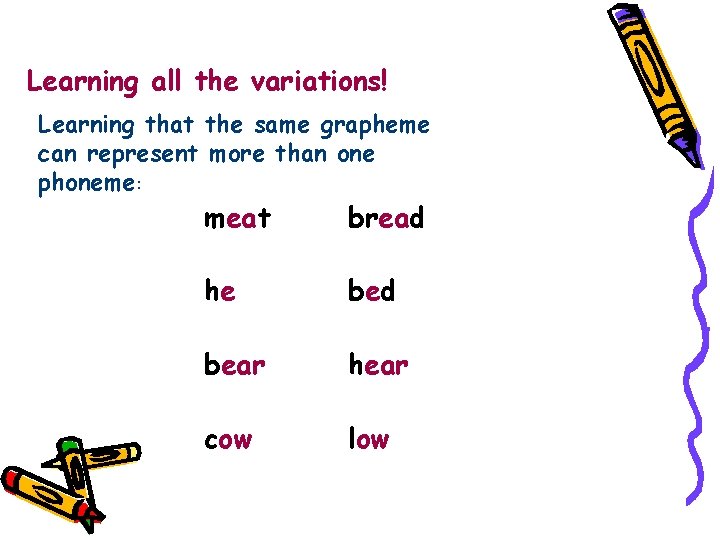
Learning all the variations! Learning that the same grapheme can represent more than one phoneme: meat bread he bed bear hear cow low
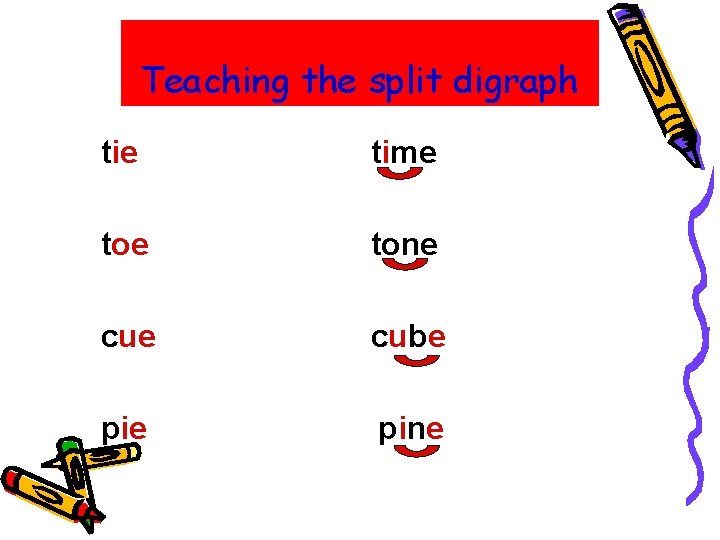
Teaching the split digraph tie time tone cube pine
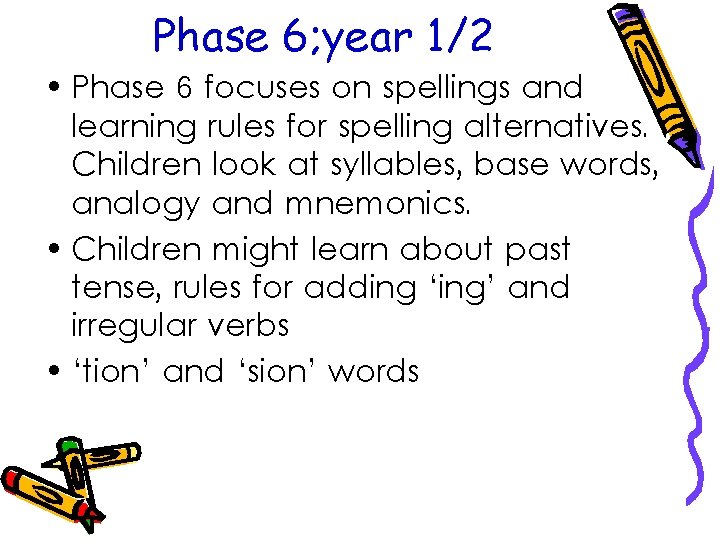
Phase 6; year 1/2 • Phase 6 focuses on spellings and learning rules for spelling alternatives. Children look at syllables, base words, analogy and mnemonics. • Children might learn about past tense, rules for adding ‘ing’ and irregular verbs • ‘tion’ and ‘sion’ words
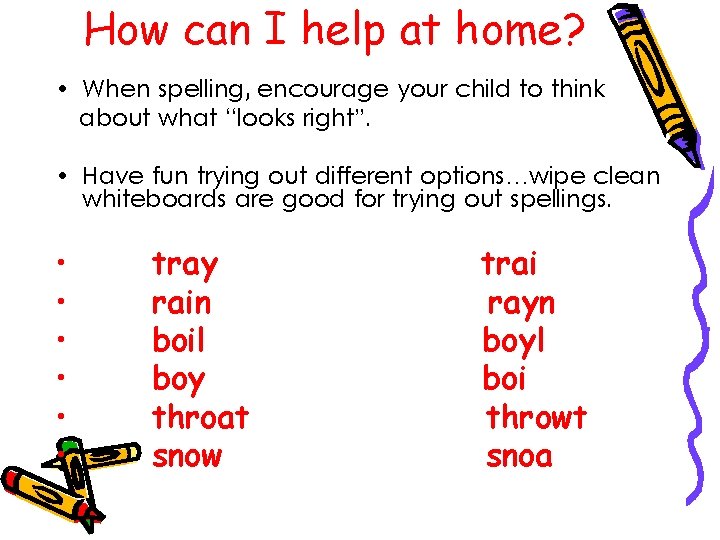
How can I help at home? • When spelling, encourage your child to think about what “looks right”. • Have fun trying out different options…wipe clean whiteboards are good for trying out spellings. • • • tray rain boil boy throat snow trai rayn boyl boi throwt snoa
At home • • Phonics Packs for every child in FS Spellings from year one Practise the phonemes together. Use them to make different words at home and play phonics games • Read everyday with your child if possible • Practice reading and writing words every day. • Use the words to make sentences.
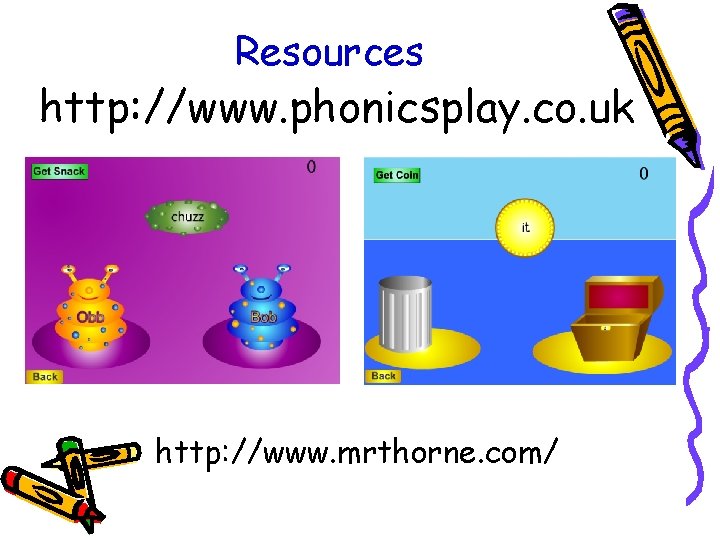
Resources http: //www. phonicsplay. co. uk http: //www. mrthorne. com/
Any questions!?