
Phonetics Phonology John Corbett USPCAPES International Fellow Session
Phonetics & Phonology John Corbett: USP-CAPES International Fellow Session 1: Introduction
Today’s session What is Phonetics & Phonology? Why should we study it? Course aims & structure. The concept of ‘accent’. The vocal organs. The International Phonetic Alphabet The consonants of English.
The systematic study of pronunciation The scientific study of spoken language What is ‘Phonetics & Phonology’? Phonetics: individual units of sound Phonology: putting those sounds together Say these words Handbag
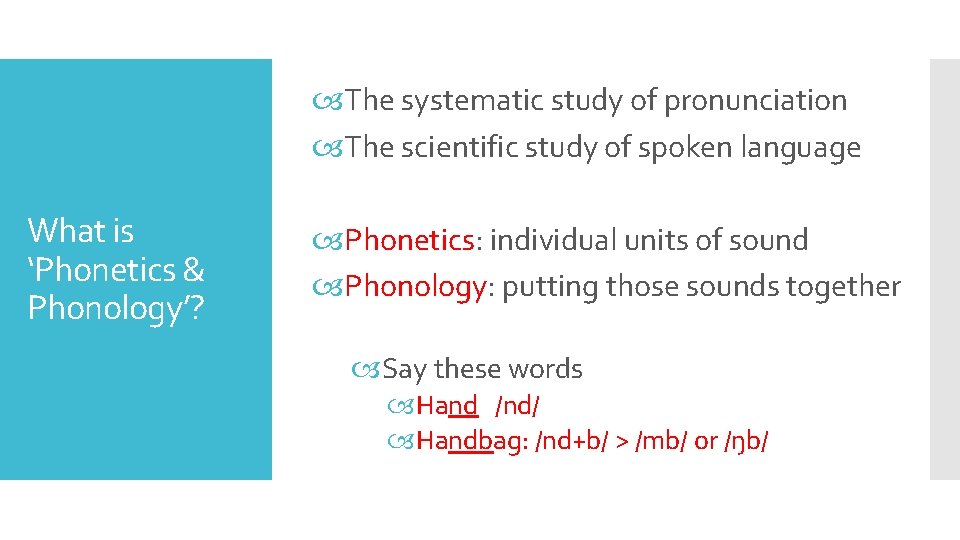
The systematic study of pronunciation The scientific study of spoken language What is ‘Phonetics & Phonology’? Phonetics: individual units of sound Phonology: putting those sounds together Say these words Hand /nd/ Handbag: /nd+b/ > /mb/ or /ŋb/
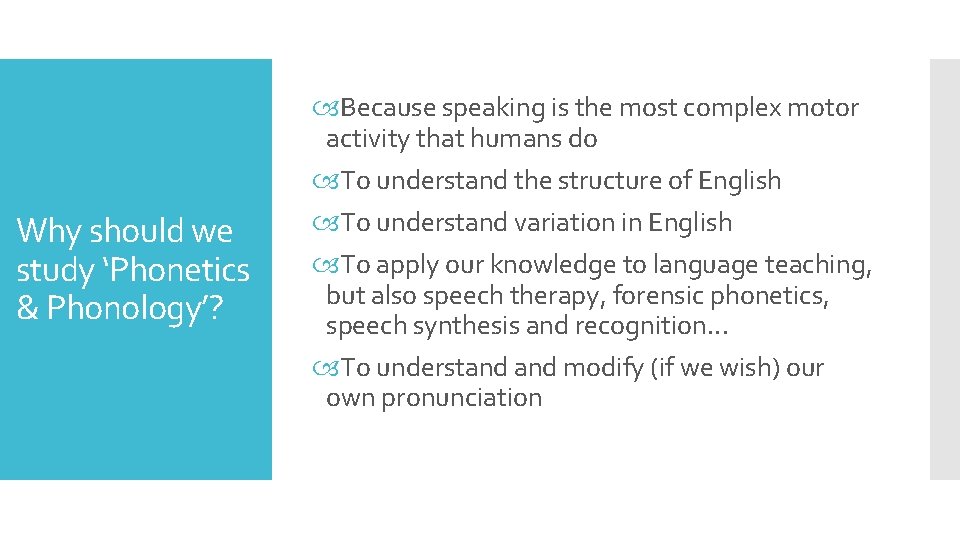
Why should we study ‘Phonetics & Phonology’? Because speaking is the most complex motor activity that humans do To understand the structure of English To understand variation in English To apply our knowledge to language teaching, but also speech therapy, forensic phonetics, speech synthesis and recognition. . . To understand modify (if we wish) our own pronunciation
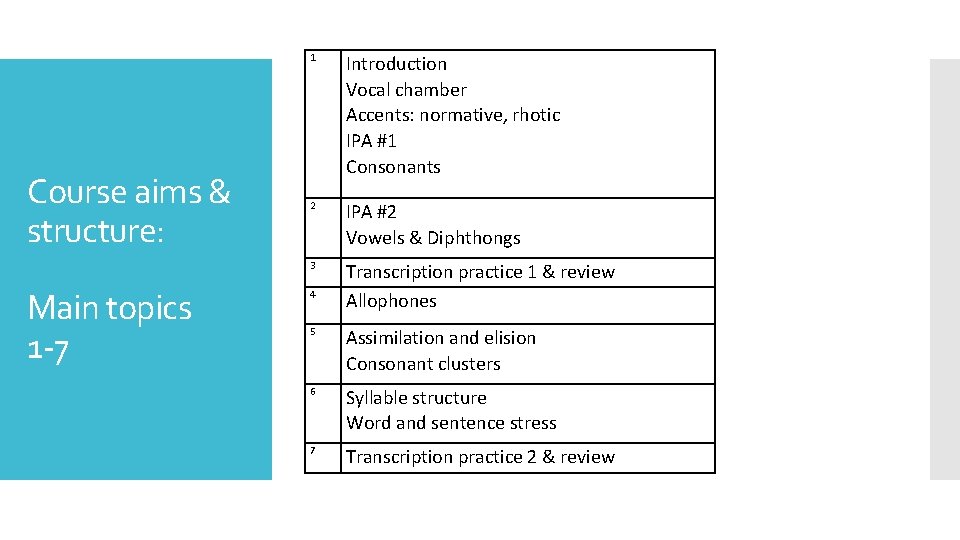
Course aims & structure: Main topics 1 -7 1 Introduction Vocal chamber Accents: normative, rhotic IPA #1 Consonants 2 IPA #2 Vowels & Diphthongs 3 Transcription practice 1 & review Allophones 4 5 Assimilation and elision Consonant clusters 6 Syllable structure Word and sentence stress 7 Transcription practice 2 & review
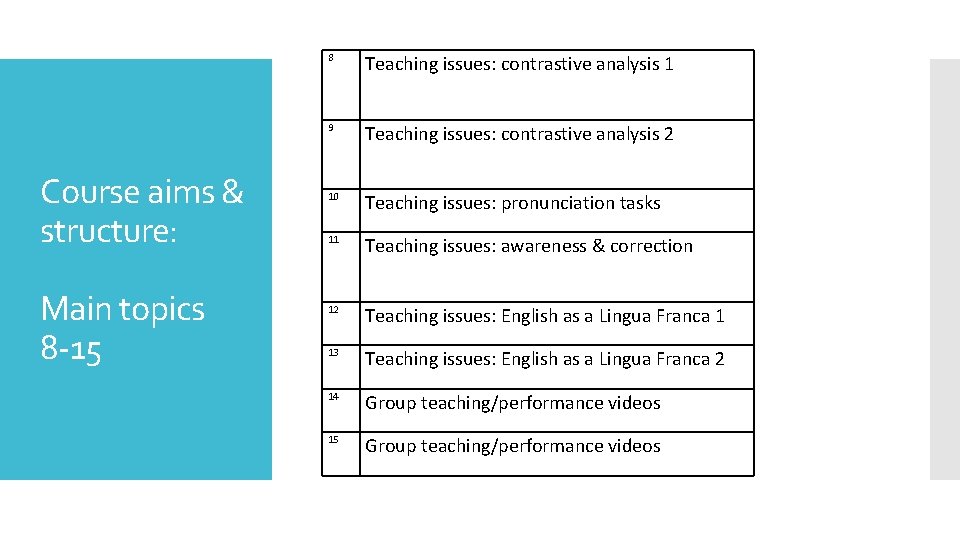
Course aims & structure: Main topics 8 -15 8 Teaching issues: contrastive analysis 1 9 Teaching issues: contrastive analysis 2 10 Teaching issues: pronunciation tasks 11 Teaching issues: awareness & correction 12 Teaching issues: English as a Lingua Franca 1 13 Teaching issues: English as a Lingua Franca 2 14 Group teaching/performance videos 15 Group teaching/performance videos
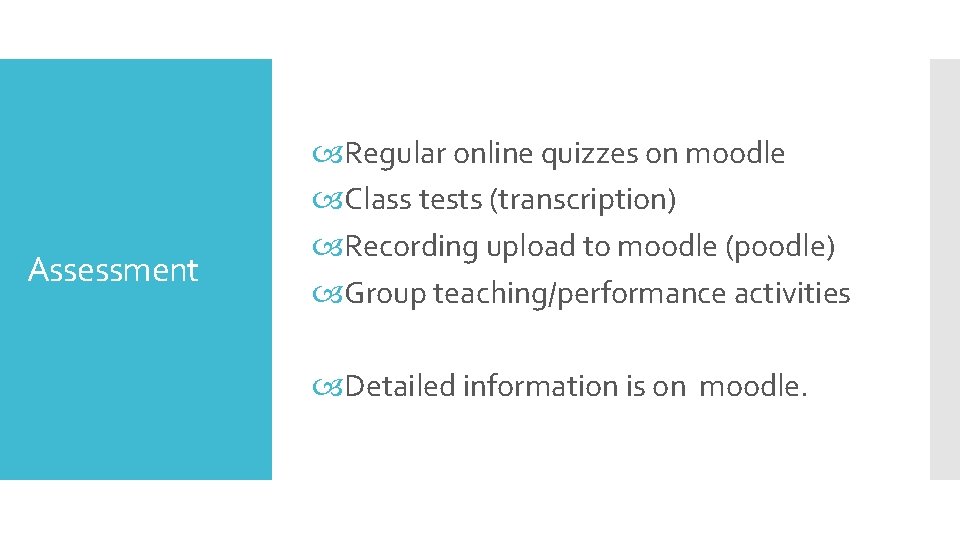
Assessment Regular online quizzes on moodle Class tests (transcription) Recording upload to moodle (poodle) Group teaching/performance activities Detailed information is on moodle.
Resources on moodle Course slides Further reading Assessment actvities Links to useful and fun web resources http: //youtu. be/oed 8 Nj 1 OPMM
Accent = how you realise the sounds of a language Accents and norms Different accents give indication of Geographical origin, e. g. West of Scotland Social class Ethnicity Gender orientation, etc Normative accents include RP (‘Received’ or ‘socially acceptable’ pronunciation) Gen. Am (‘General American’) Lingua Franca English (‘rational/non-native’)
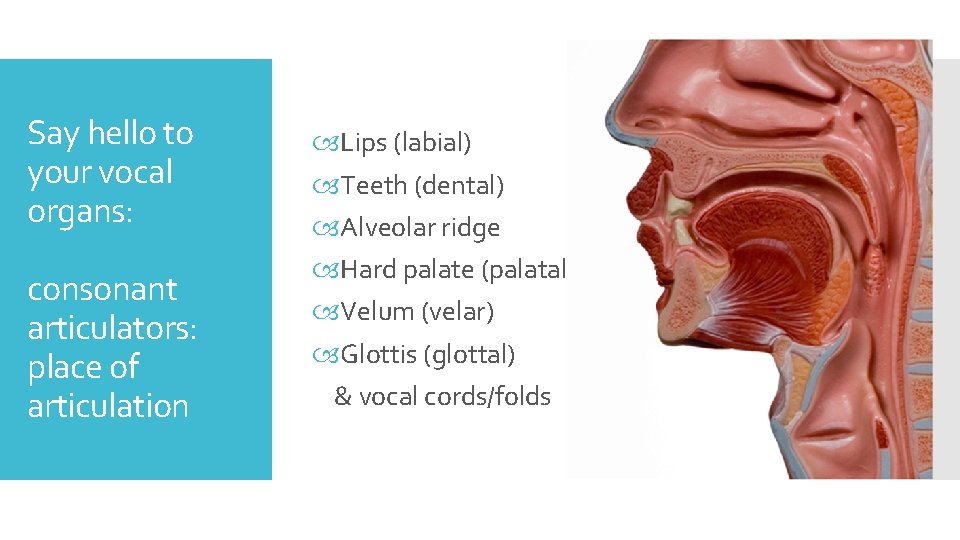
Say hello to your vocal organs: consonant articulators: place of articulation Lips (labial) Teeth (dental) Alveolar ridge Hard palate (palatal) Velum (velar) Glottis (glottal) & vocal cords/folds
How to make a consonant Consonants involve an obstruction of the passage of air from the lungs out through the mouth or nose. We ask: 1. Where does the obstruction occur? (place of articulation) 2. How does the obstruction occur? (manner of articulation) 3. Is there vibration of the vocal cords during production? (voicing)
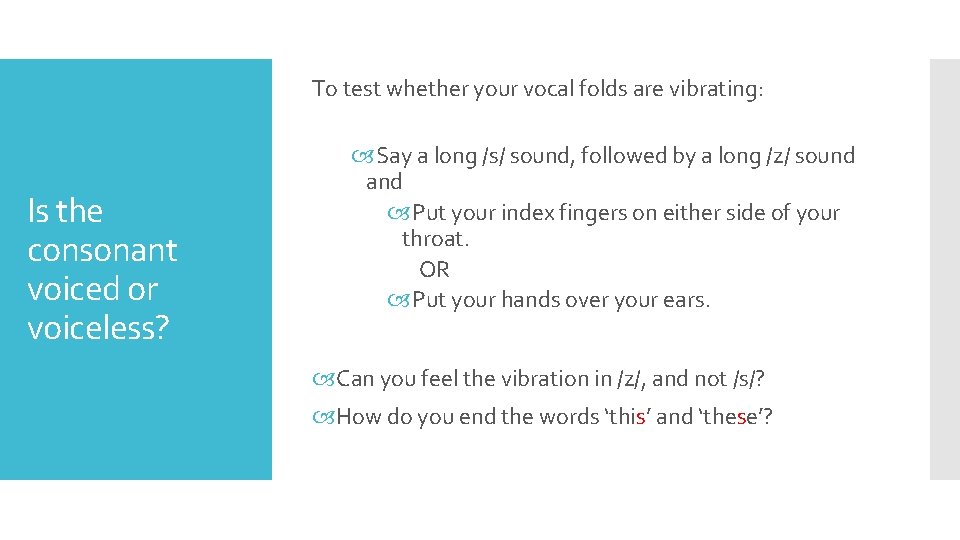
To test whether your vocal folds are vibrating: Is the consonant voiced or voiceless? Say a long /s/ sound, followed by a long /z/ sound and Put your index fingers on either side of your throat. OR Put your hands over your ears. Can you feel the vibration in /z/, and not /s/? How do you end the words ‘this’ and ‘these’?
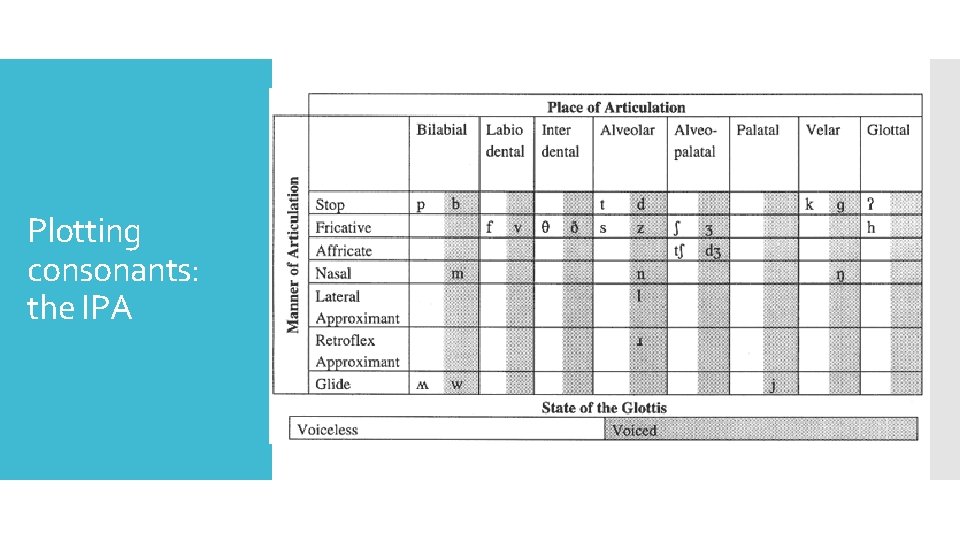
Plotting consonants: the IPA
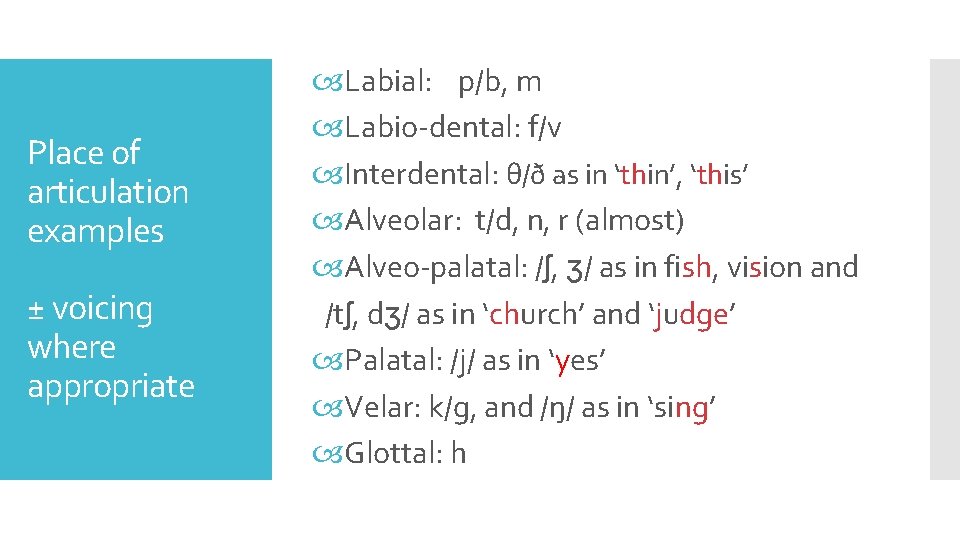
Place of articulation examples ± voicing where appropriate Labial: p/b, m Labio-dental: f/v Interdental: θ/ð as in ‘thin’, ‘this’ Alveolar: t/d, n, r (almost) Alveo-palatal: /ʃ, ʒ/ as in fish, vision and /tʃ, dʒ/ as in ‘church’ and ‘judge’ Palatal: /j/ as in ‘yes’ Velar: k/g, and /ŋ/ as in ‘sing’ Glottal: h
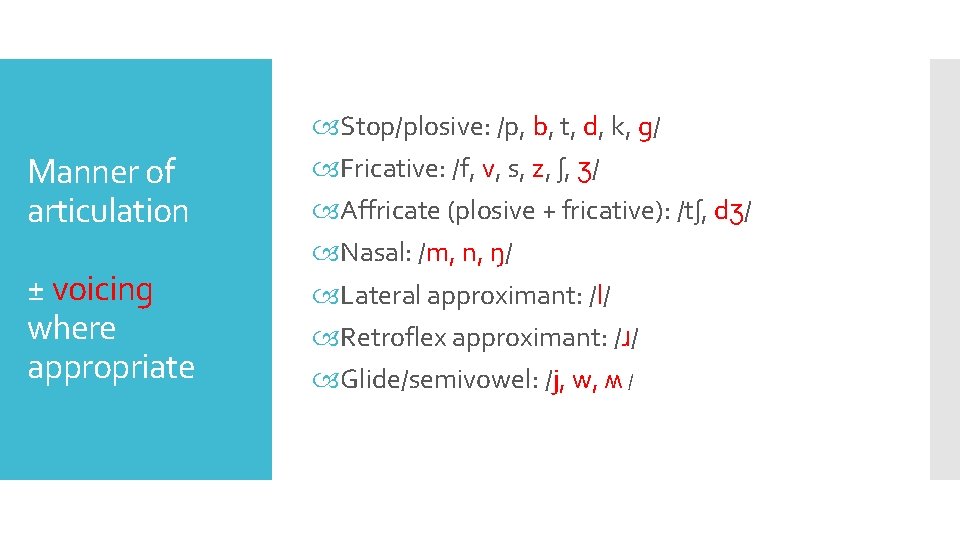
Manner of articulation ± voicing where appropriate Stop/plosive: /p, b, t, d, k, g/ Fricative: /f, v, s, z, ʃ, ʒ/ Affricate (plosive + fricative): /tʃ, dʒ/ Nasal: /m, n, ŋ/ Lateral approximant: /l/ Retroflex approximant: /ɹ/ Glide/semivowel: /j, w, ʍ /
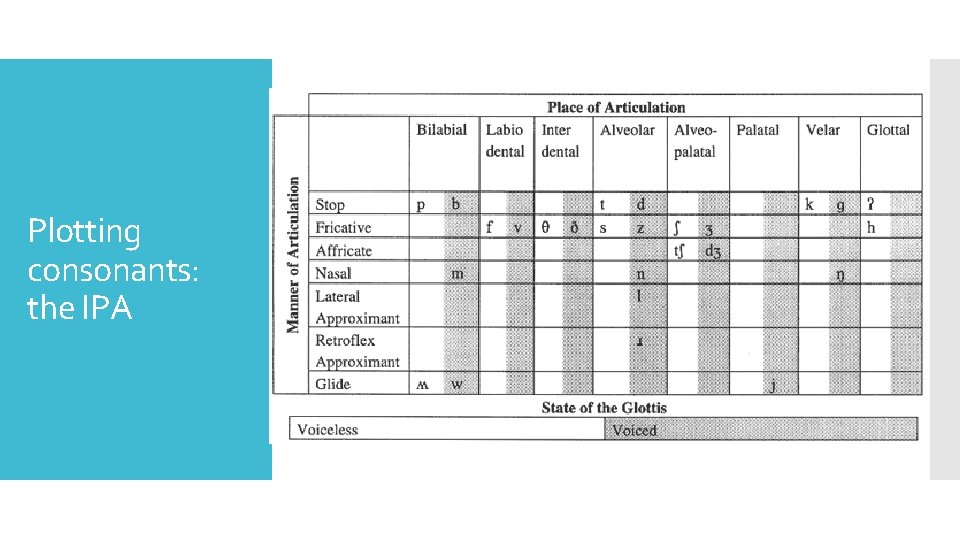
Plotting consonants: the IPA
/ʍ/ is used by speakers of those accents that make a difference in the pronunciation of ‘whales’ and ‘Wales’. Interesting consonants We sometimes hear /ʔ/ instead of /t/ in the middle and end of words like ‘butter’ or ‘slight’. This is the famous ‘glottal stop’. In some (non-rhotic) accents, /r/ is not pronounced word-finally or before consonants. Where it is pronounced, it can be pronounced in many ways, eg [r] (trill) [ɾ] (tap or flap] [ɹ] (approximant) [R] retroflex approximant, ‘uvular r’
In groups of 2 -3, do the following: 1. Say the following words with a /t/ sound and then a glottal stop: A bit of groupwork ‘litter’ ‘butter’ ‘cut’ ‘fright’ 2. Is there a difference (apart from the first sound!) in the way you pronounce ‘singer’ and ‘finger’? Is there a rule? Does everybody follow it? 2. Say the following dialogue in a non-rhotic and then a rhotic accent: A: ‘There’s been a murder!’ B: Where!? ’ C: /A ‘There!!’ 3. Shout the word ‘freedom’ together, using a Scottish trill and then an RP approximant.
Beyond today’s session Familiarising yourself with IPA In your copious free time, look at some of the following resources on moodle: Familiarise yourself with the consonant symbols and sounds of the IPA by checking out the consonants in the following resources. http: //www. yorku. ca/earmstro/ipa/consonants. html http: //www. seeingspeech. ac. uk/ Note that the speakers will put the consonants in different contexts: initial, medial and final. If you want to type and then cut and paste IPA symbols, look at http: //ipa. typeit. org/
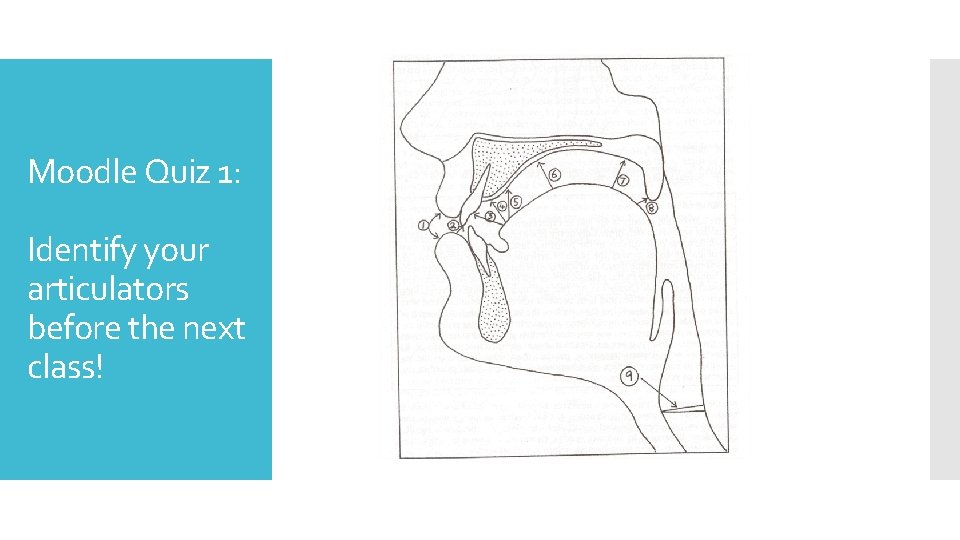
Moodle Quiz 1: Identify your articulators before the next class!
Thanks! Contact info: jcorbett@usp. br Make sure you can access moodle! Next week…vowels!!
- Slides: 22