
PHONETICS PART I ENGLISH Dr Sarla Verma Dr

- Slides: 39
PHONETICS PART I ENGLISH Dr. Sarla Verma Dr. B. R. Ambedkar Polytechnic College Gwalior
Learning a Language �Native Language is naturally acquired by listening and imitating during childhood. �When it comes to learning a second language, it needs special training and it is not heard except in the classroom. Dr. Sarla Verma 2
�The ingrained habits of our native language cause serious conflict or interference with pronunciation, grammar and syntax of the new language. �This poses great difficulty for non-native speakers to develop neutral or standard accents that can be correctly understood and properly interpreted. • Due to inconsistency in script and pronunciation, English poses considerable difficulty for non native learners. Dr. Sarla Verma 3
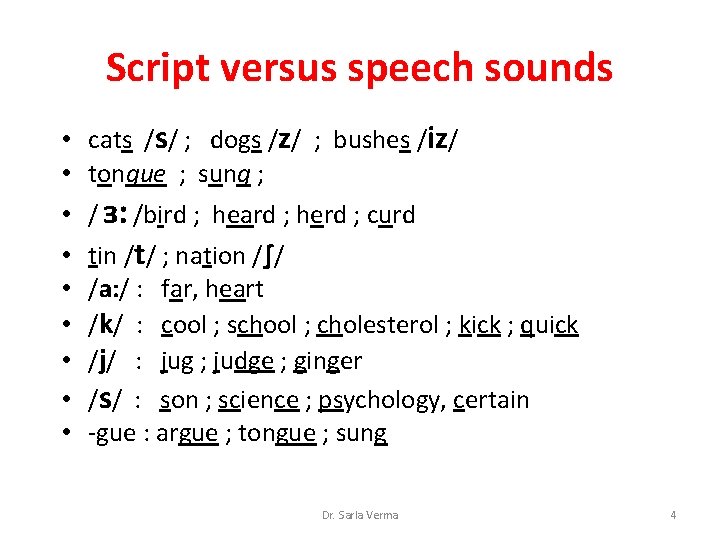
Script versus speech sounds • cats /s/ ; dogs /z/ ; bushes /iz/ • tongue ; sung ; • • / ɜ: /bird ; heard ; herd ; curd tin /t/ ; nation /∫/ /a: / : far, heart /k/ : cool ; school ; cholesterol ; kick ; quick /j/ : jug ; judge ; ginger /s/ : son ; science ; psychology, certain -gue : argue ; tongue ; sung Dr. Sarla Verma 4
Language and Sound system • Spoken language is nothing but clusters of particular sounds in meaningful sequence. • Every language has specific sounds which are characteristics of that language. The smallest unit of sound in a language is called a PHONEME. • Study of sound system of a language is called PHONETICS. Dr. Sarla Verma 5
Phonetics and English Language • Representation of speech with the help of symbols to indicate respective sounds is known as PHONEMIC TRANSCRIPTION. • Due to inconsistency in script and speech sounds in English language, Phonetic Transcription offers a great help for non native speakers. Standard Dictionaries are based on phonetic transcriptions approved universally as IPA – International Phonetic Alphabet. Dr. Sarla Verma 6
Why Phonetics ? • Pronunciations in one language can not be equated with pronunciation of any other language. • It is inaccurate to transcribe verbal equivalent of words of one language into another. • Every language has sounds that are characteristic of that language. • Teachers who use English as a second language must have a neutral accent free from regional or dialectical influences for training standard (Indian) English in our context. Dr. Sarla Verma 7
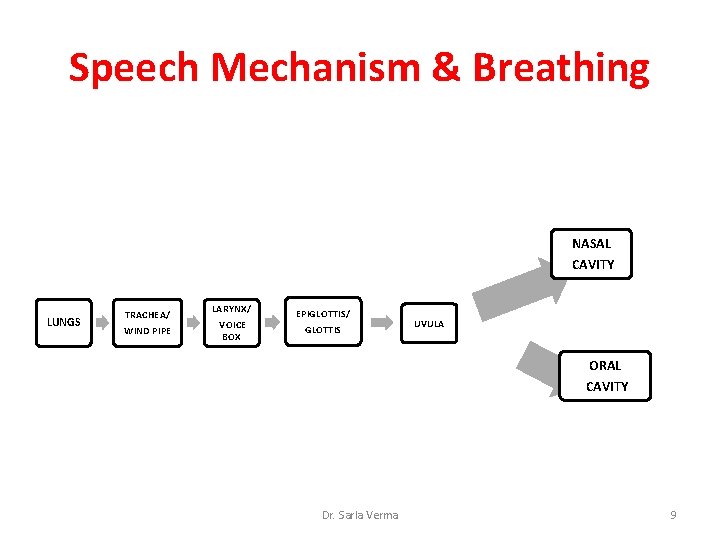
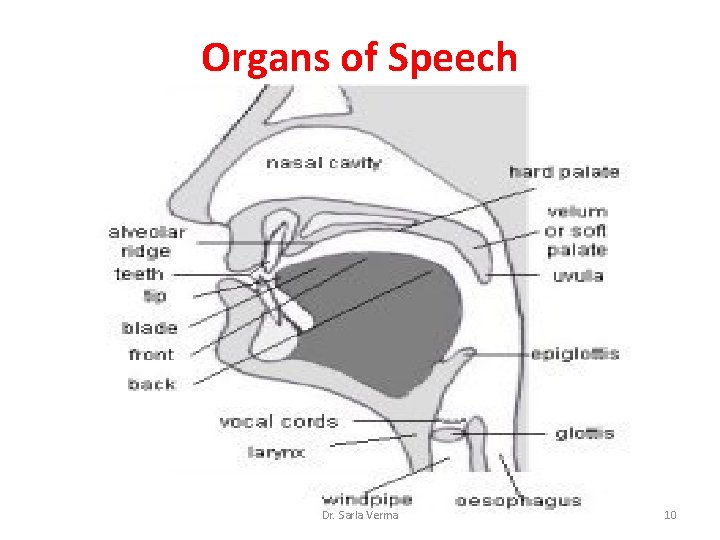
Speech Mechanism • Speech mechanism basically involves breathing correctly and articulating speech organs correctly. • Speaking requires breathing fully, breathing at the right time and having power to retain breath. • Air is exhaled from lungs with the raising of the diaphragm through the wind pipe or Trachea to pass through Larynx or Voice Box which contains pair of vocal cords that vibrate to produce VOICED SOUNDS. These vibrations can be felt by keeping our fingers at the throat. VOICELESS SOUNDS are produced without vibration of vocal cords. Dr. Sarla Verma 8
Speech Mechanism & Breathing NASAL CAVITY LUNGS TRACHEA/ WIND PIPE LARYNX/ VOICE BOX EPIGLOTTIS/ GLOTTIS UVULA ORAL CAVITY Dr. Sarla Verma 9
Organs of Speech Dr. Sarla Verma 10
Phonetic Symbols • In Phonetics each sound is assigned a symbol and each sound is characterized distinctly on the basis of its articulation and its acoustic properties. • Sounds can be divided into two major groups, consonants and vowels. Dr. Sarla Verma 11
Vowels • Vowels are comparatively difficult to characterize on the basis of articulation, as they are unobstructed in articulation and are produced without friction. • Also often they can be articulated in more than one way. IPA is one way; American is another. Dr. Sarla Verma 12
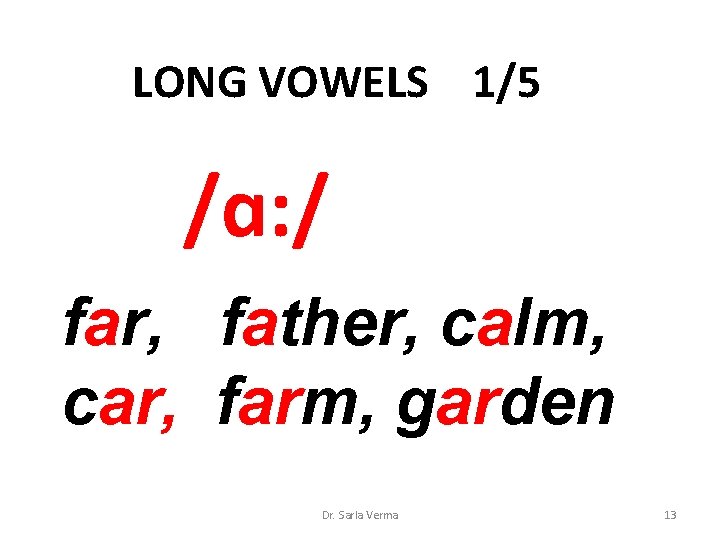
LONG VOWELS 1/5 /ɑ: / far, father, calm, car, farm, garden Dr. Sarla Verma 13
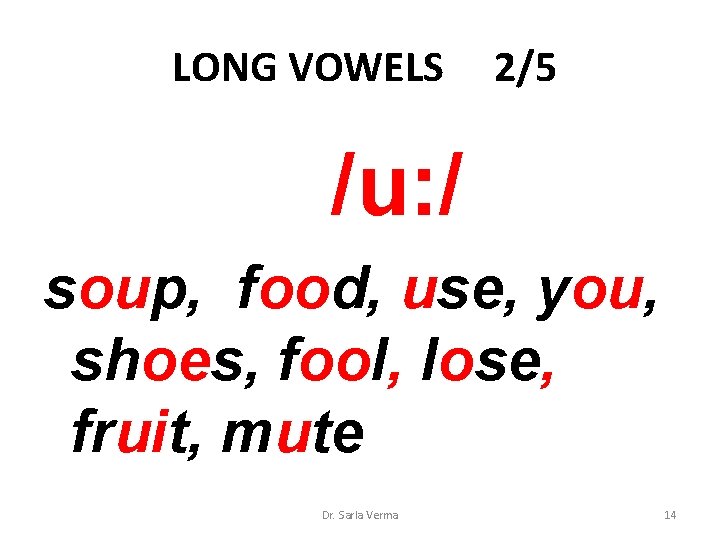
LONG VOWELS 2/5 /u: / soup, food, use, you, shoes, fool, lose, fruit, mute Dr. Sarla Verma 14
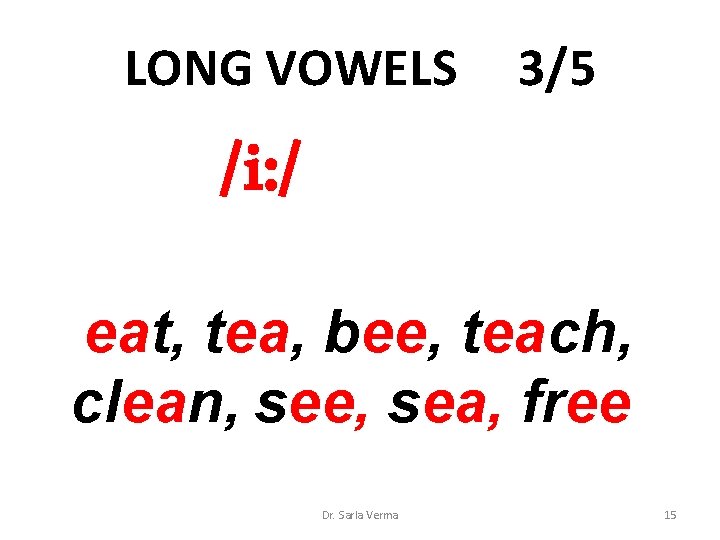
LONG VOWELS 3/5 /i: / eat, tea, bee, teach, clean, see, sea, free Dr. Sarla Verma 15
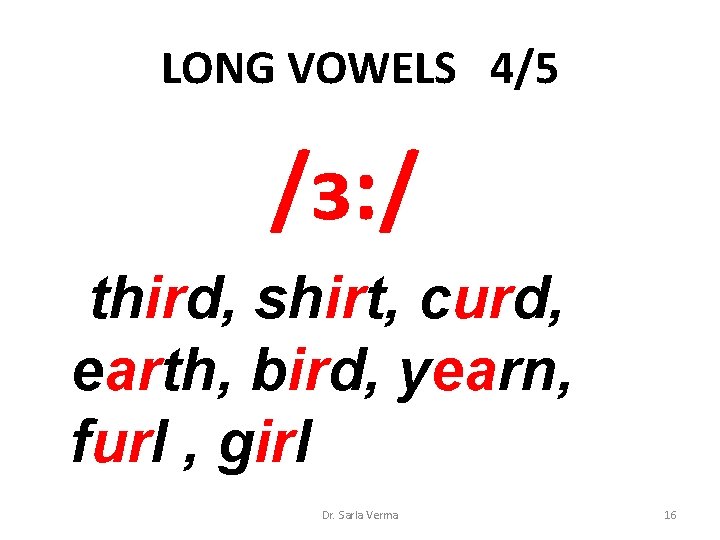
LONG VOWELS 4/5 /ɜ: / third, shirt, curd, earth, bird, yearn, furl , girl Dr. Sarla Verma 16
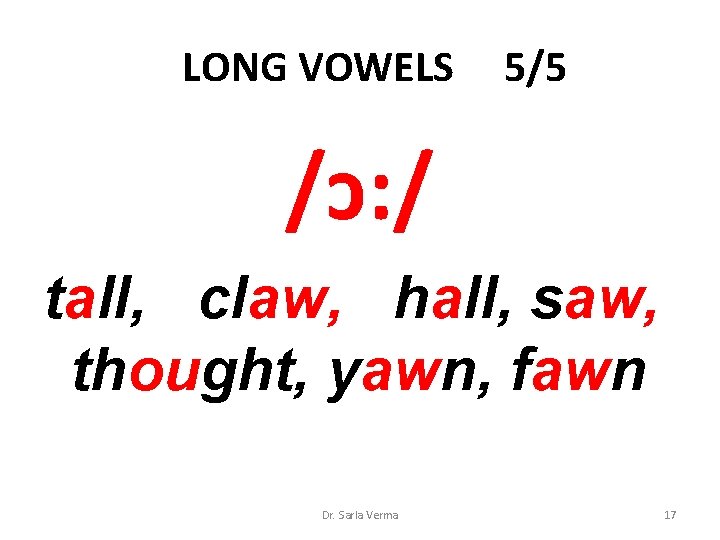
LONG VOWELS 5/5 /ɔ: / tall, claw, hall, saw, thought, yawn, fawn Dr. Sarla Verma 17
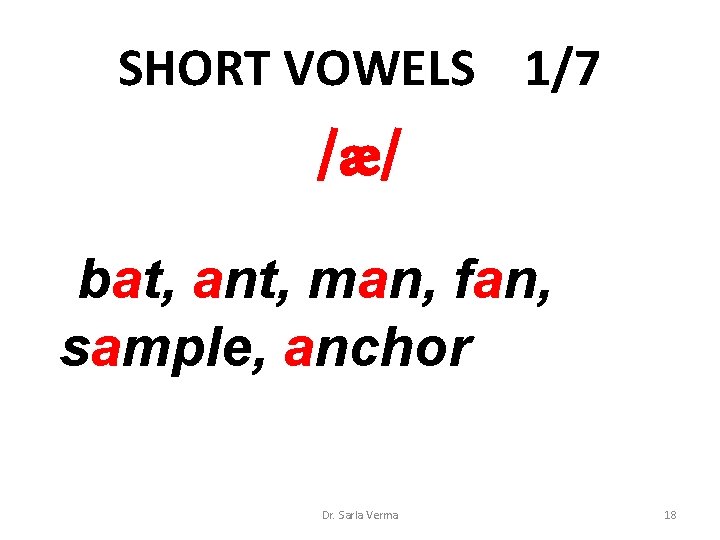
SHORT VOWELS 1/7 /æ/ bat, ant, man, fan, sample, anchor Dr. Sarla Verma 18
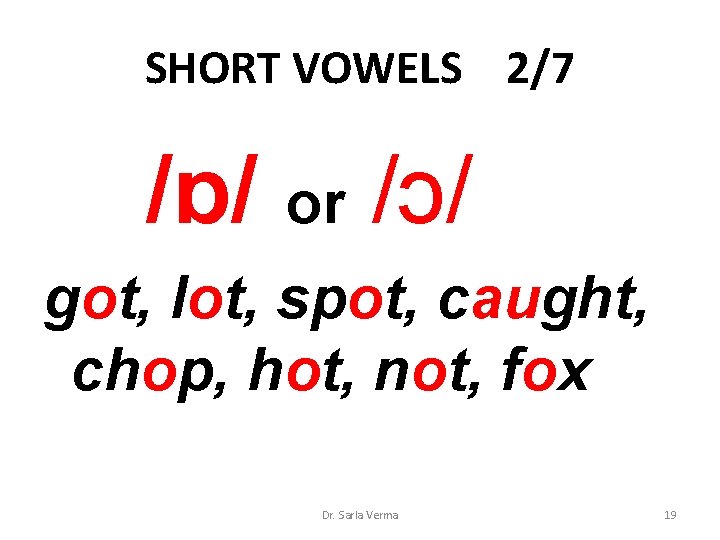
SHORT VOWELS 2/7 /ɒ/ or /ɔ/ got, lot, spot, caught, chop, hot, not, fox Dr. Sarla Verma 19
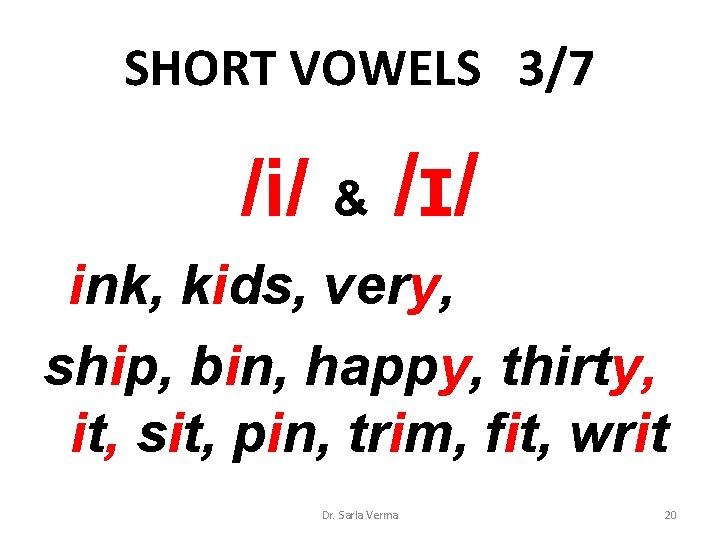
SHORT VOWELS 3/7 /i/ & /ɪ/ ink, kids, very, ship, bin, happy, thirty, it, sit, pin, trim, fit, writ Dr. Sarla Verma 20
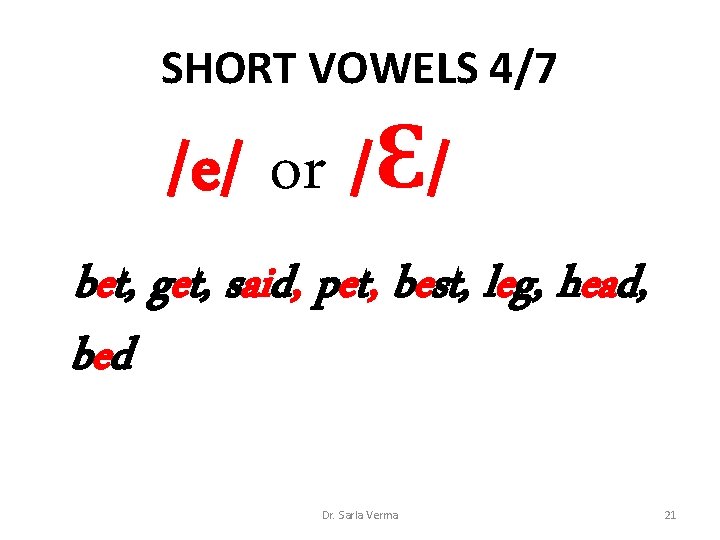
SHORT VOWELS 4/7 /e/ or /Ɛ/ bet, get, said, pet, best, leg, head, bed Dr. Sarla Verma 21
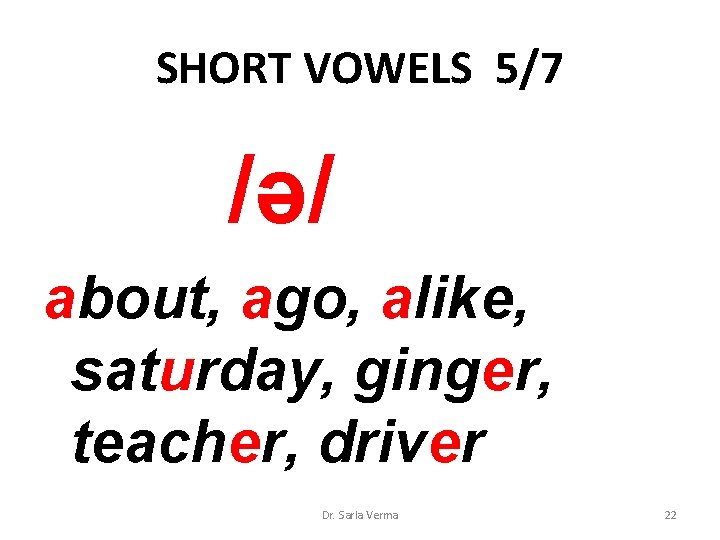
SHORT VOWELS 5/7 /ə/ about, ago, alike, saturday, ginger, teacher, driver Dr. Sarla Verma 22
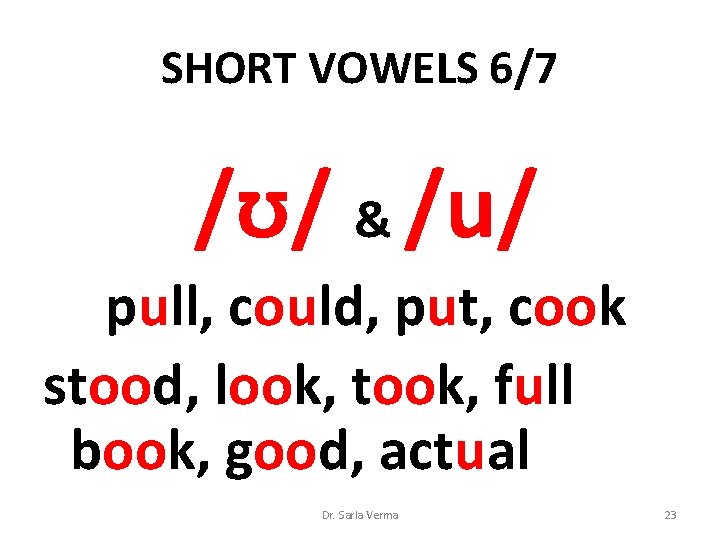
SHORT VOWELS 6/7 /ʊ/ & /u/ pull, could, put, cook stood, look, took, full book, good, actual Dr. Sarla Verma 23
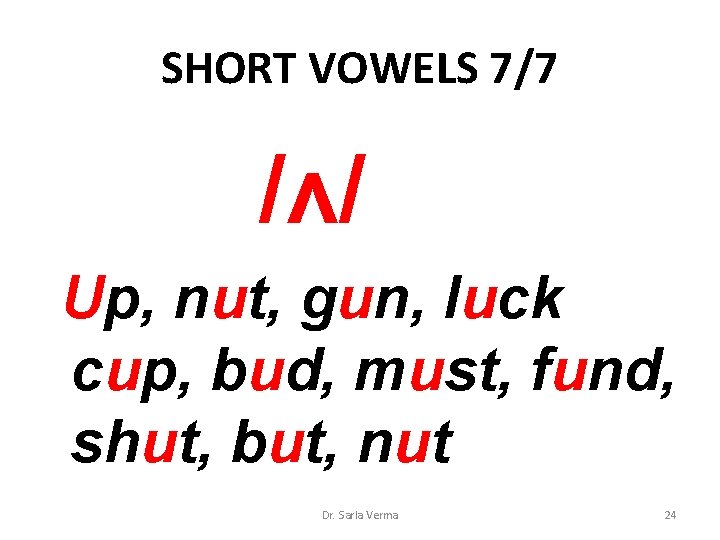
SHORT VOWELS 7/7 /ʌ/ Up, nut, gun, luck cup, bud, must, fund, shut, but, nut Dr. Sarla Verma 24
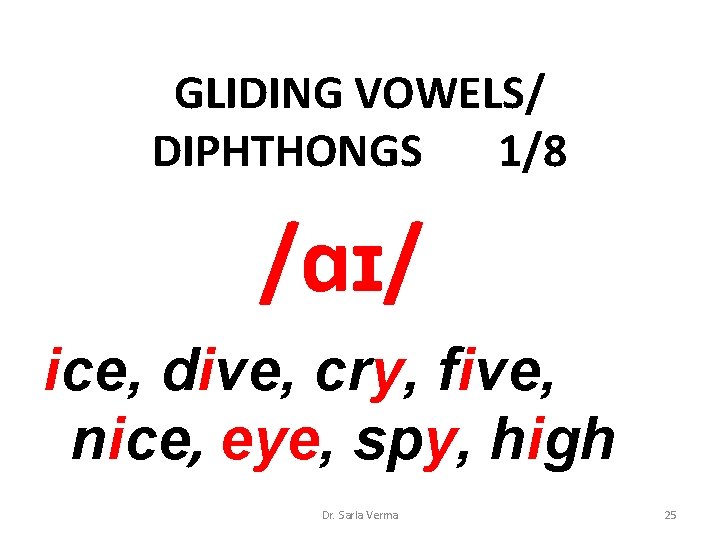
GLIDING VOWELS/ DIPHTHONGS 1/8 /ɑɪ/ ice, dive, cry, five, nice, eye, spy, high Dr. Sarla Verma 25
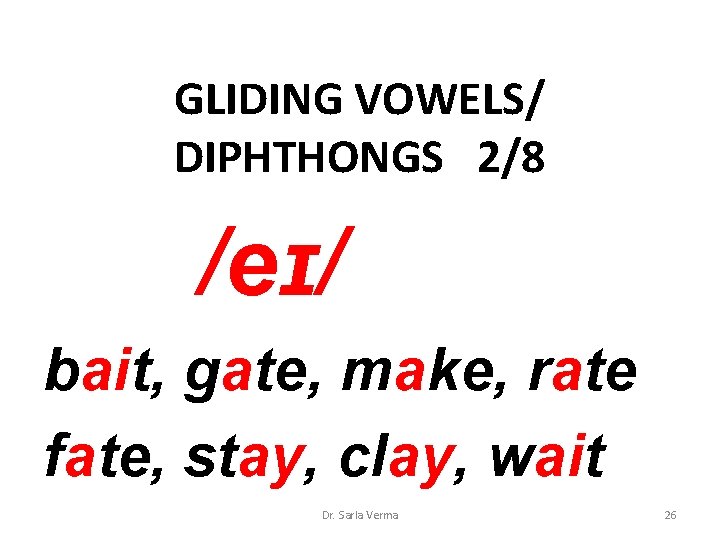
GLIDING VOWELS/ DIPHTHONGS 2/8 /eɪ/ bait, gate, make, rate fate, stay, clay, wait Dr. Sarla Verma 26
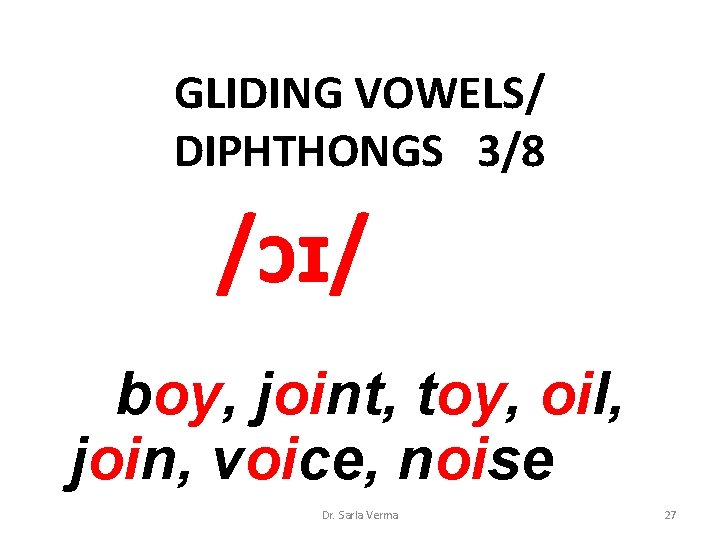
GLIDING VOWELS/ DIPHTHONGS 3/8 /ɔɪ/ boy, joint, toy, oil, join, voice, noise Dr. Sarla Verma 27
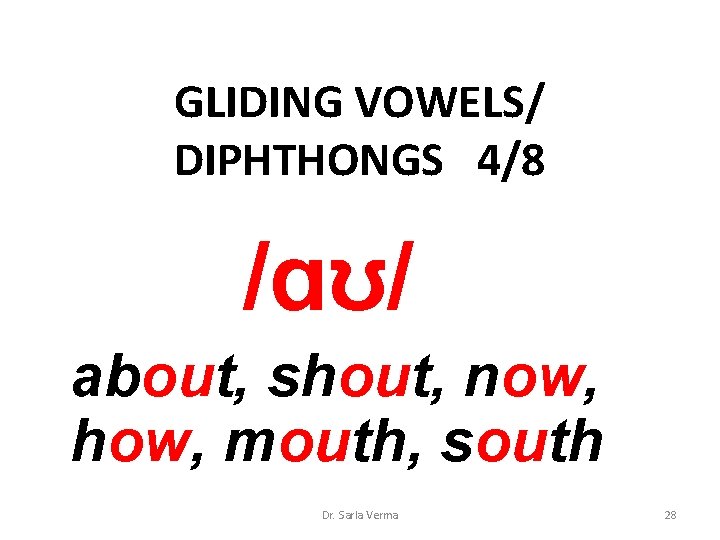
GLIDING VOWELS/ DIPHTHONGS 4/8 /ɑʊ/ about, shout, now, how, mouth, south Dr. Sarla Verma 28
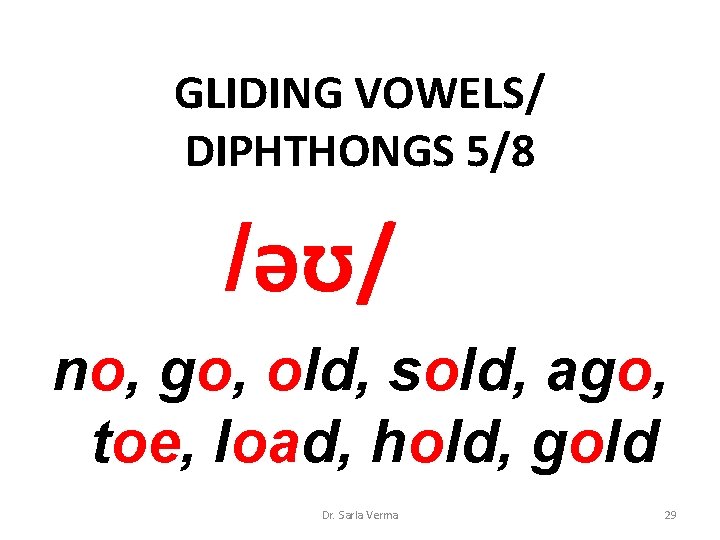
GLIDING VOWELS/ DIPHTHONGS 5/8 /əʊ/ no, go, old, sold, ago, toe, load, hold, gold Dr. Sarla Verma 29
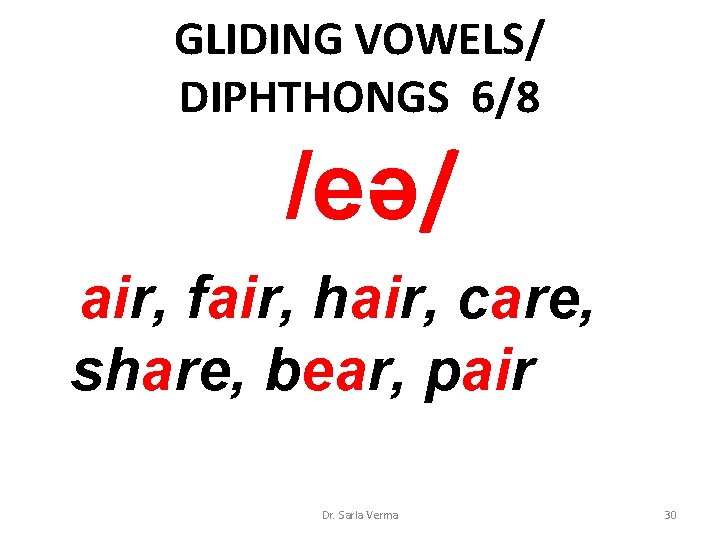
GLIDING VOWELS/ DIPHTHONGS 6/8 /eə/ air, fair, hair, care, share, bear, pair Dr. Sarla Verma 30
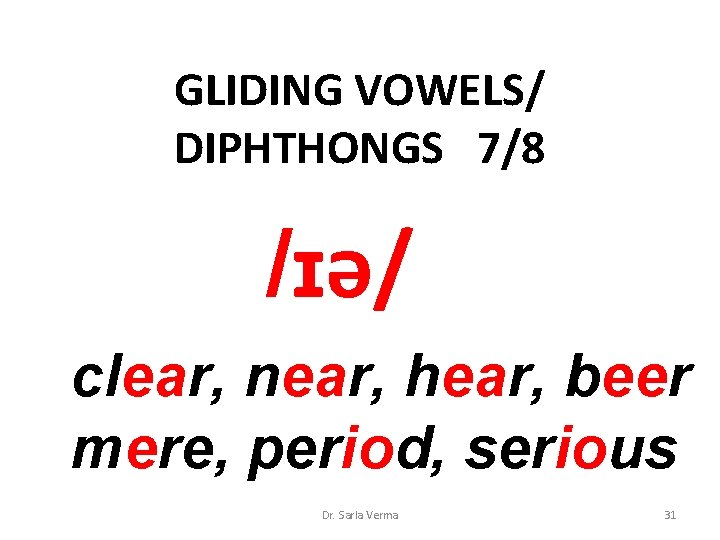
GLIDING VOWELS/ DIPHTHONGS 7/8 /ɪə/ clear, near, hear, beer mere, period, serious Dr. Sarla Verma 31
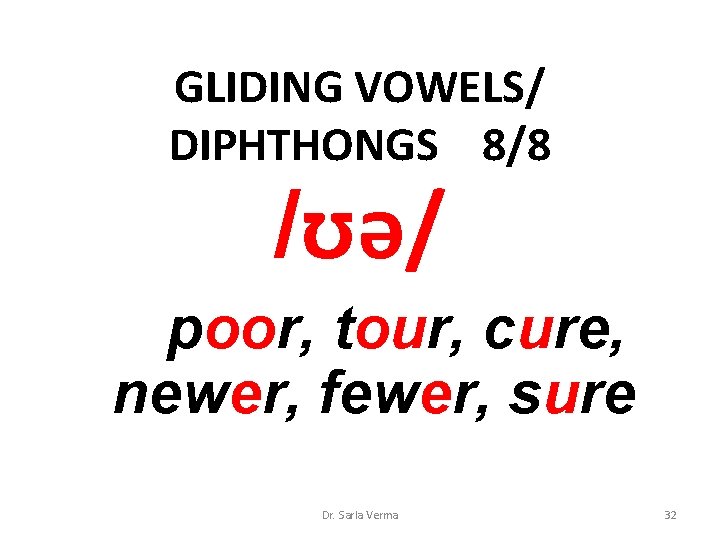
GLIDING VOWELS/ DIPHTHONGS 8/8 /ʊə/ poor, tour, cure, newer, fewer, sure Dr. Sarla Verma 32
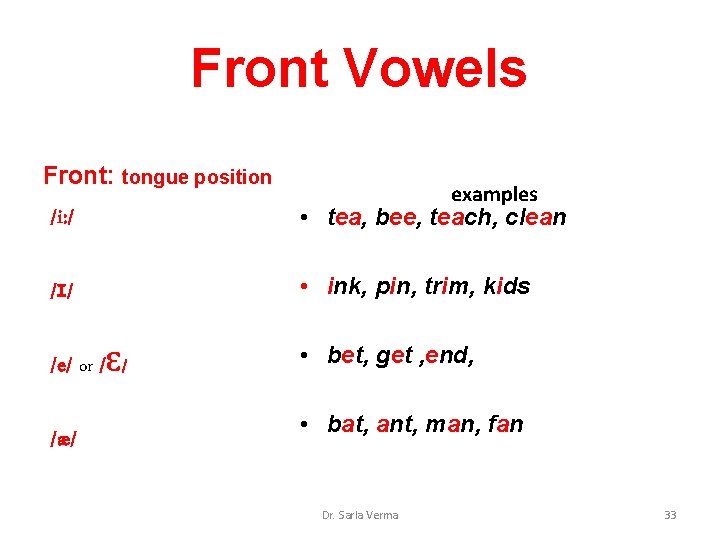
Front Vowels Front: tongue position examples /i: / • tea, bee, teach, clean /ɪ/ • ink, pin, trim, kids /e/ or /Ɛ/ • bet, get , end, /æ/ • bat, ant, man, fan Dr. Sarla Verma 33
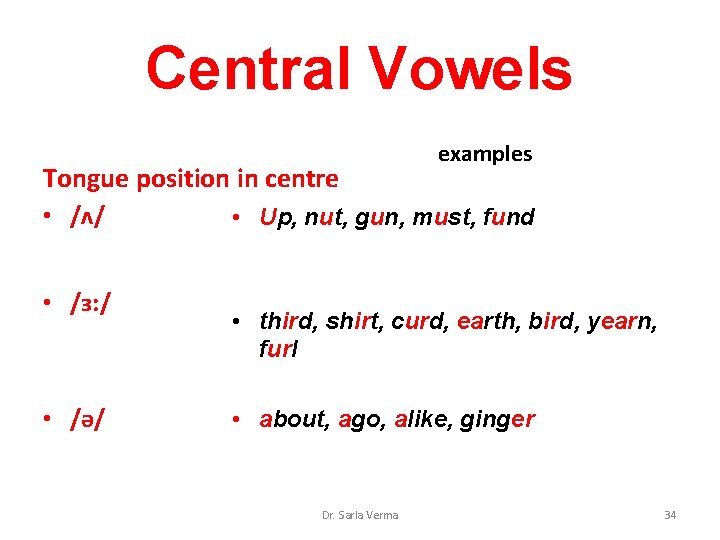
Central Vowels Tongue position in centre • /ʌ/ • /ɜ: / • /ə/ examples • Up, nut, gun, must, fund • third, shirt, curd, earth, bird, yearn, furl • about, ago, alike, ginger Dr. Sarla Verma 34
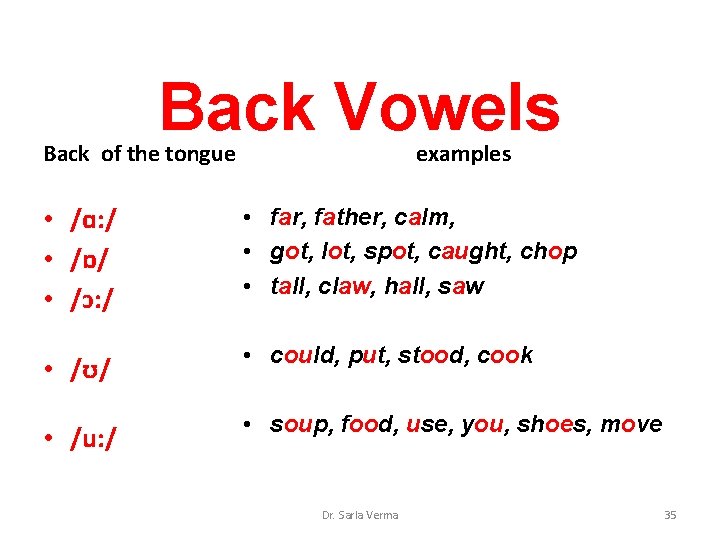
Back Vowels Back of the tongue examples • /ɑ: / • /ɒ/ • /ɔ: / • far, father, calm, • got, lot, spot, caught, chop • tall, claw, hall, saw • /ʊ/ • could, put, stood, cook • /u: / • soup, food, use, you, shoes, move Dr. Sarla Verma 35
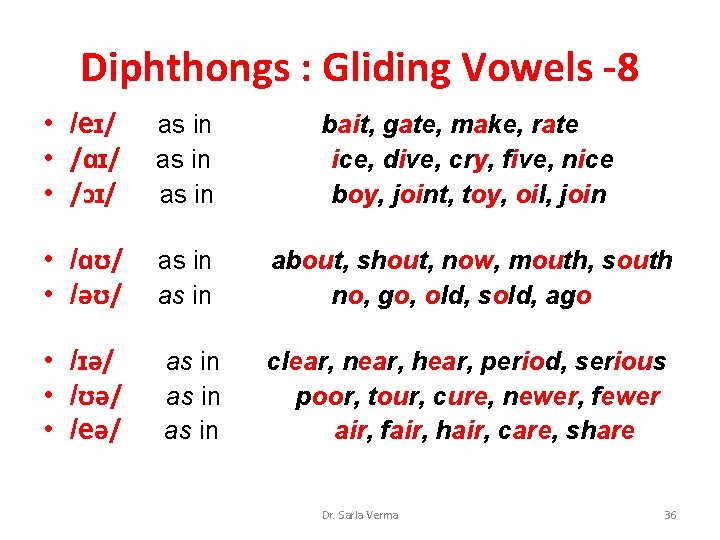
Diphthongs : Gliding Vowels -8 • /eɪ/ • /ɑɪ/ • /ɔɪ/ as in bait, gate, make, rate ice, dive, cry, five, nice boy, joint, toy, oil, join • /ɑʊ/ • /əʊ/ as in about, shout, now, mouth, south no, go, old, sold, ago • /ɪə/ • /ʊə/ • /eə/ as in clear, near, hear, period, serious poor, tour, cure, newer, fewer air, fair, hair, care, share Dr. Sarla Verma 36
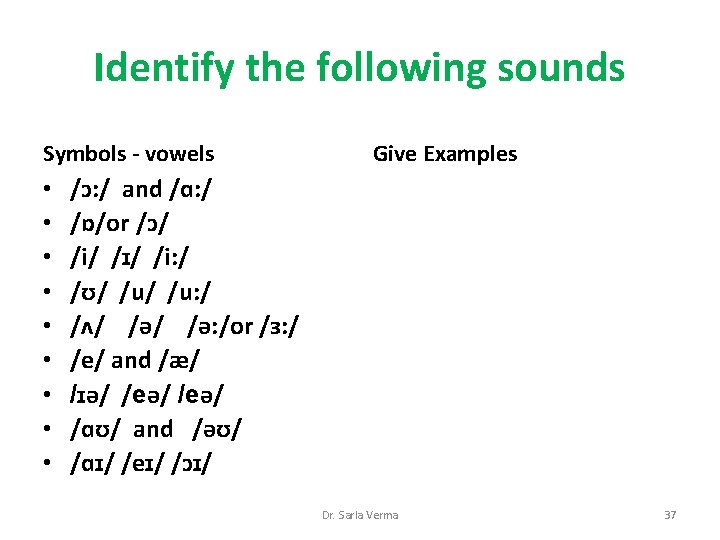
Identify the following sounds Symbols - vowels • • • Give Examples /ɔ: / and /ɑ: / /ɒ/or /ɔ/ /i/ /ɪ/ /i: / /ʊ/ /u: / /ʌ/ /ə: /or /ɜ: / /e/ and /æ/ /ɪə/ /eə/ /ɑʊ/ and /əʊ/ /ɑɪ/ /eɪ/ /ɔɪ/ Dr. Sarla Verma 37
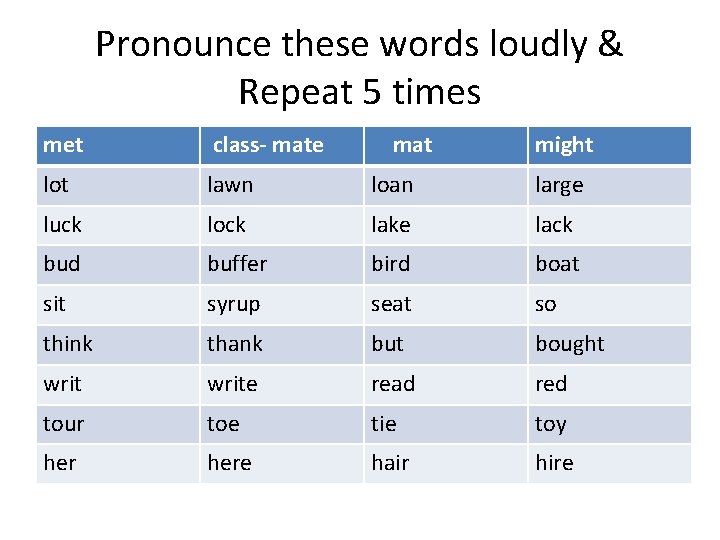
Pronounce these words loudly & Repeat 5 times met class- mate mat might lot lawn loan large luck lock lake lack bud buffer bird boat sit syrup seat so think thank but bought write read red tour toe tie toy here hair hire
THANKS Dr. Sarla Verma 9826297033 , 8839216118 dr_sarlaverma@rediffmail. com