
PHONETICS Introduction PHONETICS Definition The scientific study of
![CONTINUE 4. Some letters are silent: [knife, whole, lamb, island, castle] 5. Some sound](https://slidetodoc.com/presentation_image_h/3382eb0e3fbc72bd834bc74fb371a359/image-9.jpg "CONTINUE 4. Some letters are silent: [knife, whole, lamb, island, castle] 5. Some sound")
![COMMON MISTAKES 1. Substituting one consonant sound for another: [please-blease] [pin- bin] 2. Delete](https://slidetodoc.com/presentation_image_h/3382eb0e3fbc72bd834bc74fb371a359/image-12.jpg "COMMON MISTAKES 1. Substituting one consonant sound for another: [please-blease] [pin- bin] 2. Delete")
![CONTINUE 4. Substituting one vowel sound for another: [cot-cut] 5. Misplacing primary stress: [E’vent-](https://slidetodoc.com/presentation_image_h/3382eb0e3fbc72bd834bc74fb371a359/image-13.jpg "CONTINUE 4. Substituting one vowel sound for another: [cot-cut] 5. Misplacing primary stress: [E’vent-")
- Slides: 18
PHONETICS Introduction
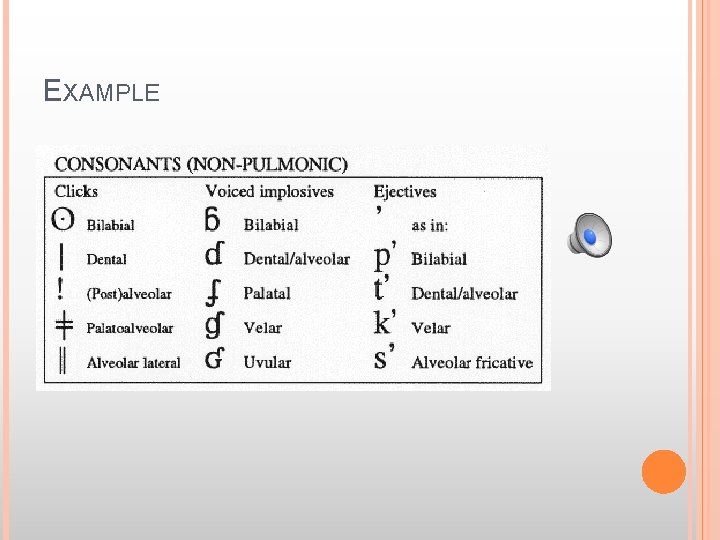
PHONETICS Definition: The scientific study of speech. Speech? Represents words and other units of language. There are some sounds we can identify easily enough and some sounds are difficult. (E. g nonpulmonic sounds) Scientific? To measure as accurately as possible and give an agreed terminology
EXAMPLE
WHISTLE LANGUAGE http: //www. lemondesiffle. free. fr/presentation_eng/la nguessifflees. htm
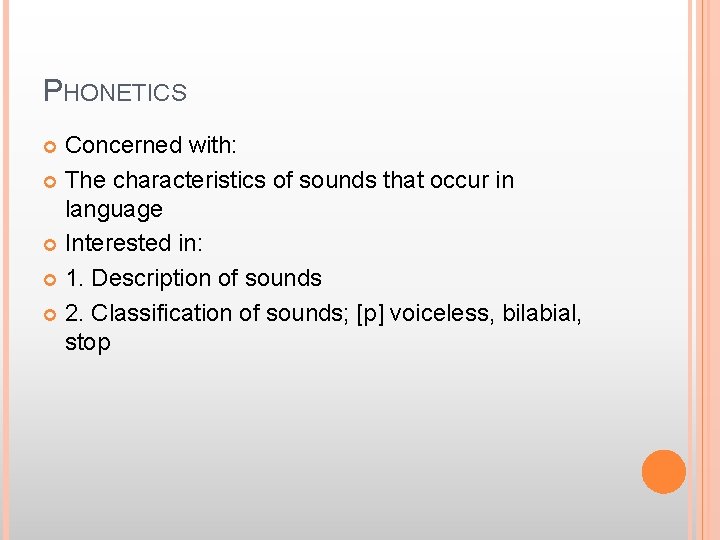
PHONETICS Concerned with: The characteristics of sounds that occur in language Interested in: 1. Description of sounds 2. Classification of sounds; [p] voiceless, bilabial, stop
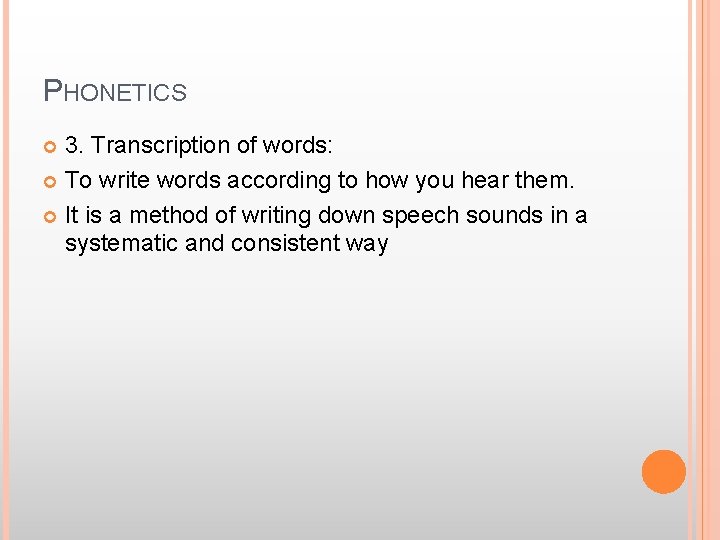
PHONETICS 3. Transcription of words: To write words according to how you hear them. It is a method of writing down speech sounds in a systematic and consistent way
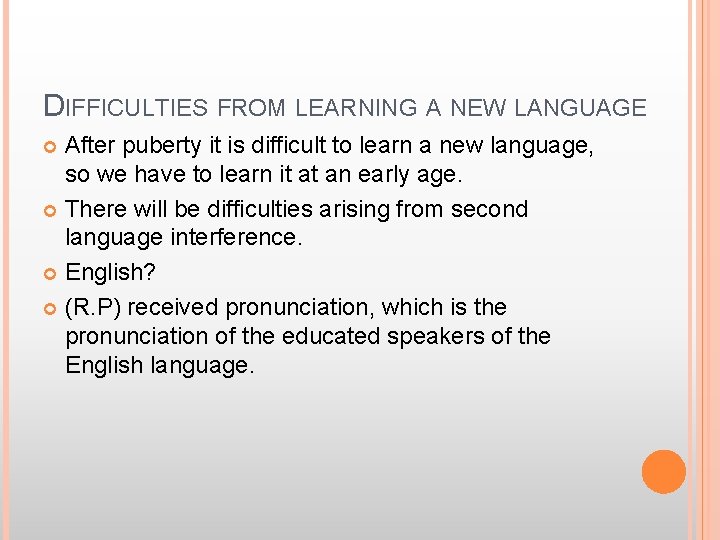
DIFFICULTIES FROM LEARNING A NEW LANGUAGE After puberty it is difficult to learn a new language, so we have to learn it at an early age. There will be difficulties arising from second language interference. English? (R. P) received pronunciation, which is the pronunciation of the educated speakers of the English language.
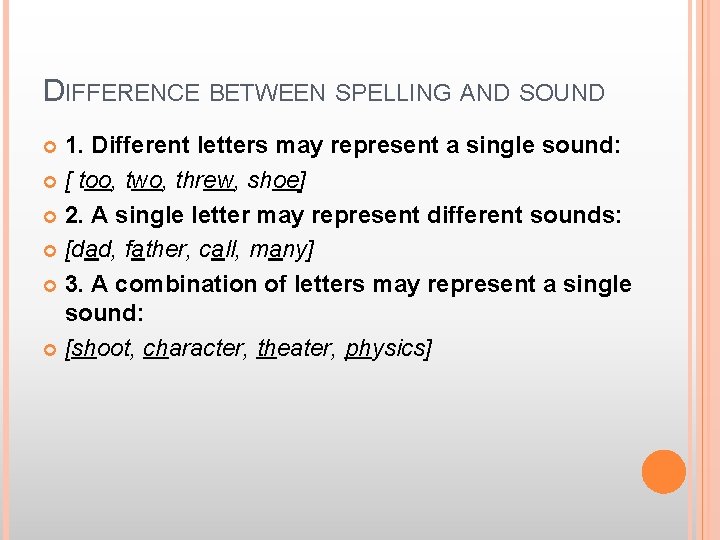
DIFFERENCE BETWEEN SPELLING AND SOUND 1. Different letters may represent a single sound: [ too, two, threw, shoe] 2. A single letter may represent different sounds: [dad, father, call, many] 3. A combination of letters may represent a single sound: [shoot, character, theater, physics]
CONTINUE 4. Some letters are silent: [knife, whole, lamb, island, castle] 5. Some sound are not represented in the spelling: [cute]
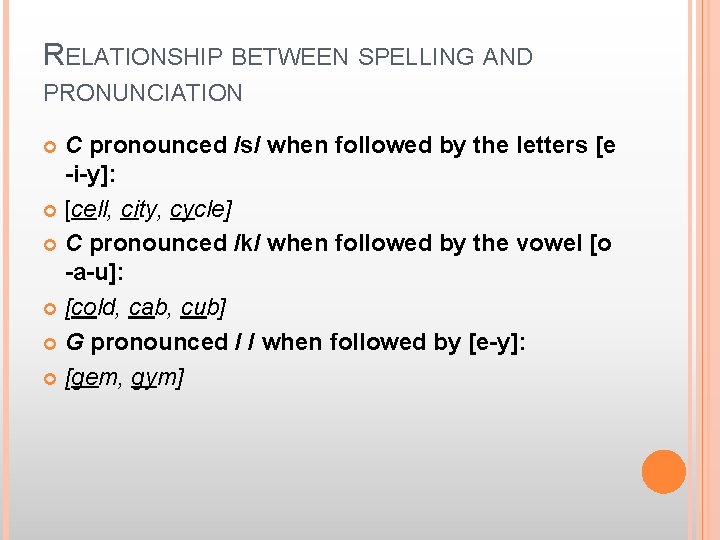
RELATIONSHIP BETWEEN SPELLING AND PRONUNCIATION C pronounced /s/ when followed by the letters [e -i-y]: [cell, city, cycle] C pronounced /k/ when followed by the vowel [o -a-u]: [cold, cab, cub] G pronounced / / when followed by [e-y]: [gem, gym]
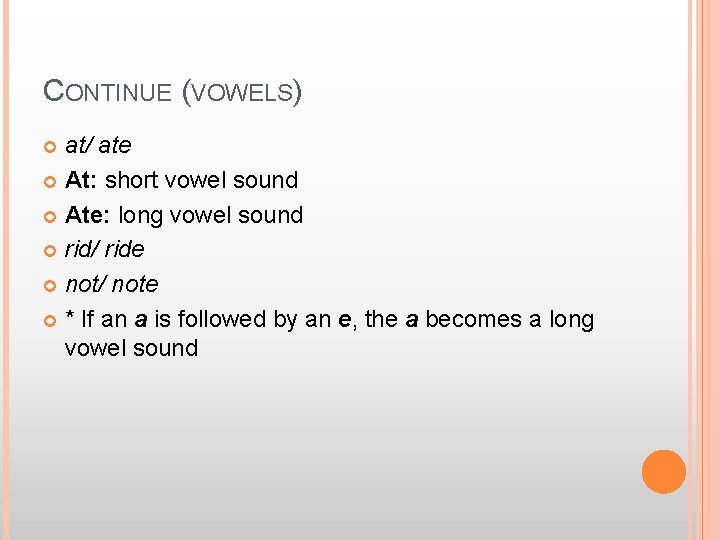
CONTINUE (VOWELS) at/ ate At: short vowel sound Ate: long vowel sound rid/ ride not/ note * If an a is followed by an e, the a becomes a long vowel sound
COMMON MISTAKES 1. Substituting one consonant sound for another: [please-blease] [pin- bin] 2. Delete consonants: [price- pice] 3. Change the length of vowel: [this- these]
CONTINUE 4. Substituting one vowel sound for another: [cot-cut] 5. Misplacing primary stress: [E’vent- e ‘VENT]
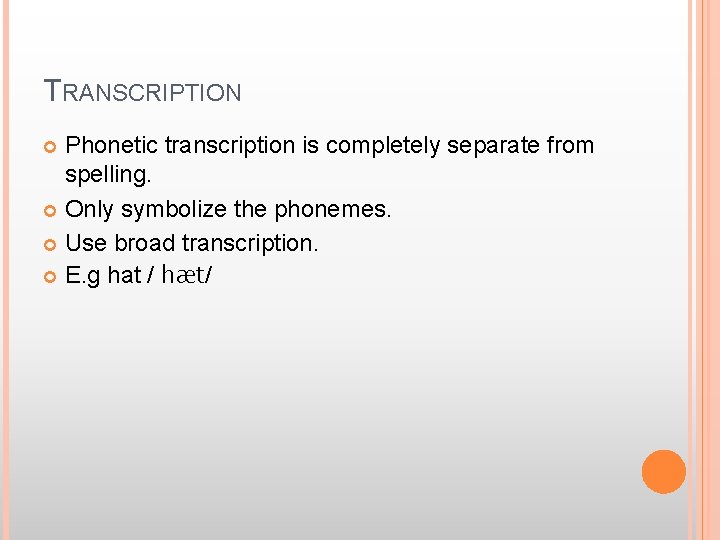
TRANSCRIPTION Phonetic transcription is completely separate from spelling. Only symbolize the phonemes. Use broad transcription. E. g hat / hæt/
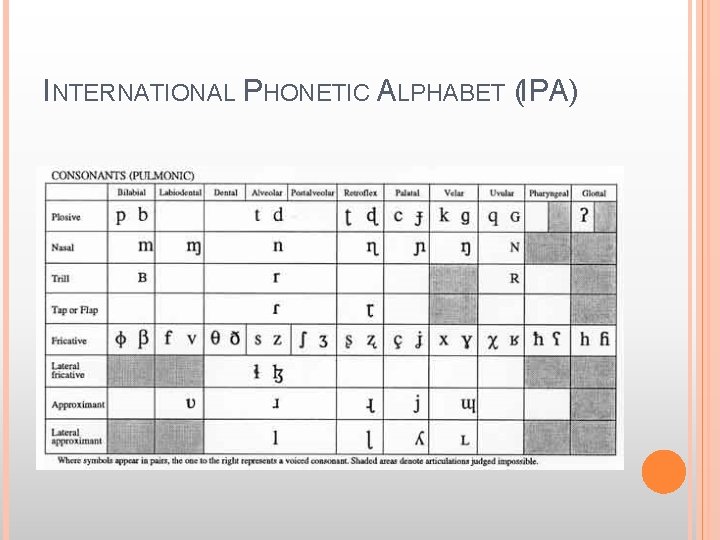
INTERNATIONAL PHONETIC ALPHABET (IPA)
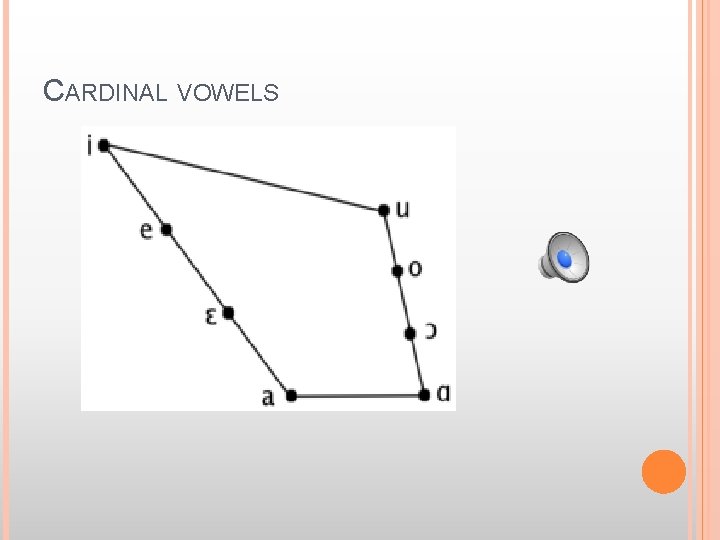
CARDINAL VOWELS
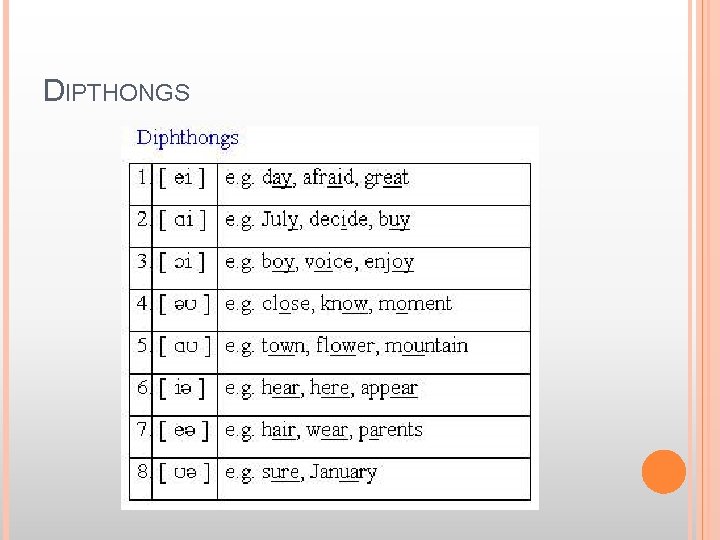
DIPTHONGS
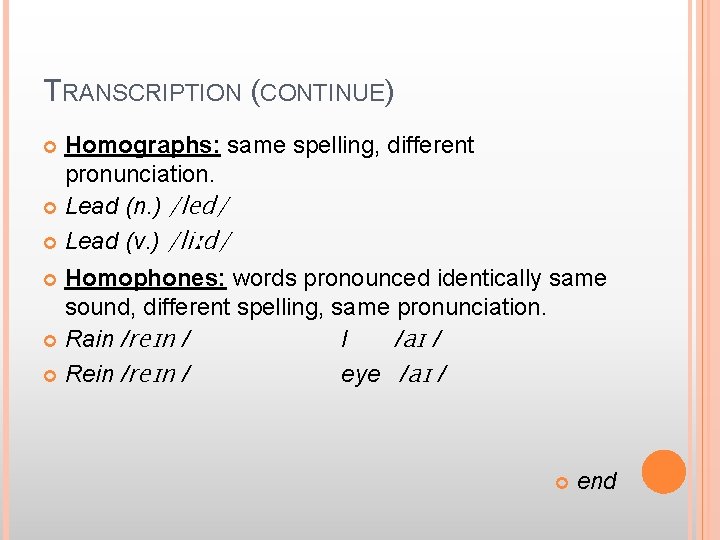
TRANSCRIPTION (CONTINUE) Homographs: same spelling, different pronunciation. Lead (n. ) /led/ Lead (v. ) /liːd/ Homophones: words pronounced identically same sound, different spelling, same pronunciation. Rain /reɪn / I /aɪ / Rein /reɪn / eye /aɪ / end