
Phonetics Description and articulation of phones Describing Consonants
Phonetics Description and articulation of phones
Describing Consonants n We use three parameters to describe phones: n VOICING n PLACE OF ARTICULATION n MANNER OF ARTICULATION n The IPA chart shows all three parameters for each phone
VOICING n n The state of the vocal folds (VF) determines whether a sound is voiced or voiceless When VF are open air can pass through it freely, without any vibration When VF are drawn close together air passes through it with w/ difficulty, creating vibration Compare [s] vs [z] ; [f] vs [v]; [k] vs [g]
PLACE OF ARTICULATION n Refers to WHERE in the vocal tract a constriction is made (generally with some part of the tongue)
![Places of articulation (see p. 18 in cp) n Bilabial [p, b, m, w]](http://slidetodoc.com/presentation_image_h2/9e2859c1d0be72ac7b41e8860a7e7be3/image-5.jpg "Places of articulation (see p. 18 in cp) n Bilabial [p, b, m, w]")
Places of articulation (see p. 18 in cp) n Bilabial [p, b, m, w] n n Labiodental [f, v] n n Lower lip touches upper teeth Interdental [D, T] n n Closure of both lips Tongue protrudes through teeth Alveolar [t, d, s, z, n, l, ®] n Tongue touches alveolar ridge
![Places of articulation, continued n Palatal [S, Z, t. S, d. Z, j] n](http://slidetodoc.com/presentation_image_h2/9e2859c1d0be72ac7b41e8860a7e7be3/image-6.jpg "Places of articulation, continued n Palatal [S, Z, t. S, d. Z, j] n")
Places of articulation, continued n Palatal [S, Z, t. S, d. Z, j] n n Velar [k, g, ŋ] n n Top of tongue approximates/touches the middle/hard palate Back of tongue touches the soft palate/velum Glottal [h, /] n Opening or closing of the glottis (the space between the vocal folds)
MANNER OF ARTICULATION n Refers to HOW this constriction is made
![Manners of Articulation n Stop [p, b, t, d, k, g, /] & [n,](http://slidetodoc.com/presentation_image_h2/9e2859c1d0be72ac7b41e8860a7e7be3/image-8.jpg "Manners of Articulation n Stop [p, b, t, d, k, g, /] & [n,")
Manners of Articulation n Stop [p, b, t, d, k, g, /] & [n, m, N] n n Fricative [f, v, s, z, D, T, S, Z, h] n n airflow through mouth is completely impeded narrow constriction produces turbulence Affricate [t. S, d. Z] n a stop followed by a fricative
![Manners of Articulation, cont’d n Nasal [m, n, N] n n air flows through](http://slidetodoc.com/presentation_image_h2/9e2859c1d0be72ac7b41e8860a7e7be3/image-9.jpg "Manners of Articulation, cont’d n Nasal [m, n, N] n n air flows through")
Manners of Articulation, cont’d n Nasal [m, n, N] n n air flows through the nose; velum is lowered Approximants [l, ® (liquids)] [w, j (glides)] n wide constriction that does not produce turbulence ** FLAP: the voiced alveolar flap [R] is also an English sound, though it’s not listed in the chart. **
Properties of Vowels n n n Most Sonorant (Audible) Sounds Almost always voiced Vowel sounds change according to SHAPE of vocal tract, no obstructions in vowels
Parameters n Review: Consonant parameters? n n Voicing, Place of articulation, Manner of articulation Vowel articulation is described using FOUR parameters.
Four parameters of vowels n Tongue HEIGHT n n Tongue BACKNESS n n front / central / back Lip ROUNDING n n high / mid / low round / unround TENSENESS n tense / lax
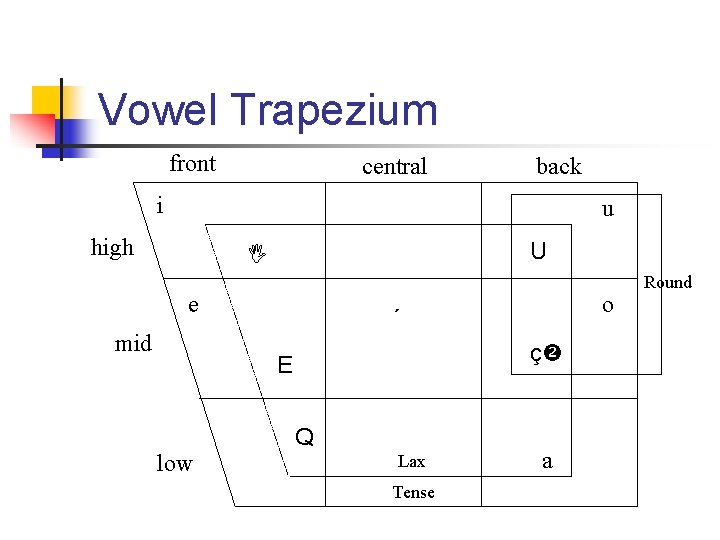
Vowel Trapezium front central back i u high U e mid ´ ç E low o Q Lax Tense a Round
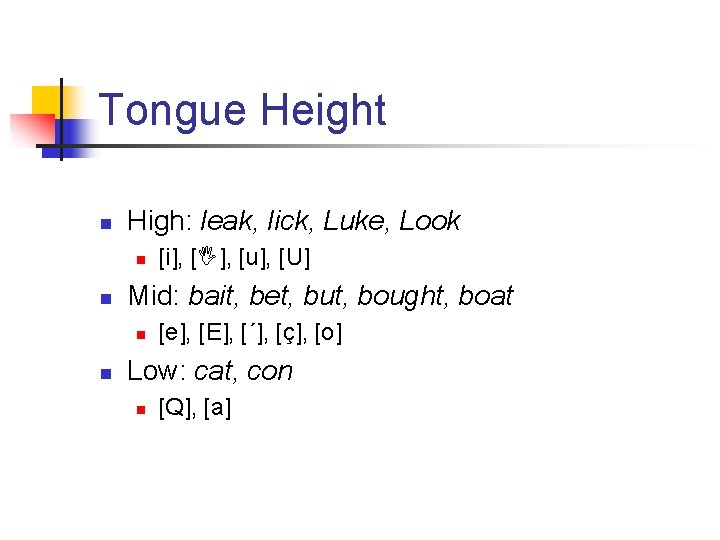
Tongue Height n High: leak, lick, Luke, Look n n Mid: bait, bet, but, bought, boat n n [i], [u], [U] [e], [E], [´], [ç], [o] Low: cat, con n [Q], [a]
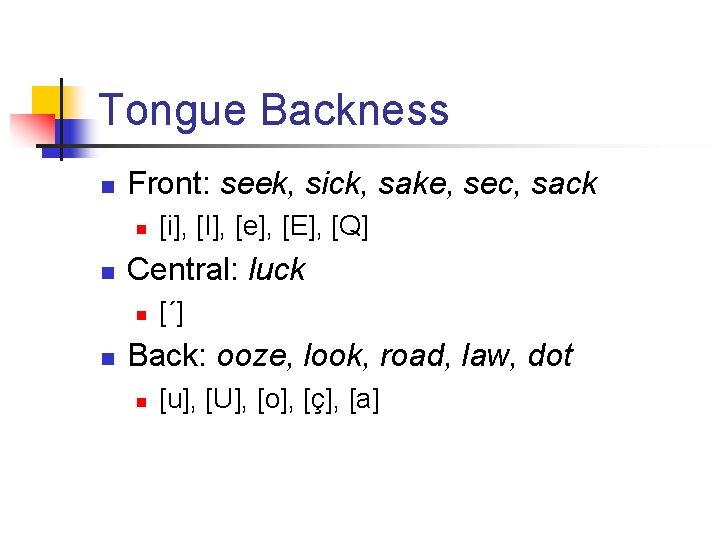
Tongue Backness n Front: seek, sick, sake, sec, sack n n Central: luck n n [i], [I], [e], [E], [Q] [´] Back: ooze, look, road, law, dot n [u], [U], [o], [ç], [a]
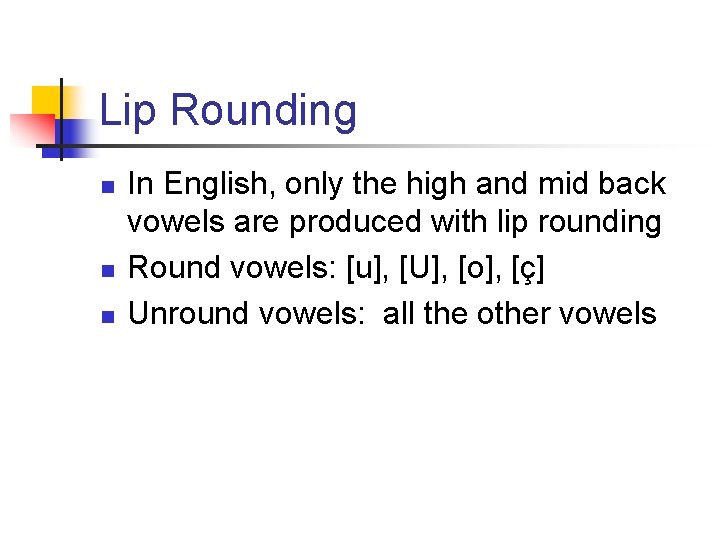
Lip Rounding n n n In English, only the high and mid back vowels are produced with lip rounding Round vowels: [u], [U], [o], [ç] Unround vowels: all the other vowels
Tenseness n Tense vowels n n Lax vowels n n the tongue is at an extreme height or backness the tongue is not at an extreme position Compare Pete and pit
Diphthongs n n n A diphthong is a complex vowel where the tongue begins in one place and moves to another (a two part vowel sound) The vowel diphthongs: [aj]: bite [aw]: bout [oj]: boy
Drills n Voicing n n Place n n VD or VL BL, LD, ID, A, P, V, G Manner n S, F, AF, N, AP
- Slides: 19