
Phonetics and Phonology The two primary linguistic disciplines
![Phonetics and Phonology ABSTRACT: Phonology: phoneme /i/: [i] and [i: ] as in ship](https://slidetodoc.com/presentation_image_h2/5c0418491fe8e4a74c20b53895e621cb/image-7.jpg "Phonetics and Phonology ABSTRACT: Phonology: phoneme /i/: [i] and [i: ] as in ship")
![Classification of consonants Bilabial plosives: [p] e [b] are produced with both lips pressed](https://slidetodoc.com/presentation_image_h2/5c0418491fe8e4a74c20b53895e621cb/image-16.jpg "Classification of consonants Bilabial plosives: [p] e [b] are produced with both lips pressed")
![Ø manner of articulation: Classification of consonants Alveolar plosives: [t] e [d] are produced](https://slidetodoc.com/presentation_image_h2/5c0418491fe8e4a74c20b53895e621cb/image-17.jpg "Ø manner of articulation: Classification of consonants Alveolar plosives: [t] e [d] are produced")
![Classification of consonants manner of articulation: Velar plosives: [k] e [g] are articulated with](https://slidetodoc.com/presentation_image_h2/5c0418491fe8e4a74c20b53895e621cb/image-18.jpg "Classification of consonants manner of articulation: Velar plosives: [k] e [g] are articulated with")
![Classification of consonants manner of articulation: labio-dental fricatives [f] and [v]: the lower lip](https://slidetodoc.com/presentation_image_h2/5c0418491fe8e4a74c20b53895e621cb/image-20.jpg "Classification of consonants manner of articulation: labio-dental fricatives [f] and [v]: the lower lip")
![Classification of consonants manner of articulation: interdental fricatives [θ] and [ð]: the tip of](https://slidetodoc.com/presentation_image_h2/5c0418491fe8e4a74c20b53895e621cb/image-21.jpg "Classification of consonants manner of articulation: interdental fricatives [θ] and [ð]: the tip of")
![Classification of consonants manner of articulation: alveolar fricatives [s] and [z] : the tip](https://slidetodoc.com/presentation_image_h2/5c0418491fe8e4a74c20b53895e621cb/image-22.jpg "Classification of consonants manner of articulation: alveolar fricatives [s] and [z] : the tip")
![Classification of consonants manner of articulation: palate-alveolar fricatives [ ] and [ ] :](https://slidetodoc.com/presentation_image_h2/5c0418491fe8e4a74c20b53895e621cb/image-23.jpg "Classification of consonants manner of articulation: palate-alveolar fricatives [ ] and [ ] :")
![Classification of consonants manner of articulation: glottal fricative [ ] is produced with a](https://slidetodoc.com/presentation_image_h2/5c0418491fe8e4a74c20b53895e621cb/image-24.jpg "Classification of consonants manner of articulation: glottal fricative [ ] is produced with a")
![Classification of consonants manner of articulation: bilabial nasal [m]: The lips are firmly kept](https://slidetodoc.com/presentation_image_h2/5c0418491fe8e4a74c20b53895e621cb/image-27.jpg "Classification of consonants manner of articulation: bilabial nasal [m]: The lips are firmly kept")
![Classification of consonants manner of articulation: alveolar nasal [n]: The tip of the tongue](https://slidetodoc.com/presentation_image_h2/5c0418491fe8e4a74c20b53895e621cb/image-28.jpg "Classification of consonants manner of articulation: alveolar nasal [n]: The tip of the tongue")
![Ø Classification of consonants manner of articulation: velar nasal [ŋ]: The back of the](https://slidetodoc.com/presentation_image_h2/5c0418491fe8e4a74c20b53895e621cb/image-29.jpg "Ø Classification of consonants manner of articulation: velar nasal [ŋ]: The back of the")
![Classification of consonants Ø manner of articulation: liquids include alveolar [l] and post-alveolar [r]:](https://slidetodoc.com/presentation_image_h2/5c0418491fe8e4a74c20b53895e621cb/image-30.jpg "Classification of consonants Ø manner of articulation: liquids include alveolar [l] and post-alveolar [r]:")
![Classification of consonants Ø manner of articulation: alveolar [l]: the tip of the tongue](https://slidetodoc.com/presentation_image_h2/5c0418491fe8e4a74c20b53895e621cb/image-31.jpg "Classification of consonants Ø manner of articulation: alveolar [l]: the tip of the tongue")
![Classification of consonants Ø manner of articulation: post-alveolar [r]: the tip of the tongue](https://slidetodoc.com/presentation_image_h2/5c0418491fe8e4a74c20b53895e621cb/image-32.jpg "Classification of consonants Ø manner of articulation: post-alveolar [r]: the tip of the tongue")
![manner of articulation: Classification of consonants semivowels : include bilabial [w] and the palatal](https://slidetodoc.com/presentation_image_h2/5c0418491fe8e4a74c20b53895e621cb/image-33.jpg "manner of articulation: Classification of consonants semivowels : include bilabial [w] and the palatal")
- Slides: 56
Phonetics and Phonology The two primary linguistic disciplines concerned with speech sounds: Phonetics: forms of sounds (how they are produced, heard, etc. ) Phonology: functions of sounds (relates forms and functions) 1
Phonetics and Phonology The smallest unit of Phonetics is the phone : the phone belongs to the same system of sound, therefore it does not have meaning- differentiation function. E. g. in Italian [cane] [ca: ne]; [desk], [de: sk]: /a/ and /e/. 2
Phonetics and Phonology Allophones: some sound difference do not differentiate meaning as in the words in Italian [cane] [ca: ne] [a] and [a: ]; [desk], [de: sk]: /a/ and /e/. , or as in the pronunciation of /l/ in the word lip and pill. From a phonetic point of view the two realizations of /l/ have to be considered two phones, but not phonemes. They are called clear and dark /l/ and are allophones of the phoneme /l/ in English. 3
Phonetics and Phonology Distribution of Allophones: Allophones can occur in A) complementary distribution: as in the case of clear and dark /l/ in lip and pill; or as in the pronunciation of /l/ in the word lip and pill. From a phonetic point of view the two realizations of /l/ have to be considered two phones, but not phonemes. They are called clear and dark /l/ and are allophones of the phoneme /l/ in English. 4
Phonetics and Phonology Distribution of Allophones: Allophones can occur in B) Free variation: as in car [Ka: (r)] and [Kha: (r)] (aspirated version: aspiration). The decisive difference between phonems and their allophones is that the variants of a phoneme do not differentiate meaning, and therefore the sound difference does not constitute a relevant phonetic feature. 5
Phonetics and Phonology The smallest unit of Phonology is the phoneme: the phoneme, which is an abstract idealized unit, has meaning-differentiation function. The test for these smallest distinct units is the minimal pair test, e. g. when a difference is sound structure causes a difference in meaning. Ship [i], sheep [i: ]. 6
Phonetics and Phonology ABSTRACT: Phonology: phoneme /i/: [i] and [i: ] as in ship and sheep; or /a/: [a] and [a: ] as in cane; CONCRETE: phonetics: phone [i]; [i: ] or [a: ]; 7
The sounds of English u Traditionally sounds are consonants and vowels. u Consonants are produced with a major obstruction in the mouth cavity. u Vowels are sounds produced without such obstruction. 8
The sounds of English u Another difference consonants and vowels. u u between Consonants can be voiced or voiceless. The vocal cords are far apart they do not vibrate (as in “fan”) or they are closed and vibrate (as in “van”). Vowels are voiced: the vocal cords are set vibrating by the outgoing airflow. 9
The sounds of English u Phonological system of a a language is also the inventory of its phonems; e. g the sum of all those sounds that show distinctive (meaning differentiating) phonetic differences. u English has 44 phonemes, 24 consonant and 20 vowel sounds u Drammatical difference between the written alphabet and most English accents. 10
Consonants Sounds made with a certain amount of temporary block of the airflow through the mouth. They are articulated in two ways: partial or total blockage of one of the vocal organs. The closing movement may involve the lips, the tongue, or the throat. From a phonological point of view they occupy the edges or margins of a syllable. They may also appear in clusters or sequences: play [pleɪ]; jump [dʒʌmp]; twelfth [twelfθ]. Some consonants involve the vibration of the vocal cords: they are voiced consonants, others have no vocal cord vibration. They are called voiceless. 11
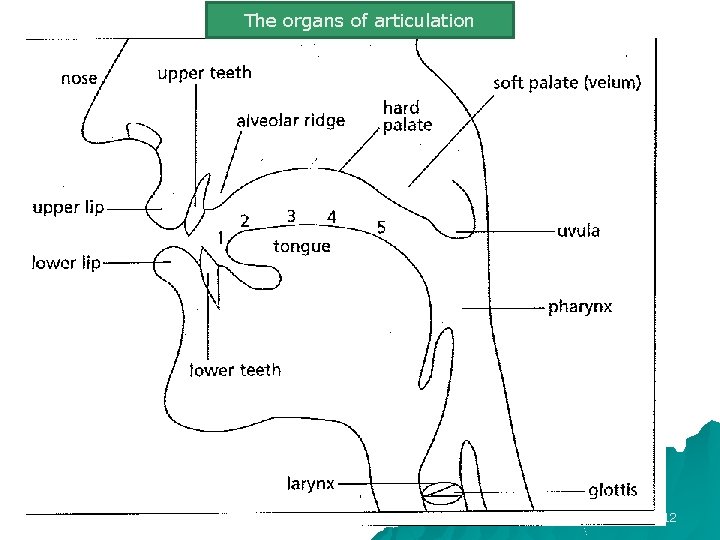
The organs of articulation 12
Classification of consonants Factors relevant for the classification of consonants include: manner of articulation place of articulation voicing 13
Classification of consonants Ø manner of articulation: plosives, fricatives, affricates, nasals, liquids. 14
Ø manner of articulation: Classification of consonants Plosives: are made by completely blocking the airflow. There is a compression of air behind obstruction and a subsequently release of the compressed air in the form of ‘explosion’ (hence the term ‘plosive’. ) Place of articulation: bilabial [p] e [b] alveolar [t] e [d] velar [k] e [g] 15
Classification of consonants Bilabial plosives: [p] e [b] are produced with both lips pressed together. In the case of [b], the vocal cords are vibrating; voiceless bilabial plosive [p]; voiced bilabial posive [b]; 16
Ø manner of articulation: Classification of consonants Alveolar plosives: [t] e [d] are produced with the tip of the tongue pressed agaisnt the alveolar ridge. The air is pressed for a short time and then breaks the obstruction with a slight explosion. In the case of [d] the vocal cords are vibrating. Voiceless alveolar plosive: [t] voiced alveolar plosive: [d] 17
Classification of consonants manner of articulation: Velar plosives: [k] e [g] are articulated with the back of the tongue against the soft palate. The air is pressed for a short time and then breaks the obstruction with a slight explosion. In the case of [g] the vocal cords are vibrating. Voiceless velar plosive: [k] voiced velar plosive: [g] 18
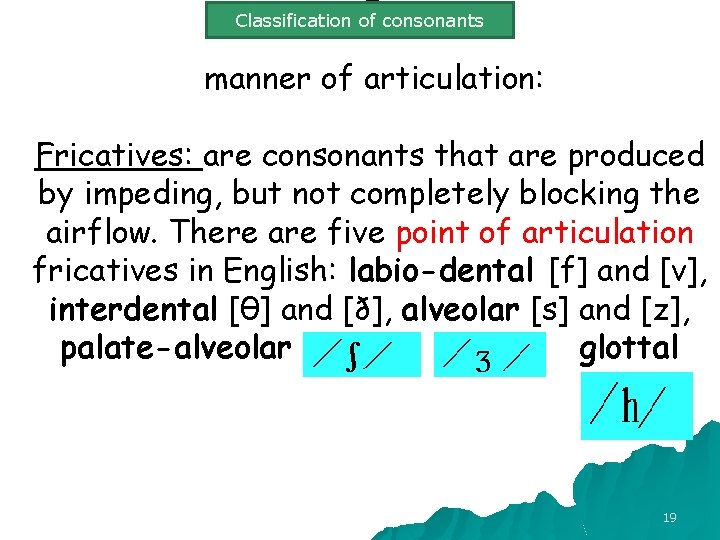
Ø Classification of consonants manner of articulation: Fricatives: are consonants that are produced by impeding, but not completely blocking the airflow. There are five point of articulation fricatives in English: labio-dental [f] and [v], interdental [θ] and [ð], alveolar [s] and [z], palate-alveolar [ ] glottal 19
Classification of consonants manner of articulation: labio-dental fricatives [f] and [v]: the lower lip is very close to the edge of the upper front teeth thus forming an incomplete obstruction. When the airflow goes through the narrrowing it causes slight friction (hence the term fricative). For [f] the vocal cords do not vibrate; there may some vibration with [v] when it occurs in initial position [vast] or between vowels [never] voicelss labio-dental fricative: [f] voiced labio-dental fricative: [v] 20
Classification of consonants manner of articulation: interdental fricatives [θ] and [ð]: the tip of the tongue is either close to the edge of the upper teeth or slightly projected between the teeth. For [θ] the vocal cords do not vibrate; they vibrate for [ð] when it occurs in word initial position, before a vowel and in intervocalic positions e. g. that, rather. Voiceless interdental fricative: [θ]; voiced interdental fricatives [ð]; 21
Classification of consonants manner of articulation: alveolar fricatives [s] and [z] : the tip of the tongue is close to the alveolar ridge forming flat narrowing. [s] is voiceless and [z] is voiced. E. G. Sun [s] and cause [z] Voicelss alveolar fricative [s]; voiced alveolar fricative [z]; 22
Classification of consonants manner of articulation: palate-alveolar fricatives [ ] and [ ] : the tip of the tongue is close to the back part alveolar ridge forming flat narrowing. For [ ] the vocal cords do not vibrate; they vibrate for [ ] when it occurs before vowels. E. G. shine, pleasure. Voiceless palate-alveolar fricative [ ]; voiced palate-alveolar fricative [ ]; 23
Classification of consonants manner of articulation: glottal fricative [ ] is produced with a voiceless expulsion of air from the lungs with the mouth and tongue already in position for the following vowel. Voiceless glottal frcative 24
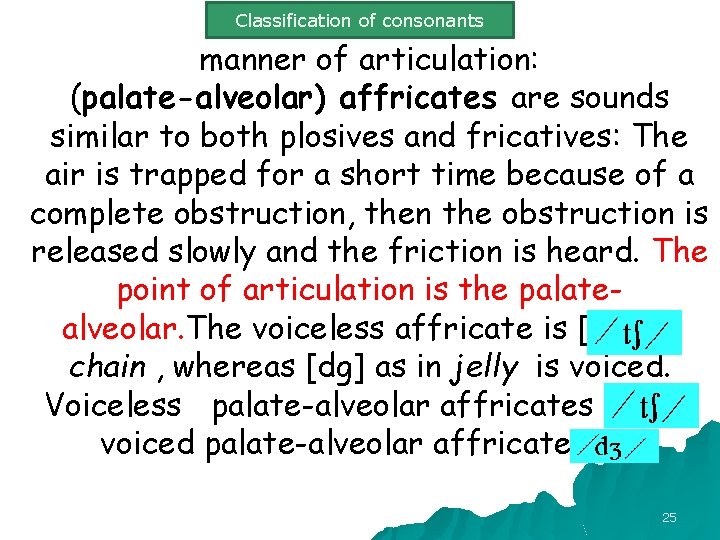
Classification of consonants manner of articulation: (palate-alveolar) affricates are sounds similar to both plosives and fricatives: The air is trapped for a short time because of a complete obstruction, then the obstruction is released slowly and the friction is heard. The point of articulation is the palatealveolar. The voiceless affricate is [] as in chain , whereas [dg] as in jelly is voiced. Voiceless palate-alveolar affricates [ ]; voiced palate-alveolar affricate ; 25
Classification consonants manner of ofarticulation: nasals are consonants which, like plosives, are produced by completely blocking the airstream. But there is an important difference: the airflow escapes through the nasal cavity (hence the term nasals) not through the mouth cavity. There are three points of articulations for the nasal consonants in English: bilabial [m], alveolar [n], and velar [ŋ]: . 26
Classification of consonants manner of articulation: bilabial nasal [m]: The lips are firmly kept together forming a complete obstruction. The air escapes through the nasal cavity. The vocal cords are vibrating. Bilabial nasal [m] NASALS ARE ALWAYS VOICED 27
Classification of consonants manner of articulation: alveolar nasal [n]: The tip of the tongue is pressed against the alveolar ridge forming a complete obstruction. The air escapes through the nasal cavity. The vocal cords are vibrating. Alveolar nasal: [n]; 28
Ø Classification of consonants manner of articulation: velar nasal [ŋ]: The back of the tongue is pressed to the soft palate forming the complete obstruction. The air again escapes through the nasal cavity. EG. To hang The vocal cords are vibrating for all the nasals velar nasal: [ŋ] 29
Classification of consonants Ø manner of articulation: liquids include alveolar [l] and post-alveolar [r]: 30
Classification of consonants Ø manner of articulation: alveolar [l]: the tip of the tongue is in firm contact with the alveolar ridge forming the complete obstruction. The air passes on both sides of the tongue. The vocal cords vibrate. 31
Classification of consonants Ø manner of articulation: post-alveolar [r]: the tip of the tongue is held in a position near to but not touching the back part of the alveolar ridge. The vocal cords vibrate. 32
manner of articulation: Classification of consonants semivowels : include bilabial [w] and the palatal [j]. [w] as in why and [j] as in you. The reason why they are called semivowels is their manner of articulation: like true vowels, they are produced without a major obstruction, since there is gap in the point of articulation, the airflow can escape freely. Unlike true vowels, they never form the nucleous of a syllable (week, yellow), and they are usually considered consonant and are called thus semiconsonant. 33
Consonants 34
Consonants Some sounds may be confused, as they are articulated in the same way as vowels, but function in the language as consonants: /j/ in YES and /w/ in WE. These two consonants are sometimes described as semi-vowels 35
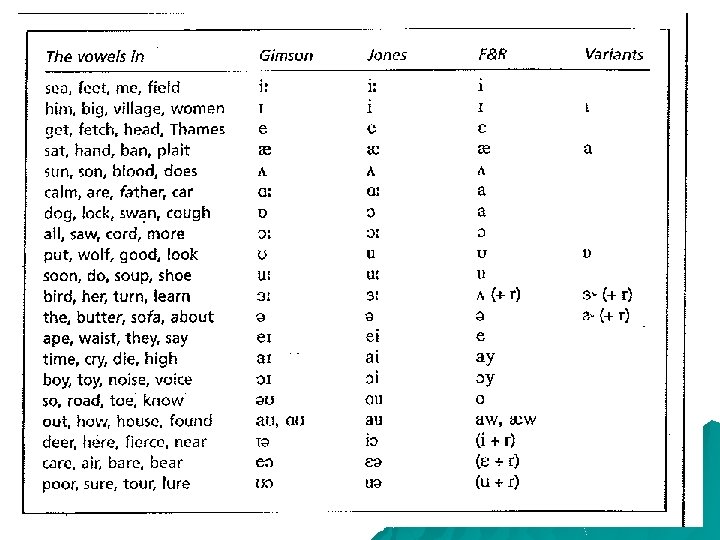
The sounds of English VOWEL A sound made without any such restrictions in the airflow. The 20 vowel sounds may be divided into 12 'pure' vowel sounds or monothongs, and 8 diphthongs. 36
37
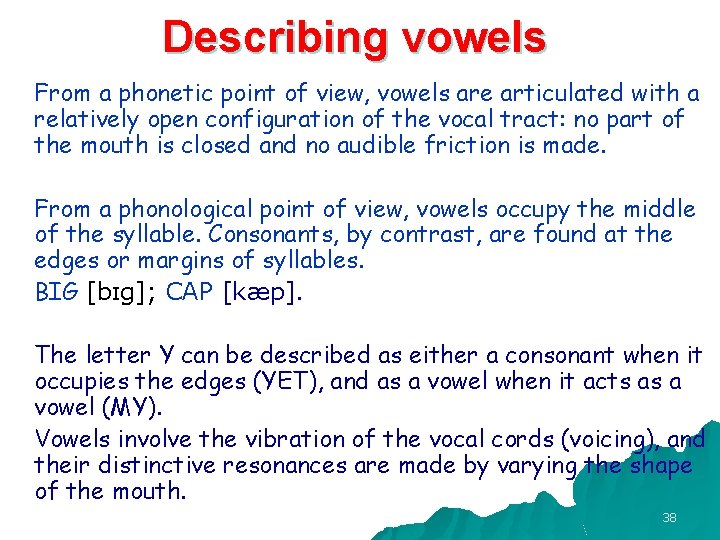
Describing vowels From a phonetic point of view, vowels are articulated with a relatively open configuration of the vocal tract: no part of the mouth is closed and no audible friction is made. From a phonological point of view, vowels occupy the middle of the syllable. Consonants, by contrast, are found at the edges or margins of syllables. BIG [bɪg]; CAP [kæp]. The letter Y can be described as either a consonant when it occupies the edges (YET), and as a vowel when it acts as a vowel (MY). Vowels involve the vibration of the vocal cords (voicing), and their distinctive resonances are made by varying the shape of the mouth. 38
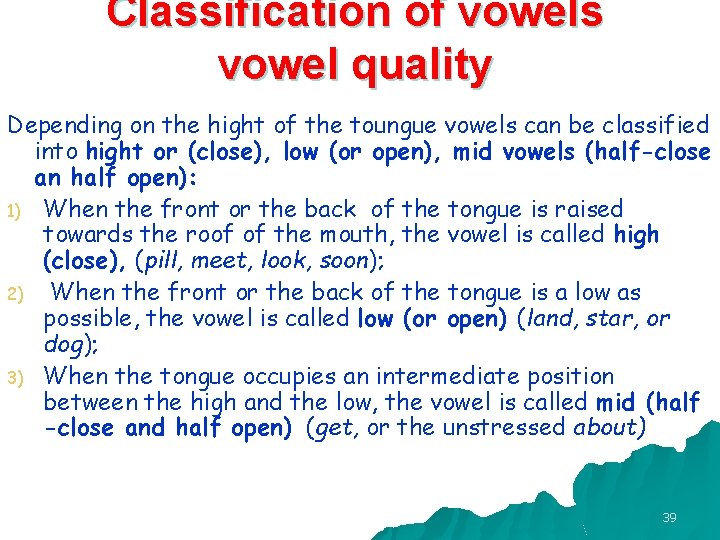
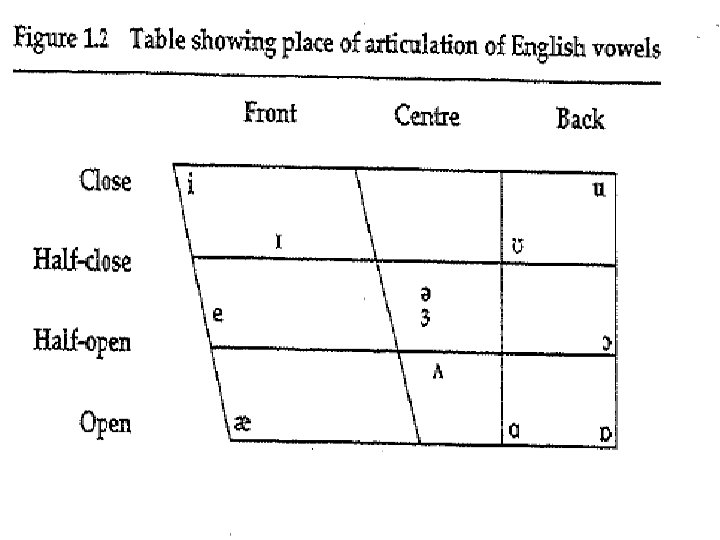
Classification of vowels vowel quality Depending on the hight of the toungue vowels can be classified into hight or (close), low (or open), mid vowels (half-close an half open): 1) When the front or the back of the tongue is raised towards the roof of the mouth, the vowel is called high (close), (pill, meet, look, soon); 2) When the front or the back of the tongue is a low as possible, the vowel is called low (or open) (land, star, or dog); 3) When the tongue occupies an intermediate position between the high and the low, the vowel is called mid (half -close and half open) (get, or the unstressed about) 39
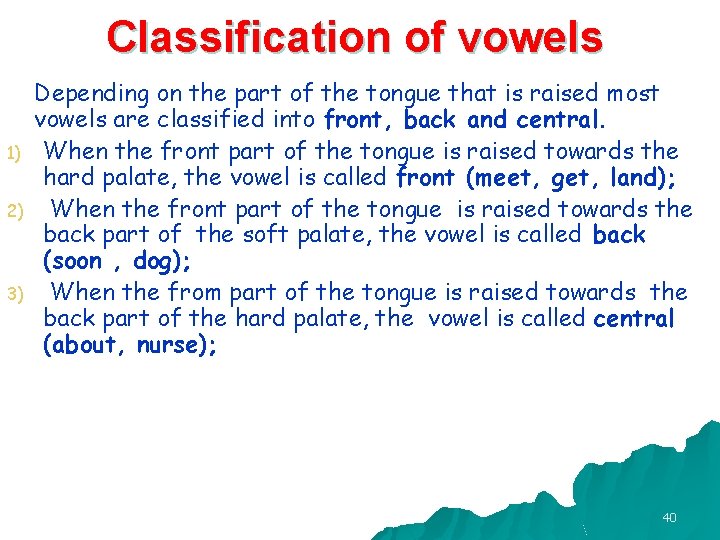
Classification of vowels 1) 2) 3) Depending on the part of the tongue that is raised most vowels are classified into front, back and central. When the front part of the tongue is raised towards the hard palate, the vowel is called front (meet, get, land); When the front part of the tongue is raised towards the back part of the soft palate, the vowel is called back (soon , dog); When the from part of the tongue is raised towards the back part of the hard palate, the vowel is called central (about, nurse); 40
Describing vowels 41
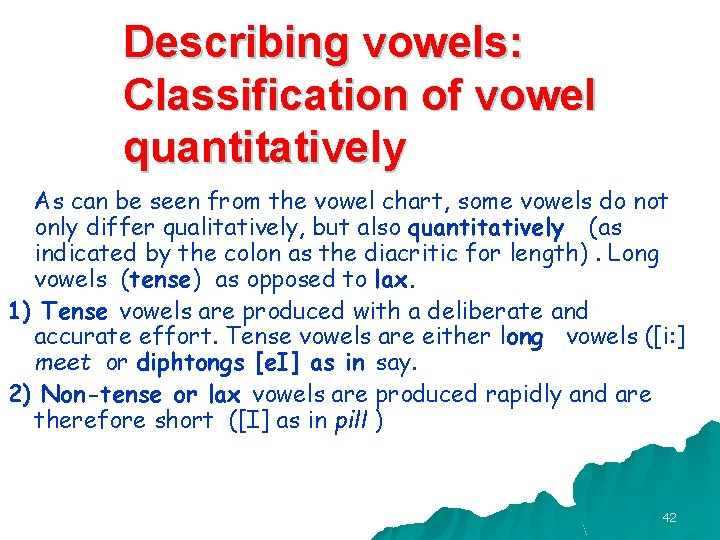
Describing vowels: Classification of vowel quantitatively As can be seen from the vowel chart, some vowels do not only differ qualitatively, but also quantitatively (as indicated by the colon as the diacritic for length). Long vowels (tense) as opposed to lax. 1) Tense vowels are produced with a deliberate and accurate effort. Tense vowels are either long vowels ([i: ] meet or diphtongs [e. I] as in say. 2) Non-tense or lax vowels are produced rapidly and are therefore short ([I] as in pill ) 42
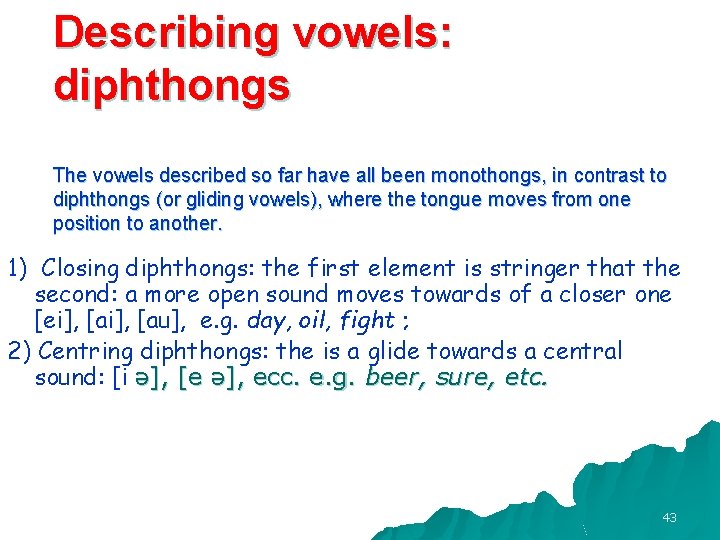
Describing vowels: diphthongs The vowels described so far have all been monothongs, in contrast to diphthongs (or gliding vowels), where the tongue moves from one position to another. 1) Closing diphthongs: the first element is stringer that the second: a more open sound moves towards of a closer one [ei], [au], e. g. day, oil, fight ; 2) Centring diphthongs: the is a glide towards a central sound: [i ə], [e ə], ecc. e. g. beer, sure, etc. 43
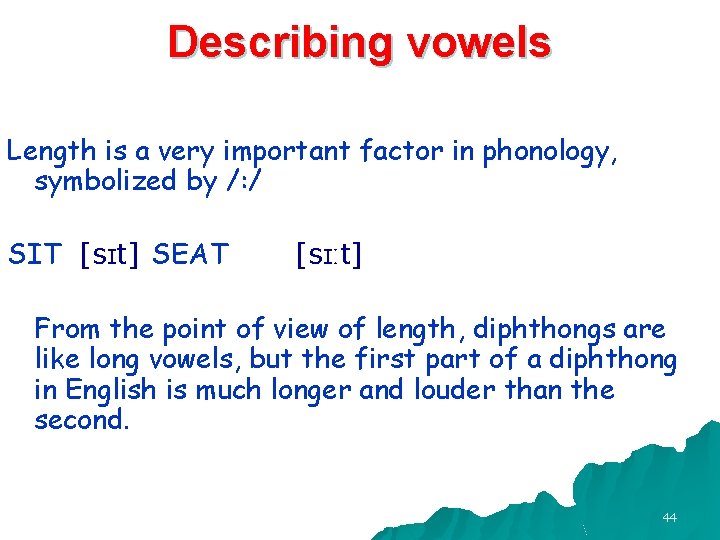
Describing vowels Length is a very important factor in phonology, symbolized by /: / SIT [sɪt] SEAT [sɪːt] From the point of view of length, diphthongs are like long vowels, but the first part of a diphthong in English is much longer and louder than the second. 44
The sounds of English THE PHONETIC ALPHABET DISTINGUISHES ALL PHONEMES IN WRITING. The International Phonetic Alphabet (IPA) provides a writing symbol for any linguistic sound of any world language. 45
The International Phonetic Alphabet Enables students and linguists to learn and record the pronunciation of languages accurately, thereby avoiding the confusion of inconsistent, conventional spellings. One aim of the IPA was to provide a unique symbol for each distinctive sound in a language--that is, every sound, or phoneme, that serves to distinguish one word from another. 46
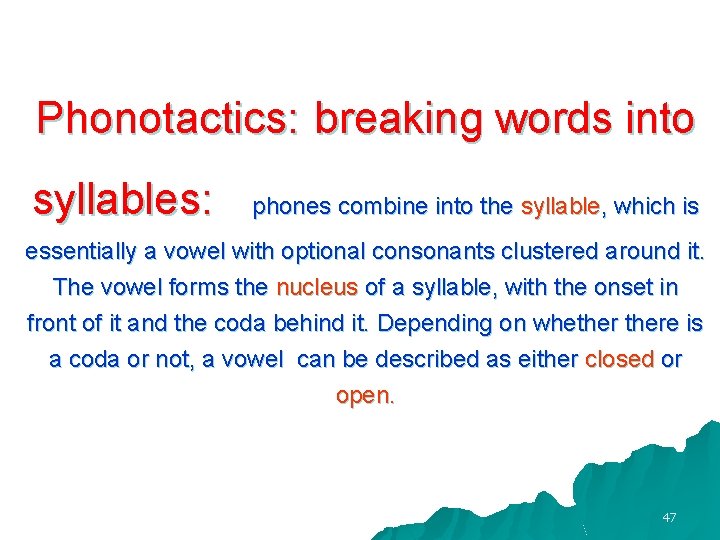
Phonotactics: breaking words into syllables: phones combine into the syllable, which is essentially a vowel with optional consonants clustered around it. The vowel forms the nucleus of a syllable, with the onset in front of it and the coda behind it. Depending on whethere is a coda or not, a vowel can be described as either closed or open. 47
Things you need to know: pho 1) Each syllable in English contains a vowel; 2) For breaking words into syllables it is the way you pronounce the words that is important, not the spelling. We focus on the number of vowel sounds not the letters; 3) Sometimes one vowel sound is made up of more then one vowel letter. For example in the word ‘laugh’ the two vowel letters ‘au’ form one sound. The letters ‘au’ make the single vowel sound /a: / like in ‘car’. The word ‘laugh’ has therefore one syllable because we pronounce only one vowel sound. 4) Beware silent letters, like the words ‘late’ and ‘name’. ‘Late’ and ‘name’have one syllable as we only pronunce one vowel when we say these words. The letter ‘e’ is silent. 5) A diphthong vowel sound makes one syllable. For instance /ei/ makes one syllable in the word ‘rate’. 48
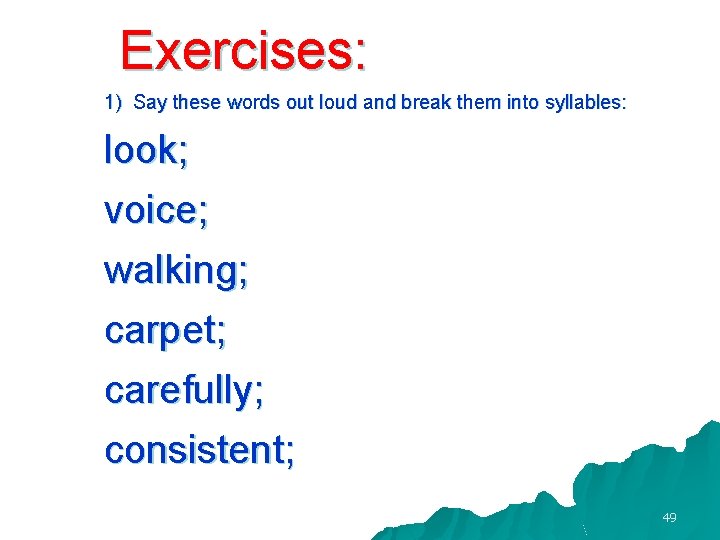
Exercises: 1) Say these words out loud and break them into syllables: look; voice; walking; carpet; carefully; consistent; 49
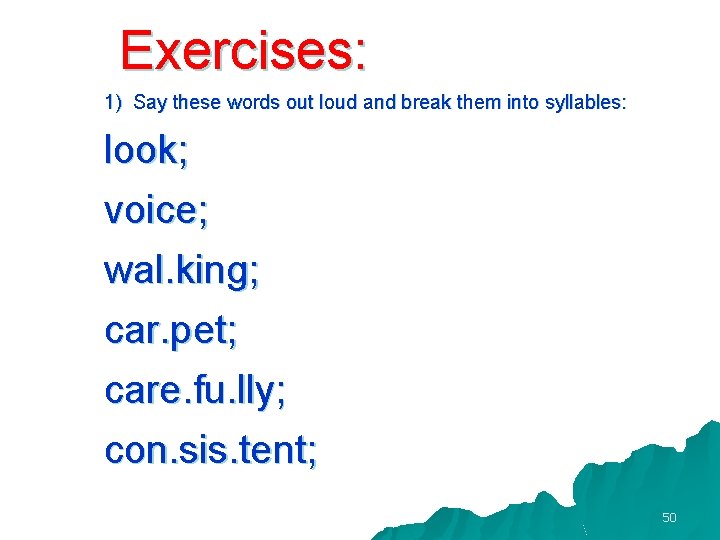
Exercises: 1) Say these words out loud and break them into syllables: look; voice; wal. king; car. pet; care. fu. lly; con. sis. tent; 50
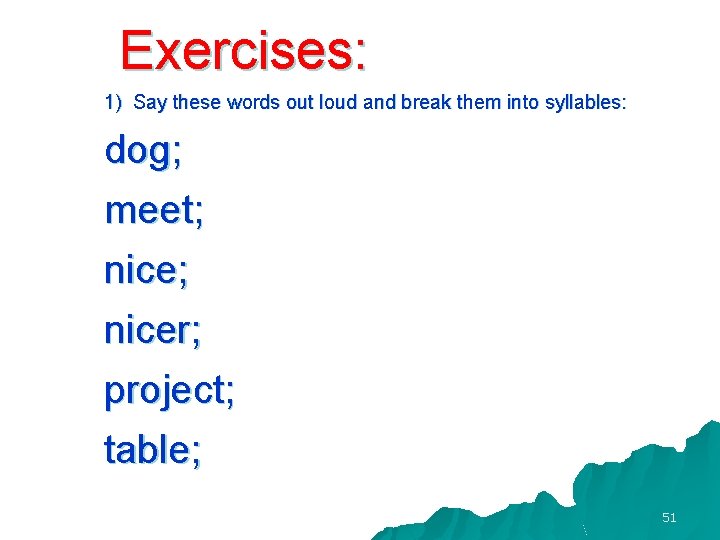
Exercises: 1) Say these words out loud and break them into syllables: dog; meet; nicer; project; table; 51
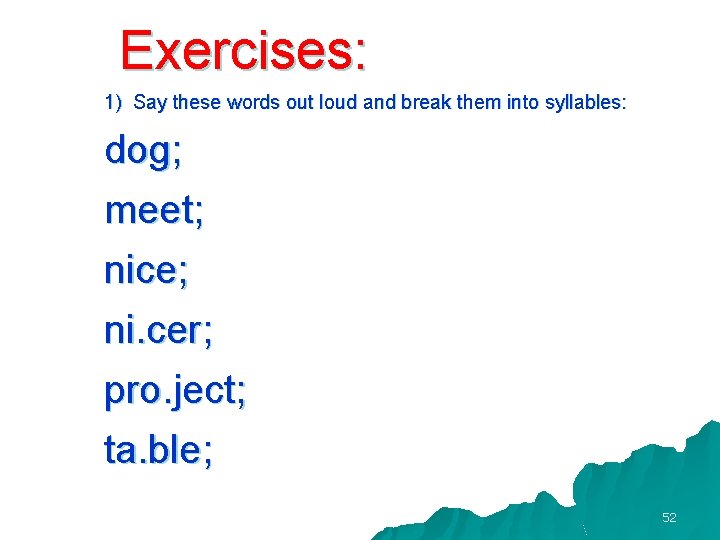
Exercises: 1) Say these words out loud and break them into syllables: dog; meet; nice; ni. cer; pro. ject; ta. ble; 52
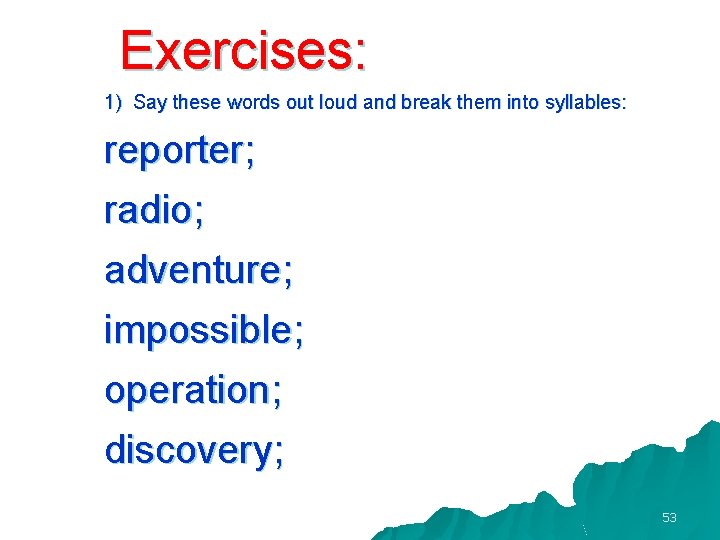
Exercises: 1) Say these words out loud and break them into syllables: reporter; radio; adventure; impossible; operation; discovery; 53
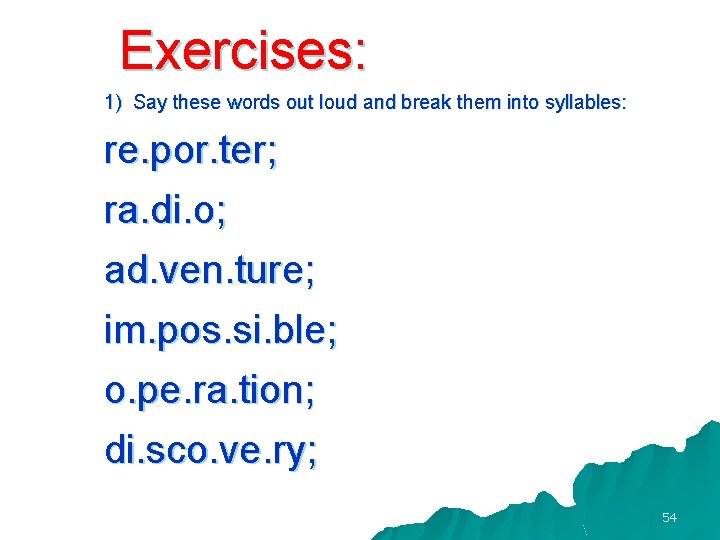
Exercises: 1) Say these words out loud and break them into syllables: re. por. ter; ra. di. o; ad. ven. ture; im. pos. si. ble; o. pe. ra. tion; di. sco. ve. ry; 54
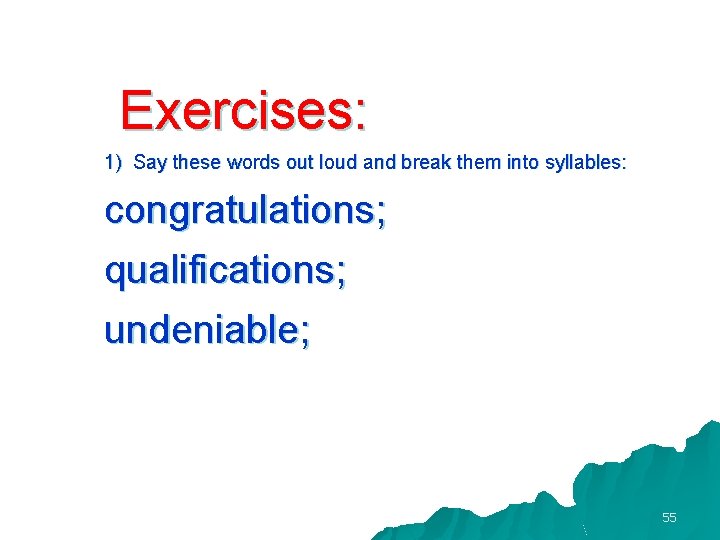
Exercises: 1) Say these words out loud and break them into syllables: congratulations; qualifications; undeniable; 55
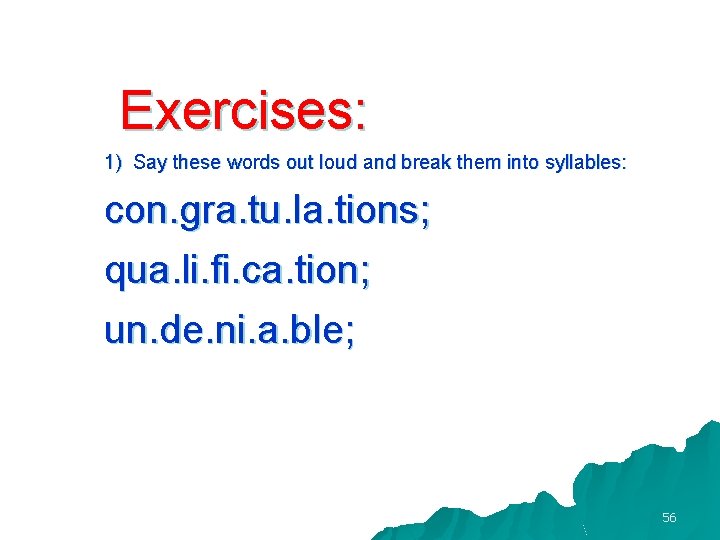
Exercises: 1) Say these words out loud and break them into syllables: con. gra. tu. la. tions; qua. li. fi. ca. tion; un. de. ni. a. ble; 56