
Phonemic Awareness www ed govteachershowtoolsinitiativesumme rworkshopvaldes ppt Bridging
Phonemic Awareness www. ed. gov/teachers/how/tools/initiative/summe rworkshop/valdes. ppt
Bridging the 5 Elements of Reading n n n Phonemic Awareness Phonics Vocabulary Fluency Comprehension
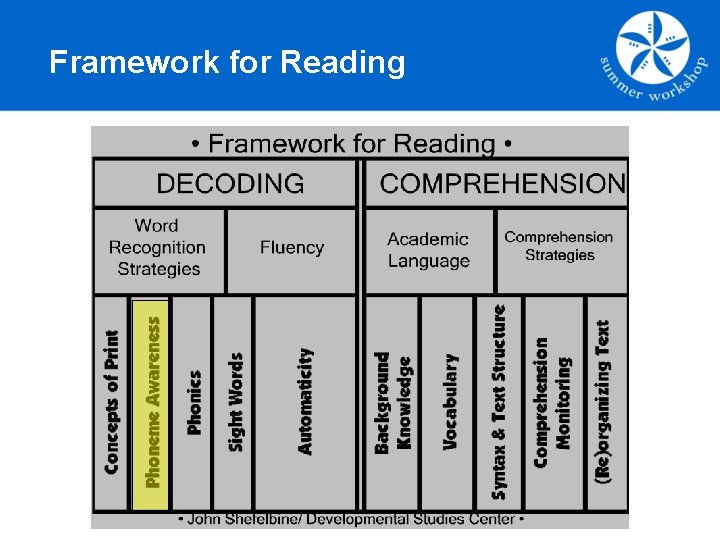
Framework for Reading
Workshop Outcomes § Define phonological awareness and its components § Understand why phoneme awareness is important § Identify the progression of phoneme awareness skills § Learn how to teach and model effective phonemic awareness strategies § Know how to explicitly teach blending and segmenting § Understand the importance of concepts about print and letter identification
Phonology n The study of sounds n Refers to the sound structure of speech, and to the perception, representation, and production of speech sounds. n Phonological aspects include prosodic and articulatory units.
Phonological Awareness n Broad term that includes phonemic awareness n In addition to phonemes, phonological awareness activities can involve work with rhymes, words, syllables, and onsets and rimes.
Phoneme & Phonemic Awareness Phoneme: The smallest part of spoken language that makes a difference in the meaning of words Phonemic Awareness: The ability to hear, identify, and manipulate the individual sounds – phonemes – in spoken words
Why is Phonemic Awareness important? § Phonemic awareness instruction helps children learn to read. § Phonemic awareness instruction helps children learn to spell.
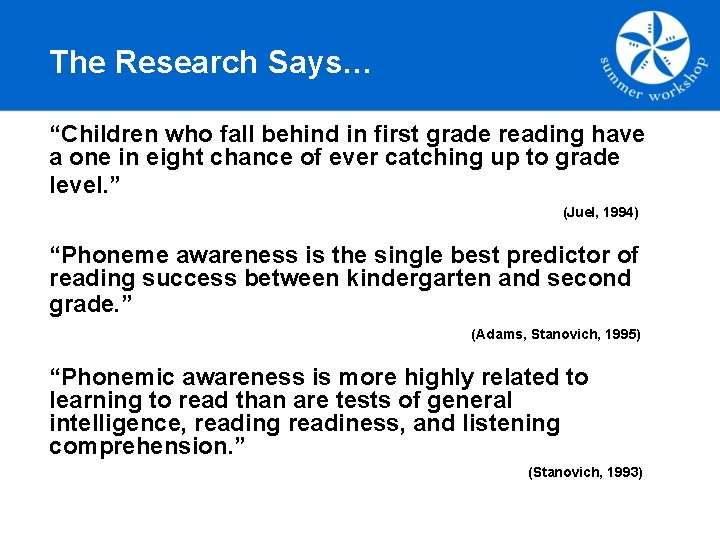
The Research Says… “Children who fall behind in first grade reading have a one in eight chance of ever catching up to grade level. ” (Juel, 1994) “Phoneme awareness is the single best predictor of reading success between kindergarten and second grade. ” (Adams, Stanovich, 1995) “Phonemic awareness is more highly related to learning to read than are tests of general intelligence, reading readiness, and listening comprehension. ” (Stanovich, 1993)
Who is it for? n Preschool n Kindergarten through second grade n Basic and below grade level readers
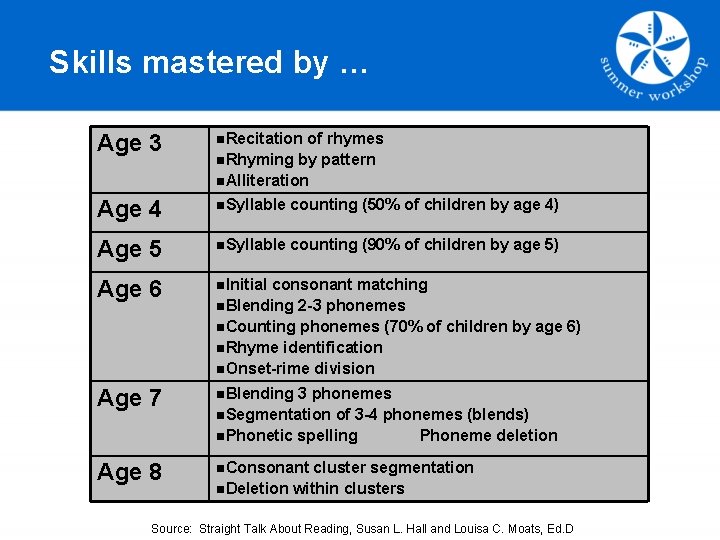
Skills mastered by … Age 3 n. Recitation Age 4 n. Syllable counting (50% of children by age 4) Age 5 n. Syllable counting (90% of children by age 5) Age 6 n. Initial Age 7 n. Blending Age 8 n. Consonant of rhymes n. Rhyming by pattern n. Alliteration consonant matching n. Blending 2 -3 phonemes n. Counting phonemes (70% of children by age 6) n. Rhyme identification n. Onset-rime division 3 phonemes n. Segmentation of 3 -4 phonemes (blends) n. Phonetic spelling Phoneme deletion cluster segmentation n. Deletion within clusters Source: Straight Talk About Reading, Susan L. Hall and Louisa C. Moats, Ed. D
Areas of instruction n n n n Isolation Identify Categorization Blending Segmentation Deletion Addition Substitution
How Much Instructional Time? “No more than 20 hours over the school year. ” Stanovich, 1993
What does instruction look like? Direct Instruction Model How To Let’s Do You Do
Phoneme Isolation Children recognize individual sounds in a word. How To: Teacher: What is the first sound in van? Children: The first sound in van is /v/.
Phoneme Isolation Let’s Do: What is the first sound in: n Tire n Pail n Goat n Clock n Star n Fish What is the last sound in:
Phoneme Isolation You Do: I spy something in the room that starts like: n Purple n Water n Teacher n Cat Handout Activity #1
Phoneme Identity Children recognize the same sounds in different words How To: Teacher: What sound is the same in fix, fall, and fun? Children: The first sound /f/ is the same.
Phoneme Identity Let’s Do: Which sound is the same in…? n n n sat run bike sister rice bake sorry river birth
Phoneme Categorization Children recognize the word in a set of three or four words that has the “odd” sound. How To: Teacher: Which word doesn’t belong? bus, bun, rig Children: Rig does not belong. It doesn’t begin with /b/.
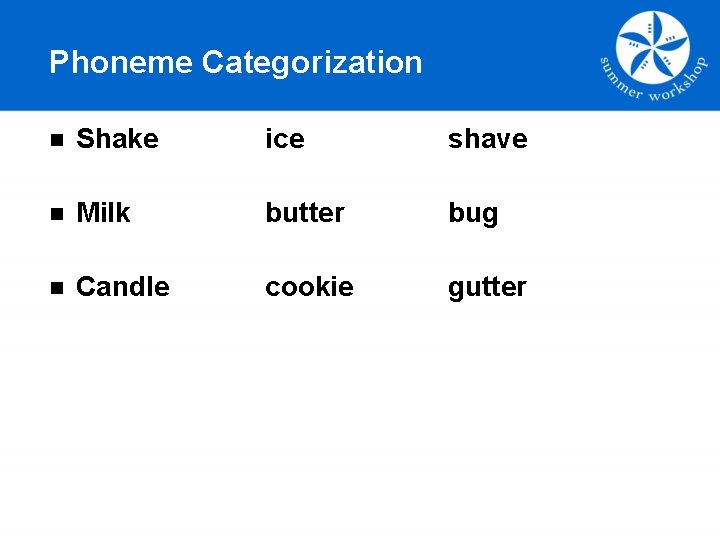
Phoneme Categorization n Shake ice shave n Milk butter bug n Candle cookie gutter
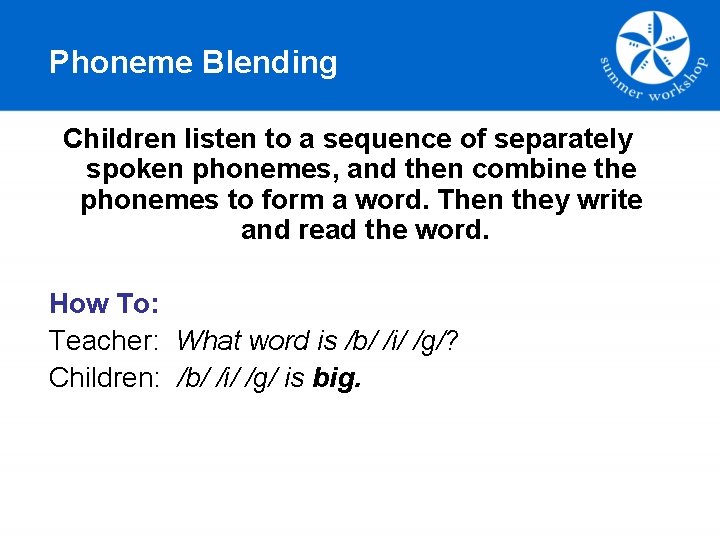
Phoneme Blending Children listen to a sequence of separately spoken phonemes, and then combine the phonemes to form a word. Then they write and read the word. How To: Teacher: What word is /b/ /i/ /g/? Children: /b/ /i/ /g/ is big.
Types of Blending Continuous Blending Sound by Sound Blending Vowel-First Blending
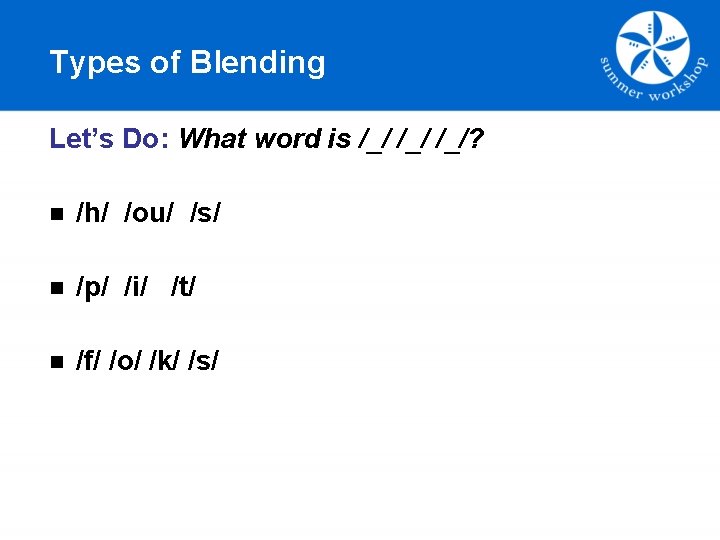
Types of Blending Let’s Do: What word is /_/ /_/? n /h/ /ou/ /s/ n /p/ /i/ /t/ n /f/ /o/ /k/ /s/
Phoneme Segmentation Children break a word into its separate sounds, saying each sound as they tap out or count it. Then they write and read the sounds. How To: Teacher: How many sounds are in grab? Children: /g/ /r/ /a/ /b/. Four sounds.
Segmentation Levels n Counting words in a sentence n Counting syllables in words n Compound words n Counting phonemes in words
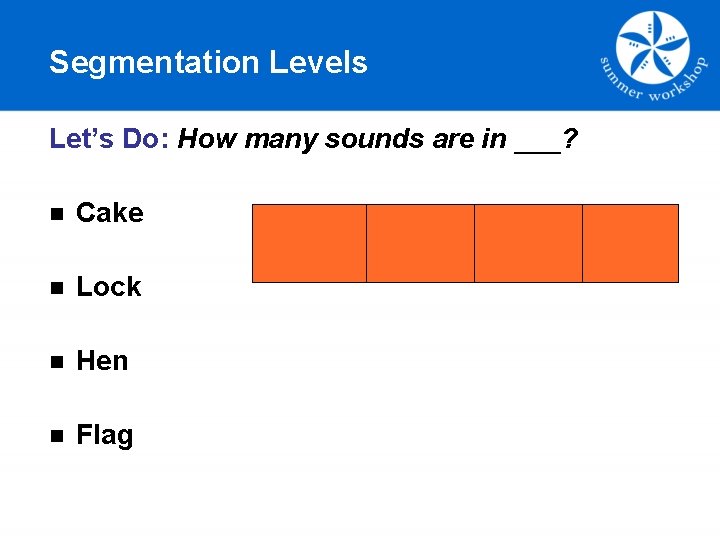
Segmentation Levels Let’s Do: How many sounds are in ___? n Cake n Lock n Hen n Flag
Phoneme Deletion Children recognize the word that remains when a phoneme is removed from another word. How To: Teacher: What is smile without the /s/? Children: Smile without the /s/ is mile.
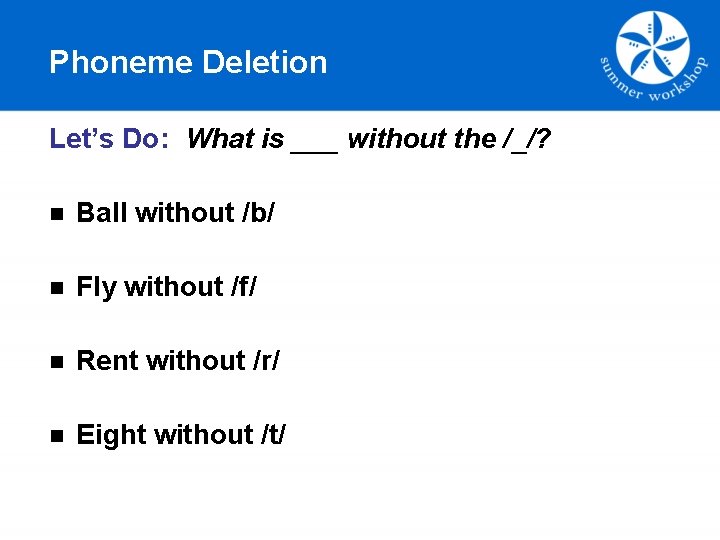
Phoneme Deletion Let’s Do: What is ___ without the /_/? n Ball without /b/ n Fly without /f/ n Rent without /r/ n Eight without /t/
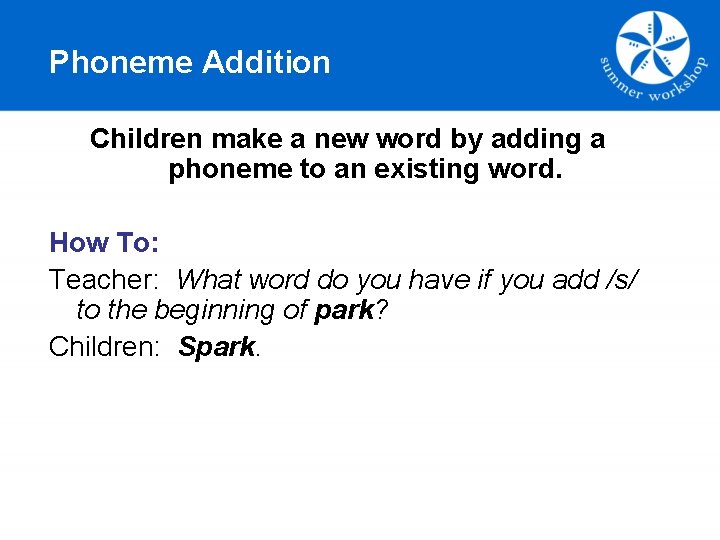
Phoneme Addition Children make a new word by adding a phoneme to an existing word. How To: Teacher: What word do you have if you add /s/ to the beginning of park? Children: Spark.
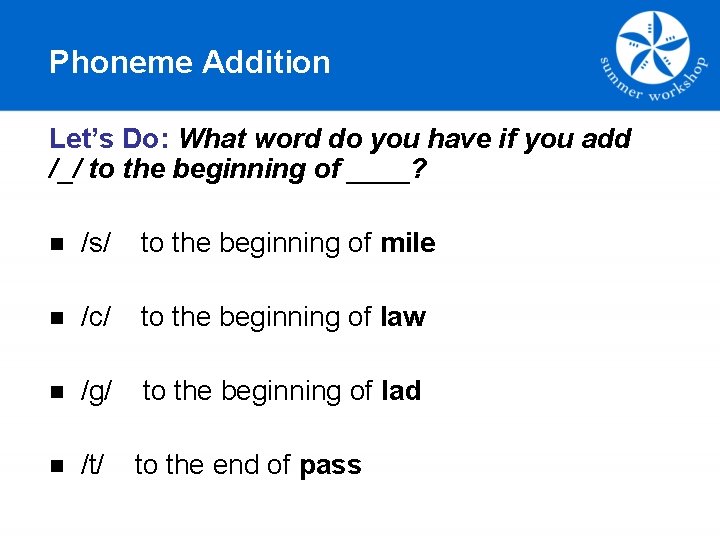
Phoneme Addition Let’s Do: What word do you have if you add /_/ to the beginning of ____? n /s/ to the beginning of mile n /c/ to the beginning of law n /g/ to the beginning of lad n /t/ to the end of pass
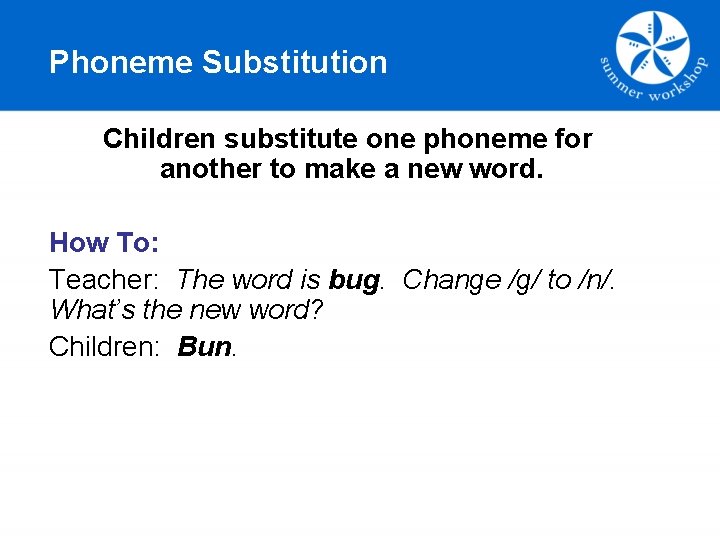
Phoneme Substitution Children substitute one phoneme for another to make a new word. How To: Teacher: The word is bug. Change /g/ to /n/. What’s the new word? Children: Bun.
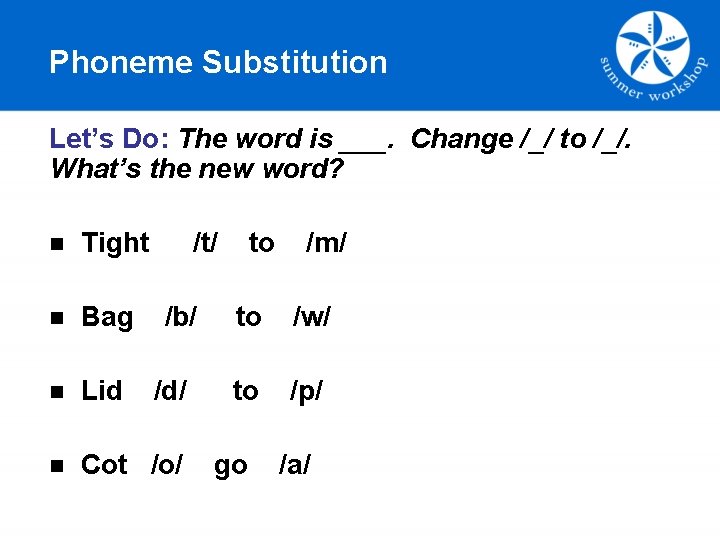
Phoneme Substitution Let’s Do: The word is ___. Change /_/ to /_/. What’s the new word? n Tight /t/ n Bag n Lid n Cot /o/ /b/ /d/ to /m/ to /w/ to /p/ go /a/
May seem like play; however, n Requires explicit teaching n Highly structured practice n Independent practice
Which methods have the greatest impact? n Blending and Segmenting Phoneme Awareness instruction is most effective when it focuses on only one or two types of phoneme manipulation, rather than several types.
National Reading Panel reports: “Phoneme Awareness measured at The beginning of kindergarten is one of the two best predictors of how well Children will learn to read. ”
How do I assess it? n n Usually 1: 1 Recommended to assess by mid kindergarten year Focus on assessing blending and segmenting Use information to make data driven decisions for instruction
Reveal the Data information n n What do we know based on the data? What is my targeted skill for instruction? What is the best way to reteach it? How do I use assessment to improve teaching and learning?
Concepts About Print and Letter ID § Rapid and accurate recognition of letter name
Summary n Phoneme awareness is necessary, but not sufficient. n Phoneme awareness can be directly taught. n Phoneme awareness does not require extensive teaching time. n Phoneme awareness should be assessed in kindergarten. n Focus majority of instruction on blending and segmenting sounds.
- Slides: 40