
Phoneaware Neural Language Identification Zhiyuan Tang Dong Wang
- Slides: 23
Phone-aware Neural Language Identification Zhiyuan Tang, Dong Wang*, Yixiang Chen, Ying Shi, Lantian Li Center for Speech and Language Technologies, Tsinghua University *wangdong 99@mails. tsinghua. edu. cn Oriental-COCOSDA, November 1 -3, 2017, Seoul, R. O. Korea
OUTLINE >>>>> 1 Introduction 2 Phonetic feature 3 Phone-aware LID 4 Experiments 5 Conclusions extended
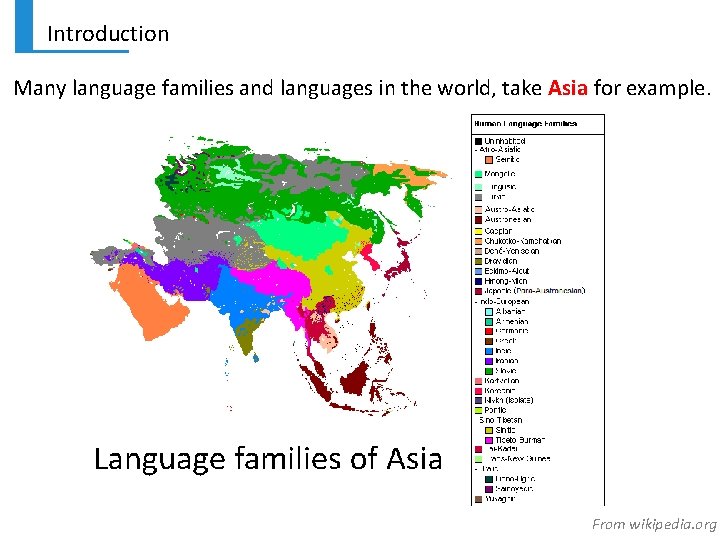
Introduction Many language families and languages in the world, take Asia for example. From wikipedia. org
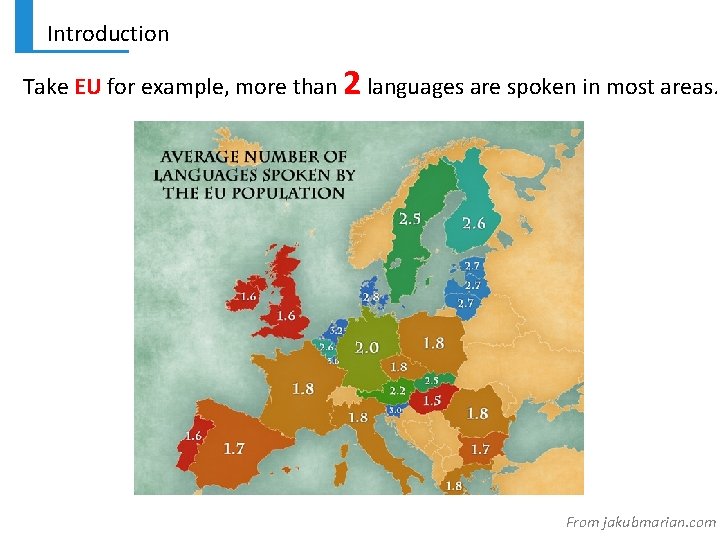
Introduction Take EU for example, more than 2 languages are spoken in most areas. From jakubmarian. com
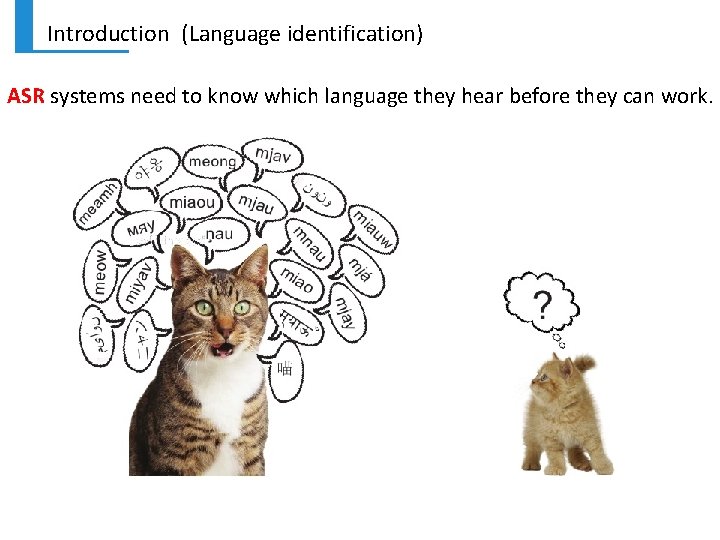
Introduction (Language identification) ASR systems need to know which language they hear before they can work.
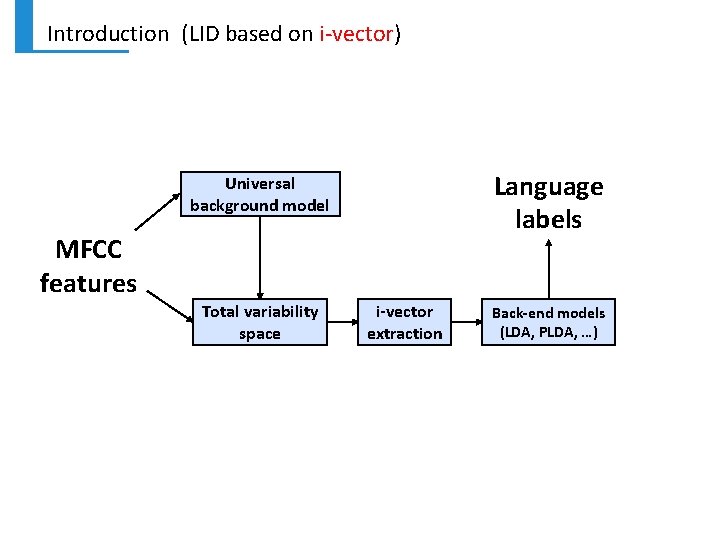
Introduction (LID based on i-vector) Language labels Universal background model MFCC features Total variability space i-vector extraction Back-end models (LDA, PLDA, …)
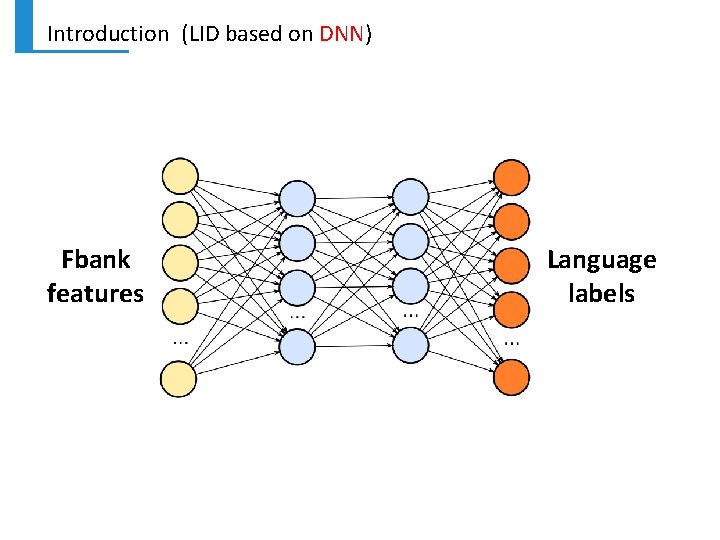
Introduction (LID based on DNN) Fbank features Language labels
Introduction (Acoustic features) • MFCC and Fbank features are both acoustic features. • Acoustic features involve no explicit phonetic information which is important for LID system. • Could we design features involving much phonetic information?
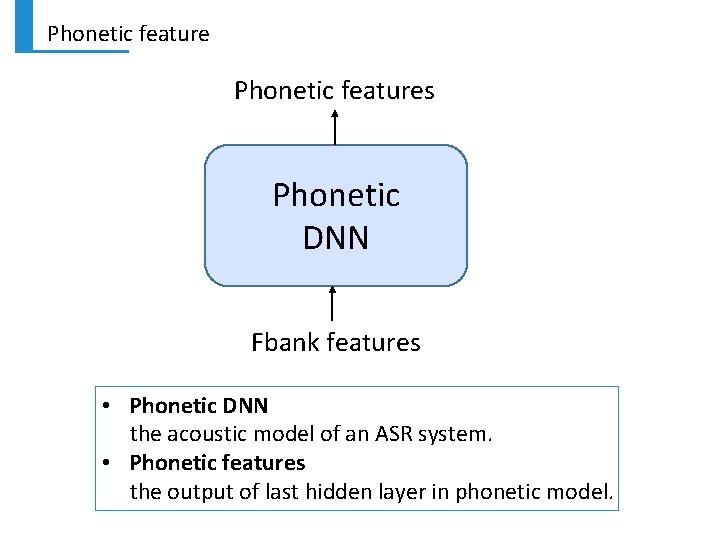
Phonetic features Phonetic DNN Fbank features • Phonetic DNN the acoustic model of an ASR system. • Phonetic features the output of last hidden layer in phonetic model.
Phonetic feature Advantages of phonetic features for LID • languages are more discriminated by phonetic information than by acoustic information. • phonetic features represent information at a higher level, thus more invariant with respect to noise and channels
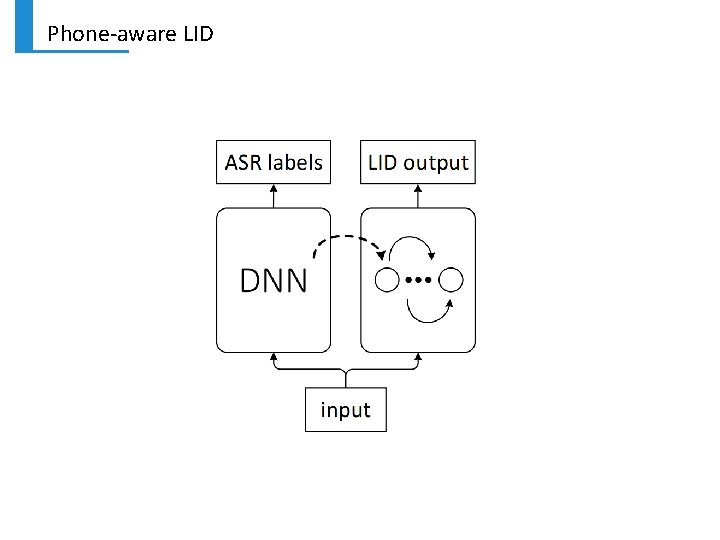
Phone-aware LID
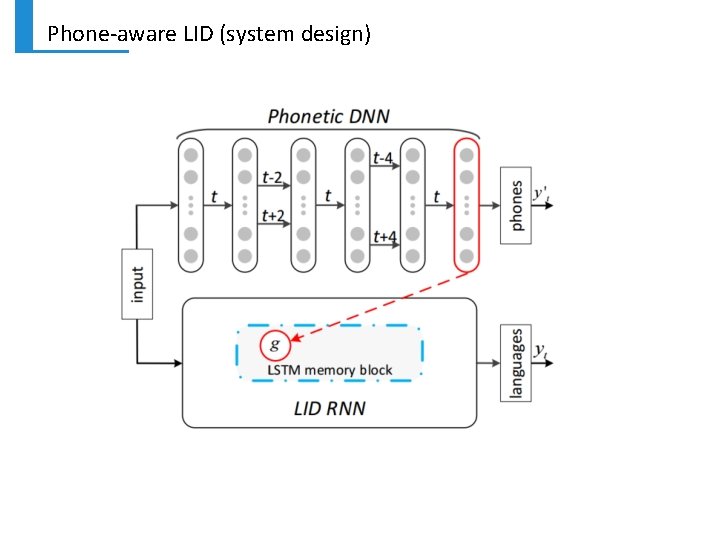
Phone-aware LID (system design)
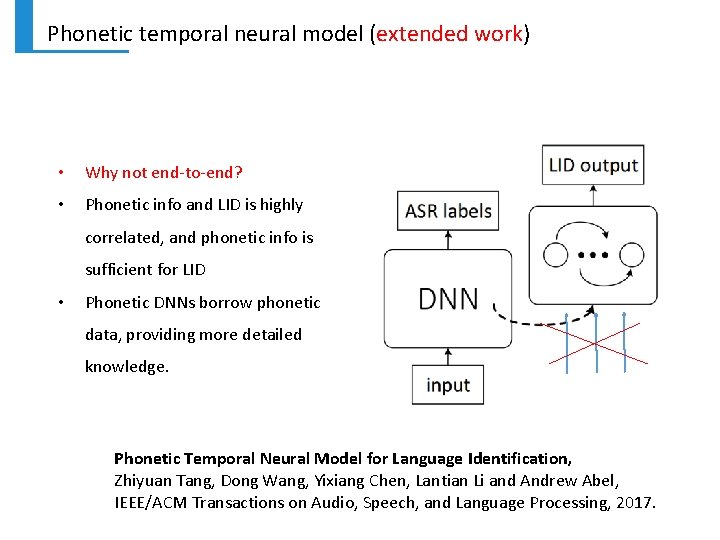
Phonetic temporal neural model (extended work) • Why not end-to-end? • Phonetic info and LID is highly correlated, and phonetic info is sufficient for LID • Phonetic DNNs borrow phonetic data, providing more detailed knowledge. Phonetic Temporal Neural Model for Language Identification, Zhiyuan Tang, Dong Wang, Yixiang Chen, Lantian Li and Andrew Abel, IEEE/ACM Transactions on Audio, Speech, and Language Processing, 2017.
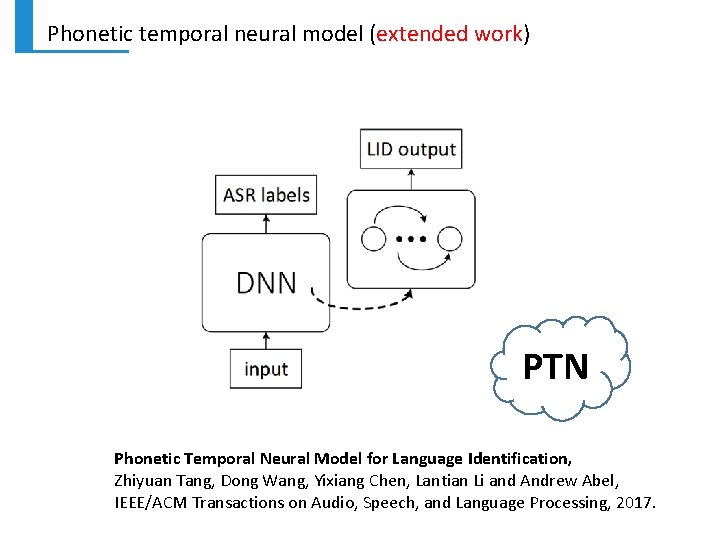
Phonetic temporal neural model (extended work) PTN Phonetic Temporal Neural Model for Language Identification, Zhiyuan Tang, Dong Wang, Yixiang Chen, Lantian Li and Andrew Abel, IEEE/ACM Transactions on Audio, Speech, and Language Processing, 2017.
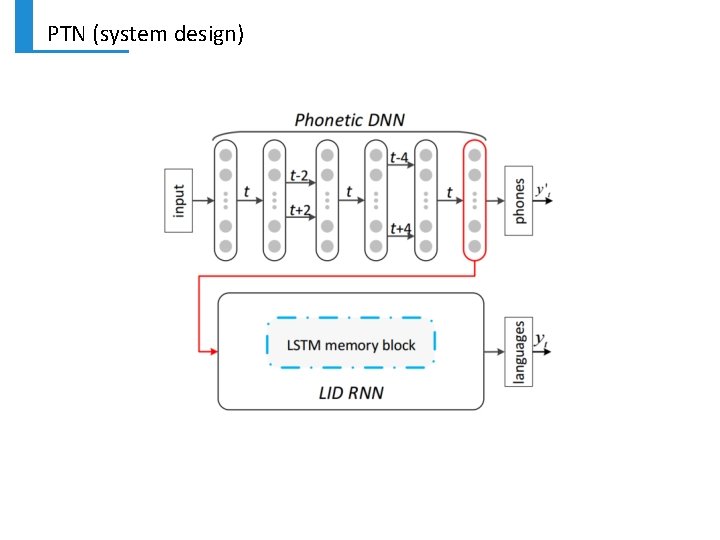
PTN (system design)
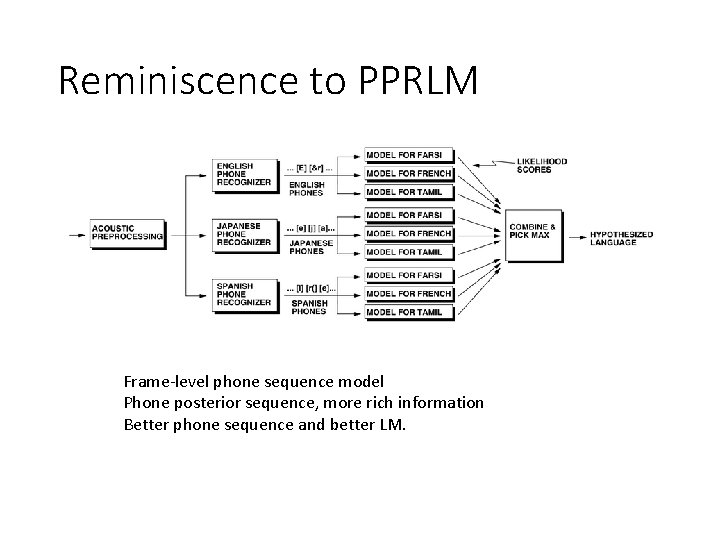
Reminiscence to PPRLM Frame-level phone sequence model Phone posterior sequence, more rich information Better phone sequence and better LM.
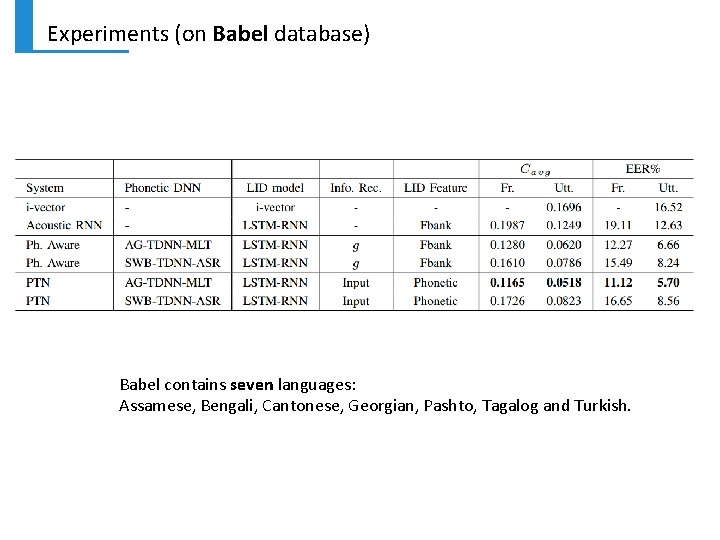
Experiments (on Babel database) Babel contains seven languages: Assamese, Bengali, Cantonese, Georgian, Pashto, Tagalog and Turkish.
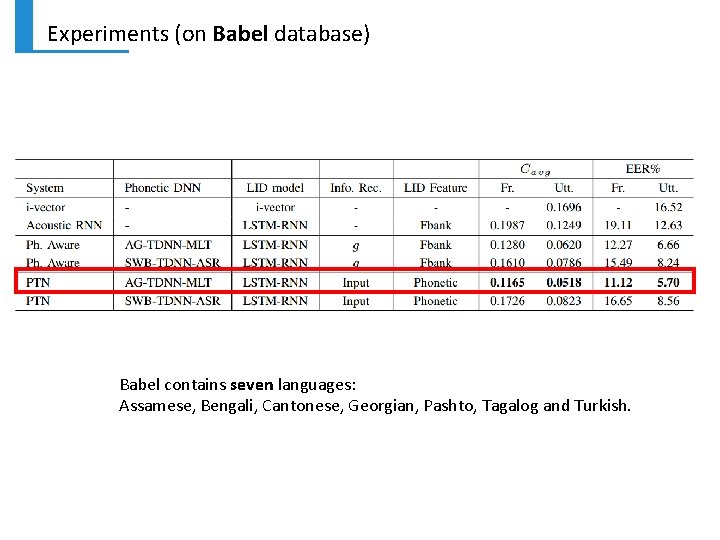
Experiments (on Babel database) Babel contains seven languages: Assamese, Bengali, Cantonese, Georgian, Pashto, Tagalog and Turkish.
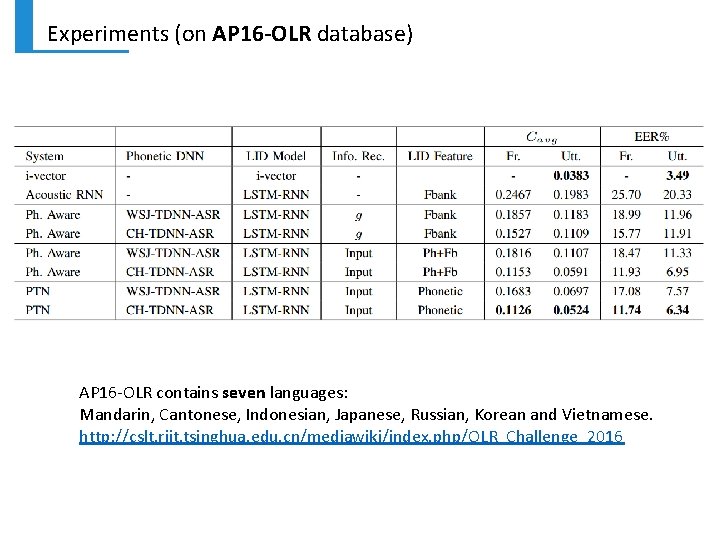
Experiments (on AP 16 -OLR database) AP 16 -OLR contains seven languages: Mandarin, Cantonese, Indonesian, Japanese, Russian, Korean and Vietnamese. http: //cslt. riit. tsinghua. edu. cn/mediawiki/index. php/OLR_Challenge_2016
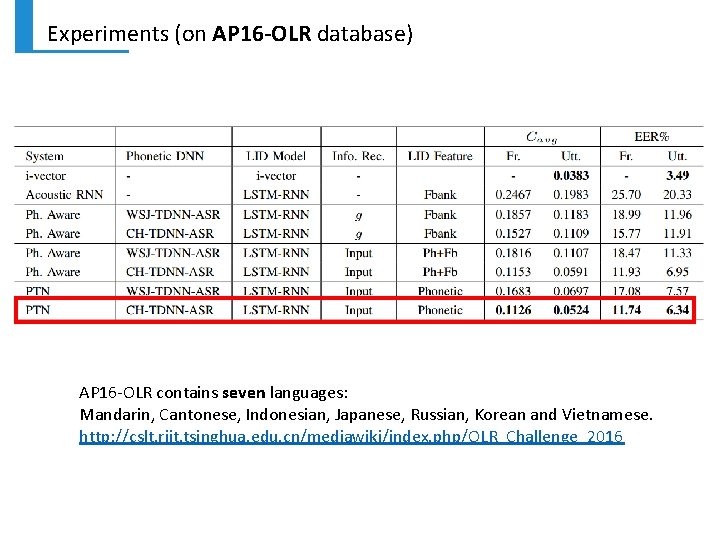
Experiments (on AP 16 -OLR database) AP 16 -OLR contains seven languages: Mandarin, Cantonese, Indonesian, Japanese, Russian, Korean and Vietnamese. http: //cslt. riit. tsinghua. edu. cn/mediawiki/index. php/OLR_Challenge_2016
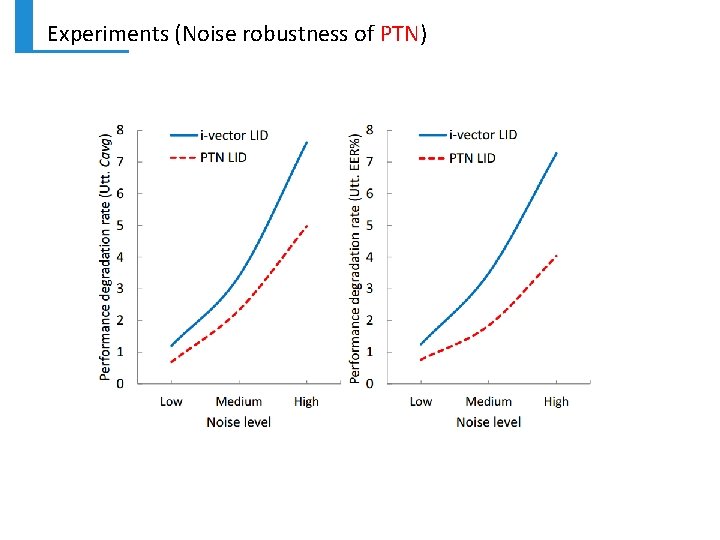
Experiments (Noise robustness of PTN)
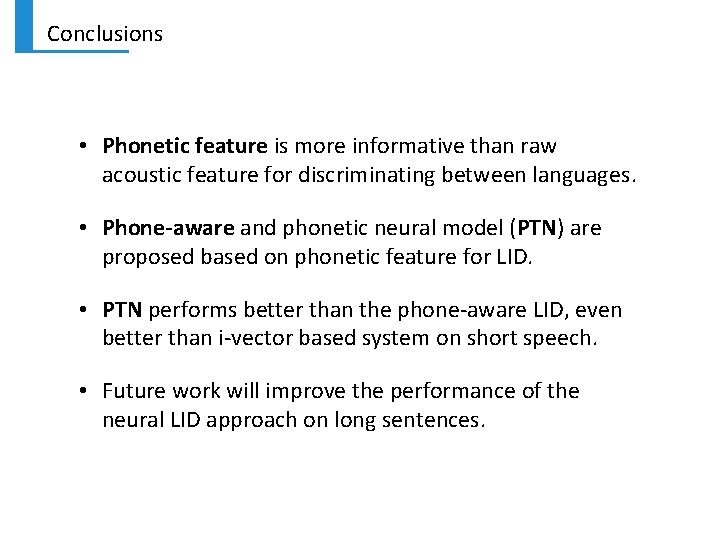
Conclusions • Phonetic feature is more informative than raw acoustic feature for discriminating between languages. • Phone-aware and phonetic neural model (PTN) are proposed based on phonetic feature for LID. • PTN performs better than the phone-aware LID, even better than i-vector based system on short speech. • Future work will improve the performance of the neural LID approach on long sentences.
Thanks a lot.