
Phlebotomists Duties Responsibilities Prepare patients site for specimen
Phlebotomist’s Duties & Responsibilities Prepare patients & site for specimen collection Collect venipuncture & capillary specimens for testing Transport & dispatch samples efficiently Prepare specimens for proper transport Adhere to all HIPAA & confidentiality guidelines Comply with safety rules Quality customer service Participate in continuing education Document monthly workload Perform quality-control Perform instrument maintenance Perform point-of-care (POCT) testing Perform lab computer information operations Proper instruction to patients for non-blood specimen collection Train new technicians & students
CERTIFICATION VS LICENSURE Certification Mastered competencies in a certain area Indicates completion of defined academic and training requirements Satisfactory score on exam CPT: Certified Phlebotomy Technician Licensure A document or permit issued by state Can perform certain service after meeting education & experience Successful completion of state or national exam.
Continuing Education Must to keep knowledge base and skills up to date, CEU’s: Must continuing education units have for renewal of credential granted
Recognizing Diversity Affect health beliefs and behaviors of patients and providers Cultural awareness provides enhances potential for rewarding interpersonal experiences Critical factors: Beliefs & values shape a person’s approach to health & illness Health-related needs according to living environment Knowledge of customs and traditions Attitude toward seeking help
Professionalism Conduct & qualities that characterize a professional Patient’s perception based on your conduct and appearance & grooming Involves personal behaviors Integrity Compassion Motivation Dependability Diplomacy/Ethical behavior
Patient’s Bill of Rights Treated with respect Refuse to have blood drawn Results of blood work remains confidential Obtain purpose of testing All communications confidential
Confidentiality HIPPA: Health Insurance Portability and Accountability Act Requires all health care providers to obtain patient’s consent before disclosing medical information to any unauthorized person Safeguards the confidentiality of protected health information (PHI)
HIPAA Training http: //www. proprofs. com/training/course/? title=hipaa-for -plan-sponsors-group-health-plans-business-associates When you get to the HIPAA violations videos, describe what violations have occurred Whenever there is a quiz, take it and print a copy if you pass. If you failed it, go back to re-read the info and retake the test and print a copy.
Communication Skills http: //www. proprofs. com/training/course/? title=buil ding-better-working-relationships-relationalcommunication-and-listening&c=1 Patient’s perception of healthcare facility derived from one-on-one interaction Favorable impressions result when professionals respond properly Must have good bedside manner Communicate empathetically with patient
Barriers to Communication Language limitations Culture diversity Age Physical disabilities Emotion https: //www. youtube. com/watch? v=6 Te. OGJP 5 v. GA
Non-Verbal Communication 80% of communication is non-verbal (kinesics) Kinesic slip: verbal and non-verbal messages don’t match Facial expressions Eye contact
Non-Verbal Communications Proxemics Study of person’s concept & use of space Every patient has personal territory or comfort zone Phlebotomists must enter intimate zone Patient control may feel threatened, insecure or out of
Non-Verbal Communication Touch Different kinds with different meanings Accidental touch Social touch Therapeutic touching designed to aid healing Based on cultural background Patient more aware of phlebotomist’s touch Make sure touch a thoughtful expression of caring
Active Listening Taking steps through feedback to ensure that listener interprets what speaker is saying Don’t interrupt Summarize what patient says Promotes rapport with patients
Elements in Healthcare Communication Empathy Identifying with feelings or thoughts of another person Putting yourself in place of another person Validates patient’s feeling Control Feeling in control essential to patient’s sense of wellbeing If patient refuses blood drawn, allow express statement of control. Patient will often change their mind because they made the decision
Elements in Healthcare Communications Confirmation Each patient needs to accepted as unique individual with special needs Avoid labels Trust The unquestioning belief by patient that phlebotomist is performing job as well as possible Don’t emphasize skills while ignoring interpersonal communications Do everything possible to win patient’s confidence
Proper Telephone Protocol Answer promptly Be helpful Prioritize calls Be prepared to record information Know laboratory policies Diffuse hostile situations Try to assist everyone
Outpatient or Ambulatory Facilities Primary source of healthcare Offer routine care or specialized care under a PCP-primary care physician Examples: Doctor/Dentist Offices Surgical centers Outpatient areas of hospital
Inpatient Facilities Key resource and center of US healthcare system Patient usually stays overnight or longer Examples: Acute care hospitals Nursing homes Rehab centers
Healthcare Financing Affordable Care Act (ACA) About insurance market reform Provide insurance option and increased access to affordable health care No one can be denied coverage or charged more for pre-existing conditions Third-party Insurance payer companies Government programs
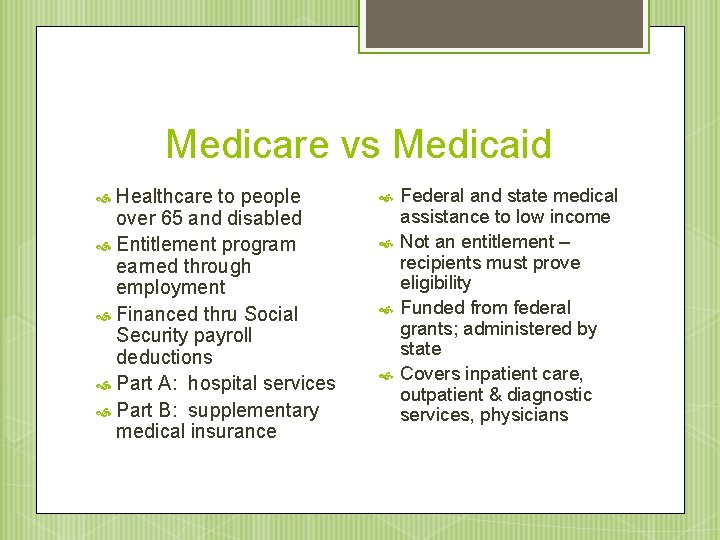
Medicare vs Medicaid Healthcare to people over 65 and disabled Entitlement program earned through employment Financed thru Social Security payroll deductions Part A: hospital services Part B: supplementary medical insurance Federal and state medical assistance to low income Not an entitlement – recipients must prove eligibility Funded from federal grants; administered by state Covers inpatient care, outpatient & diagnostic services, physicians
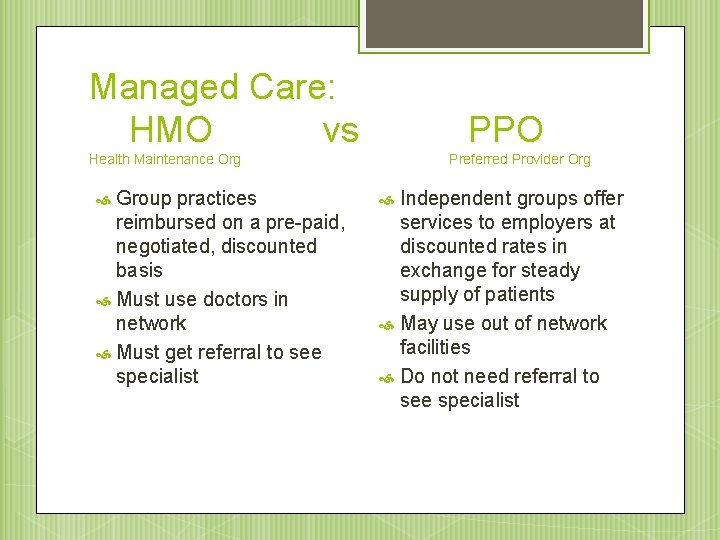
Managed Care: HMO vs PPO Health Maintenance Org Group practices reimbursed on a pre-paid, negotiated, discounted basis Must use doctors in network Must get referral to see specialist Preferred Provider Org Independent groups offer services to employers at discounted rates in exchange for steady supply of patients May use out of network facilities Do not need referral to see specialist
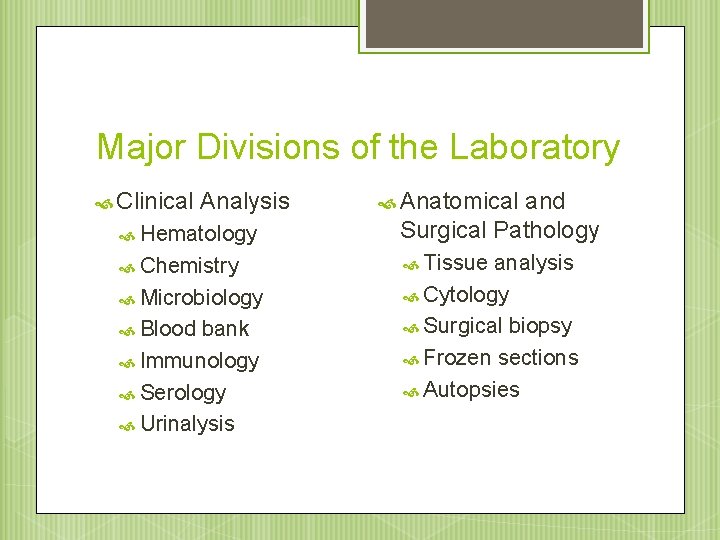
Major Divisions of the Laboratory Hematology and Surgical Pathology Chemistry Tissue Clinical Analysis Microbiology Blood bank Immunology Serology Urinalysis Anatomical analysis Cytology Surgical biopsy Frozen sections Autopsies
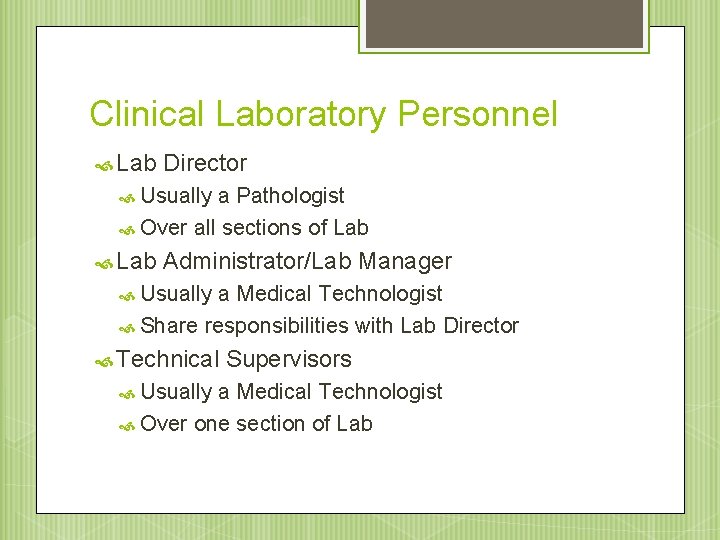
Clinical Laboratory Personnel Lab Director Usually a Pathologist Over all sections of Lab Administrator/Lab Manager Usually a Medical Technologist Share responsibilities with Lab Director Technical Usually Supervisors a Medical Technologist Over one section of Lab
Clinical Laboratory Personnel Med Techs Bachelor’s degree Must have license Perform all levels of testing Med Lab Technicians Associate’s degree Requires license Lower level testing
Clinical Laboratory Personnel Phlebotomist Certification required Blood collection May process specimens
STAT Lab Tests performed in response to medical emergencies Part of upper level healthcare facilities
Reference Lab Large, independent labs Receive specimens from large numbers of facilities Provide routine and/or specialized analysis of specimens Fast turnaround time
CLIAA Clinical Laboratory Improvement Act All labs must be regulated using the same standards Obtain a certificate from federal gov assuring that testing is reliable Determines complexity High, moderate, low complexity Personnel qualifications
- Slides: 29