
PHL 424 Nuclear fission Lise Meitner Otto Hahn
- Slides: 39
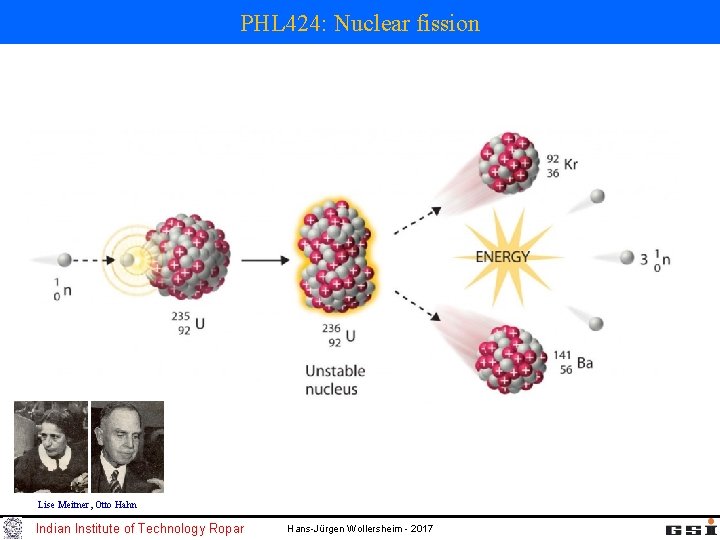
PHL 424: Nuclear fission Lise Meitner, Otto Hahn Indian Institute of Technology Ropar Hans-Jürgen Wollersheim - 2017
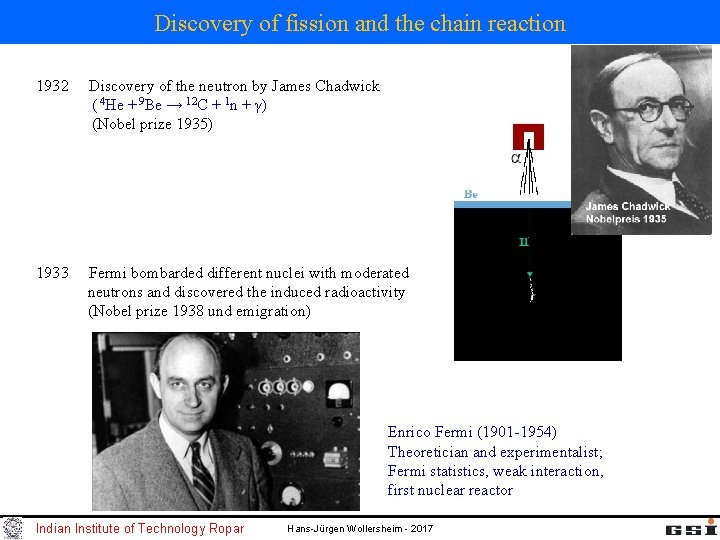
Discovery of fission and the chain reaction 1932 Discovery of the neutron by James Chadwick ( 4 He + 9 Be → 12 C + 1 n + γ) (Nobel prize 1935) 1933 Fermi bombarded different nuclei with moderated neutrons and discovered the induced radioactivity (Nobel prize 1938 und emigration) Enrico Fermi (1901 -1954) Theoretician and experimentalist; Fermi statistics, weak interaction, first nuclear reactor Indian Institute of Technology Ropar Hans-Jürgen Wollersheim - 2017
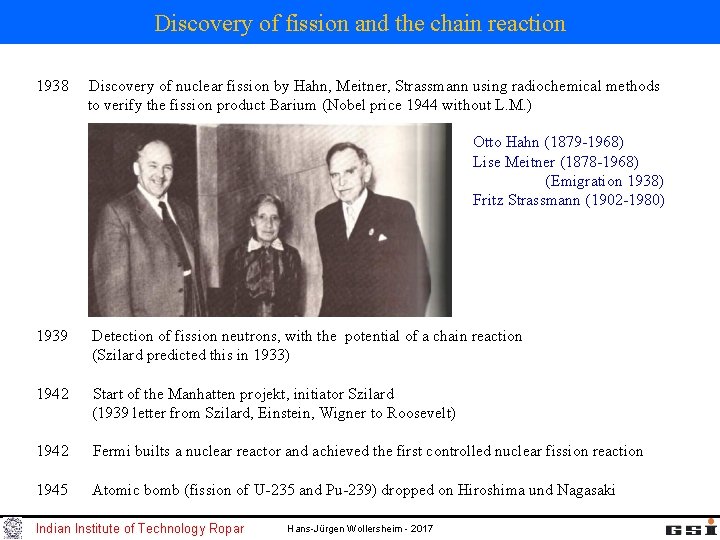
Discovery of fission and the chain reaction 1938 Discovery of nuclear fission by Hahn, Meitner, Strassmann using radiochemical methods to verify the fission product Barium (Nobel price 1944 without L. M. ) Otto Hahn (1879 -1968) Lise Meitner (1878 -1968) (Emigration 1938) Fritz Strassmann (1902 -1980) 1939 Detection of fission neutrons, with the potential of a chain reaction (Szilard predicted this in 1933) 1942 Start of the Manhatten projekt, initiator Szilard (1939 letter from Szilard, Einstein, Wigner to Roosevelt) 1942 Fermi builts a nuclear reactor and achieved the first controlled nuclear fission reaction 1945 Atomic bomb (fission of U-235 and Pu-239) dropped on Hiroshima und Nagasaki Indian Institute of Technology Ropar Hans-Jürgen Wollersheim - 2017
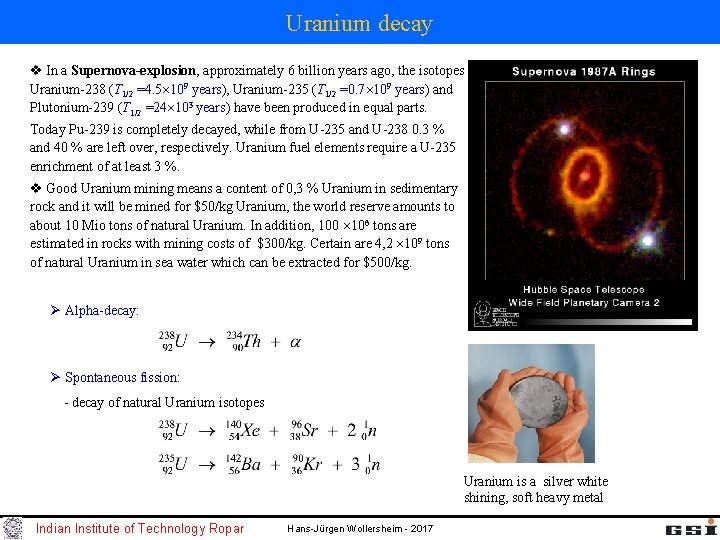
Uranium decay v In a Supernova-explosion, approximately 6 billion years ago, the isotopes Uranium-238 (T 1/2 =4. 5 109 years), Uranium-235 (T 1/2 =0. 7 109 years) and Plutonium-239 (T 1/2 =24 103 years) have been produced in equal parts. Today Pu-239 is completely decayed, while from U-235 and U-238 0. 3 % and 40 % are left over, respectively. Uranium fuel elements require a U-235 enrichment of at least 3 %. v Good Uranium mining means a content of 0, 3 % Uranium in sedimentary rock and it will be mined for $50/kg Uranium, the world reserve amounts to about 10 Mio tons of natural Uranium. In addition, 100 106 tons are estimated in rocks with mining costs of $300/kg. Certain are 4, 2 109 tons of natural Uranium in sea water which can be extracted for $500/kg. Ø Alpha-decay: Ø Spontaneous fission: - decay of natural Uranium isotopes Uranium is a silver white shining, soft heavy metal Indian Institute of Technology Ropar Hans-Jürgen Wollersheim - 2017
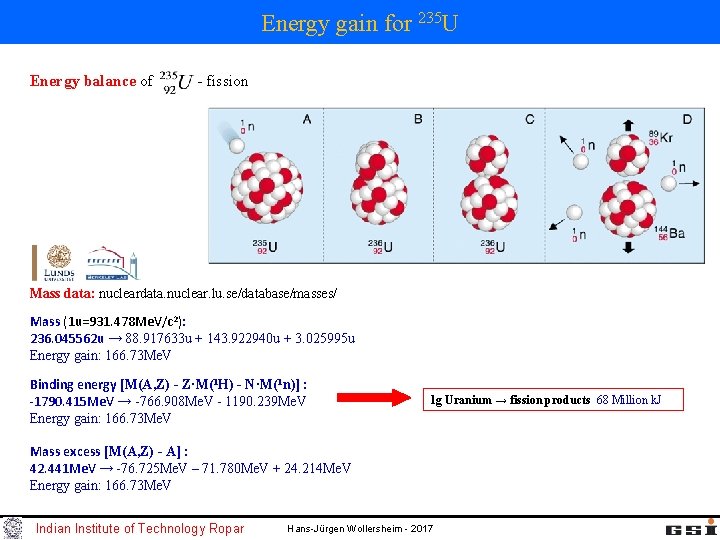
Energy gain for 235 U Energy balance of - fission Mass data: nucleardata. nuclear. lu. se/database/masses/ Mass (1 u=931. 478 Me. V/c 2): 236. 045562 u → 88. 917633 u + 143. 922940 u + 3. 025995 u Energy gain: 166. 73 Me. V Binding energy [M(A, Z) - Z·M(1 H) - N·M(1 n)] : -1790. 415 Me. V → -766. 908 Me. V - 1190. 239 Me. V Energy gain: 166. 73 Me. V 1 g Uranium → fission products 68 Million k. J Mass excess [M(A, Z) - A] : 42. 441 Me. V → -76. 725 Me. V – 71. 780 Me. V + 24. 214 Me. V Energy gain: 166. 73 Me. V Indian Institute of Technology Ropar Hans-Jürgen Wollersheim - 2017
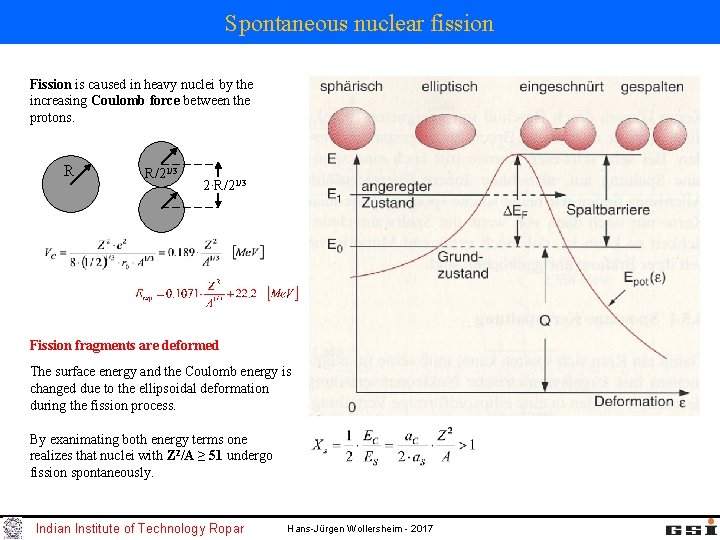
Spontaneous nuclear fission Fission is caused in heavy nuclei by the increasing Coulomb force between the protons. R R/21/3 2·R/21/3 Fission fragments are deformed The surface energy and the Coulomb energy is changed due to the ellipsoidal deformation during the fission process. By exanimating both energy terms one realizes that nuclei with Z 2/A ≥ 51 undergo fission spontaneously. Indian Institute of Technology Ropar Hans-Jürgen Wollersheim - 2017
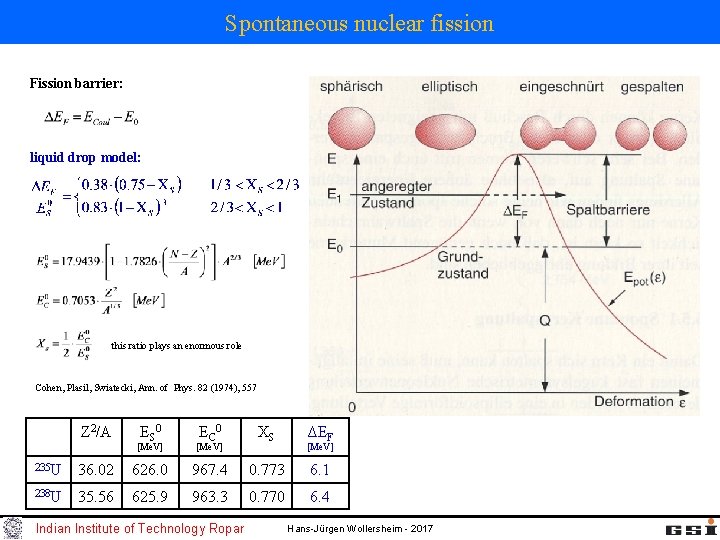
Spontaneous nuclear fission Fission barrier: liquid drop model: this ratio plays an enormous role Cohen, Plasil, Swiatecki, Ann. of Phys. 82 (1974), 557 Z 2/A ES 0 [Me. V] EC 0 [Me. V] XS ΔEF [Me. V] 235 U 36. 02 626. 0 967. 4 0. 773 6. 1 238 U 35. 56 625. 9 963. 3 0. 770 6. 4 Indian Institute of Technology Ropar Hans-Jürgen Wollersheim - 2017
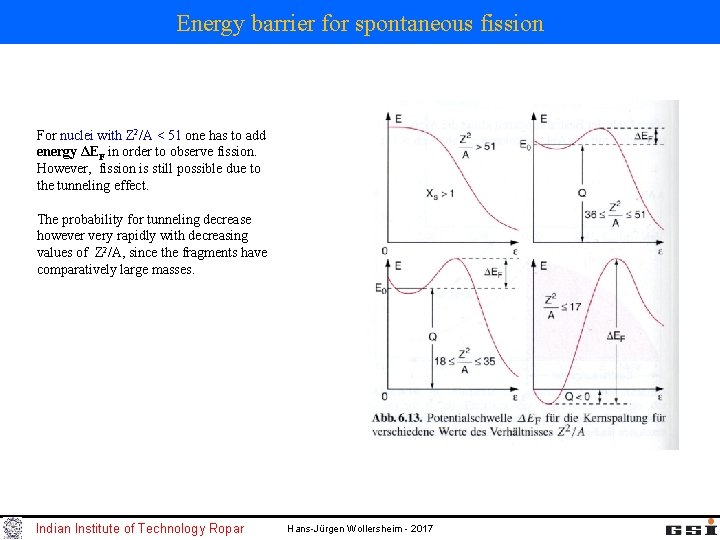
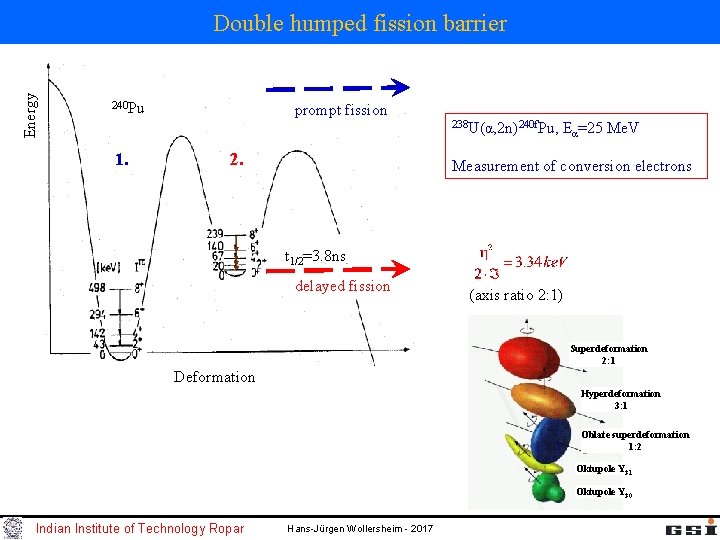
Energy barrier for spontaneous fission For nuclei with Z 2/A < 51 one has to add energy ΔEF in order to observe fission. However, fission is still possible due to the tunneling effect. The probability for tunneling decrease however very rapidly with decreasing values of Z 2/A, since the fragments have comparatively large masses. Indian Institute of Technology Ropar Hans-Jürgen Wollersheim - 2017
Energy Double humped fission barrier 240 Pu 1. prompt fission 2. 238 U(α, 2 n)240 f. Pu, E α=25 Me. V Measurement of conversion electrons t 1/2=3. 8 ns delayed fission (axis ratio 2: 1) Superdeformation 2: 1 Deformation Hyperdeformation 3: 1 Oblate superdeformation 1: 2 Oktupole Y 31 Oktupole Y 30 Indian Institute of Technology Ropar Hans-Jürgen Wollersheim - 2017
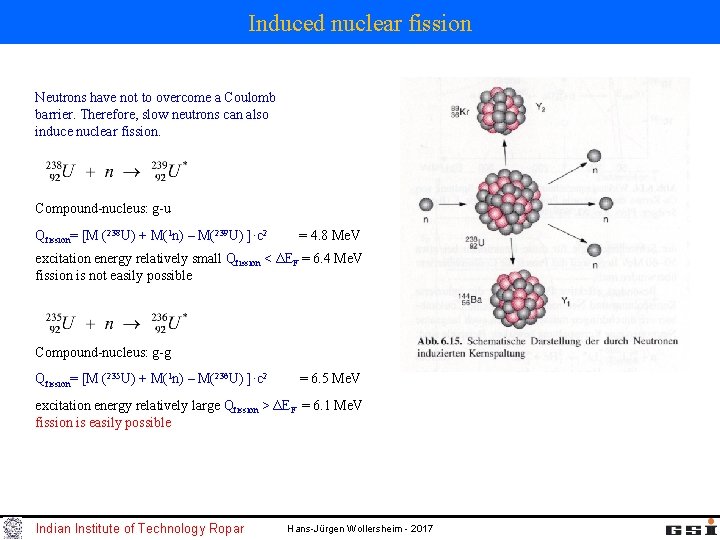
Induced nuclear fission Neutrons have not to overcome a Coulomb barrier. Therefore, slow neutrons can also induce nuclear fission. Compound-nucleus: g-u Qfission= [M (238 U) + M(1 n) – M(239 U) ]·c 2 = 4. 8 Me. V excitation energy relatively small Qfission < ΔEF = 6. 4 Me. V fission is not easily possible Compound-nucleus: g-g Qfission= [M (235 U) + M(1 n) – M(236 U) ]·c 2 = 6. 5 Me. V excitation energy relatively large Qfission > ΔEF = 6. 1 Me. V fission is easily possible Indian Institute of Technology Ropar Hans-Jürgen Wollersheim - 2017
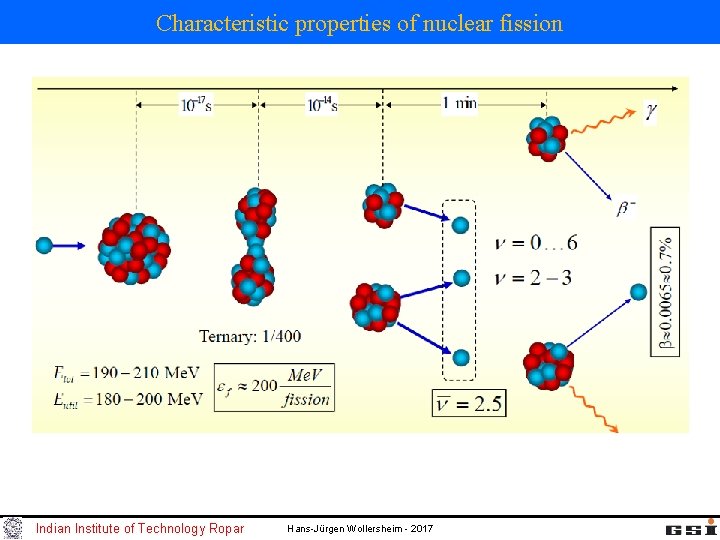
Characteristic properties of nuclear fission Indian Institute of Technology Ropar Hans-Jürgen Wollersheim - 2017
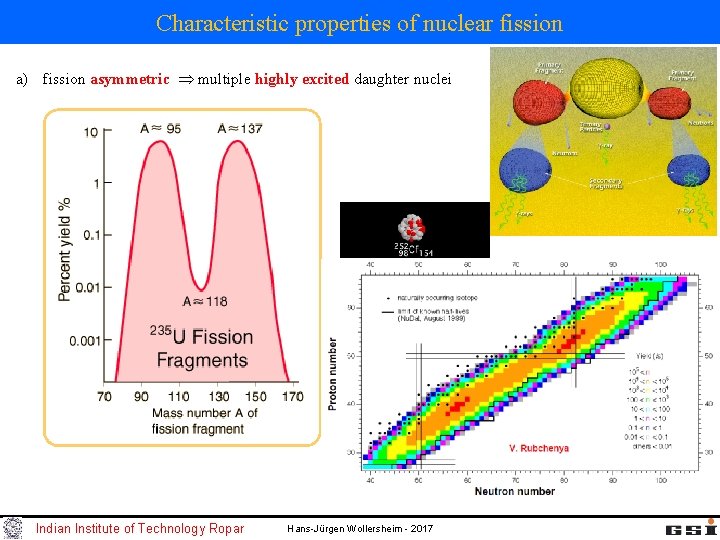
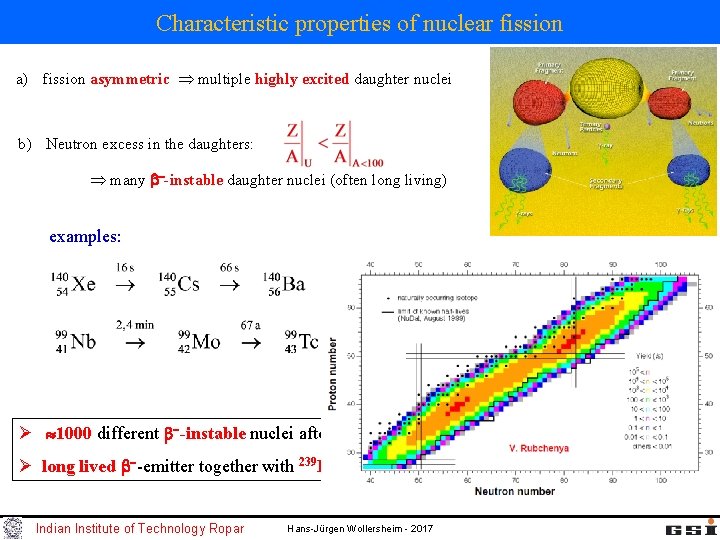
Characteristic properties of nuclear fission a) fission asymmetric multiple highly excited daughter nuclei Indian Institute of Technology Ropar Hans-Jürgen Wollersheim - 2017
Characteristic properties of nuclear fission a) fission asymmetric multiple highly excited daughter nuclei b) Neutron excess in the daughters: many -instable daughter nuclei (often long living) examples: Ø 1000 different -instable nuclei after fission Ø long lived -emitter together with 239 Pu are called radioactive waste Indian Institute of Technology Ropar Hans-Jürgen Wollersheim - 2017
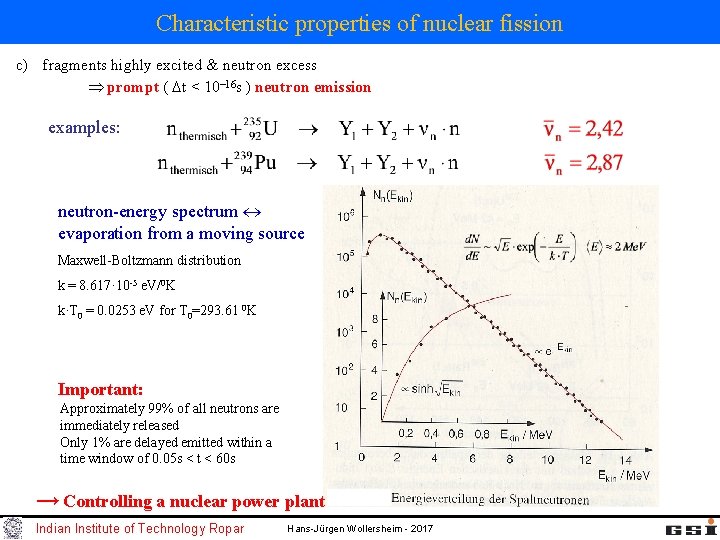
Characteristic properties of nuclear fission c) fragments highly excited & neutron excess prompt ( t < 10 16 s ) neutron emission examples: neutron-energy spectrum evaporation from a moving source Maxwell-Boltzmann distribution k = 8. 617· 10 -5 e. V/0 K k·T 0 = 0. 0253 e. V for T 0=293. 61 0 K Important: Approximately 99% of all neutrons are immediately released Only 1% are delayed emitted within a time window of 0. 05 s < t < 60 s → Controlling a nuclear power plant Indian Institute of Technology Ropar Hans-Jürgen Wollersheim - 2017
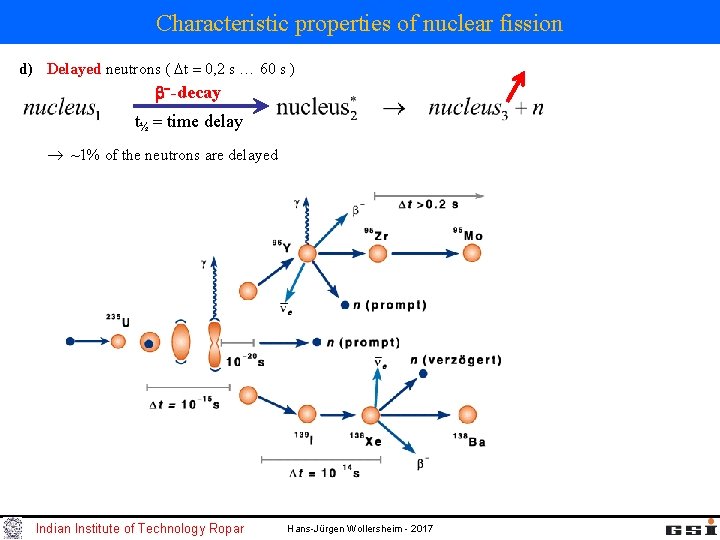
Characteristic properties of nuclear fission d) Delayed neutrons ( t 0, 2 s 60 s ) -decay t½ time delay ~1% of the neutrons are delayed Indian Institute of Technology Ropar Hans-Jürgen Wollersheim - 2017
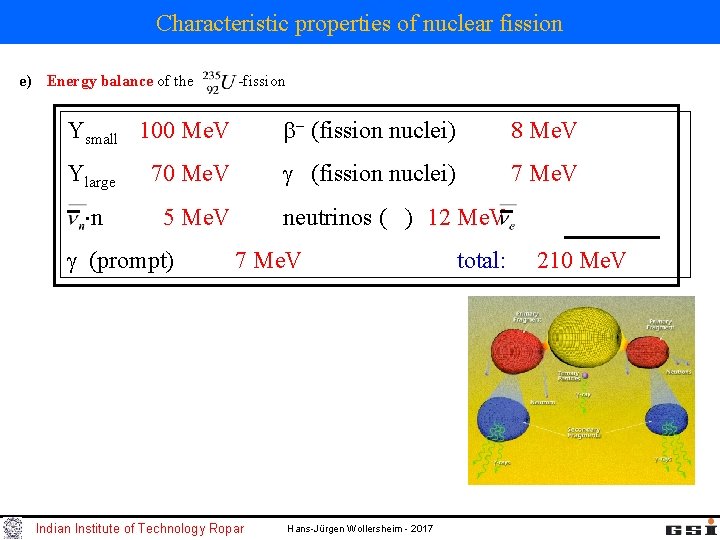
Characteristic properties of nuclear fission e) Energy balance of the -fission Ysmall 100 Me. V (fission nuclei) 8 Me. V Ylarge 70 Me. V (fission nuclei) 7 Me. V n 5 Me. V neutrinos ( ) 12 Me. V (prompt) 7 Me. V Indian Institute of Technology Ropar total: 210 Me. V Hans-Jürgen Wollersheim - 2017
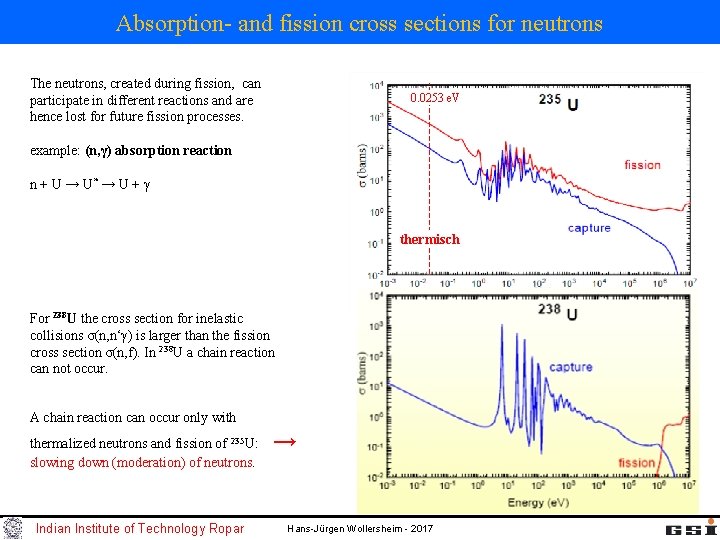
Absorption- and fission cross sections for neutrons The neutrons, created during fission, can participate in different reactions and are hence lost for future fission processes. 0. 0253 e. V example: (n, γ) absorption reaction n + U → U* → U + γ thermisch For 238 U the cross section for inelastic collisions σ(n, n‘γ) is larger than the fission cross section σ(n, f). In 238 U a chain reaction can not occur. A chain reaction can occur only with thermalized neutrons and fission of 235 U: slowing down (moderation) of neutrons. Indian Institute of Technology Ropar → Hans-Jürgen Wollersheim - 2017
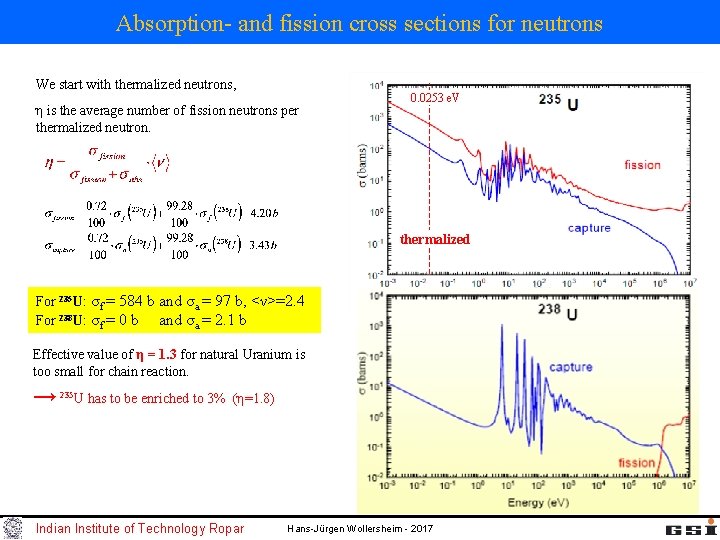
Absorption- and fission cross sections for neutrons We start with thermalized neutrons, η is the average number of fission neutrons per thermalized neutron. 0. 0253 e. V thermalized For 235 U: σf = 584 b and σa = 97 b, <ν>=2. 4 For 238 U: σf = 0 b and σa = 2. 1 b Effective value of η = 1. 3 for natural Uranium is too small for chain reaction. → 235 U has to be enriched to 3% (η=1. 8) Indian Institute of Technology Ropar Hans-Jürgen Wollersheim - 2017
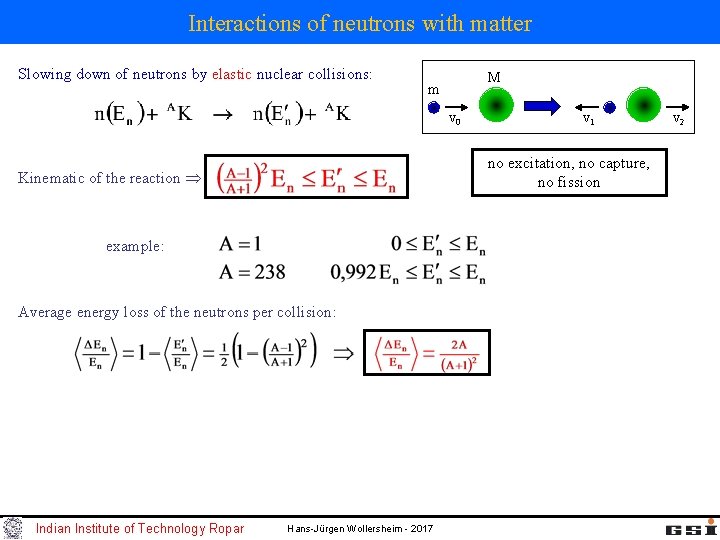
Interactions of neutrons with matter Slowing down of neutrons by elastic nuclear collisions: M m v 0 no excitation, no capture, no fission Kinematic of the reaction example: Average energy loss of the neutrons per collision: Indian Institute of Technology Ropar v 1 Hans-Jürgen Wollersheim - 2017 v 2
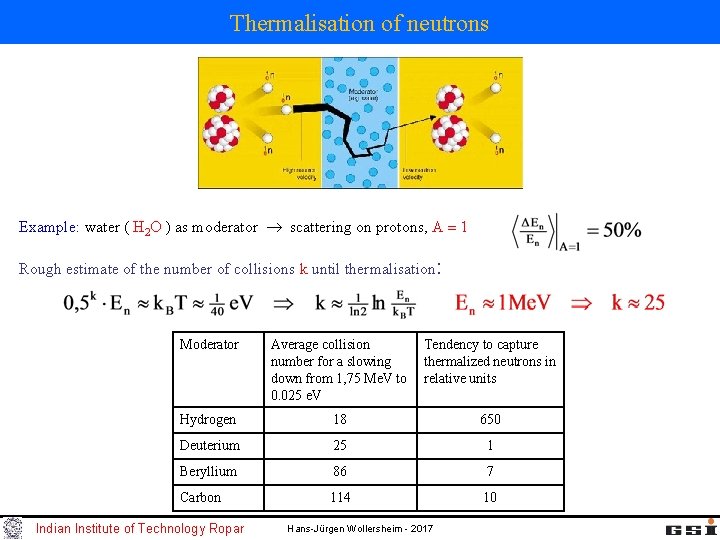
Thermalisation of neutrons Example: water ( H 2 O ) as moderator scattering on protons, A 1 Rough estimate of the number of collisions k until thermalisation: Moderator Average collision Tendency to capture number for a slowing thermalized neutrons in down from 1, 75 Me. V to relative units 0. 025 e. V Hydrogen 18 650 Deuterium 25 1 Beryllium 86 7 Carbon 114 10 Indian Institute of Technology Ropar Hans-Jürgen Wollersheim - 2017
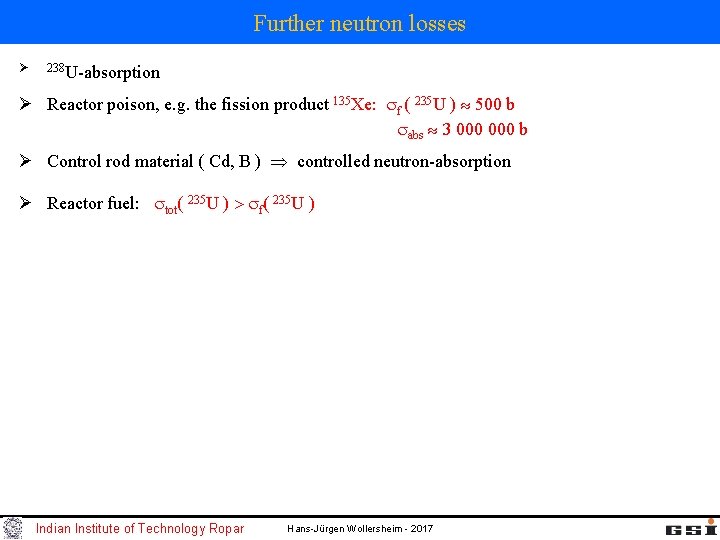
Further neutron losses Ø 238 U-absorption Ø Reactor poison, e. g. the fission product 135 Xe: f ( 235 U ) 500 b abs 3 000 b Ø Control rod material ( Cd, B ) controlled neutron-absorption Ø Reactor fuel: tot( 235 U ) f( 235 U ) Indian Institute of Technology Ropar Hans-Jürgen Wollersheim - 2017
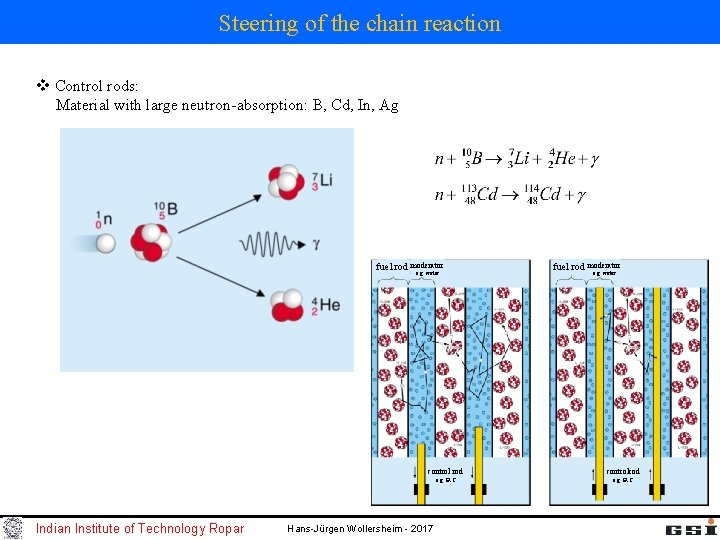
Steering of the chain reaction v Control rods: Material with large neutron-absorption: B, Cd, In, Ag fuel rod moderator e. g. water Indian Institute of Technology Ropar fuel rod moderator e. g. water control rod controlrod e. g. B 4 C Hans-Jürgen Wollersheim - 2017
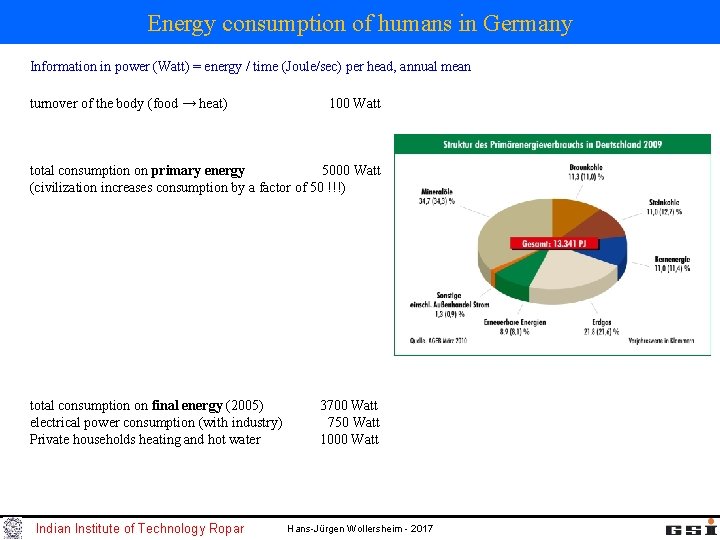
Energy consumption of humans in Germany Information in power (Watt) = energy / time (Joule/sec) per head, annual mean turnover of the body (food → heat) 100 Watt total consumption on primary energy 5000 Watt (civilization increases consumption by a factor of 50 !!!) total consumption on final energy (2005) 3700 Watt electrical power consumption (with industry) 750 Watt Private households heating and hot water 1000 Watt Indian Institute of Technology Ropar Hans-Jürgen Wollersheim - 2017
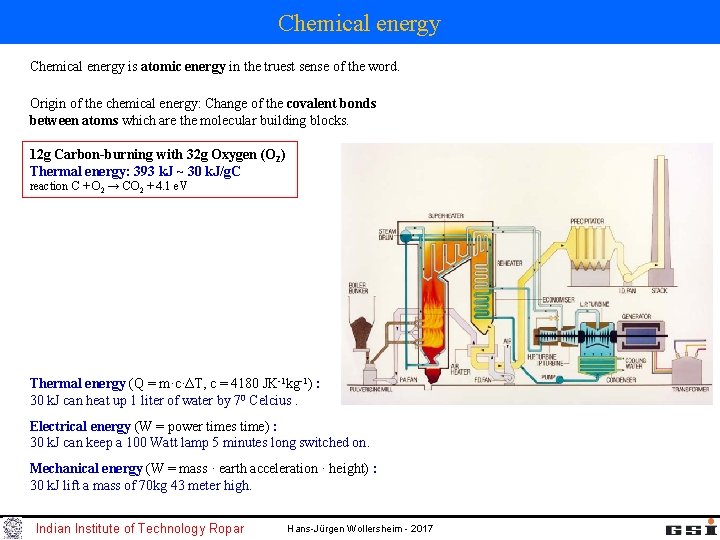
Chemical energy is atomic energy in the truest sense of the word. Origin of the chemical energy: Change of the covalent bonds between atoms which are the molecular building blocks. 12 g Carbon-burning with 32 g Oxygen (O 2) Thermal energy: 393 k. J ~ 30 k. J/g. C reaction C + O 2 → CO 2 + 4. 1 e. V Thermal energy (Q = m·c·ΔT, c = 4180 JK-1 kg-1) : 30 k. J can heat up 1 liter of water by 70 Celcius. Electrical energy (W = power times time) : 30 k. J can keep a 100 Watt lamp 5 minutes long switched on. Mechanical energy (W = mass · earth acceleration · height) : 30 k. J lift a mass of 70 kg 43 meter high. Indian Institute of Technology Ropar Hans-Jürgen Wollersheim - 2017
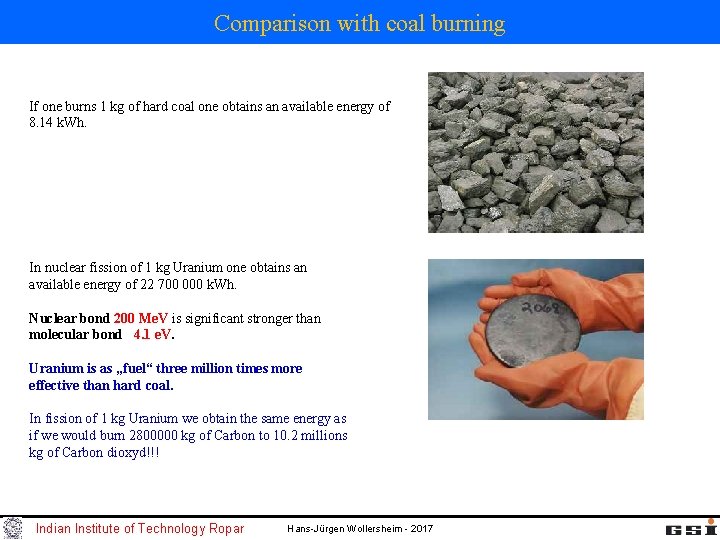
Comparison with coal burning If one burns 1 kg of hard coal one obtains an available energy of 8. 14 k. Wh. In nuclear fission of 1 kg Uranium one obtains an available energy of 22 700 000 k. Wh. Nuclear bond 200 Me. V is significant stronger than molecular bond 4. 1 e. V. Uranium is as „fuel“ three million times more effective than hard coal. In fission of 1 kg Uranium we obtain the same energy as if we would burn 2800000 kg of Carbon to 10. 2 millions kg of Carbon dioxyd!!! Indian Institute of Technology Ropar Hans-Jürgen Wollersheim - 2017
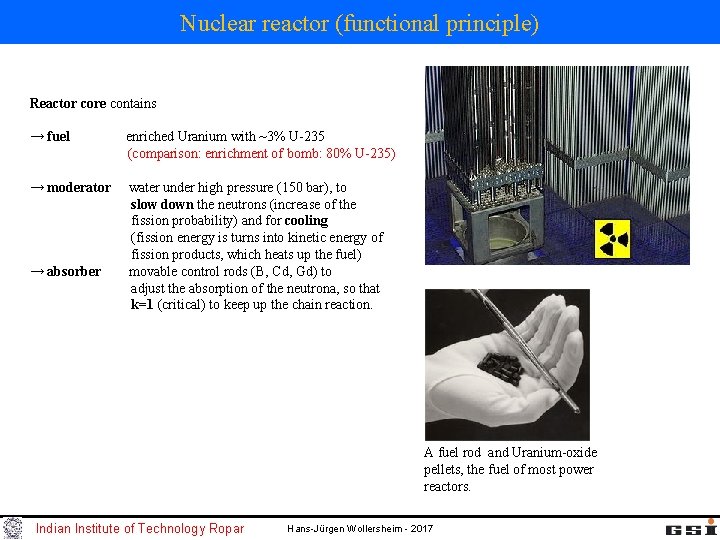
Nuclear reactor (functional principle) Reactor core contains → fuel enriched Uranium with ~3% U-235 (comparison: enrichment of bomb: 80% U-235) → moderator water under high pressure (150 bar), to slow down the neutrons (increase of the fission probability) and for cooling (fission energy is turns into kinetic energy of fission products, which heats up the fuel) → absorber movable control rods (B, Cd, Gd) to adjust the absorption of the neutrona, so that k=1 (critical) to keep up the chain reaction. A fuel rod and Uranium-oxide pellets, the fuel of most power reactors. Indian Institute of Technology Ropar Hans-Jürgen Wollersheim - 2017
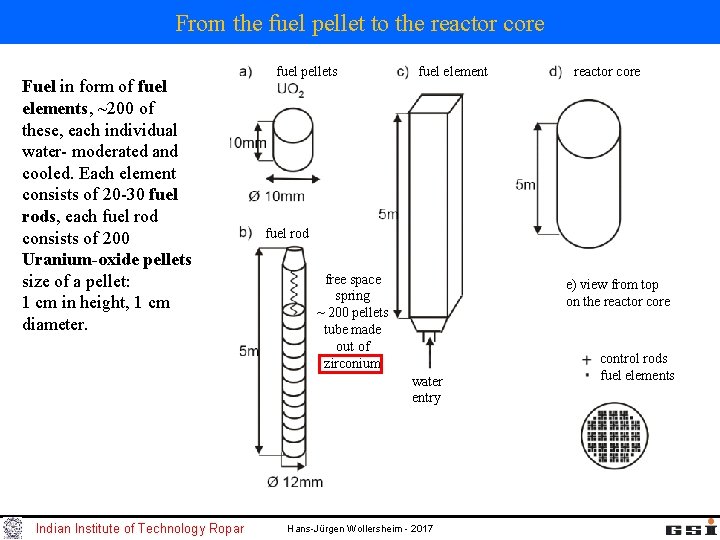
From the fuel pellet to the reactor core Fuel in form of fuel elements, ~200 of these, each individual water- moderated and cooled. Each element consists of 20 -30 fuel rods, each fuel rod consists of 200 Uranium-oxide pellets size of a pellet: 1 cm in height, 1 cm diameter. fuel pellets fuel element fuel rod free space spring ~ 200 pellets tube made out of zirconium e) view from top on the reactor core water entry Indian Institute of Technology Ropar reactor core Hans-Jürgen Wollersheim - 2017 control rods fuel elements
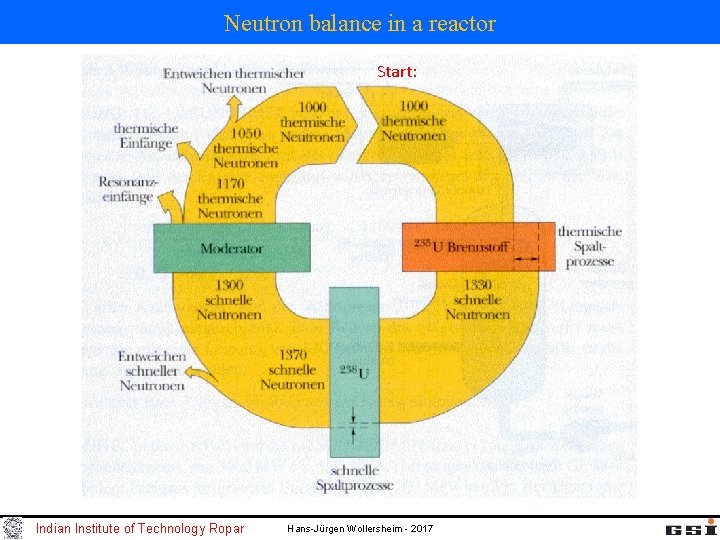
Neutron balance in a reactor Start: Indian Institute of Technology Ropar Hans-Jürgen Wollersheim - 2017
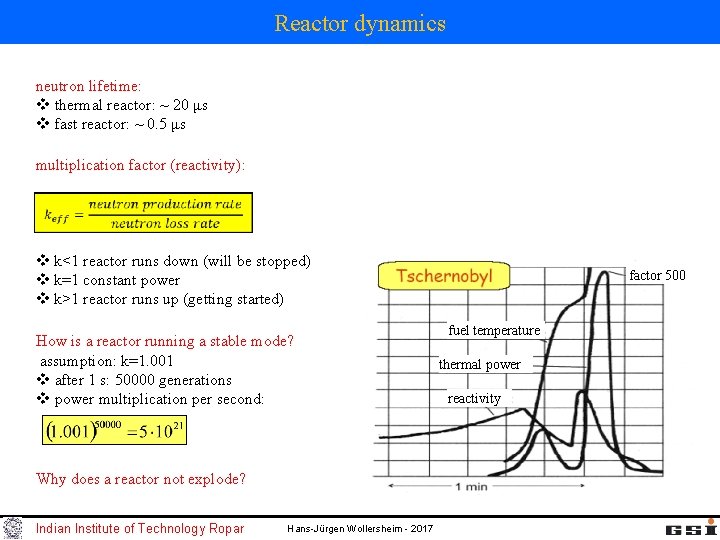
Reactor dynamics neutron lifetime: v thermal reactor: ~ 20 μs v fast reactor: ~ 0. 5 μs multiplication factor (reactivity): v k<1 reactor runs down (will be stopped) v k=1 constant power v k>1 reactor runs up (getting started) How is a reactor running a stable mode? assumption: k=1. 001 v after 1 s: 50000 generations v power multiplication per second: Why does a reactor not explode? Indian Institute of Technology Ropar Hans-Jürgen Wollersheim - 2017 factor 500 fuel temperature thermal power reactivity
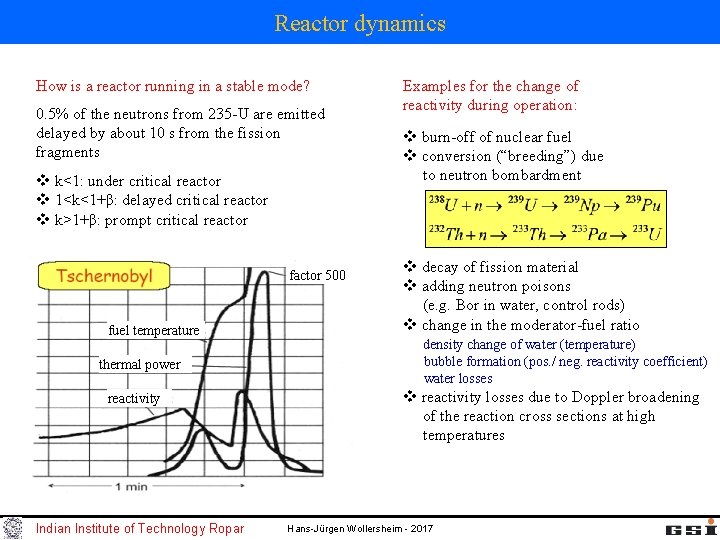
Reactor dynamics How is a reactor running in a stable mode? 0. 5% of the neutrons from 235 -U are emitted delayed by about 10 s from the fission fragments v k<1: under critical reactor v 1<k<1+β: delayed critical reactor v k>1+β: prompt critical reactor factor 500 fuel temperature thermal power reactivity Indian Institute of Technology Ropar Examples for the change of reactivity during operation: v burn-off of nuclear fuel v conversion (“breeding”) due to neutron bombardment v decay of fission material v adding neutron poisons (e. g. Bor in water, control rods) v change in the moderator-fuel ratio density change of water (temperature) bubble formation (pos. / neg. reactivity coefficient) water losses v reactivity losses due to Doppler broadening of the reaction cross sections at high temperatures Hans-Jürgen Wollersheim - 2017
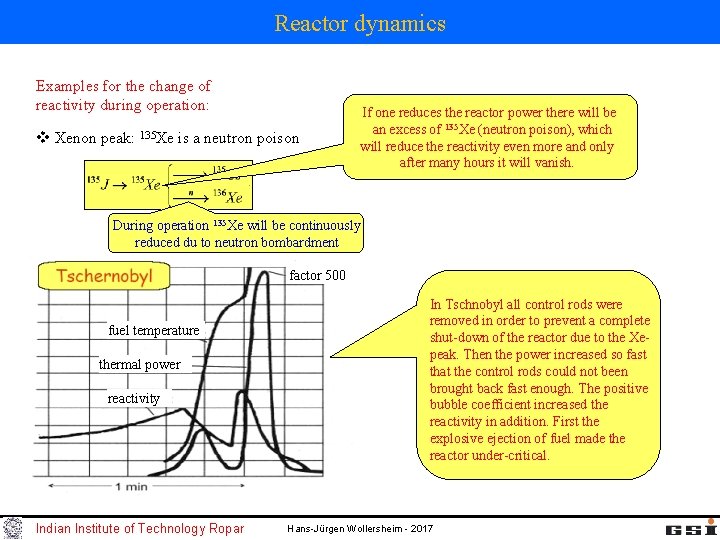
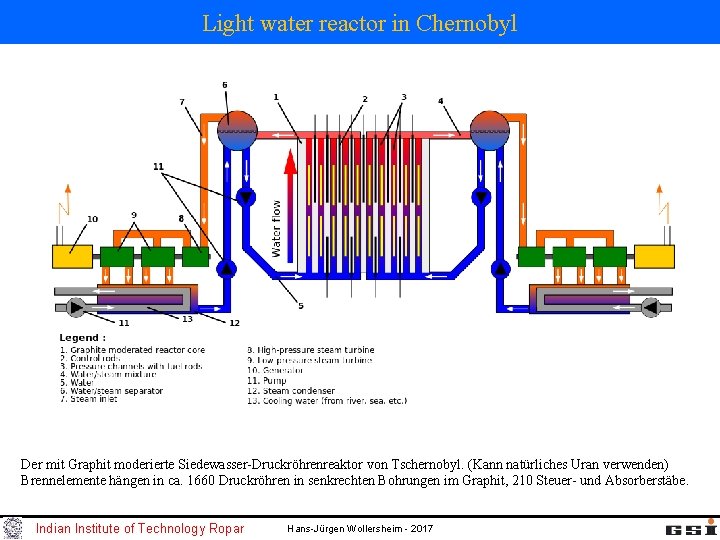
Reactor dynamics Examples for the change of reactivity during operation: v Xenon peak: 135 Xe is a neutron poison If one reduces the reactor power there will be an excess of 135 Xe (neutron poison), which will reduce the reactivity even more and only after many hours it will vanish. During operation 135 Xe will be continuously reduced du to neutron bombardment factor 500 fuel temperature thermal power reactivity Indian Institute of Technology Ropar In Tschnobyl all control rods were removed in order to prevent a complete shut-down of the reactor due to the Xepeak. Then the power increased so fast that the control rods could not been brought back fast enough. The positive bubble coefficient increased the reactivity in addition. First the explosive ejection of fuel made the reactor under-critical. Hans-Jürgen Wollersheim - 2017
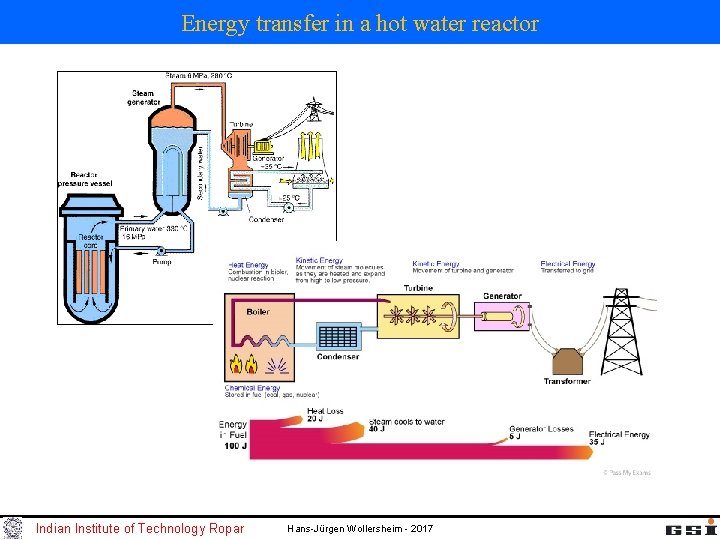
Energy transfer in a nuclear reactor • release of nuclear binding energy during fission • Transfer into kinetic energy of the fission products • Thermal energy due to slowing down of the fragments (neutrons) in the solid fuel • Use of thermal energy to heat and evaporate the cooling medium (water) • Water steam will be guided to a turbine • Transformation of the rotational energy of the turbine into electrical energy via a generator • Supply the electricity into the grid • The waste heat will be given either directly (e. g. into a river) or indirectly (e. g. via a cooling tower to air) to the environment. Indian Institute of Technology Ropar Hans-Jürgen Wollersheim - 2017
Energy transfer in a hot water reactor Indian Institute of Technology Ropar Hans-Jürgen Wollersheim - 2017
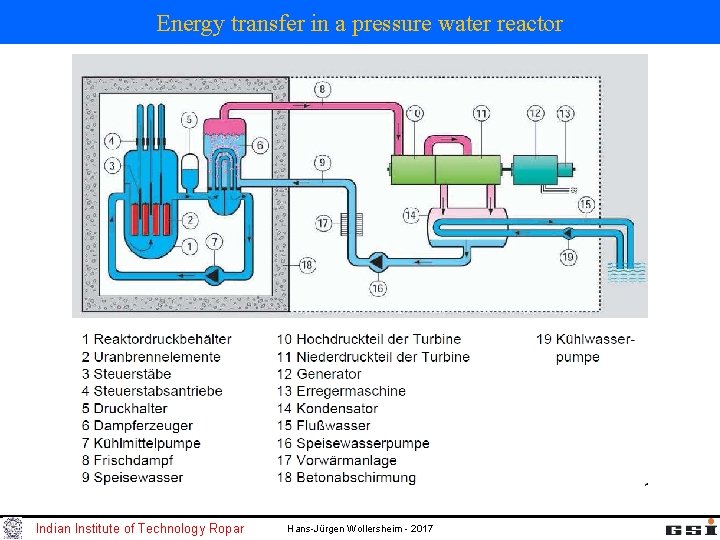
Energy transfer in a pressure water reactor Indian Institute of Technology Ropar Hans-Jürgen Wollersheim - 2017
Light water reactor in Chernobyl Der mit Graphit moderierte Siedewasser-Druckröhrenreaktor von Tschernobyl. (Kann natürliches Uran verwenden) Brennelemente hängen in ca. 1660 Druckröhren in senkrechten Bohrungen im Graphit, 210 Steuer- und Absorberstäbe. Indian Institute of Technology Ropar Hans-Jürgen Wollersheim - 2017
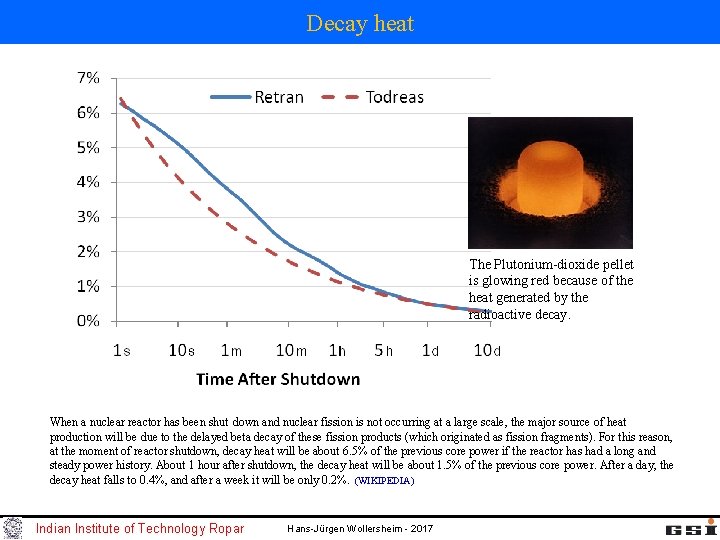
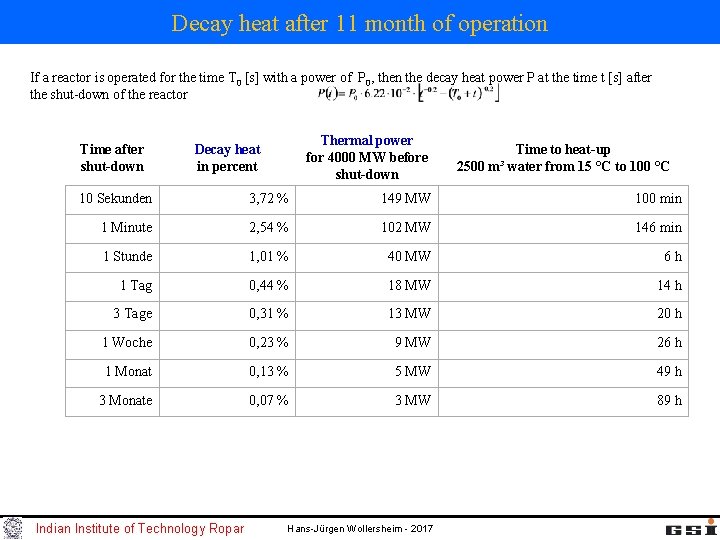
Decay heat The Plutonium-dioxide pellet is glowing red because of the heat generated by the radioactive decay. When a nuclear reactor has been shut down and nuclear fission is not occurring at a large scale, the major source of heat production will be due to the delayed beta decay of these fission products (which originated as fission fragments). For this reason, at the moment of reactor shutdown, decay heat will be about 6. 5% of the previous core power if the reactor has had a long and steady power history. About 1 hour after shutdown, the decay heat will be about 1. 5% of the previous core power. After a day, the decay heat falls to 0. 4%, and after a week it will be only 0. 2%. (WIKIPEDIA) Indian Institute of Technology Ropar Hans-Jürgen Wollersheim - 2017
Decay heat after 11 month of operation If a reactor is operated for the time T 0 [s] with a power of P 0, then the decay heat power P at the time t [s] after the shut-down of the reactor Time after shut-down Thermal power for 4000 MW before shut-down Decay heat in percent Time to heat-up 2500 m³ water from 15 °C to 100 °C 10 Sekunden 3, 72 % 149 MW 100 min 1 Minute 2, 54 % 102 MW 146 min 1 Stunde 1, 01 % 40 MW 6 h 1 Tag 0, 44 % 18 MW 14 h 3 Tage 0, 31 % 13 MW 20 h 1 Woche 0, 23 % 9 MW 26 h 1 Monat 0, 13 % 5 MW 49 h 3 Monate 0, 07 % 3 MW 89 h Indian Institute of Technology Ropar Hans-Jürgen Wollersheim - 2017
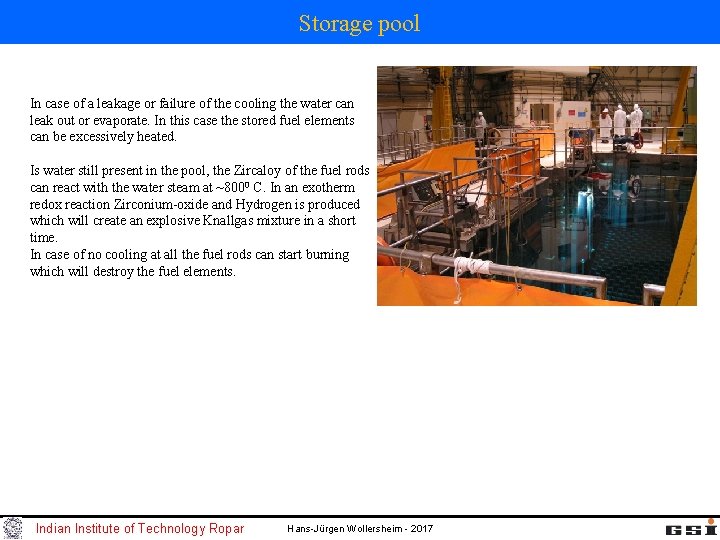
Storage pool In case of a leakage or failure of the cooling the water can leak out or evaporate. In this case the stored fuel elements can be excessively heated. Is water still present in the pool, the Zircaloy of the fuel rods can react with the water steam at ~8000 C. In an exotherm redox reaction Zirconium-oxide and Hydrogen is produced which will create an explosive Knallgas mixture in a short time. In case of no cooling at all the fuel rods can start burning which will destroy the fuel elements. Indian Institute of Technology Ropar Hans-Jürgen Wollersheim - 2017
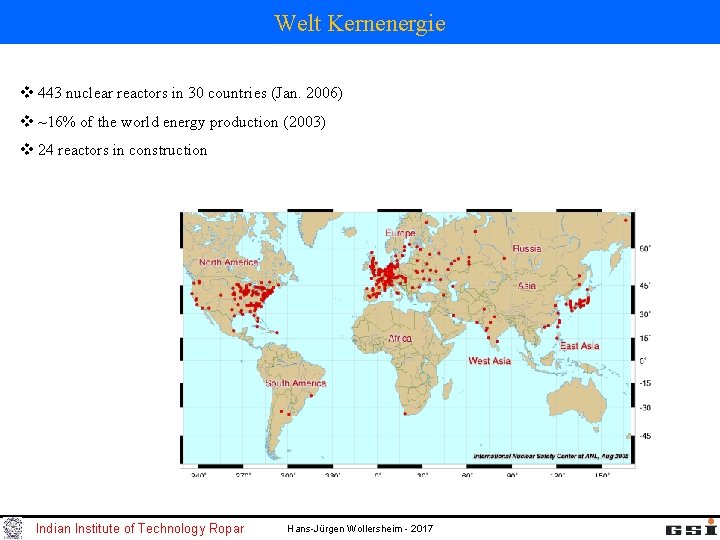
Welt Kernenergie v 443 nuclear reactors in 30 countries (Jan. 2006) v ~16% of the world energy production (2003) v 24 reactors in construction Indian Institute of Technology Ropar Hans-Jürgen Wollersheim - 2017