
PHL 313 Lab 2 Effect of cholinergic drugs
PHL 313 (Lab. 2) Effect of cholinergic drugs on intestine and % of antagonism. 1
2
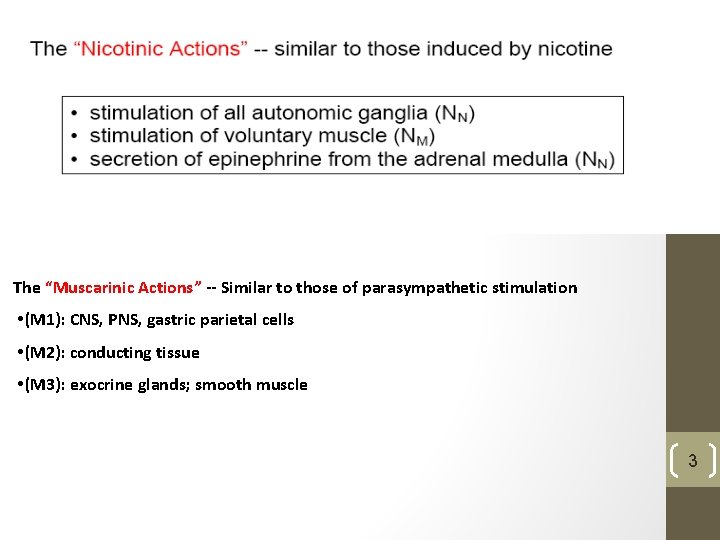
The “Muscarinic Actions” -- Similar to those of parasympathetic stimulation • (M 1): CNS, PNS, gastric parietal cells • (M 2): conducting tissue • (M 3): exocrine glands; smooth muscle 3
4
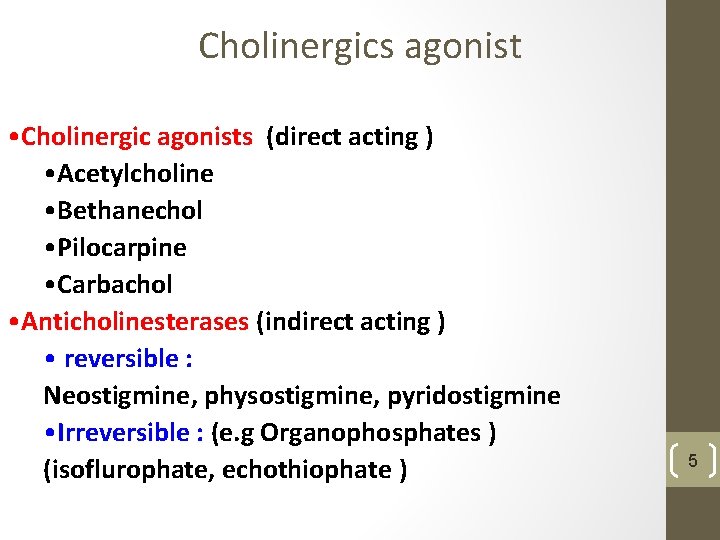
Cholinergics agonist • Cholinergic agonists (direct acting ) • Acetylcholine • Bethanechol • Pilocarpine • Carbachol • Anticholinesterases (indirect acting ) • reversible : Neostigmine, physostigmine, pyridostigmine • Irreversible : (e. g Organophosphates ) (isoflurophate, echothiophate ) 5
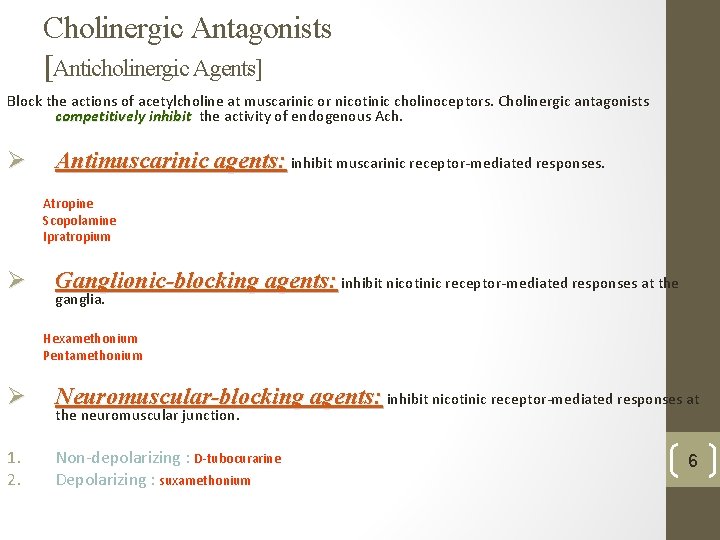
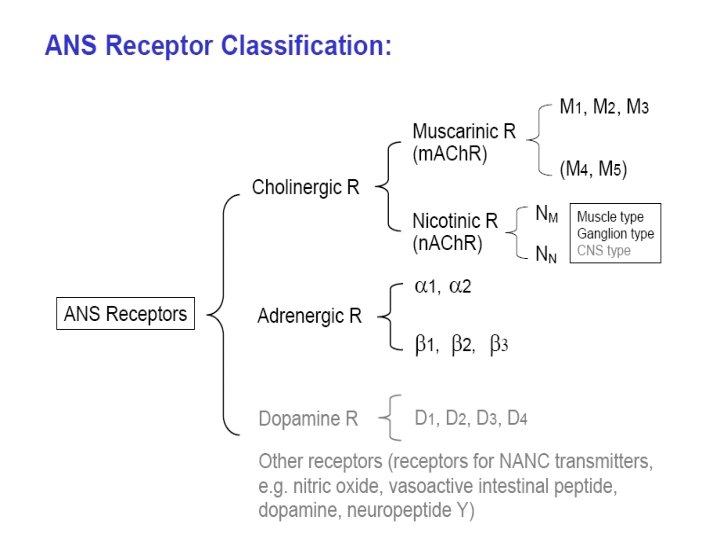
Cholinergic Antagonists [Anticholinergic Agents] Block the actions of acetylcholine at muscarinic or nicotinic cholinoceptors. Cholinergic antagonists competitively inhibit the activity of endogenous Ach. Ø Antimuscarinic agents: inhibit muscarinic receptor-mediated responses. Atropine Scopolamine Ipratropium Ø Ganglionic-blocking agents: inhibit nicotinic receptor-mediated responses at the ganglia. Hexamethonium Pentamethonium Ø Neuromuscular-blocking agents: inhibit nicotinic receptor-mediated responses at 1. 2. Non-depolarizing : D-tubocurarine Depolarizing : suxamethonium the neuromuscular junction. 6
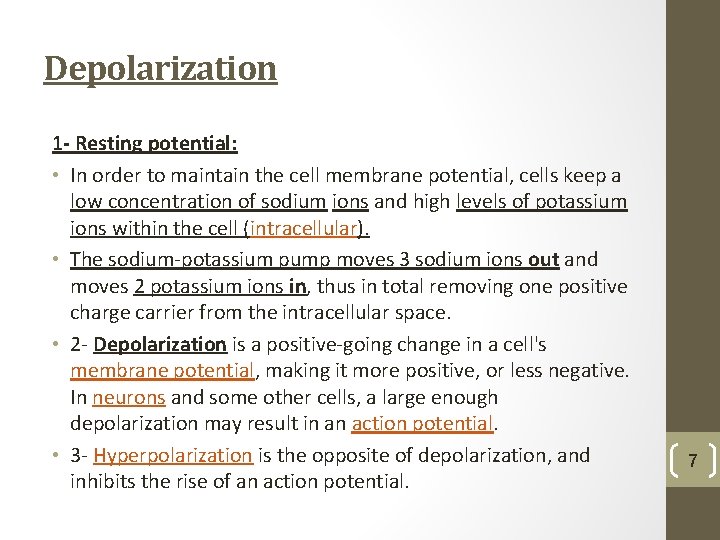
Depolarization 1 - Resting potential: • In order to maintain the cell membrane potential, cells keep a low concentration of sodium ions and high levels of potassium ions within the cell (intracellular). • The sodium-potassium pump moves 3 sodium ions out and moves 2 potassium ions in, thus in total removing one positive charge carrier from the intracellular space. • 2 - Depolarization is a positive-going change in a cell's membrane potential, making it more positive, or less negative. In neurons and some other cells, a large enough depolarization may result in an action potential. • 3 - Hyperpolarization is the opposite of depolarization, and inhibits the rise of an action potential. 7
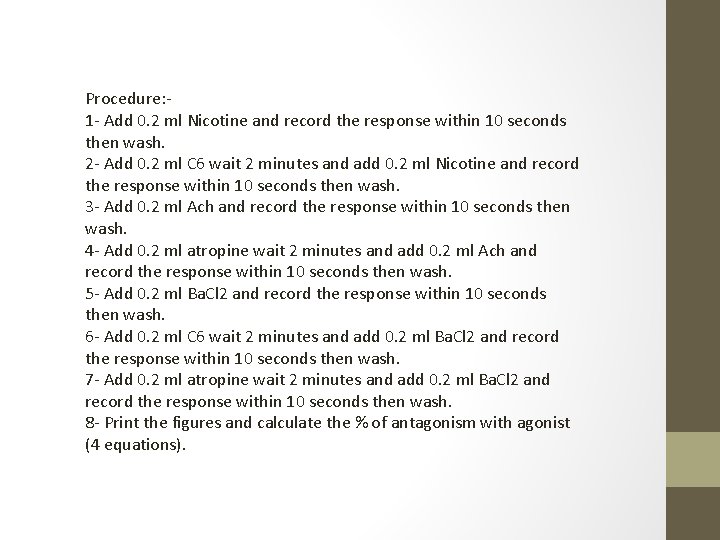
Procedure: 1 - Add 0. 2 ml Nicotine and record the response within 10 seconds then wash. 2 - Add 0. 2 ml C 6 wait 2 minutes and add 0. 2 ml Nicotine and record the response within 10 seconds then wash. 3 - Add 0. 2 ml Ach and record the response within 10 seconds then wash. 4 - Add 0. 2 ml atropine wait 2 minutes and add 0. 2 ml Ach and record the response within 10 seconds then wash. 5 - Add 0. 2 ml Ba. Cl 2 and record the response within 10 seconds then wash. 6 - Add 0. 2 ml C 6 wait 2 minutes and add 0. 2 ml Ba. Cl 2 and record the response within 10 seconds then wash. 7 - Add 0. 2 ml atropine wait 2 minutes and add 0. 2 ml Ba. Cl 2 and record the response within 10 seconds then wash. 8 - Print the figures and calculate the % of antagonism with agonist (4 equations).
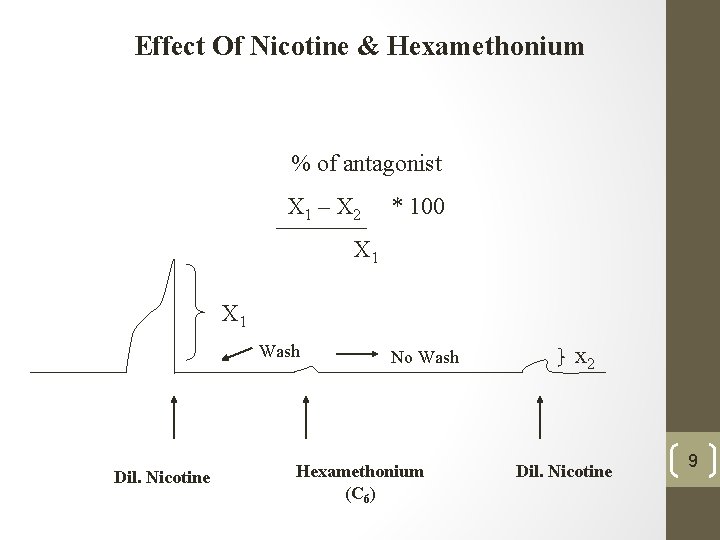
Effect Of Nicotine & Hexamethonium % of antagonist X 1 – X 2 * 100 X 1 Wash Dil. Nicotine No Wash Hexamethonium (C 6) x 2 Dil. Nicotine 9
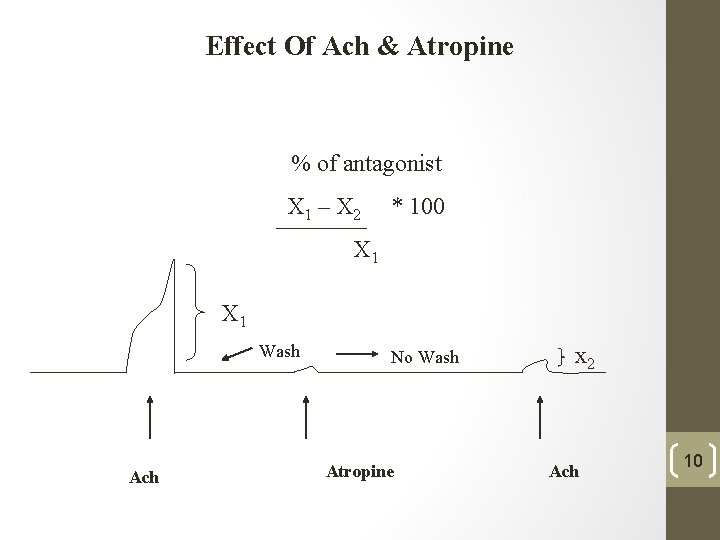
Effect Of Ach & Atropine % of antagonist X 1 – X 2 * 100 X 1 Wash Ach No Wash Atropine x 2 Ach 10
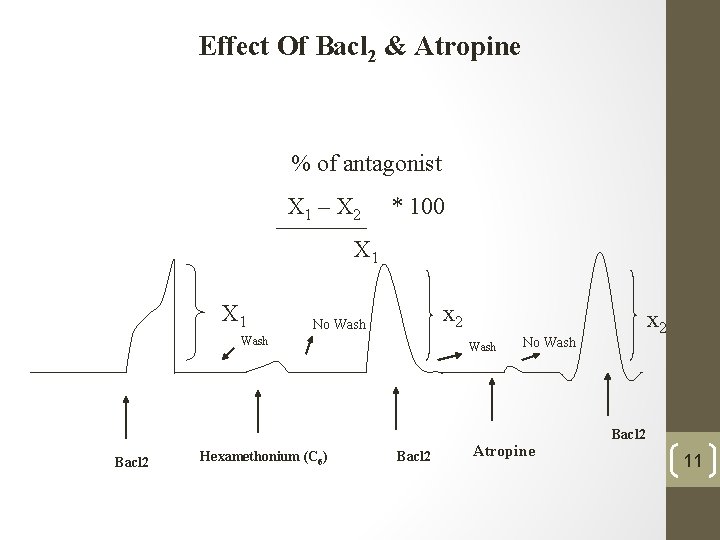
Effect Of Bacl 2 & Atropine % of antagonist X 1 – X 2 * 100 X 1 x 2 No Wash Bacl 2 Hexamethonium (C 6) Wash Bacl 2 x 2 No Wash Atropine Bacl 2 11
Chemicals 1 - Tyroid solution 2 - Ach (0. 01%) 3 - Dilute Nicotine (0. 01%) 4 - Hexamethonium (C 6) (0. 1%) 5 - Atropine (0. 1%) 6 - Barium Chloride (3%)
- Slides: 12