
PHITS MultiPurpose Particle and Heavy Ion Transport code
![How to set 1 At [source] section, set e-type subsection (Unit of energy is](https://slidetodoc.com/presentation_image_h/b2f5fc6e0dc21aa3a074a0970d7833e0/image-6.jpg "How to set 1 At [source] section, set e-type subsection (Unit of energy is")
![Exercise 1 Set proton beam with energy distribution Bin : [0, 50], [50, 100],](https://slidetodoc.com/presentation_image_h/b2f5fc6e0dc21aa3a074a0970d7833e0/image-8.jpg "Exercise 1 Set proton beam with energy distribution Bin : [0, 50], [50, 100],")
![Answer 1 Set proton beam with energy distribution Bin : [0, 50], [50, 100],](https://slidetodoc.com/presentation_image_h/b2f5fc6e0dc21aa3a074a0970d7833e0/image-9.jpg "Answer 1 Set proton beam with energy distribution Bin : [0, 50], [50, 100],")
![Exercise 2 Change the energy bin from [100: 150] to [100: 200]. • Change](https://slidetodoc.com/presentation_image_h/b2f5fc6e0dc21aa3a074a0970d7833e0/image-10.jpg "Exercise 2 Change the energy bin from [100: 150] to [100: 200]. • Change")
![Answer 2 Change the energy bin from [100: 150] to [100: 200]. source. A.](https://slidetodoc.com/presentation_image_h/b2f5fc6e0dc21aa3a074a0970d7833e0/image-11.jpg "Answer 2 Change the energy bin from [100: 150] to [100: 200]. source. A.")
![Answer 4 Simulate 60 Co source. A. inp [Source] totfact = 1. 0 s-type](https://slidetodoc.com/presentation_image_h/b2f5fc6e0dc21aa3a074a0970d7833e0/image-17.jpg "Answer 4 Simulate 60 Co source. A. inp [Source] totfact = 1. 0 s-type")
![How to set l In [source] section, set multi-source subsection starting with ”<source>=relative intensity”](https://slidetodoc.com/presentation_image_h/b2f5fc6e0dc21aa3a074a0970d7833e0/image-20.jpg "How to set l In [source] section, set multi-source subsection starting with ”<source>=relative intensity”")
![Answer 8 source. A. inp [Source] totfact = 3. 0 <source> = 1. 0](https://slidetodoc.com/presentation_image_h/b2f5fc6e0dc21aa3a074a0970d7833e0/image-31.jpg "Answer 8 source. A. inp [Source] totfact = 3. 0 <source> = 1. 0")
- Slides: 33
PHITS Multi-Purpose Particle and Heavy Ion Transport code System Setting of various sources A Aug. 2018 revised Title 1
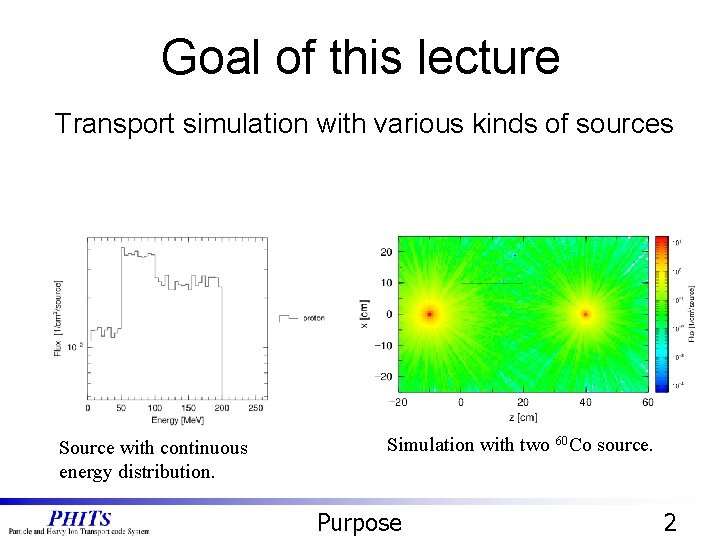
Goal of this lecture Transport simulation with various kinds of sources Source with continuous energy distribution. Simulation with two 60 Co source. Purpose 2
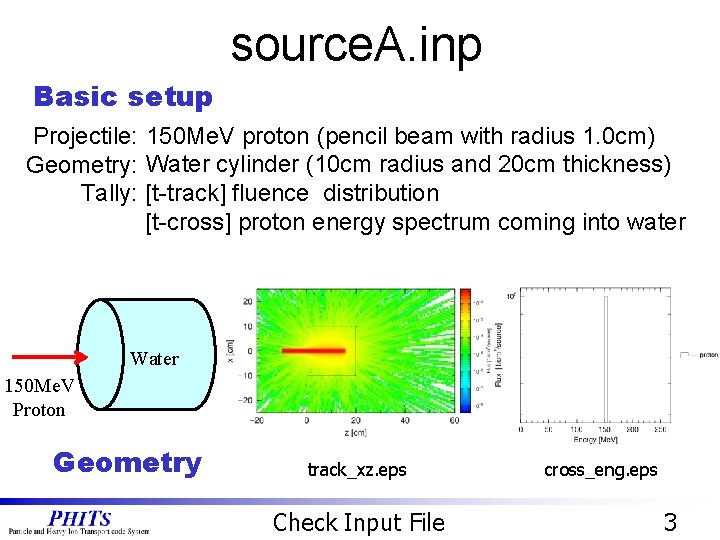
source. A. inp Basic setup Projectile: 150 Me. V proton (pencil beam with radius 1. 0 cm) Geometry: Water cylinder (10 cm radius and 20 cm thickness) Tally: [t-track] fluence distribution [t-cross] proton energy spectrum coming into water Water 150 Me. V Proton Geometry track_xz. eps Check Input File cross_eng. eps 3
Table of contents 1. Source with energy distribution A) Continuous energy distribution B) Discrete energy distribution 2. Setup of multiple sources 3. RI source 4. Summary Table of Contents 4
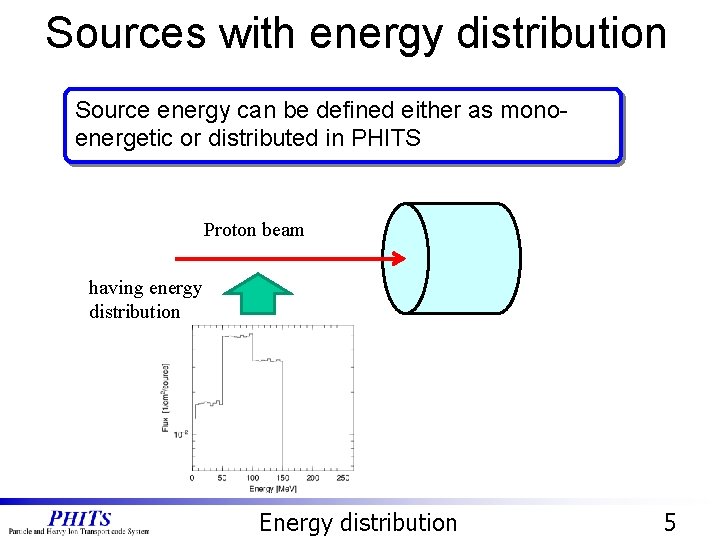
Sources with energy distribution Source energy can be defined either as monoenergetic or distributed in PHITS Proton beam having energy distribution Energy distribution 5
How to set 1 At [source] section, set e-type subsection (Unit of energy is Me. V or angstrom). [Source] totfact = 1. 0 s-type = 1 proj = proton e 0 = 150. r 0 = 1. 0 z 0 = -10. z 1 = -10. dir = 1. 0 [Source] totfact = 1. 0 s-type = 1 proj = proton $ e 0 = 150. r 0 = 1. 0 z 0 = -10. z 1 = -10. dir = 1. 0 e-type = 1 ne = 2 0. 0 4 50. 0 1 100. 0 Energy distribution 6
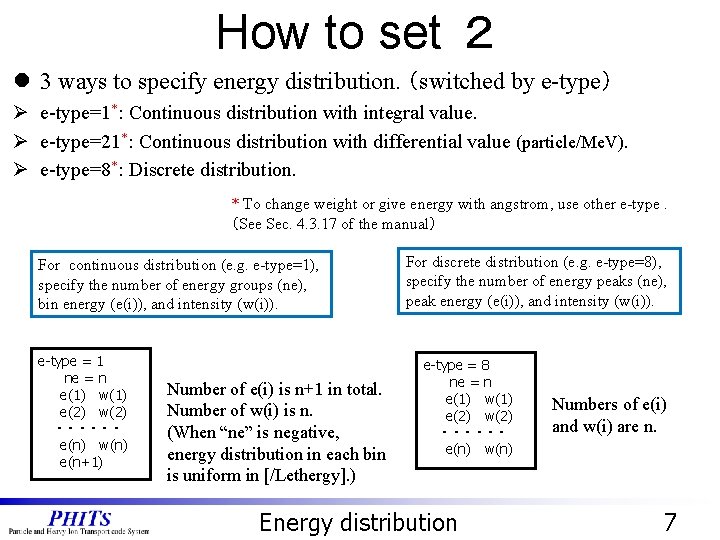
How to set 2 l 3 ways to specify energy distribution. (switched by e-type) Ø e-type=1*: Continuous distribution with integral value. Ø e-type=21*: Continuous distribution with differential value (particle/Me. V). Ø e-type=8*: Discrete distribution. * To change weight or give energy with angstrom, use other e-type. (See Sec. 4. 3. 17 of the manual) For continuous distribution (e. g. e-type=1), specify the number of energy groups (ne), bin energy (e(i)), and intensity (w(i)). e-type = 1 ne = n e(1) w(1) e(2) w(2) ・・・・・・ e(n) w(n) e(n+1) Number of e(i) is n+1 in total. Number of w(i) is n. (When “ne” is negative, energy distribution in each bin is uniform in [/Lethergy]. ) For discrete distribution (e. g. e-type=8), specify the number of energy peaks (ne), peak energy (e(i)), and intensity (w(i)). e-type = 8 ne = n e(1) w(1) e(2) w(2) ・・・・・・ e(n) w(n) Energy distribution Numbers of e(i) and w(i) are n. 7
Exercise 1 Set proton beam with energy distribution Bin : [0, 50], [50, 100], [100, 150] in Me. V Intensity : 1: 3: 2 in ratio. (See right figure) • Add e-type subsection and set energy distribution. • Comment out the line “e 0=150”. source. A. inp [Source] totfact = 1. 0 s-type = 1 proj = proton e 0 = 150. r 0 = 1. 0 z 0 = -10. z 1 = -10. dir = 1. 0 e-type = e-type=1 format e-type = 1 ne = n e(1) w(1) e(2) w(2) ・・・・・・ e(n) w(n) e(n+1) Energy distribution 8
Answer 1 Set proton beam with energy distribution Bin : [0, 50], [50, 100], [100, 150] in Me. V Intensity : 1: 3: 2 in ratio. source. A. inp [Source] totfact = 1. 0 s-type = 1 proj = proton $ e 0 = 150. r 0 = 1. 0 z 0 = -10. z 1 = -10. dir = 1. 0 e-type = 1 ne = 3 0. 0 1 50. 0 3 100. 0 2 150. 0 cross_eng. eps The ratio of intensity is 1: 3: 2. (The ratio is given in integral value for e-type=1. ) Energy distribution 9
Exercise 2 Change the energy bin from [100: 150] to [100: 200]. • Change the energy range of the 3 rd bin. • Check the energy distribution in the new energy bin setup. source. A. inp [Source] ・・・・・・ e-type = 1 ne = 3 0. 0 1 50. 0 3 100. 0 2 150. 0 e-type=1 : Source intensity is given by integral value. Energy distribution 10
Answer 2 Change the energy bin from [100: 150] to [100: 200]. source. A. inp [Source] ・・・・・・ e-type = 1 ne = 3 0. 0 1 50. 0 3 100. 0 2 200. 0 cross_eng. eps The ratio of energy-integrated intensity in the three bins is 1: 3: 2. (The ratio is 1: 3: 1 if it is given in per unit energy or differential value. ) Energy distribution 11
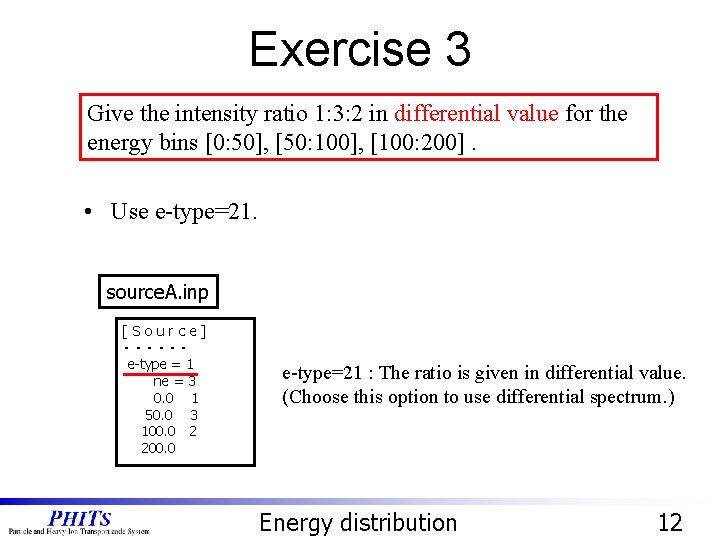
Exercise 3 Give the intensity ratio 1: 3: 2 in differential value for the energy bins [0: 50], [50: 100], [100: 200]. • Use e-type=21. source. A. inp [Source] ・・・・・・ e-type = 1 ne = 3 0. 0 1 50. 0 3 100. 0 2 200. 0 e-type=21 : The ratio is given in differential value. (Choose this option to use differential spectrum. ) Energy distribution 12
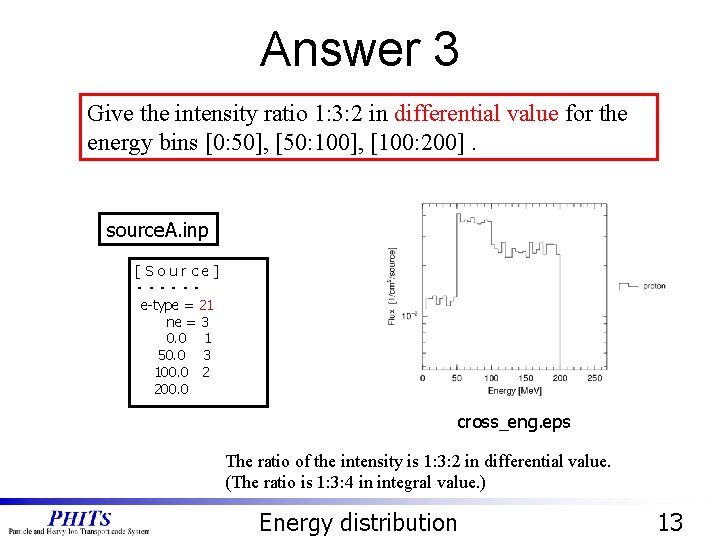
Answer 3 Give the intensity ratio 1: 3: 2 in differential value for the energy bins [0: 50], [50: 100], [100: 200]. source. A. inp [Source] ・・・・・・ e-type = 21 ne = 3 0. 0 1 50. 0 3 100. 0 2 200. 0 cross_eng. eps The ratio of the intensity is 1: 3: 2 in differential value. (The ratio is 1: 3: 4 in integral value. ) Energy distribution 13
Table of contents 1. Source with energy distribution A) Continuous energy distribution B) Discrete energy distribution 2. Setup of multiple sources 3. RI source 4. Summary Table of Contents 14
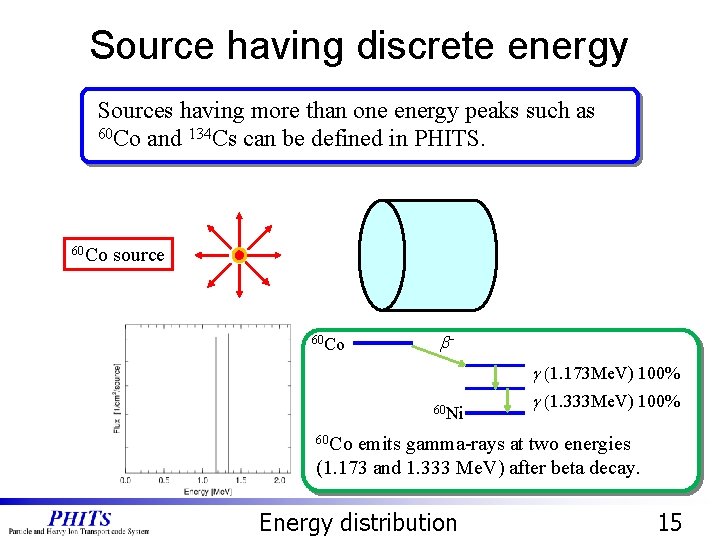
Source having discrete energy Sources having more than one energy peaks such as 60 Co and 134 Cs can be defined in PHITS. 60 Co source 60 Co b- 60 Ni g (1. 173 Me. V) 100% g (1. 333 Me. V) 100% 60 Co emits gamma-rays at two energies (1. 173 and 1. 333 Me. V) after beta decay. Energy distribution 15
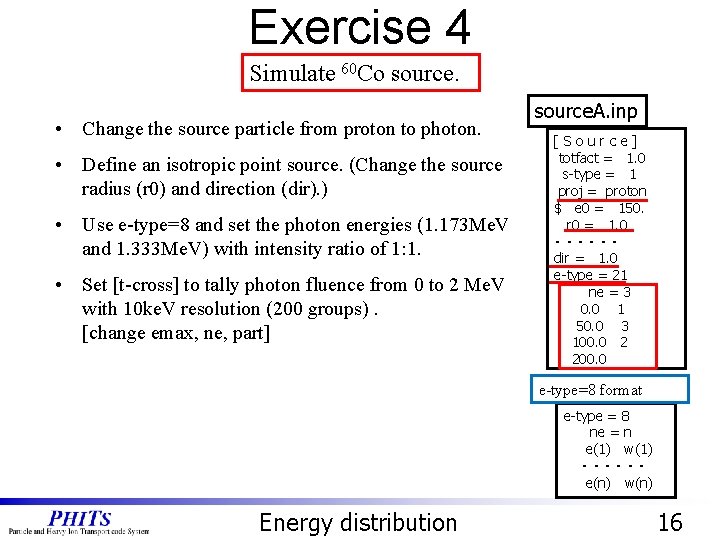
Exercise 4 Simulate 60 Co source. • Change the source particle from proton to photon. • Define an isotropic point source. (Change the source radius (r 0) and direction (dir). ) • Use e-type=8 and set the photon energies (1. 173 Me. V and 1. 333 Me. V) with intensity ratio of 1: 1. • Set [t-cross] to tally photon fluence from 0 to 2 Me. V with 10 ke. V resolution (200 groups). [change emax, ne, part] source. A. inp [Source] totfact = 1. 0 s-type = 1 proj = proton $ e 0 = 150. r 0 = 1. 0 ・・・・・・ dir = 1. 0 e-type = 21 ne = 3 0. 0 1 50. 0 3 100. 0 2 200. 0 e-type=8 format e-type = 8 ne = n e(1) w(1) ・・・・・・ e(n) w(n) Energy distribution 16
Answer 4 Simulate 60 Co source. A. inp [Source] totfact = 1. 0 s-type = 1 proj = photon $ e 0 = 150. r 0 = 0. 0 z 0 = -10. z 1 = -10. dir = all e-type = 8 ne = 2 1. 173 1 1. 333 1 [T-Cross] ・・・・・・ emin = 0. 0 emax = 2. 0 ne = 200 unit = 1 axis = eng file = cross_eng. output = flux part = photon epsout = 1 60 Co cross_eng. eps source track_xz. eps Energy distribution 17
Table of contents 1. Source with energy distribution A) Continuous energy distribution B) Discrete energy distribution 2. Setup of multiple sources 3. RI source 4. Summary Table of Contents 18
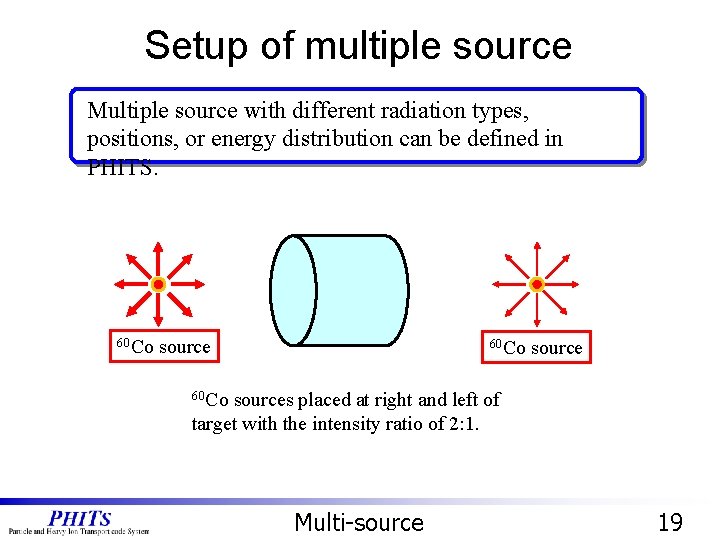
Setup of multiple source Multiple source with different radiation types, positions, or energy distribution can be defined in PHITS. 60 Co sources placed at right and left of target with the intensity ratio of 2: 1. Multi-source 19
How to set l In [source] section, set multi-source subsection starting with ”<source>=relative intensity” l Set totfact to normalize the total source intensity [Source] totfact = 1. 0 <source> = 2. 0 s-type = 1 proj = proton ・・・・・・ Triple sources <source> = 1. 0 s-type = 1 proj = neutron ・・・・・・ Normalization factor. • If it is positive, particles are produced with the ratio of the defined intensity. • If it is negative, same number of particles are produced, and their weight is adjusted to realize the defined intensity ratio. Relative intensity of each source. (In this case, 2: 1: 3 from the top. ) <source> = 3. 0 s-type = 2 proj = photon ・・・・・・ Multi-source 20
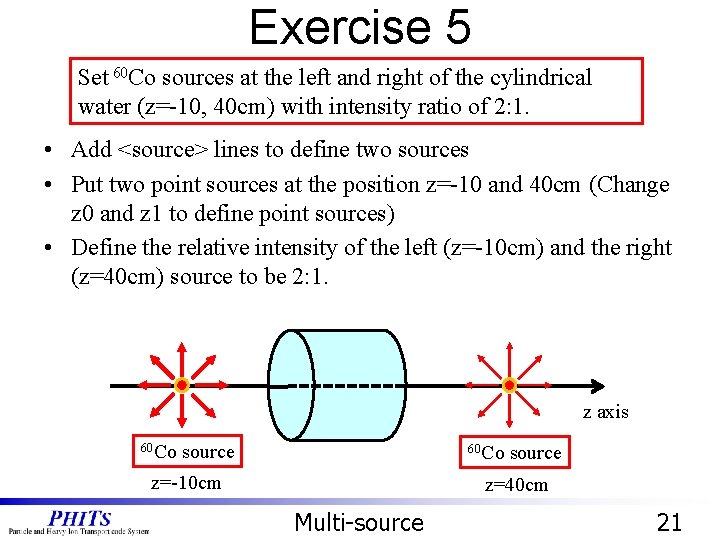
Exercise 5 Set 60 Co sources at the left and right of the cylindrical water (z=-10, 40 cm) with intensity ratio of 2: 1. • Add <source> lines to define two sources • Put two point sources at the position z=-10 and 40 cm (Change z 0 and z 1 to define point sources) • Define the relative intensity of the left (z=-10 cm) and the right (z=40 cm) source to be 2: 1. z axis 60 Co source 60 Co z=-10 cm source z=40 cm Multi-source 21
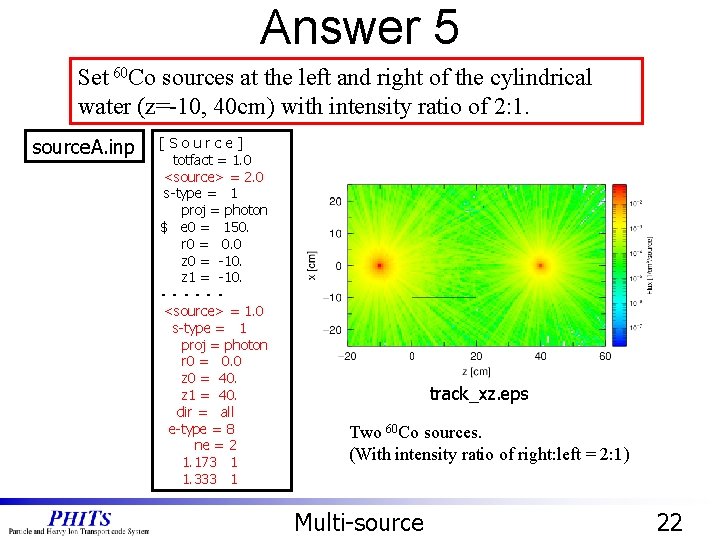
Answer 5 Set 60 Co sources at the left and right of the cylindrical water (z=-10, 40 cm) with intensity ratio of 2: 1. source. A. inp [Source] totfact = 1. 0 <source> = 2. 0 s-type = 1 proj = photon $ e 0 = 150. r 0 = 0. 0 z 0 = -10. z 1 = -10. ・・・・・・ <source> = 1. 0 s-type = 1 proj = photon r 0 = 0. 0 z 0 = 40. z 1 = 40. dir = all e-type = 8 ne = 2 1. 173 1 1. 333 1 track_xz. eps Two 60 Co sources. (With intensity ratio of right: left = 2: 1) Multi-source 22
Table of contents 1. Source having energy distribution A) Continuous energy distribution B) Discrete energy distribution 2. Setup of multiple sources 3. RI source 4. Summary Table of Contents 23
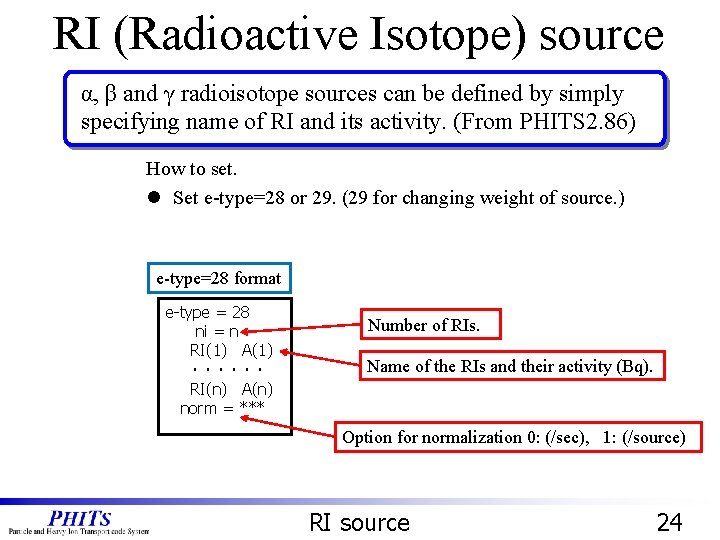
RI (Radioactive Isotope) source α, β and γ radioisotope sources can be defined by simply specifying name of RI and its activity. (From PHITS 2. 86) How to set. l Set e-type=28 or 29. (29 for changing weight of source. ) e-type=28 format e-type = 28 ni = n RI(1) A(1) ・・・・・・ RI(n) A(n) norm = *** Number of RIs. Name of the RIs and their activity (Bq). Option for normalization 0: (/sec), 1: (/source) RI source 24
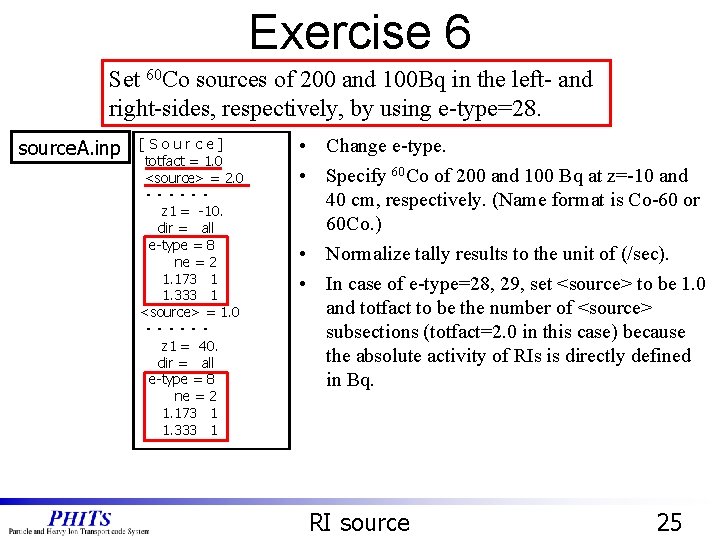
Exercise 6 Set 60 Co sources of 200 and 100 Bq in the left- and right-sides, respectively, by using e-type=28. source. A. inp [Source] totfact = 1. 0 <source> = 2. 0 ・・・・・・ z 1 = -10. dir = all e-type = 8 ne = 2 1. 173 1 1. 333 1 <source> = 1. 0 ・・・・・・ z 1 = 40. dir = all e-type = 8 ne = 2 1. 173 1 1. 333 1 • Change e-type. • Specify 60 Co of 200 and 100 Bq at z=-10 and 40 cm, respectively. (Name format is Co-60 or 60 Co. ) • Normalize tally results to the unit of (/sec). • In case of e-type=28, 29, set <source> to be 1. 0 and totfact to be the number of <source> subsections (totfact=2. 0 in this case) because the absolute activity of RIs is directly defined in Bq. RI source 25
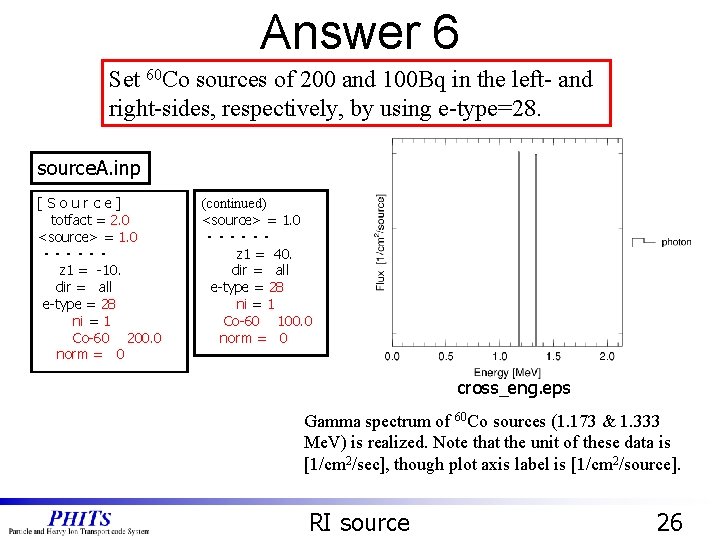
Answer 6 Set 60 Co sources of 200 and 100 Bq in the left- and right-sides, respectively, by using e-type=28. source. A. inp [Source] totfact = 2. 0 <source> = 1. 0 ・・・・・・ z 1 = -10. dir = all e-type = 28 ni = 1 Co-60 200. 0 norm = 0 (continued) <source> = 1. 0 ・・・・・・ z 1 = 40. dir = all e-type = 28 ni = 1 Co-60 100. 0 norm = 0 cross_eng. eps Gamma spectrum of 60 Co sources (1. 173 & 1. 333 Me. V) is realized. Note that the unit of these data is [1/cm 2/sec], though plot axis label is [1/cm 2/source]. RI source 26
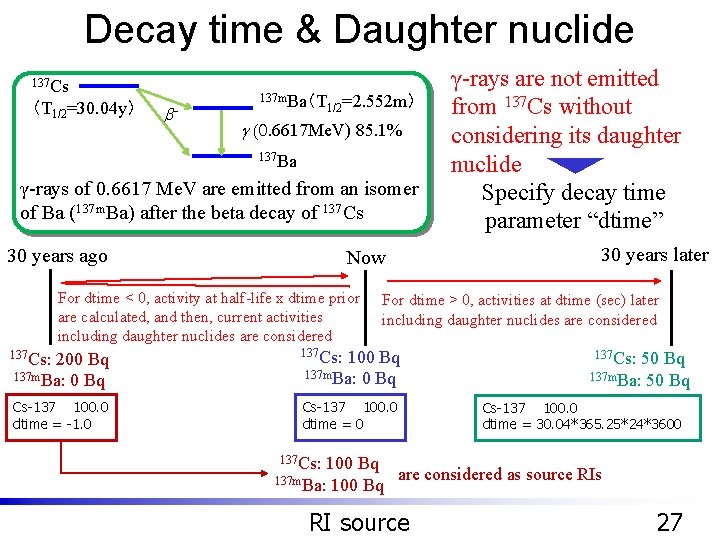
Decay time & Daughter nuclide 137 Cs (T 1/2=30. 04 y) b - 137 m. Ba(T 1/2=2. 552 m) g (0. 6617 Me. V) 85. 1% 137 Ba γ-rays of 0. 6617 Me. V are emitted from an isomer of Ba (137 m. Ba) after the beta decay of 137 Cs 30 years ago Now For dtime < 0, activity at half-life x dtime prior are calculated, and then, current activities including daughter nuclides are considered 30 years later For dtime > 0, activities at dtime (sec) later including daughter nuclides are considered 200 Bq 137 m. Ba: 0 Bq 137 Cs: Cs-137 100. 0 dtime = -1. 0 Cs-137 100. 0 dtime = 0 137 Cs: γ-rays are not emitted from 137 Cs without considering its daughter nuclide Specify decay time parameter “dtime” 100 Bq 137 m. Ba: 0 Bq 137 Cs: 50 Bq 137 m. Ba: 50 Bq Cs-137 100. 0 dtime = 30. 04*365. 25*24*3600 137 Cs: 100 Bq 137 m. Ba: 100 Bq are considered as source RIs RI source 27
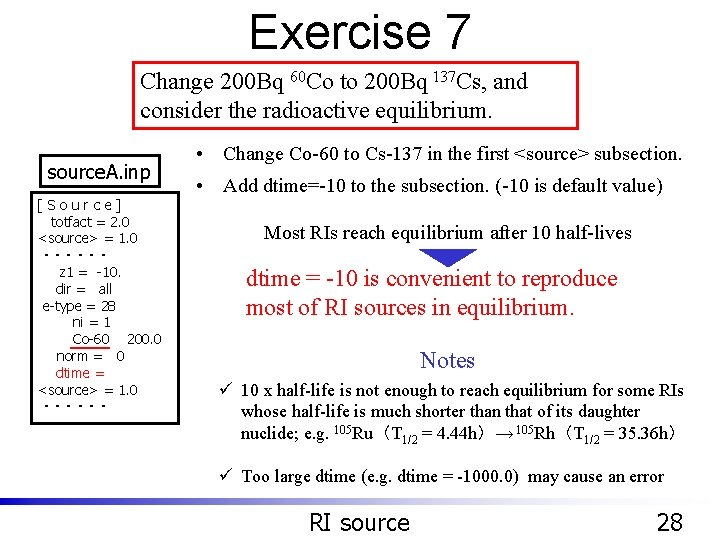
Exercise 7 Change 200 Bq 60 Co to 200 Bq 137 Cs, and consider the radioactive equilibrium. source. A. inp [Source] totfact = 2. 0 <source> = 1. 0 ・・・・・・ z 1 = -10. dir = all e-type = 28 ni = 1 Co-60 200. 0 norm = 0 dtime = <source> = 1. 0 ・・・・・・ • Change Co-60 to Cs-137 in the first <source> subsection. • Add dtime=-10 to the subsection. (-10 is default value) Most RIs reach equilibrium after 10 half-lives dtime = -10 is convenient to reproduce most of RI sources in equilibrium. Notes ü 10 x half-life is not enough to reach equilibrium for some RIs whose half-life is much shorter than that of its daughter nuclide; e. g. 105 Ru(T 1/2 = 4. 44 h)→ 105 Rh(T 1/2 = 35. 36 h) ü Too large dtime (e. g. dtime = -1000. 0) may cause an error RI source 28
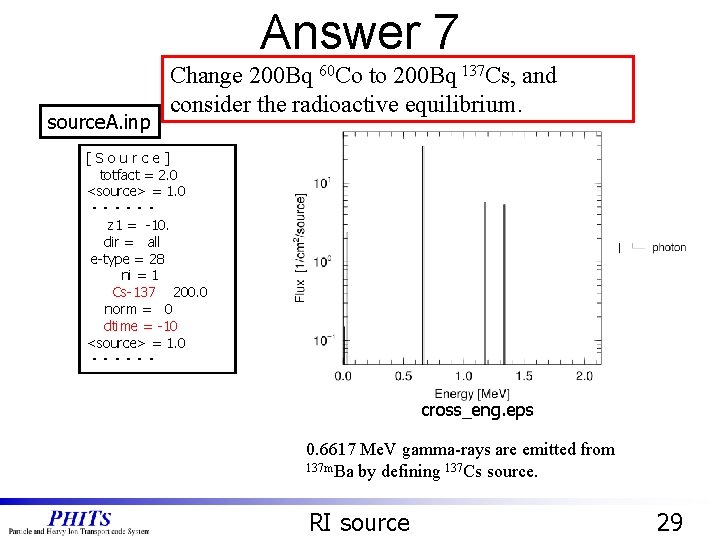
Answer 7 source. A. inp Change 200 Bq 60 Co to 200 Bq 137 Cs, and consider the radioactive equilibrium. [Source] totfact = 2. 0 <source> = 1. 0 ・・・・・・ z 1 = -10. dir = all e-type = 28 ni = 1 Cs-137 200. 0 norm = 0 dtime = -10 <source> = 1. 0 ・・・・・・ cross_eng. eps 0. 6617 Me. V gamma-rays are emitted from 137 m. Ba by defining 137 Cs source. RI source 29
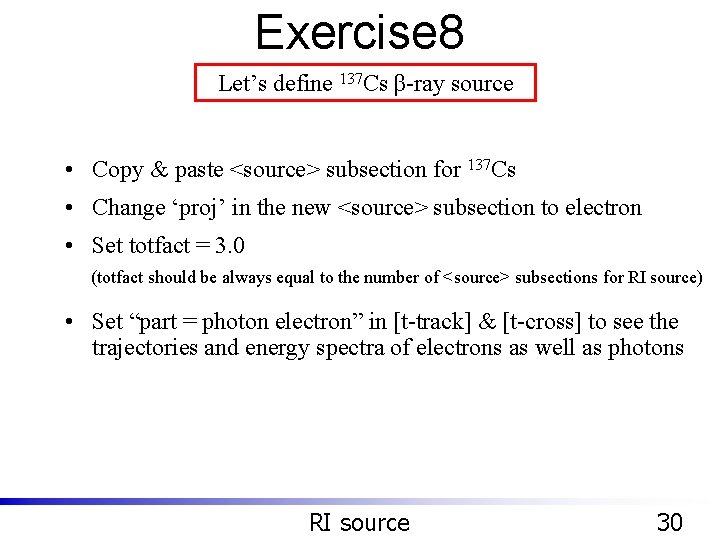
Exercise 8 Let’s define 137 Cs β-ray source • Copy & paste <source> subsection for 137 Cs • Change ‘proj’ in the new <source> subsection to electron • Set totfact = 3. 0 (totfact should be always equal to the number of <source> subsections for RI source) • Set “part = photon electron” in [t-track] & [t-cross] to see the trajectories and energy spectra of electrons as well as photons RI source 30
Answer 8 source. A. inp [Source] totfact = 3. 0 <source> = 1. 0 proj = photon ・・・・・・ ni = 1 Cs-137 200. 0 norm = 0 dtime = -10 track_xz. eps (2 nd page) cross_eng. eps <source> = 1. 0 proj = electron ・・・・・・ ni = 1 Cs-137 200. 0 norm = 0 dtime = -10 ・・・・・・ Continuum spectrum of β-rays RI source 31
Table of contents 1. Source having energy distribution A) Continuous energy distribution B) Discrete energy distribution 2. Setup of multiple source 3. RI source 4. Summary Table of Contents 32
Summary • Source energy distribution (continuous and discrete) can be defined by specifying e-type in the [source] section. • Multiple sources can be defined by setting <source> subsections. • α, β, γ decay sources can be defined by directly specifying the name and activity of RIs. Refer to “setting of various source B” (phits-lec-source. B-jp. ppt) for the setup of source using “Dump data”. Summary 33