
PHILOSOPHY TO PROBLEM SOLVING NTD 412 NUTRITION COUNSELING
PHILOSOPHY TO PROBLEM SOLVING NTD 412 NUTRITION COUNSELING
PROBLEM SOLVING • Problem solving is a learned behavior that includes generating a set of strategies for problem resolution, selecting the most appropriate strategy, and evaluating the effectiveness of the strategy.
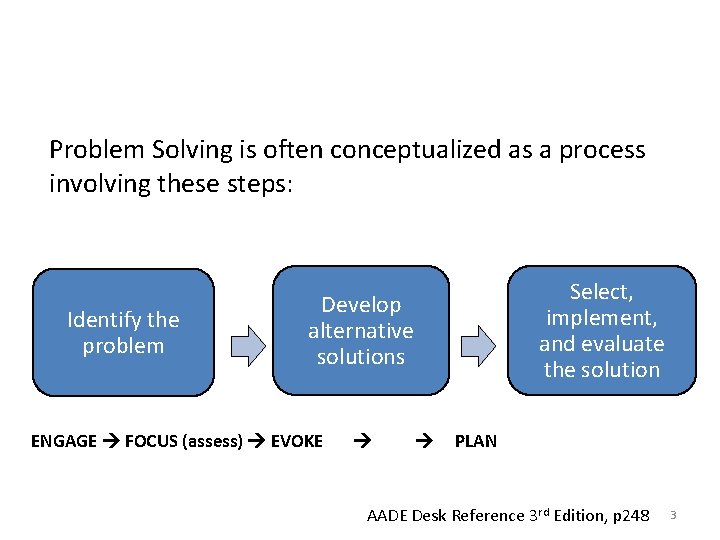
Problem Solving is often conceptualized as a process involving these steps: Identify the problem Select, implement, and evaluate the solution Develop alternative solutions ENGAGE FOCUS (assess) EVOKE PLAN AADE Desk Reference 3 rd Edition, p 248 3
Importance of Problem Solving • It describes what we do – helps patient identify problem and generate a solution • It describes something a patient can do with you as well as on their own in anticipation of a problem – relapse prevention • It describes something to do that builds confidence in a patient that they can achieve their goal of taking care of themselves • It can be taught 4
STEP 1 IDENTIFY THE PROBLEM 5
Tip – Identifying Problems • Use open questions to help the patient open up. Use reflective responses to state the problem and show that you are listening and nonjudgmental. “What is the hardest part for you about taking care of diabetes? ” • Probe further and ask for details about the problem. “Tell me more about that. ” • Then reflect back to the patient what you think the problem is by stating it in terms of behavior. Example More specifically, the patient is not taking their medication. The educator identifies the problem as: “So you find that you have high blood glucose after dinner if you forget to take your pre-dinner medication. ” 6
STEP 2 BRAINSTORMING 1. Using Problem solving boxes 2. Positive thinking 7
1. Using Problem Solving Boxes 1. 2. 1. 3. 4. 5. “I want to eat appropriate portions, but I don’t do it over the holidays. ” Show patient the Problem Solving Boxes handout and explain the various components to consider food, exercise, behavior, self talk Elicit client ideas for each component Find out which idea the client want to try first Ask client to make a plan for his/her idea 1. 2. 6. Restate client goal with the barrier Be specific May need to break down a step into smaller steps At Follow Up, review the plan “How well did it work? Anything further to do? ” 8
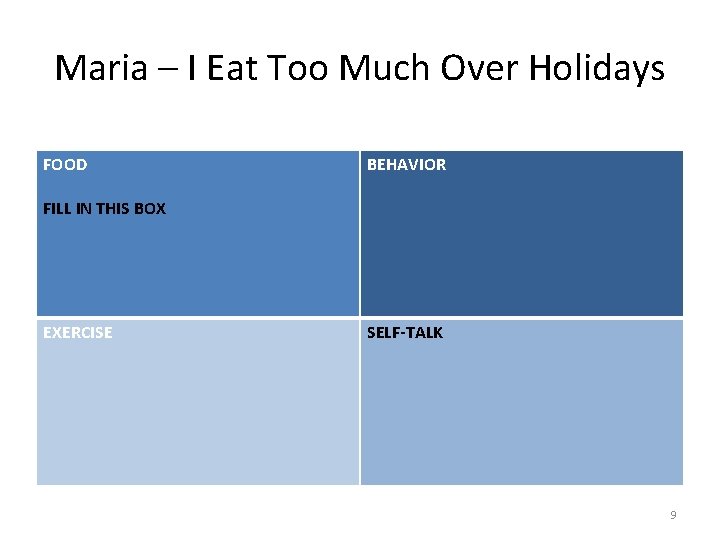
Maria – I Eat Too Much Over Holidays FOOD BEHAVIOR FILL IN THIS BOX EXERCISE SELF-TALK 9
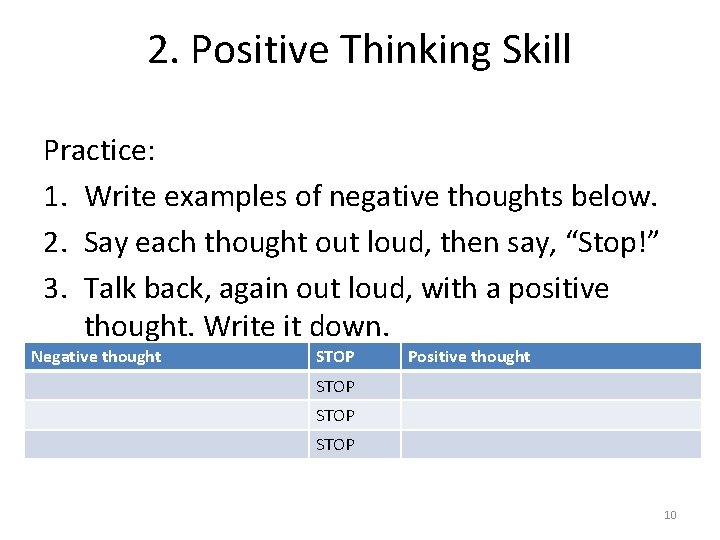
2. Positive Thinking Skill Practice: 1. Write examples of negative thoughts below. 2. Say each thought out loud, then say, “Stop!” 3. Talk back, again out loud, with a positive thought. Write it down. Negative thought STOP Positive thought STOP 10
STEP 3 MAKING A PLAN 1. Problem solving with smart goals 2. Problem solving with s. o. a. r. 3. Problem solving by direct instruction. 11
1. SMART Goal After brainstorming ideas, ask the patient to select one solution to work on. Together, create a plan for the patient to try it. The educator should ask, “What will you do first? ” or “What specific steps need to be done? ” 12
What is a SMART Goal? Setting a SMART goal with the patient means being specific about what the patient will do (behavior) to overcome their problem and achieve the desired outcome (e. g. a lower weight or lower A 1 c. ) 13
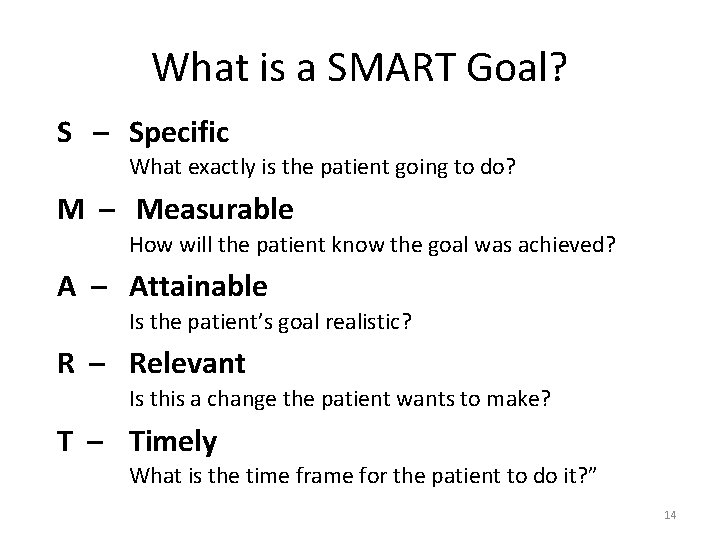
What is a SMART Goal? S – Specific What exactly is the patient going to do? M – Measurable How will the patient know the goal was achieved? A – Attainable Is the patient’s goal realistic? R – Relevant Is this a change the patient wants to make? T – Timely What is the time frame for the patient to do it? ” 14
SMART Goals Example: “Starting Monday for the whole week, I will set a daily alarm for 5 pm on my cell phone to remind me to take my medication before dinner to prevent high blood glucose. ” 15
2. - S. O. A. R. is an acronym coined by David B. Rosengren to remember the steps in problem solving. It simplifies remembering the process. S. O. A. R. stands for: S – Set goal (based on a well defined problem) O – sort Options (aka solutions to the problem) A – Arrive at a plan (set a SMART goal) R – Reaffirm commitment 16
Approach #2 - S. O. A. R. Example: S – Set goals First set a general goal to remember to take predinner meds. O – Sort Options Patient (alone or with educator) brainstorms options. A – Arrive at a plan Patient choose one option and sets a goal with specifics such as a SMART goal R – Reaffirm commitment The patient confirms that the plan is what they WANT to do. This is an MI strategy for behavior change. 17
3. Direct Instruction Some problems require direct instructions to follow when it would be too great a risk for patients to brainstorm alternatives. • Hypoglycemia • Hyperglycemia • Sick days
Direct Instruction vs Problem Solving Use Direct Instruction if… • Problem is well defined and straightforward • Problem has a single best strategy for resolution • Problem has a known, specific course of action that the individual with diabetes should take for problem resolution • Use of trial and error could be detrimental or life threatening 19
When to use Direct Instruction Examples: • If there is only one way to use a specific glucometer, then patient should follow the instructions for proper usage • If patient has acute hypoglycemia or hyperglycemia, the proper treatment steps should be followed • If the patient is ill, the Sick Day Rules should be be followed 20
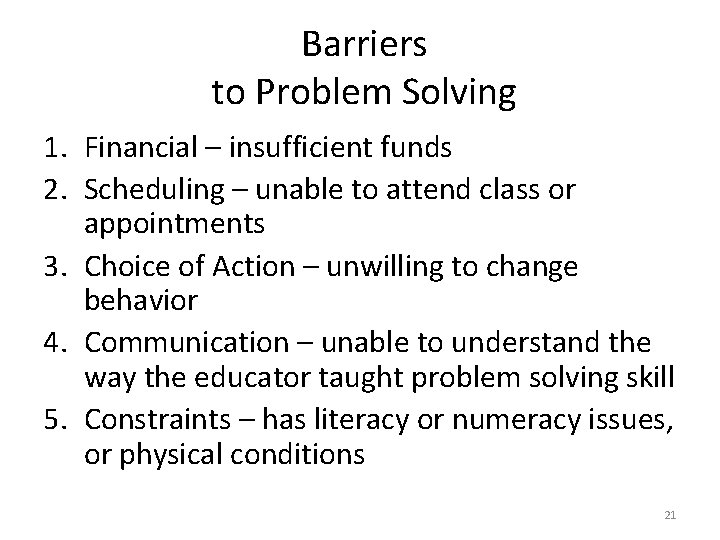
Barriers to Problem Solving 1. Financial – insufficient funds 2. Scheduling – unable to attend class or appointments 3. Choice of Action – unwilling to change behavior 4. Communication – unable to understand the way the educator taught problem solving skill 5. Constraints – has literacy or numeracy issues, or physical conditions 21
- Slides: 21