
PHILOSOPHY THE SUBJECT AND THE RANGE OF PHILOSOPHICAL
PHILOSOPHY: THE SUBJECT AND THE RANGE OF PHILOSOPHICAL PROBLEMS, ITS ROLE AND SIGNIFICANCE IN CULTURE
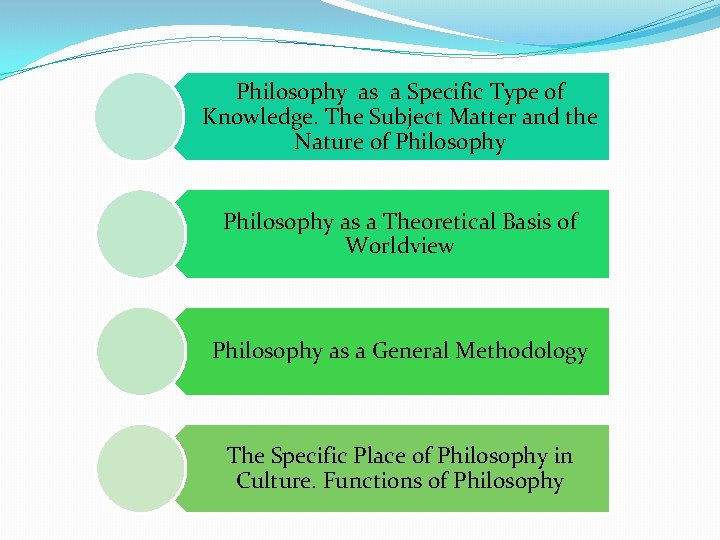
Philosophy as a Specific Type of Knowledge. The Subject Matter and the Nature of Philosophy as a Theoretical Basis of Worldview Philosophy as a General Methodology The Specific Place of Philosophy in Culture. Functions of Philosophy

Literature � Basic: � Alexander Spirkin. Fundamentals of Philosophy / Alexander Spirkin. — M. : Progress Publishers, 1990. — 423 p. � Donald M. Borchert. Encyclopedia of Philosophy / Donald M. Borchert. — New-York : Thomson Gale, 2006. — Vol. 1— 10. — 6200 p. � Jr. H. W. Johnstone What is philosophy? / Jr. H. W. Johnstone. — New-York : Macmillan, 1965. — 287 p. � Philosophy. Historical-Philosophical Introduction : [the course of lectures] / L. V. Kadnikova − K. : NAU, 2004. — 172 p. � Supplementary: � B. Russel A History of Western Philosophy / B. Russel. – London : George Allen & Unviwn LTD, 2002. — 923 p. � Mark B. Woodhouse. A preface to philosophy / Mark B. Woodhouse. — [3 d ed. ]. — Belmont, Calif. : Wadsworth, 1984. — 203 p. � The Cambridge Dictionary of Philosophy / Robert Audi. — Cambridge, New York : Cambridge University Press, 1995. — 1001 p. � Primary sources: � Bertrand Russel. The Problems of Philosophy / Bertrand Russel. – New York : Oxford University Press, 1959. — 61 p. � Karl Jaspers. The Origin and Goal of History / Karl Jaspers : [transl. By Michael Bullock]. − New Haven, CT: Yale University Press, 1953. — 294 p. � Ortega y Gasset Jose. What is philosophy? — Eelectronic resource : http: //www. erraticimpact. com/~20 thcentury/html/ortega_y_gasset_jose. htm � Victor Frankl. Man’s Search for Meaning / Victor Frankl. — New York : Washington Suare Press, 1963. – P. 206— 213.
1. Philosophy as a Specific Type of Knowledge. The Subject Matter and the Nature of Philosophy
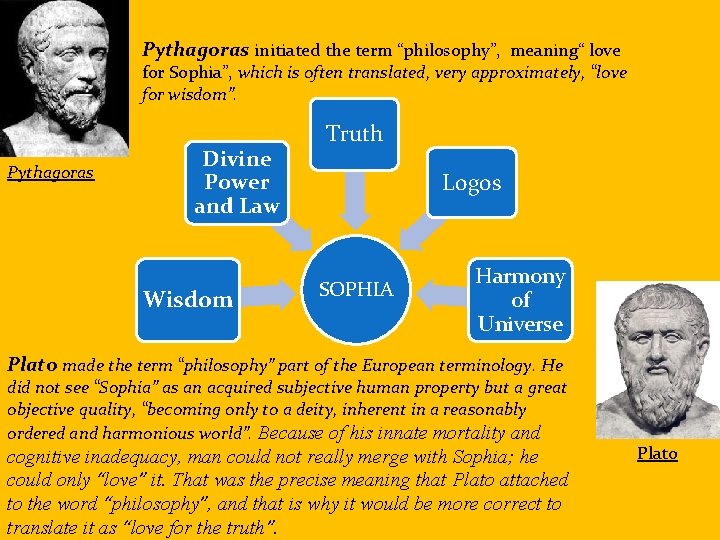
Pythagoras initiated the term “philosophy”, meaning“ love for Sophia”, which is often translated, very approximately, “love for wisdom”. Pythagoras Divine Power and Law Wisdom Truth Logos SOPHIA Harmony of Universe Plato made the term “philosophy” part of the European terminology. He did not see “Sophia” as an acquired subjective human property but a great objective quality, “becoming only to a deity, inherent in a reasonably ordered and harmonious world”. Because of his innate mortality and cognitive inadequacy, man could not really merge with Sophia; he could only “love” it. That was the precise meaning that Plato attached to the word “philosophy”, and that is why it would be more correct to translate it as “love for the truth”. Plato
is a philosophical category denoting the process of human selfcreation that is developing one’s own “inner world” and personal life position, determining one’s proper place in the world. What do I live for? What do I study for? What do I earn money for? What do I make a career for? To be or not to be? What kind of man to be? What is better: death or disgrace? S. B. Krymskyi, a prominent Ukrainian philosopher, considered that to seek to answers on such questions requires an intensive work of personality's mind and soul in forming his own “internal world". This is man's way to himself. Just here the work of philosophy begins and it makes an area of human spirituality.
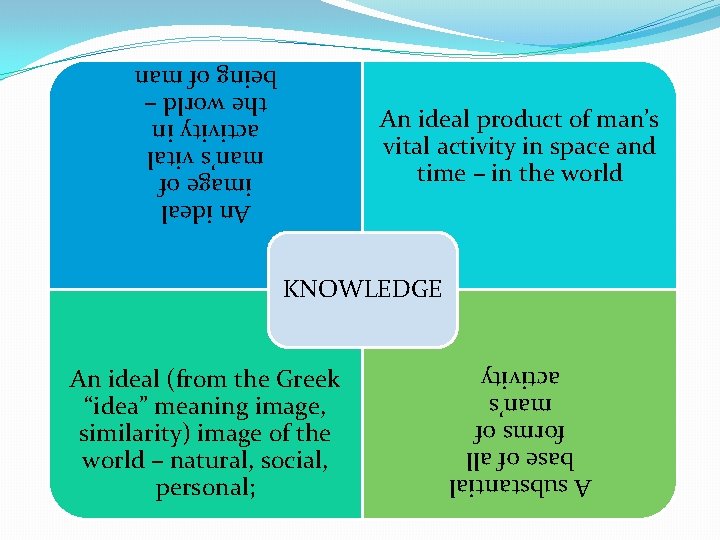
An ideal image of man’s vital activity in the world – being of man An ideal product of man’s vital activity in space and time – in the world KNOWLEDGE A substantial base of all forms of man’s activity An ideal (from the Greek “idea” meaning image, similarity) image of the world – natural, social, personal;
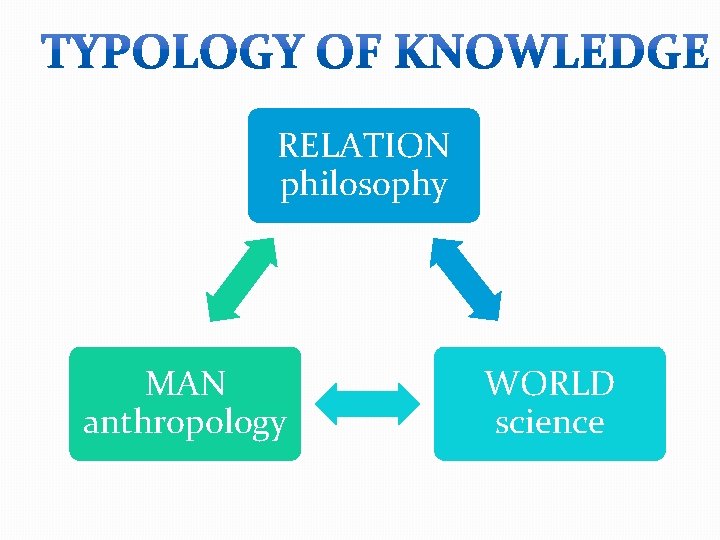
RELATION philosophy MAN anthropology WORLD science
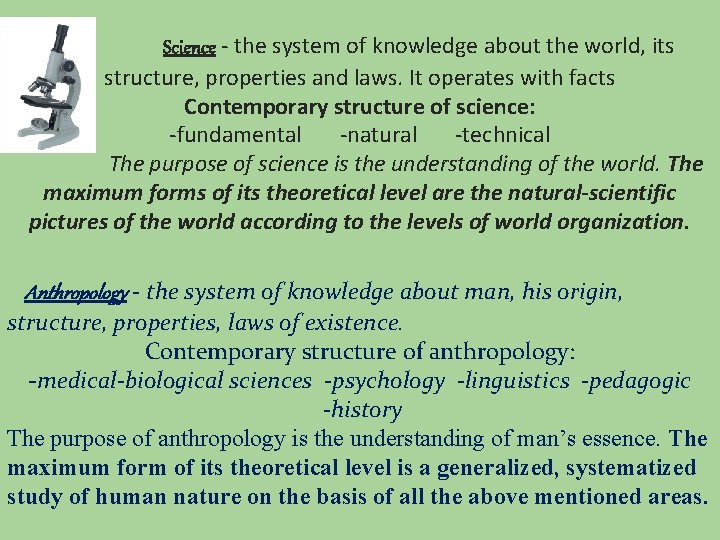
Science - the system of knowledge about the world, its structure, properties and laws. It operates with facts Contemporary structure of science: -fundamental -natural -technical The purpose of science is the understanding of the world. The maximum forms of its theoretical level are the natural-scientific pictures of the world according to the levels of world organization. Anthropology - the system of knowledge about man, his origin, structure, properties, laws of existence. Contemporary structure of anthropology: -medical-biological sciences -psychology -linguistics -pedagogic -history The purpose of anthropology is the understanding of man’s essence. The maximum form of its theoretical level is a generalized, systematized study of human nature on the basis of all the above mentioned areas.
Philosophy � The system of knowledge of the most general nature of man’s relation to the world, its structure, properties, and functioning laws. �Philosophy deals with purports and senses. �Philosophy as a system of theoretical knowledge is the unity of: Principles, Categories and Laws of development and cognition of its object – man’s relation to the world. The aim of philosophy is understanding the purport of man’s relation to the world. The highest form of its theoretical level is a methodology system (from the Greek “methods” meaning the way to something, and “logos” meaning theory - teaching about means, methods of man’s activity. )
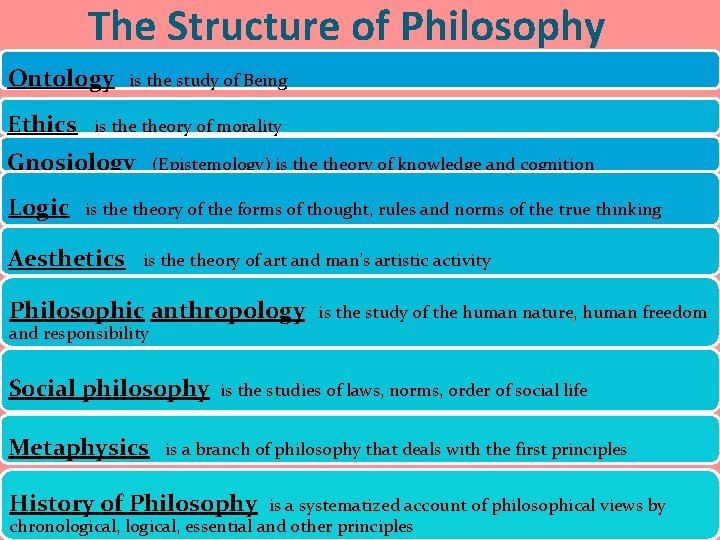
The Structure of Philosophy Ontology Ethics is the study of Being is theory of morality Gnosiology Logic (Epistemology) is theory of knowledge and cognition is theory of the forms of thought, rules and norms of the true thinking Aesthetics is theory of art and man’s artistic activity Philosophic anthropology and responsibility Social philosophy Metaphysics is the study of the human nature, human freedom is the studies of laws, norms, order of social life is a branch of philosophy that deals with the first principles History of Philosophy is a systematized account of philosophical views by chronological, essential and other principles
PHILOSOPHY is a specific form of theoretical knowledge about the world as a unity and possibility to understand it with human mind, which is reflected in the most general notions (categories). It is a form of man’s intellectual activity where the focus is centered on the idea of man in his relation to the world.
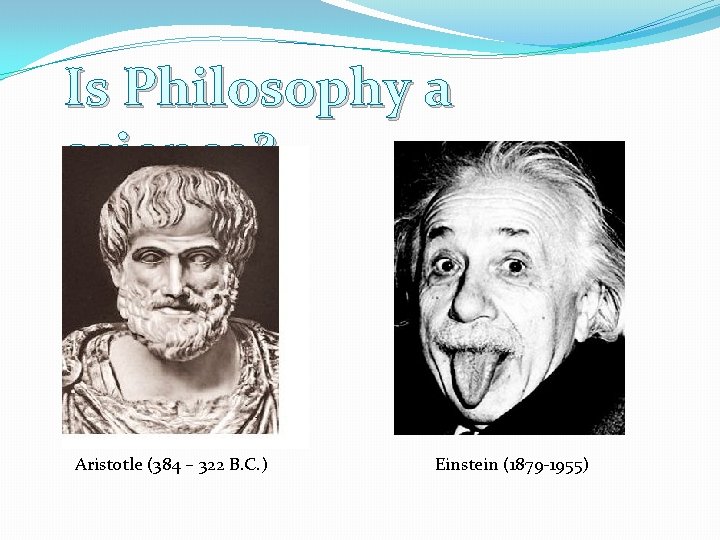
Is Philosophy a science? Aristotle (384 – 322 B. C. ) Einstein (1879 -1955)
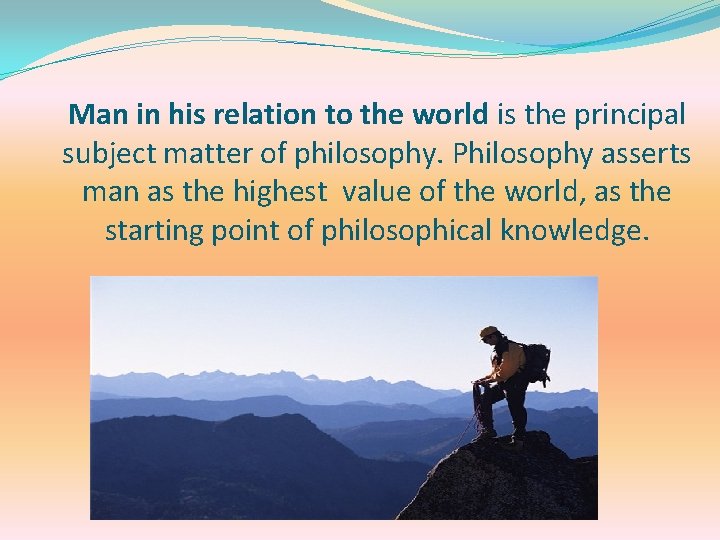
Man in his relation to the world is the principal subject matter of philosophy. Philosophy asserts man as the highest value of the world, as the starting point of philosophical knowledge.
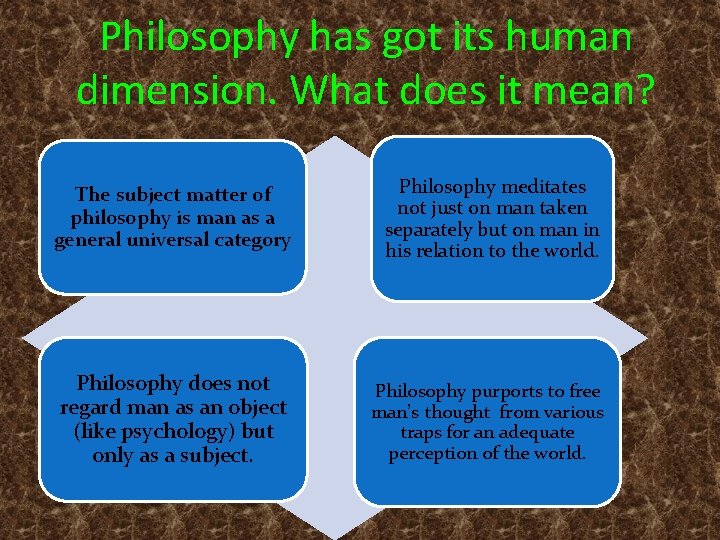
Philosophy has got its human dimension. What does it mean? The subject matter of philosophy is man as a general universal category Philosophy meditates not just on man taken separately but on man in his relation to the world. Philosophy does not regard man as an object (like psychology) but only as a subject. Philosophy purports to free man’s thought from various traps for an adequate perception of the world.

To be continued at the lecture.
- Slides: 16