
Philosophy of Social Science Roundtable Ecole Normale Suprieure
Philosophy of Social Science Roundtable Ecole Normale Supérieure 20. 03. 2011 Higher School of Economics, Moscow Greg Yudin Reflexivity at the crossroads: Form reflexive objectification to reflexive subjectification
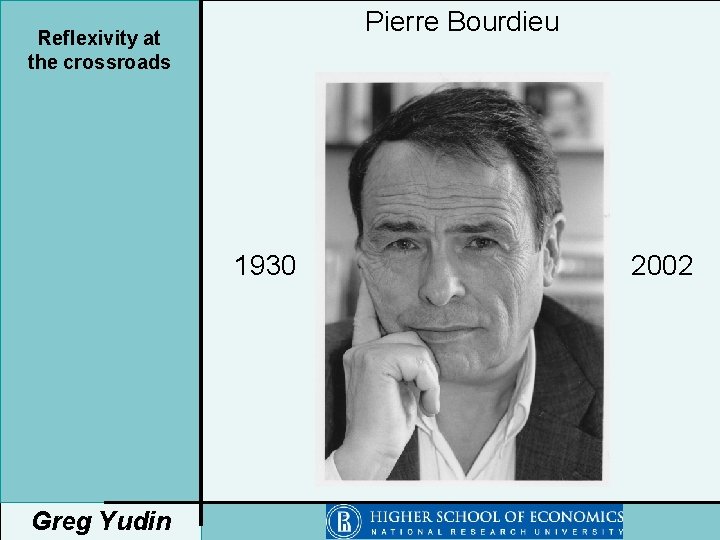
Pierre Bourdieu Reflexivity at the crossroads 1930 Greg Yudin 2002
Outline of the talk Reflexivity at the crossroads 1. Greg Yudin What is new about reflexive sociology from an epistemological point of view? 2. Does reflexive sociology live up to the expectations? 3. What is implied by ‘epistemology’? 4. Phenomenological roots of ‘reflection’ 5. Reflexive sociology: useful if correctly understood. Implications
Reflexivity at the crossroads Pierre Bourdieu’s Epistemology Bringing epistemology to existence Reflexive sociology Between objectivism and subjectivism: “taking the things of logic for the logic of things” vs. ‘synoptic illusion’ “Social world constructs its own representation, by using sociology and the sociologist for this purpose” (Bourdieu & Wacquant 1992) Greg Yudin
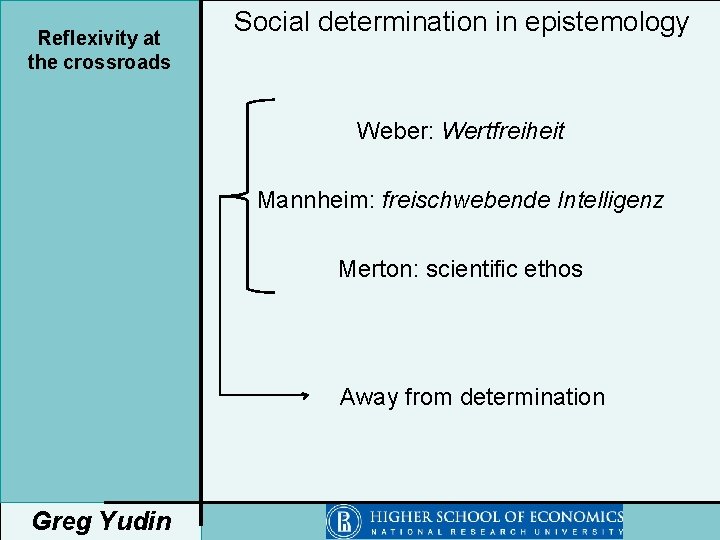
Reflexivity at the crossroads Social determination in epistemology Weber: Wertfreiheit Mannheim: freischwebende Intelligenz Merton: scientific ethos Away from determination Greg Yudin
Reflexivity at the crossroads Social determination in epistemology-2 Sociology of sociology “uses the knowledge it gains of the social determinations that may bear upon [sociology], and particularly the scientific analysis of all the constraints and all the limitations associated with the fact of occupying a definite position in a definite field at a particular moment and with a certain trajectory, in an attempt to locate and neutralize their effects” (Bourdieu & Wacquant 1992). Greg Yudin
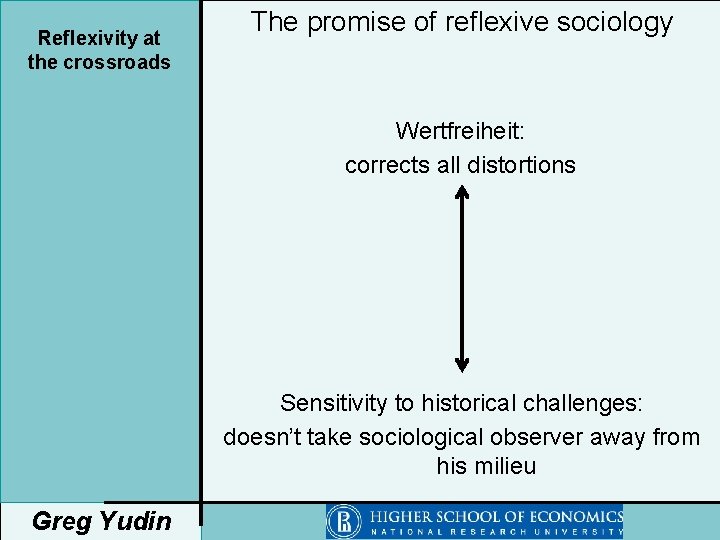
Reflexivity at the crossroads The promise of reflexive sociology Wertfreiheit: corrects all distortions Sensitivity to historical challenges: doesn’t take sociological observer away from his milieu Greg Yudin
Reflexivity at the crossroads The promise of reflexive sociology-2 “The intellectual has the privilege of being placed in conditions that enable him to strive to understand his generic and specific conditions. In so doing, he can hope to free himself (in part at least) and to offer others the means of liberation. . . The sociologist’s privilege, if he has one, is not that of trying to remain suspended above those whom he classifies, but that of knowing he is classified and knowing roughly where he stands in the classifications” (Bourdieu 1993) Greg Yudin
Reflexivity at the crossroads Objections Criticism of sociology of knowledge Extra-social viewpoint? “The failure of Bourdieu's theory is instructive, because it clearly shows why no more reflexivity can ever be granted to theorists than is already granted by such a theory to agents themselves” (Bohman 1997) Vicious circle (Pels 2003) ‘Radical reflexivity’ is devastating and selfdestructive (Lynch 2000) Greg Yudin
Reflexivity at the crossroads Panoptical objectivity Reflexive sociology fails to rise above partiality No way past determinations causing biases No road to consensus among subjects No access to an impartial view No panoptical objectivity Greg Yudin
Reflexivity at the crossroads Epistemology? “epistemology differs from abstract methodology inasmuch as it strives to grasp the logic of error in order to construct the logic of discovery of truth as a polemic against error and as an endeavor to subject the approximated truths of science and the methods it uses to methodical, permanent rectification” (Bourdieu et al. 1991 [1968]) Greg Yudin
Reflexivity at the crossroads Bachelard’s Epistemology “Scientific experience is an experience that contradicts common experience” (Bachelard 1938). Epistemological obstacles Doxa vs. episteme Episteme: 1) objectifies doxa 2) overcomes doxa Greg Yudin
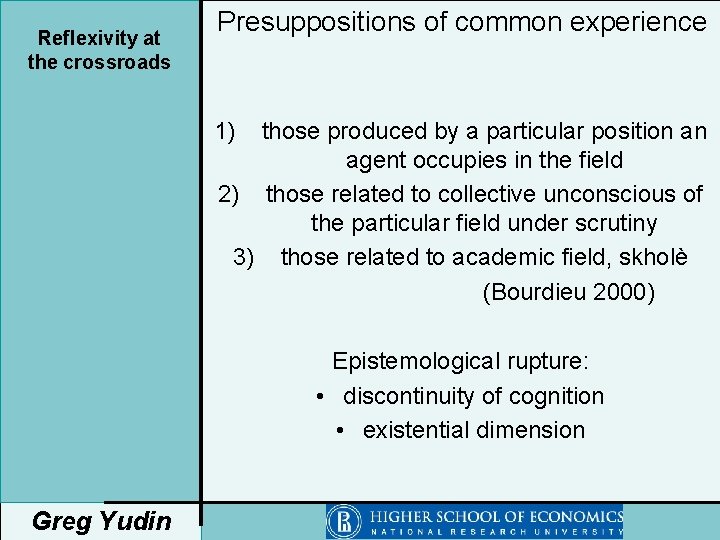
Reflexivity at the crossroads Presuppositions of common experience 1) those produced by a particular position an agent occupies in the field 2) those related to collective unconscious of the particular field under scrutiny 3) those related to academic field, skholè (Bourdieu 2000) Epistemological rupture: • discontinuity of cognition • existential dimension Greg Yudin
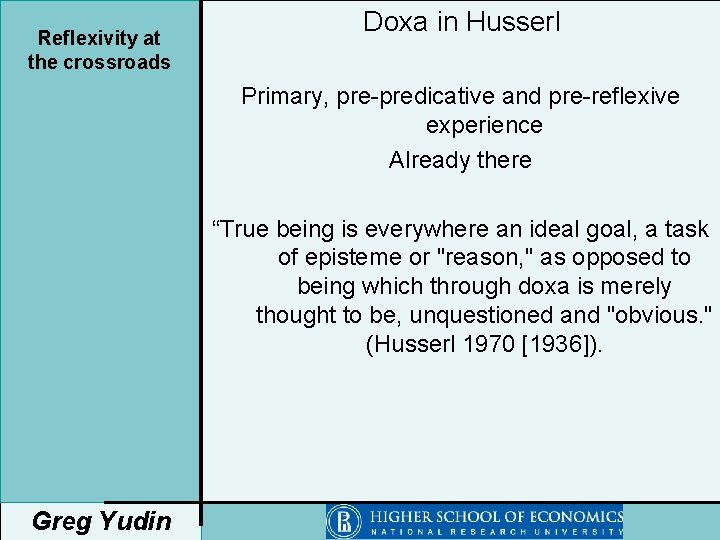
Reflexivity at the crossroads Doxa in Husserl Primary, pre-predicative and pre-reflexive experience Already there “True being is everywhere an ideal goal, a task of episteme or "reason, " as opposed to being which through doxa is merely thought to be, unquestioned and "obvious. " (Husserl 1970 [1936]). Greg Yudin
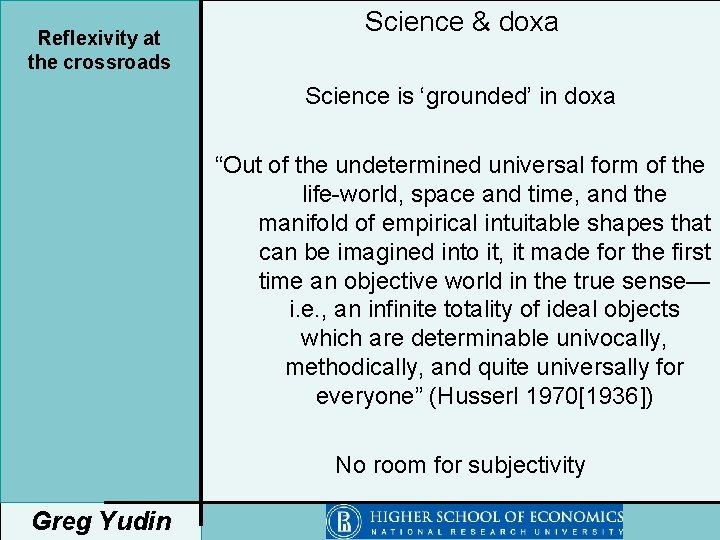
Reflexivity at the crossroads Science & doxa Science is ‘grounded’ in doxa “Out of the undetermined universal form of the life-world, space and time, and the manifold of empirical intuitable shapes that can be imagined into it, it made for the first time an objective world in the true sense— i. e. , an infinite totality of ideal objects which are determinable univocally, methodically, and quite universally for everyone” (Husserl 1970[1936]) No room for subjectivity Greg Yudin
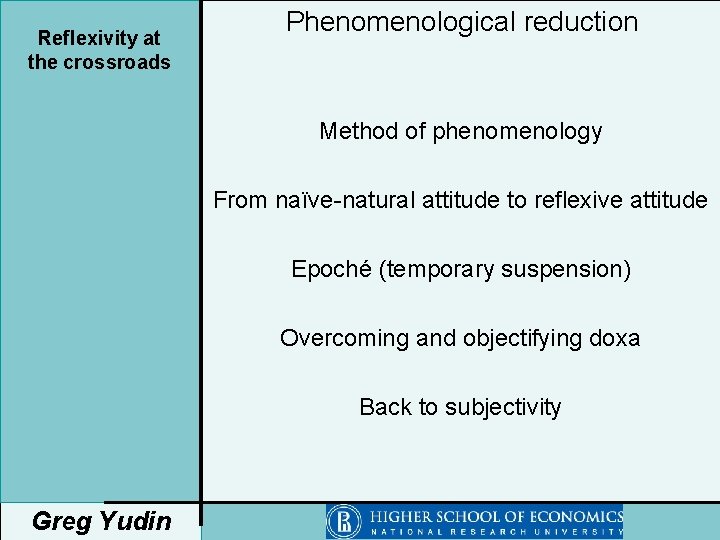
Reflexivity at the crossroads Phenomenological reduction Method of phenomenology From naïve-natural attitude to reflexive attitude Epoché (temporary suspension) Overcoming and objectifying doxa Back to subjectivity Greg Yudin
Reflexivity at the crossroads Phenomenological reduction-2 1) objectification is subjectification (Humean problem: ‘how is this most radical subjectivism, which subjectivizes the world itself, comprehensible’ (Husserl 1970[1936]) 2) subjectification means overcoming Greg Yudin
Reflexivity at the crossroads Reduction: Evolution Ideas I (1913): “The unrestricted doubt is within the realm of our "perfect freedom" … It is my complete freedom [to carry out the epoché]” Ideas II (1918): attitude = direction of interest or thematization Scheler (1912): “If after the phenomenological reduction has been undertaken, facts and connections between them still remain, we have proof that … the facts are ‘pure’ facts … If facts and their interconnections do not remain, … the constitution of our picture of the world is relative to the sense-functions” Greg Yudin
Reflexivity at the crossroads Reduction: Evolution-2 Reduction and humanity “Only when the spirit returns from its naive external orientation to itself, and remains with itself and purely with itself, can it be sufficient unto itself” (Husserl 1935) “Animal lives fully in the concrete and in the reality … To be a human being means to cast a strong ‘no’ to this kind of reality … This is what Husserl has in mind when he relates the cognition of ideas with ‘phenomenological reduction’” (Scheler 1928) Greg Yudin
Reflexivity at the crossroads Conclusions 1. Reflexive sociology: non-panoptical objectivity 2. “By forcing one to discover externality at the heart of internality, banality in the illusion of rarity, the common in the pursuit of the unique, sociology does more than denounce all the impostures of egoistic narcissism; it offers perhaps the only means of con-tributing, if only through awareness of determinations, to the construction, otherwise abandoned to the forces of the world, of something like a subject” (Bourdieu 1973) Greg Yudin
Reflexivity at the crossroads More conclusions 3. Epistemology is the study of doxa (and sociology, too) 4. Break with doxa as an existential challenge 5. True sociological explanation should be able not only to overcome the beliefs about the object that the subject held before the research, but also to account for these beliefs. 6. Phenomenology of phenomenology Greg Yudin
- Slides: 21