
Philosophy of Neuroscience Neuroscience Created in the 1960
- Slides: 21
Philosophy of Neuroscience • Neuroscience: Created in the 1960 s to integrate those parts of anatomy, physiology, chemistry, and genetics that focused on the brain • Philosophy of neuroscience studies the neurosciences and the scientists working in them • What counts as a neuroscientific explanation? • What sorts of evidence is available for understanding the brain? • What role do representations play in neural explanations? • How are cognitive functions localized in the brain? • How can cognitive processes be reduced to brain processes? • We will focus on • Mind-Body Problem • Reductionism • Nature-Nurture • Neuroplasticity • Consciousness
Mind – Body Problem • What is the relationship between mind and body? • First explicitly raised by Descartes (1596 -1650) • Dualism (Descartes’ version) • Mind (soul) Body (brain) are distinct • The Mind (soul) outlives the body and operates by non-physical means. • Monism - (either Materialism or Reductive Physicalism): • Everything that actually exists is material, or physical • There is nothing beyond the physical world • Mind must be some feature or aspect of the Body (brain)
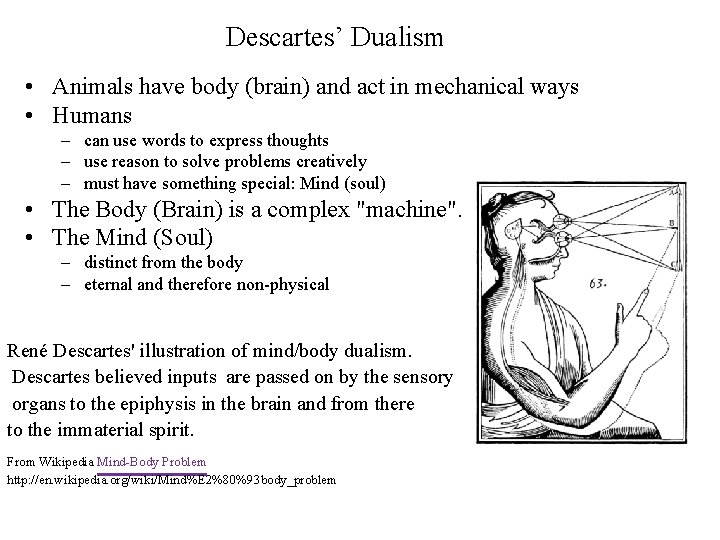
Descartes’ Dualism • Animals have body (brain) and act in mechanical ways • Humans – can use words to express thoughts – use reason to solve problems creatively – must have something special: Mind (soul) • The Body (Brain) is a complex "machine". • The Mind (Soul) – distinct from the body – eternal and therefore non-physical René Descartes' illustration of mind/body dualism. Descartes believed inputs are passed on by the sensory organs to the epiphysis in the brain and from there to the immaterial spirit. From Wikipedia Mind-Body Problem http: //en. wikipedia. org/wiki/Mind%E 2%80%93 body_problem
Concept of Mind • Do you have a mind? – If so, where is it located? • Concept of mind – – – Sense of self Free Will Consciousness A little person in your head Immaterial spirit or soul • Biological Psychology approach to understanding mind – “. . in this book we explore the many ways in which the structures and actions of the brain produce mind and behavior. ” Breedlove & Watson 2017, Biological Psychology, page 1.
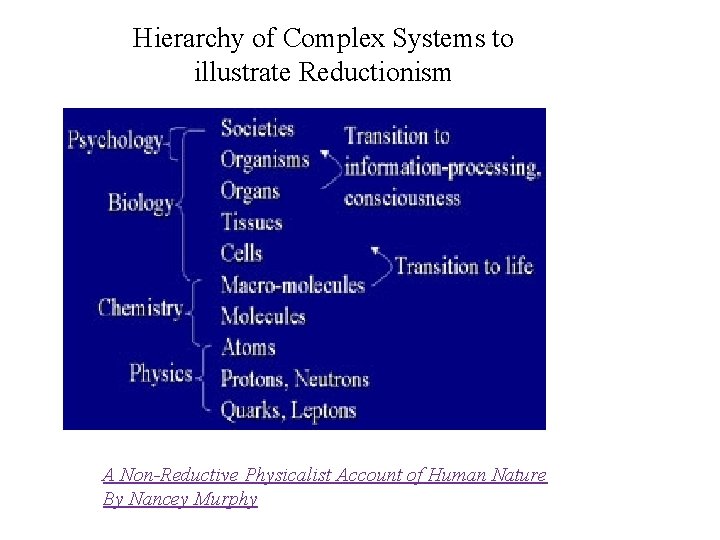
Reductionism (reductionistic approach) • Complex systems can be completely understood in terms of their components. –explain and interpret phenomena at a different level of analysis. –For example: “consciousness” reduced to principles of the brain • The idea that certain things might be shown to be nothing but certain other sorts of things. –water is nothing but hydrogen (H) and oxygen (O) molecules • statements about water are reducible to statements about collections of H & O molecules –Related to Mind-Body problem because it is often referred to as Reductive Physicalism
Hierarchy of Complex Systems to illustrate Reductionism A Non-Reductive Physicalist Account of Human Nature By Nancey Murphy
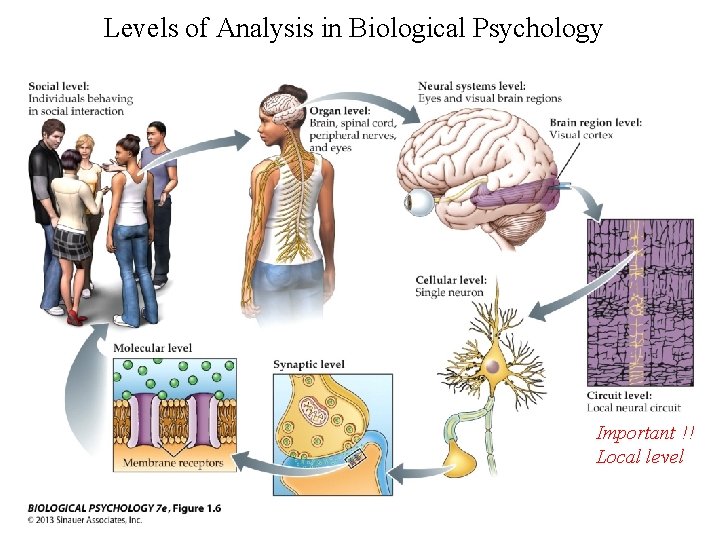
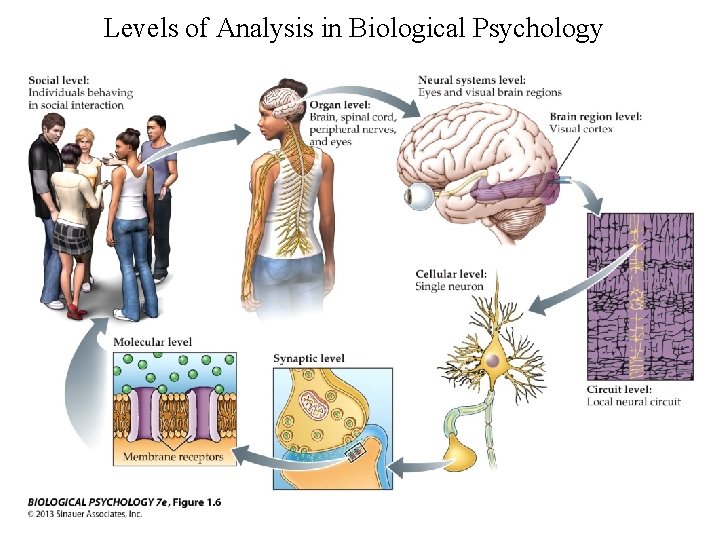
Levels of Analysis in Biological Psychology Important !! Local level
Levels of Analysis in Biological Psychology • Reductionism “In principle, it is possible to reduce each explanatory series down to the molecular or atomic level, though for practical reasons this extent of reductionism is rare. ” (Breedlove, 2017 p. 10 ) • “The units of each level of analysis are simpler in structure and organization than those of the level above. ” (Breedlove, 2017 p. 10 ) – This approach is reductive physicalism – Physicalism implies that everything is physical – Stanford Encyclopedia of Philosophy: Physicalism • There are problems with these assumptions about reductionism. – Appears that you can explain everything at the atomic level – Is the atomic and molecular levels really simpler? See fig 1. 6
Limitations of Reductionism • Gendle, Point #2: At present reductive physicalism is fundamentally unable to answer how basic biological, chemical, or physical processes create specific individual experience (“qualia”) – Qualia is subjective personal experience such as seeing the color blue. – Referred to as the “hard problem” of human consciousness. – An “explanatory gap” between our knowledge of neuroscience and explaining subjective experience • Conscious awareness includes a sense of self – Humans have a very strong subjective sense of self – Which brings us back around to the concept of mind – Do you have a mind? • If so, where is it? • If so, what is it? • So are we stuck without an explanation for subjective experience?
Limitations of Reductionism • Gendle point #3: promissory materialism is a provisionary position, and the inclusion of it in an empirically focus discussion of philosophy of mind is inappropriate. – Neuroscience will one day figure it all out. – There must be a mechanism that explains how the mind works • Gendle is being too harsh with this comment. – Speculation is okay as long as it does not substitute for explanation. – So, what type of explanations exists that could help explain the mind, body problem?
Limitations of Reductionism • Gendle point #1: There currently exists no one single theoretical framework that can completely account for how mental phenomena arise from physical processes occurring in the nervous system. – Neither monist reductive physicalism nor Cartesian dualism is acceptable. • But other approaches such as non-reductive physicalism can explain the relationship between mental processes and physical activity. – Non-reductive physicalism is a weak version of emergentism
Non-reductive Physicalism • The mind is an emergent property of the brain – sensation of pain emerges from (supervenes) the firing of 'pain neurons' – Emergent properties are produced by the merging of properties at a finer scale. • water molecules have emergent properties that arise out of the properties of oxygen and hydrogen atoms • Mind is more than the sum of brain parts – i. e. not an additive process rather it is an emergent property of the brain – could be a nonlinear system explained by chaos theory • Gilbert Ryle The Concept of Mind (1949) – A founding document in the philosophy of mind – Descartes' Myth of "the dogma of the Ghost in the machine“ • António Damásio, Descartes' Error: (1994) – Damasio's research in neuroscience has shown that emotions play a central role in social cognition – René Descartes' "error" was the dualist separation of mind and body, rationality and emotion
Levels of Analysis in Biological Psychology
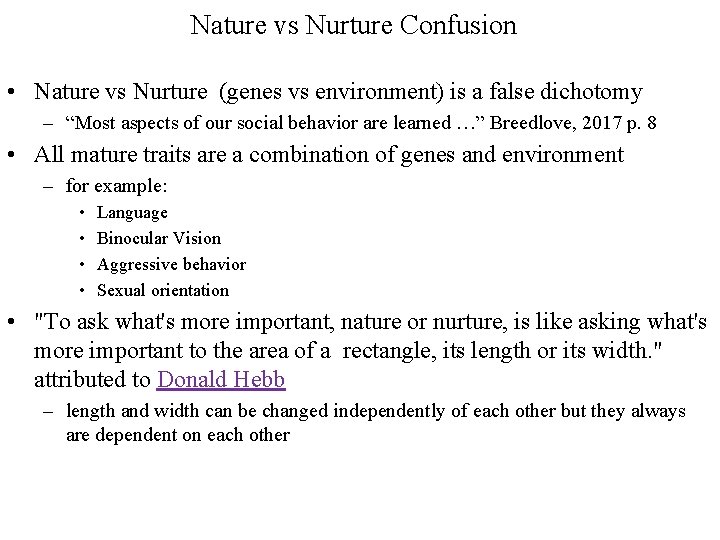
Nature vs Nurture Confusion • Nature vs Nurture (genes vs environment) is a false dichotomy – “Most aspects of our social behavior are learned …” Breedlove, 2017 p. 8 • All mature traits are a combination of genes and environment – for example: • • Language Binocular Vision Aggressive behavior Sexual orientation • "To ask what's more important, nature or nurture, is like asking what's more important to the area of a rectangle, its length or its width. " attributed to Donald Hebb – length and width can be changed independently of each other but they always are dependent on each other
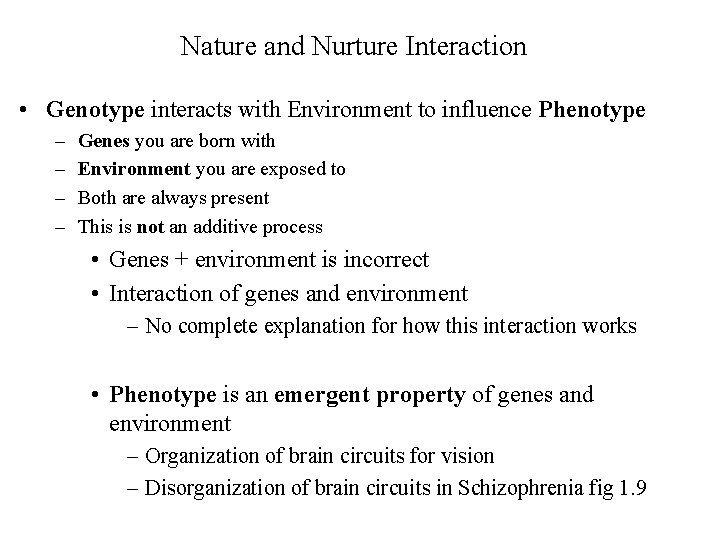
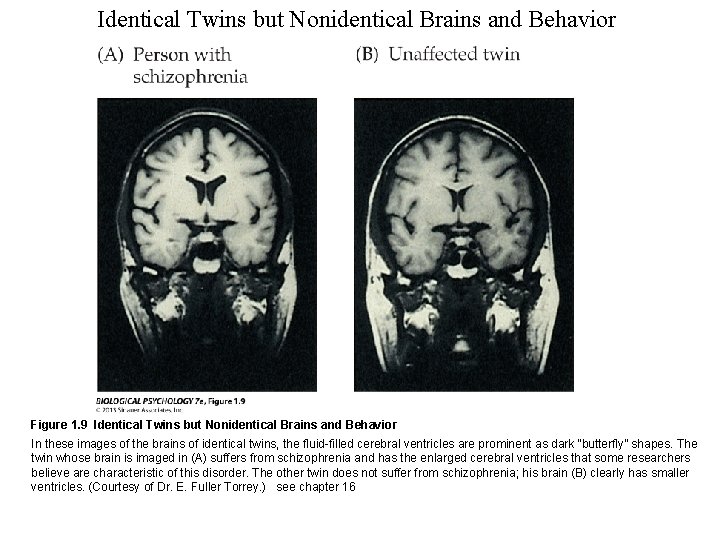
Nature and Nurture Interaction • Genotype interacts with Environment to influence Phenotype – – Genes you are born with Environment you are exposed to Both are always present This is not an additive process • Genes + environment is incorrect • Interaction of genes and environment – No complete explanation for how this interaction works • Phenotype is an emergent property of genes and environment – Organization of brain circuits for vision – Disorganization of brain circuits in Schizophrenia fig 1. 9
Identical Twins but Nonidentical Brains and Behavior Figure 1. 9 Identical Twins but Nonidentical Brains and Behavior In these images of the brains of identical twins, the fluid-filled cerebral ventricles are prominent as dark “butterfly” shapes. The twin whose brain is imaged in (A) suffers from schizophrenia and has the enlarged cerebral ventricles that some researchers believe are characteristic of this disorder. The other twin does not suffer from schizophrenia; his brain (B) clearly has smaller ventricles. (Courtesy of Dr. E. Fuller Torrey. ) see chapter 16
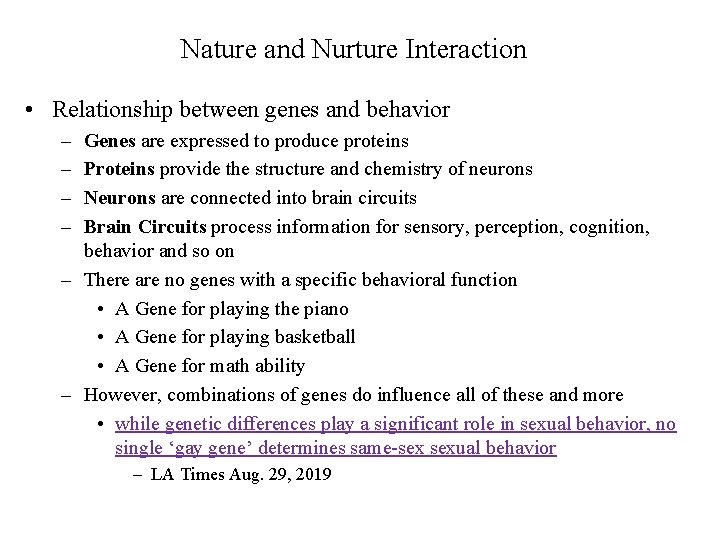
Nature and Nurture Interaction • Relationship between genes and behavior – – Genes are expressed to produce proteins Proteins provide the structure and chemistry of neurons Neurons are connected into brain circuits Brain Circuits process information for sensory, perception, cognition, behavior and so on – There are no genes with a specific behavioral function • A Gene for playing the piano • A Gene for playing basketball • A Gene for math ability – However, combinations of genes do influence all of these and more • while genetic differences play a significant role in sexual behavior, no single ‘gay gene’ determines same-sex sexual behavior – LA Times Aug. 29, 2019
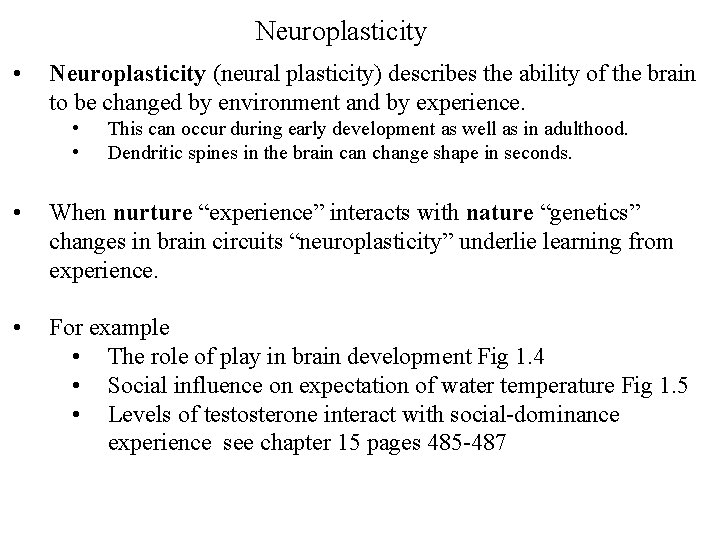
Neuroplasticity • Neuroplasticity (neural plasticity) describes the ability of the brain to be changed by environment and by experience. • • This can occur during early development as well as in adulthood. Dendritic spines in the brain can change shape in seconds. • When nurture “experience” interacts with nature “genetics” changes in brain circuits “neuroplasticity” underlie learning from experience. • For example • The role of play in brain development Fig 1. 4 • Social influence on expectation of water temperature Fig 1. 5 • Levels of testosterone interact with social-dominance experience see chapter 15 pages 485 -487
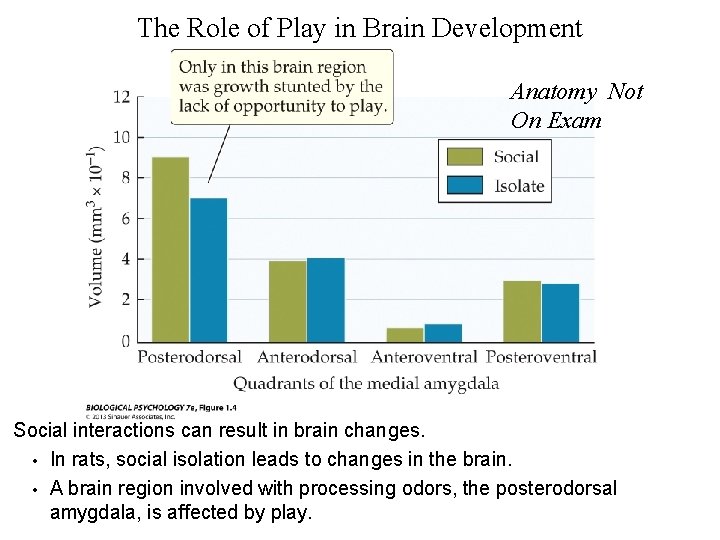
The Role of Play in Brain Development Anatomy Not On Exam Social interactions can result in brain changes. • In rats, social isolation leads to changes in the brain. • A brain region involved with processing odors, the posterodorsal amygdala, is affected by play.
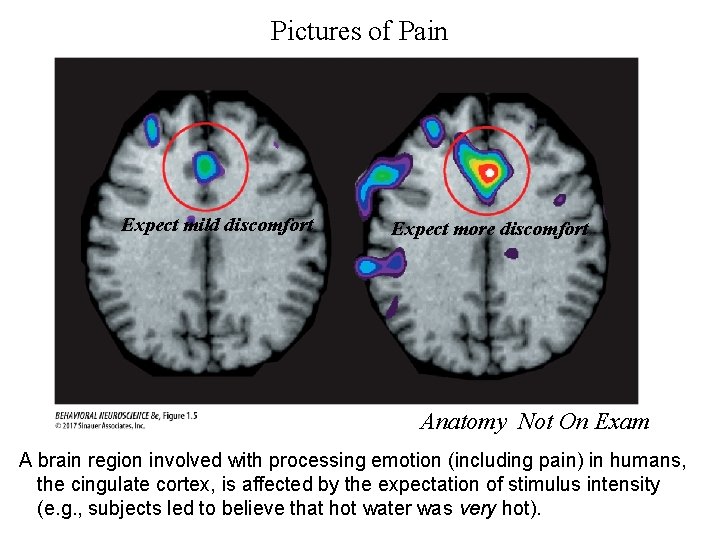
Pictures of Pain Expect mild discomfort Expect more discomfort Anatomy Not On Exam A brain region involved with processing emotion (including pain) in humans, the cingulate cortex, is affected by the expectation of stimulus intensity (e. g. , subjects led to believe that hot water was very hot).
Consciousness is a thorny problem • Can be regarded as conscious in a number of different senses • Sentience: capable of sensing and responding • Wakefulness: awake and alert • Self-consciousness: aware of self • Awareness Consciousness: the state of awareness of one’s own existence and experience, • is important and is connected to brain activity. • allows us to do important things like planning and reaching conclusions • However, some brain activity is unconscious. • deep parts of our brain are important for arousal • topmost parts of the brain are responsible for current experience • Our understanding of consciousness is still in its infancy • difficulty explaining it in terms of brain mechanisms • for example: patterns of activity in brain circuits for color perception • A qualitative state of consciousness • Stanford Encyclopedia of Philosophy : Consciousness