
PHILOSOPHY OF LIMIT STATE DESIGN AND CLASSIFICATION OF







- Slides: 68
PHILOSOPHY OF LIMIT STATE DESIGN AND CLASSIFICATION OF SECTIONS
What is Limit State? Acceptable limit for the safety and serviceability requirements before failure occurs is called a Limit state
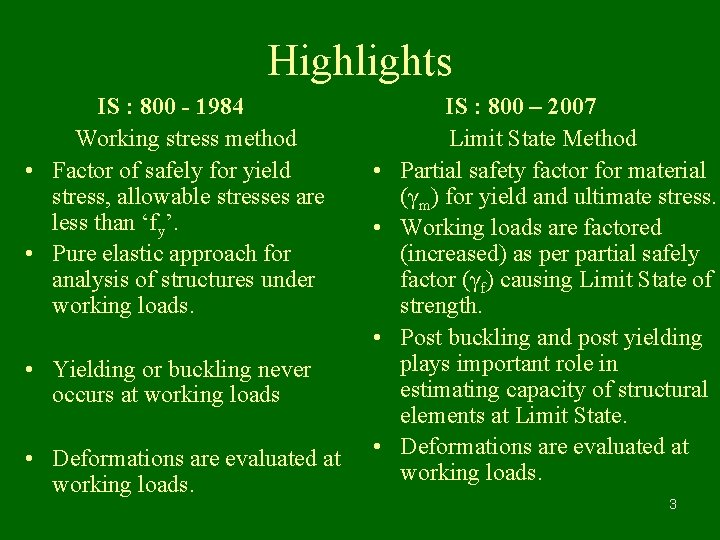
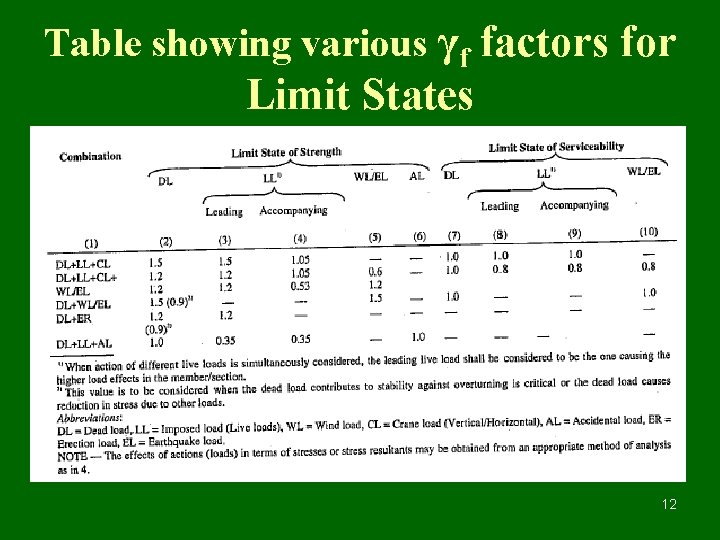
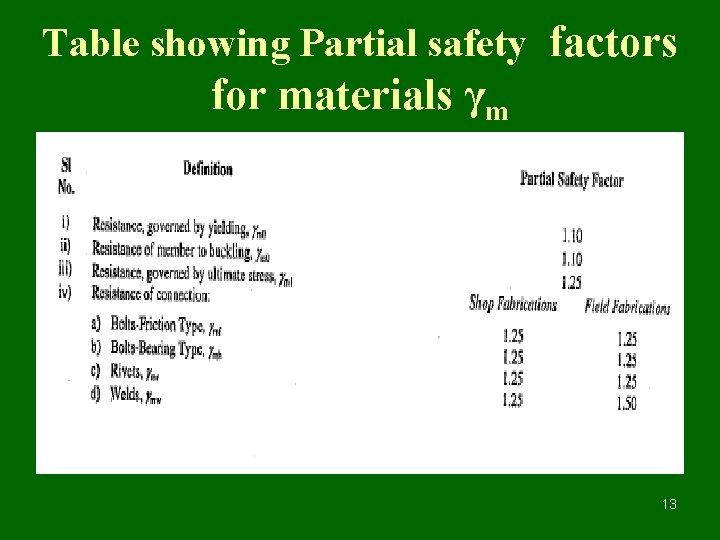
Highlights IS : 800 - 1984 Working stress method • Factor of safely for yield stress, allowable stresses are less than ‘fy’. • Pure elastic approach for analysis of structures under working loads. • • Yielding or buckling never occurs at working loads • Deformations are evaluated at working loads. • IS : 800 – 2007 Limit State Method Partial safety factor for material (γm) for yield and ultimate stress. Working loads are factored (increased) as per partial safely factor (γf) causing Limit State of strength. Post buckling and post yielding plays important role in estimating capacity of structural elements at Limit State. Deformations are evaluated at working loads. 3
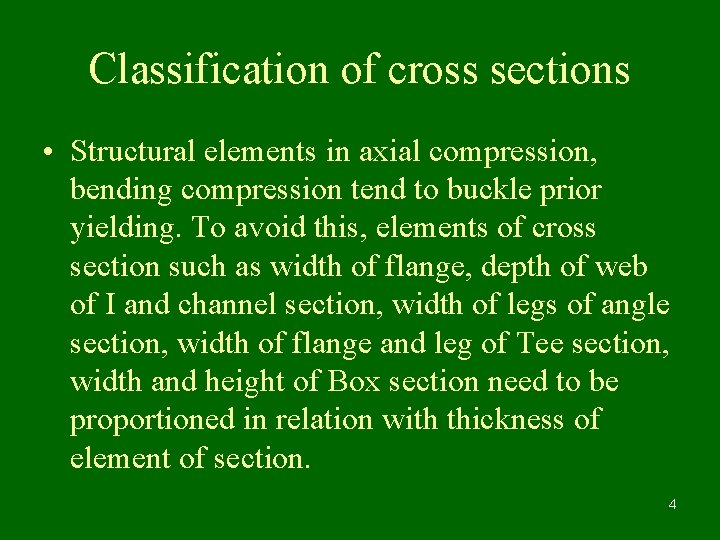
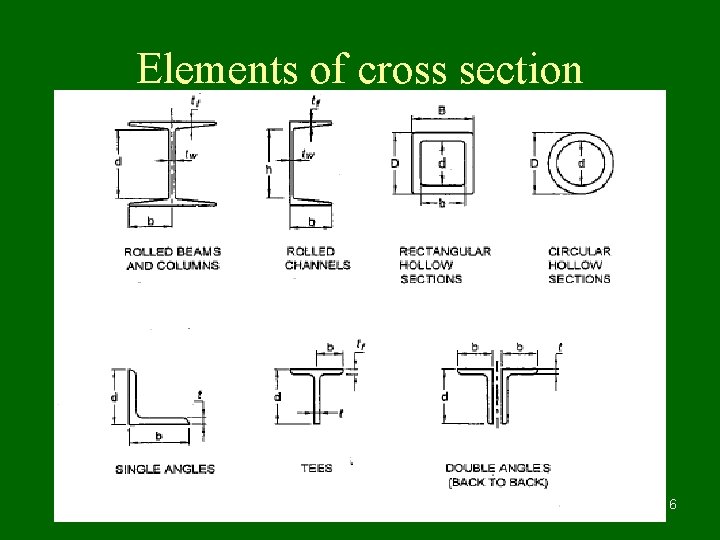
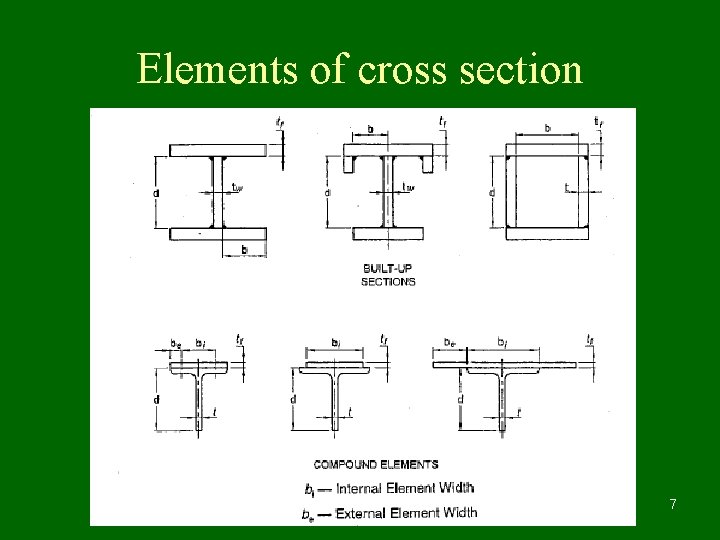
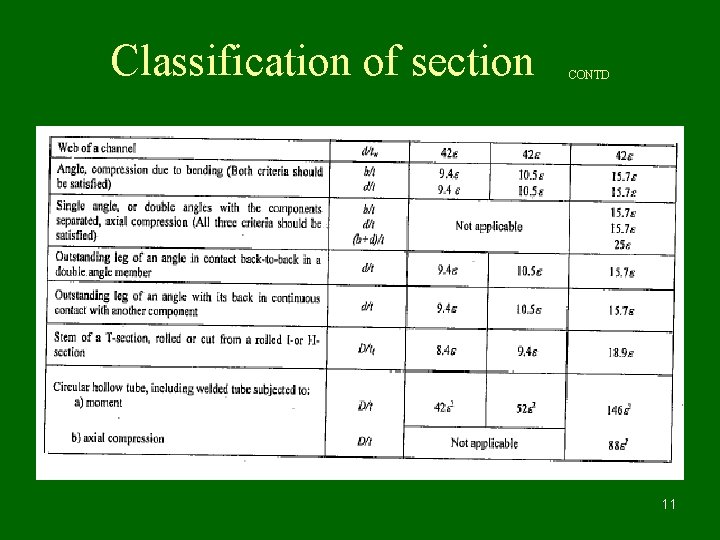
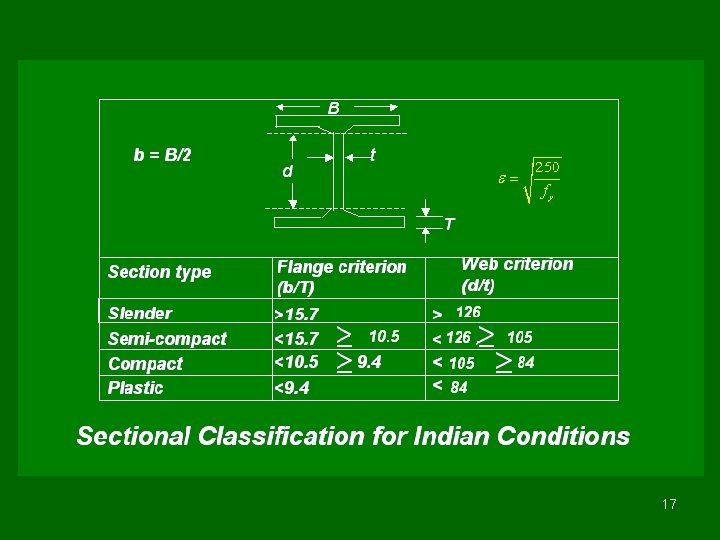
Classification of cross sections • Structural elements in axial compression, bending compression tend to buckle prior yielding. To avoid this, elements of cross section such as width of flange, depth of web of I and channel section, width of legs of angle section, width of flange and leg of Tee section, width and height of Box section need to be proportioned in relation with thickness of element of section. 4
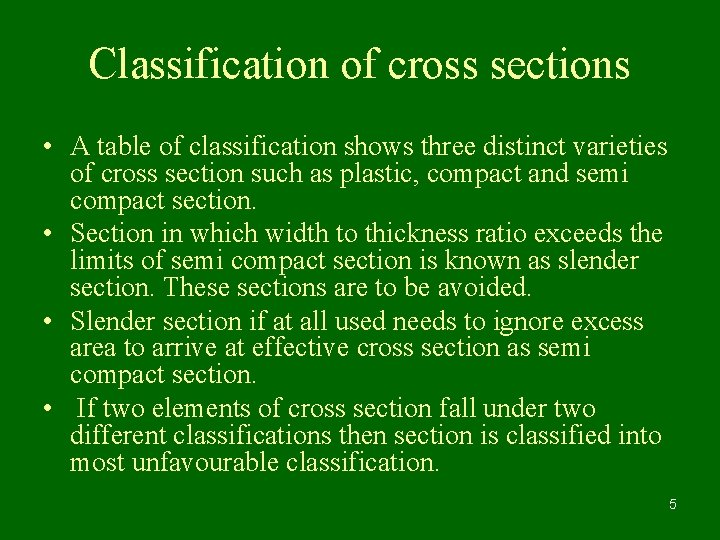
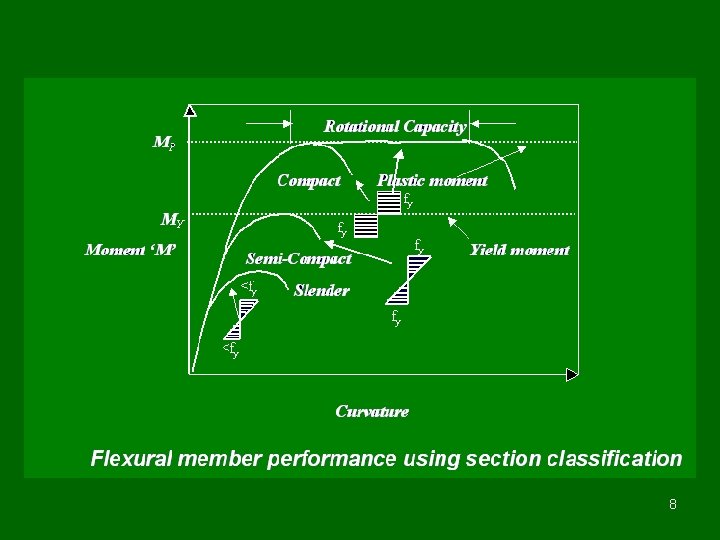
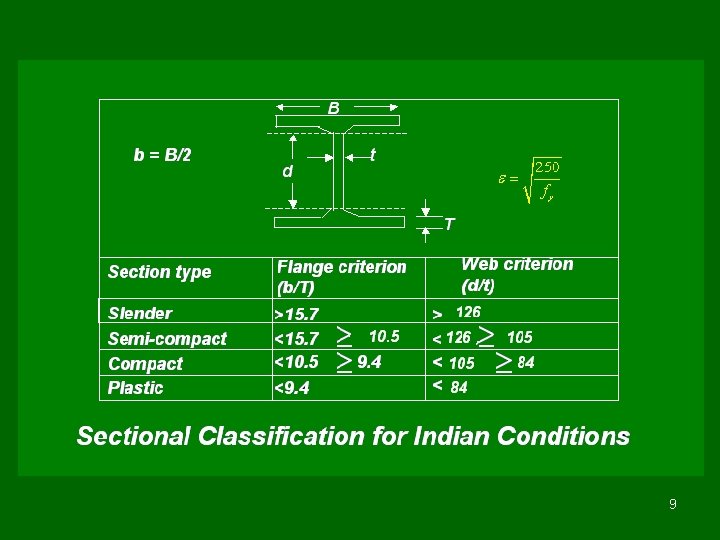
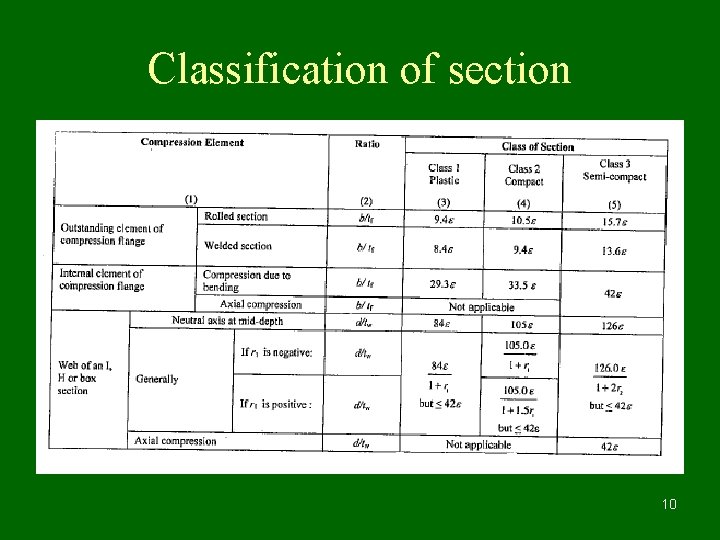
Classification of cross sections • A table of classification shows three distinct varieties of cross section such as plastic, compact and semi compact section. • Section in which width to thickness ratio exceeds the limits of semi compact section is known as slender section. These sections are to be avoided. • Slender section if at all used needs to ignore excess area to arrive at effective cross section as semi compact section. • If two elements of cross section fall under two different classifications then section is classified into most unfavourable classification. 5
Elements of cross section 6
Elements of cross section 7
8
9
Classification of section 10
Classification of section CONTD 11
Table showing various γf factors for Limit States 12
Table showing Partial safety factors for materials γm 13
THE END 14
DESIGN OF FLEXURAL MEMBER AND BENDING WITH HIGH SHEAR 15
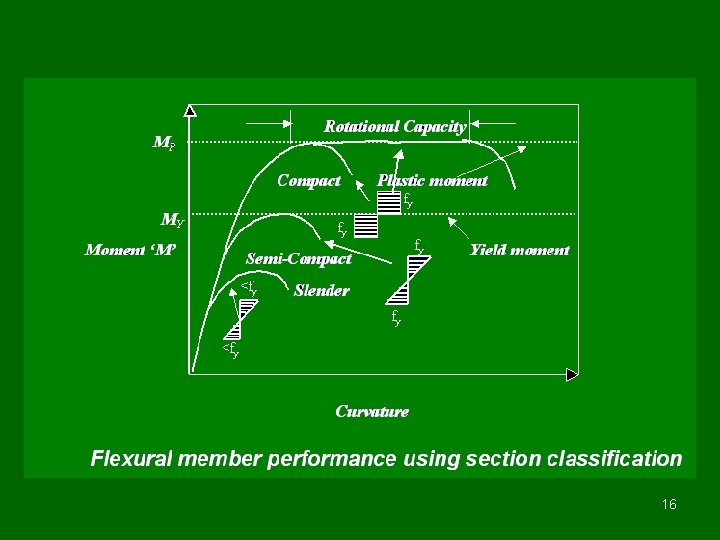
16
17
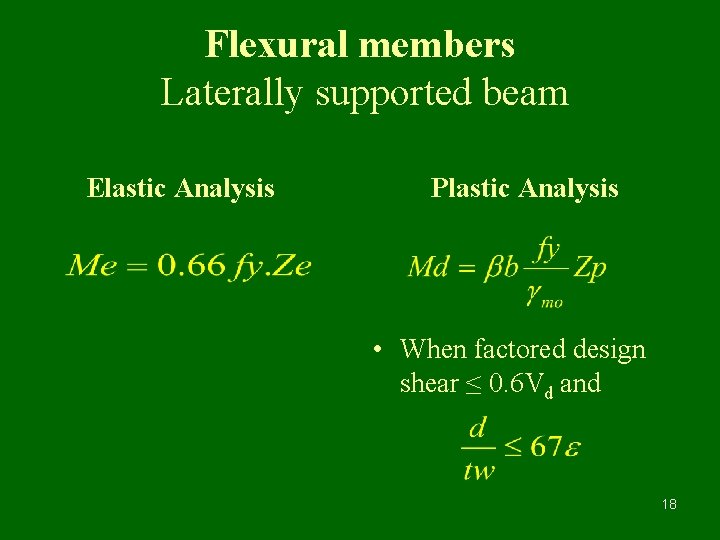
Flexural members Laterally supported beam Elastic Analysis Plastic Analysis • When factored design shear ≤ 0. 6 Vd and 18
Conditions to Qualify as a Laterally Restrained Beam • It should not laterally buckle • None of its element should buckle until a desired limit state is achieved • Limit state of serviceability must be satisfied • Member should behave in accordance with the expected performance of the system 19
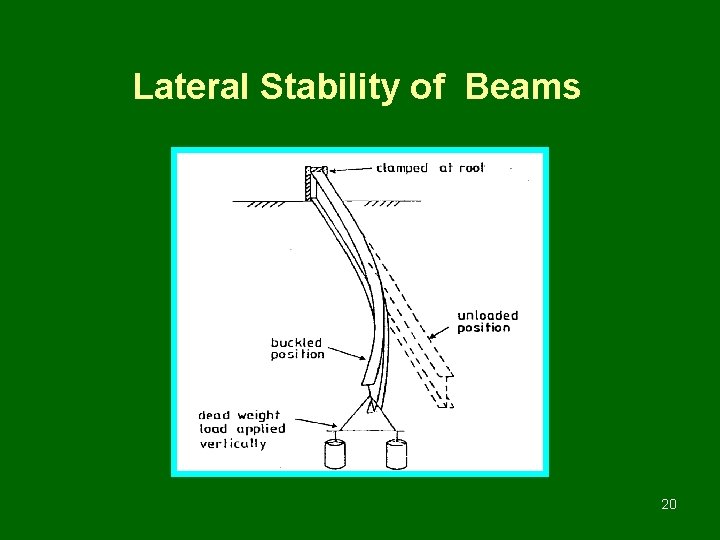
Lateral Stability of Beams 20
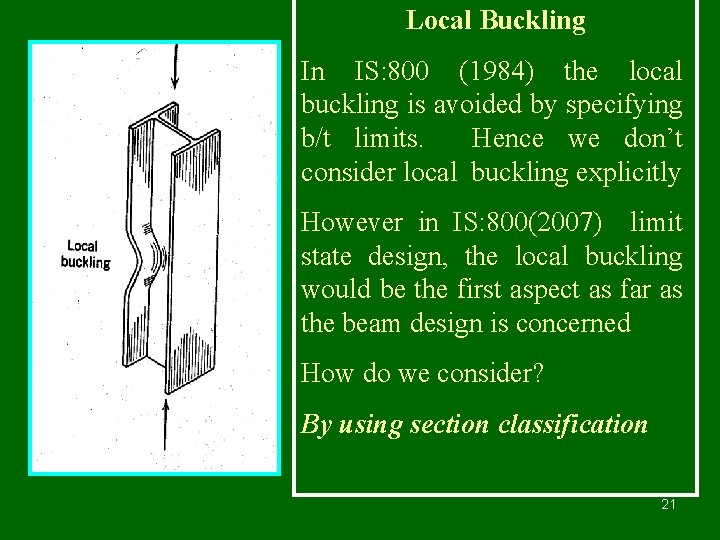
Local Buckling In IS: 800 (1984) the local buckling is avoided by specifying b/t limits. Hence we don’t consider local buckling explicitly However in IS: 800(2007) limit state design, the local buckling would be the first aspect as far as the beam design is concerned How do we consider? By using section classification 21
Limit states for LR beams • Limit state of flexure • Limit state of shear • Limit state of bearing • Limit state of serviceability 22
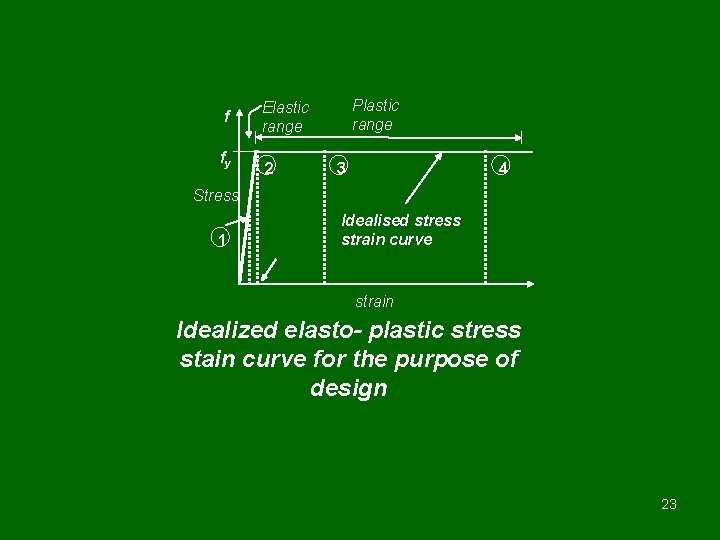
f fy Plastic range Elastic range 2 3 4 Stress 1 Idealised stress strain curve strain Idealized elasto- plastic stress stain curve for the purpose of design 23
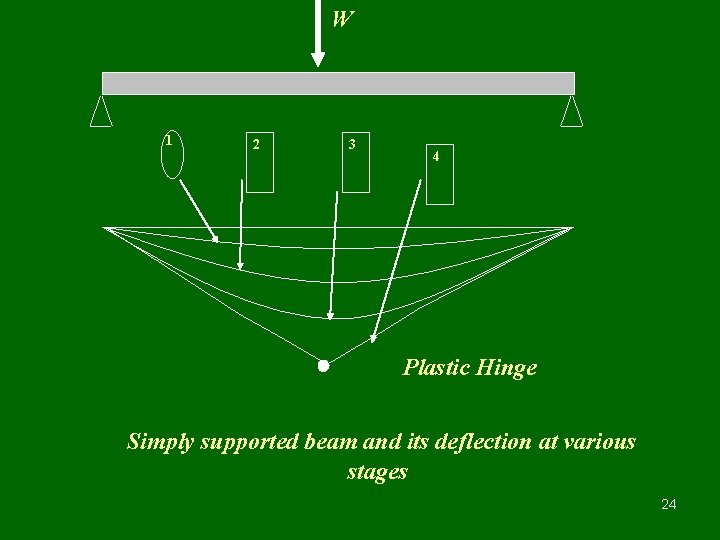
W 1 2 3 4 Plastic Hinge Simply supported beam and its deflection at various stages 24
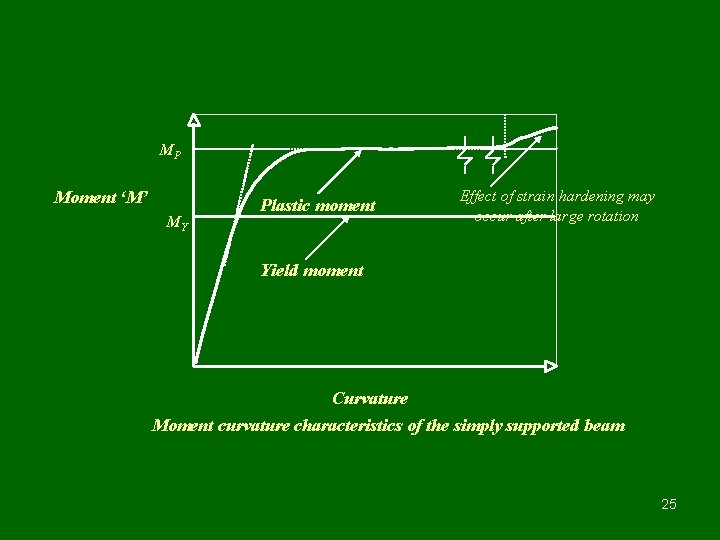
MP Moment ‘M’ MY Plastic moment Effect of strain hardening may occur after large rotation Yield moment Curvature Moment curvature characteristics of the simply supported beam 25
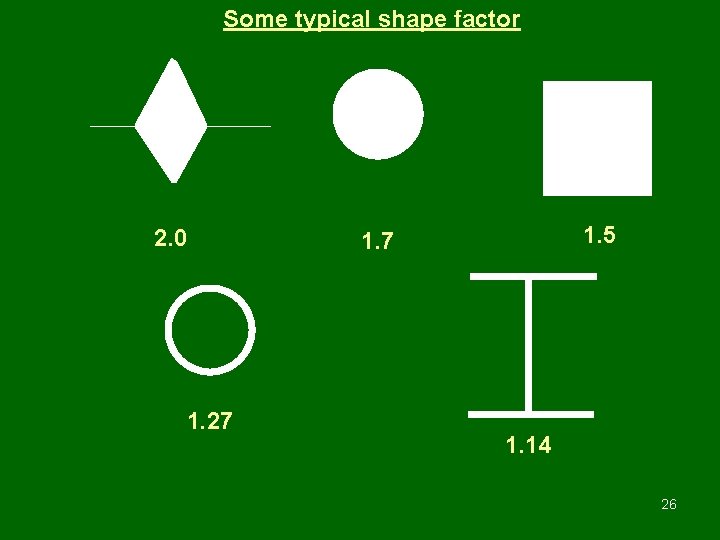
Some typical shape factor 2. 0 1. 27 1. 5 1. 7 1. 14 26
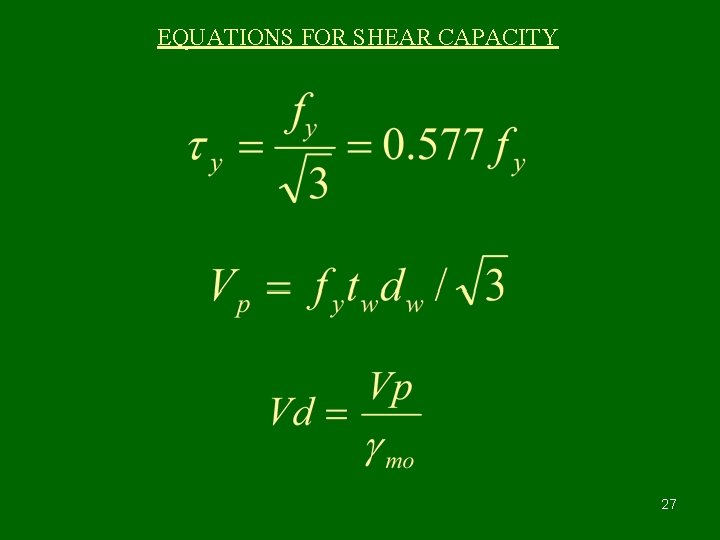
EQUATIONS FOR SHEAR CAPACITY 27
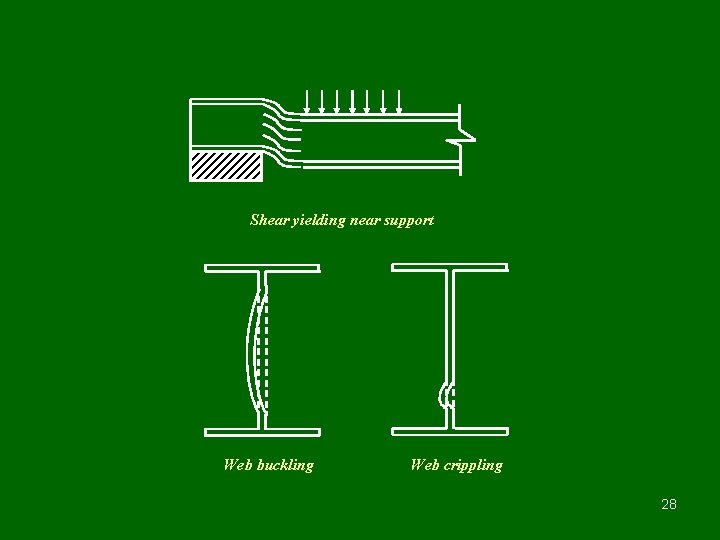
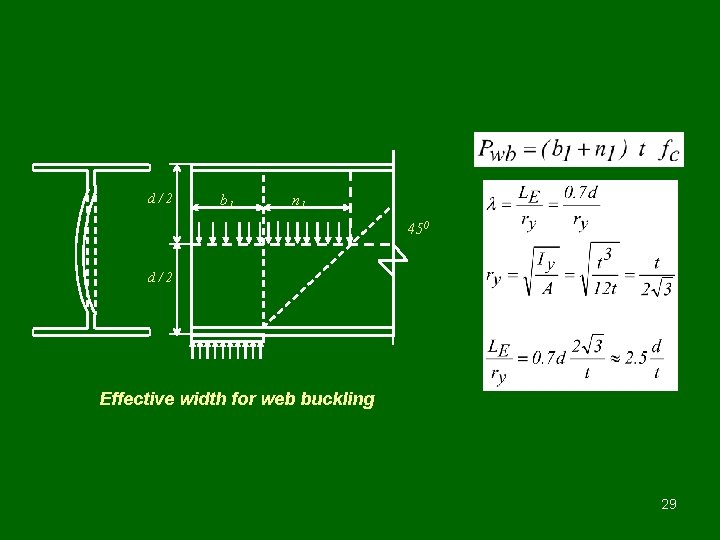
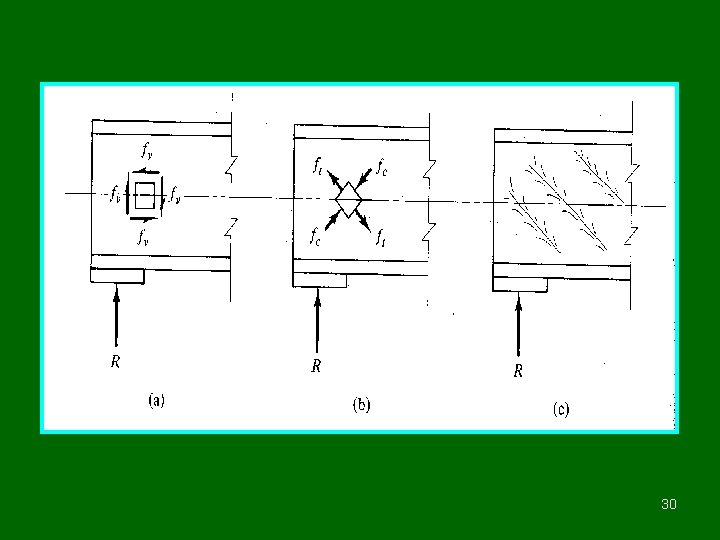
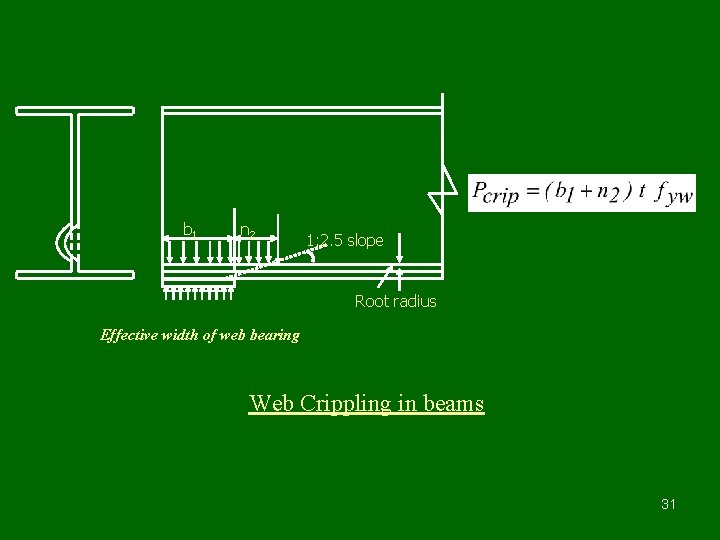
Shear yielding near support Web buckling Web crippling 28
d/2 b 1 n 1 450 d/2 Effective width for web buckling 29
30
b 1 n 2 1: 2. 5 slope Root radius Effective width of web bearing Web Crippling in beams 31
Design of Laterally Supported Beam Limit State Method – As per IS: 800 - 2007. Example No : 1 Design a suitable I beam for a simply supported span of 5 m. and carrying a dead load of 20 k. N/m and imposed load of 40 k. N/m. Take fy = 250 MPa Design load calculations : Factored load = γLD x 20 + γLL x 40 Using partial safety factors for D. L γLD = 1. 50 and for L. L γLL = 1. 5 (Cl. 5. 3. 3 Table 4, Page 29) 32
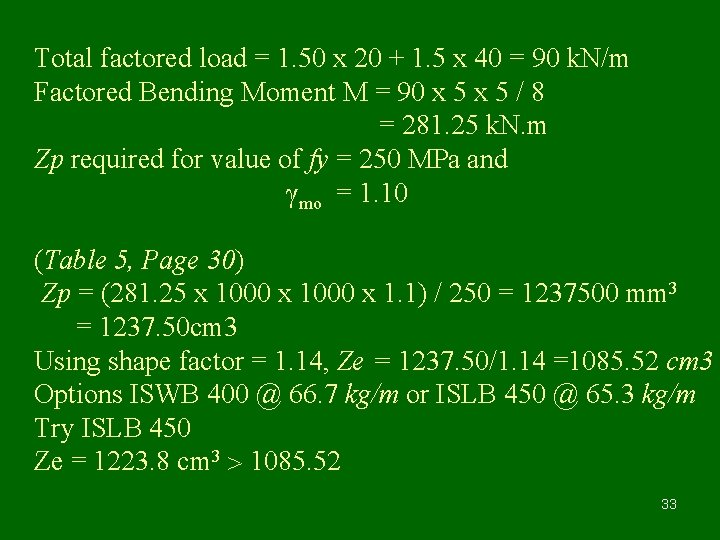
Total factored load = 1. 50 x 20 + 1. 5 x 40 = 90 k. N/m Factored Bending Moment M = 90 x 5 / 8 = 281. 25 k. N. m Zp required for value of fy = 250 MPa and γmo = 1. 10 (Table 5, Page 30) Zp = (281. 25 x 1000 x 1. 1) / 250 = 1237500 mm 3 = 1237. 50 cm 3 Using shape factor = 1. 14, Ze = 1237. 50/1. 14 =1085. 52 cm 3 Options ISWB 400 @ 66. 7 kg/m or ISLB 450 @ 65. 3 kg/m Try ISLB 450 Ze = 1223. 8 cm 3 1085. 52 33
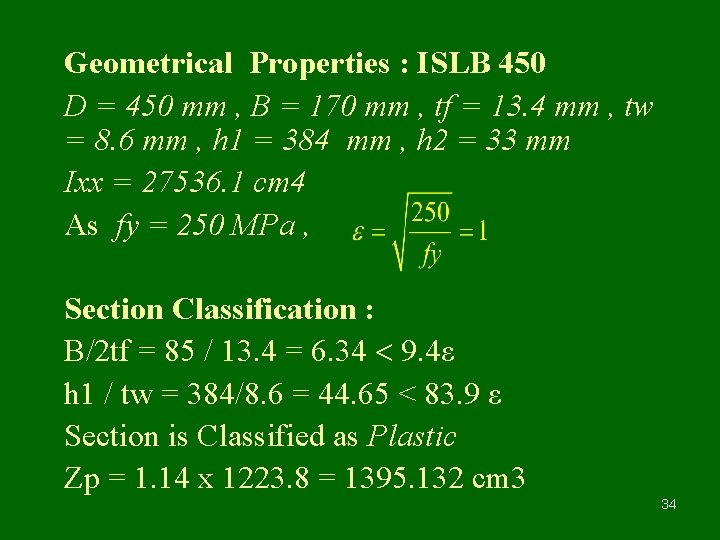
Geometrical Properties : ISLB 450 D = 450 mm , B = 170 mm , tf = 13. 4 mm , tw = 8. 6 mm , h 1 = 384 mm , h 2 = 33 mm Ixx = 27536. 1 cm 4 As fy = 250 MPa , Section Classification : B/2 tf = 85 / 13. 4 = 6. 34 9. 4ε h 1 / tw = 384/8. 6 = 44. 65 < 83. 9 ε Section is Classified as Plastic Zp = 1. 14 x 1223. 8 = 1395. 132 cm 3 34
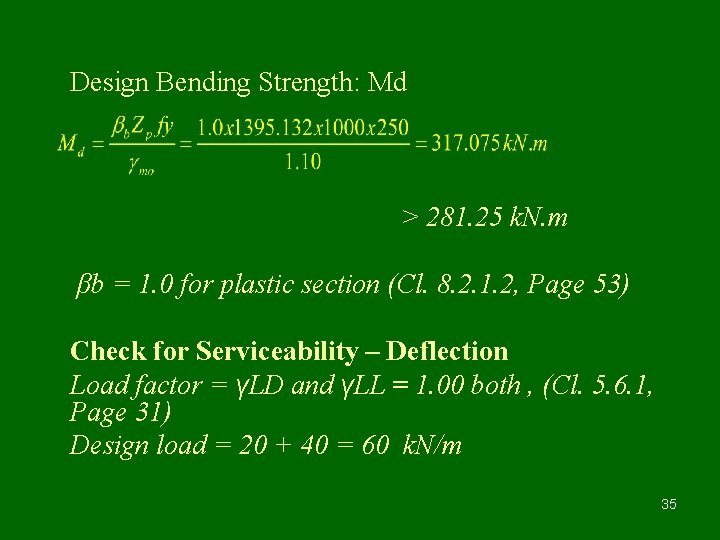
Design Bending Strength: Md > 281. 25 k. N. m βb = 1. 0 for plastic section (Cl. 8. 2. 1. 2, Page 53) Check for Serviceability – Deflection Load factor = γLD and γLL = 1. 00 both , (Cl. 5. 6. 1, Page 31) Design load = 20 + 40 = 60 k. N/m 35
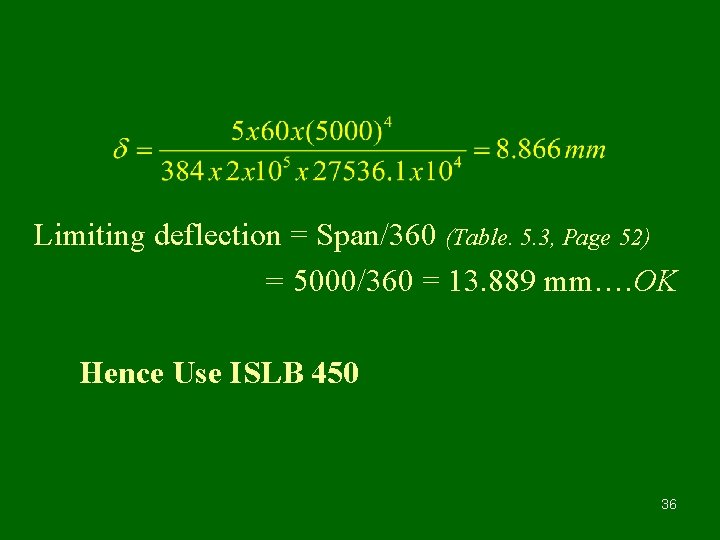
Limiting deflection = Span/360 (Table. 5. 3, Page 52) = 5000/360 = 13. 889 mm…. OK Hence Use ISLB 450 36
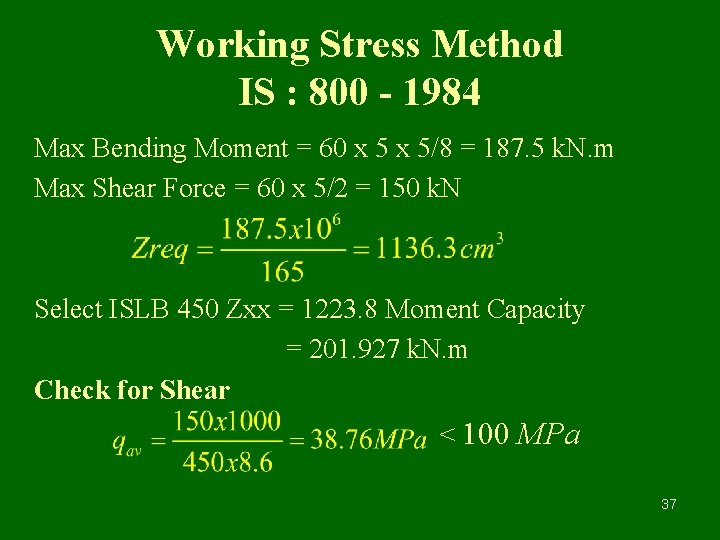
Working Stress Method IS : 800 - 1984 Max Bending Moment = 60 x 5/8 = 187. 5 k. N. m Max Shear Force = 60 x 5/2 = 150 k. N Select ISLB 450 Zxx = 1223. 8 Moment Capacity = 201. 927 k. N. m Check for Shear < 100 MPa 37
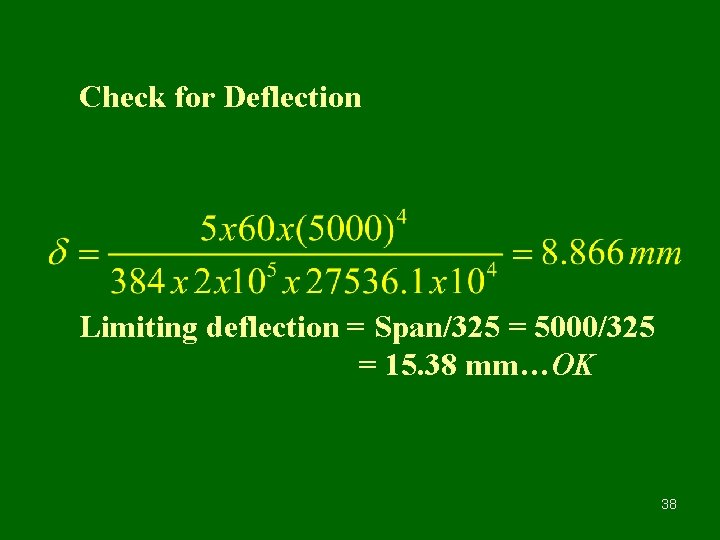
Check for Deflection Limiting deflection = Span/325 = 5000/325 = 15. 38 mm…OK 38
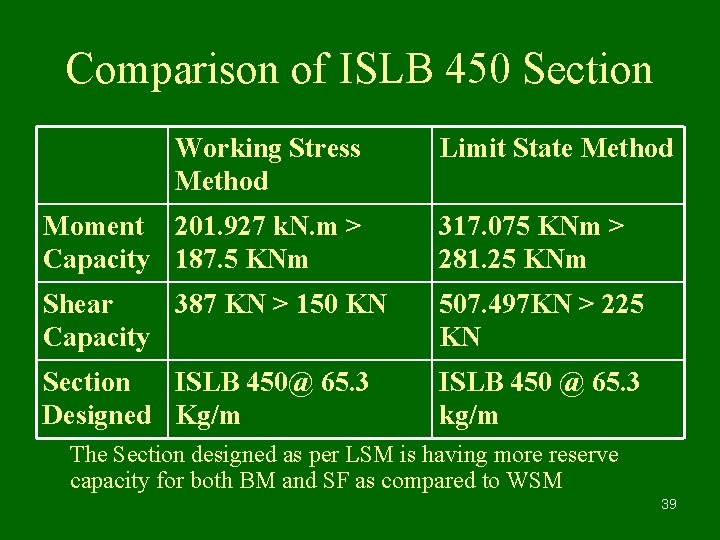
Comparison of ISLB 450 Section Working Stress Method Limit State Method Moment 201. 927 k. N. m > Capacity 187. 5 KNm 317. 075 KNm > 281. 25 KNm Shear 387 KN > 150 KN Capacity 507. 497 KN > 225 KN Section ISLB 450@ 65. 3 Designed Kg/m ISLB 450 @ 65. 3 kg/m The Section designed as per LSM is having more reserve capacity for both BM and SF as compared to WSM 39
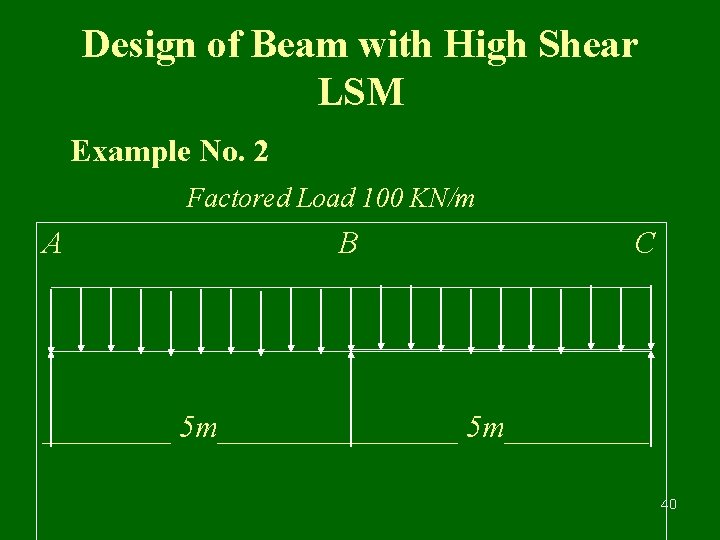
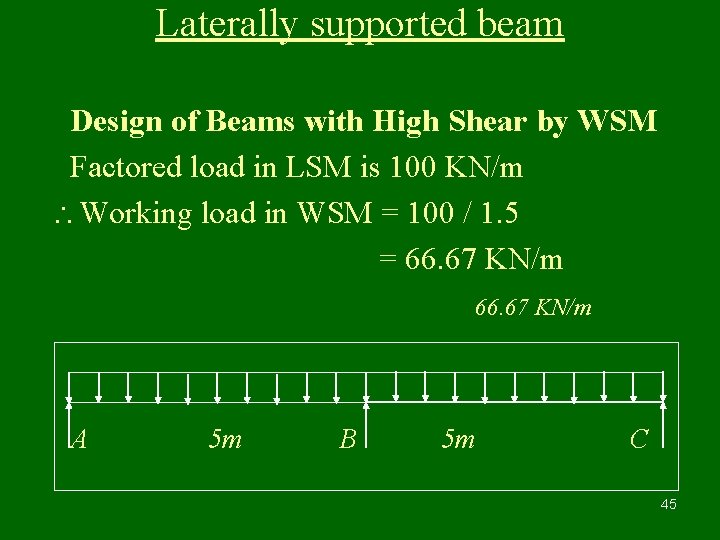
Design of Beam with High Shear LSM Example No. 2 Factored Load 100 KN/m A B C ________ 5 m_________ 40
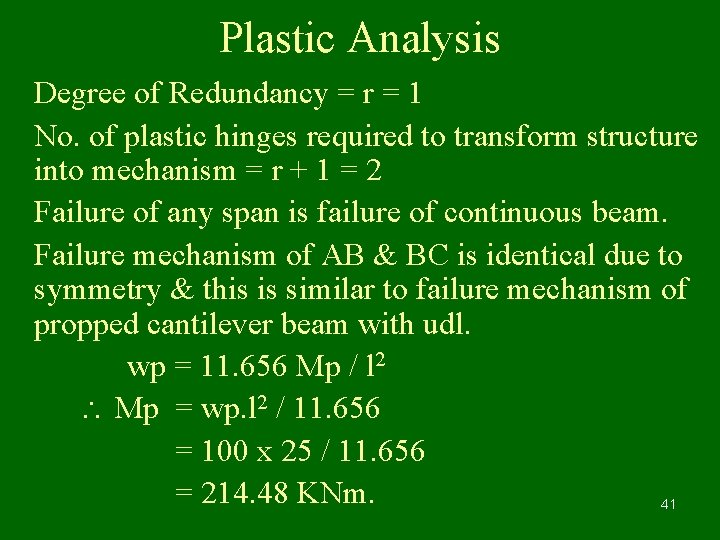
Plastic Analysis Degree of Redundancy = r = 1 No. of plastic hinges required to transform structure into mechanism = r + 1 = 2 Failure of any span is failure of continuous beam. Failure mechanism of AB & BC is identical due to symmetry & this is similar to failure mechanism of propped cantilever beam with udl. wp = 11. 656 Mp / l 2 Mp = wp. l 2 / 11. 656 = 100 x 25 / 11. 656 = 214. 48 KNm. 41
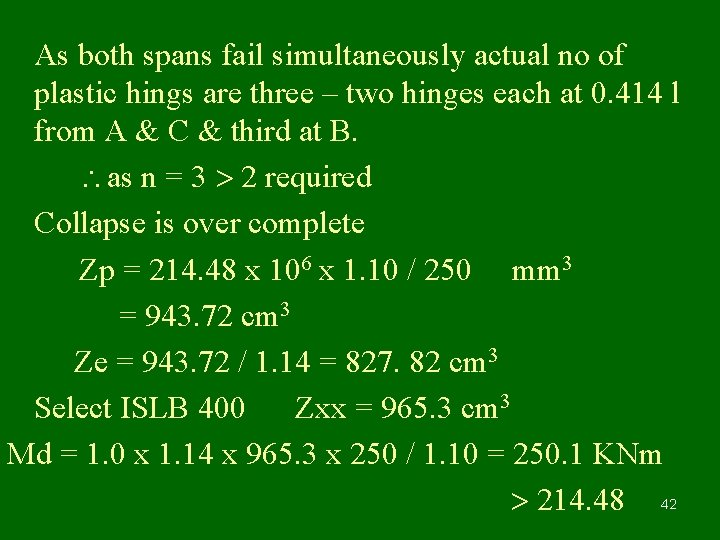
As both spans fail simultaneously actual no of plastic hings are three – two hinges each at 0. 414 l from A & C & third at B. as n = 3 2 required Collapse is over complete Zp = 214. 48 x 106 x 1. 10 / 250 mm 3 = 943. 72 cm 3 Ze = 943. 72 / 1. 14 = 827. 82 cm 3 Select ISLB 400 Zxx = 965. 3 cm 3 Md = 1. 0 x 1. 14 x 965. 3 x 250 / 1. 10 = 250. 1 KNm 214. 48 42
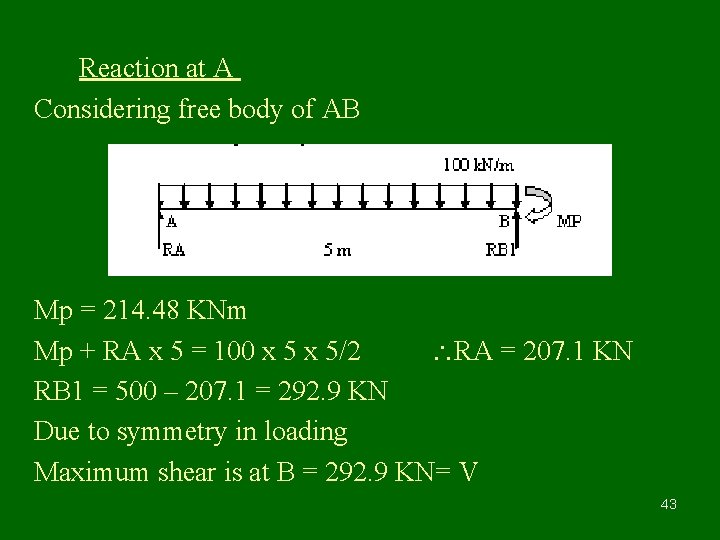
Reaction at A Considering free body of AB Mp = 214. 48 KNm Mp + RA x 5 = 100 x 5/2 RA = 207. 1 KN RB 1 = 500 – 207. 1 = 292. 9 KN Due to symmetry in loading Maximum shear is at B = 292. 9 KN= V 43
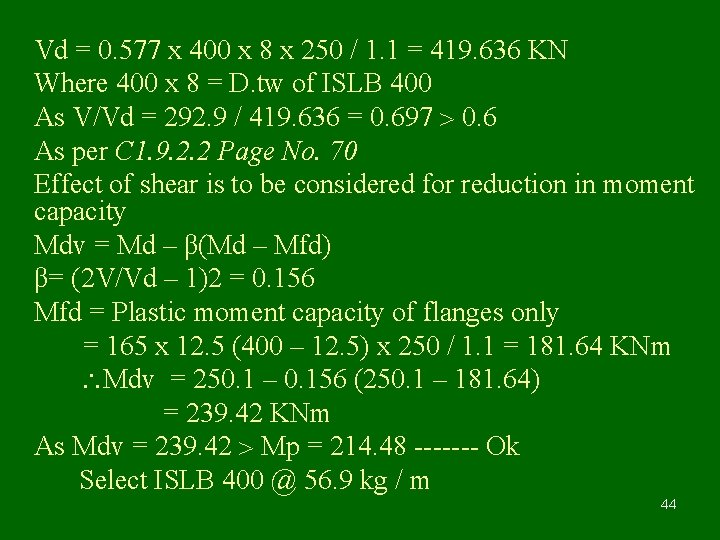
Vd = 0. 577 x 400 x 8 x 250 / 1. 1 = 419. 636 KN Where 400 x 8 = D. tw of ISLB 400 As V/Vd = 292. 9 / 419. 636 = 0. 697 0. 6 As per C 1. 9. 2. 2 Page No. 70 Effect of shear is to be considered for reduction in moment capacity Mdv = Md – β(Md – Mfd) β= (2 V/Vd – 1)2 = 0. 156 Mfd = Plastic moment capacity of flanges only = 165 x 12. 5 (400 – 12. 5) x 250 / 1. 1 = 181. 64 KNm Mdv = 250. 1 – 0. 156 (250. 1 – 181. 64) = 239. 42 KNm As Mdv = 239. 42 Mp = 214. 48 ------- Ok Select ISLB 400 @ 56. 9 kg / m 44
Laterally supported beam Design of Beams with High Shear by WSM Factored load in LSM is 100 KN/m Working load in WSM = 100 / 1. 5 = 66. 67 KN/m A 5 m B 5 m C 45
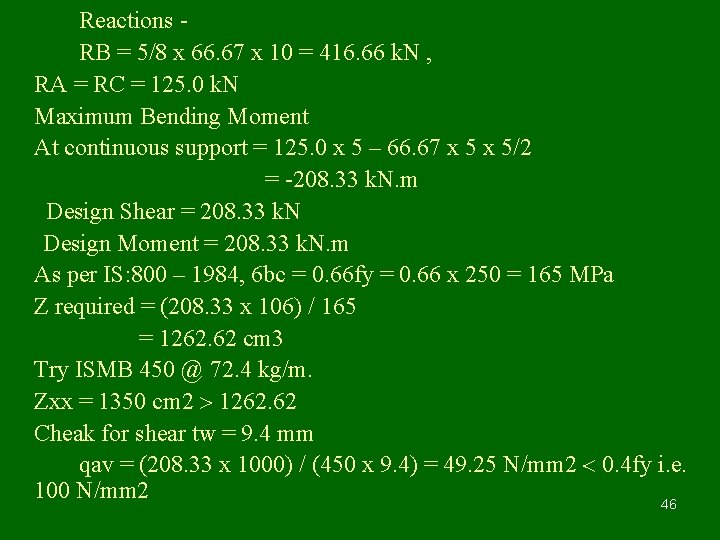
Reactions RB = 5/8 x 66. 67 x 10 = 416. 66 k. N , RA = RC = 125. 0 k. N Maximum Bending Moment At continuous support = 125. 0 x 5 – 66. 67 x 5/2 = -208. 33 k. N. m Design Shear = 208. 33 k. N Design Moment = 208. 33 k. N. m As per IS: 800 – 1984, 6 bc = 0. 66 fy = 0. 66 x 250 = 165 MPa Z required = (208. 33 x 106) / 165 = 1262. 62 cm 3 Try ISMB 450 @ 72. 4 kg/m. Zxx = 1350 cm 2 1262. 62 Cheak for shear tw = 9. 4 mm qav = (208. 33 x 1000) / (450 x 9. 4) = 49. 25 N/mm 2 0. 4 fy i. e. 100 N/mm 2 46
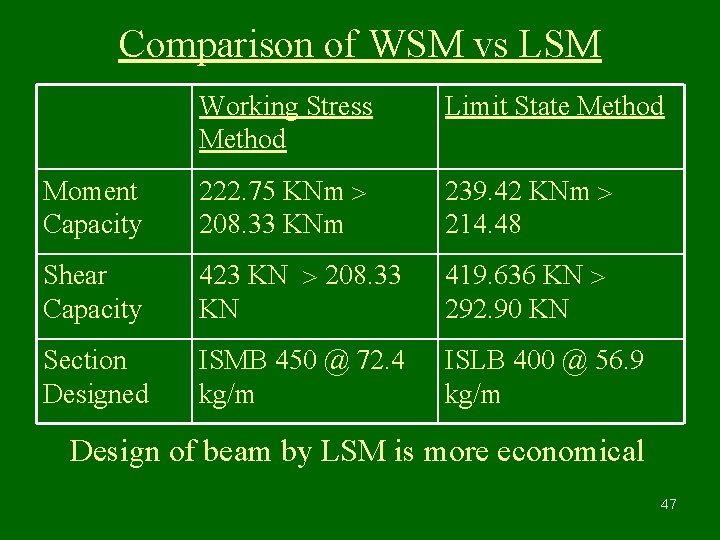
Comparison of WSM vs LSM Working Stress Method Limit State Method Moment Capacity 222. 75 KNm 208. 33 KNm 239. 42 KNm 214. 48 Shear Capacity 423 KN 208. 33 KN 419. 636 KN 292. 90 KN Section Designed ISMB 450 @ 72. 4 kg/m ISLB 400 @ 56. 9 kg/m Design of beam by LSM is more economical 47
THE END 48
DESIGN OF BEAM COLUMN 49
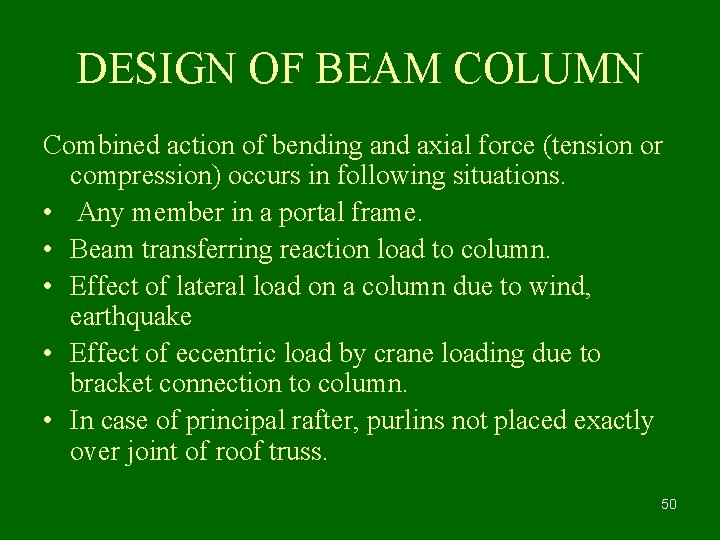
DESIGN OF BEAM COLUMN Combined action of bending and axial force (tension or compression) occurs in following situations. • Any member in a portal frame. • Beam transferring reaction load to column. • Effect of lateral load on a column due to wind, earthquake • Effect of eccentric load by crane loading due to bracket connection to column. • In case of principal rafter, purlins not placed exactly over joint of roof truss. 50
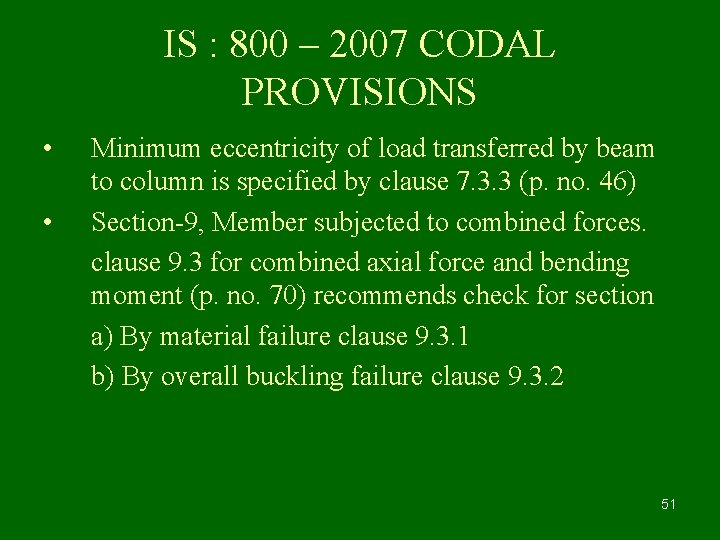
IS : 800 – 2007 CODAL PROVISIONS • • Minimum eccentricity of load transferred by beam to column is specified by clause 7. 3. 3 (p. no. 46) Section-9, Member subjected to combined forces. clause 9. 3 for combined axial force and bending moment (p. no. 70) recommends check for section a) By material failure clause 9. 3. 1 b) By overall buckling failure clause 9. 3. 2 51
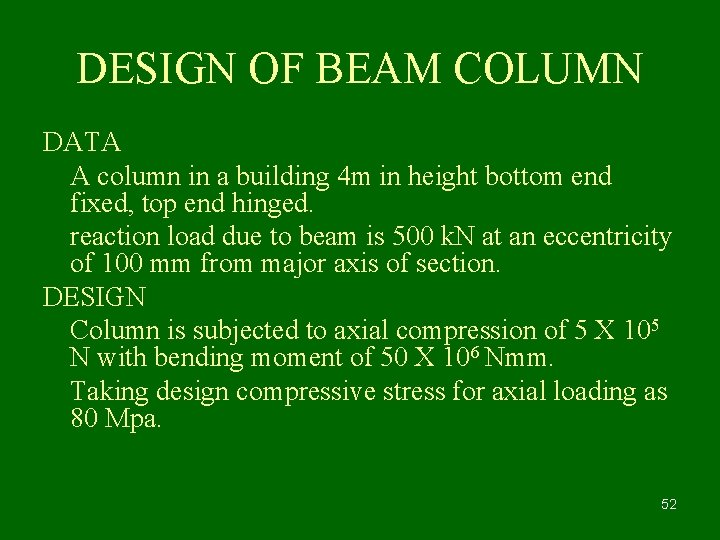
DESIGN OF BEAM COLUMN DATA A column in a building 4 m in height bottom end fixed, top end hinged. reaction load due to beam is 500 k. N at an eccentricity of 100 mm from major axis of section. DESIGN Column is subjected to axial compression of 5 X 10⁵ N with bending moment of 50 X 106 Nmm. Taking design compressive stress for axial loading as 80 Mpa. 52
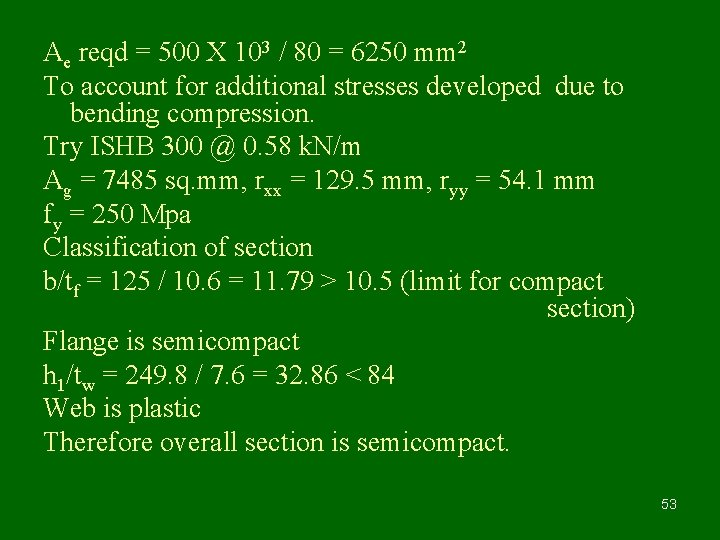
Ae reqd = 500 X 103 / 80 = 6250 mm 2 To account for additional stresses developed due to bending compression. Try ISHB 300 @ 0. 58 k. N/m Ag = 7485 sq. mm, rxx = 129. 5 mm, ryy = 54. 1 mm fy = 250 Mpa Classification of section b/tf = 125 / 10. 6 = 11. 79 > 10. 5 (limit for compact section) Flange is semicompact h 1/tw = 249. 8 / 7. 6 = 32. 86 < 84 Web is plastic Therefore overall section is semicompact. 53
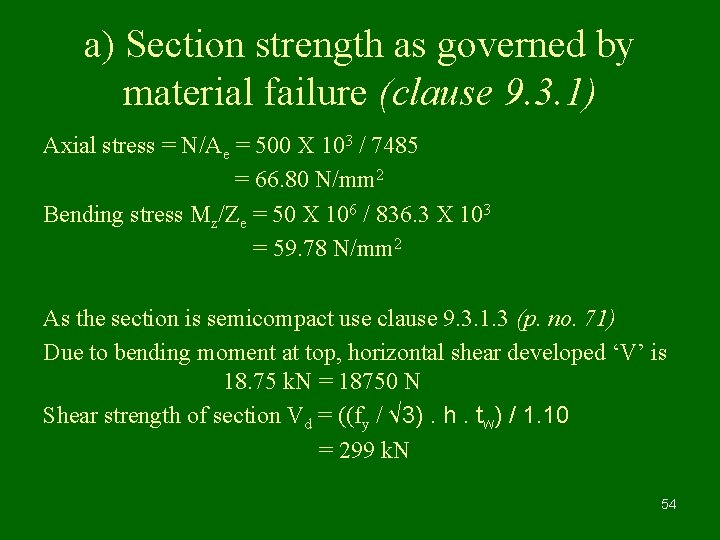
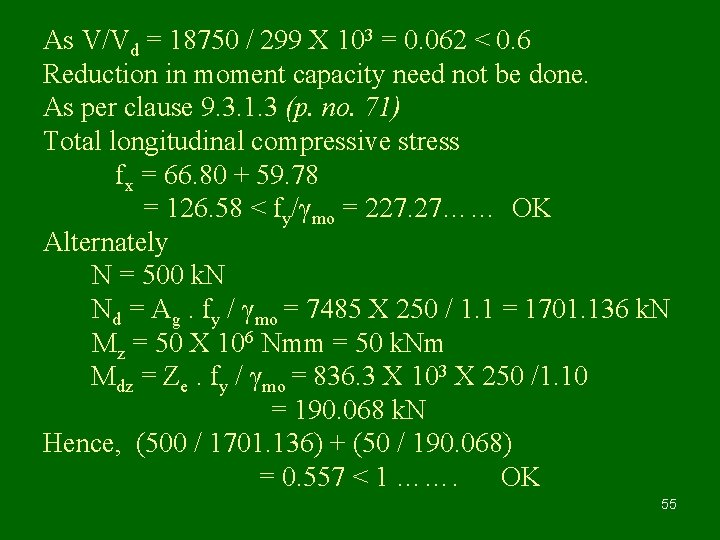
a) Section strength as governed by material failure (clause 9. 3. 1) Axial stress = N/Ae = 500 X 103 / 7485 = 66. 80 N/mm 2 Bending stress Mz/Ze = 50 X 106 / 836. 3 X 103 = 59. 78 N/mm 2 As the section is semicompact use clause 9. 3. 1. 3 (p. no. 71) Due to bending moment at top, horizontal shear developed ‘V’ is 18. 75 k. N = 18750 N Shear strength of section Vd = ((fy / √ 3). h. tw) / 1. 10 = 299 k. N 54
As V/Vd = 18750 / 299 X 103 = 0. 062 < 0. 6 Reduction in moment capacity need not be done. As per clause 9. 3. 1. 3 (p. no. 71) Total longitudinal compressive stress fx = 66. 80 + 59. 78 = 126. 58 < fy/γmo = 227. 27…… OK Alternately N = 500 k. N Nd = Ag. fy / γmo = 7485 X 250 / 1. 1 = 1701. 136 k. N Mz = 50 X 106 Nmm = 50 k. Nm Mdz = Ze. fy / γmo = 836. 3 X 103 X 250 /1. 10 = 190. 068 k. N Hence, (500 / 1701. 136) + (50 / 190. 068) = 0. 557 < 1 ……. OK 55
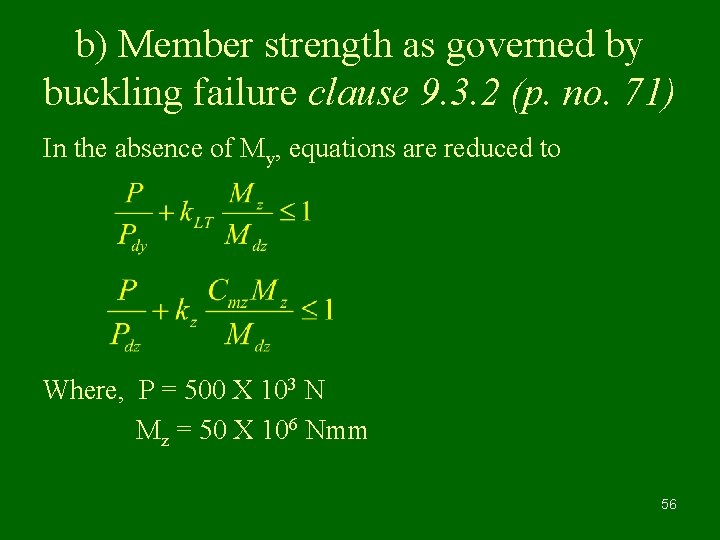
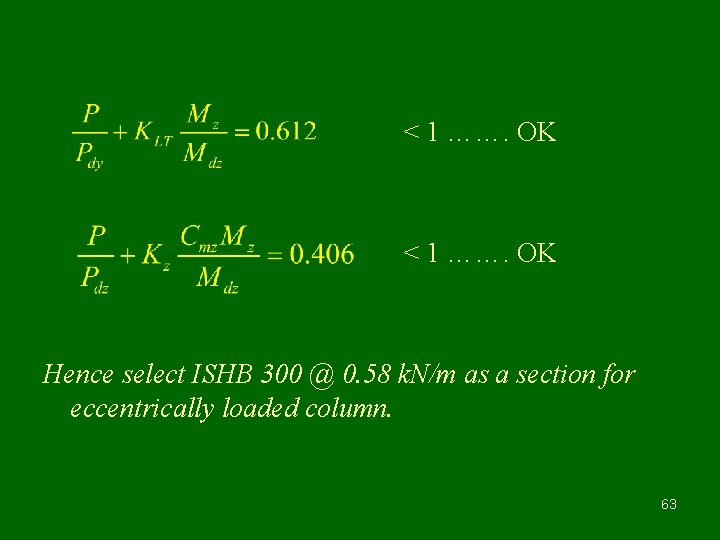
b) Member strength as governed by buckling failure clause 9. 3. 2 (p. no. 71) In the absence of My, equations are reduced to Where, P = 500 X 103 N Mz = 50 X 106 Nmm 56
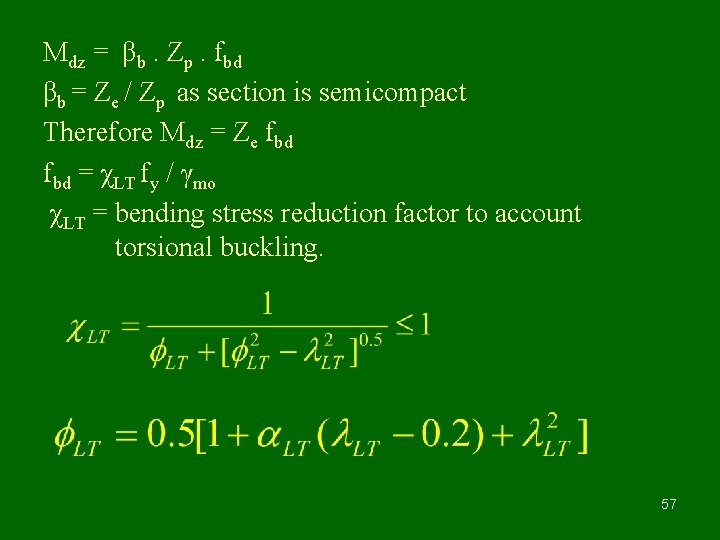
Mdz = βb. Zp. fbd βb = Ze / Zp as section is semicompact Therefore Mdz = Ze fbd = χLT fy / γmo χLT = bending stress reduction factor to account torsional buckling. 57
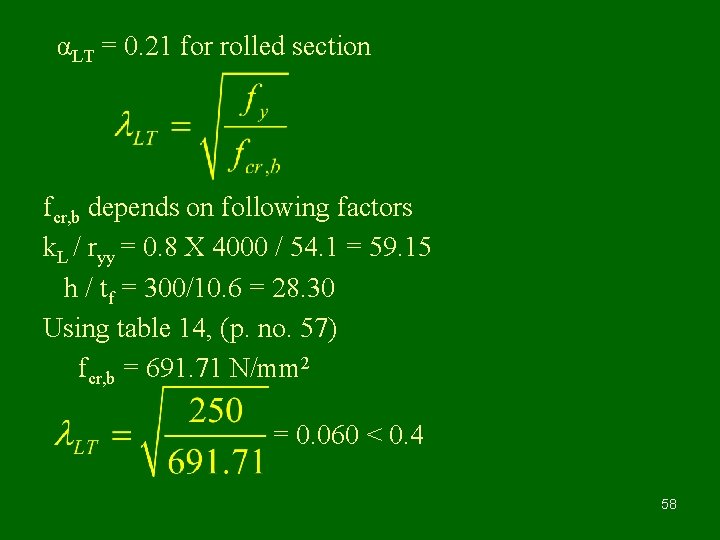
αLT = 0. 21 for rolled section fcr, b depends on following factors k. L / ryy = 0. 8 X 4000 / 54. 1 = 59. 15 h / tf = 300/10. 6 = 28. 30 Using table 14, (p. no. 57) fcr, b = 691. 71 N/mm 2 = 0. 060 < 0. 4 58
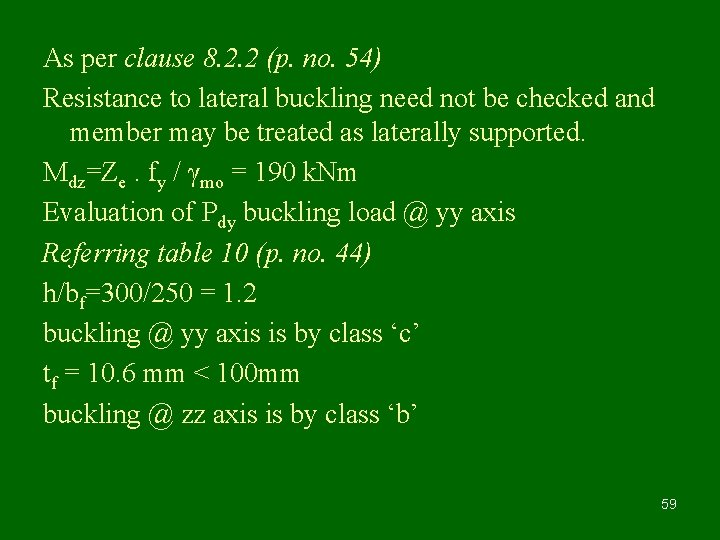
As per clause 8. 2. 2 (p. no. 54) Resistance to lateral buckling need not be checked and member may be treated as laterally supported. Mdz=Ze. fy / γmo = 190 k. Nm Evaluation of Pdy buckling load @ yy axis Referring table 10 (p. no. 44) h/bf=300/250 = 1. 2 buckling @ yy axis is by class ‘c’ tf = 10. 6 mm < 100 mm buckling @ zz axis is by class ‘b’ 59
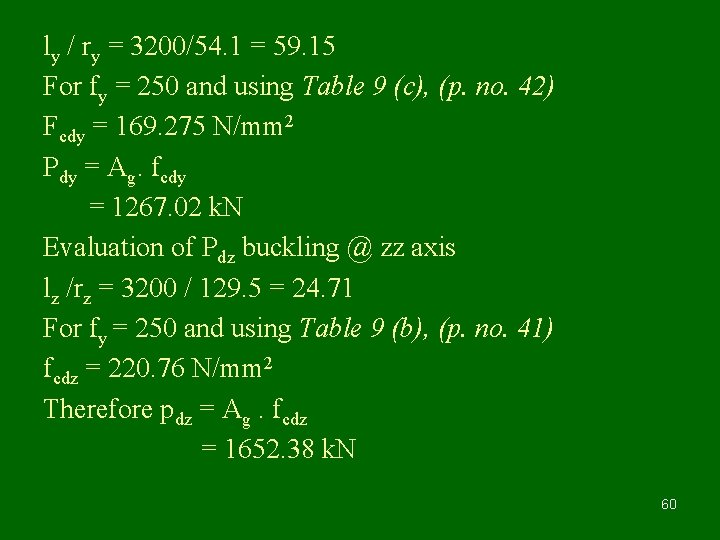
ly / ry = 3200/54. 1 = 59. 15 For fy = 250 and using Table 9 (c), (p. no. 42) Fcdy = 169. 275 N/mm 2 Pdy = Ag. fcdy = 1267. 02 k. N Evaluation of Pdz buckling @ zz axis lz /rz = 3200 / 129. 5 = 24. 71 For fy = 250 and using Table 9 (b), (p. no. 41) fcdz = 220. 76 N/mm 2 Therefore pdz = Ag. fcdz = 1652. 38 k. N 60
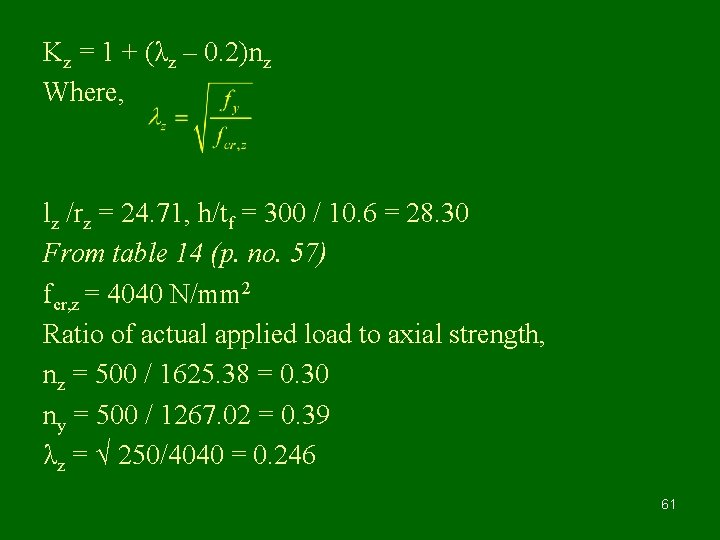
Kz = 1 + (λz – 0. 2)nz Where, lz /rz = 24. 71, h/tf = 300 / 10. 6 = 28. 30 From table 14 (p. no. 57) fcr, z = 4040 N/mm 2 Ratio of actual applied load to axial strength, nz = 500 / 1625. 38 = 0. 30 ny = 500 / 1267. 02 = 0. 39 λz = √ 250/4040 = 0. 246 61
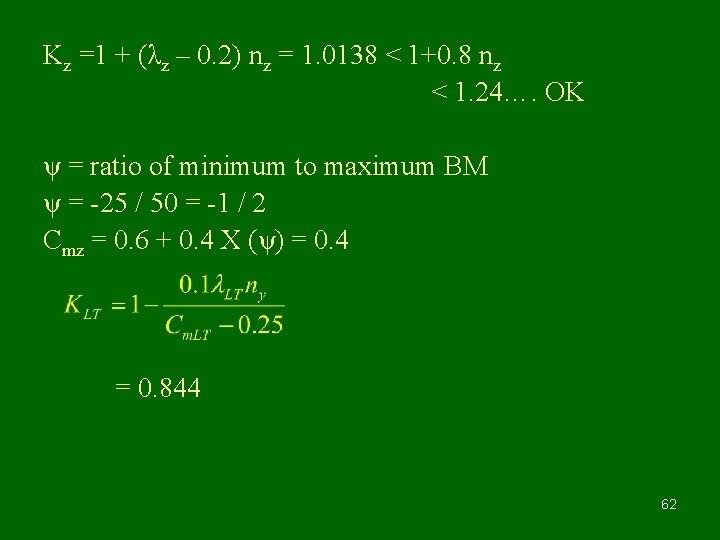
Kz =1 + (λz – 0. 2) nz = 1. 0138 < 1+0. 8 nz < 1. 24…. OK ψ = ratio of minimum to maximum BM ψ = -25 / 50 = -1 / 2 Cmz = 0. 6 + 0. 4 X (ψ) = 0. 4 = 0. 844 62
< 1 ……. OK Hence select ISHB 300 @ 0. 58 k. N/m as a section for eccentrically loaded column. 63
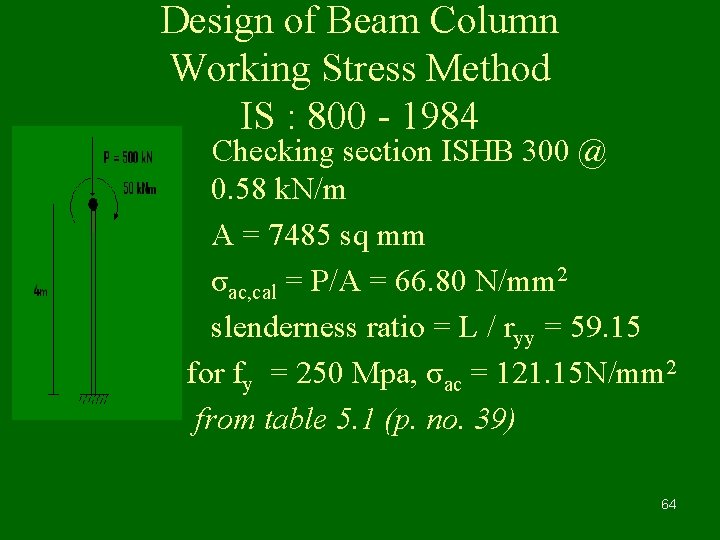
Design of Beam Column Working Stress Method IS : 800 - 1984 Checking section ISHB 300 @ 0. 58 k. N/m A = 7485 sq mm σac, cal = P/A = 66. 80 N/mm 2 slenderness ratio = L / ryy = 59. 15 for fy = 250 Mpa, σac = 121. 15 N/mm 2 from table 5. 1 (p. no. 39) 64
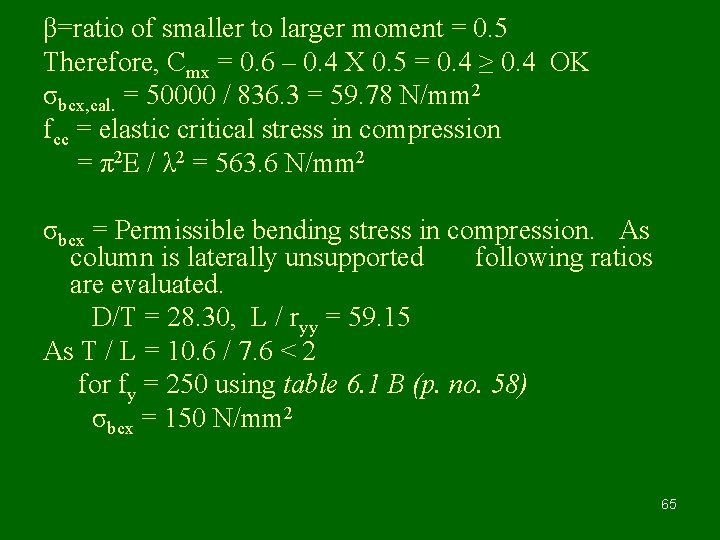
β=ratio of smaller to larger moment = 0. 5 Therefore, Cmx = 0. 6 – 0. 4 X 0. 5 = 0. 4 ≥ 0. 4 OK σbcx, cal. = 50000 / 836. 3 = 59. 78 N/mm 2 fcc = elastic critical stress in compression = π2 E / λ 2 = 563. 6 N/mm 2 σbcx = Permissible bending stress in compression. As column is laterally unsupported following ratios are evaluated. D/T = 28. 30, L / ryy = 59. 15 As T / L = 10. 6 / 7. 6 < 2 for fy = 250 using table 6. 1 B (p. no. 58) σbcx = 150 N/mm 2 65
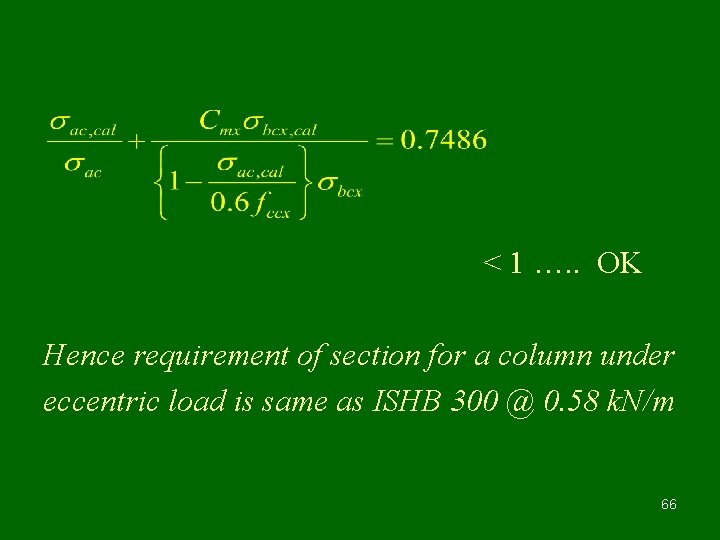
< 1 …. . OK Hence requirement of section for a column under eccentric load is same as ISHB 300 @ 0. 58 k. N/m 66
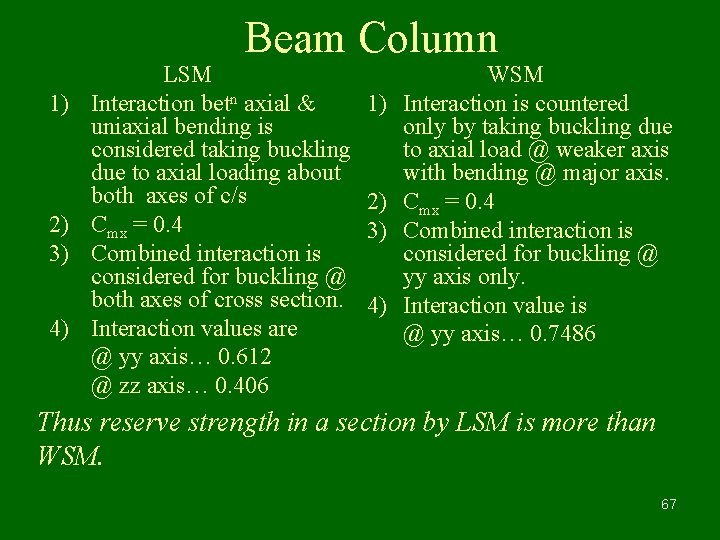
Beam Column 1) 2) 3) 4) LSM Interaction betn axial & uniaxial bending is considered taking buckling due to axial loading about both axes of c/s Cmx = 0. 4 Combined interaction is considered for buckling @ both axes of cross section. Interaction values are @ yy axis… 0. 612 @ zz axis… 0. 406 1) 2) 3) 4) WSM Interaction is countered only by taking buckling due to axial load @ weaker axis with bending @ major axis. Cmx = 0. 4 Combined interaction is considered for buckling @ yy axis only. Interaction value is @ yy axis… 0. 7486 Thus reserve strength in a section by LSM is more than WSM. 67
THE END 68