
Philosophy Objective Spt 30 th Opener Understand Cartesian
Philosophy Objective Spt. 30 th Opener • Understand Cartesian Skepticism • Crash Course Reality by analyzing “Meditation One” using close reading and active Last Day for Online Discussion listening skills. posts!
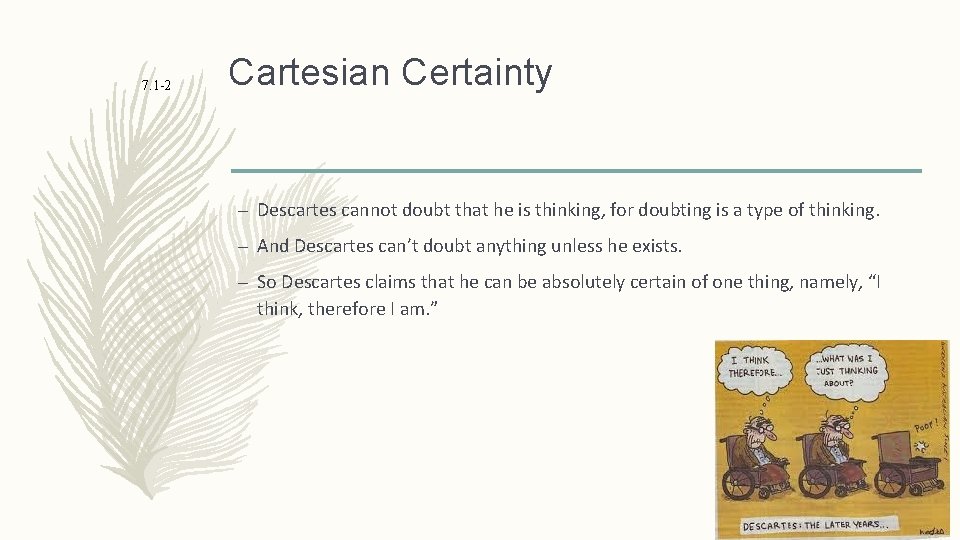
7. 1 -2 Cartesian Certainty – Descartes cannot doubt that he is thinking, for doubting is a type of thinking. – And Descartes can’t doubt anything unless he exists. – So Descartes claims that he can be absolutely certain of one thing, namely, “I think, therefore I am. ”
7. 1 -3 What Descartes Knows – Descartes knows the contents of his mind; if he seems to see a tree, he knows that he seems to see a tree. – To acquire knowledge of the external world, he needs a principle to bridge the gap between appearance and reality.
7. 1 -4 The Principle of Clarity and Distinctness 1. God exists and is no deceiver. 2. If God exists and is no deceiver, then whatever I clearly and distinctly perceive is true. 3. Therefore, whatever I clearly and distinctly perceive is true.
7. 1 -5 Application of the Principle of Clarity and Distinctness 1. I clearly and distinctly seem to see a tree in front of me. 2. Whatever I clearly and distinctly perceive is true. 3. Therefore, there is a tree in front of me.

7. 1 -6 The Cartesian Circle – Descartes can’t know that God exists and is no deceiver unless he knows that what he clearly and distinctly perceives is true. God exists and is no deceiver – But he can’t know that what he clearly and distinctly perceives is true unless he knows that God exists and is no deceiver. I clearly and distinctly perceive God exists and is no deceiver Therefore what I clearly and distinctly perceive is true

7. 1 -7 Foundationalism – The doctrine that there are basic beliefs, that is, beliefs whose justification does not depend on other beliefs. The justification of all other beliefs depends, at least in part, on the basic beliefs. Problem: How are those beliefs justified? – – What are some Basic beliefs you have that you use to justify other beliefs? Ex. Historical texts accurately describe historic people.
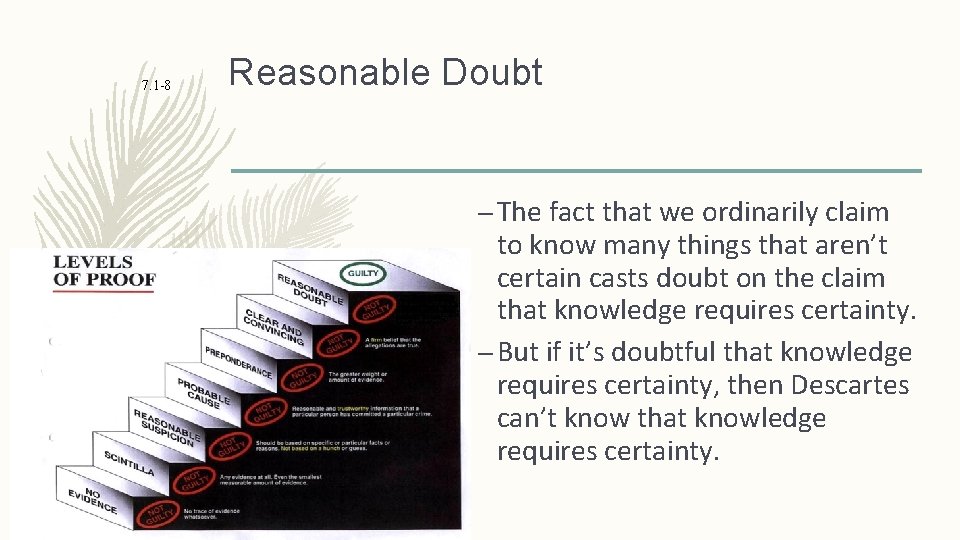
7. 1 -8 Reasonable Doubt – The fact that we ordinarily claim to know many things that aren’t certain casts doubt on the claim that knowledge requires certainty. – But if it’s doubtful that knowledge requires certainty, then Descartes can’t know that knowledge requires certainty.
7. 1 -9 Shadow of a Doubt vs. Reasonable Doubt – To know a proposition, it doesn’t have to be established beyond a shadow of a doubt. – It only has to be established beyond a reasonable doubt. – This is the standard used by courts to adjudicate matters of life and death; it can also be used to adjudicate matters of knowledge and ignorance.
7. 1 -10 Empiricism – The doctrine that our only source of knowledge about the external world is sense experience. – If something cannot be sensed, it cannot be known. – So the existence of God, the soul, or the afterlife cannot be known.
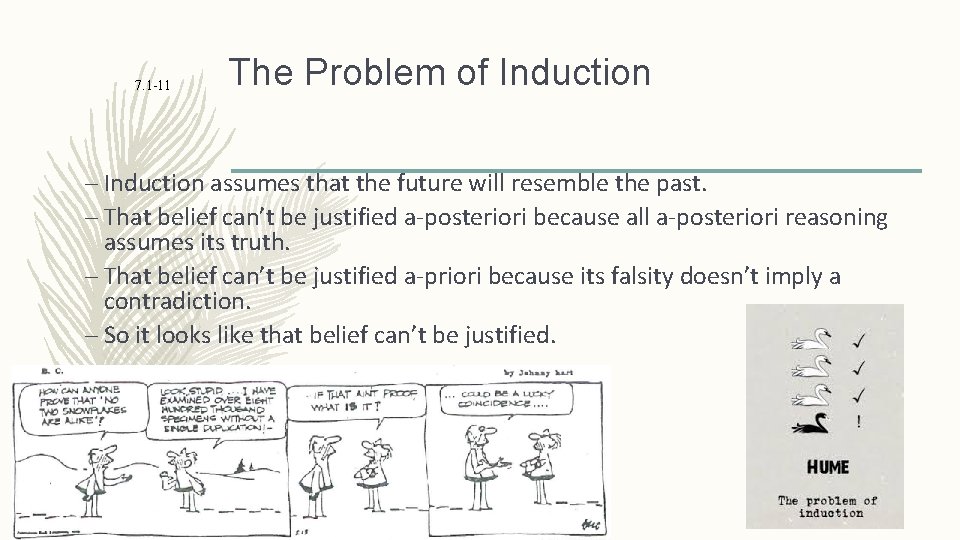
7. 1 -11 The Problem of Induction – Induction assumes that the future will resemble the past. – That belief can’t be justified a-posteriori because all a-posteriori reasoning assumes its truth. – That belief can’t be justified a-priori because its falsity doesn’t imply a contradiction. – So it looks like that belief can’t be justified.
7. 1 -12 Thought Probe: Science and Faith – We can’t prove that the future will resemble the past (that like causes produce like effects). – Yet all scientific inferences are based on that belief. – Is science, then, based on faith? Is science a form of religion?
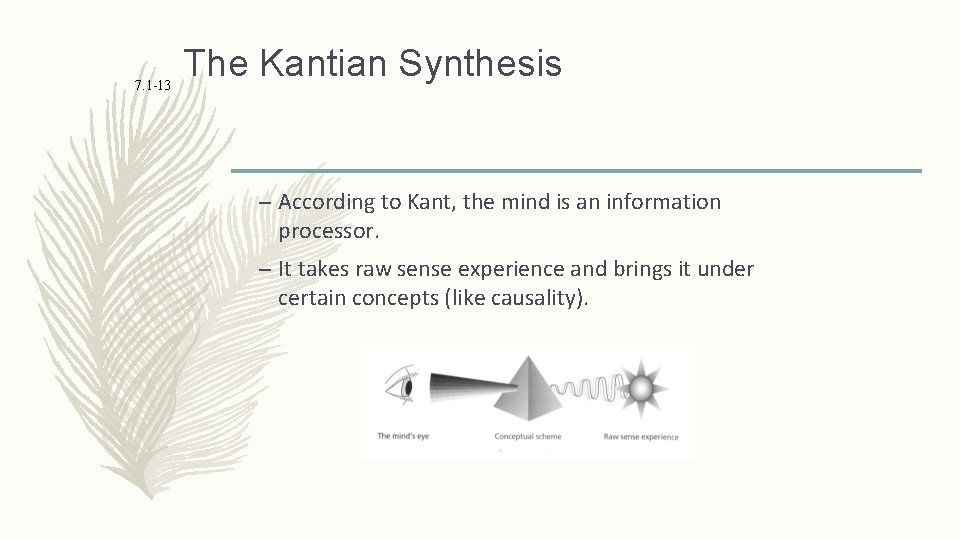
7. 1 -13 The Kantian Synthesis – According to Kant, the mind is an information processor. – It takes raw sense experience and brings it under certain concepts (like causality).
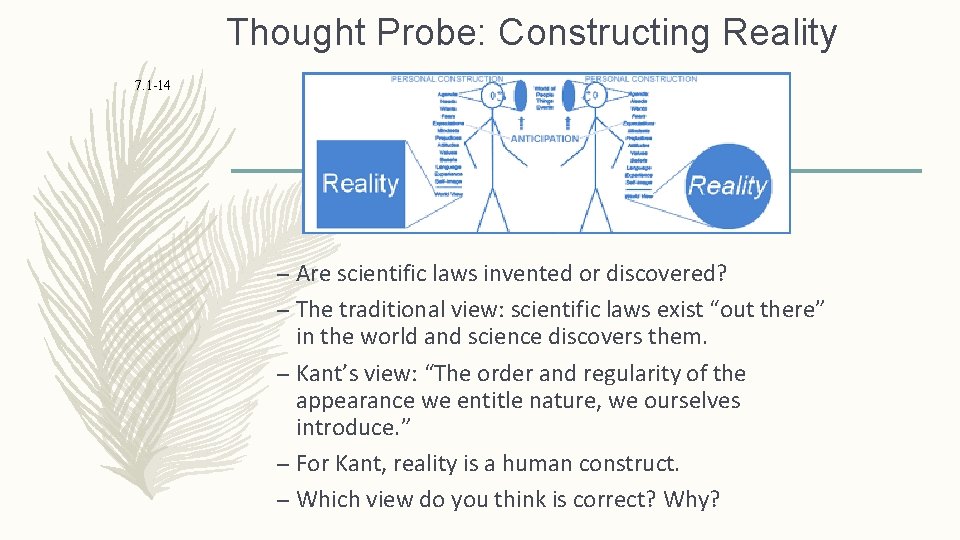
Thought Probe: Constructing Reality 7. 1 -14 – Are scientific laws invented or discovered? – The traditional view: scientific laws exist “out there” in the world and science discovers them. – Kant’s view: “The order and regularity of the appearance we entitle nature, we ourselves introduce. ” – For Kant, reality is a human construct. – Which view do you think is correct? Why?
7. 1 -15 Crash Course Descartes
7. 1 -16 Descartes’ Meditations p 592 Close Reading with Active Listening – Paragraph 1 -2: partner 1 reads, partner 2 listens, partner 2 summarizes, partner 1 writes – Paragraph 3 -4: partner 2 reads, partner 1 listens, partner 1 summarizes, partner 2 writes – Continue reading alternating partners each couple of paragraphs. – Make sure you are discussing confusing or complicated passages. – Respond to each (6) Question on a separate sheet of paper to be collected next class.
- Slides: 16