
Philosophy Language Thought Experiments and Laws of Thought



- Slides: 12
Philosophy: Language, Thought Experiments and Laws of Thought
Plato’s Cave: An Analysis the prisoner’s climb from darkness into light symbolized the search for knowledge suggests that like the prisoner, people can be freed from blindly accepting uninformed opinions in order to do so, we need to acquire and develop certain skills
Language Matters! philosophers distinguish between what they refer to as: FIRST ORDER LANGUAGE SECOND ORDER LANGUAGE
Examples: FOL: Is it right or wrong to cheat on this test? SOL: What does it mean to say that cheating is wrong?
FOL: His lie caused the mistake. SOL: What does it mean to say that his lie caused the mistake?
examples illustrate that SOL is more general its used to clarity FOL which refers to specifics SOL is sometimes called higher-order language much of philosophy is concerned with SOL which helps clarify language use and thinking it enables philosophers to produce well-reasoned arguments and to arrive at clear, precise conclusions
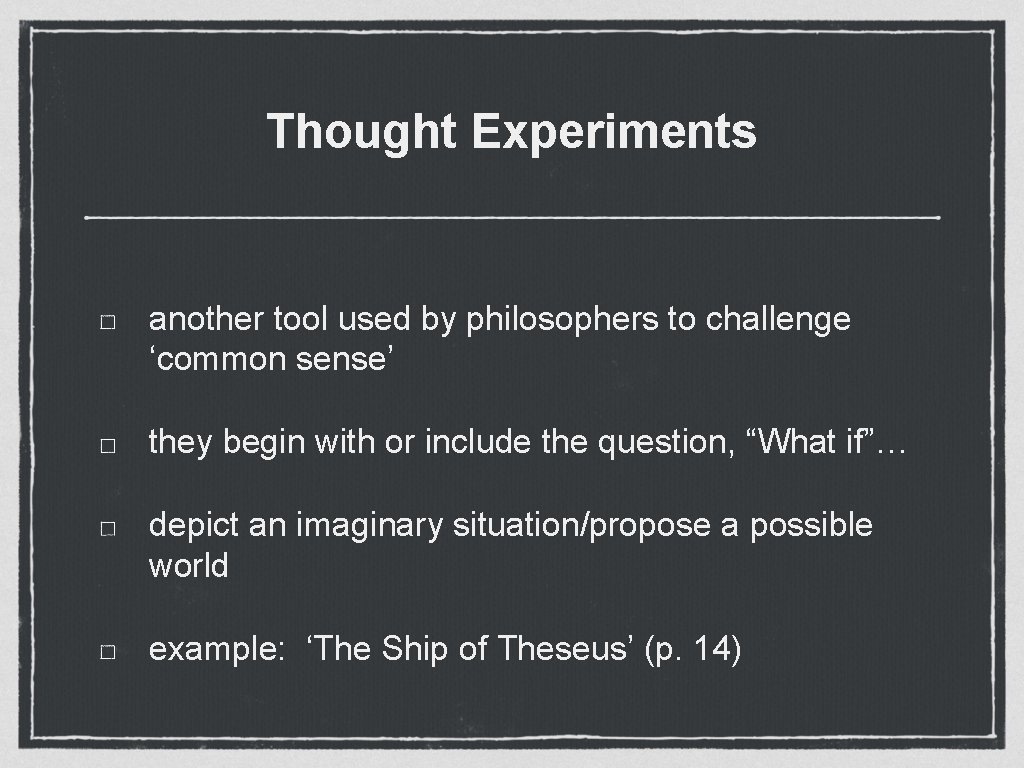
Thought Experiments another tool used by philosophers to challenge ‘common sense’ they begin with or include the question, “What if”… depict an imaginary situation/propose a possible world example: ‘The Ship of Theseus’ (p. 14)
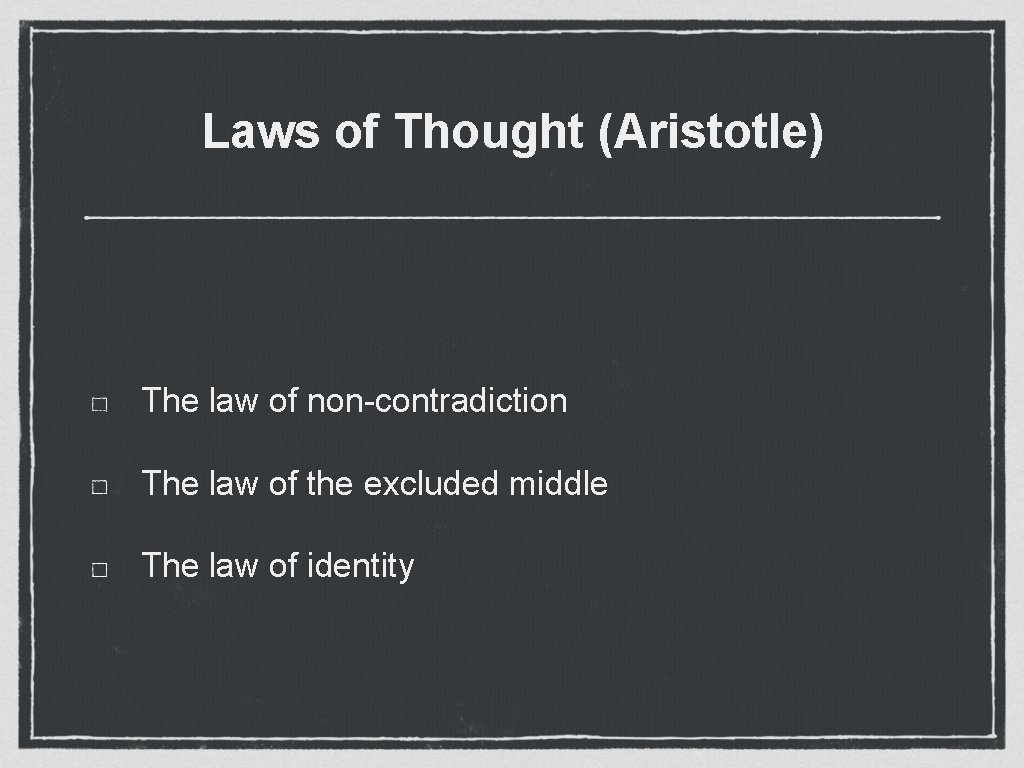
Laws of Thought (Aristotle) The law of non-contradiction The law of the excluded middle The law of identity
Law of non-contradition: This law says that something cannot be said both to be and not to be at the same time and in the same respect. Example: Bertha exists. If this statement is true, it cannot also be false. Bertha cannot exist and not exist at the same time.
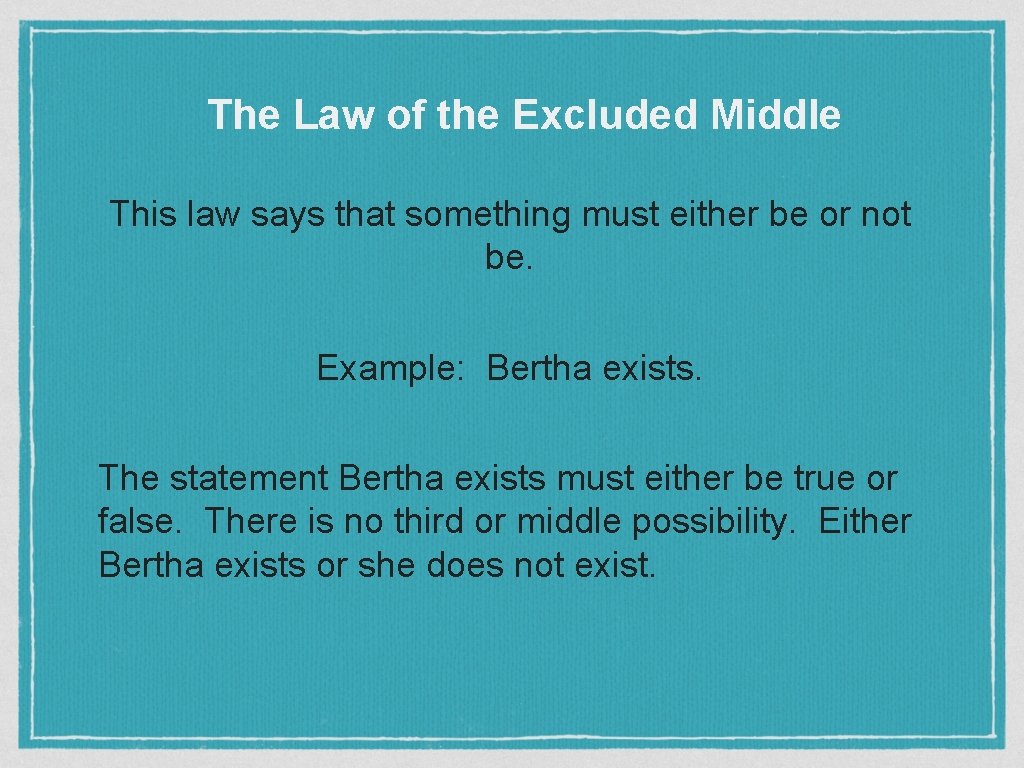
The Law of the Excluded Middle This law says that something must either be or not be. Example: Bertha exists. The statement Bertha exists must either be true or false. There is no third or middle possibility. Either Bertha exists or she does not exist.
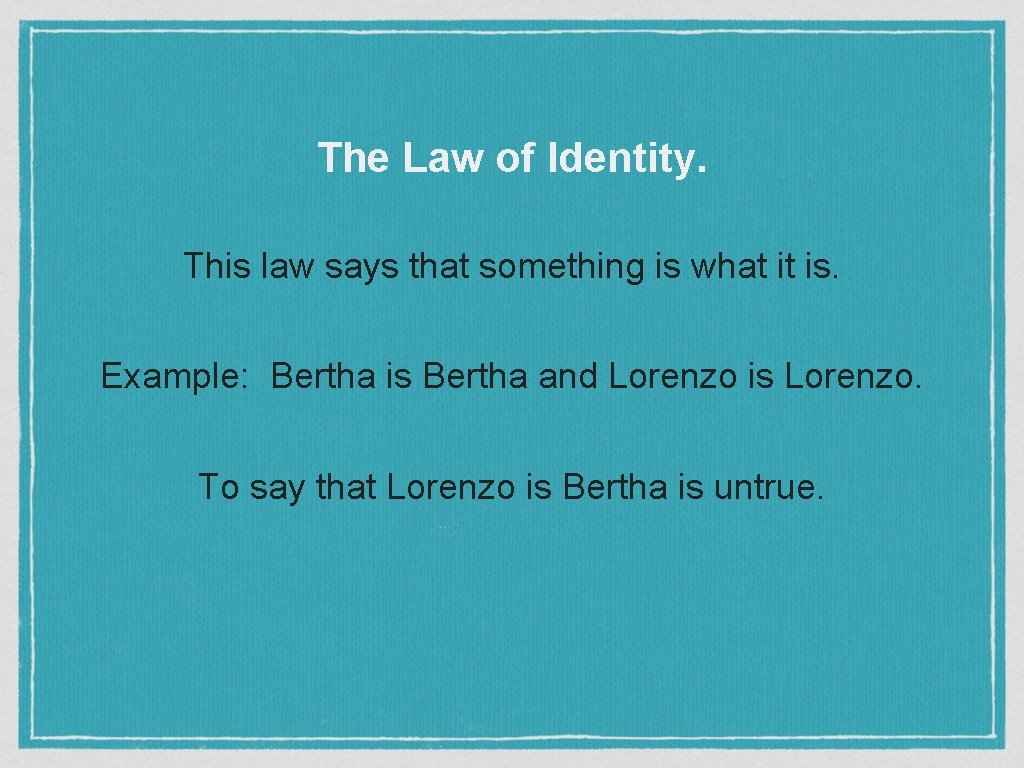
The Law of Identity. This law says that something is what it is. Example: Bertha is Bertha and Lorenzo is Lorenzo. To say that Lorenzo is Bertha is untrue.
These laws are key to logic. More contemporary philosophers have developed far more complex tools and systems, these laws are often the basis.