
PHILOSOPHY HISTORICAL PERIODS OF PHILOSOPHY Ancient Philosophy n

- Slides: 17
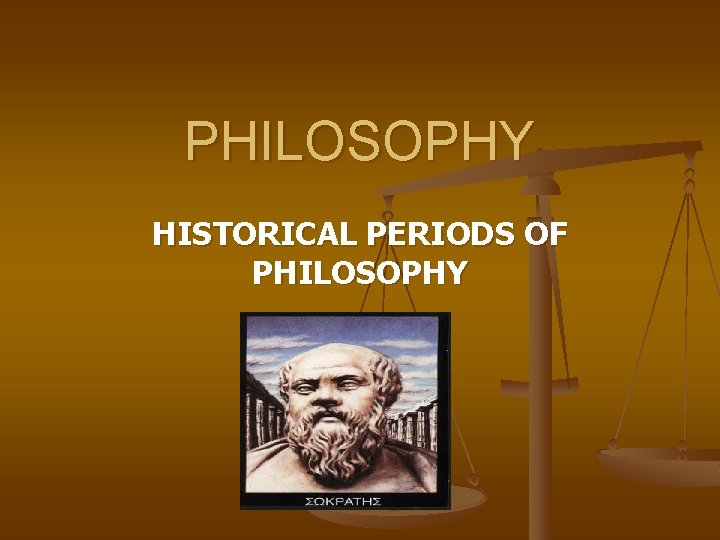
PHILOSOPHY HISTORICAL PERIODS OF PHILOSOPHY
Ancient Philosophy n Asked questions concerned with nature, the origins of the universe, and mans place in it.
Socrates n World’s most famous philosopher n Studied physics and credited with inventing the field of “Metaphysics” n Felt a person should never disobey the government, no matter if they were wrong or not.
Socratic Quotes n“The unexamined life is not worth living” n“Knowledge n“He is Virtue” knows nothing except that he knows nothing”
Plato n Believed dialogue was the only way to discover the truth or to examine an idea n Wrote all we know about Socrates today n Concerned himself with the best form of government (believed in Aristocracy or “rule by the best”)
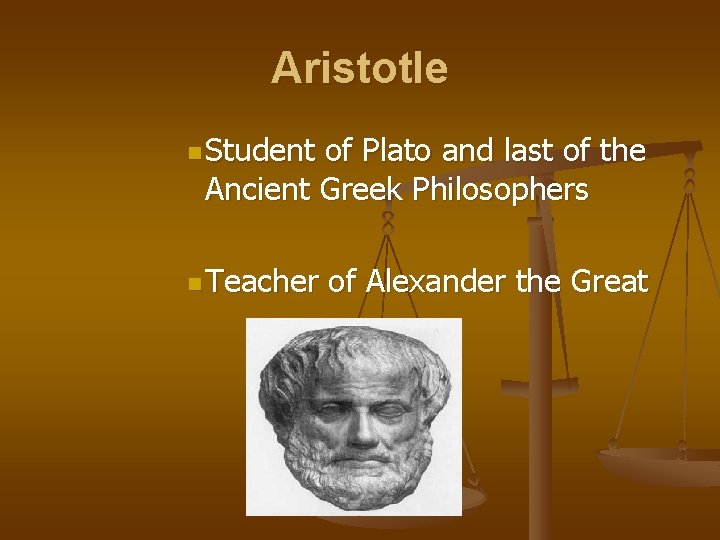
Aristotle n Student of Plato and last of the Ancient Greek Philosophers n Teacher of Alexander the Great
Aristotle n n Developed “Inductive Reasoning, ” the foundation of the scientific method…believed in detailed observation and cataloging of phenomenon. Believed everything in the universe had a purpose.
Medieval Philosophy n Philosophy of Western Europe from the Middle Ages to the Renaissance concerned primarily with argument from authority.
St. Augustine n n Attempted to prove the existence of God Argued for the independence and superiority of the church over the civil state
St. Thomas Aquinas n most era influential philosopher of n Influenced Catholic church and their views about God
Modern Philosophy n Period where new ideas began to question authority. Began with the writings of Rene Descartes and the mind-body problem.
Immanuel Kant n Studied metaphysics and epistemology n Developed the idea of the “Categorical Imperative”
John Stuart Mill n Radical empiricist who believed all human knowledge was gathered from sensory experience n Promoted Utilitarianism
Contemporary Philosophy n Philosophical thought that has occurred in the last half century.
Jean-Paul Sartre n Wrote novels, stories, plays, and pamphlets dealing with existentialism and personal freedom and choice.
Bertrand Russell n Outlined problems with organized religion n Discussed advantages to studying philosophy