
Philosophy 224 Hobbess Vision of the Human Thomas
Philosophy 224 Hobbes’s Vision of the Human
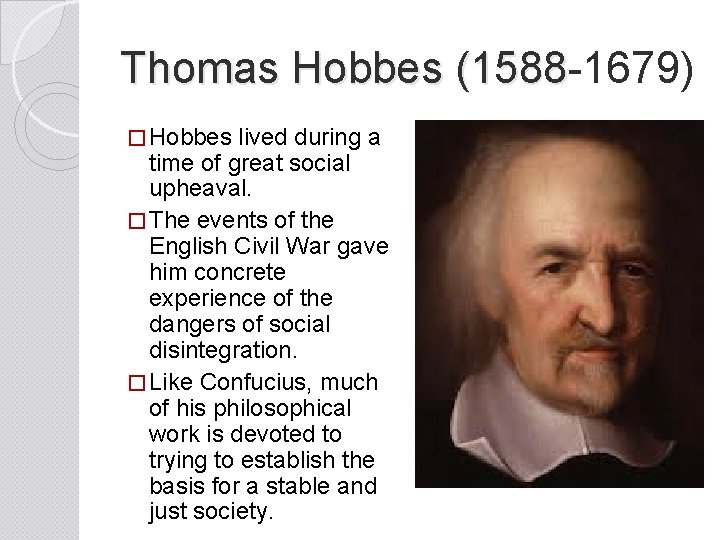
Thomas Hobbes (1588 -1679) (1588 � Hobbes lived during a time of great social upheaval. � The events of the English Civil War gave him concrete experience of the dangers of social disintegration. � Like Confucius, much of his philosophical work is devoted to trying to establish the basis for a stable and just society.
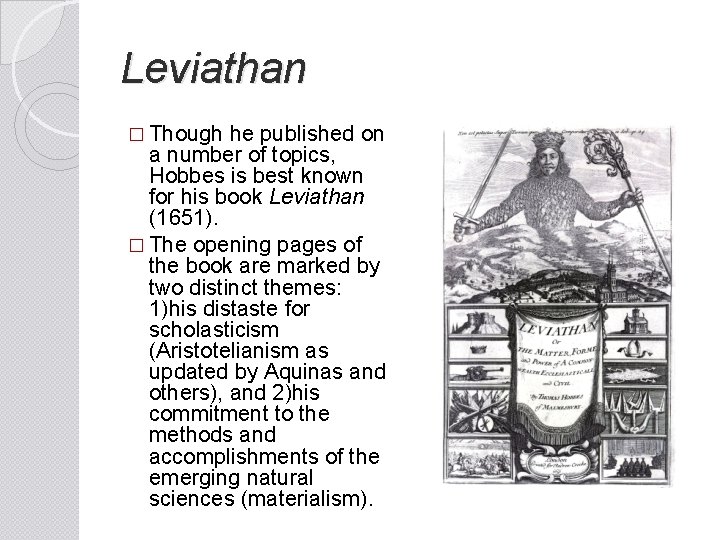
Leviathan � Though he published on a number of topics, Hobbes is best known for his book Leviathan (1651). � The opening pages of the book are marked by two distinct themes: 1)his distaste for scholasticism (Aristotelianism as updated by Aquinas and others), and 2)his commitment to the methods and accomplishments of the emerging natural sciences (materialism).
Philosophical Materialism �Like many other philosophers from this era (the era of modern philosophy), Hobbes was a philosophical materialist. �In general, this metaphysical position is committed to the following assumptions: 1. Monism: everything is material, for Hobbes, even God is a material being. 2. Corpuscularism: material reality ultimately resolves into fundamental material particles. The behavior and appearance of wholes is wholly a function of the interaction of these parts. 3. Mechanism: All phenomena explained by mechanical interaction of the ‘corpuscles. ’

The Human Machine �Consistent with his commitment to materialism, Hobbes took the position that human beings, including their minds, were completely material. �Hobbes’s account of the human mind and knowledge was an essentially empiricist one: ideas in the mind are caused by sense experience, which is ultimately resolvable into fundamental material particles. �We are, in our bodies and minds, complex wholes completely resolvable into the causal parts of which we are composed.
Our Natural State �Hobbes’s operative assumption is that human beings are fundamentally equal in physical and mental abilities. ◦ Differences do exist, but in practical terms they don’t amount to much (e. g. , the weak can gang up to overpower the strong). ◦ This is particularly true with regard to mental abilities. Key claim: everyone is content with their ‘share. ’ �Implication: “equality of hope in the attaining of our ends” (98).
Naturally Egoistic �As we all have equal hope, when we have a desire in common with another, we are naturally in competition with that other, “they become enemies” (98). �Hobbes is making a few assumptions here: ◦ Human beings are selfish by nature. ◦ Human beings aggressively seek to satisfy our desires. ◦ The objects of those are desires are limited. �If he’s right about these assumptions, we can understand why people view others as a threat or an obstacle in achieving their goals.
A State of War �Given this natural enmity, we can understand why, absent some “common power” our natural state is one of war: “every (hu)man against every (hu)man” (99). �In such a situation, no industry, culture or development is possible and thus, “the life of man [is] solitary, poor, nasty, brutish, and short
Surprising Implications �In the state of nature, there is no right and wrong, “Where there is no common power, there is no law; where no law, no injustice” (101). ◦ Hobbes thus rejects the idea of a transcendent morality, insisting that all moral norms are social in origin. �There is also no property. There is only possession.
No Rules, but Passions �While there are no rules, human actions are governed by causes, namely emotions (passions). �These passions do provide an incentive to avoid conflict, thus showing us a way out of the state of war. ◦ These passions are: 1. Fear of death 2. Desire for comforts 3. Recognition that comforts can be obtained.
Natural Rights? �The regularities observable in human capabilities and behaviors allow us to articulate basic principles which can serve as the basis for both social forms and determinate moral principles. �The starting point is what Hobbes calls The Right of Nature: the right to protect your own life in the best way suggested by reason.
Natural Laws �On the basis of this natural right, Hobbes then moves to specify two corresponding natural laws. �These laws specify the rationally optimal means of preserving your life. ◦ The First Law of Nature (102) is to seek peace whenever possible, and when it is impossible defend yourself by any means necessary. ◦ The Second Law of Nature (102) is to be willing to give up your unfettered claim to natural goods to the extent necessary for common agreement.
The Social Contract �The force of these rights suggests that the best way to achieve a stable social order, one maximally protective of each individual’s life while preserving as much of their liberty as possible, is to conceive of the social order as a form of contract (104). �Each individual willingly renounces their claim on everything in exchange for protection in their person and in their goods.
Theorems of Morality �The contract is accomplished in the general acknowledgement of a number of subordinate moral principles (articulated in Chapter XV). �These include general principles like: ◦ ◦ ◦ keep your promises reciprocate gifts and kindnesses be accommodating pardon people seek rehabilitation, not revenge be friendly
- Slides: 14