
Philosophy 220 TruthFunctional Equivalence and Consistency Review Logical
![Review • Logical equivalency: The members of a pair of sentences [of natural language]](https://slidetodoc.com/presentation_image_h2/4d56cadde8f91634cd968464cf9cb527/image-2.jpg "Review • Logical equivalency: The members of a pair of sentences [of natural language]")
- Slides: 41
Philosophy 220 Truth-Functional Equivalence and Consistency
Review • Logical equivalency: The members of a pair of sentences [of natural language] are logically equivalent if and only if it is not [logically] possible for one of the sentences to be true while the other sentence is false. • Logical consistency: A set of sentences is logically consistent if and only if it is [logically] possible for all the members of that set to be true [at the same time].
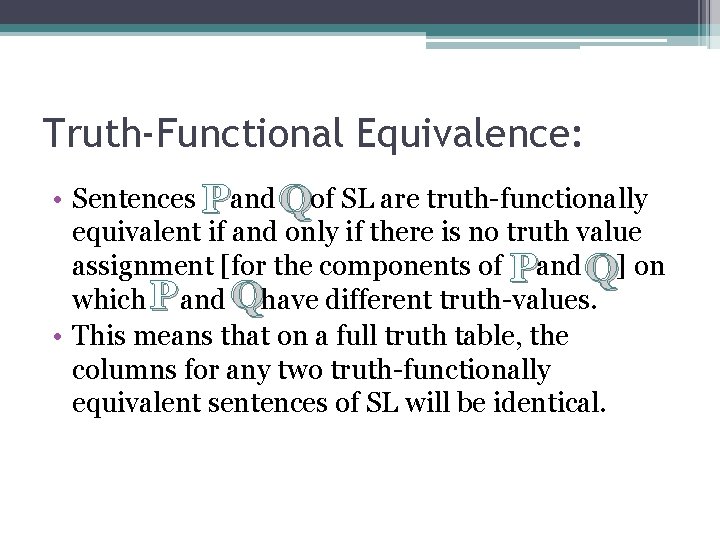
Truth-Functional Equivalence: • Sentences Pand Qof SL are truth-functionally equivalent if and only if there is no truth value assignment [for the components of Pand Q] on which P and Qhave different truth-values. • This means that on a full truth table, the columns for any two truth-functionally equivalent sentences of SL will be identical.
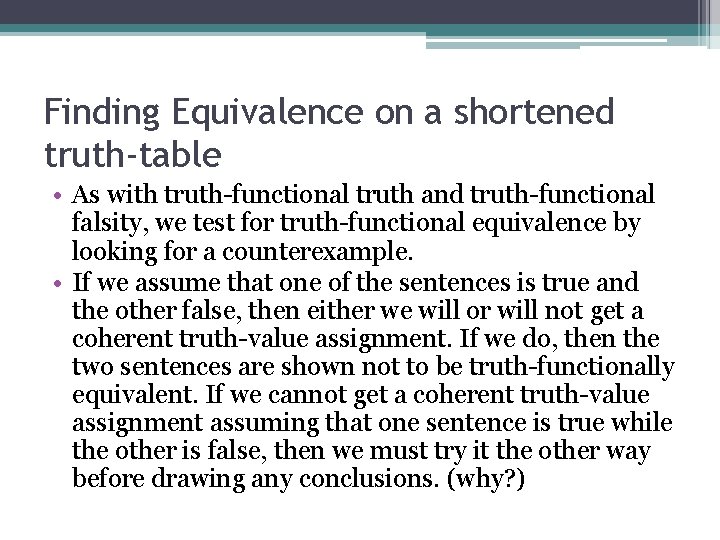
Finding Equivalence on a shortened truth-table • As with truth-functional truth and truth-functional falsity, we test for truth-functional equivalence by looking for a counterexample. • If we assume that one of the sentences is true and the other false, then either we will or will not get a coherent truth-value assignment. If we do, then the two sentences are shown not to be truth-functionally equivalent. If we cannot get a coherent truth-value assignment assuming that one sentence is true while the other is false, then we must try it the other way before drawing any conclusions. (why? )
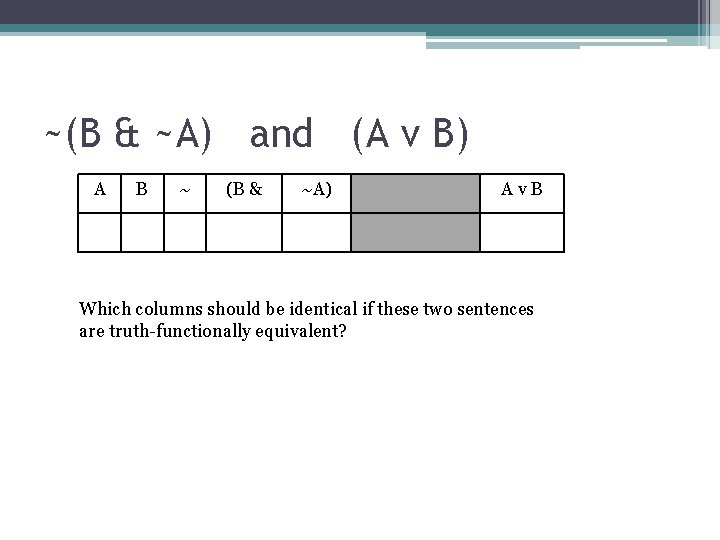
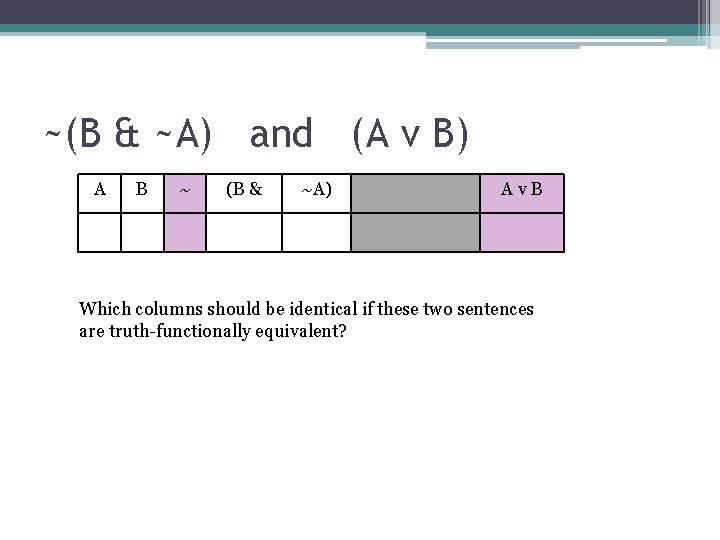
~(B & ~A) and (A v B) A B ~ (B & ~A) Av. B Which columns should be identical if these two sentences are truth-functionally equivalent?
~(B & ~A) and (A v B) A B ~ (B & ~A) Av. B Which columns should be identical if these two sentences are truth-functionally equivalent?
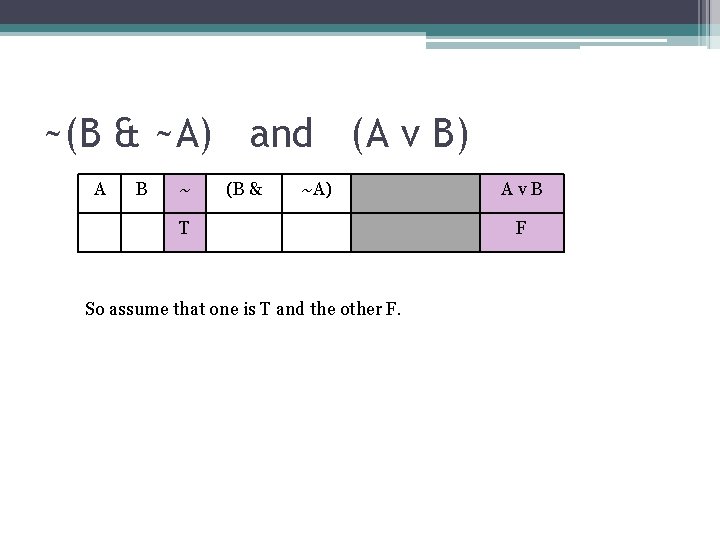
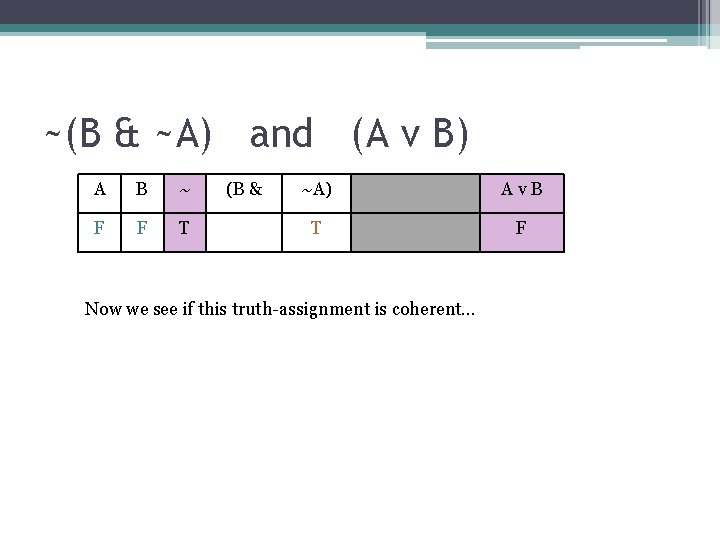
~(B & ~A) and (A v B) A B ~ (B & ~A) T So assume that one is T and the other F. Av. B F
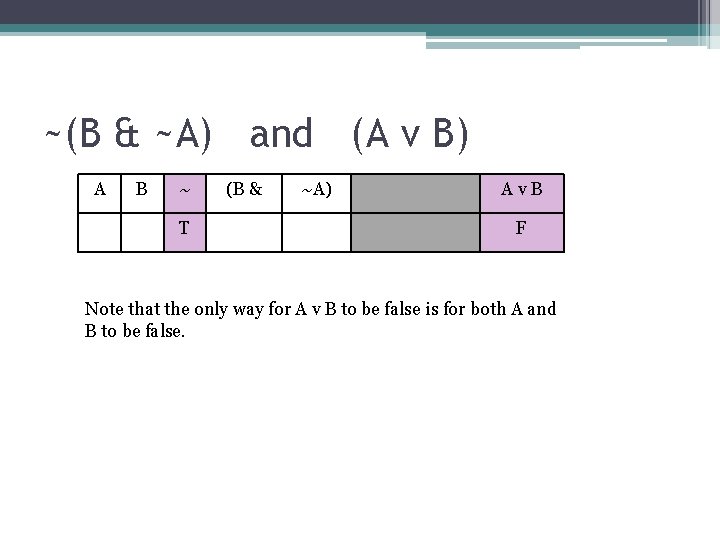
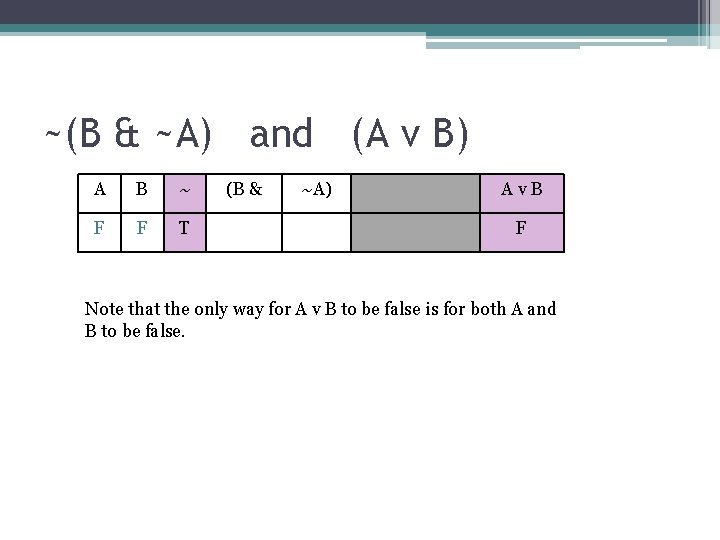
~(B & ~A) and (A v B) A B ~ T (B & ~A) Av. B F Note that the only way for A v B to be false is for both A and B to be false.
~(B & ~A) and (A v B) A B ~ F F T (B & ~A) Av. B F Note that the only way for A v B to be false is for both A and B to be false.
~(B & ~A) and (A v B) A B ~ F F T (B & ~A) Av. B T F Now we see if this truth-assignment is coherent…
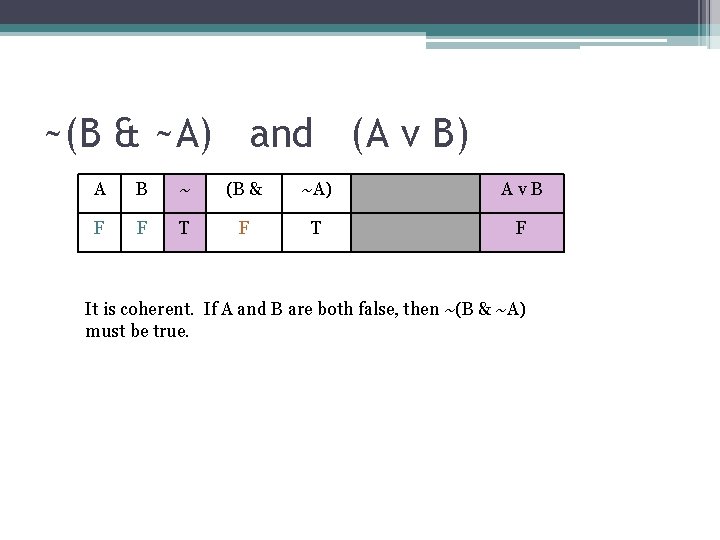
~(B & ~A) and (A v B) A B ~ (B & ~A) Av. B F F T F It is coherent. If A and B are both false, then ~(B & ~A) must be true.
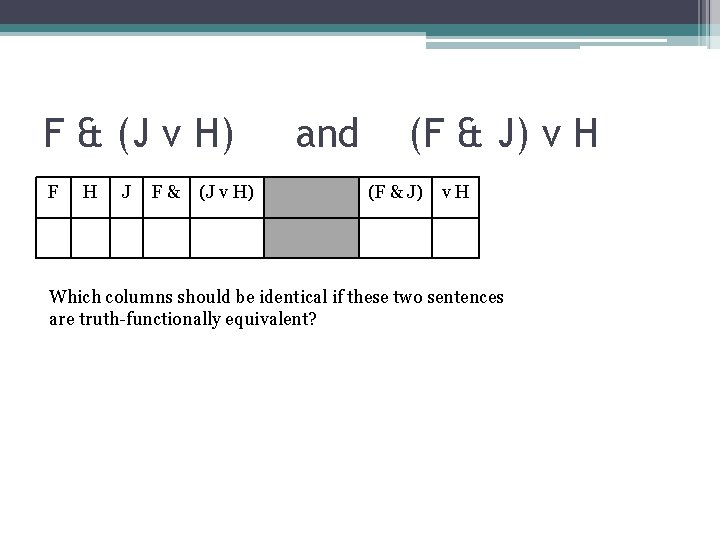
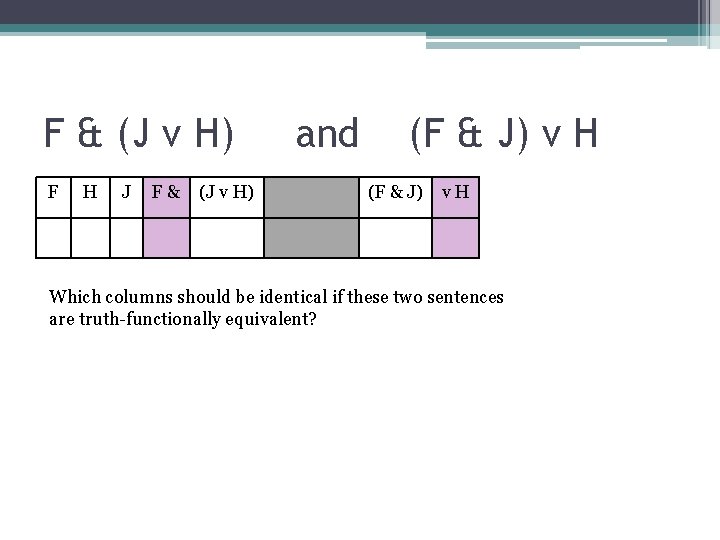
F & (J v H) F H J F& (J v H) and (F & J) v H (F & J) v. H Which columns should be identical if these two sentences are truth-functionally equivalent?
F & (J v H) F H J F& (J v H) and (F & J) v H (F & J) v. H Which columns should be identical if these two sentences are truth-functionally equivalent?
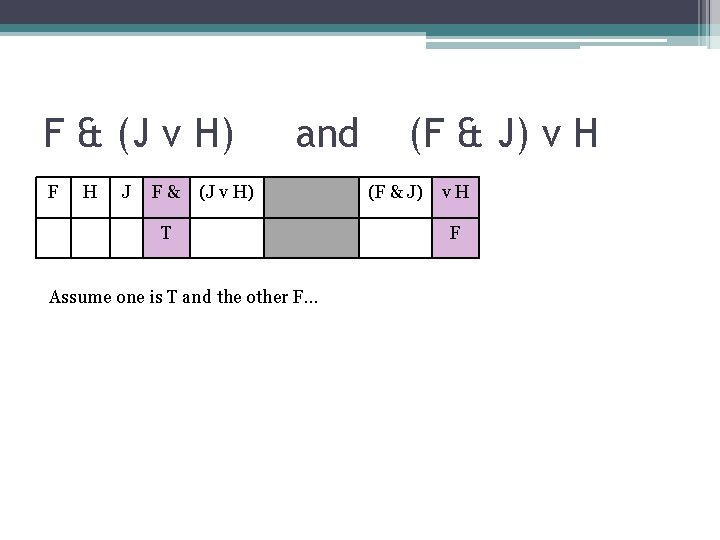
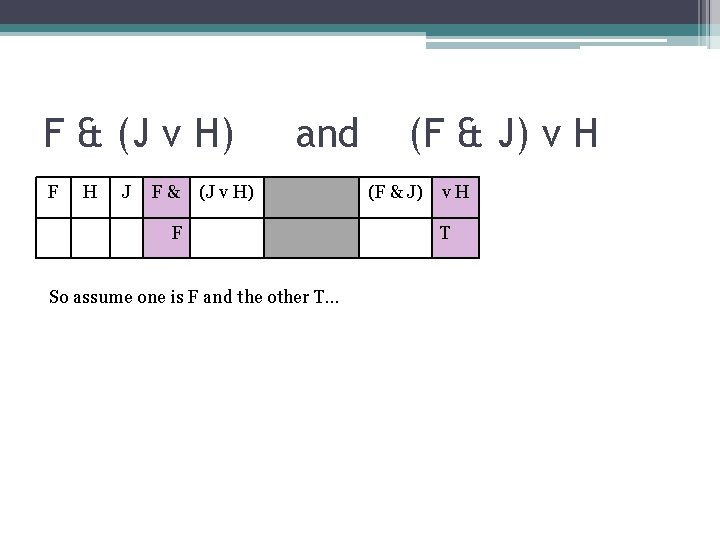
F & (J v H) F H J F& and (J v H) T Assume one is T and the other F… (F & J) v H (F & J) v. H F
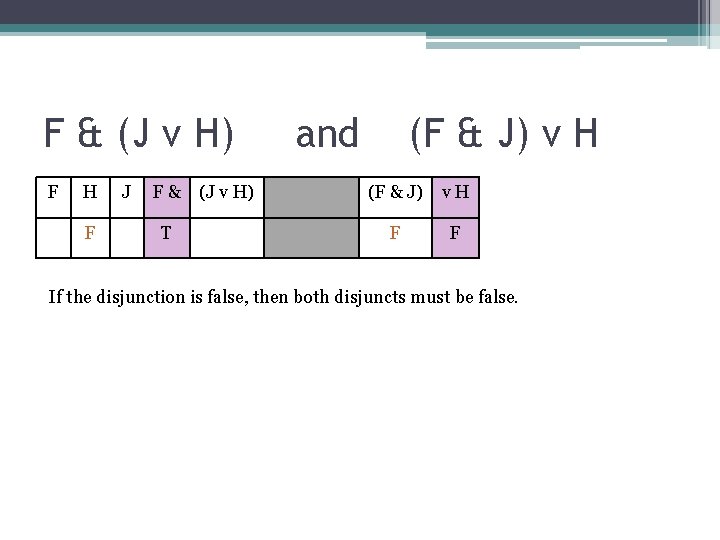
F & (J v H) F H F J F& T (J v H) and (F & J) v H (F & J) v. H F F If the disjunction is false, then both disjuncts must be false.
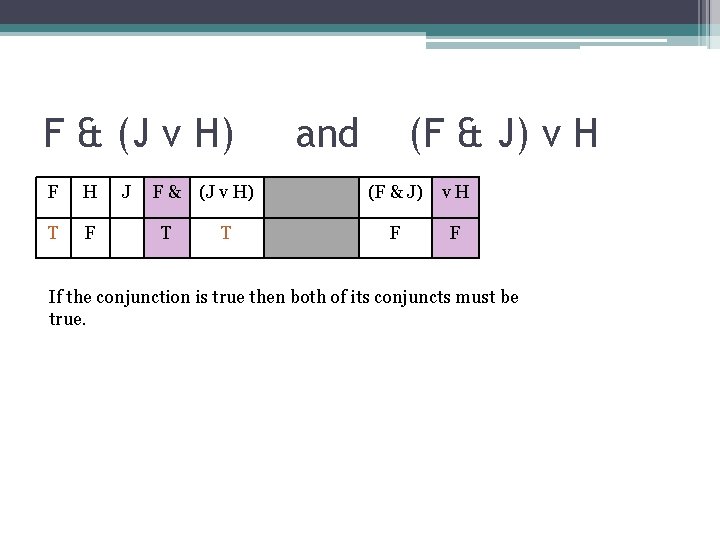
F & (J v H) F H T F J and (F & J) v H F& (J v H) (F & J) v. H T T F F If the conjunction is true then both of its conjuncts must be true.
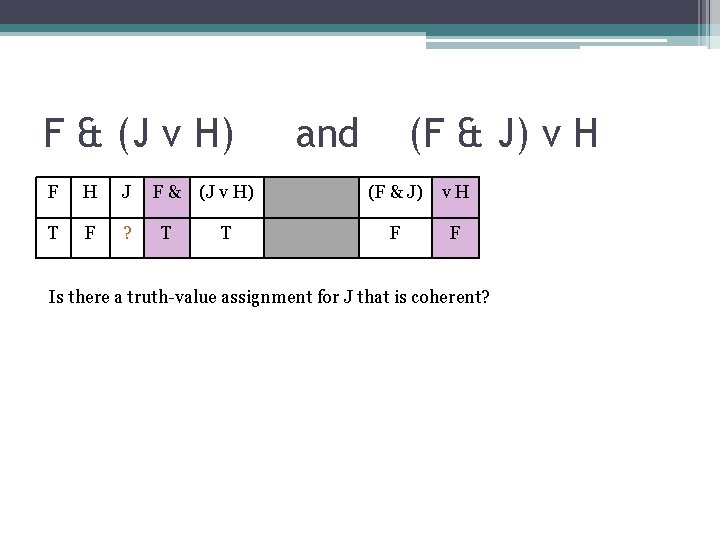
F & (J v H) and (F & J) v H F H J F& (J v H) (F & J) v. H T F ? T T F F Is there a truth-value assignment for J that is coherent?
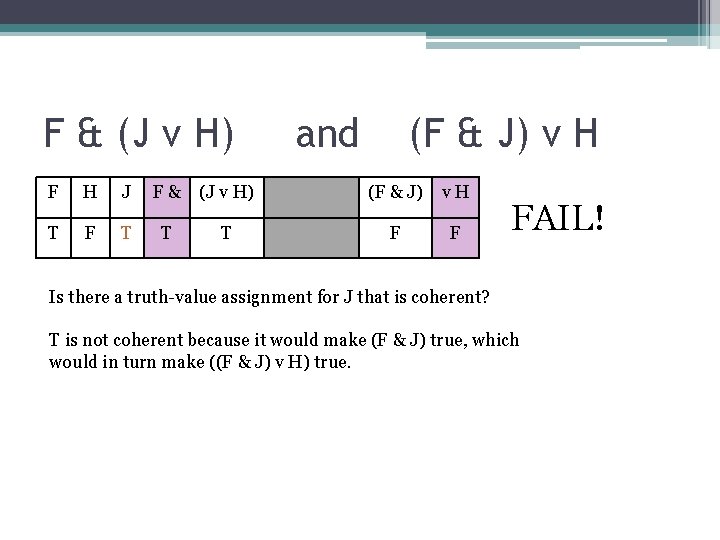
F & (J v H) and (F & J) v H F H J F& (J v H) (F & J) v. H T F T T T F F FAIL! Is there a truth-value assignment for J that is coherent? T is not coherent because it would make (F & J) true, which would in turn make ((F & J) v H) true.
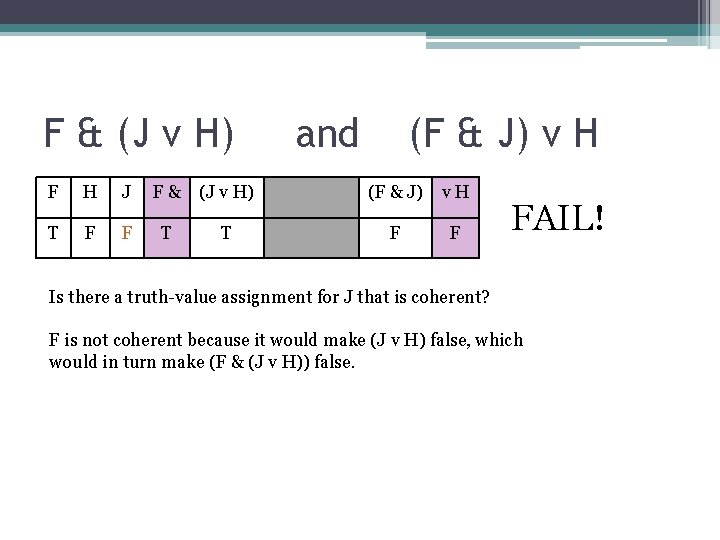
F & (J v H) and (F & J) v H F H J F& (J v H) (F & J) v. H T F F T T F F FAIL! Is there a truth-value assignment for J that is coherent? F is not coherent because it would make (J v H) false, which would in turn make (F & (J v H)) false.
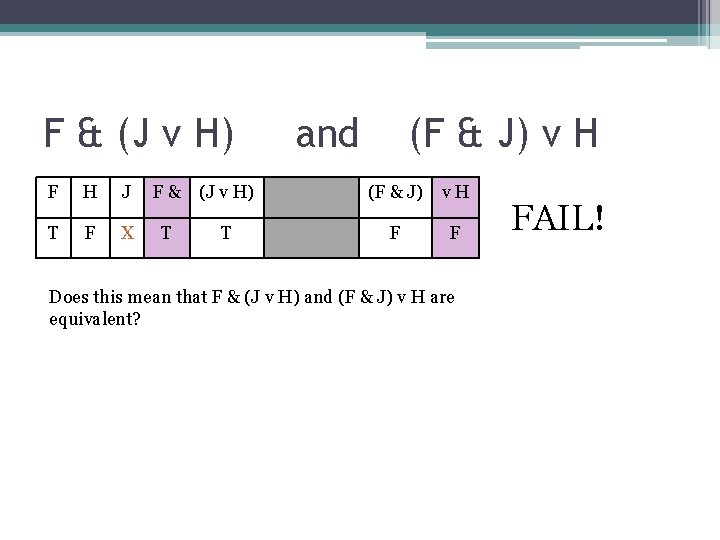
F & (J v H) and (F & J) v H F H J F& (J v H) (F & J) v. H T F X T T F F Does this mean that F & (J v H) and (F & J) v H are equivalent? FAIL!
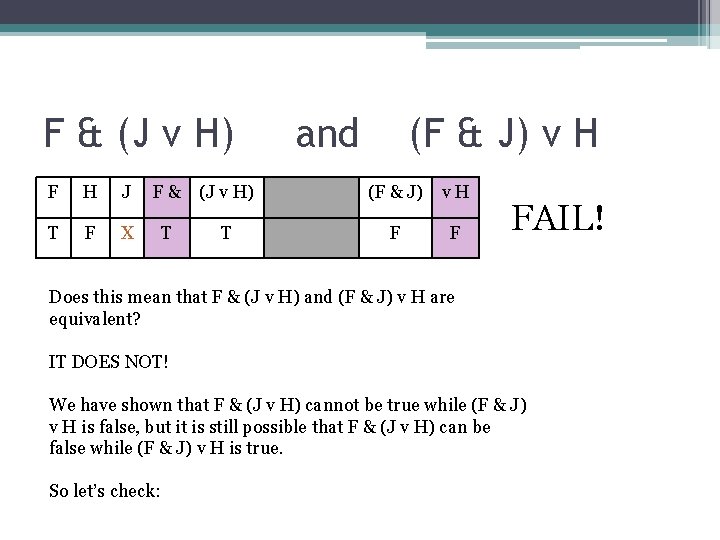
F & (J v H) and (F & J) v H F H J F& (J v H) (F & J) v. H T F X T T F F FAIL! Does this mean that F & (J v H) and (F & J) v H are equivalent? IT DOES NOT! We have shown that F & (J v H) cannot be true while (F & J) v H is false, but it is still possible that F & (J v H) can be false while (F & J) v H is true. So let’s check:
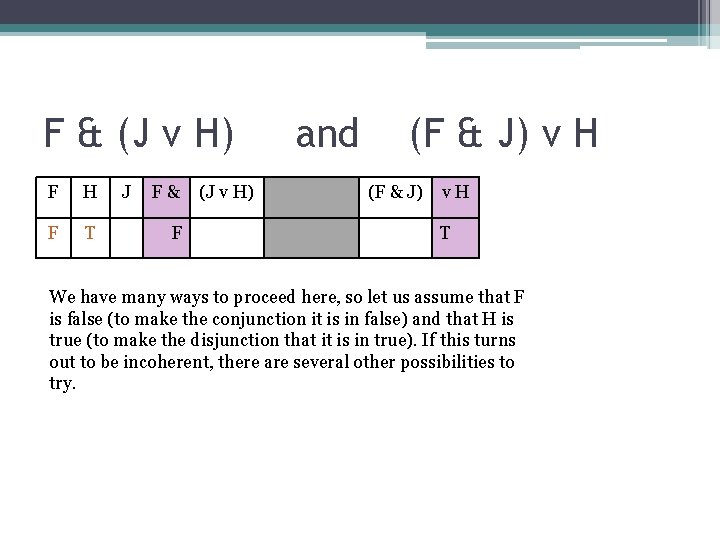
F & (J v H) F H J F& and (J v H) F So assume one is F and the other T… (F & J) v H (F & J) v. H T
F & (J v H) F H F T J F& F (J v H) and (F & J) v H (F & J) v. H T We have many ways to proceed here, so let us assume that F is false (to make the conjunction it is in false) and that H is true (to make the disjunction that it is in true). If this turns out to be incoherent, there are several other possibilities to try.
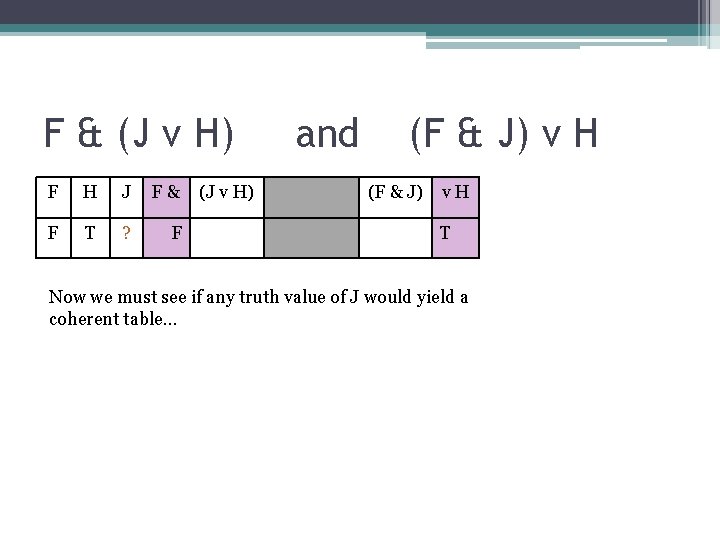
F & (J v H) F H J F& F T ? F (J v H) and (F & J) v H (F & J) v. H T Now we must see if any truth value of J would yield a coherent table…
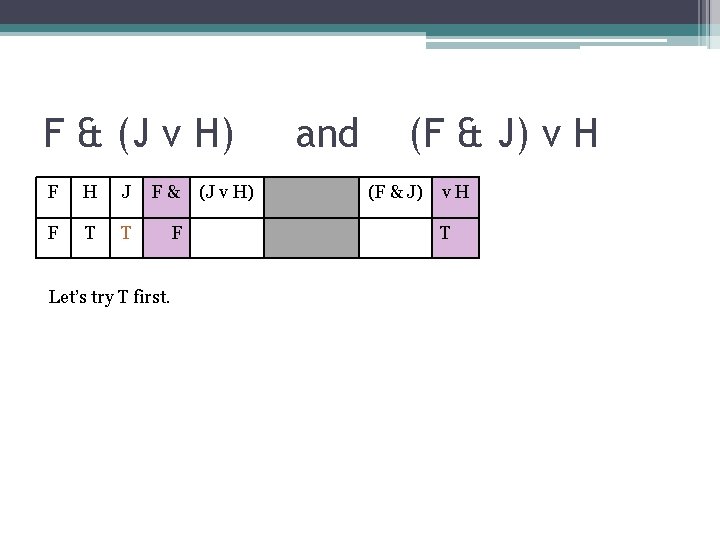
F & (J v H) F H J F& F T T F Let’s try T first. (J v H) and (F & J) v H (F & J) v. H T
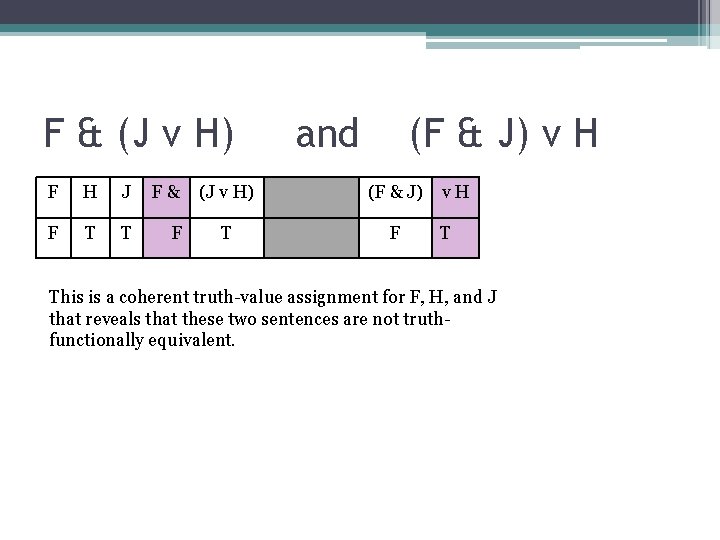
F & (J v H) F H J F& F T T F and (F & J) v H (J v H) (F & J) T F v. H T This is a coherent truth-value assignment for F, H, and J that reveals that these two sentences are not truthfunctionally equivalent.
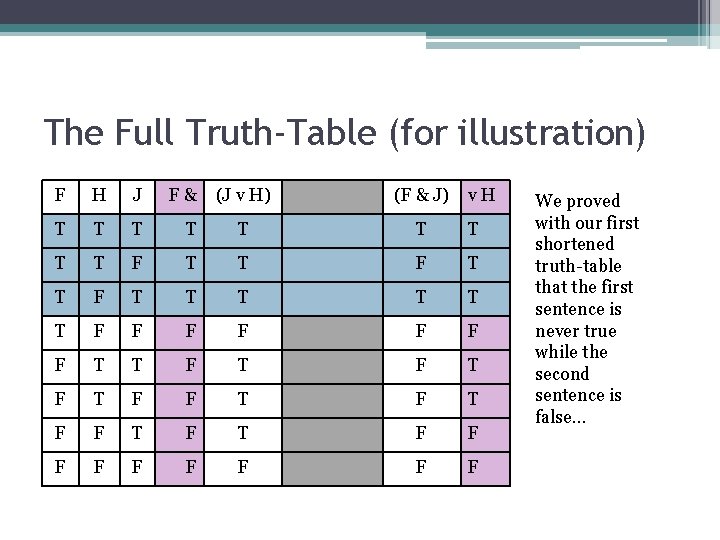
The Full Truth-Table (for illustration) F H J F& (J v H) (F & J) T T T v. H T T F T T T F F F F T T F T F F F F F We proved with our first shortened truth-table that the first sentence is never true while the second sentence is false…
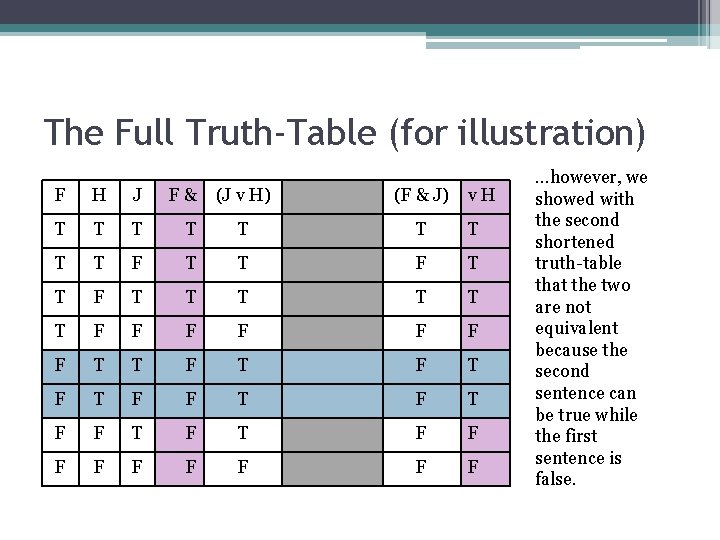
The Full Truth-Table (for illustration) F H J F& (J v H) (F & J) T T T v. H T T F T T T F F F F T T F T F F F F F …however, we showed with the second shortened truth-table that the two are not equivalent because the second sentence can be true while the first sentence is false.
Truth-Functional Consistency • A set of sentences of SL is truth-functionally consistent if and only if there is at least one truth value assignment [of the constituents of the set of sentences] on which all the members of the set are true. • That means that if each of the set of sentences of SL were done on a truth-table, there would be one row of the truth table on which all of the sentences of the set are true.
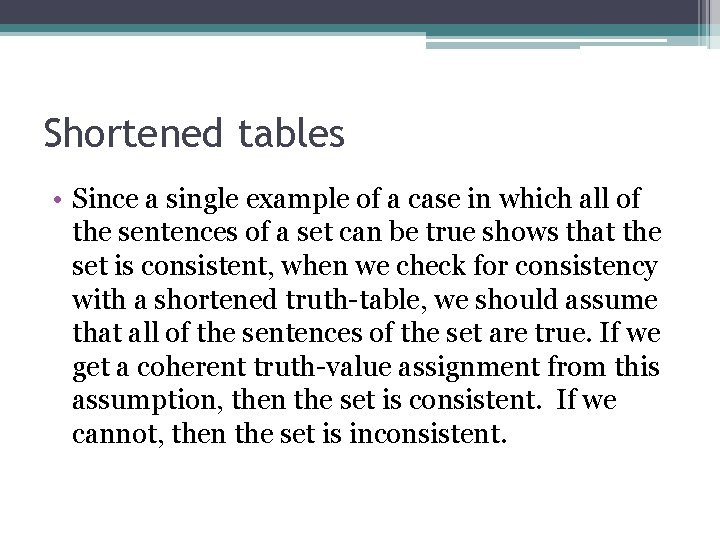
Shortened tables • Since a single example of a case in which all of the sentences of a set can be true shows that the set is consistent, when we check for consistency with a shortened truth-table, we should assume that all of the sentences of the set are true. If we get a coherent truth-value assignment from this assumption, then the set is consistent. If we cannot, then the set is inconsistent.
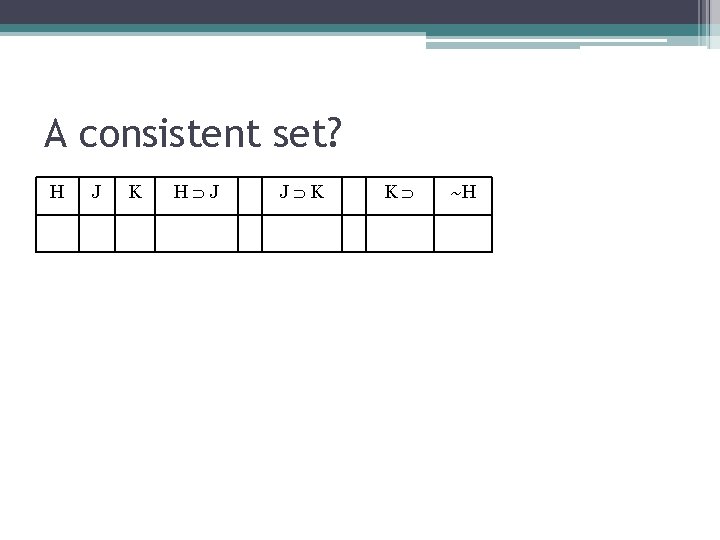
A consistent set? H J K H J J K K ~H
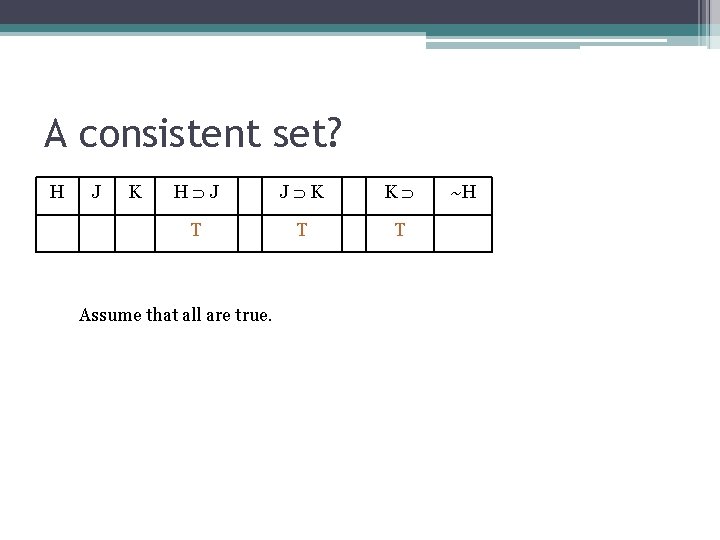
A consistent set? H J K H J J K K T T T Assume that all are true. ~H
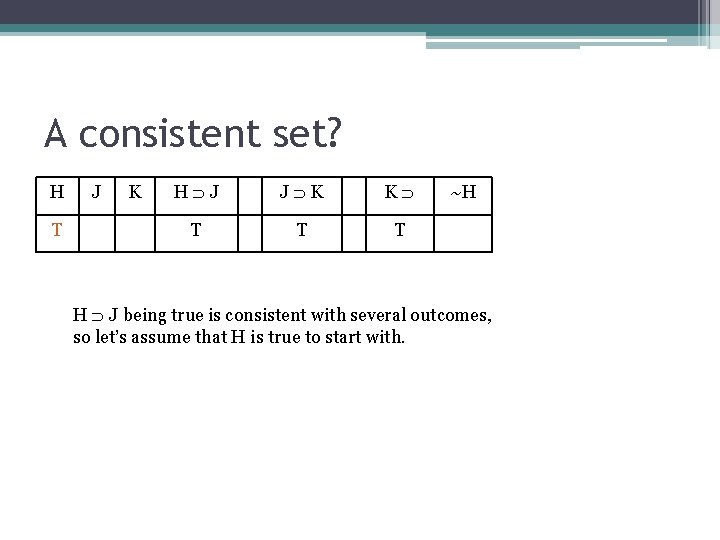
A consistent set? H T J K H J J K K T T T ~H H J being true is consistent with several outcomes, so let’s assume that H is true to start with.
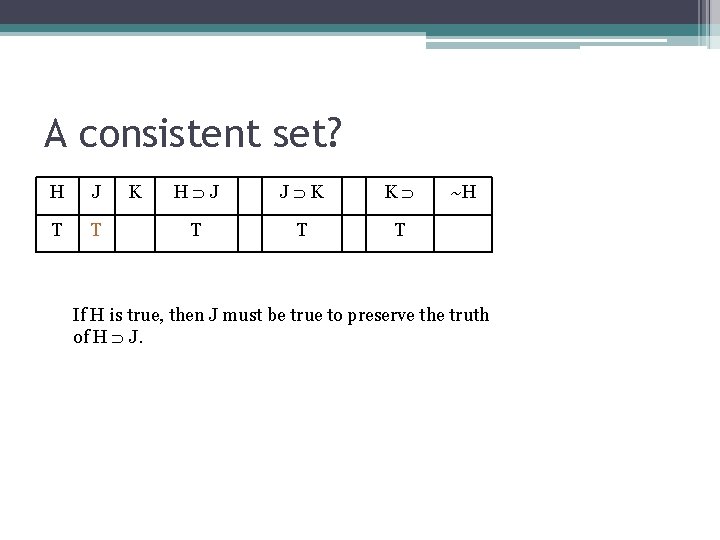
A consistent set? H J T T K H J J K K T T T ~H If H is true, then J must be true to preserve the truth of H J.
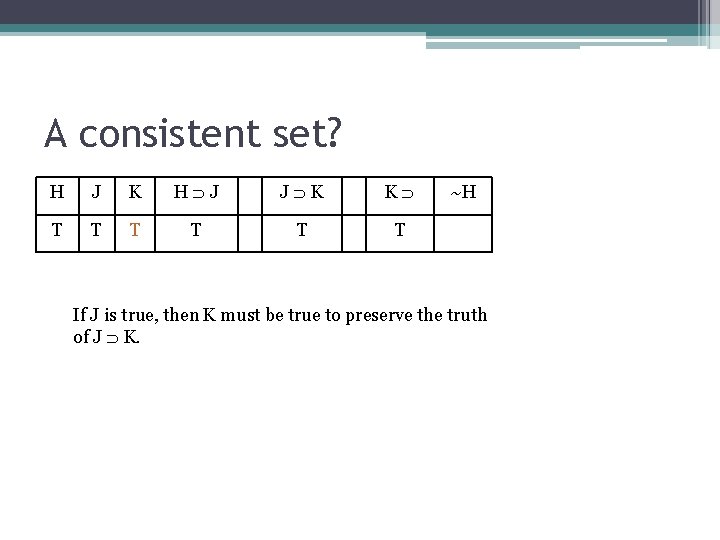
A consistent set? H J K H J J K K T T T ~H If J is true, then K must be true to preserve the truth of J K.
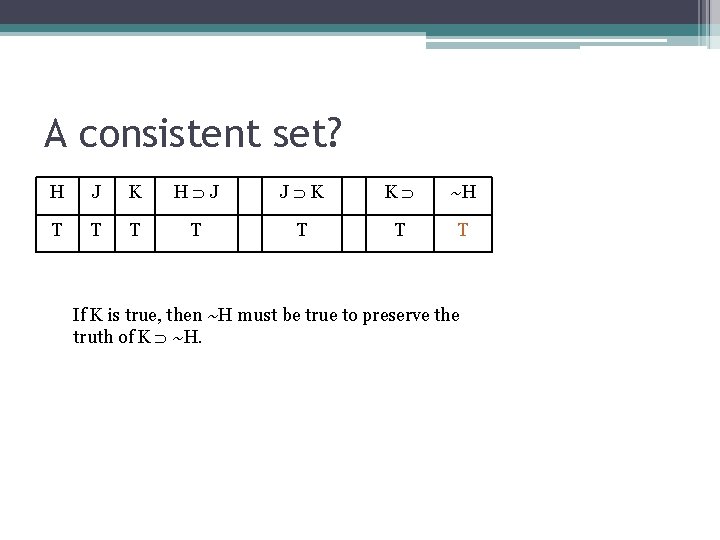
A consistent set? H J K H J J K K ~H T T T T If K is true, then ~H must be true to preserve the truth of K ~H.
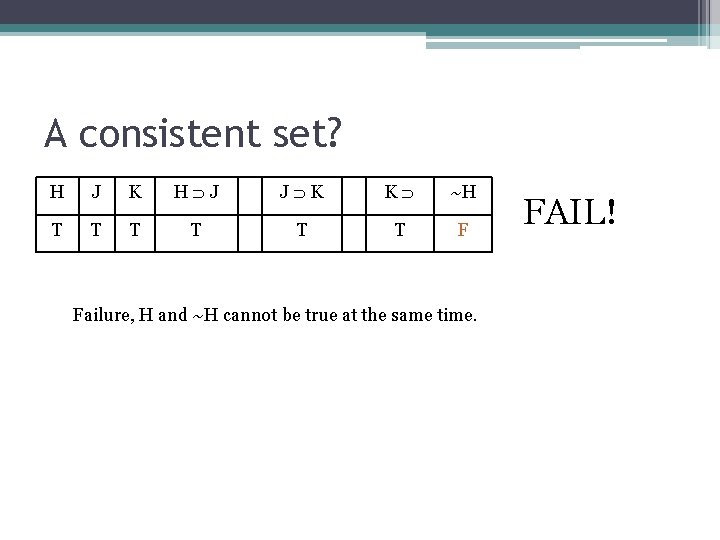
A consistent set? H J K H J J K K ~H T T T F Failure, H and ~H cannot be true at the same time. FAIL!
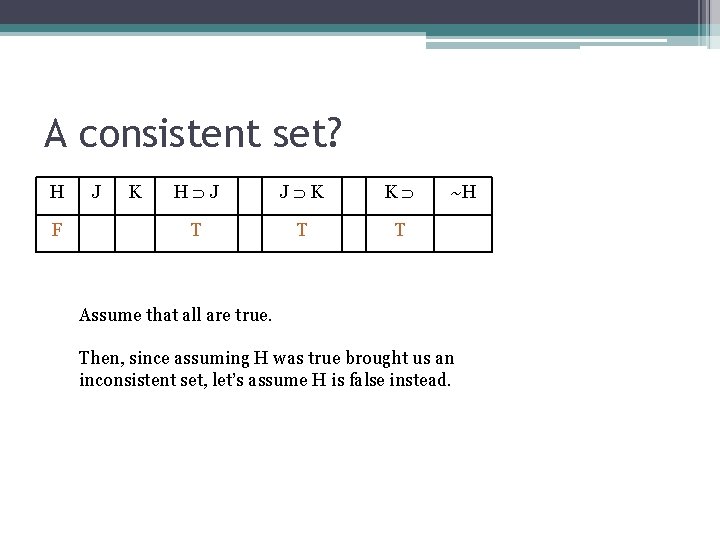
A consistent set? H F J K H J J K K T T T ~H Assume that all are true. Then, since assuming H was true brought us an inconsistent set, let’s assume H is false instead.
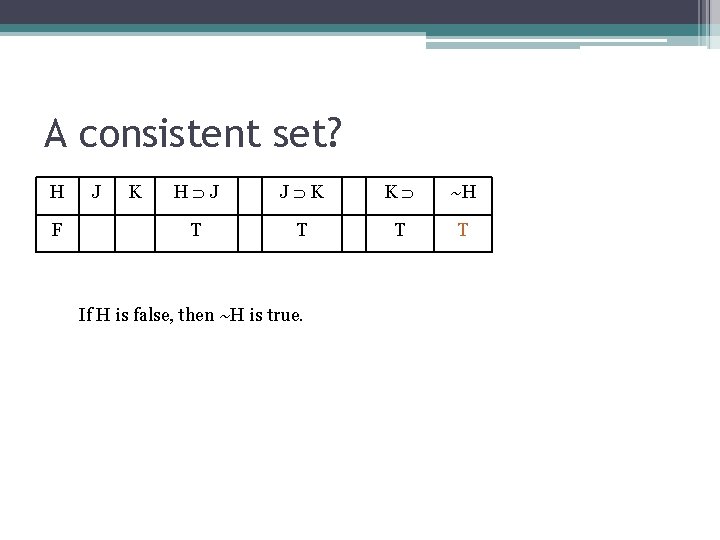
A consistent set? H F J K H J J K K ~H T T If H is false, then ~H is true.
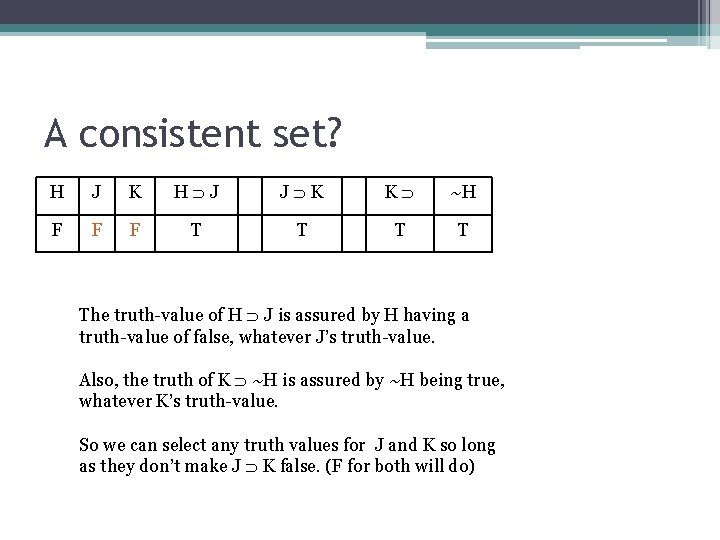
A consistent set? H J K H J J K K ~H F F F T T The truth-value of H J is assured by H having a truth-value of false, whatever J’s truth-value. Also, the truth of K ~H is assured by ~H being true, whatever K’s truth-value. So we can select any truth values for J and K so long as they don’t make J K false. (F for both will do)
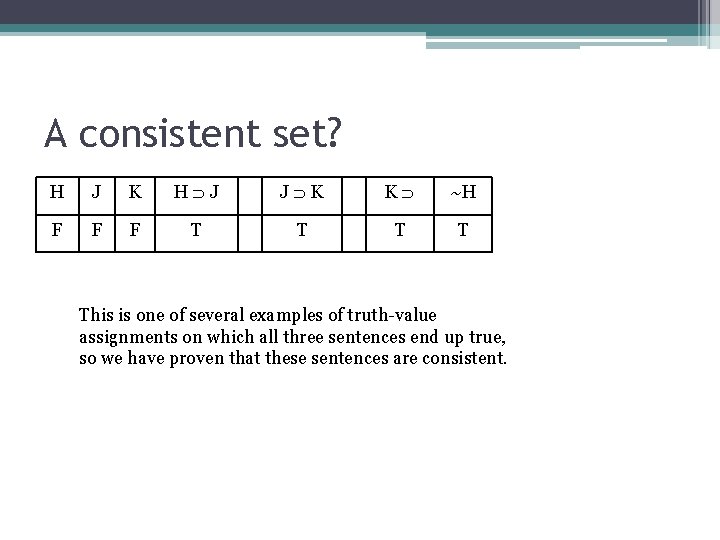
A consistent set? H J K H J J K K ~H F F F T T This is one of several examples of truth-value assignments on which all three sentences end up true, so we have proven that these sentences are consistent.