
Philosophical Foundations of Learning Theory The roots of

- Slides: 13
Philosophical Foundations of Learning Theory The roots of learning theory are in an area of philosophy called “epistemology”, a field concerned with how we acquire knowledge. Two philosophical traditions emerged from the writings of the ancient Greek philosophers, Plato and Aristotle, that parallel the cognitive and behavioral traditions in learning theory. These traditions are nativism (Plato) and empiricism (Aristotle). Cognitive psychology reflects the nativist tradition. Behavioral psychology reflects the empiricist tradition.
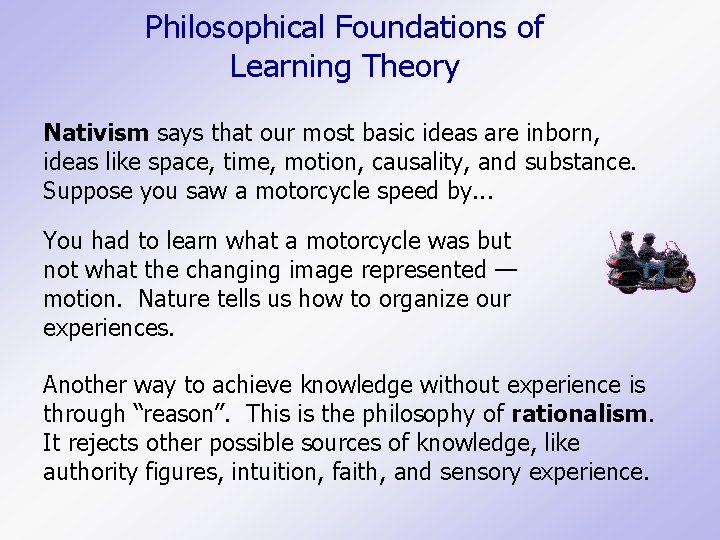
Philosophical Foundations of Learning Theory Nativism says that our most basic ideas are inborn, ideas like space, time, motion, causality, and substance. Suppose you saw a motorcycle speed by. . . You had to learn what a motorcycle was but not what the changing image represented — motion. Nature tells us how to organize our experiences. Another way to achieve knowledge without experience is through “reason”. This is the philosophy of rationalism. It rejects other possible sources of knowledge, like authority figures, intuition, faith, and sensory experience.
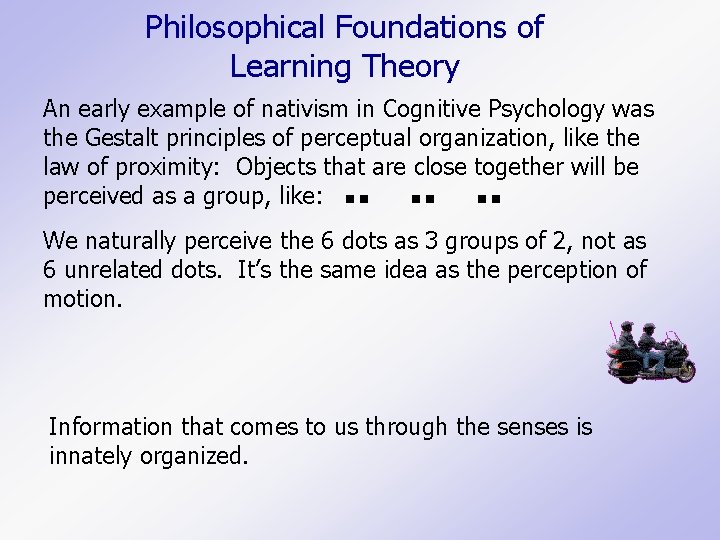
Philosophical Foundations of Learning Theory An early example of nativism in Cognitive Psychology was the Gestalt principles of perceptual organization, like the law of proximity: Objects that are close together will be perceived as a group, like: . . . We naturally perceive the 6 dots as 3 groups of 2, not as 6 unrelated dots. It’s the same idea as the perception of motion. Information that comes to us through the senses is innately organized.
Philosophical Foundations of Learning Theory In cognitive learning theory we see this nativist perspective in the information-processing approach, which compares the mind to a computer to understand mental processes. When you enter information into a computer, it is automatically organized by being stored in a certain folder on a certain drive, like the hard disk or floppy. Similarly, when you enter information into your mental computer, it is automatically stored in categories. It is then moved around within the apparatus according to the rules of the “operating system. ”
Philosophical Foundations of Learning Theory The influence of rationalism is seen in the complexity of cognitive theories. Cognitive theories typically consist of a lot of intervening variables with complex, often mathematical relationships between them. It is assumed that discoveries can be made through logical deduction and mathematics. These insights would then generate predictions (hypotheses) that would be tested experimentally. Behaviorists tend to be more data-oriented and reluctant to venture very far beyond observed facts.
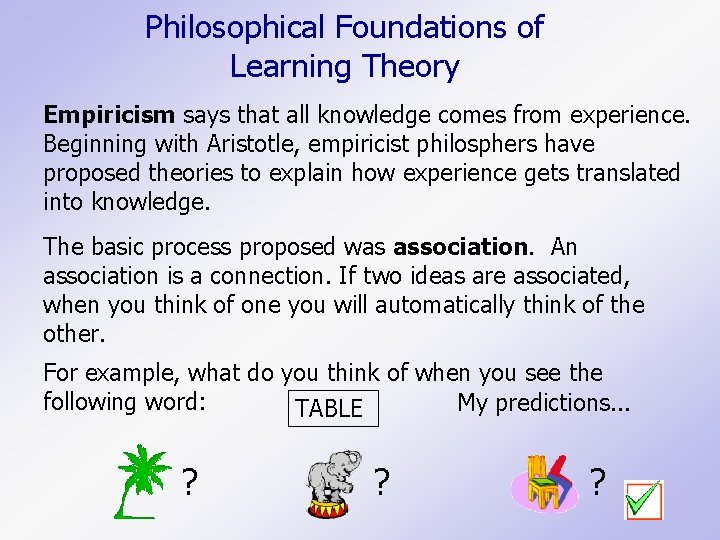
Philosophical Foundations of Learning Theory Empiricism says that all knowledge comes from experience. Beginning with Aristotle, empiricist philosphers have proposed theories to explain how experience gets translated into knowledge. The basic process proposed was association. An association is a connection. If two ideas are associated, when you think of one you will automatically think of the other. For example, what do you think of when you see the following word: My predictions. . . TABLE ? ? ?
Philosophical Foundations of Learning Theory Why chair? Probably because we see tables and chairs together so often. This statement points to two key principles philosophers used to explain the formation of associations: temporal contiguity and frequency. Temporal Contiguity Two events that are experienced at the same time will tend to be associated. A series of philosophers in England, from about 1650 to 1850, took Aristotle’s ideas about association, developed them further, and applied them to a wide range of human experiences. These “British associationists” included John Locke, David Hume, Thomas Hobbes, David Hartley, James Mill, and his son, John Stuart Mill.
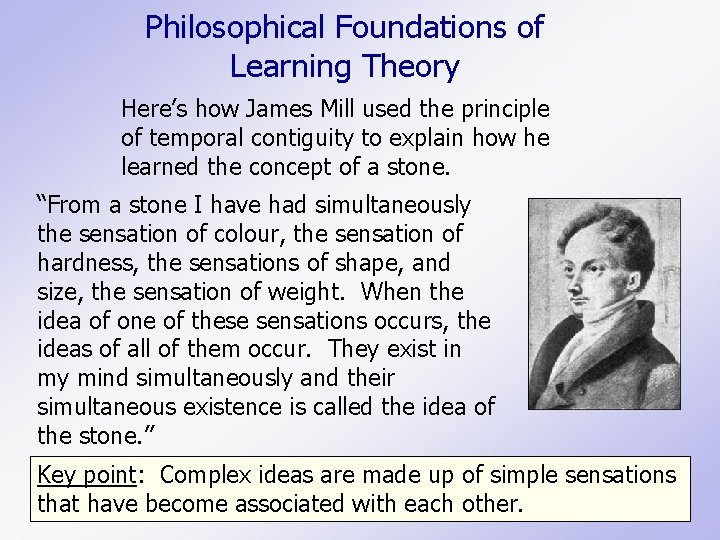
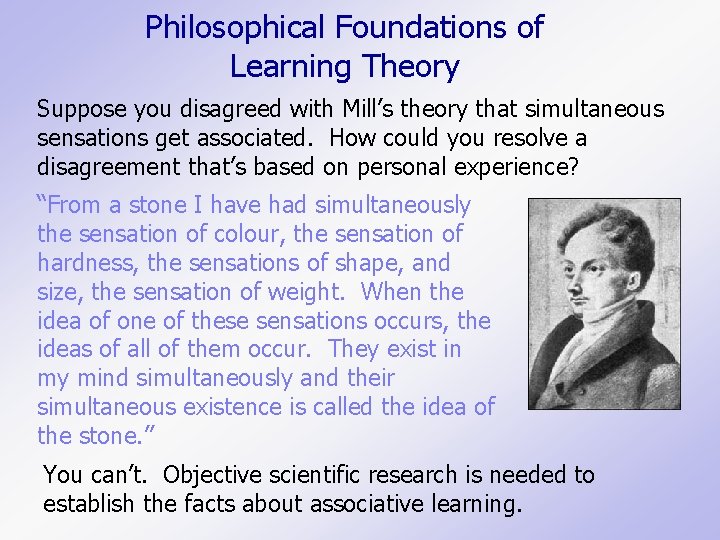
Philosophical Foundations of Learning Theory Here’s how James Mill used the principle of temporal contiguity to explain how he learned the concept of a stone. “From a stone I have had simultaneously the sensation of colour, the sensation of hardness, the sensations of shape, and size, the sensation of weight. When the idea of one of these sensations occurs, the ideas of all of them occur. They exist in my mind simultaneously and their simultaneous existence is called the idea of the stone. ” Key point: Complex ideas are made up of simple sensations that have become associated with each other.
Philosophical Foundations of Learning Theory Suppose you disagreed with Mill’s theory that simultaneous sensations get associated. How could you resolve a disagreement that’s based on personal experience? “From a stone I have had simultaneously the sensation of colour, the sensation of hardness, the sensations of shape, and size, the sensation of weight. When the idea of one of these sensations occurs, the ideas of all of them occur. They exist in my mind simultaneously and their simultaneous existence is called the idea of the stone. ” You can’t. Objective scientific research is needed to establish the facts about associative learning.
Philosophical Foundations of Learning Theory Closely related to the contiguity principle is the principle of frequency. Frequency The more often we experience events that are contiguous, the more strongly we will associate them. According to John Locke, repetition can strengthen associations even when it occurs mentally rather than by exposure to physical events.
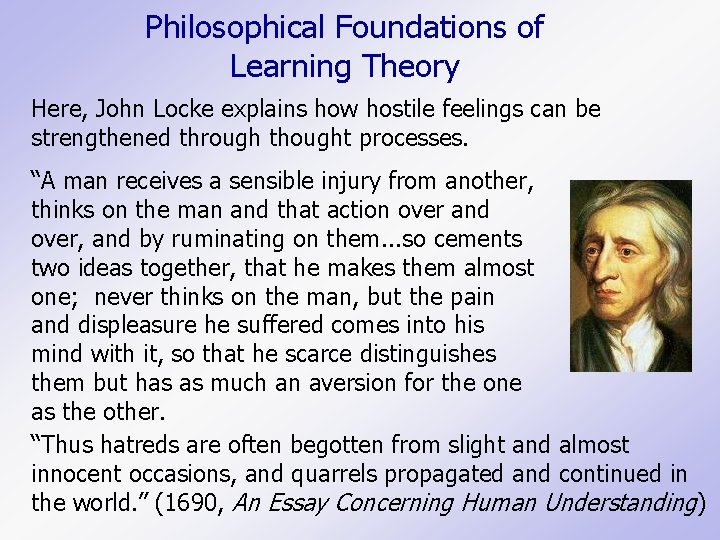
Philosophical Foundations of Learning Theory Here, John Locke explains how hostile feelings can be strengthened through thought processes. “A man receives a sensible injury from another, thinks on the man and that action over and over, and by ruminating on them. . . so cements two ideas together, that he makes them almost one; never thinks on the man, but the pain and displeasure he suffered comes into his mind with it, so that he scarce distinguishes them but has as much an aversion for the one as the other. “Thus hatreds are often begotten from slight and almost innocent occasions, and quarrels propagated and continued in the world. ” (1690, An Essay Concerning Human Understanding)
Philosophical Foundations of Learning Theory Research on classical (Pavlovian) conditioning has shown that the principles of temporal contiguity and frequency must be modified to explain associative learning. We’ll see how in later presentations. Still, the philosophers’ insights into how associations are formed continue to provide the conceptual framework for research in the behavioral tradition.