
PHILIPPINE QUALITY AWARD PQA An Overview and Application
- Slides: 25
PHILIPPINE QUALITY AWARD (PQA) An Overview and Application Development Process ELVIN FADRIQUELA GAAC 23 March 2016 Romblon State University Main Campus
Presentation Outline � What is the Philippine Quality Award (PQA)? � PQA Criteria for Performance Excellence and Assessment points � Award and Recognition Levels � PQA Selection Process � Scope of Application : which organization can apply? � PQA Application Development Process � Partial List of the PQA recipients/awardees � PQA Committee Members
What is the PQA? � v v v A set of organizational performance assessment criteria covering a wide range of key excellence indicators: Customer Product and Services Operational Human Resources Financial
What is the PQA? � It is the highest level of national recognition for exemplary organizational performance. � The Award is focuses on results, including customer satisfaction; not for product or service quality… but for quality management system � Established through Executive Order No. 448 by former President Fidel V. Ramos on 03 October 1997 � It was institutionalized through the signing of Republic Act No. 9013 on 28 February 2001
What is the PQA? It is also a measure of the overall health of the organizations, beyond the financials � It measures the overall health of the organization, beyond financials � � Thus, it has a set of organizational performance assessment criteria covering a wide range of key indicators: customer, product and service, operational, human resource and financial
Objectives of the PQA � To promote standards on organizational performance comparable to those of leading businesses/organization abroad � To establish a national system for assessing quality and productivity performance in both private and public organizations � To recognize organizations which have achieved the highest level of quality and excellence thus providing benchmarks which could be emulated.
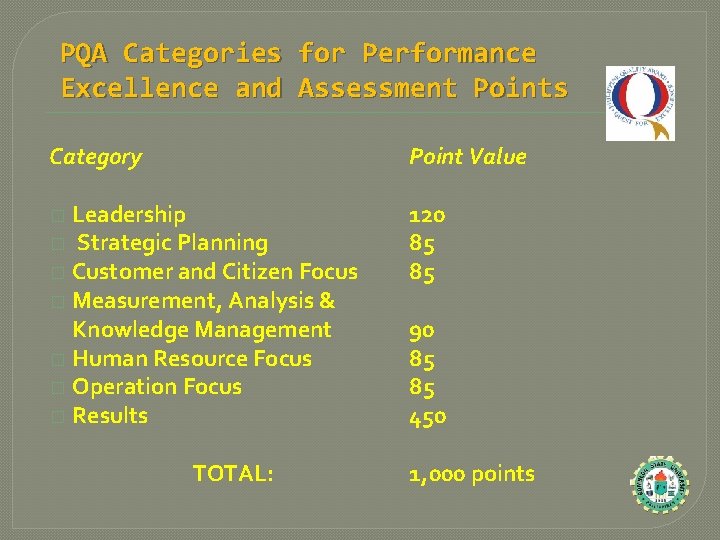
PQA Categories for Performance Excellence and Assessment Points Category Point Value Leadership � Strategic Planning � Customer and Citizen Focus � Measurement, Analysis & Knowledge Management � Human Resource Focus � Operation Focus � Results 120 85 85 � TOTAL: 90 85 85 450 1, 000 points
What are these criteria? They are set of requirements � They provide a structured approach to performance improvement � They provide a framework for a system’s view of performance management � They are based upon a set of core values � They provide a common language of assessment �
Assessment Criteria help to: Align and achieve the strategic goals of the university Improve the unit productivity in particular and of the university in general � Improve the communication within and across units and systems o Provide guidance for organizations who want to deliver ever-improving value to costumers while at the same time maximizing overall organizational performance and capabilities o To serve as bases for organizational self-assessment, for giving awards, and for giving feedback to PQA applicants � �
What do assessors look for? Ø Ø For Process Items For Results Items Approach Deployment Learning Integration Levels Trends Comparisons Integration
APPROACH • • What is the methodology used to address the criteria requirement? Is the method appropriate for the criteria requirement and the organization, considering the organizational profile? Is the methodology effective? Is the methodology understandable, documented, repeatable, measurable ( based on reliable data & information), systematic, predictable?
Deployment To what extent is the methodology used by all appropriate work units within the organization (horizontally & vertically? � To what extent is the methodology applied consistently? � To what extent are suppliers, partners, costumers, and other stakeholders involved in the approach? �
Learning �How are the approaches refined through cycles of evaluation & improvements? �To what extent have we used benchmarking and “best practices sharing” to improve our own processes and practices? �How do you encourage breakthrough changes to your approach through innovation? �How are refinements and innovations shared with other relevant work units and processes in our organization?
Integration �Is the approach aligned with organization needs identified in the organizational profile? �Are our measures, information and improvement systems complementary across processes and work units? �Are our plans, processes, analyses, learning and actions harmonized across processes and work units to support organizational-wide goals?
Levels What are our current levels of performance compared to our goals /targets/standards? � Do we show numerical information that reflects our organization’s results and performance in a meaningful measurement scale? � Are we using the appropriate chart for the results we wish � to show?
Trends � Do we show the rate of our performance improvement (+ or- ) or the sustainability of good performance ( i. e. , the slope of trend data)? � Do you show the breath (i. e. , the extent of deployment) of your performance results? � Do you show trends over a 3 -5 year time period? § The time period for a trend is determined by the cycle time of the process being measured.
Comparison �Do we show our performance relative to appropriate comparisons, such as competitors or organizations similar to ours? �Do we show our performance relative to benchmarks or industry leaders? �When applicable, do we show our performance relative to the same period last cycle?
Integration Do our results cover important customer, product and service, market, process, and action plan performance requirements identified in your organizational profile? � Do our results include valid indicators of future performance? � Are our results harmonized across processes and work units to support organizational goals? �
The Senior Leadership Team of Landmark consist of the President/CEO, Directors, Business Excellence Director, and Advisory Board. With addition of the Advisory Board in 1990, Landmark formalized its Vision, Mission, and values in the Organizational Profile. This initiative was led by the President/CEO, using a consensus process, and agreed upon by other members of the Senior Leadership Team. As described, VMV are reviewed annually during the Strategic Planning Process and are incorporated into the Strategy Matrix. While the VMV remains consistent to guide and sustain the organization, two additions have been made to the Values. In 1995, in response to an emerging consumer trend toward healthier lifestyles was added as a Value. In addition, while ethical conduct always has been a family value, Ethics, Honesty, and Integrity was added to the organization’s Values in 1998.
Award and Recognition Levels � LEVEL 1: Recognition for Commitment to Quality Management � LEVEL 2: Recognition for Proficiency in Quality Management � LEVEL 3: Recognition for Mastery in Quality Management � LEVEL 4: PQA for Performance Excellence
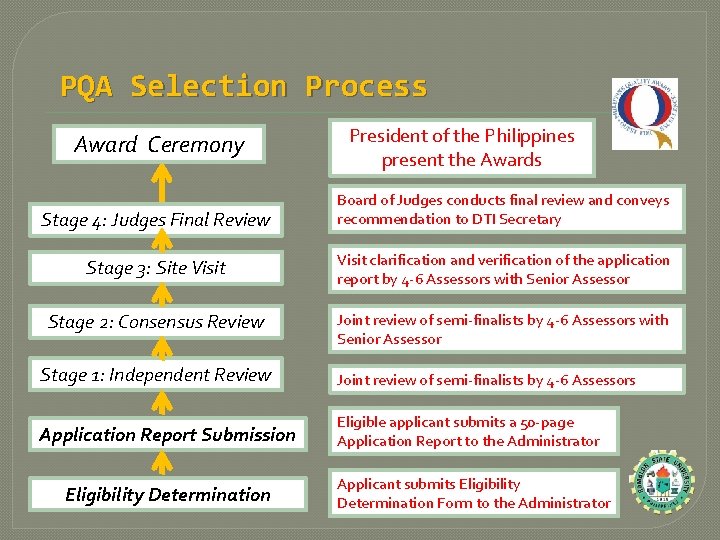
PQA Selection Process Award Ceremony Stage 4: Judges Final Review President of the Philippines present the Awards Board of Judges conducts final review and conveys recommendation to DTI Secretary Stage 3: Site Visit clarification and verification of the application report by 4 -6 Assessors with Senior Assessor Stage 2: Consensus Review Joint review of semi-finalists by 4 -6 Assessors with Senior Assessor Stage 1: Independent Review Joint review of semi-finalists by 4 -6 Assessors Application Report Submission Eligible applicant submits a 50 -page Application Report to the Administrator Eligibility Determination Applicant submits Eligibility Determination Form to the Administrator
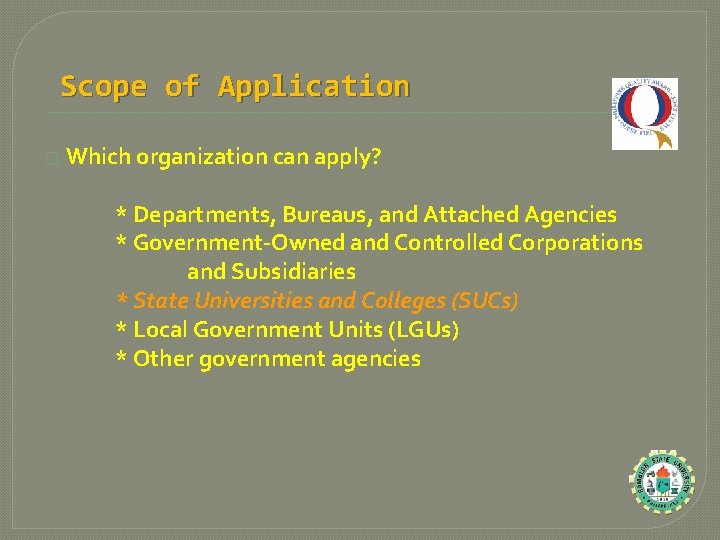
Scope of Application � Which organization can apply? * Departments, Bureaus, and Attached Agencies * Government-Owned and Controlled Corporations and Subsidiaries * State Universities and Colleges (SUCs) * Local Government Units (LGUs) * Other government agencies
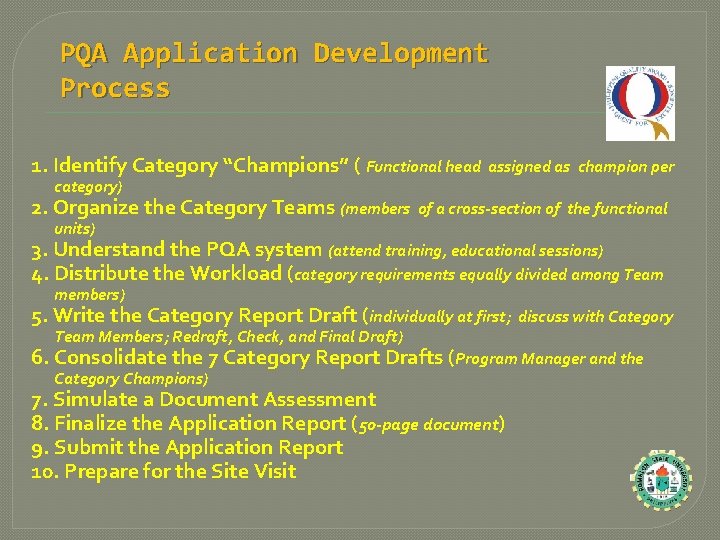
PQA Application Development Process 1. Identify Category “Champions” ( Functional head category) 2. Organize the Category Teams (members units) assigned as champion per of a cross-section of the functional 3. Understand the PQA system (attend training, educational sessions) 4. Distribute the Workload (category requirements equally divided among Team members) 5. Write the Category Report Draft (individually at first; Team Members; Redraft, Check, and Final Draft) discuss with Category 6. Consolidate the 7 Category Report Drafts (Program Manager and the Category Champions) 7. Simulate a Document Assessment 8. Finalize the Application Report (50 -page document) 9. Submit the Application Report 10. Prepare for the Site Visit
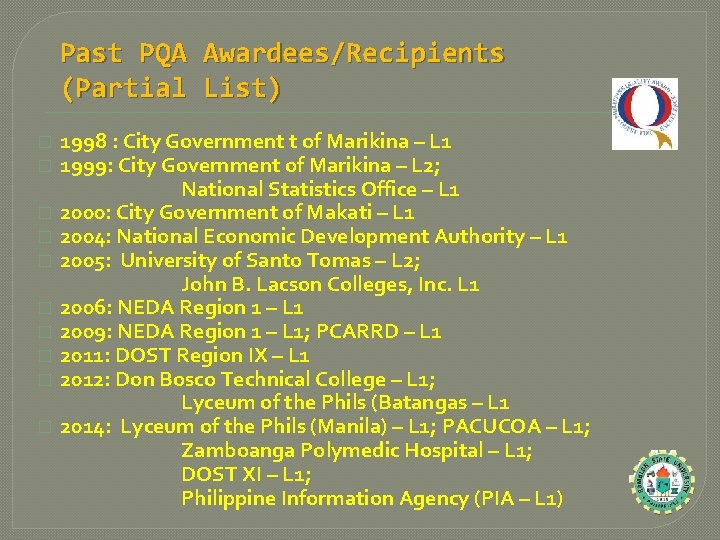
Past PQA Awardees/Recipients (Partial List) � � � � � 1998 : City Government t of Marikina – L 1 1999: City Government of Marikina – L 2; National Statistics Office – L 1 2000: City Government of Makati – L 1 2004: National Economic Development Authority – L 1 2005: University of Santo Tomas – L 2; John B. Lacson Colleges, Inc. L 1 2006: NEDA Region 1 – L 1 2009: NEDA Region 1 – L 1; PCARRD – L 1 2011: DOST Region IX – L 1 2012: Don Bosco Technical College – L 1; Lyceum of the Phils (Batangas – L 1 2014: Lyceum of the Phils (Manila) – L 1; PACUCOA – L 1; Zamboanga Polymedic Hospital – L 1; DOST XI – L 1; Philippine Information Agency (PIA – L 1)
PQA Committee Chair: DTI Secretary Vice Chairs: DAP President (public sector) and PQPM President (private sector) � Members: Highest ranking officials of the following: * PSQ, IDC, NWPC, PATE, DBM, MAP, and CSC � Awards Manager: DTI Secretary � Management Team: Organized by the PQA Committee � Award Administrators: DAP-CQC (public sector); PSQ (private sector) � Board of Judges and Team of Assessors: Selected judges and qualifies assessors � � NOTE: Application Forms and Submission : DTI and DAP