
Philippine Plan of Action for Nutrition PPAN 2017
- Slides: 48
Philippine Plan of Action for Nutrition (PPAN) 2017 -2022 1
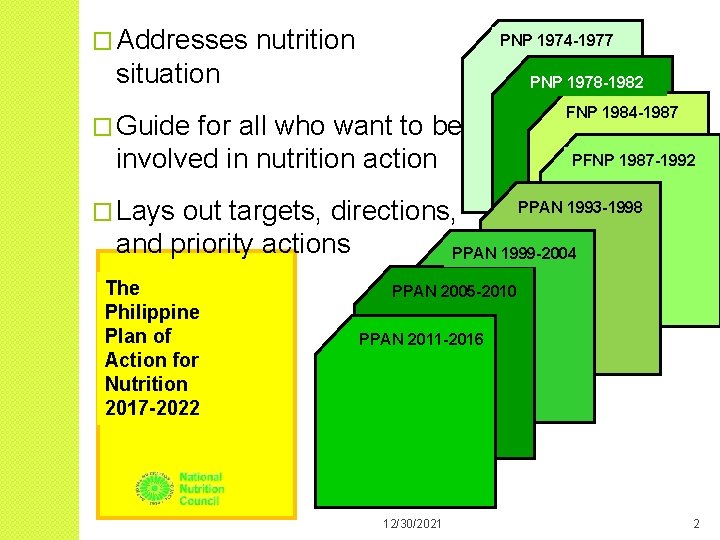
� Addresses nutrition PNP 1974 -1977 situation PNP 1978 -1982 � Guide for all who want to be involved in nutrition action FNP 1984 -1987 PFNP 1987 -1992 � Lays PPAN 1993 -1998 out targets, directions, and priority actions PPAN 1999 -2004 The Philippine Plan of Action for Nutrition 2017 -2022 PPAN 2005 -2010 PPAN 2011 -2016 12/30/2021 2
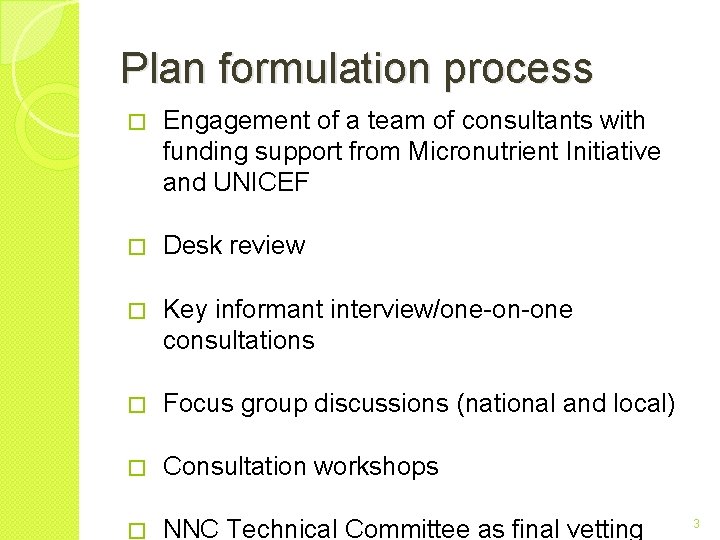
Plan formulation process � Engagement of a team of consultants with funding support from Micronutrient Initiative and UNICEF � Desk review � Key informant interview/one-on-one consultations � Focus group discussions (national and local) � Consultation workshops � NNC Technical Committee as final vetting 3
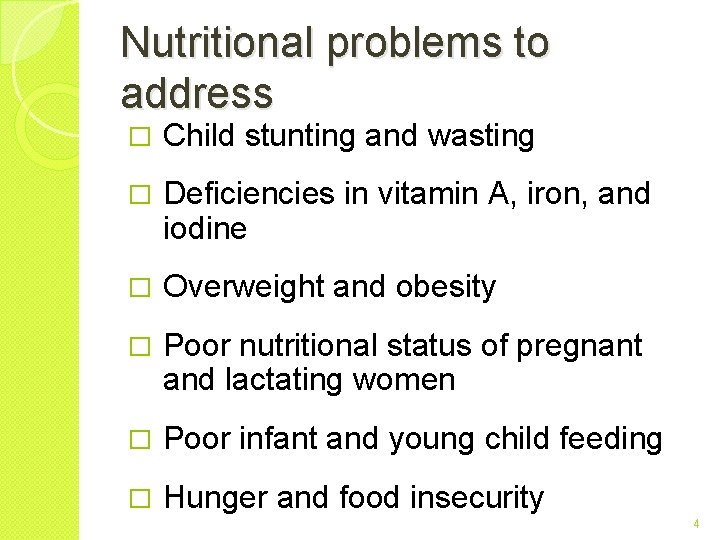
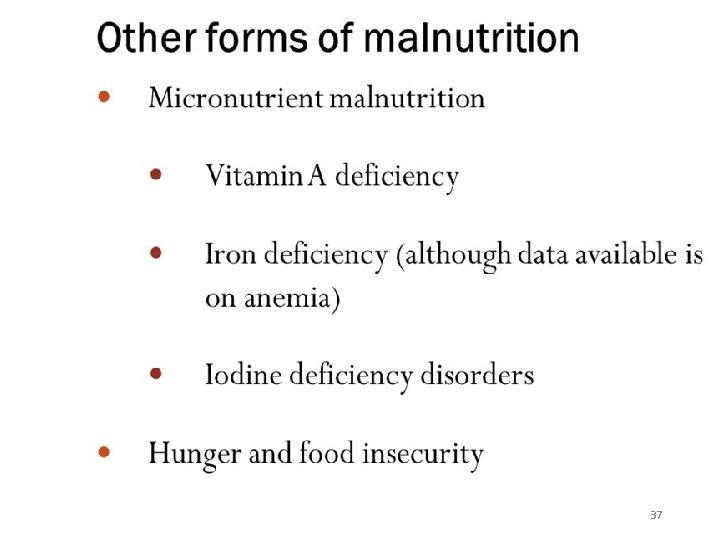
Nutritional problems to address � Child stunting and wasting � Deficiencies in vitamin A, iron, and iodine � Overweight and obesity � Poor nutritional status of pregnant and lactating women � Poor infant and young child feeding � Hunger and food insecurity 4
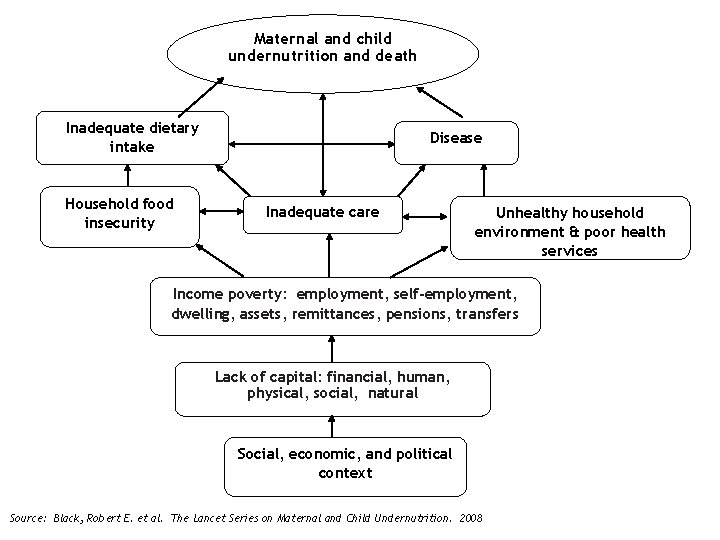
Maternal and child undernutrition and death Inadequate dietary intake Household food insecurity Disease Inadequate care Unhealthy household environment & poor health services Income poverty: employment, self-employment, dwelling, assets, remittances, pensions, transfers Lack of capital: financial, human, physical, social, natural Social, economic, and political context Source: Black, Robert E. et al. The Lancet Series on Maternal and Child Undernutrition. 2008
PPAN 2017 -2022 Outcome targets • In general, consistent with the 2025 Global Targets for Maternal, Infant and Young Child Nutrition
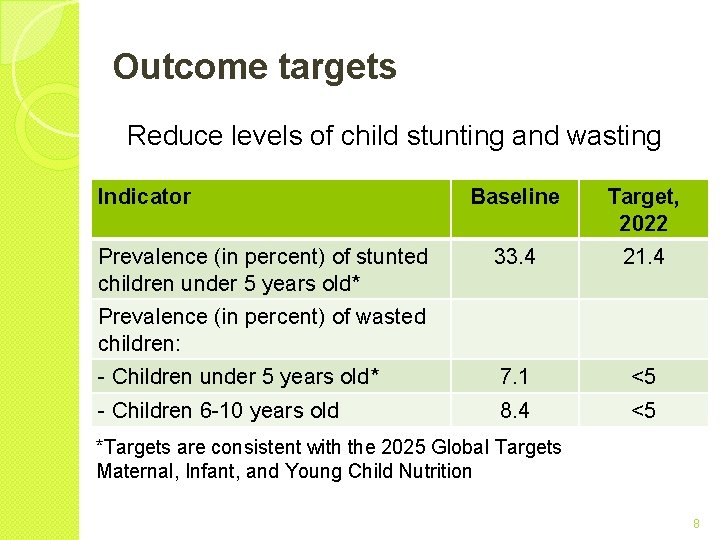
Outcome targets Reduce levels of child stunting and wasting Indicator Baseline Target, 2022 33. 4 21. 4 - Children under 5 years old* 7. 1 <5 - Children 6 -10 years old 8. 4 <5 Prevalence (in percent) of stunted children under 5 years old* Prevalence (in percent) of wasted children: *Targets are consistent with the 2025 Global Targets Maternal, Infant, and Young Child Nutrition 8
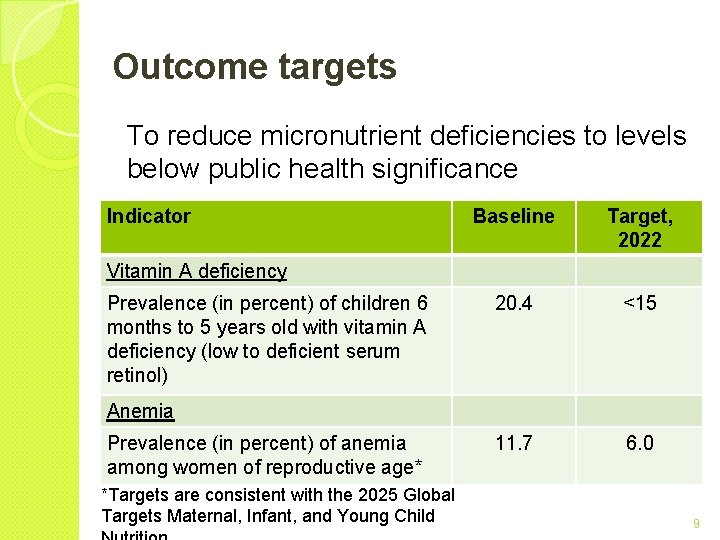
Outcome targets To reduce micronutrient deficiencies to levels below public health significance Indicator Baseline Target, 2022 20. 4 <15 11. 7 6. 0 Vitamin A deficiency Prevalence (in percent) of children 6 months to 5 years old with vitamin A deficiency (low to deficient serum retinol) Anemia Prevalence (in percent) of anemia among women of reproductive age* *Targets are consistent with the 2025 Global Targets Maternal, Infant, and Young Child 9
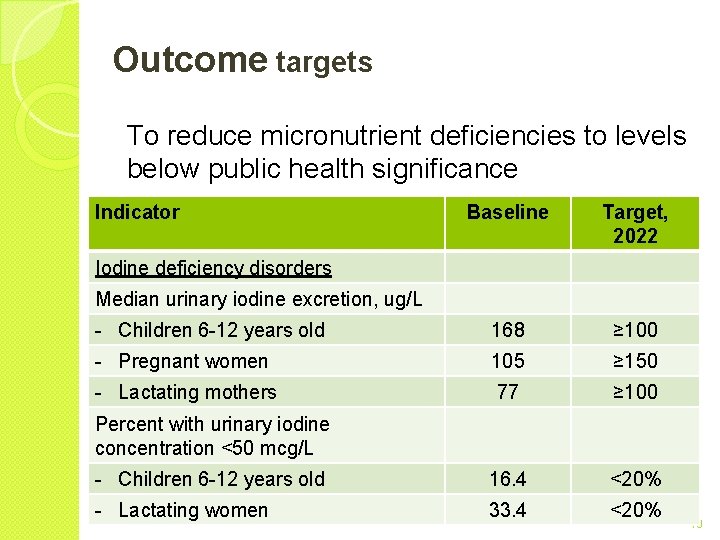
Outcome targets To reduce micronutrient deficiencies to levels below public health significance Indicator Baseline Target, 2022 - Children 6 -12 years old 168 ≥ 100 - Pregnant women 105 ≥ 150 - Lactating mothers 77 ≥ 100 - Children 6 -12 years old 16. 4 <20% - Lactating women 33. 4 <20% Iodine deficiency disorders Median urinary iodine excretion, ug/L Percent with urinary iodine concentration <50 mcg/L 10
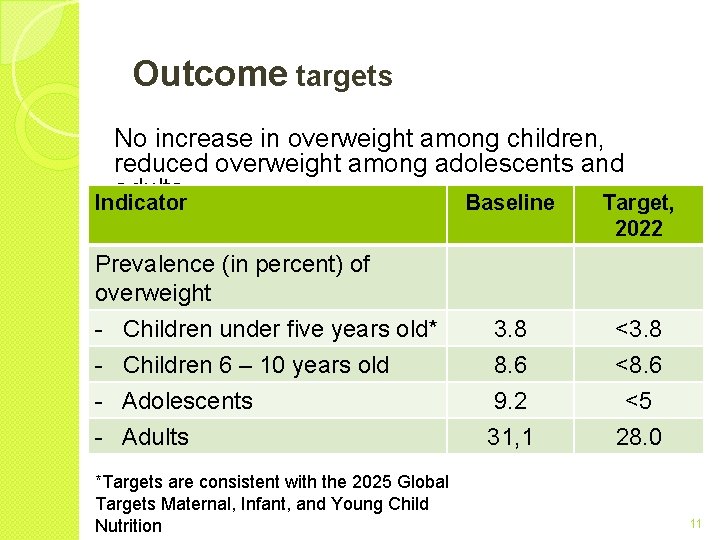
Outcome targets No increase in overweight among children, reduced overweight among adolescents and adults Indicator Baseline Target, 2022 Prevalence (in percent) of overweight - Children under five years old* Children 6 – 10 years old Adolescents Adults *Targets are consistent with the 2025 Global Targets Maternal, Infant, and Young Child Nutrition 3. 8 8. 6 9. 2 31, 1 <3. 8 <8. 6 <5 28. 0 11
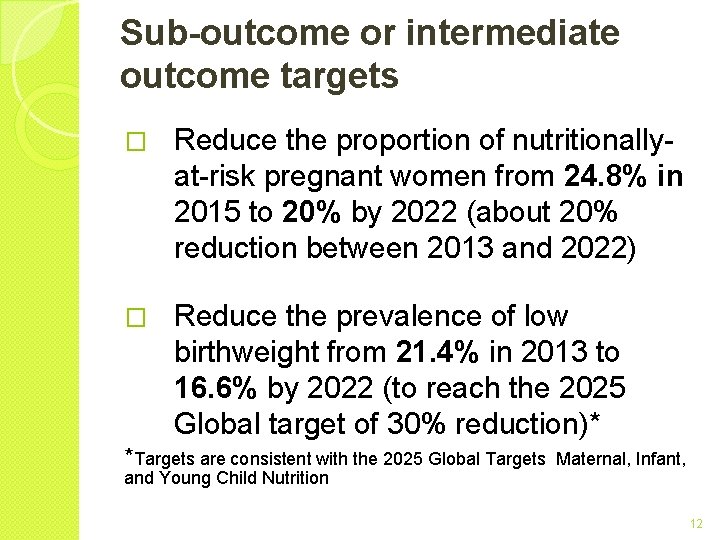
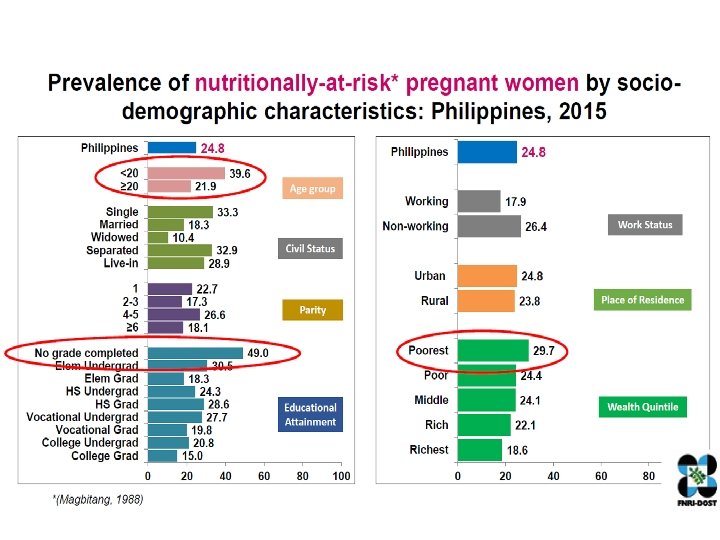
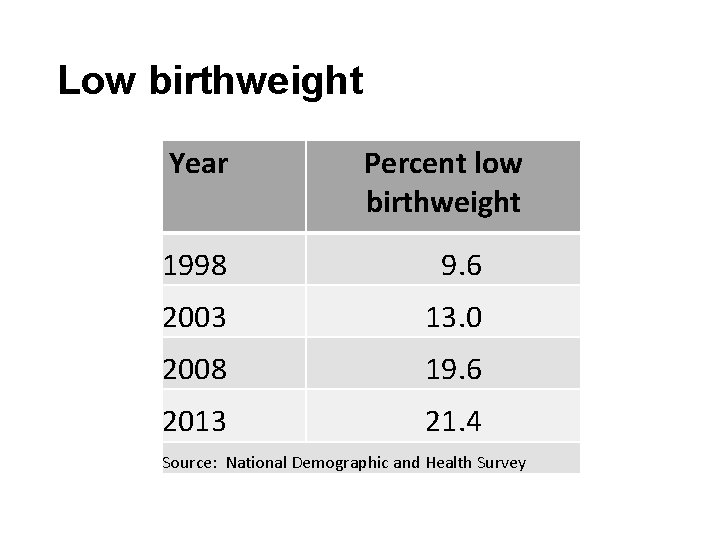
Sub-outcome or intermediate outcome targets � Reduce the proportion of nutritionallyat-risk pregnant women from 24. 8% in 2015 to 20% by 2022 (about 20% reduction between 2013 and 2022) � Reduce the prevalence of low birthweight from 21. 4% in 2013 to 16. 6% by 2022 (to reach the 2025 Global target of 30% reduction)* *Targets are consistent with the 2025 Global Targets and Young Child Nutrition Maternal, Infant, 12
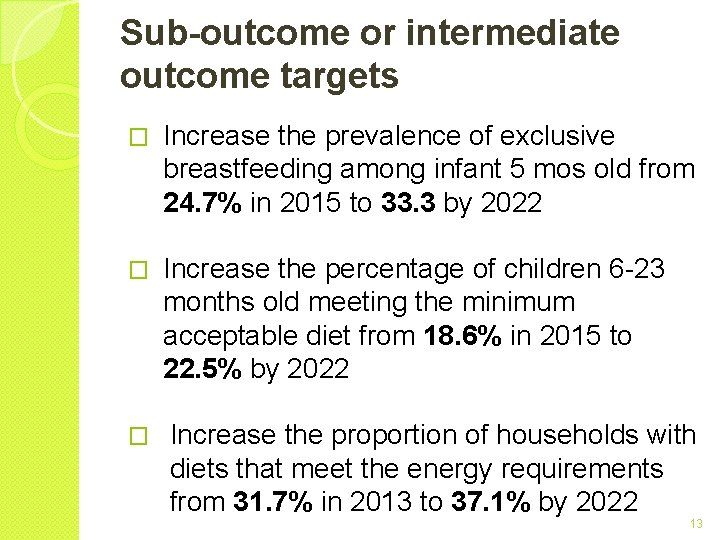
Sub-outcome or intermediate outcome targets � Increase the prevalence of exclusive breastfeeding among infant 5 mos old from 24. 7% in 2015 to 33. 3 by 2022 � Increase the percentage of children 6 -23 months old meeting the minimum acceptable diet from 18. 6% in 2015 to 22. 5% by 2022 � Increase the proportion of households with diets that meet the energy requirements from 31. 7% in 2013 to 37. 1% by 2022 13
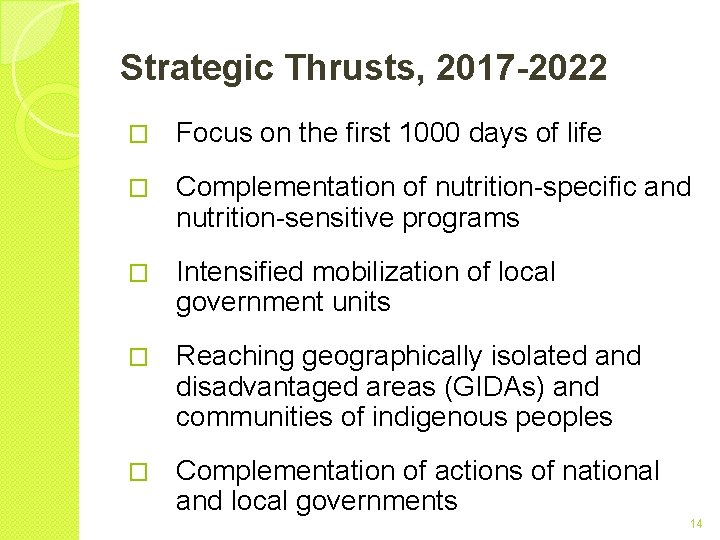
Strategic Thrusts, 2017 -2022 � Focus on the first 1000 days of life � Complementation of nutrition-specific and nutrition-sensitive programs � Intensified mobilization of local government units � Reaching geographically isolated and disadvantaged areas (GIDAs) and communities of indigenous peoples � Complementation of actions of national and local governments 14
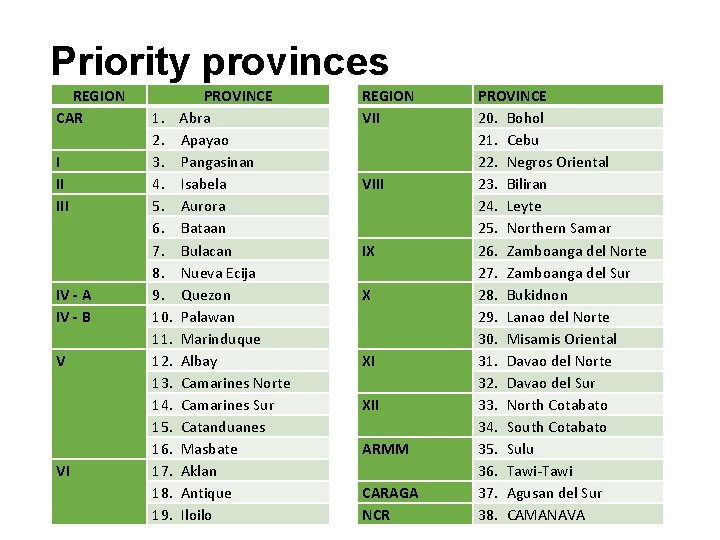
Priority provinces REGION CAR I II IV - A IV - B V VI 1. 2. 3. 4. 5. 6. 7. 8. 9. 10. 11. 12. 13. 14. 15. 16. 17. 18. 19. PROVINCE Abra Apayao Pangasinan Isabela Aurora Bataan Bulacan Nueva Ecija Quezon Palawan Marinduque Albay Camarines Norte Camarines Sur Catanduanes Masbate Aklan Antique Iloilo REGION VIII IX X XI XII ARMM CARAGA NCR PROVINCE 20. Bohol 21. Cebu 22. Negros Oriental 23. Biliran 24. Leyte 25. Northern Samar 26. Zamboanga del Norte 27. Zamboanga del Sur 28. Bukidnon 29. Lanao del Norte 30. Misamis Oriental 31. Davao del Norte 32. Davao del Sur 33. North Cotabato 34. South Cotabato 35. Sulu 36. Tawi-Tawi 37. Agusan del Sur 38. CAMANAVA
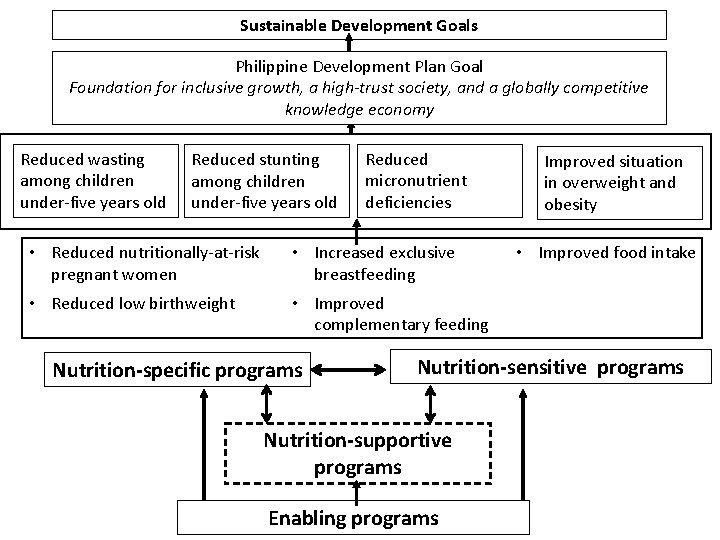
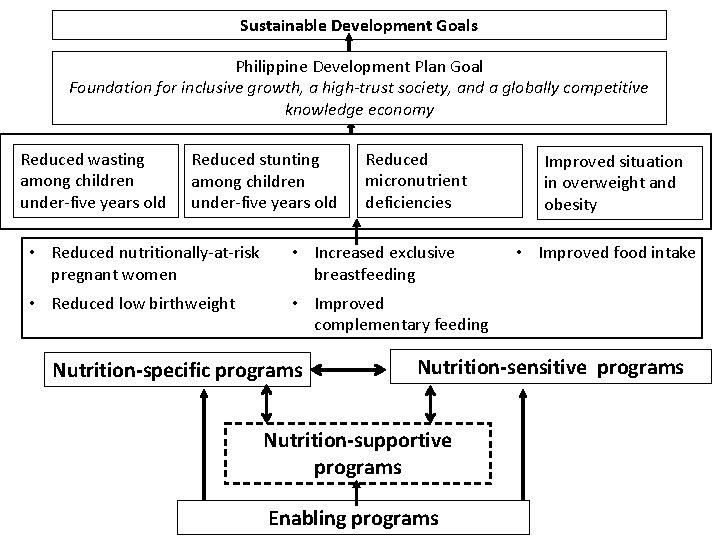
Sustainable Development Goals Philippine Development Plan Goal Foundation for inclusive growth, a high-trust society, and a globally competitive knowledge economy Reduced wasting among children under-five years old Reduced stunting among children under-five years old Reduced micronutrient deficiencies • Reduced nutritionally-at-risk pregnant women • Increased exclusive breastfeeding • Reduced low birthweight • Improved complementary feeding Nutrition-specific programs Improved situation in overweight and obesity • Improved food intake Nutrition-sensitive programs Nutrition-supportive programs Enabling programs
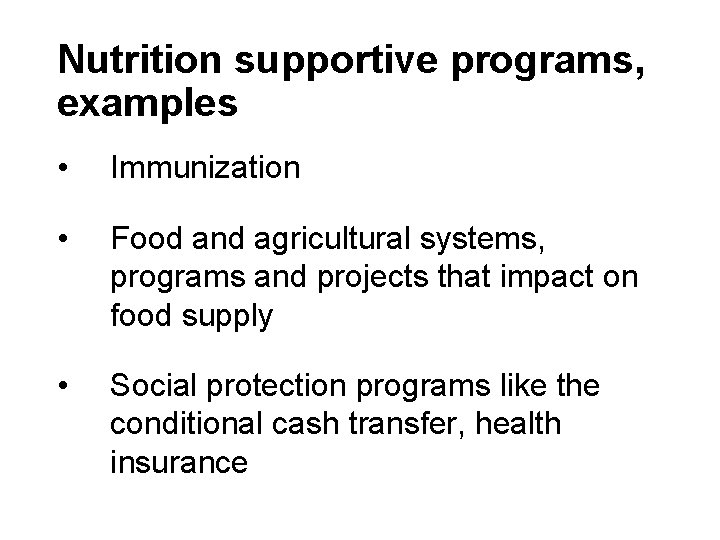
Nutrition supportive programs, examples • Immunization • Food and agricultural systems, programs and projects that impact on food supply • Social protection programs like the conditional cash transfer, health insurance
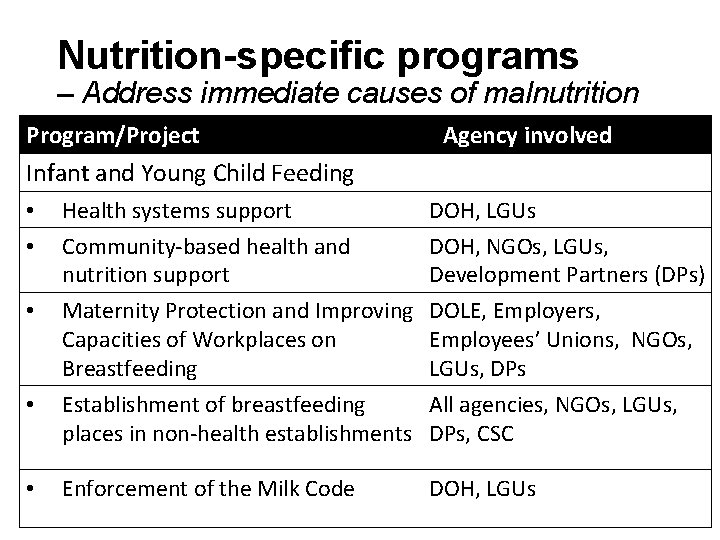
Nutrition-specific programs – Address immediate causes of malnutrition Program/Project Agency involved Infant and Young Child Feeding • • Health systems support Community-based health and nutrition support DOH, LGUs DOH, NGOs, LGUs, Development Partners (DPs) • Maternity Protection and Improving DOLE, Employers, Capacities of Workplaces on Employees’ Unions, NGOs, Breastfeeding LGUs, DPs • Establishment of breastfeeding All agencies, NGOs, LGUs, places in non-health establishments DPs, CSC • Enforcement of the Milk Code DOH, LGUs
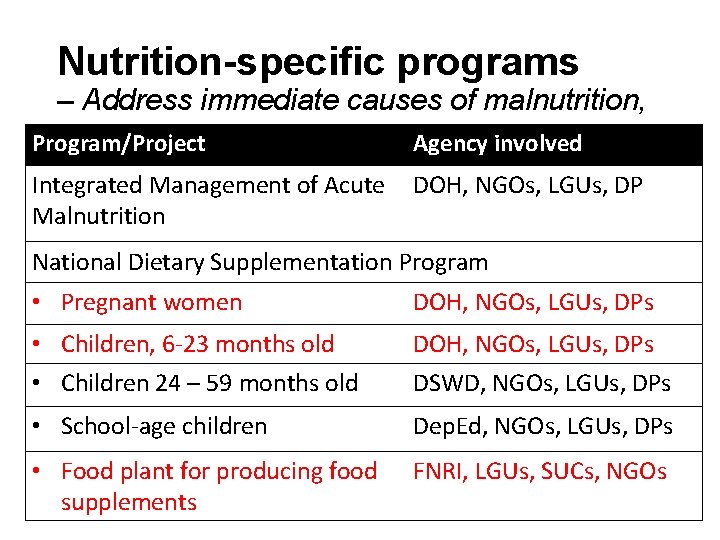
Nutrition-specific programs – Address immediate causes of malnutrition, Program/Project Agency involved Integrated Management of Acute Malnutrition DOH, NGOs, LGUs, DP National Dietary Supplementation Program • Pregnant women DOH, NGOs, LGUs, DPs • Children, 6 -23 months old • Children 24 – 59 months old DOH, NGOs, LGUs, DPs DSWD, NGOs, LGUs, DPs • School-age children Dep. Ed, NGOs, LGUs, DPs • Food plant for producing food supplements FNRI, LGUs, SUCs, NGOs
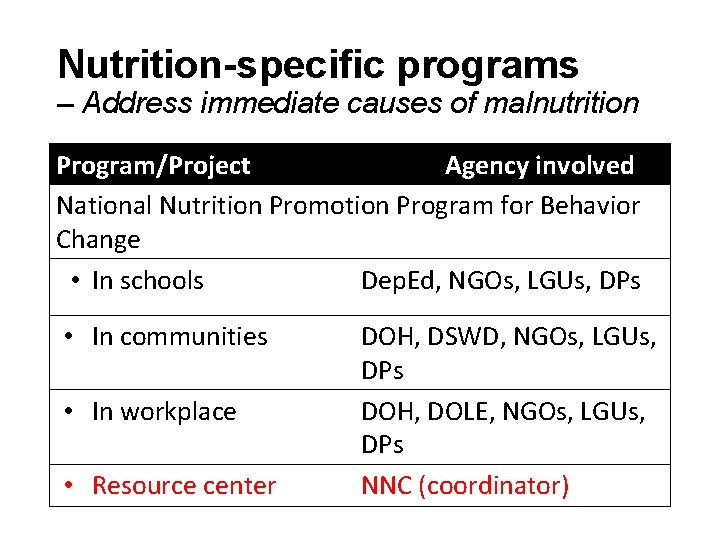
Nutrition-specific programs – Address immediate causes of malnutrition Program/Project Agency involved National Nutrition Promotion Program for Behavior Change • In schools Dep. Ed, NGOs, LGUs, DPs • In communities • In workplace • Resource center DOH, DSWD, NGOs, LGUs, DPs DOH, DOLE, NGOs, LGUs, DPs NNC (coordinator)
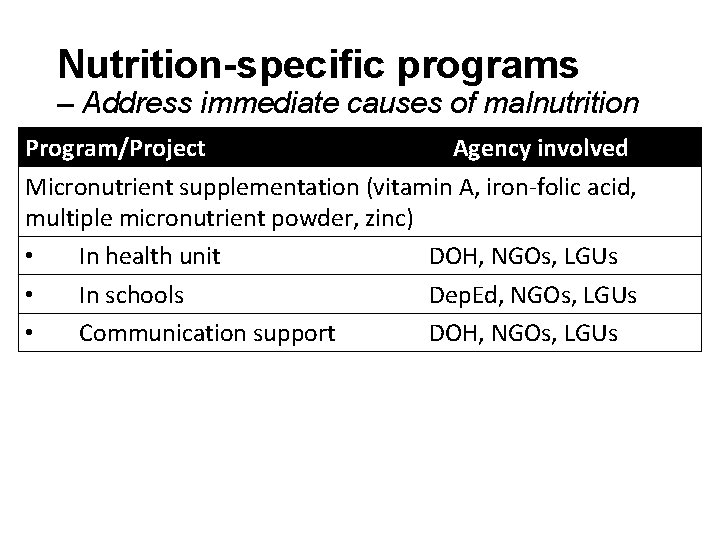
Nutrition-specific programs – Address immediate causes of malnutrition Program/Project Agency involved Micronutrient supplementation (vitamin A, iron-folic acid, multiple micronutrient powder, zinc) • In health unit DOH, NGOs, LGUs • In schools Dep. Ed, NGOs, LGUs • Communication support DOH, NGOs, LGUs
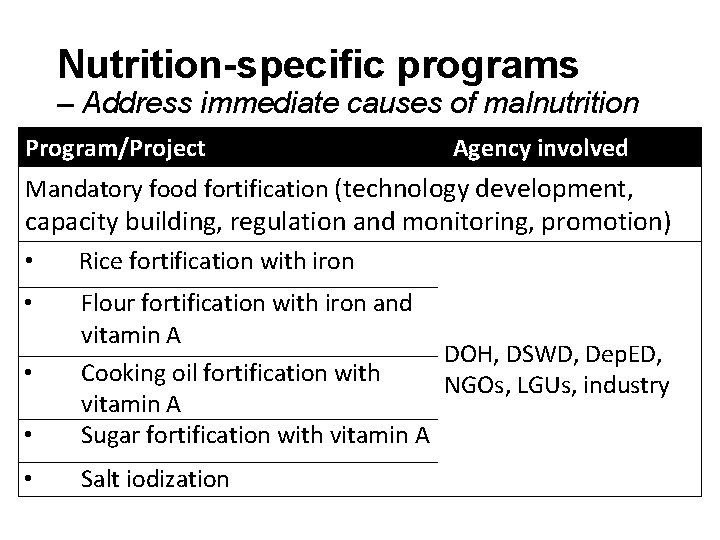
Nutrition-specific programs – Address immediate causes of malnutrition Program/Project Agency involved Mandatory food fortification (technology development, capacity building, regulation and monitoring, promotion) • Rice fortification with iron • • Flour fortification with iron and vitamin A DOH, DSWD, Dep. ED, Cooking oil fortification with NGOs, LGUs, industry vitamin A Sugar fortification with vitamin A • Salt iodization •
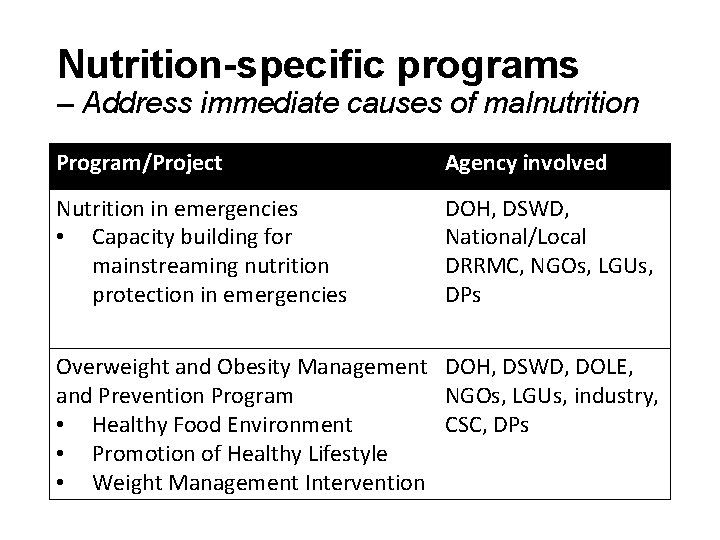
Nutrition-specific programs – Address immediate causes of malnutrition Program/Project Agency involved Nutrition in emergencies • Capacity building for mainstreaming nutrition protection in emergencies DOH, DSWD, National/Local DRRMC, NGOs, LGUs, DPs Overweight and Obesity Management DOH, DSWD, DOLE, and Prevention Program NGOs, LGUs, industry, • Healthy Food Environment CSC, DPs • Promotion of Healthy Lifestyle • Weight Management Intervention
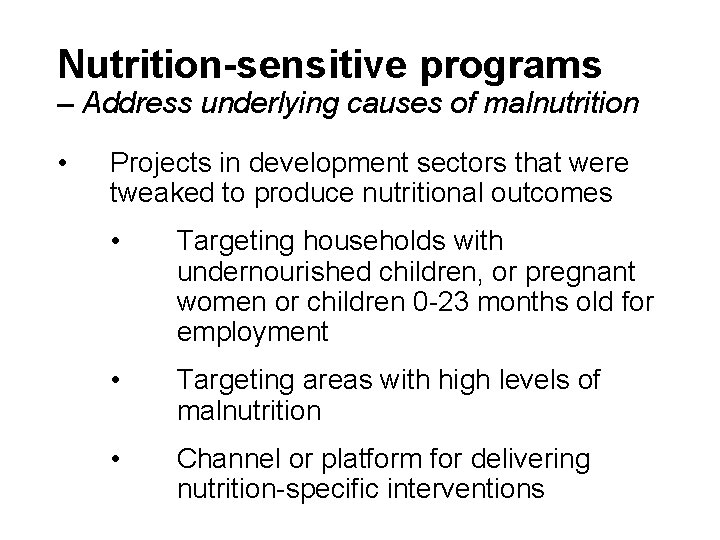
Nutrition-sensitive programs – Address underlying causes of malnutrition • Projects in development sectors that were tweaked to produce nutritional outcomes • Targeting households with undernourished children, or pregnant women or children 0 -23 months old for employment • Targeting areas with high levels of malnutrition • Channel or platform for delivering nutrition-specific interventions
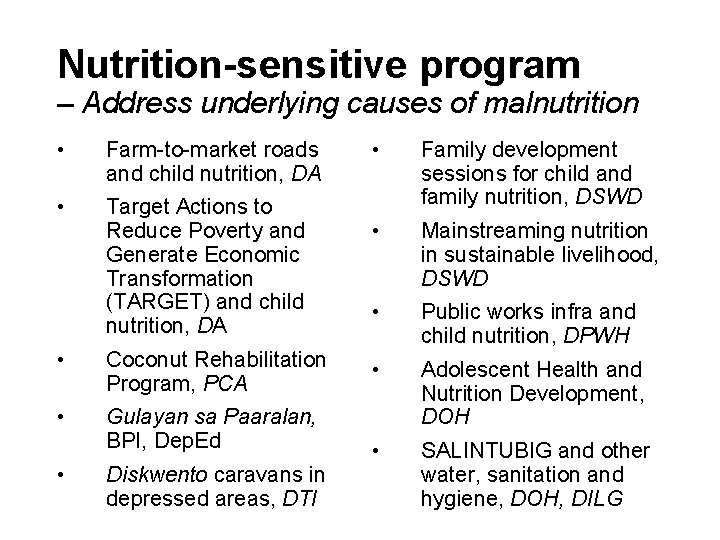
Nutrition-sensitive program – Address underlying causes of malnutrition • Farm-to-market roads and child nutrition, DA • Target Actions to Reduce Poverty and Generate Economic Transformation (TARGET) and child nutrition, DA • Coconut Rehabilitation Program, PCA • Gulayan sa Paaralan, BPI, Dep. Ed • Diskwento caravans in depressed areas, DTI • Family development sessions for child and family nutrition, DSWD • Mainstreaming nutrition in sustainable livelihood, DSWD • Public works infra and child nutrition, DPWH • Adolescent Health and Nutrition Development, DOH • SALINTUBIG and other water, sanitation and hygiene, DOH, DILG
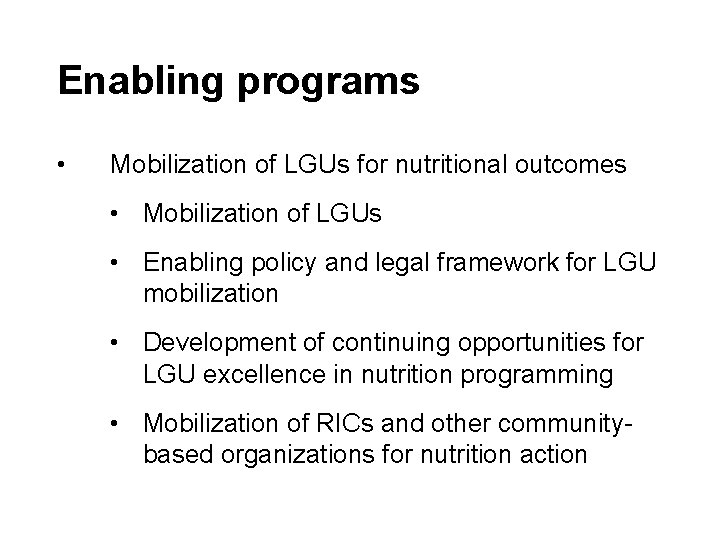
Enabling programs • Mobilization of LGUs for nutritional outcomes • Mobilization of LGUs • Enabling policy and legal framework for LGU mobilization • Development of continuing opportunities for LGU excellence in nutrition programming • Mobilization of RICs and other communitybased organizations for nutrition action
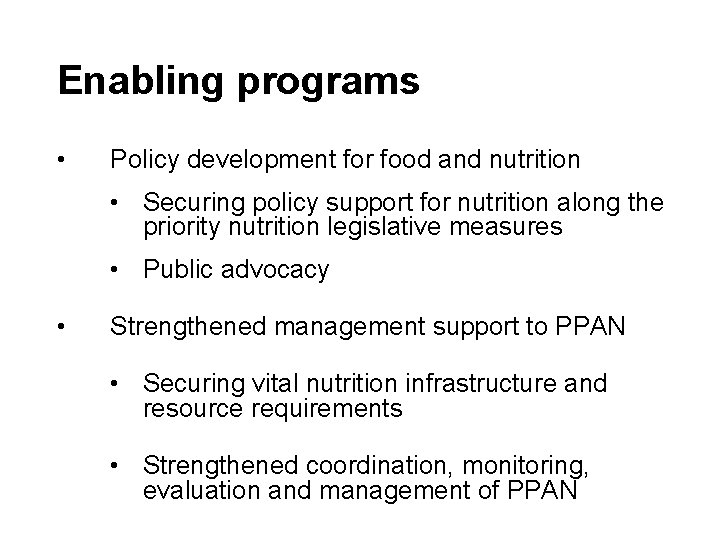
Enabling programs • Policy development for food and nutrition • Securing policy support for nutrition along the priority nutrition legislative measures • Public advocacy • Strengthened management support to PPAN • Securing vital nutrition infrastructure and resource requirements • Strengthened coordination, monitoring, evaluation and management of PPAN
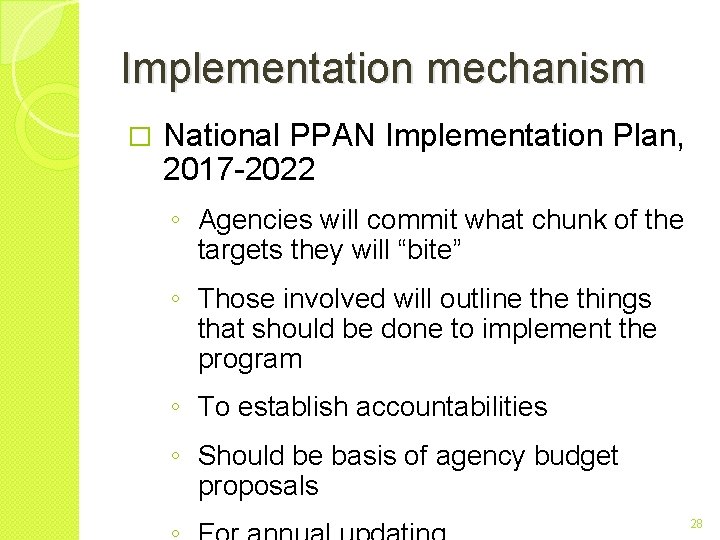
Implementation mechanism � National PPAN Implementation Plan, 2017 -2022 ◦ Agencies will commit what chunk of the targets they will “bite” ◦ Those involved will outline things that should be done to implement the program ◦ To establish accountabilities ◦ Should be basis of agency budget proposals 28
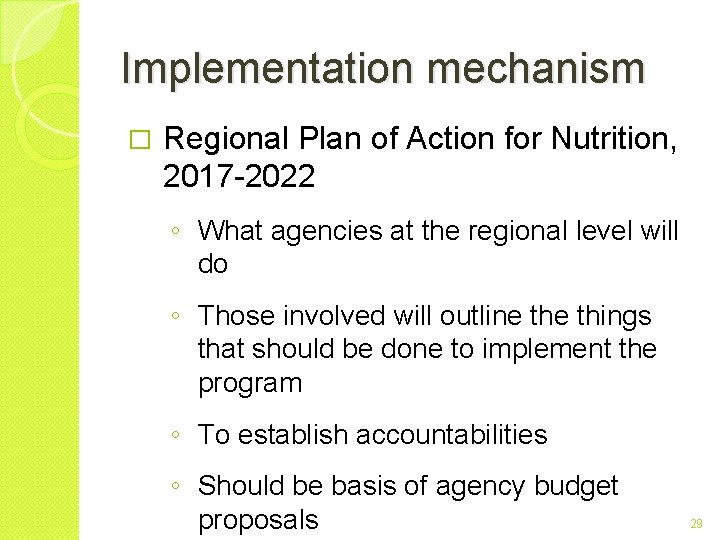
Implementation mechanism � Regional Plan of Action for Nutrition, 2017 -2022 ◦ What agencies at the regional level will do ◦ Those involved will outline things that should be done to implement the program ◦ To establish accountabilities ◦ Should be basis of agency budget proposals 29
Implementation mechanism � Local nutrition action plans � Management will involve ◦ Organization of technical working groups at the national level to tackle technical details of each program ◦ The NNC Technical Committee will provide the venue for ensuring cohesive action across the different programs 30
Implementation mechanism � Monitoring system to be set up ◦ Reporting by national agencies on physical and financial accomplishments–semestral ◦ Assessment of LGUs according to key parameters 31
Sustainable Development Goals Philippine Development Plan Goal Foundation for inclusive growth, a high-trust society, and a globally competitive knowledge economy Reduced wasting among children under-five years old Reduced stunting among children under-five years old Reduced micronutrient deficiencies • Reduced nutritionally-at-risk pregnant women • Increased exclusive breastfeeding • Reduced low birthweight • Improved complementary feeding Nutrition-specific programs Improved situation in overweight and obesity • Improved food intake Nutrition-sensitive programs Nutrition-supportive programs Enabling programs
Thank You! NATIONAL NUTRITION COUNCIL Visit @ 2332 Chino Roces Ave Extension, Taguig City Official website: http: //www. nnc. gov. ph FB Pages: https: //www. facebook. com/nncofficial https: //www. facebook. com/wastongnutrisyon Youtube acct: http: ///www. youtube. com/user/NNC 1974 Email us at: info@nnc. gov. ph Call @ telephone no. (02)843 -0142 or fax no. 818 -7398
Nutrition problems to address 34
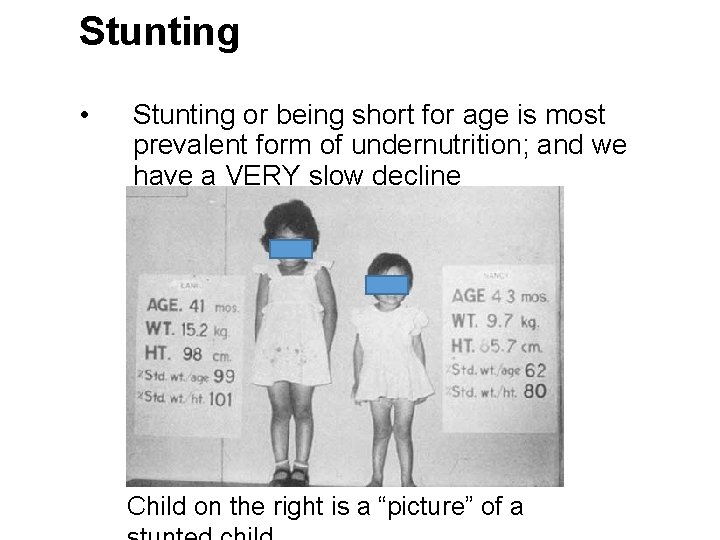
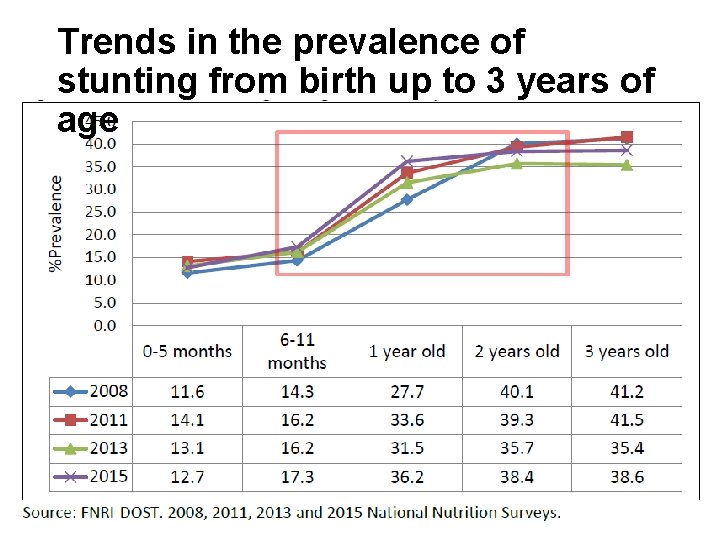
Stunting • Stunting or being short for age is most prevalent form of undernutrition; and we have a VERY slow decline Child on the right is a “picture” of a
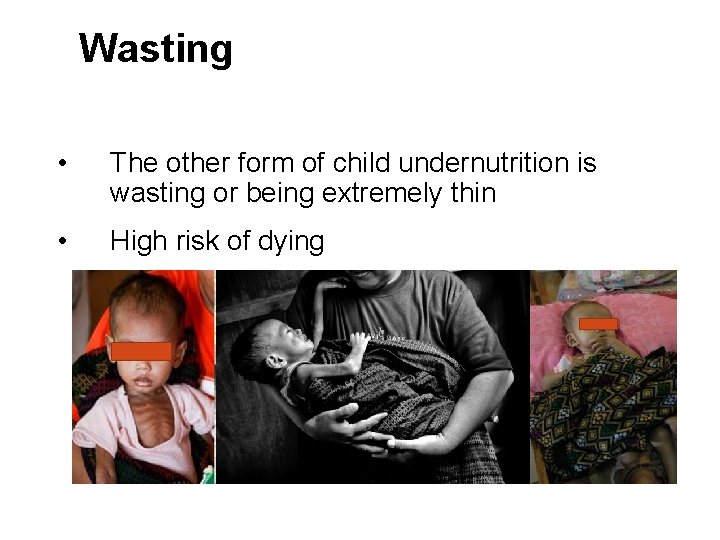
Wasting • The other form of child undernutrition is wasting or being extremely thin • High risk of dying
37
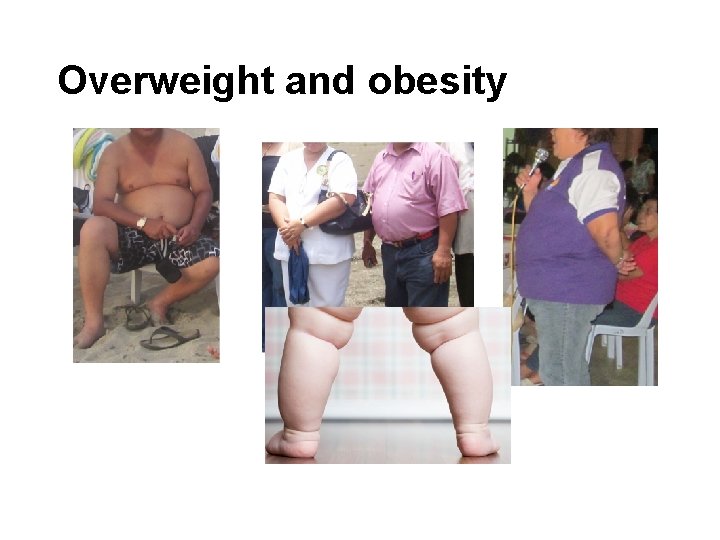
Overweight and obesity
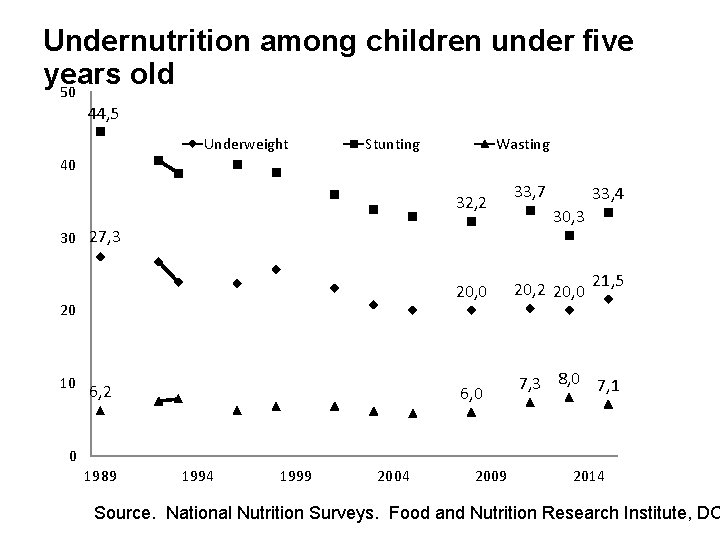
Undernutrition among children under five years old 50 44, 5 Underweight Stunting Wasting 40 32, 2 30 27, 3 20 10 6, 2 33, 7 33, 4 30, 3 21, 5 20, 0 20, 2 20, 0 6, 0 7, 3 8, 0 7, 1 0 1989 1994 1999 2004 2009 2014 Source. National Nutrition Surveys. Food and Nutrition Research Institute, DO
Trends in the prevalence of stunting from birth up to 3 years of age
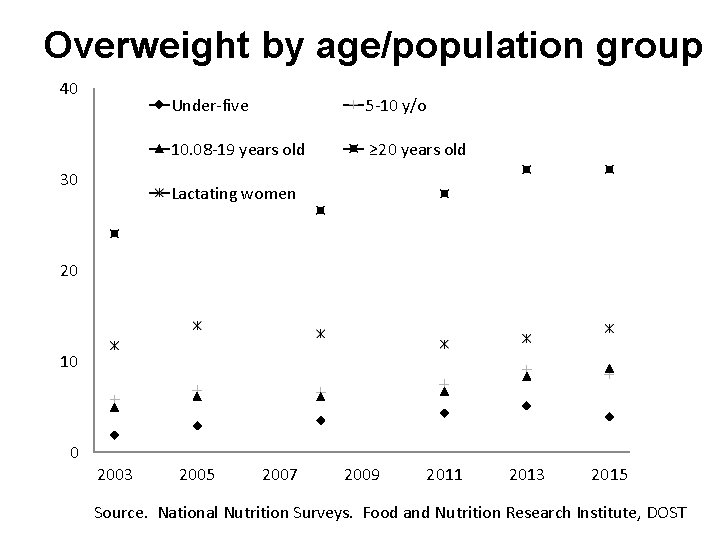
Overweight by age/population group 40 30 Under-five 5 -10 y/o 10. 08 -19 years old ≥ 20 years old Lactating women 20 10 0 2003 2005 2007 2009 2011 2013 2015 Source. National Nutrition Surveys. Food and Nutrition Research Institute, DOST
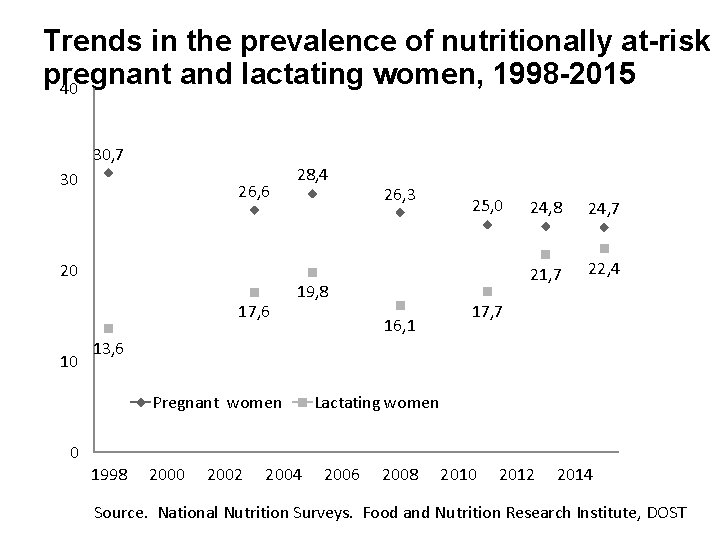
Trends in the prevalence of nutritionally at-risk pregnant and lactating women, 1998 -2015 40 30, 7 30 26, 6 20 17, 6 10 28, 4 19, 8 16, 1 25, 0 24, 8 24, 7 21, 7 22, 4 17, 7 13, 6 Pregnant women 0 26, 3 1998 2000 2002 2004 Lactating women 2006 2008 2010 2012 2014 Source. National Nutrition Surveys. Food and Nutrition Research Institute, DOST
Low birthweight Year Percent low birthweight 1998 9. 6 2003 13. 0 2008 19. 6 2013 21. 4 Source: National Demographic and Health Survey
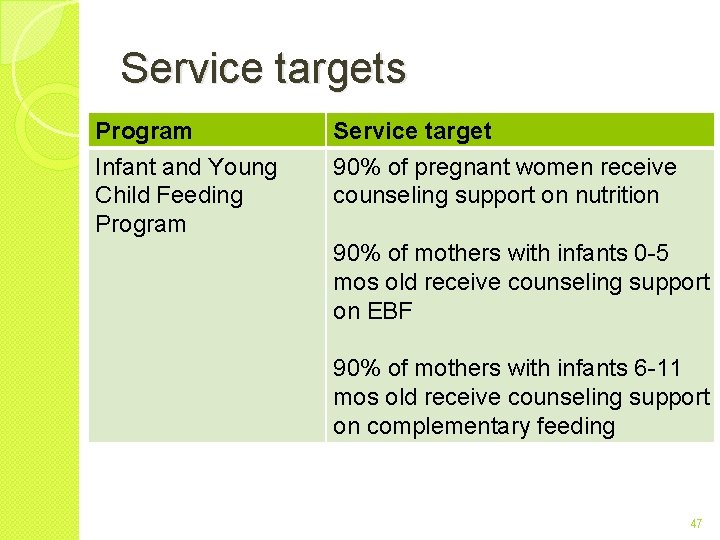
Service targets Program Infant and Young Child Feeding Program Service target 90% of pregnant women receive counseling support on nutrition 90% of mothers with infants 0 -5 mos old receive counseling support on EBF 90% of mothers with infants 6 -11 mos old receive counseling support on complementary feeding 47
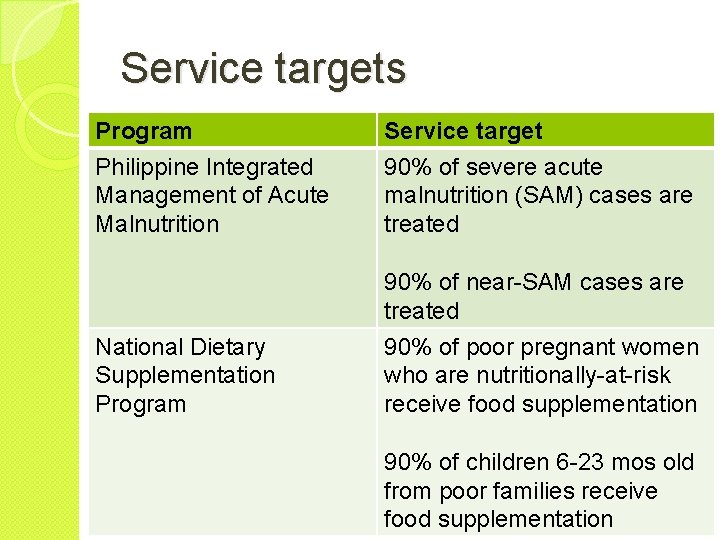
Service targets Program Philippine Integrated Management of Acute Malnutrition Service target 90% of severe acute malnutrition (SAM) cases are treated National Dietary Supplementation Program 90% of near-SAM cases are treated 90% of poor pregnant women who are nutritionally-at-risk receive food supplementation 90% of children 6 -23 mos old from poor families receive food supplementation 48
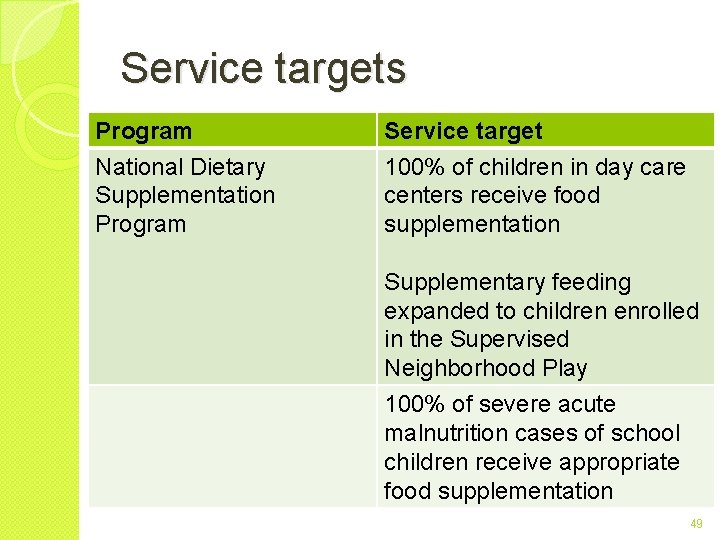
Service targets Program National Dietary Supplementation Program Service target 100% of children in day care centers receive food supplementation Supplementary feeding expanded to children enrolled in the Supervised Neighborhood Play 100% of severe acute malnutrition cases of school children receive appropriate food supplementation 49
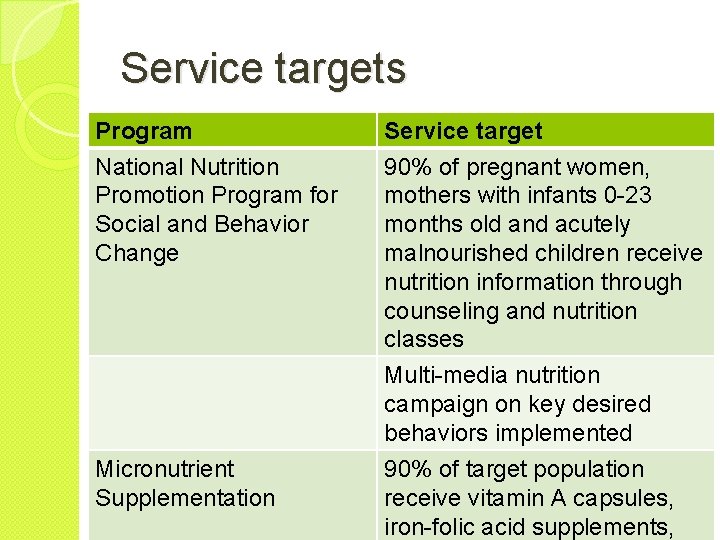
Service targets Program National Nutrition Promotion Program for Social and Behavior Change Service target 90% of pregnant women, mothers with infants 0 -23 months old and acutely malnourished children receive nutrition information through counseling and nutrition classes Multi-media nutrition campaign on key desired behaviors implemented Micronutrient Supplementation 90% of target population receive vitamin A capsules, iron-folic acid supplements, 50
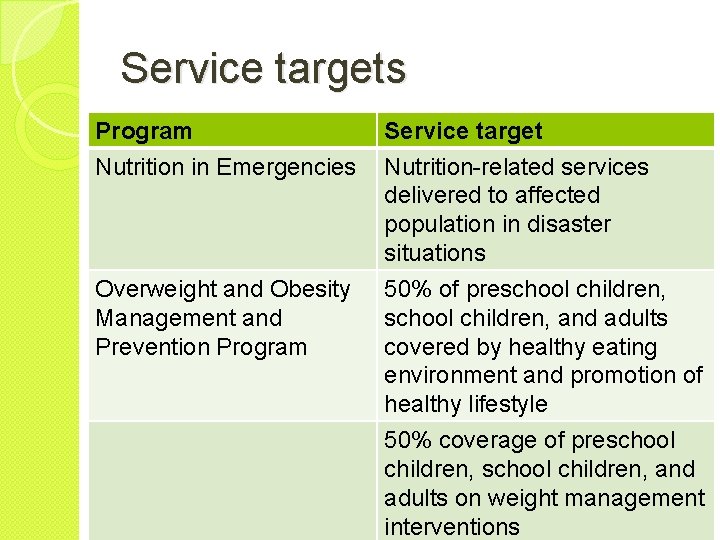
Service targets Program Nutrition in Emergencies Service target Nutrition-related services delivered to affected population in disaster situations Overweight and Obesity Management and Prevention Program 50% of preschool children, and adults covered by healthy eating environment and promotion of healthy lifestyle 50% coverage of preschool children, and adults on weight management 51 interventions