
Philippine American War Rebel leader Emilio Aguinaldo proclaimed
Philippine American War • Rebel leader Emilio Aguinaldo proclaimed the Philippines an independent republic in January 1899 • Rebellion lasted until mid-1902 • War claimed 4, 000 American lives and cost the U. S. $400 million • The U. S. set up the Philippine Gov. and they gradually moved toward independence until July 4, 1946.
Open Door Notes • By 1899, France, Germany, Britain, Japan and Russia had established prosperous settlements along the coast of China. • American leaders feared that the U. S. might lose access to China’s ports as the result of a war or takeover. • To protect American interests, U. S. Secretary of State John Hay issued the Open Door Notes.
• Sent to Great Britain, Germany, France, Italy, Japan, and Russia. • The U. S. called for open access to China’s coastal ports, the elimination of special privileges for any trading nations, and the maintenance of China’s independence. • Remained in effect until after World War II
Russo-Japanese War • In 1904, Japan and Russia went to war over Korea. • The Japanese destroyed both the Russian Pacific and European fleet. • Japan gained control of Korea and Manchuria. • Because of the costs, Japan asked Roosevelt to mediate the conflict
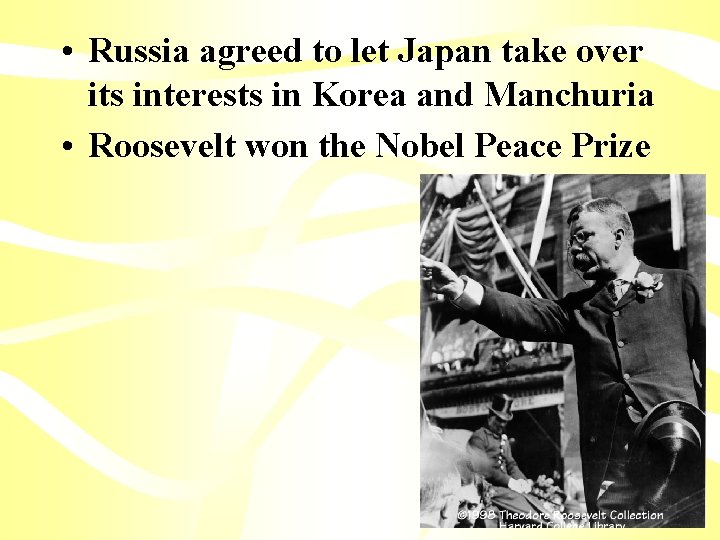
• Russia agreed to let Japan take over its interests in Korea and Manchuria • Roosevelt won the Nobel Peace Prize
Panama Canal • When Roosevelt became President, the United States had already achieved three of Admiral Mahan’s four recommendations for becoming a world power. • The nation had a modern navy and naval bases in the Caribbean and Hawaii. • Roosevelt set out to build a canal through Central America
Two Possible Routes • One, through Nicaragua, posed fewer obstacles because much of it crossed a large lake. • The other, through Panama, was shorter but was filled with mountains and swamps. • Senate approved the route through Panama.
Getting Panama From Colombia • When negotiations broke down, Philippe Bunau-Varilla, helped organize a Panamanian revolution against Columbia • A dozen U. S. warships were present when Panama declared independence • The U. S. was given perpetual control of the 10 mile wide canal zone
Constructing the Canal • Work began in 1904 • by 1913, more than 43, 400 workers were employed • More than 5, 600 workers died of disease or accidents • On August 15, 1914, the canal opened • Damaged U. S. -Latin American relations
Roosevelt Corollary • By the late 19 th century, many Latin American nations had borrowed large sums of money from European bankers to build railroads and develop industry • Roosevelt feared that if these nations defaulted on their loans, European nations might intervene in the Western Hemisphere
• Roosevelt based his Latin American policy on a West African proverb, “Speak softly and carry a big stick; you will go far”. • Roosevelt argued that European powers must not intervene in the Western Hemisphere • Also said that disorder in Latin America might “force the United States…to the exercise of an international police power” in order to protect U. S. economic interests.
- Slides: 12