
Phenomena and types of catering Capacity criteria n
- Slides: 22
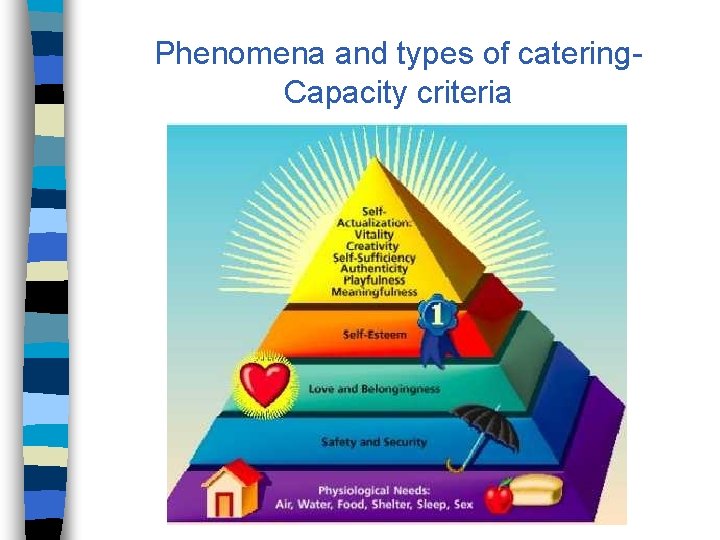
Phenomena and types of catering. Capacity criteria n The need of catering - Necessity of eating out of home – working people to be catered n Maslow's hierarchy of needs is a theory in psychology, proposed by Abraham Maslow in his 1943 paper A Theory of Human Motivation. Maslow’ s theories parallel many other theories of human developmental psychology all of which focus on describing the stages of growth in humans. n
Phenomena and types of catering. Capacity criteria
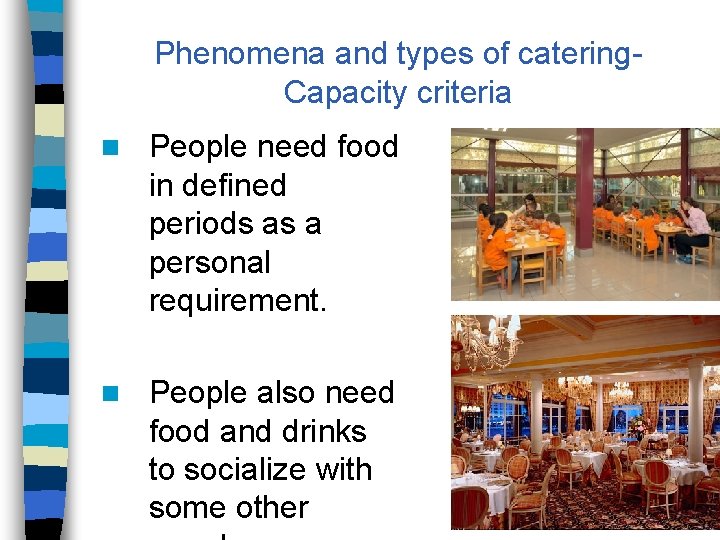
Phenomena and types of catering. Capacity criteria n People need food in defined periods as a personal requirement. n People also need food and drinks to socialize with some other
Phenomena and types of catering. Capacity criteria CAPACITY: 1: legal competency or fitness <capacity to stand trial> n 2 n a : the potential or suitability for holding, storing, or accommodating <a large seating capacity> n b : the maximum amount or number that can be contained or accommodated <a jug with a one-gallon capacity> <the auditorium was filled to capacity> n
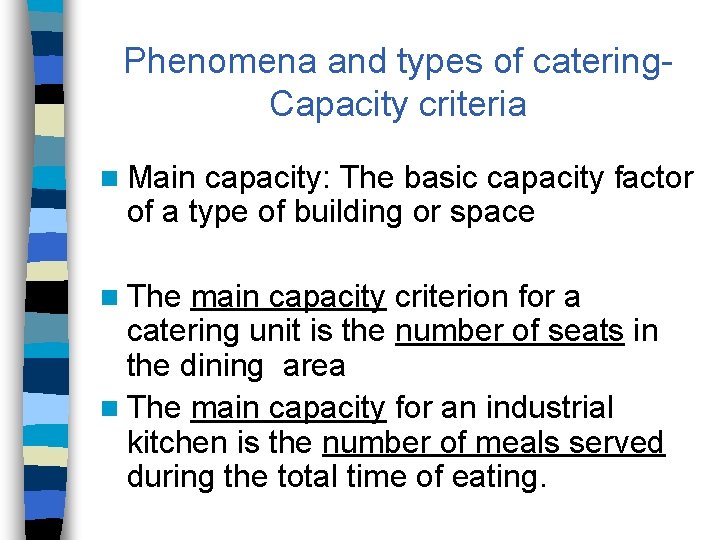
Phenomena and types of catering. Capacity criteria n Main capacity: The basic capacity factor of a type of building or space n The main capacity criterion for a catering unit is the number of seats in the dining area n The main capacity for an industrial kitchen is the number of meals served during the total time of eating.
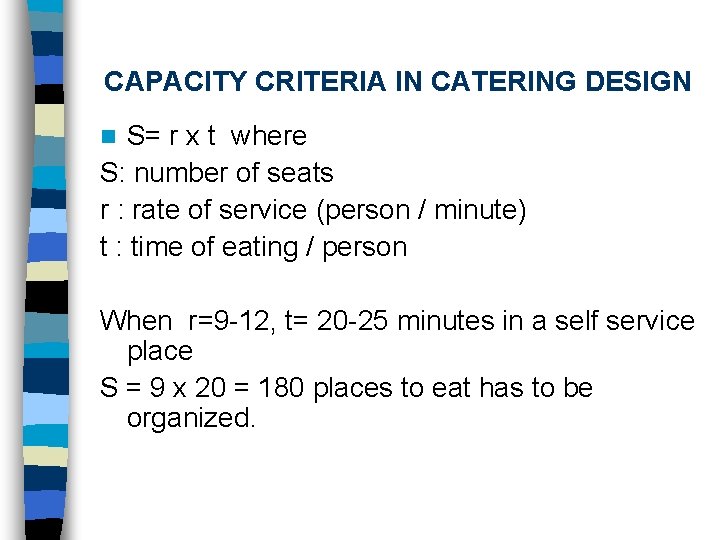
CAPACITY CRITERIA IN CATERING DESIGN S= r x t where S: number of seats r : rate of service (person / minute) t : time of eating / person n When r=9 -12, t= 20 -25 minutes in a self service place S = 9 x 20 = 180 places to eat has to be organized.
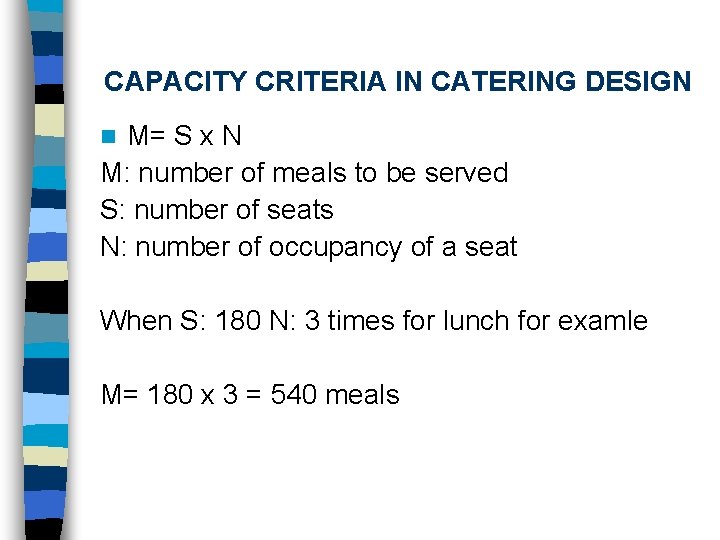
CAPACITY CRITERIA IN CATERING DESIGN M= S x N M: number of meals to be served S: number of seats N: number of occupancy of a seat n When S: 180 N: 3 times for lunch for examle M= 180 x 3 = 540 meals
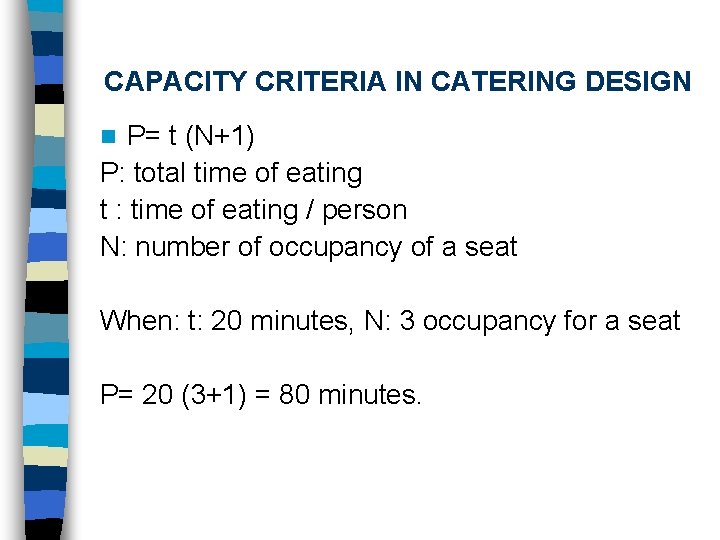
CAPACITY CRITERIA IN CATERING DESIGN P= t (N+1) P: total time of eating t : time of eating / person N: number of occupancy of a seat n When: t: 20 minutes, N: 3 occupancy for a seat P= 20 (3+1) = 80 minutes.
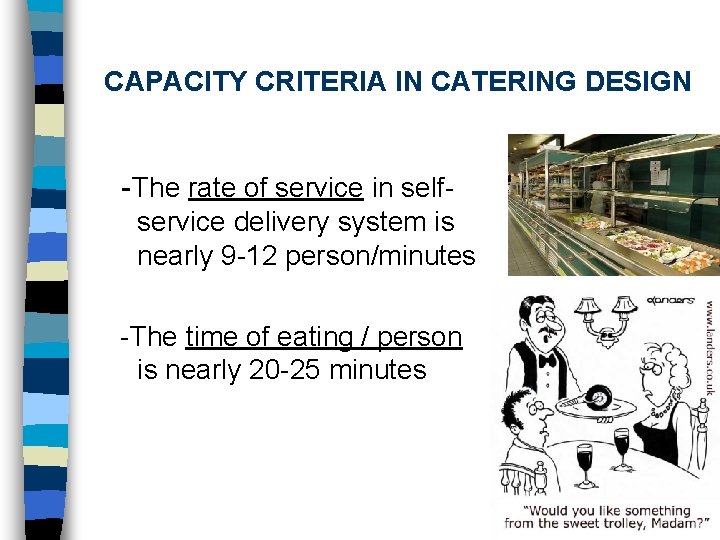
CAPACITY CRITERIA IN CATERING DESIGN -The rate of service in selfservice delivery system is nearly 9 -12 person/minutes -The time of eating / person is nearly 20 -25 minutes
CAPACITY CRITERIA IN CATERING DESIGN Spaces for eating and drinking have to be looked at from two points of view n Customers will choose a particular establishment, not only because selling good food or drink bu also for -Somewhere to entertain a guest in peace -Entertainment -Fast service n Proprietors / owners /managers n
CAPACITY CRITERIA IN CATERING DESIGN Proprietors / owners /managers İs running a labour intensive business for profit in a competative environment. Efficiency of every part of the operation must be examined. Well planned and designed spaces have big effect on the success. n
CAPACITY CRITERIA IN CATERING DESIGN n LOCATION n Location will determine success or failure of a facility. Food service establishements should locate where people need to obtain food, suc as: n Motorway service areas n Hotels n City centers n Tourist attractions n Main railway stations n Airports n Shoping Centers /Department stores n Institutions
CAPACITY CRITERIA IN CATERING DESIGN n For a good location a balance has to be found between: n The avalibility of customers n Cost of location n Accessibility: Customer parking and goods access.
BASIC PLANNING Food supply and consumption can be thought of as three overlapping industrial processing circles: n For cooking n Dishes n Customers n Each circle rotates separately: the product (food) is transferred form circle to circle
BASIC PLANNING n n n 1 the cooking circle Goods inwards (from suppliers) Storage Processing (preparation, cooking, serving (food transferred to circle 2), equipment cleaned and prepared for re-use) Goods outwards: disposal, waste
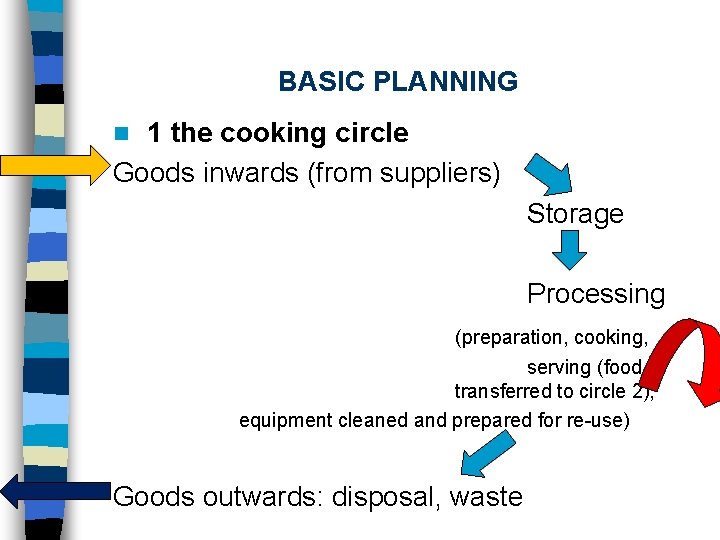
BASIC PLANNING 1 the cooking circle Goods inwards (from suppliers) n Storage Processing (preparation, cooking, serving (food transferred to circle 2), equipment cleaned and prepared for re-use) Goods outwards: disposal, waste
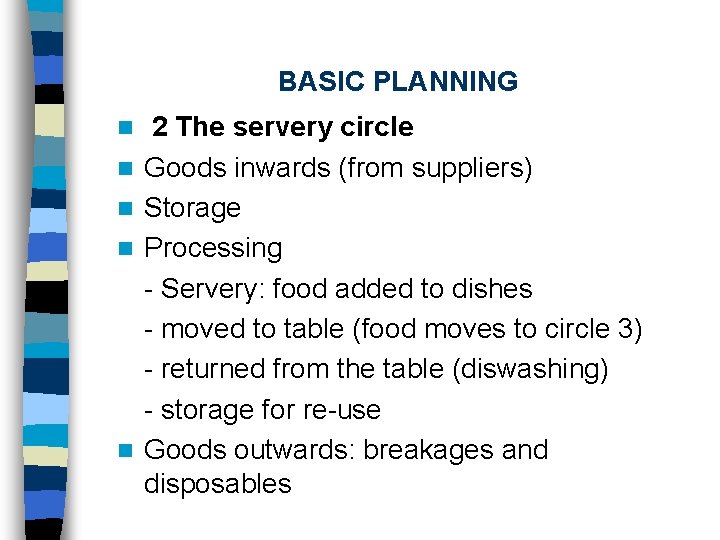
BASIC PLANNING n n n 2 The servery circle Goods inwards (from suppliers) Storage Processing - Servery: food added to dishes - moved to table (food moves to circle 3) - returned from the table (diswashing) - storage for re-use Goods outwards: breakages and disposables
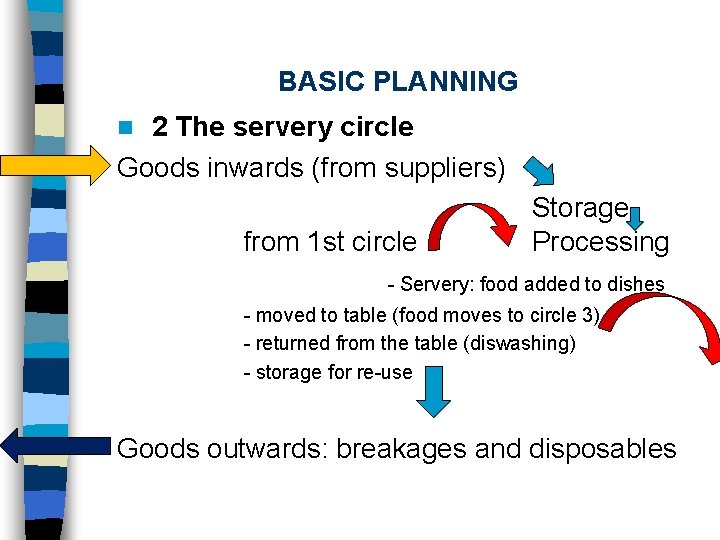
BASIC PLANNING 2 The servery circle Goods inwards (from suppliers) n from 1 st circle Storage Processing - Servery: food added to dishes - moved to table (food moves to circle 3) - returned from the table (diswashing) - storage for re-use Goods outwards: breakages and disposables
BASIC PLANNING n One of the main decisions in a food system is whether the customers have access to the servery: In cheap establishments they do: It is self-service, though returns may be handled by staff. In higher –class ones, they do not: waiters carry plates form servery to the table. Consequently, the servery will be placed either outside or inside the kitchen.
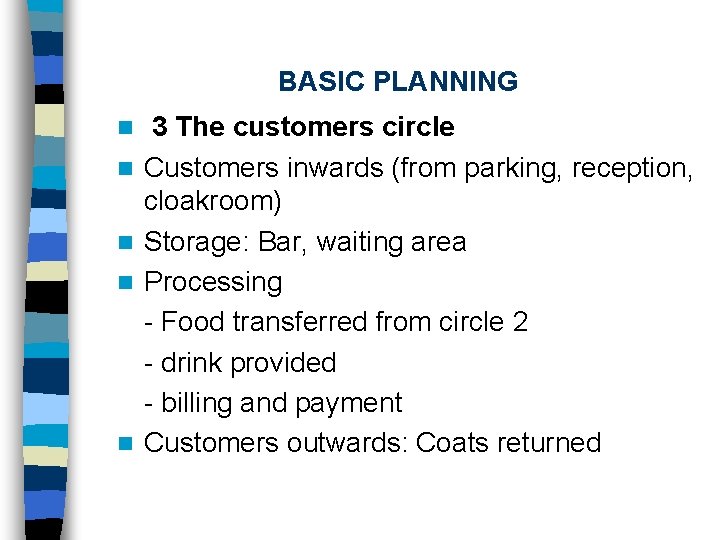
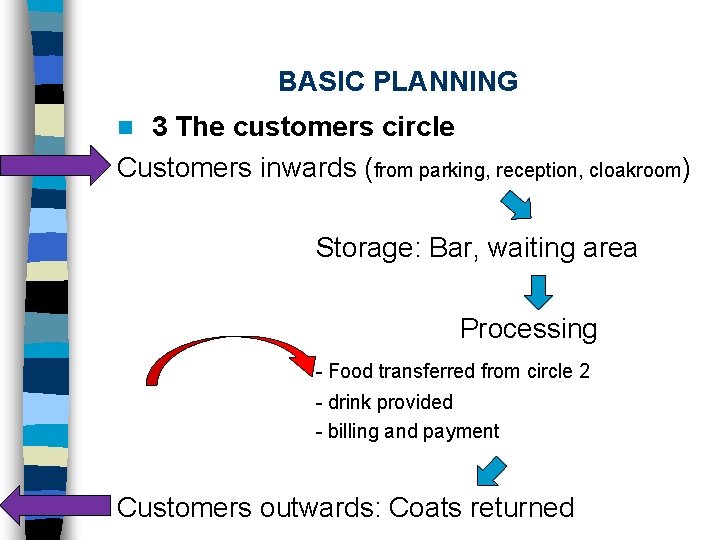
BASIC PLANNING n n n 3 The customers circle Customers inwards (from parking, reception, cloakroom) Storage: Bar, waiting area Processing - Food transferred from circle 2 - drink provided - billing and payment Customers outwards: Coats returned
BASIC PLANNING 3 The customers circle Customers inwards (from parking, reception, cloakroom) n Storage: Bar, waiting area Processing - Food transferred from circle 2 - drink provided - billing and payment Customers outwards: Coats returned
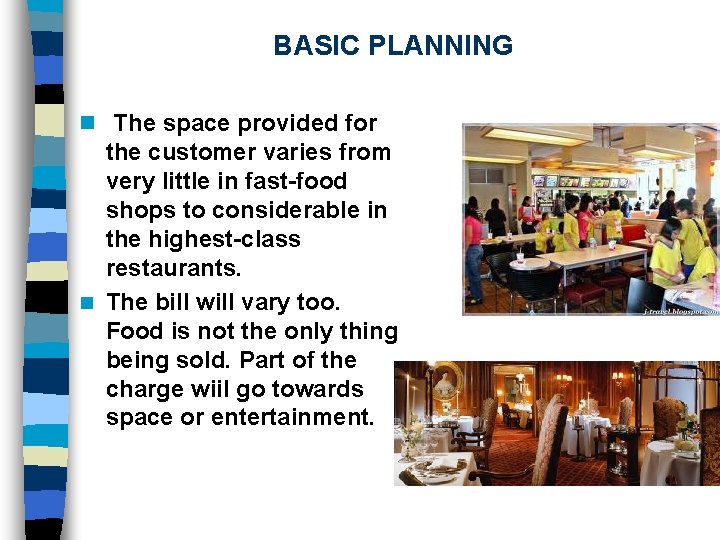
BASIC PLANNING n The space provided for the customer varies from very little in fast-food shops to considerable in the highest-class restaurants. n The bill will vary too. Food is not the only thing being sold. Part of the charge wiil go towards space or entertainment.