
PHENIX Status John Haggerty Brookhaven National Laboratory March
PHENIX Status John Haggerty Brookhaven National Laboratory March 31, 2009 1
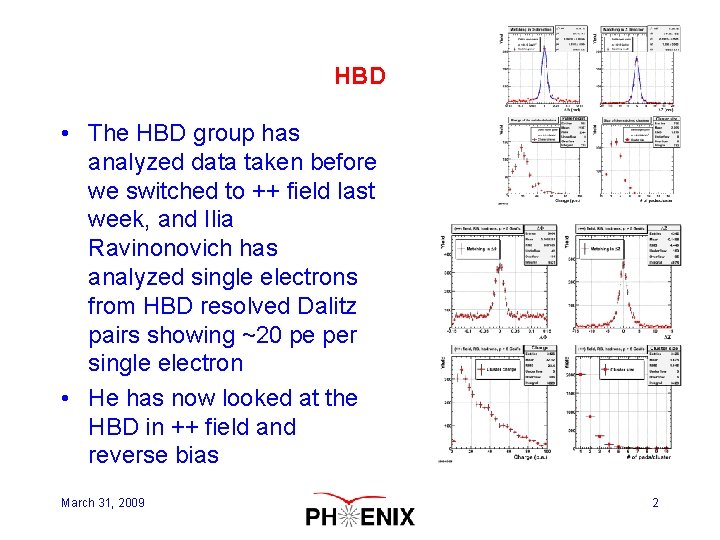
HBD • The HBD group has analyzed data taken before we switched to ++ field last week, and Ilia Ravinonovich has analyzed single electrons from HBD resolved Dalitz pairs showing ~20 pe per single electron • He has now looked at the HBD in ++ field and reverse bias March 31, 2009 2
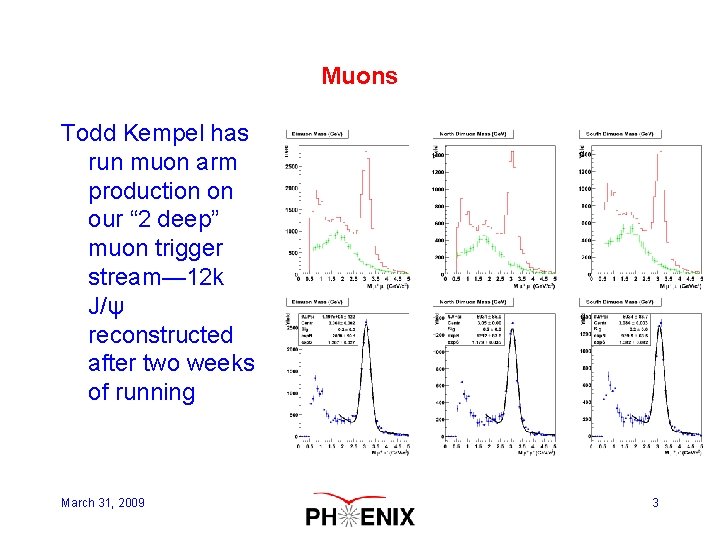
Muons Todd Kempel has run muon arm production on our “ 2 deep” muon trigger stream— 12 k J/ψ reconstructed after two weeks of running March 31, 2009 3
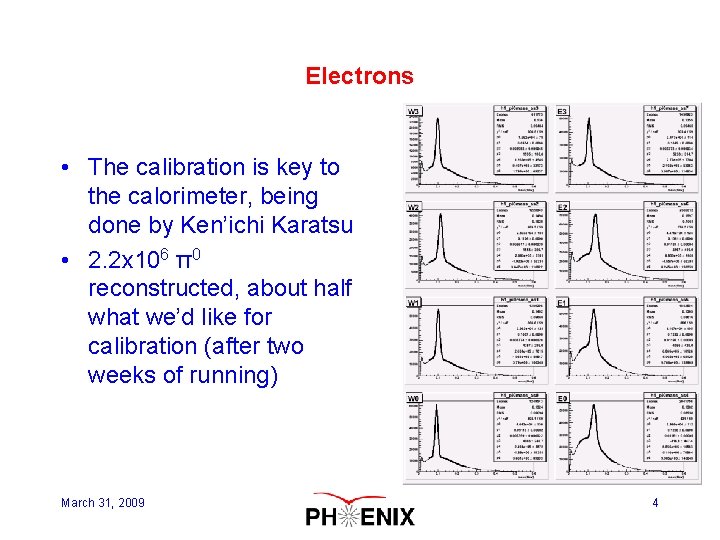
Electrons • The calibration is key to the calorimeter, being done by Ken’ichi Karatsu • 2. 2 x 10⁶ π0 reconstructed, about half what we’d like for calibration (after two weeks of running) March 31, 2009 4
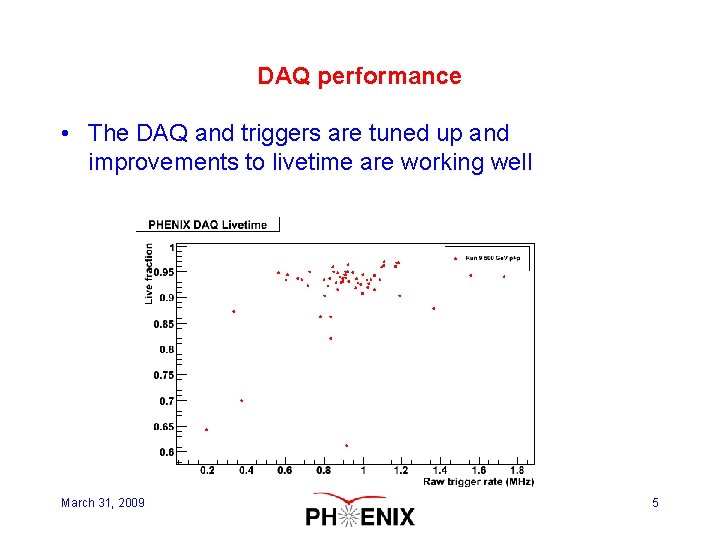
DAQ performance • The DAQ and triggers are tuned up and improvements to livetime are working well March 31, 2009 5
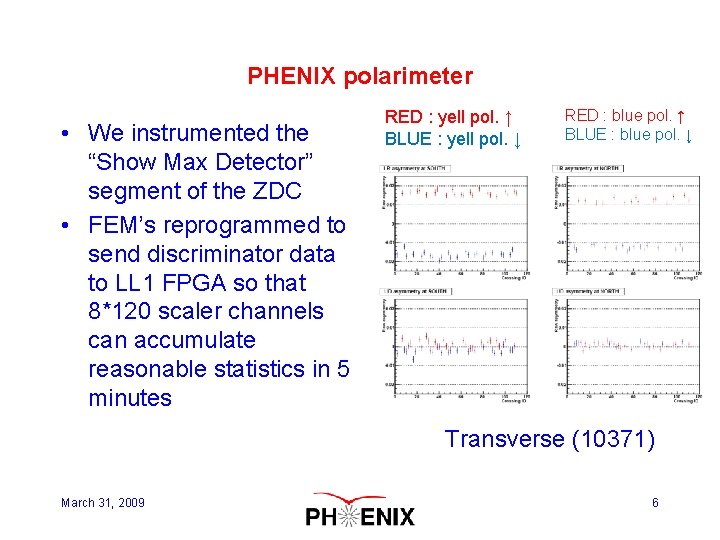
PHENIX polarimeter • We instrumented the “Show Max Detector” segment of the ZDC • FEM’s reprogrammed to send discriminator data to LL 1 FPGA so that 8*120 scaler channels can accumulate reasonable statistics in 5 minutes RED : yell pol. ↑ BLUE : yell pol. ↓ RED : blue pol. ↑ BLUE : blue pol. ↓ Transverse (10371) March 31, 2009 6
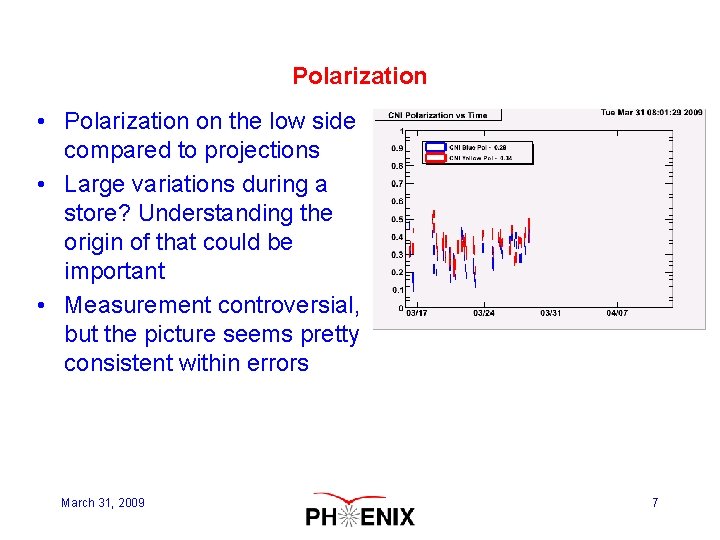
Polarization • Polarization on the low side compared to projections • Large variations during a store? Understanding the origin of that could be important • Measurement controversial, but the picture seems pretty consistent within errors March 31, 2009 7
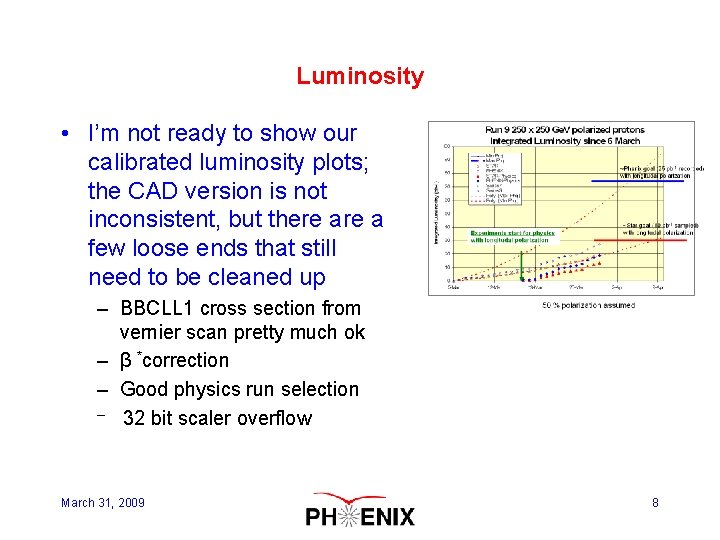
Luminosity • I’m not ready to show our calibrated luminosity plots; the CAD version is not inconsistent, but there a few loose ends that still need to be cleaned up – BBCLL 1 cross section from vernier scan pretty much ok – β *correction – Good physics run selection – 32 bit scaler overflow March 31, 2009 8
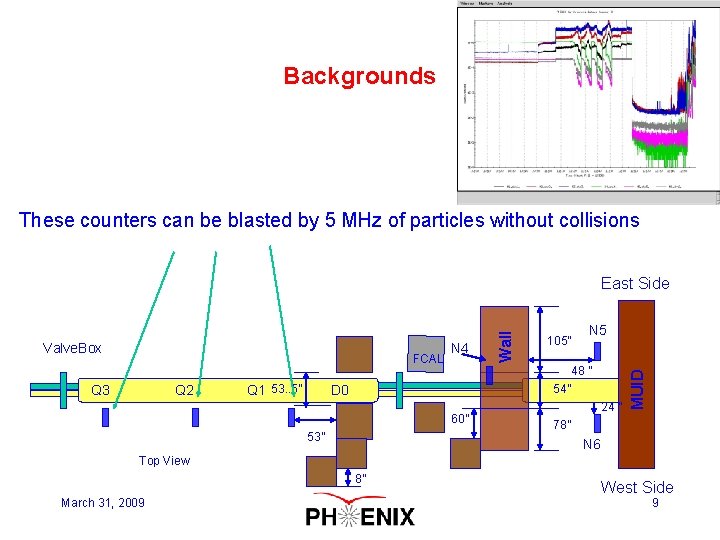
Backgrounds These counters can be blasted by 5 MHz of particles without collisions FCAL Q 3 Q 2 Q 1 53. . 5” N 4 105” N 5 48 ” 54” D 0 60” 53” 24 ” MUID Valve. Box Wall East Side 78” N 6 Top View 8” March 31, 2009 West Side 9
Do we care about background counters? • Only as far as they reflect background rates in PHENIX • BUT they indicate beam dynamics that doesn’t make sense to me • Can we live with small angle backgrounds after we install the $10 M worth of Si vertex detectors (Run 11)? March 31, 2009 10
Bottom line • There is still work to do on the big three: – Luminosity—how do we get a factor of three? – Polarization—how do we get 50% polarization on average – Backgrounds—where do they come from, how can they be reduced? • We have come a long way, but we should not stop without trying to run the whole program the way we will in the future, and we won’t learn anything new by doing the same thing… but we need to do repeated experiments to see how reproducible everything is… one good store does not a program make March 31, 2009 11
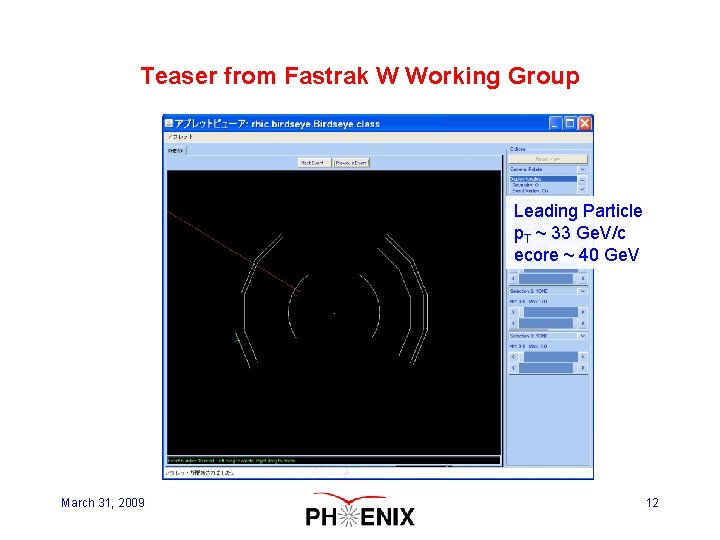
Teaser from Fastrak W Working Group Leading Particle p. T ~ 33 Ge. V/c ecore ~ 40 Ge. V March 31, 2009 12
- Slides: 12