
PHD STUDENT IDENTITY WELLBEING AND 21 ST C
PHD STUDENT IDENTITY, WELLBEING, AND 21 ST C WORK SUSAN PORTER, DEAN & VICE PROVOST, GRADUATE & POSTDOCTORAL STUDIES, UBC
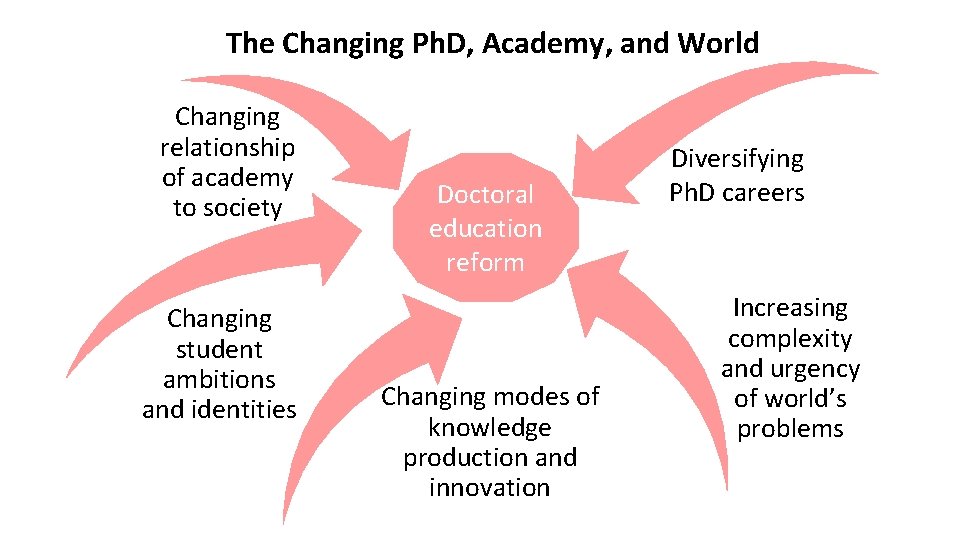
The Changing Ph. D, Academy, and World Changing relationship of academy to society Changing student ambitions and identities Doctoral education reform Changing modes of knowledge production and innovation Diversifying Ph. D careers Increasing complexity and urgency of world’s problems
Changing purposes, approaches The purposes of doctoral education: • Are no longer only to prepare students to: • conduct the forms of scholarship of their mentors • confront the problems/questions of their mentors • approach issues in the way their mentors do • discover, create, or understand knowledge in the ways their mentor does • sustain their discipline • work with and speak to their disciplinary peers Simply adding experiences to an already full plate is unlikely to lead to the kinds of expertise needed today and in the future…Serious structural and cultural changes are required for meaningful formation in a world that will surely demand more of society’s most educated citizens - Carnegie Initiative on the Doctorate, 2008
Formation: “not only the development of intellectual expertise, but the growth of ‘the personality, character, habits of heart and mind’ and [an appreciation of ]‘the role that the given discipline is capable of and meant to play in academe and society at large’. What is formed, in short, is the scholar’s professional identity in all its dimensions. ” i. e. , It is about who the student is becoming, not just what the student is learning how to do The Formation of Scholars: Rethinking Doctoral Education for the 21 st Century – Carnegie Initiative on the Doctorate (2008)
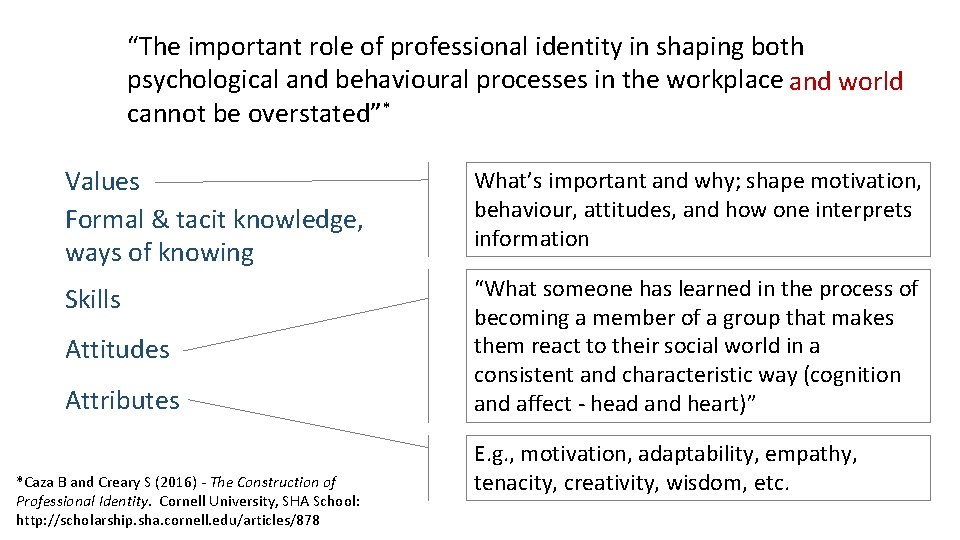
“The important role of professional identity in shaping both psychological and behavioural processes in the workplace and world cannot be overstated”* Values Formal & tacit knowledge, ways of knowing What’s important and why; shape motivation, behaviour, attitudes, and how one interprets information Skills “What someone has learned in the process of becoming a member of a group that makes them react to their social world in a consistent and characteristic way (cognition and affect - head and heart)” Attitudes Attributes *Caza B and Creary S (2016) - The Construction of Professional Identity. Cornell University, SHA School: http: //scholarship. sha. cornell. edu/articles/878 E. g. , motivation, adaptability, empathy, tenacity, creativity, wisdom, etc.
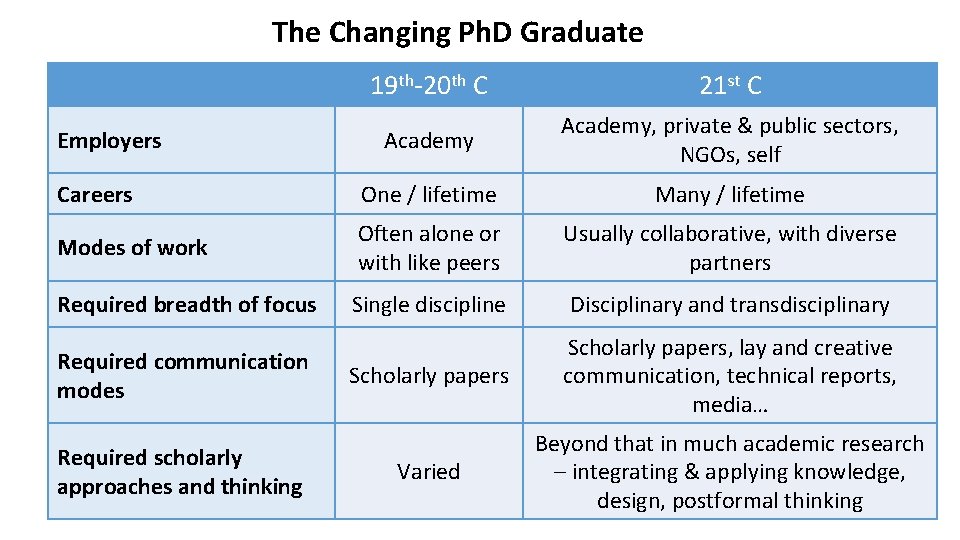
The Changing Ph. D Graduate 19 th-20 th C 21 st C Academy, private & public sectors, NGOs, self Careers One / lifetime Many / lifetime Modes of work Often alone or with like peers Usually collaborative, with diverse partners Required breadth of focus Single discipline Disciplinary and transdisciplinary Scholarly papers, lay and creative communication, technical reports, media… Varied Beyond that in much academic research – integrating & applying knowledge, design, postformal thinking Employers Required communication modes Required scholarly approaches and thinking
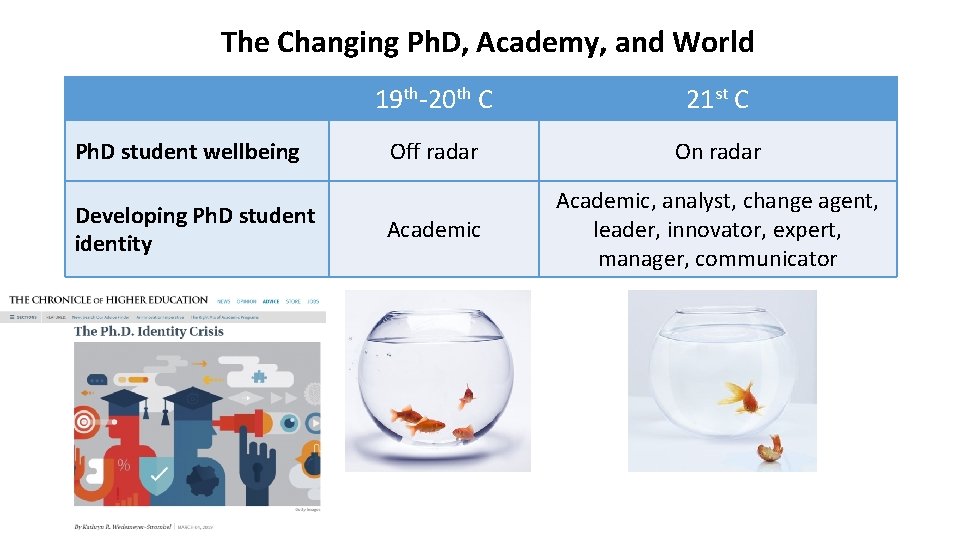
The Changing Ph. D, Academy, and World Ph. D student wellbeing Developing Ph. D student identity 19 th-20 th C 21 st C Off radar On radar Academic, analyst, change agent, leader, innovator, expert, manager, communicator
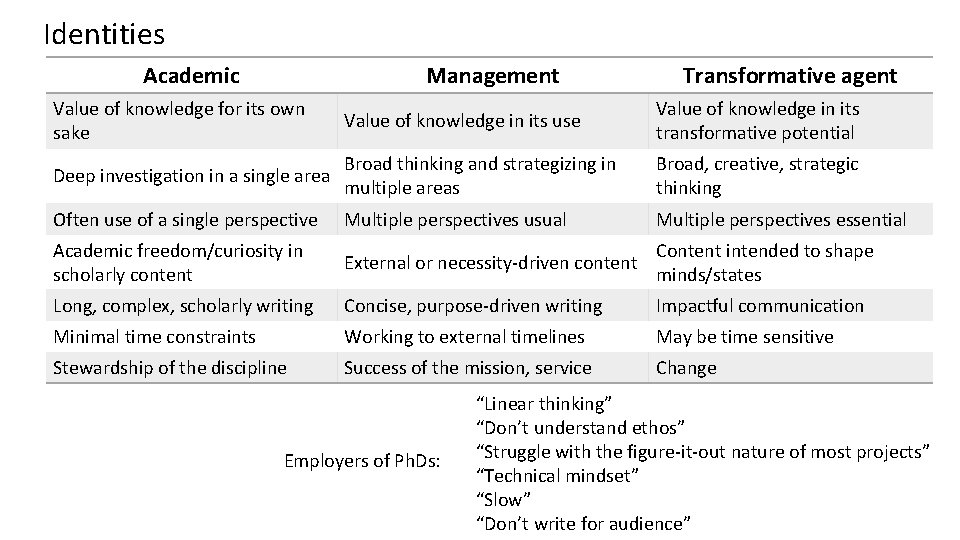
Identities Academic Management Transformative agent Value of knowledge for its own sake Value of knowledge in its use Value of knowledge in its transformative potential Deep investigation in a single area Broad thinking and strategizing in multiple areas Broad, creative, strategic thinking Often use of a single perspective Multiple perspectives usual Multiple perspectives essential Academic freedom/curiosity in scholarly content External or necessity-driven content Content intended to shape minds/states Long, complex, scholarly writing Concise, purpose-driven writing Impactful communication Minimal time constraints Working to external timelines May be time sensitive Stewardship of the discipline Success of the mission, service Change Employers of Ph. Ds: “Linear thinking” “Don’t understand ethos” “Struggle with the figure-it-out nature of most projects” “Technical mindset” “Slow” “Don’t write for audience”
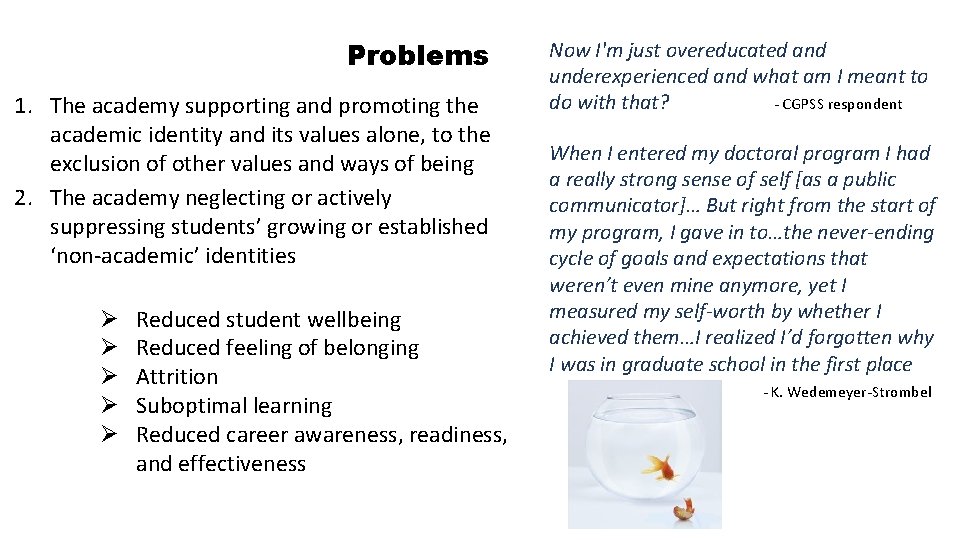
Problems 1. The academy supporting and promoting the academic identity and its values alone, to the exclusion of other values and ways of being 2. The academy neglecting or actively suppressing students’ growing or established ‘non-academic’ identities Ø Ø Ø Reduced student wellbeing Reduced feeling of belonging Attrition Suboptimal learning Reduced career awareness, readiness, and effectiveness Now I'm just overeducated and underexperienced and what am I meant to do with that? - CGPSS respondent When I entered my doctoral program I had a really strong sense of self [as a public communicator]… But right from the start of my program, I gave in to…the never-ending cycle of goals and expectations that weren’t even mine anymore, yet I measured my self-worth by whether I achieved them…I realized I’d forgotten why I was in graduate school in the first place - K. Wedemeyer-Strombel
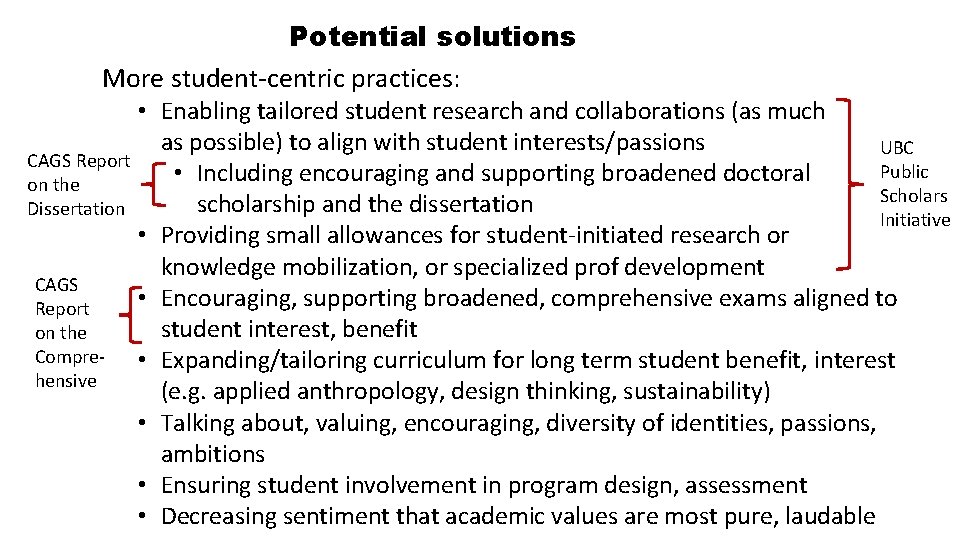
Potential solutions More student-centric practices: • Enabling tailored student research and collaborations (as much as possible) to align with student interests/passions UBC CAGS Report Public • Including encouraging and supporting broadened doctoral on the Scholars scholarship and the dissertation Dissertation Initiative • Providing small allowances for student-initiated research or knowledge mobilization, or specialized prof development CAGS • Encouraging, supporting broadened, comprehensive exams aligned to Report student interest, benefit on the Compre • Expanding/tailoring curriculum for long term student benefit, interest hensive (e. g. applied anthropology, design thinking, sustainability) • Talking about, valuing, encouraging, diversity of identities, passions, ambitions • Ensuring student involvement in program design, assessment • Decreasing sentiment that academic values are most pure, laudable
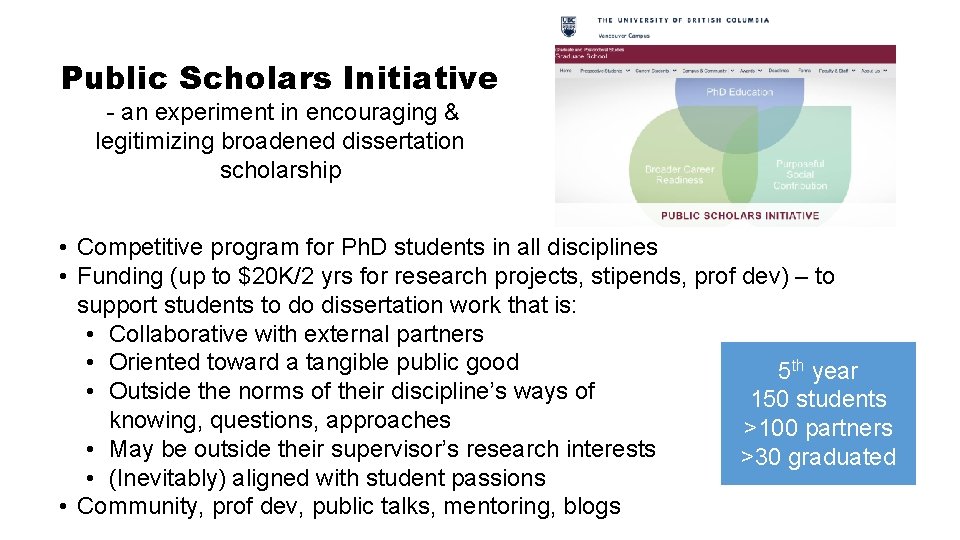
Public Scholars Initiative - an experiment in encouraging & legitimizing broadened dissertation scholarship • Competitive program for Ph. D students in all disciplines • Funding (up to $20 K/2 yrs for research projects, stipends, prof dev) – to support students to do dissertation work that is: • Collaborative with external partners • Oriented toward a tangible public good 5 th year • Outside the norms of their discipline’s ways of 150 students knowing, questions, approaches >100 partners • May be outside their supervisor’s research interests >30 graduated • (Inevitably) aligned with student passions • Community, prof dev, public talks, mentoring, blogs
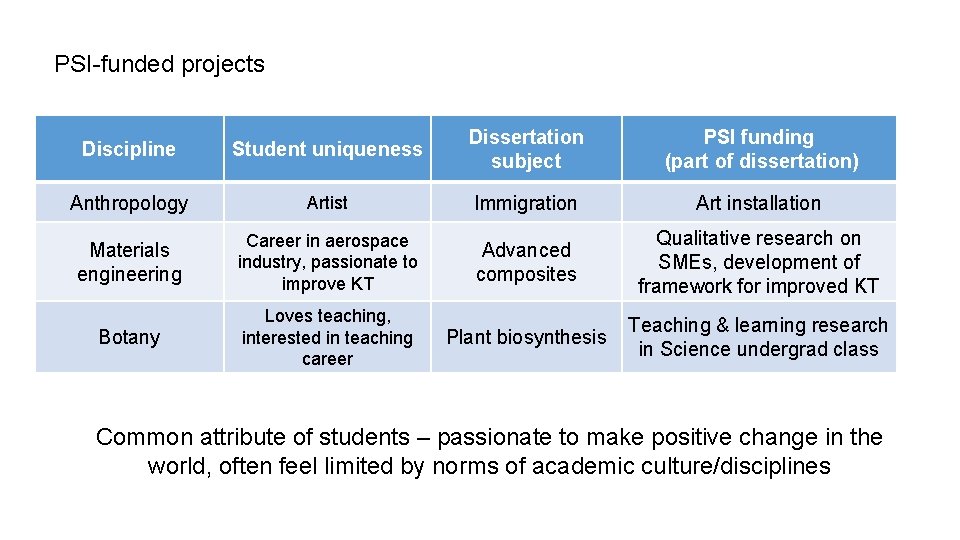
PSI-funded projects Discipline Student uniqueness Dissertation subject PSI funding (part of dissertation) Anthropology Artist Immigration Art installation Materials engineering Career in aerospace industry, passionate to improve KT Advanced composites Qualitative research on SMEs, development of framework for improved KT Botany Loves teaching, interested in teaching career Plant biosynthesis Teaching & learning research in Science undergrad class Common attribute of students – passionate to make positive change in the world, often feel limited by norms of academic culture/disciplines
Evaluations PSI Students (n=84) 85% → ‘significantly impacted my formation and identity as a scholar’ 71% → ‘helped inform/inspire me about potential career paths’ It helped me take ownership over an academic identity that I was reluctant to admit to I have often felt out of place in the academic world. Through PSI, my scholarly side developed immensely I no longer feel alone with the understanding of how research should be conceptualized and conducted It changed the way that I conceive of myself as a researcher. It renewed my belief in the possibility of conducting work that can matter. I feel more strongly about this project than any other I have worked on in my dissertation
It is not enough to rethink the doctorate. We have to rethink the faculty. - Yehuda Elkana, 2006

- Slides: 15