
PhaseInduced Amplitude Apodization Complex Mask Coronagraphy PIAACMC for



- Slides: 25
Phase-Induced Amplitude Apodization Complex Mask Coronagraphy (PIAACMC) for Large Segmented Apertures Olivier Guyon [1, 2], Brian Kern [3], Alexander Rodack [1], Justin Knight [1] Ruslan Belikov [4], Dan Sirbu [4], Stephen Bryson [4], Christopher Henze [4] Johanan Codona [1], Stuart Shaklan [3] [1] Univ. of Arizona [2] Subaru Telescope [3] JPL [4] NASA Ames Research Center Work funded by the NASA SCDA study (PI: Shaklan)
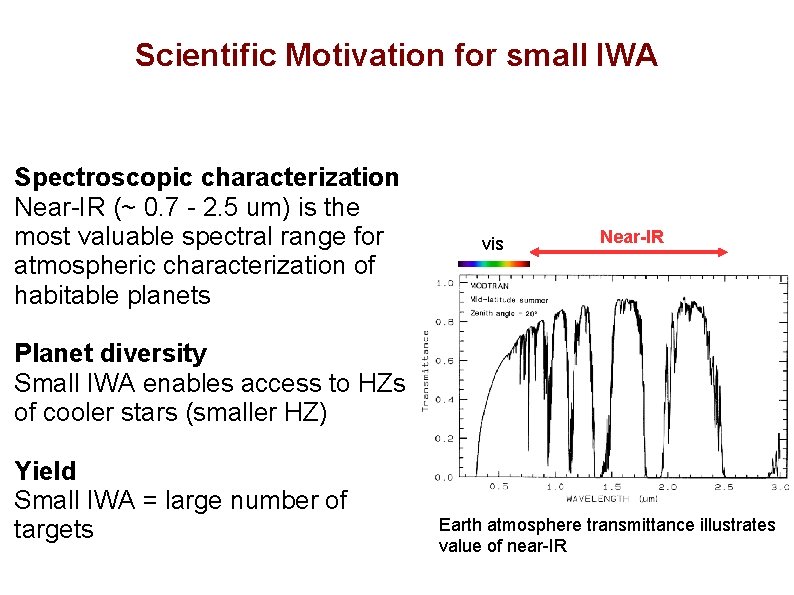
Scientific Motivation for small IWA Spectroscopic characterization Near-IR (~ 0. 7 - 2. 5 um) is the most valuable spectral range for atmospheric characterization of habitable planets vis Near-IR Planet diversity Small IWA enables access to HZs of cooler stars (smaller HZ) Yield Small IWA = large number of targets Earth atmosphere transmittance illustrates value of near-IR
Our Approach: PIAACMC … without PIAA We adopted APLCMC (= PIAACMC without PIAA) for convenience Pupil amplitude apodizer → Focal plane mask → Lyot stop Apodization loss→ Low throughput (~30%), Some loss in IWA, Larger PSF core (FUTURE designs will use PIAA → ~2 -3 x gain in efficiency expected) Easier to design, faster numerical simulation → rapid exploration of design optimization & trades (THIS presentation) Design process: (1) Design ideal monochromatic APLCMC: complete supression of on-axis light in monochromatic light, small IWA (2) Replace ideal focal plane mask with multi-zone mask. Optimize zones for broadband light and stellar angular size. For both APLCMC and PIAACMC, the multizone focal plane mask is the most critical element (Can it be manufactured ? ) Multi-zone focal plane mask. Each zone imprints an optical pathlength delay. Mutual interference between zones creates deep achromatic null. (credit: NAOJ/CNF)
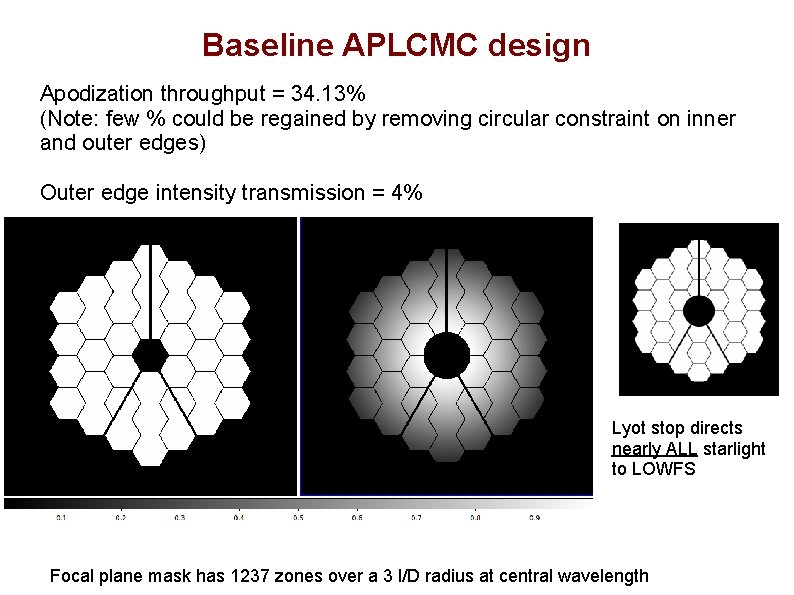
Baseline APLCMC design Apodization throughput = 34. 13% (Note: few % could be regained by removing circular constraint on inner and outer edges) Outer edge intensity transmission = 4% Lyot stop directs nearly ALL starlight to LOWFS Focal plane mask has 1237 zones over a 3 l/D radius at central wavelength
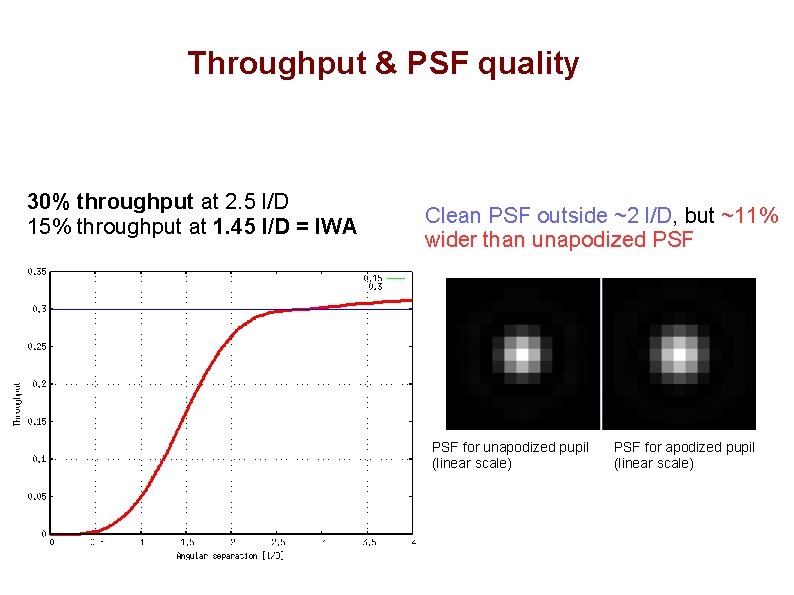
Throughput & PSF quality 30% throughput at 2. 5 l/D 15% throughput at 1. 45 l/D = IWA Clean PSF outside ~2 l/D, but ~11% wider than unapodized PSF for unapodized pupil (linear scale) PSF for apodized pupil (linear scale)
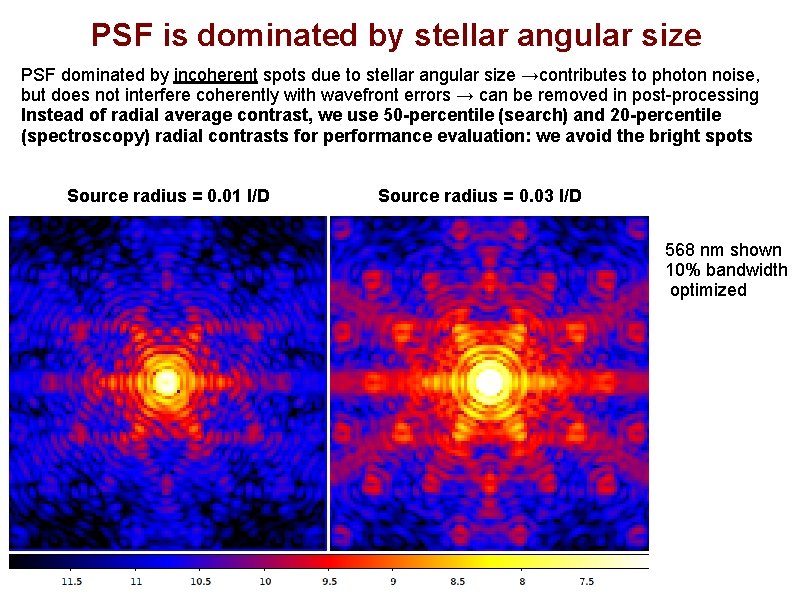
PSF is dominated by stellar angular size PSF dominated by incoherent spots due to stellar angular size →contributes to photon noise, but does not interfere coherently with wavefront errors → can be removed in post-processing Instead of radial average contrast, we use 50 -percentile (search) and 20 -percentile (spectroscopy) radial contrasts for performance evaluation: we avoid the bright spots Source radius = 0. 01 l/D Source radius = 0. 03 l/D 568 nm shown 10% bandwidth optimized
APLCMC design – Raw Contrast (20 percentile along each radius)
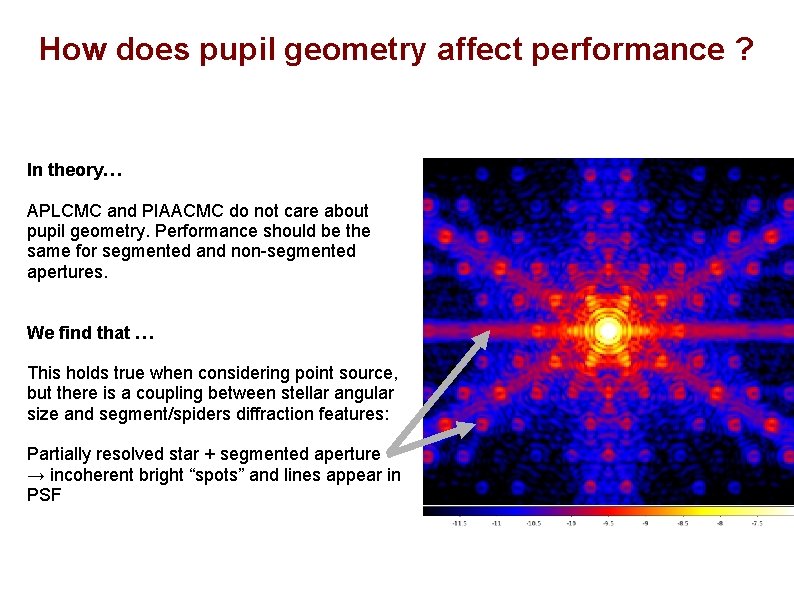
How does pupil geometry affect performance ? In theory… APLCMC and PIAACMC do not care about pupil geometry. Performance should be the same for segmented and non-segmented apertures. We find that … This holds true when considering point source, but there is a coupling between stellar angular size and segment/spiders diffraction features: Partially resolved star + segmented aperture → incoherent bright “spots” and lines appear in PSF
Stellar Angular Size Study What is the impact of stellar angular size on planet characterization ?
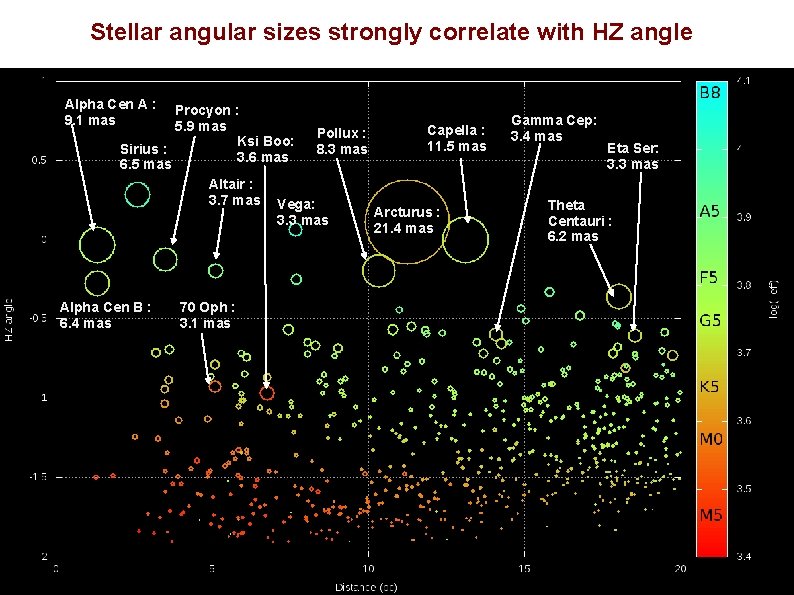
Stellar angular sizes strongly correlate with HZ angle Alpha Cen A : 9. 1 mas Procyon : 5. 9 mas Capella : Pollux : Ksi Boo: 11. 5 mas 8. 3 mas Sirius : 3. 6 mas 6. 5 mas Altair : 3. 7 mas Vega: Arcturus : 3. 3 mas 21. 4 mas Alpha Cen B : 6. 4 mas 70 Oph : 3. 1 mas Gamma Cep: 3. 4 mas Eta Ser: 3. 3 mas Theta Centauri : 6. 2 mas
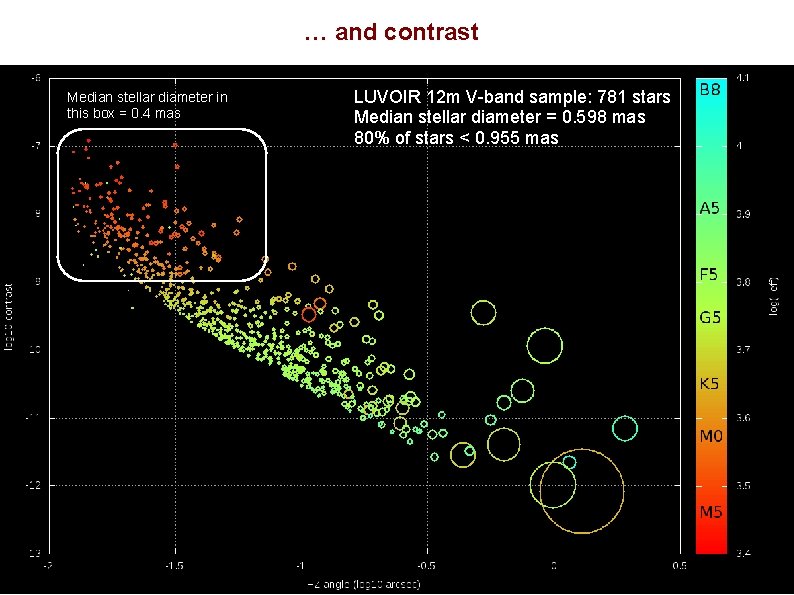
… and contrast Median stellar diameter in this box = 0. 4 mas LUVOIR 12 m V-band sample: 781 stars Median stellar diameter = 0. 598 mas 80% of stars < 0. 955 mas
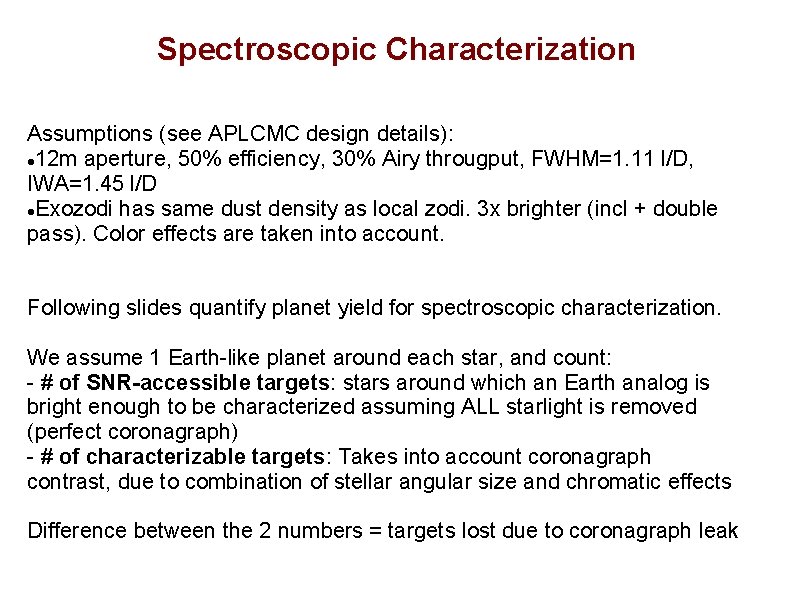
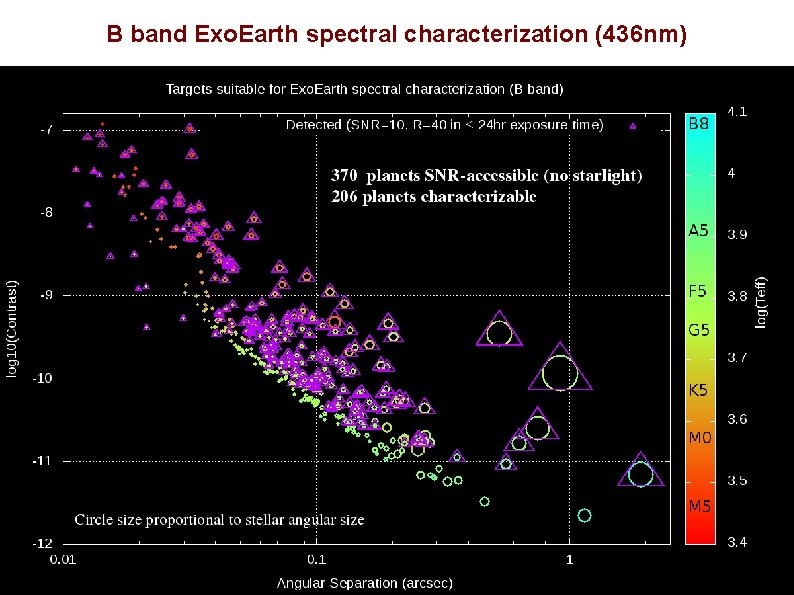
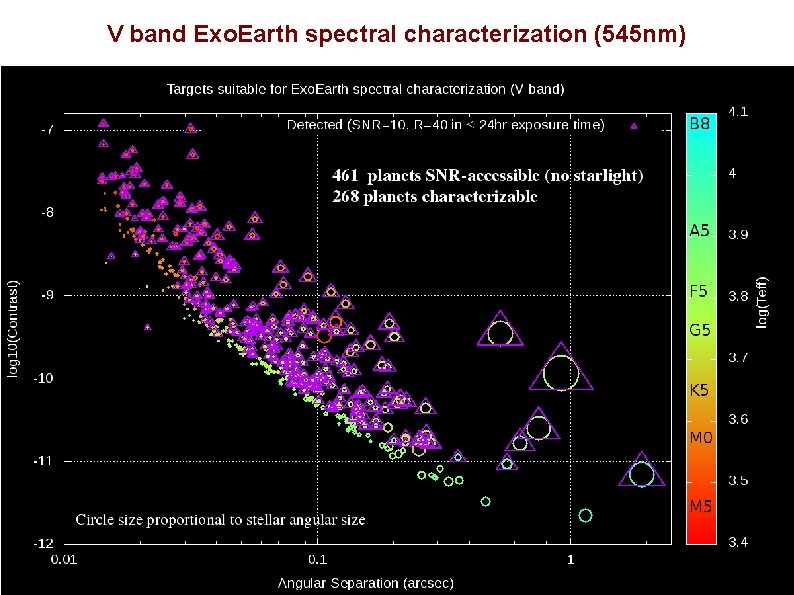
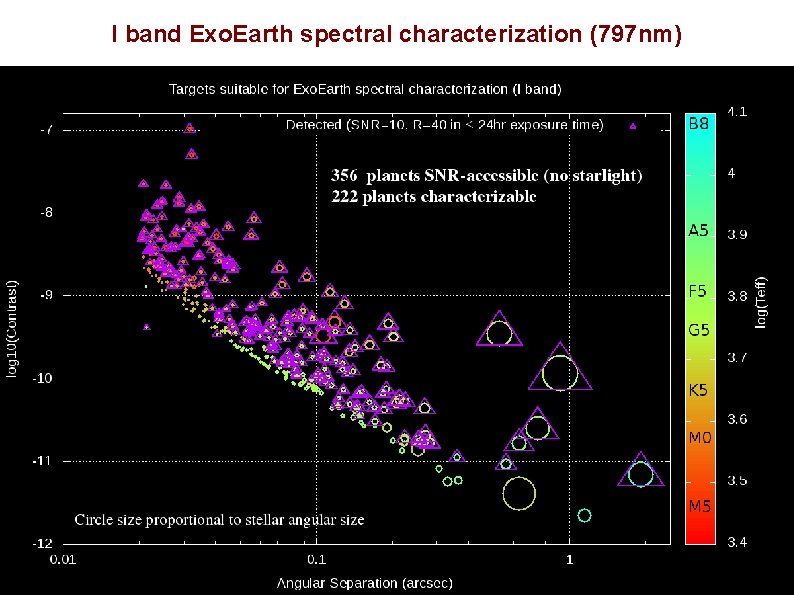
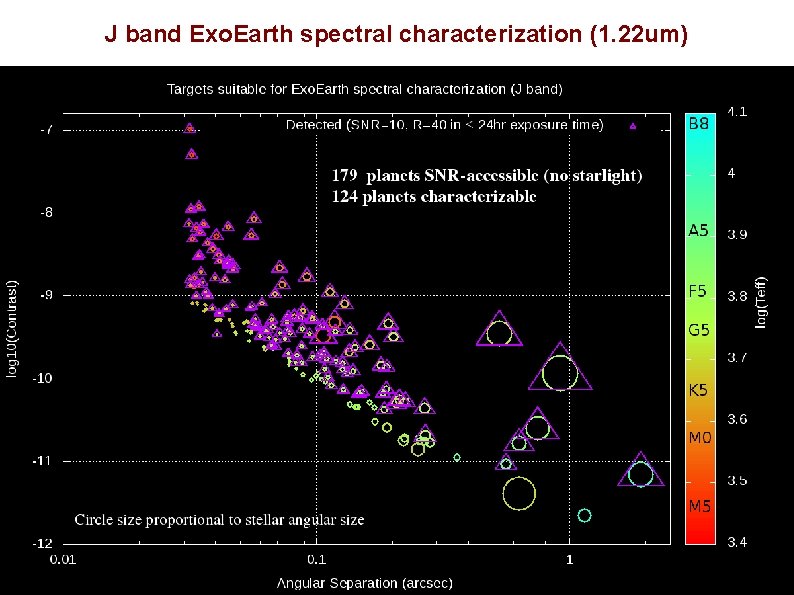
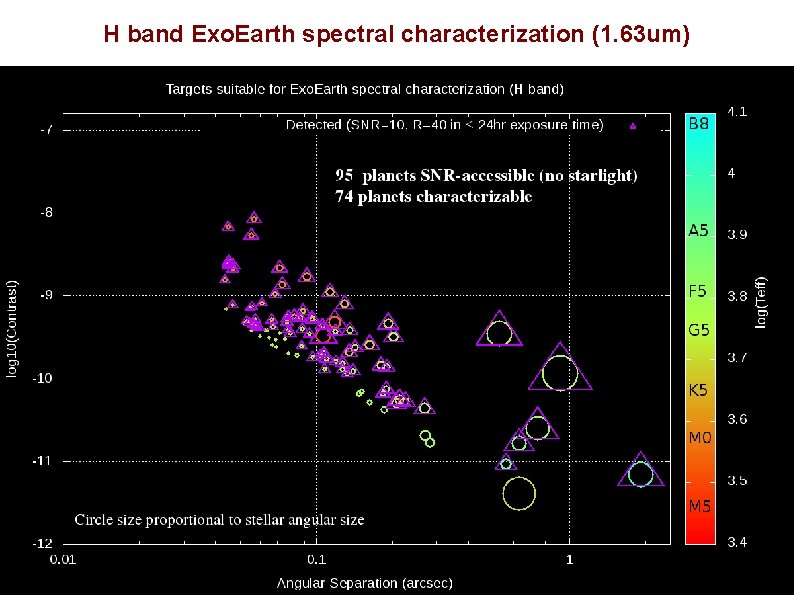
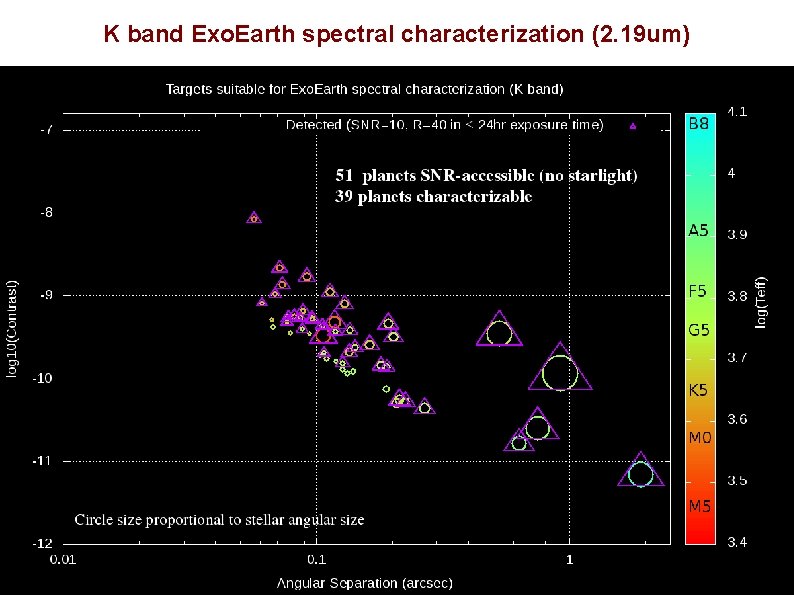
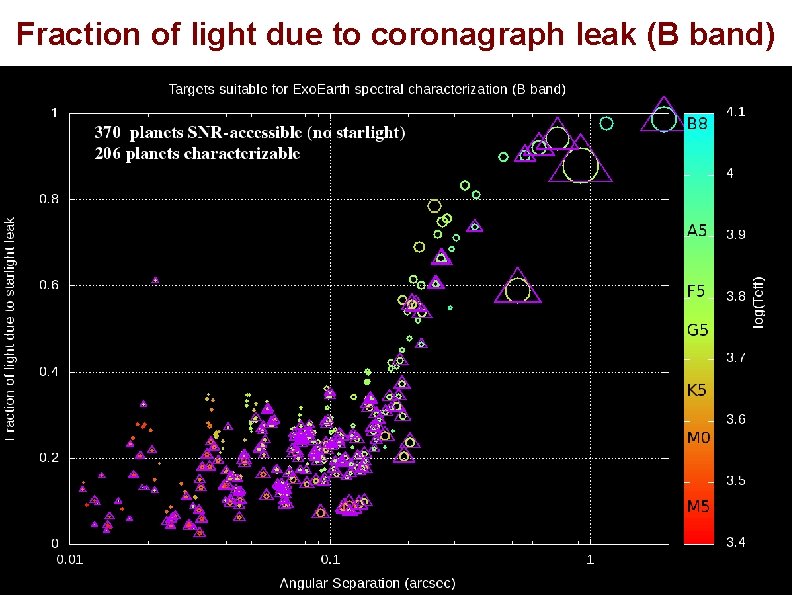
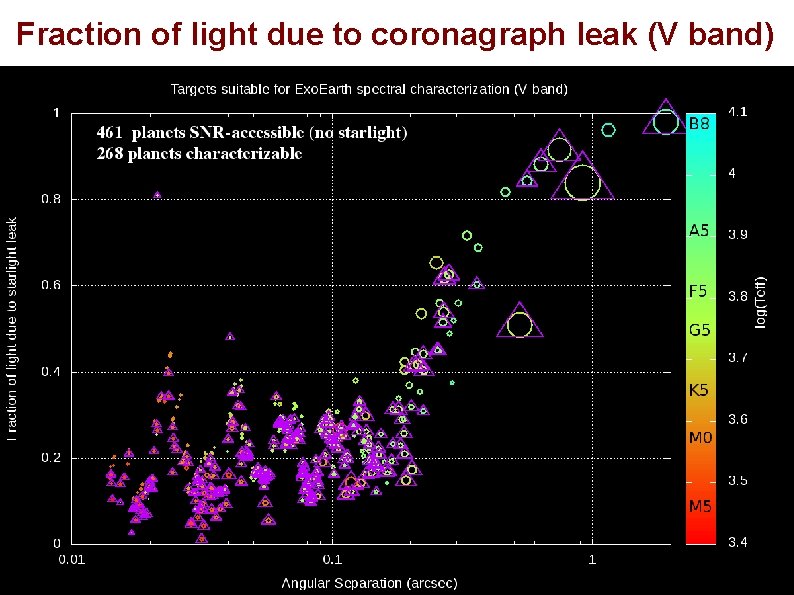
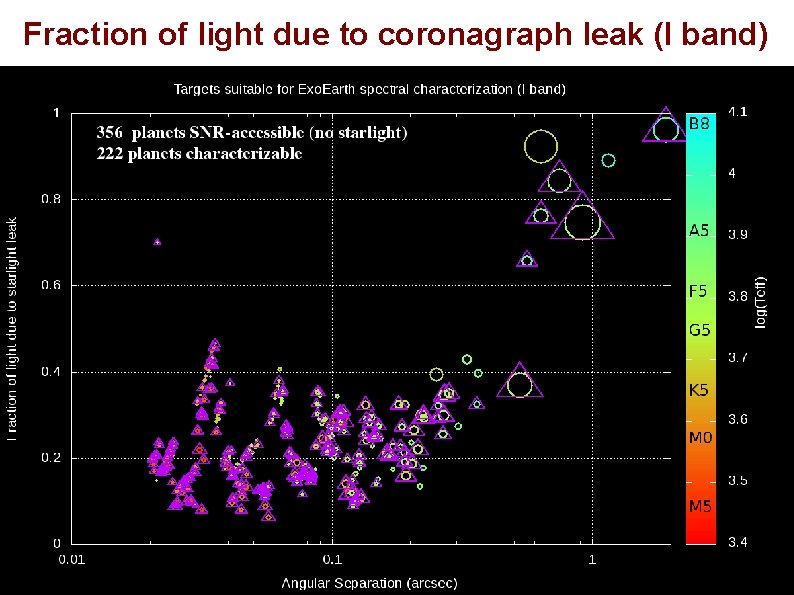
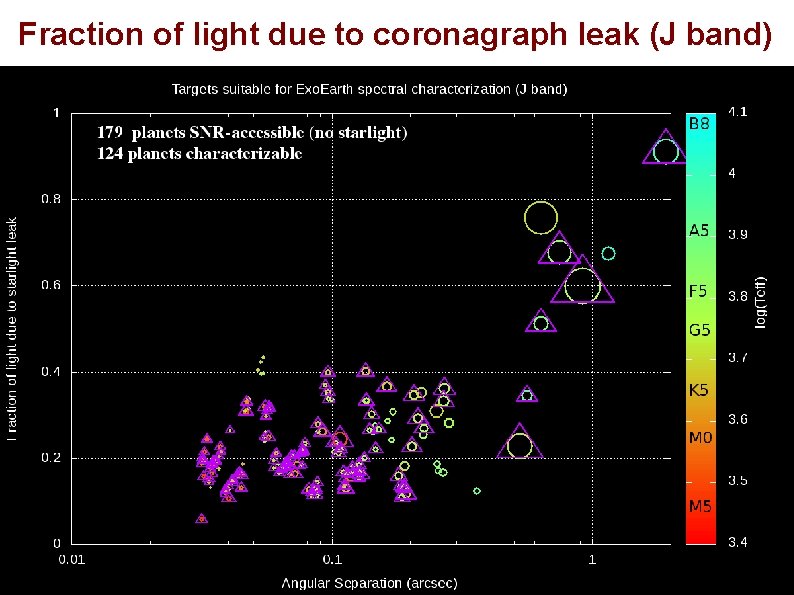
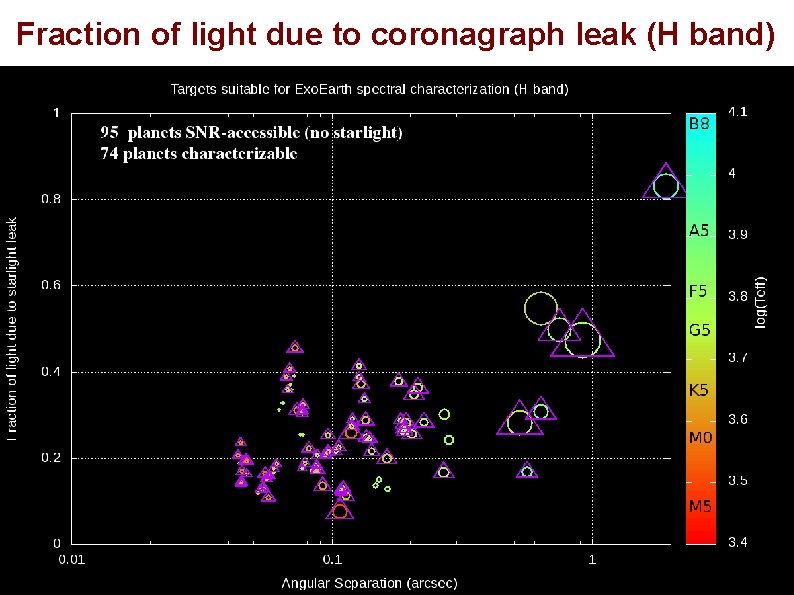
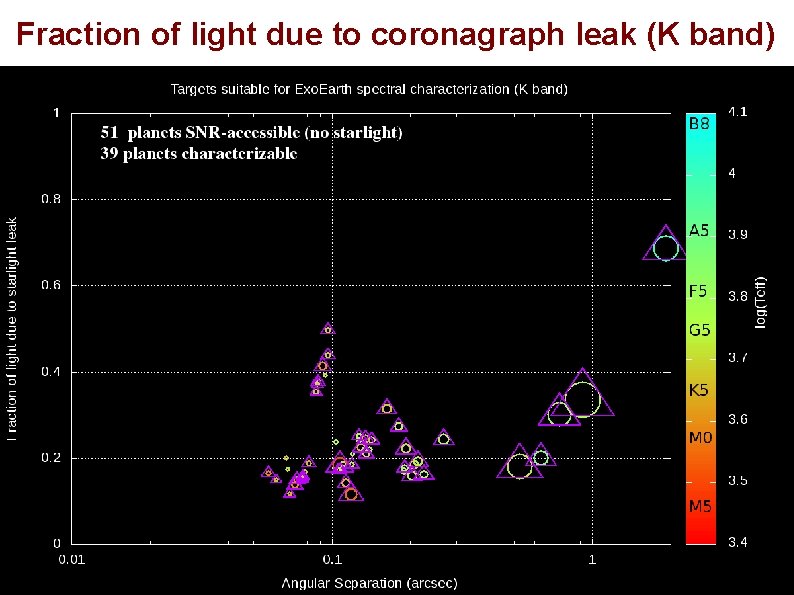
Spectroscopic Characterization Assumptions (see APLCMC design details): 12 m aperture, 50% efficiency, 30% Airy througput, FWHM=1. 11 l/D, IWA=1. 45 l/D Exozodi has same dust density as local zodi. 3 x brighter (incl + double pass). Color effects are taken into account. Following slides quantify planet yield for spectroscopic characterization. We assume 1 Earth-like planet around each star, and count: - # of SNR-accessible targets: stars around which an Earth analog is bright enough to be characterized assuming ALL starlight is removed (perfect coronagraph) - # of characterizable targets: Takes into account coronagraph contrast, due to combination of stellar angular size and chromatic effects Difference between the 2 numbers = targets lost due to coronagraph leak
B band Exo. Earth spectral characterization (436 nm)
V band Exo. Earth spectral characterization (545 nm)
I band Exo. Earth spectral characterization (797 nm)
J band Exo. Earth spectral characterization (1. 22 um)
H band Exo. Earth spectral characterization (1. 63 um)
K band Exo. Earth spectral characterization (2. 19 um)
Fraction of light due to coronagraph leak (B band)
Fraction of light due to coronagraph leak (V band)
Fraction of light due to coronagraph leak (I band)
Fraction of light due to coronagraph leak (J band)
Fraction of light due to coronagraph leak (H band)
Fraction of light due to coronagraph leak (K band)
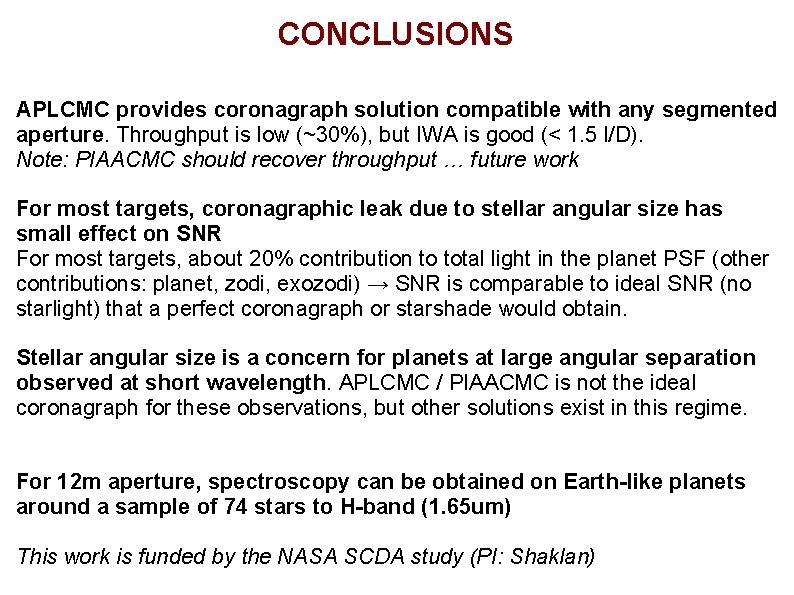
CONCLUSIONS APLCMC provides coronagraph solution compatible with any segmented aperture. Throughput is low (~30%), but IWA is good (< 1. 5 l/D). Note: PIAACMC should recover throughput … future work For most targets, coronagraphic leak due to stellar angular size has small effect on SNR For most targets, about 20% contribution to total light in the planet PSF (other contributions: planet, zodi, exozodi) → SNR is comparable to ideal SNR (no starlight) that a perfect coronagraph or starshade would obtain. Stellar angular size is a concern for planets at large angular separation observed at short wavelength. APLCMC / PIAACMC is not the ideal coronagraph for these observations, but other solutions exist in this regime. For 12 m aperture, spectroscopy can be obtained on Earth-like planets around a sample of 74 stars to H-band (1. 65 um) This work is funded by the NASA SCDA study (PI: Shaklan)