
PHASE TRANSITION CHANGING FOOD WITH THE APPLICATION OF
- Slides: 17
PHASE TRANSITION CHANGING FOOD WITH THE APPLICATION OF HEAT
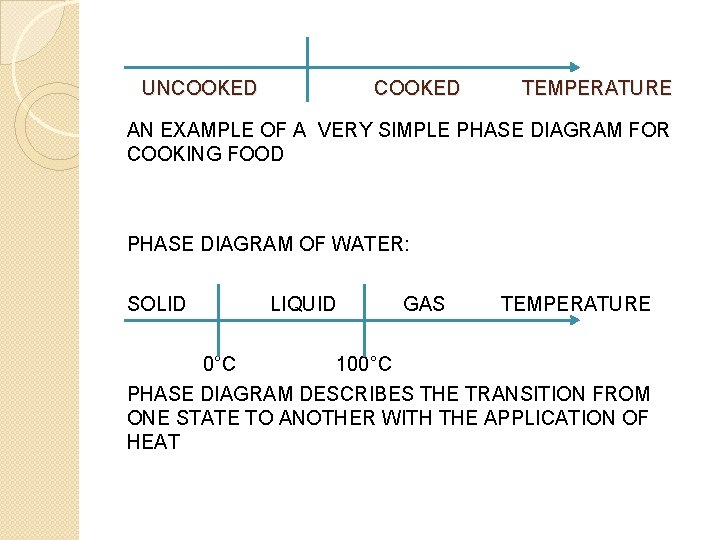
UNCOOKED TEMPERATURE AN EXAMPLE OF A VERY SIMPLE PHASE DIAGRAM FOR COOKING FOOD PHASE DIAGRAM OF WATER: SOLID LIQUID GAS TEMPERATURE 0°C 100°C PHASE DIAGRAM DESCRIBES THE TRANSITION FROM ONE STATE TO ANOTHER WITH THE APPLICATION OF HEAT
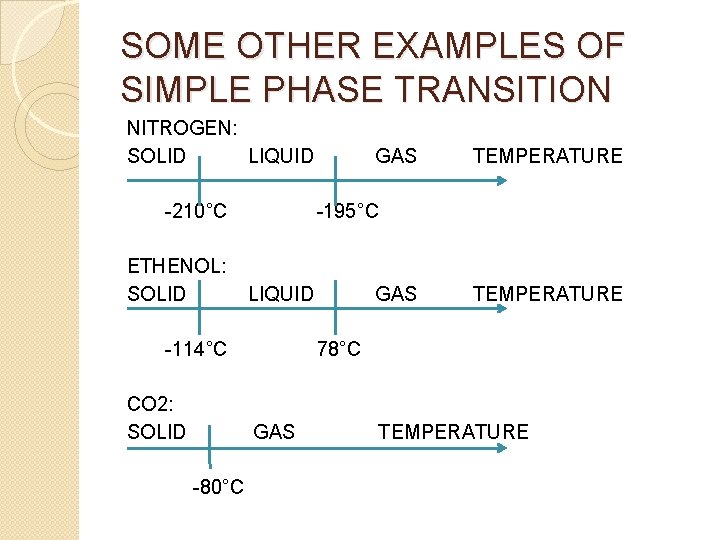
SOME OTHER EXAMPLES OF SIMPLE PHASE TRANSITION NITROGEN: SOLID LIQUID -210°C ETHENOL: SOLID LIQUID GAS TEMPERATURE 78°C GAS -80°C TEMPERATURE -195°C -114°C CO 2: SOLID GAS TEMPERATURE
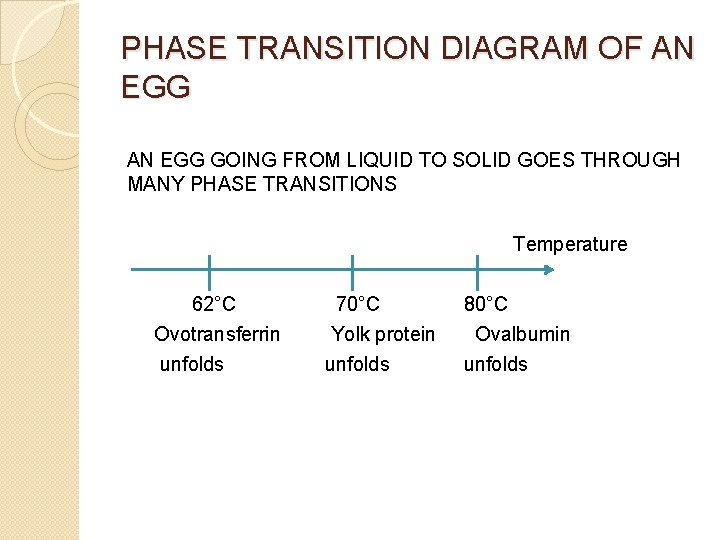
PHASE TRANSITION DIAGRAM OF AN EGG GOING FROM LIQUID TO SOLID GOES THROUGH MANY PHASE TRANSITIONS Temperature 62°C Ovotransferrin unfolds 70°C Yolk protein unfolds 80°C Ovalbumin unfolds
It’s also true of other things If you want to cook a turkey………. texture and taste change as the temperature increase Bake a pie, or cake………. . Many different textures occur as the temperature goes up.
What are we going to learn today? Eggs, turkeys, pies, and cakes all have complicated phase behavior. 1) Explain what those transitions are 2) Why they occur 3) How to control them All to make you a better chef
PHASE CHANGE IN AN EGG AND OTHER PROTIENS, AS WELL Egg whites and yolks are composed of proteins in liquid in their natural state. Heat energy disrupts their molecular structure causing one set of bonds to break and another set to form. This second bond creates a solid network referred to as coagulation The greater the temperature, the firmer the coagulation
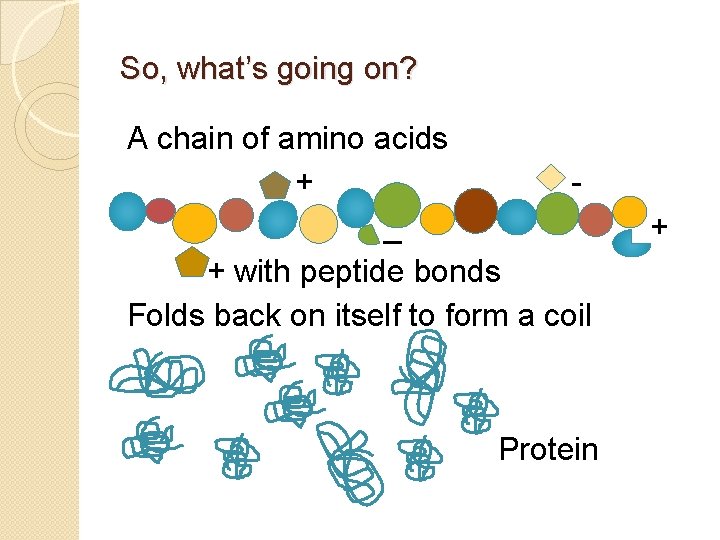
So, what’s going on? A chain of amino acids + _ + with peptide bonds Folds back on itself to form a coil Protein +
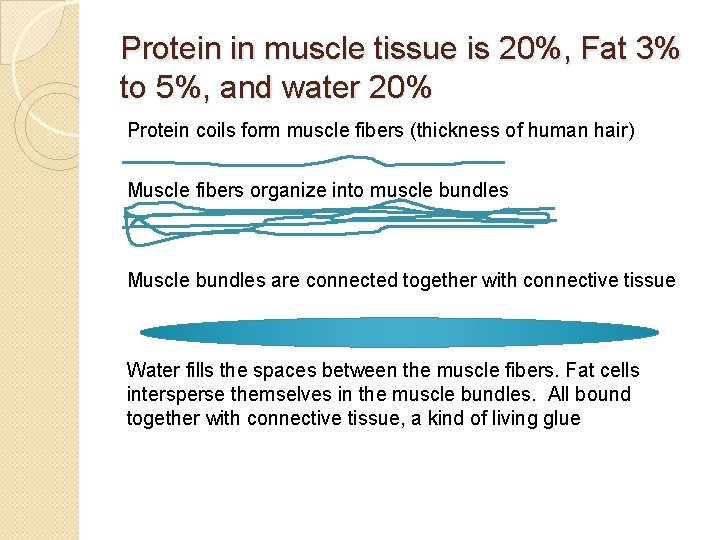
Protein in muscle tissue is 20%, Fat 3% to 5%, and water 20% Protein coils form muscle fibers (thickness of human hair) Muscle fibers organize into muscle bundles Muscle bundles are connected together with connective tissue Water fills the spaces between the muscle fibers. Fat cells intersperse themselves in the muscle bundles. All bound together with connective tissue, a kind of living glue
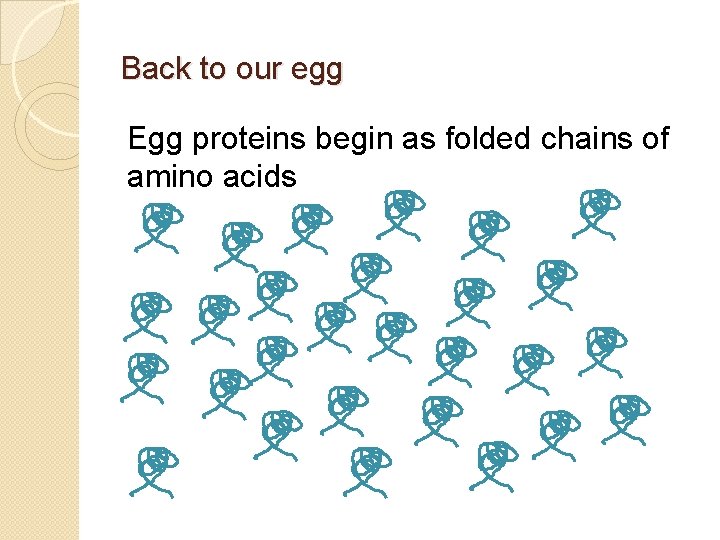
Back to our egg Egg proteins begin as folded chains of amino acids
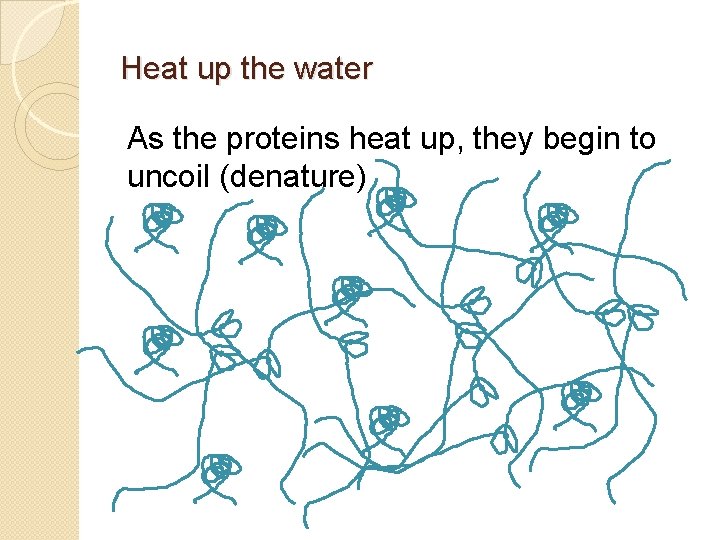
Heat up the water As the proteins heat up, they begin to uncoil (denature)
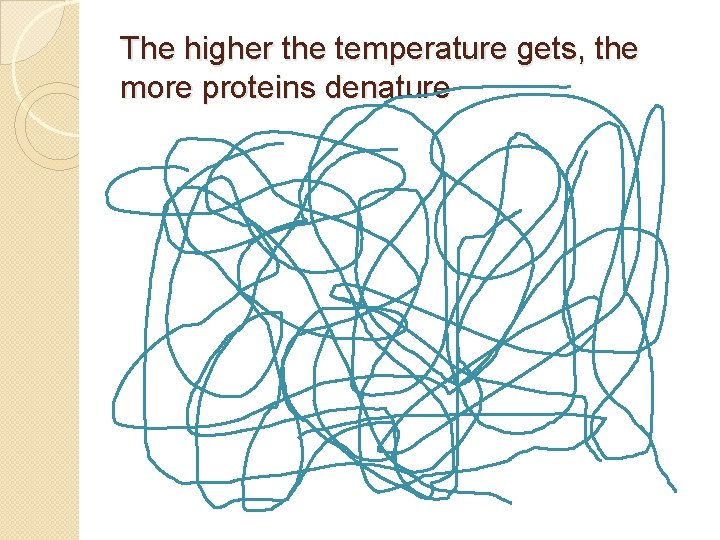
The higher the temperature gets, the more proteins denature
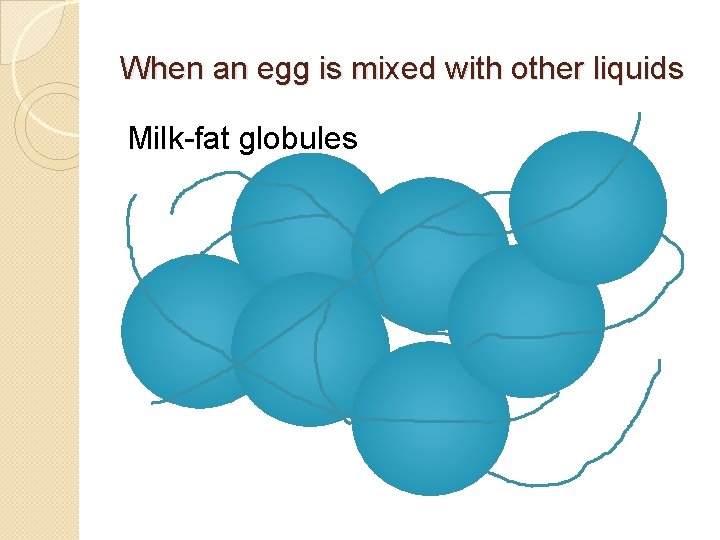
When an egg is mixed with other liquids Milk-fat globules
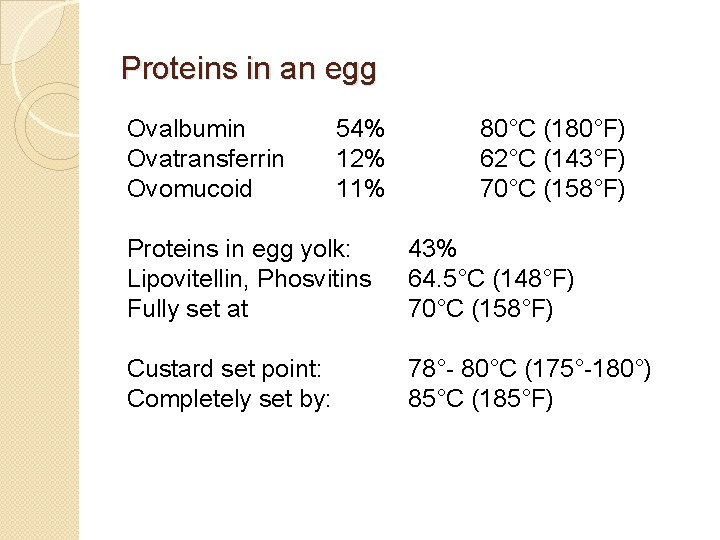
Proteins in an egg Ovalbumin Ovatransferrin Ovomucoid 54% 12% 11% 80°C (180°F) 62°C (143°F) 70°C (158°F) Proteins in egg yolk: Lipovitellin, Phosvitins Fully set at 43% 64. 5°C (148°F) 70°C (158°F) Custard set point: Completely set by: 78°- 80°C (175°-180°) 85°C (185°F)
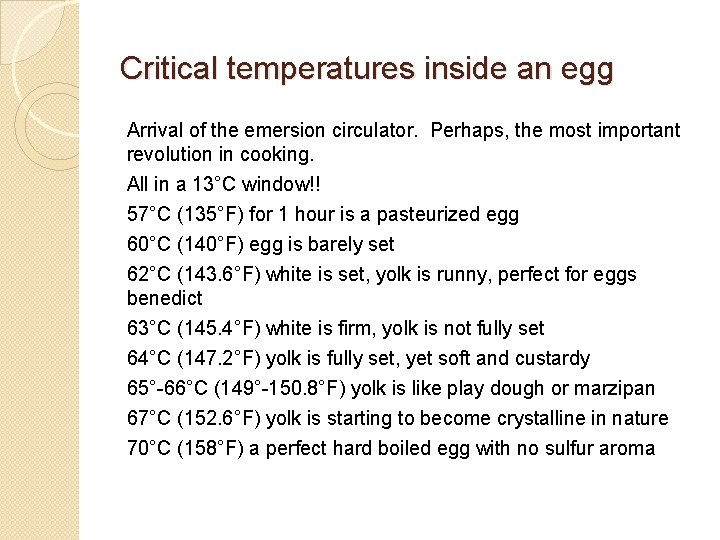
Critical temperatures inside an egg Arrival of the emersion circulator. Perhaps, the most important revolution in cooking. All in a 13°C window!! 57°C (135°F) for 1 hour is a pasteurized egg 60°C (140°F) egg is barely set 62°C (143. 6°F) white is set, yolk is runny, perfect for eggs benedict 63°C (145. 4°F) white is firm, yolk is not fully set 64°C (147. 2°F) yolk is fully set, yet soft and custardy 65°-66°C (149°-150. 8°F) yolk is like play dough or marzipan 67°C (152. 6°F) yolk is starting to become crystalline in nature 70°C (158°F) a perfect hard boiled egg with no sulfur aroma
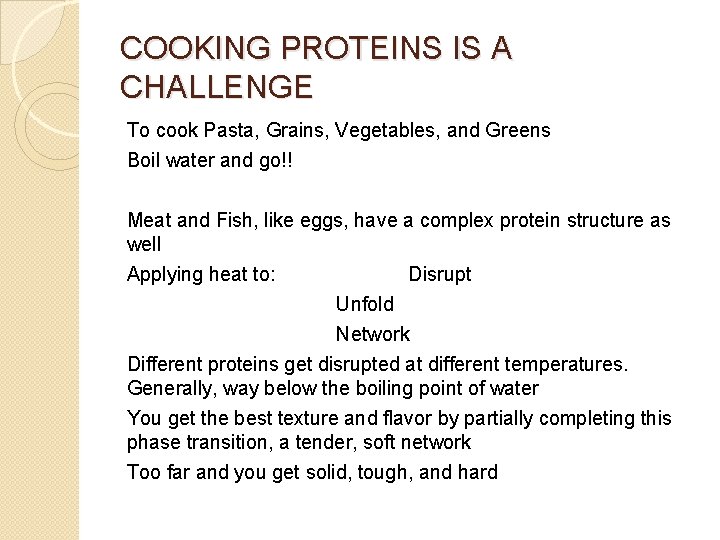
COOKING PROTEINS IS A CHALLENGE To cook Pasta, Grains, Vegetables, and Greens Boil water and go!! Meat and Fish, like eggs, have a complex protein structure as well Applying heat to: Disrupt Unfold Network Different proteins get disrupted at different temperatures. Generally, way below the boiling point of water You get the best texture and flavor by partially completing this phase transition, a tender, soft network Too far and you get solid, tough, and hard
Bibliography Harvard University of Applied Science and Engineering ed. X course on food science On Food and Cooking, the science and Lore of the kitchen. Harold Mc. Gee Lipid-protein interactions in lipovitellin. Thompson, JR & Banaszak, LJ The Nutritional Value of Egg White vs Egg Yolk, Grace Derocha