
Phase Retrieval from the Short Time Fourier Transform
- Slides: 24
Phase Retrieval from the Short -Time Fourier Transform Yonina Eldar Technion – Israel Institute of Technology Kishore Jaganathan and Babak Hassibi Department of Electrical Engineering, Caltech Optics Collaborators: Moti Segev and Oren Cohen 1/20
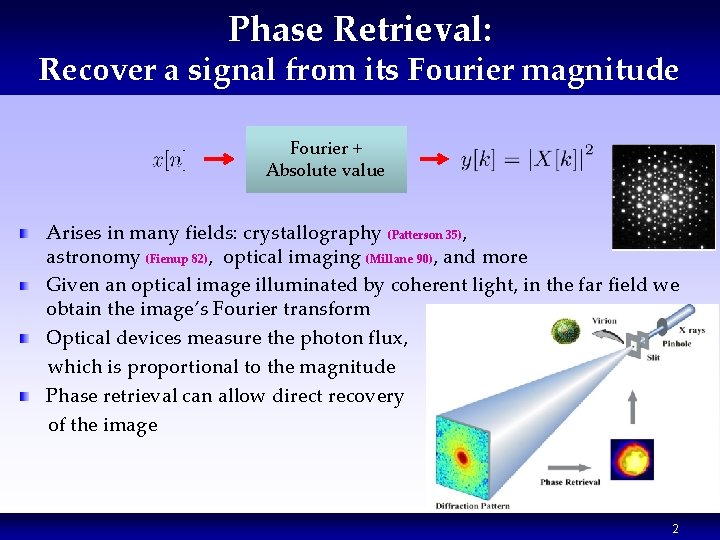
Phase Retrieval: Recover a signal from its Fourier magnitude Fourier + Absolute value Arises in many fields: crystallography (Patterson 35), astronomy (Fienup 82), optical imaging (Millane 90), and more Given an optical image illuminated by coherent light, in the far field we obtain the image’s Fourier transform Optical devices measure the photon flux, which is proportional to the magnitude Phase retrieval can allow direct recovery of the image 2
Theory of Phase Retrieval Difficult to analyze theoretically when recovery is possible No uniqueness in 1 D problems (Hofstetter 64) Uniqueness in 2 D if oversampled by factor 2 (Hayes 82) No guarantee on stability No known algorithms to achieve unique solution Recovery from Fourier Measurements is Difficult! 3
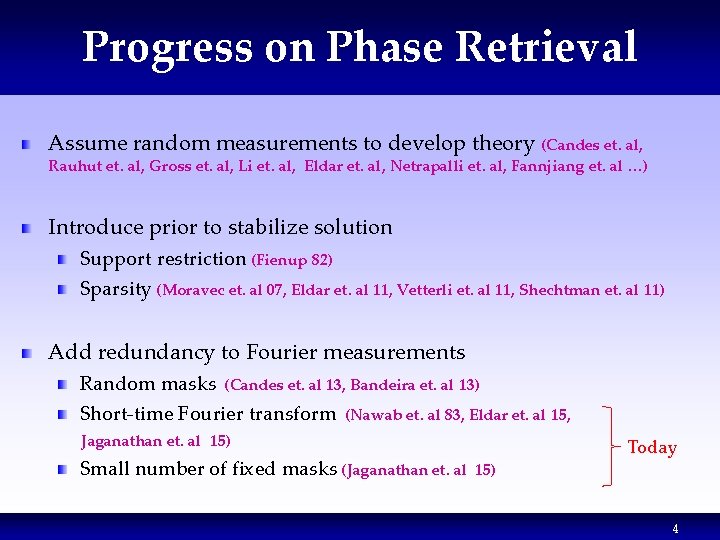
Progress on Phase Retrieval Assume random measurements to develop theory (Candes et. al, Rauhut et. al, Gross et. al, Li et. al, Eldar et. al, Netrapalli et. al, Fannjiang et. al …) Introduce prior to stabilize solution Support restriction (Fienup 82) Sparsity (Moravec et. al 07, Eldar et. al 11, Vetterli et. al 11, Shechtman et. al 11) Add redundancy to Fourier measurements Random masks (Candes et. al 13, Bandeira et. al 13) Short-time Fourier transform (Nawab et. al 83, Eldar et. al 15, Jaganathan et. al 15) Small number of fixed masks (Jaganathan et. al 15) Today 4
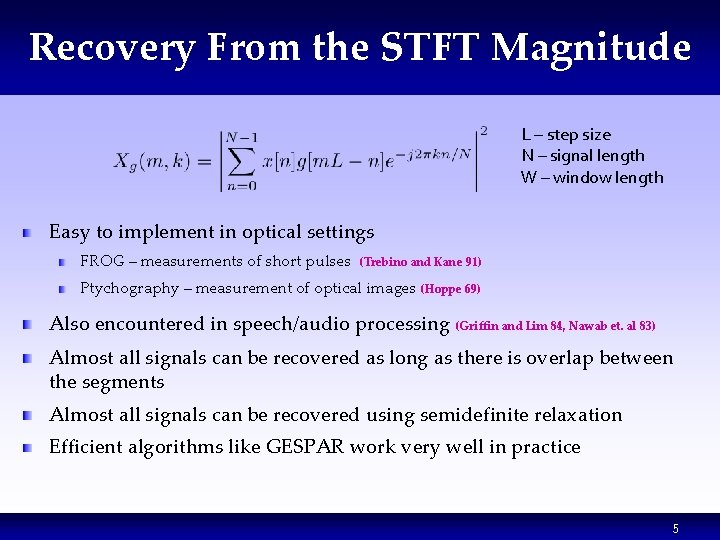
Recovery From the STFT Magnitude L – step size N – signal length W – window length Easy to implement in optical settings FROG – measurements of short pulses (Trebino and Kane 91) Ptychography – measurement of optical images (Hoppe 69) Also encountered in speech/audio processing (Griffin and Lim 84, Nawab et. al 83) Almost all signals can be recovered as long as there is overlap between the segments Almost all signals can be recovered using semidefinite relaxation Efficient algorithms like GESPAR work very well in practice 5
Talk Outline Summary of phase retrieval results Efficient algorithms STFT in optics Theoretical guarantees 6
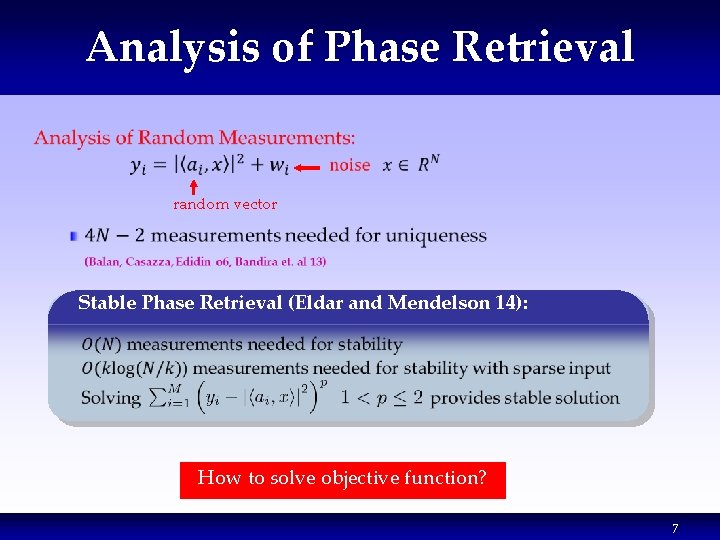
Analysis of Phase Retrieval random vector Stable Phase Retrieval (Eldar and Mendelson 14): How to solve objective function? 7
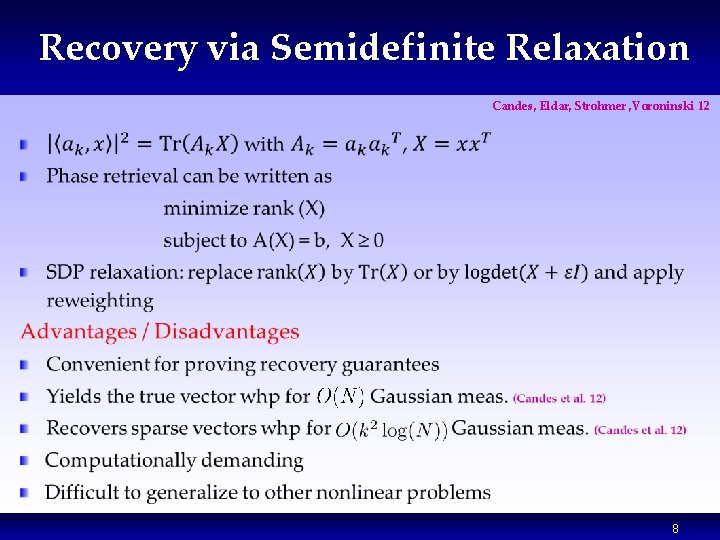
Recovery via Semidefinite Relaxation Candes, Eldar, Strohmer , Voroninski 12 8
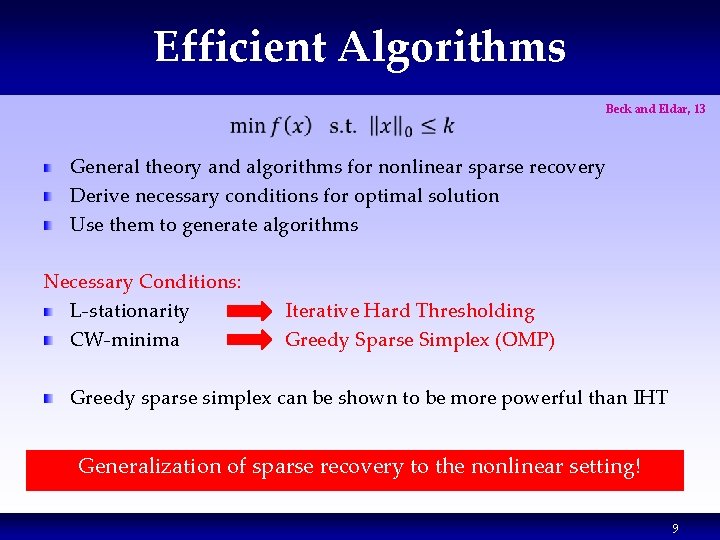
Efficient Algorithms Beck and Eldar, 13 General theory and algorithms for nonlinear sparse recovery Derive necessary conditions for optimal solution Use them to generate algorithms Necessary Conditions: L-stationarity CW-minima Iterative Hard Thresholding Greedy Sparse Simplex (OMP) Greedy sparse simplex can be shown to be more powerful than IHT Generalization of sparse recovery to the nonlinear setting! 9
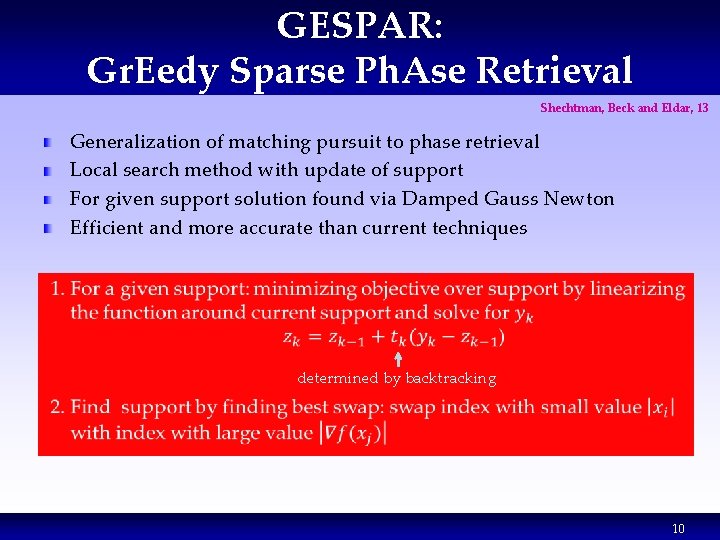
GESPAR: Gr. Eedy Sparse Ph. Ase Retrieval Shechtman, Beck and Eldar, 13 Generalization of matching pursuit to phase retrieval Local search method with update of support For given support solution found via Damped Gauss Newton Efficient and more accurate than current techniques determined by backtracking 10
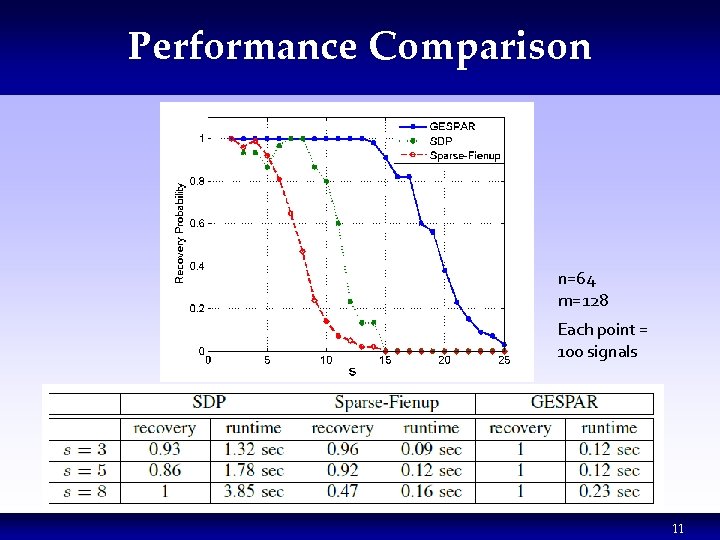
Performance Comparison n=64 m=128 Each point = 100 signals 11 11
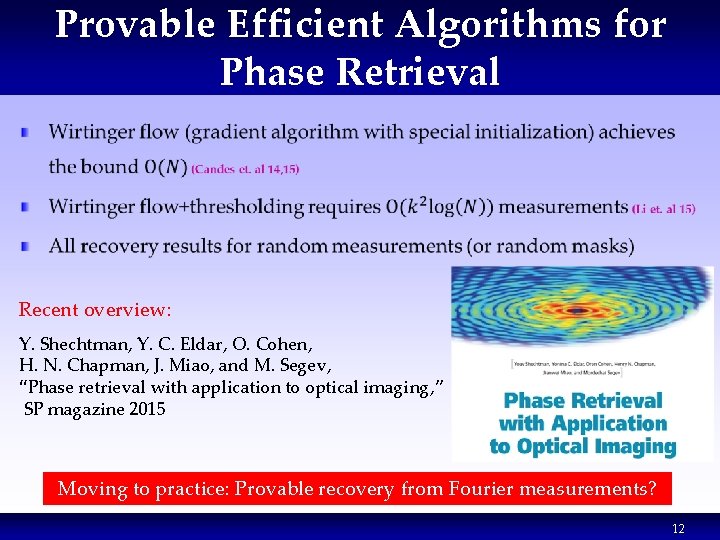
Provable Efficient Algorithms for Phase Retrieval Recent overview: Y. Shechtman, Y. C. Eldar, O. Cohen, H. N. Chapman, J. Miao, and M. Segev, “Phase retrieval with application to optical imaging, ” SP magazine 2015 Moving to practice: Provable recovery from Fourier measurements? 12
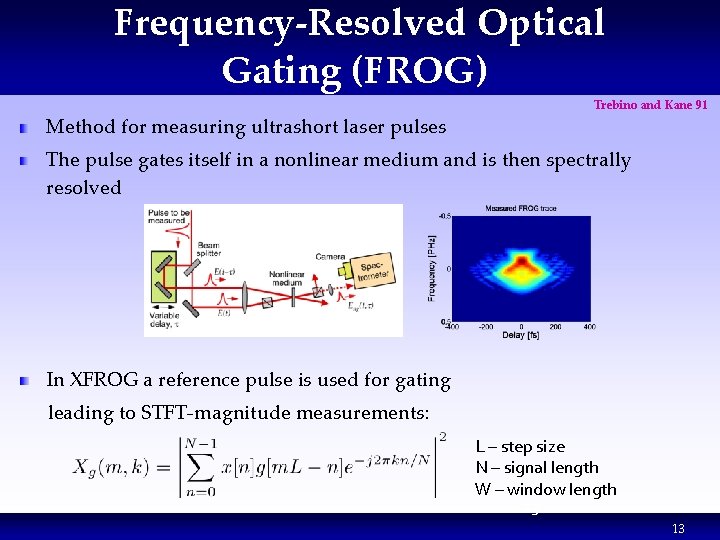
Frequency-Resolved Optical Gating (FROG) Method for measuring ultrashort laser pulses Trebino and Kane 91 The pulse gates itself in a nonlinear medium and is then spectrally resolved In XFROG a reference pulse is used for gating leading to STFT-magnitude measurements: L – step size N – signal length W – window length 13 13
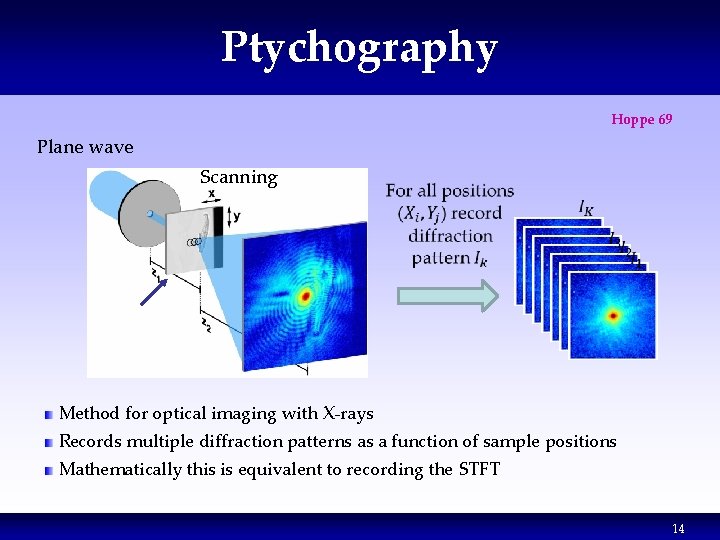
Ptychography Hoppe 69 Plane wave Scanning Method for optical imaging with X-rays Records multiple diffraction patterns as a function of sample positions Mathematically this is equivalent to recording the STFT 14
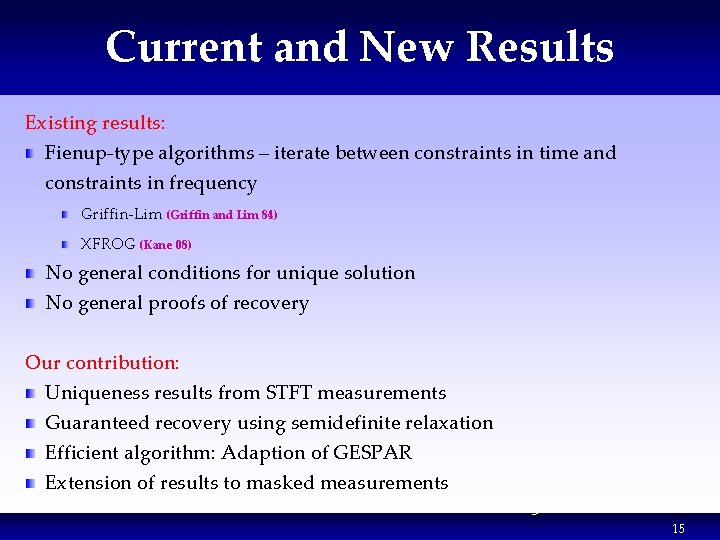
Current and New Results Existing results: Fienup-type algorithms – iterate between constraints in time and constraints in frequency Griffin-Lim (Griffin and Lim 84) XFROG (Kane 08) No general conditions for unique solution No general proofs of recovery Our contribution: Uniqueness results from STFT measurements Guaranteed recovery using semidefinite relaxation Efficient algorithm: Adaption of GESPAR Extension of results to masked measurements 15 15
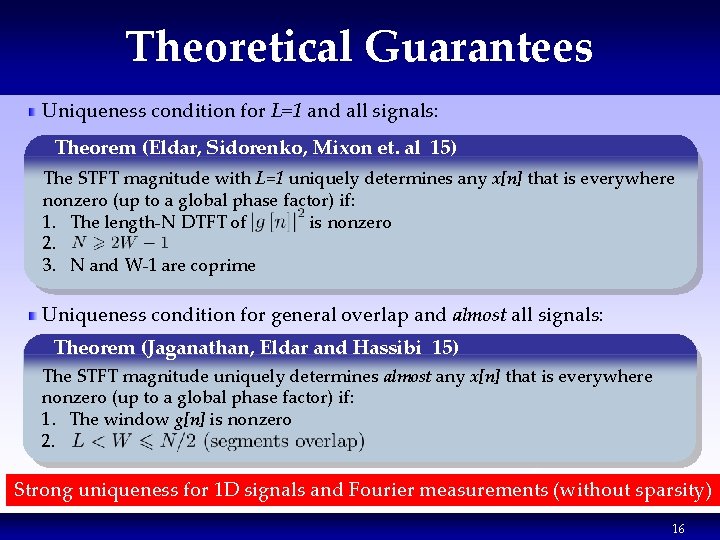
Theoretical Guarantees Uniqueness condition for L=1 and all signals: Theorem (Eldar, Sidorenko, Mixon et. al 15) The STFT magnitude with L=1 uniquely determines any x[n] that is everywhere nonzero (up to a global phase factor) if: 1. The length-N DTFT of is nonzero 2. 3. N and W-1 are coprime Uniqueness condition for general overlap and almost all signals: Theorem (Jaganathan, Eldar and Hassibi 15) The STFT magnitude uniquely determines almost any x[n] that is everywhere nonzero (up to a global phase factor) if: 1. The window g[n] is nonzero 2. 16 Strong uniqueness for 1 D signals and Fourier measurements (without sparsity) 16
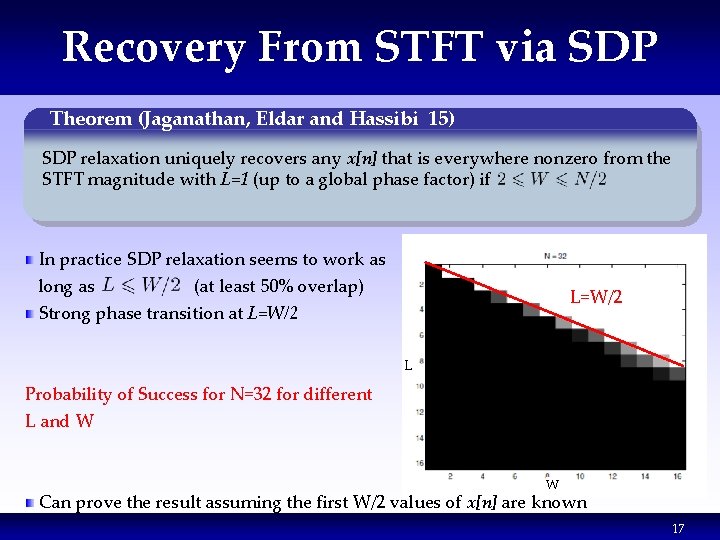
Recovery From STFT via SDP Theorem (Jaganathan, Eldar and Hassibi 15) SDP relaxation uniquely recovers any x[n] that is everywhere nonzero from the STFT magnitude with L=1 (up to a global phase factor) if In practice SDP relaxation seems to work as long as (at least 50% overlap) Strong phase transition at L=W/2 L Probability of Success for N=32 for different L and W W Can prove the result assuming the first W/2 values of x[n] are known 17
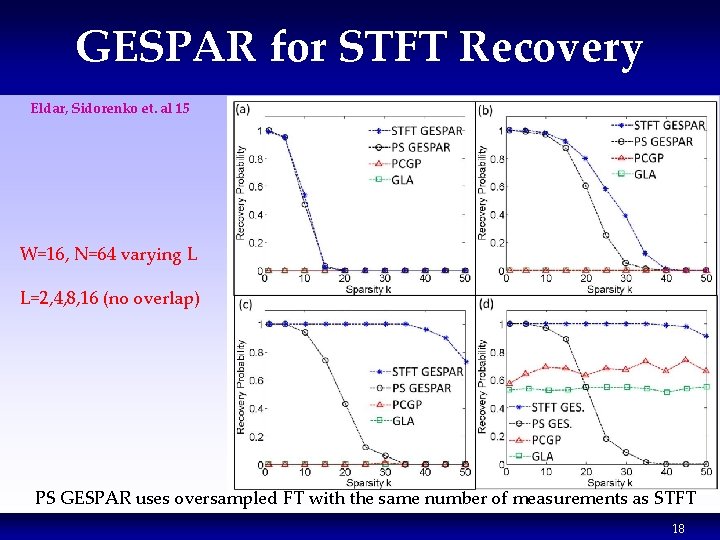
GESPAR for STFT Recovery Eldar, Sidorenko et. al 15 W=16, N=64 varying L L=2, 4, 8, 16 (no overlap) PS GESPAR uses oversampled FT with the same number of measurements as STFT 18
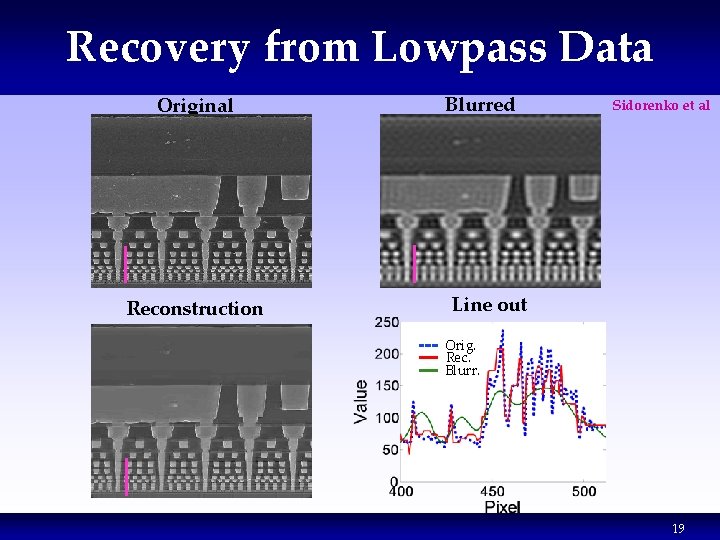
Recovery from Lowpass Data Original Reconstruction Blurred Sidorenko et al Line out Orig. Rec. Blurr. 19
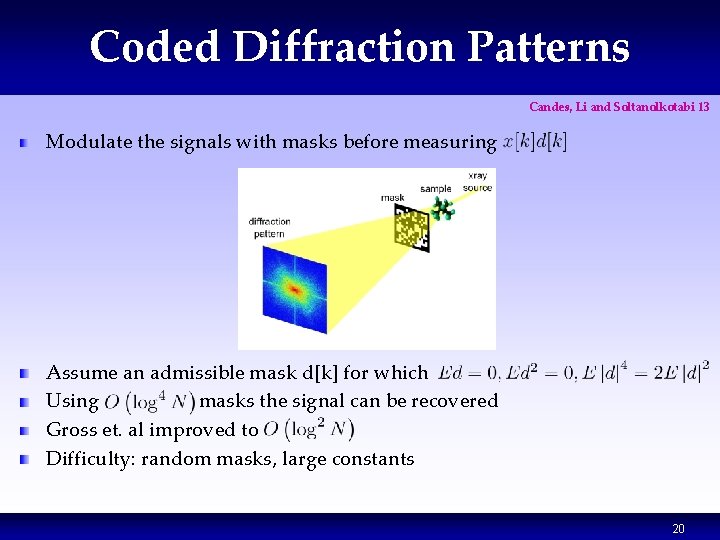
Coded Diffraction Patterns Candes, Li and Soltanolkotabi 13 Modulate the signals with masks before measuring Assume an admissible mask d[k] for which Using masks the signal can be recovered Gross et. al improved to Difficulty: random masks, large constants 20
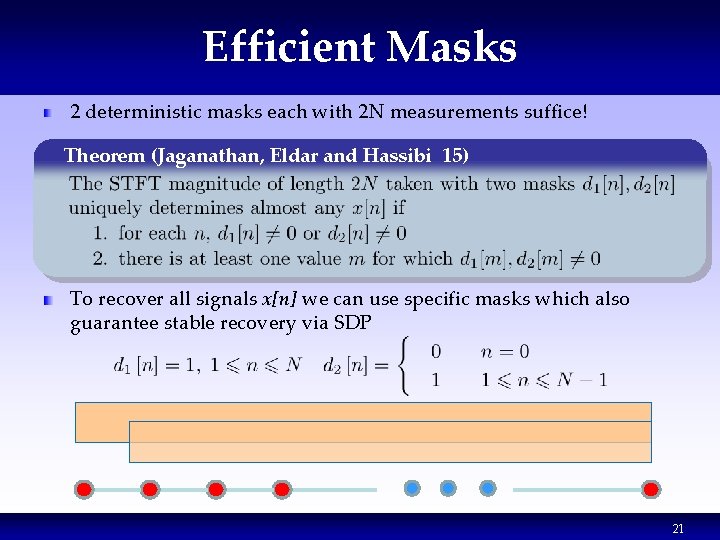
Efficient Masks 2 deterministic masks each with 2 N measurements suffice! Theorem (Jaganathan, Eldar and Hassibi 15) To recover all signals x[n] we can use specific masks which also guarantee stable recovery via SDP 21
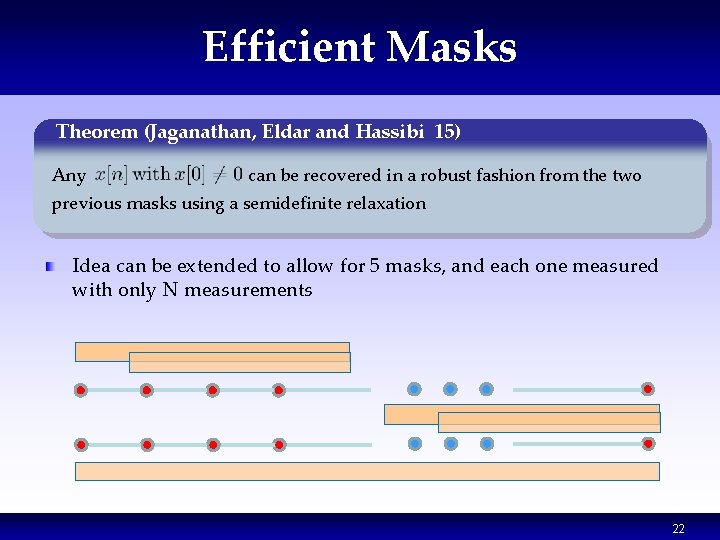
Efficient Masks Theorem (Jaganathan, Eldar and Hassibi 15) Any can be recovered in a robust fashion from the two previous masks using a semidefinite relaxation Idea can be extended to allow for 5 masks, and each one measured with only N measurements 22
Conclusion STFT provides an effective way to measure in the Fourier domain Provides better recovery for the same number of measurements Provable recovery guarantees Efficient methods in practice Deterministic robust masks can be constructed that are very efficient Future work: complete SDP relaxation analysis Practical Method for Fourier Phase Retrieval 23
Thank you! 24