
PHASE INVERSION AND VISCOSITY IN PIPE FLOW Laura


- Slides: 19
PHASE INVERSION AND VISCOSITY IN PIPE FLOW Laura Edwards, Dhurjati Prasad Chakrabarti Department of Chemical Engineering The University of The West Indies St Augustine ICon. ETech-2020, Faculty of Engineering, The UWI, St. Augustine, Trinidad and Tobago
INTRODUCTION • Multiphase flow is a general term to define the simultaneous flow of two or more phases • Knowledge of hydrodynamics of this flow is significant. • Emulsions, or the dispersion of one immiscible phase into other, are found in oil production and processing facilities where crude oil can be found to be mixed with water in the presence of naturally occurring emulsifiers. • The change of continuous phase from oil to water or water to oil is termed as phase inversion (Chakrabarti, Das and Das 2006). ICon. ETech-2020, Faculty of Engineering, The UWI, St. Augustine, Trinidad and Tobago
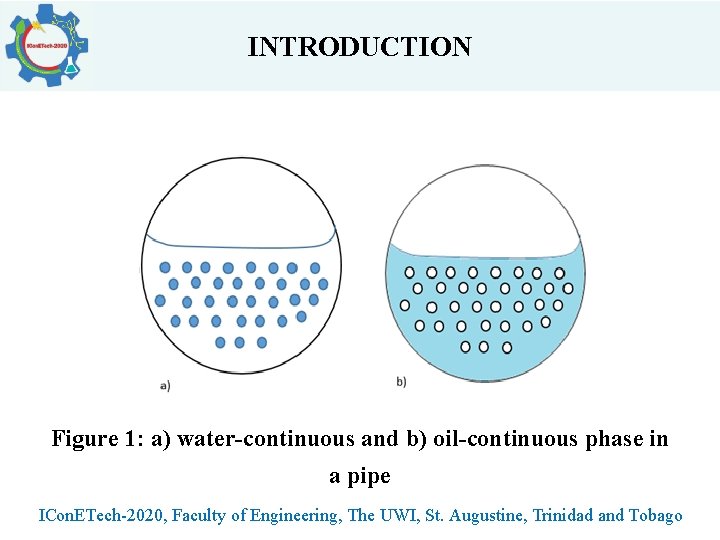
INTRODUCTION Figure 1: a) water-continuous and b) oil-continuous phase in a pipe ICon. ETech-2020, Faculty of Engineering, The UWI, St. Augustine, Trinidad and Tobago
OBJECTIVES The effects of increased oil percentage on the following parameters were investigated: • Flow pattern • Pressure drop • Holdup • Viscosity ICon. ETech-2020, Faculty of Engineering, The UWI, St. Augustine, Trinidad and Tobago
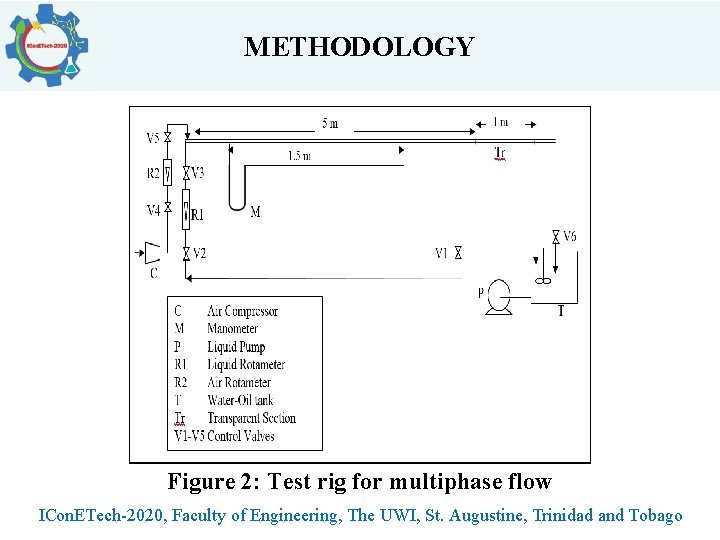
METHODOLOGY Figure 2: Test rig for multiphase flow ICon. ETech-2020, Faculty of Engineering, The UWI, St. Augustine, Trinidad and Tobago
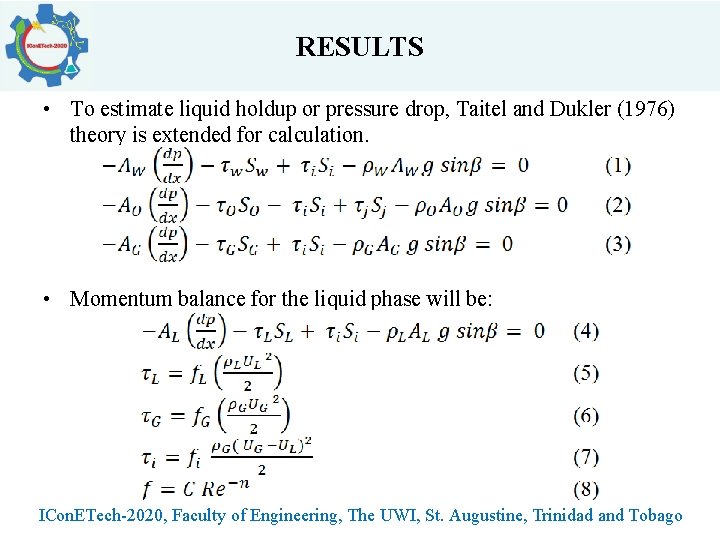
RESULTS • To estimate liquid holdup or pressure drop, Taitel and Dukler (1976) theory is extended for calculation. • Momentum balance for the liquid phase will be: ICon. ETech-2020, Faculty of Engineering, The UWI, St. Augustine, Trinidad and Tobago
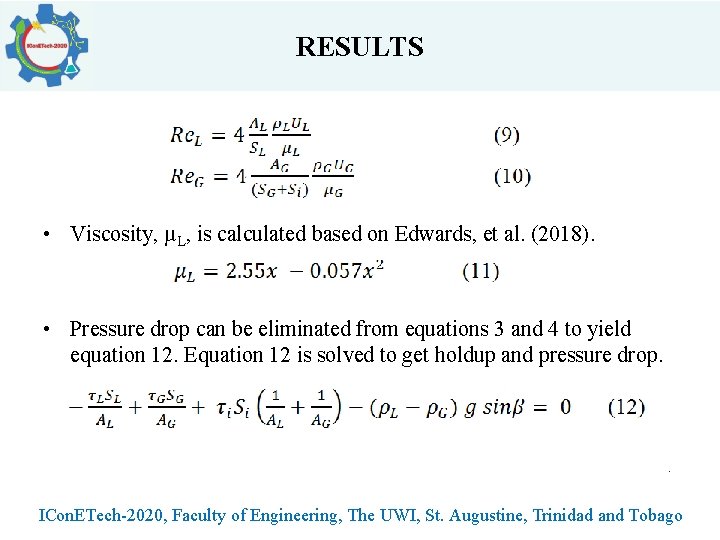
RESULTS • Viscosity, µL, is calculated based on Edwards, et al. (2018). • Pressure drop can be eliminated from equations 3 and 4 to yield equation 12. Equation 12 is solved to get holdup and pressure drop. ICon. ETech-2020, Faculty of Engineering, The UWI, St. Augustine, Trinidad and Tobago
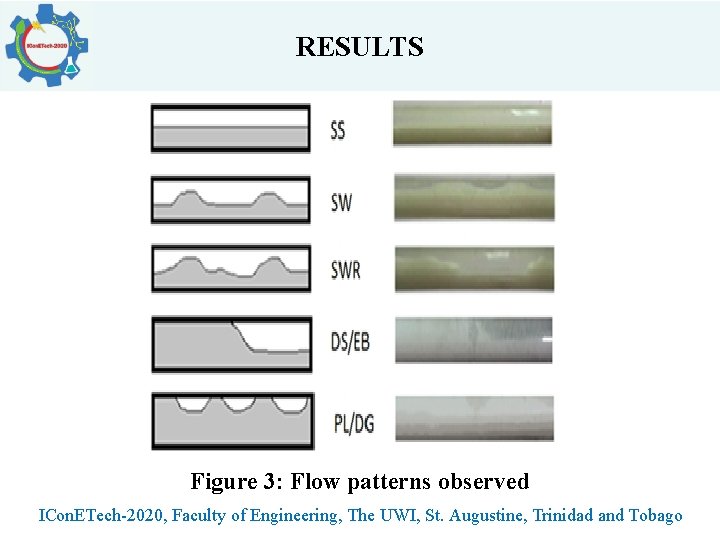
RESULTS Figure 3: Flow patterns observed ICon. ETech-2020, Faculty of Engineering, The UWI, St. Augustine, Trinidad and Tobago
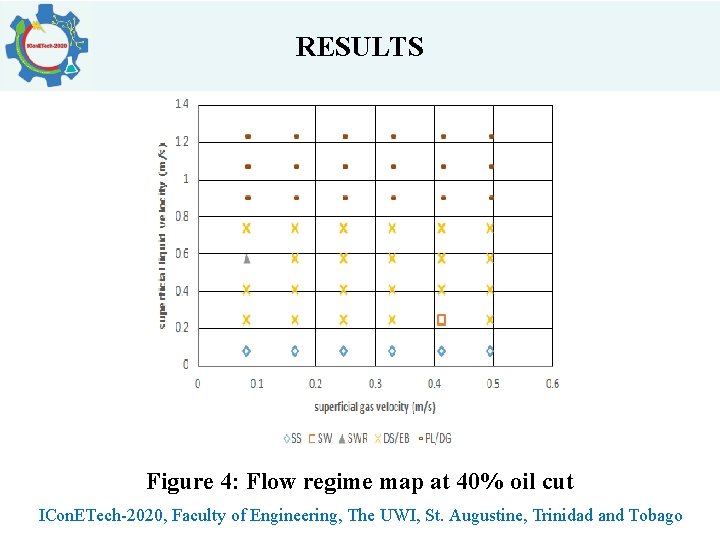
RESULTS Figure 4: Flow regime map at 40% oil cut ICon. ETech-2020, Faculty of Engineering, The UWI, St. Augustine, Trinidad and Tobago
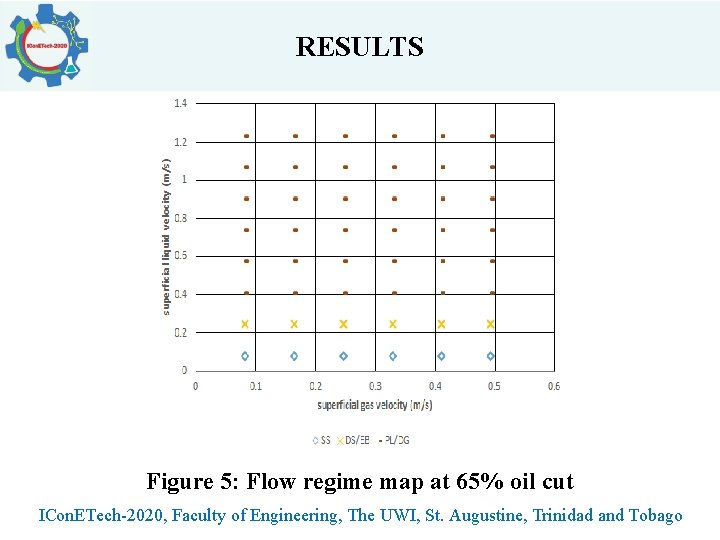
RESULTS Figure 5: Flow regime map at 65% oil cut ICon. ETech-2020, Faculty of Engineering, The UWI, St. Augustine, Trinidad and Tobago
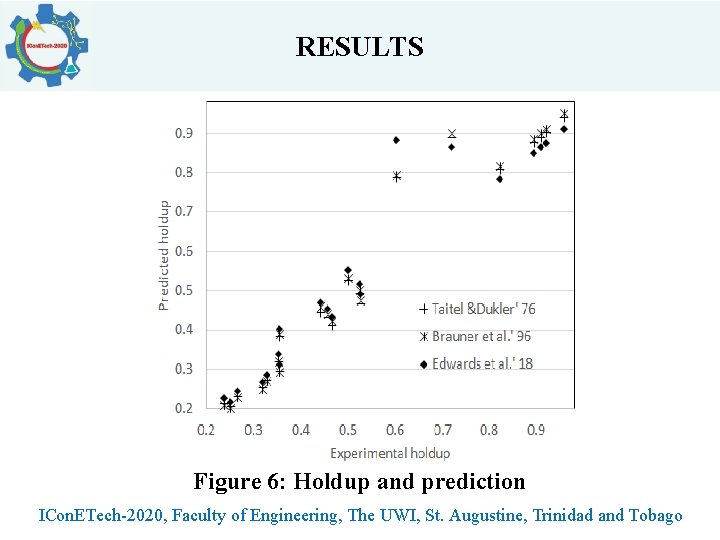
RESULTS Figure 6: Holdup and prediction ICon. ETech-2020, Faculty of Engineering, The UWI, St. Augustine, Trinidad and Tobago
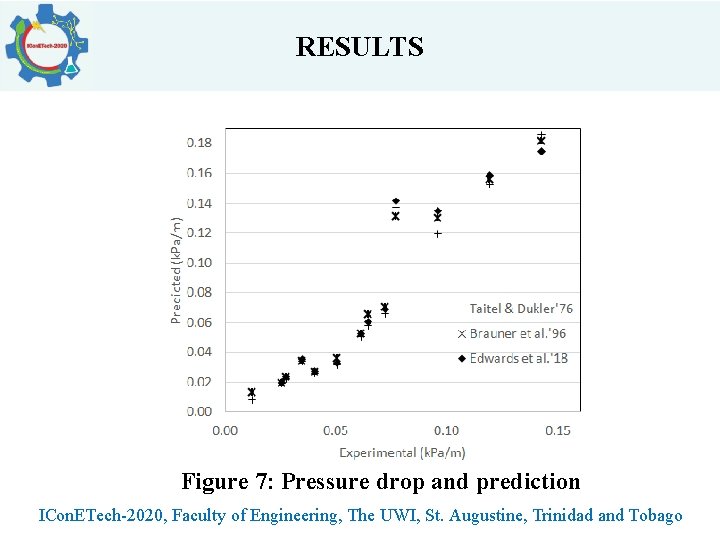
RESULTS Figure 7: Pressure drop and prediction ICon. ETech-2020, Faculty of Engineering, The UWI, St. Augustine, Trinidad and Tobago
CONCLUSION • The addition of oil to the liquid phase causes a dampening effect on the flow regime transition, most considerably from stratified to non-stratified flow. • Experimental data for pressure drop and holdup are deviated largely from prediction up to +31%. • This investigation is done mostly by normal video camera and image processing. It is recommended to have high speed camera, conductivity probe or optical probe for flow pattern detection in a finer way. ICon. ETech-2020, Faculty of Engineering, The UWI, St. Augustine, Trinidad and Tobago
REFERENCES • D. P. Chakrabarti, G. Das, P. K. Das. The Transition from Water Continuous to Oil Continuous Flow Pattern. AICh. E J 59 no 11 (2006) 3668– 3678. • A. H. Selker, Jr C. A. Sleicher. Factors affecting which phase will disperse when immiscible liquids are stirred together, Canadian Journal of Chemical Engineering 43 no 6 (1965) 298– 301. • M. A. Norato, C. Tsouris, L. L. Tavlarides. Phase inversion Studies in Liquid-Liquid Dispersions. Canadian Journal of Chemical Engineering. 76 no 3 (1998) 486 -494. • J. M. Zaldivar, M. A. Alos, E. Molga, H. Hernandez, K. R. Westerterp. The effect of phase inversion during semibatch aromatic nitrations. Chemical Engineering and Processing. 34 (1995) 529– 542. ICon. ETech-2020, Faculty of Engineering, The UWI, St. Augustine, Trinidad and Tobago
REFERENCES • S. Arirachakaran, K. D. Oglesby, M. S. Malinowsky, O. Shoham, J. P. Brill. An analysis of oil/water flow phenomena in horizontal pipes. In: SPE Paper 18836, SPE Prod. Operating Symp. , Oklahoma, March 13 -14, 1989; 155 -167. • G. Yeh, F. H. Haynie Jr, R. E. Moses. Phase-volume relationship at the point of phase inversion in liquid dispersions. AICh. E Journal. 10 no 2 (1964) 260– 265. • N. Brauner, A. Ullmann. Modelling of phase inversion phenomenon in two-phase pipe flow. International Journal of Multiphase Flow 28 no 7, (2002) 1177 -1204. • A. K. Chesters, R. Issa. A Framework for the Modelling of Phase Inversion in Liquid-Liquid Systems. 5 th International Conference on Multiphase Flow, ICMF’ 04. Yokohama, Japan, May 30–June 4, 2004. Paper No. 271. ICon. ETech-2020, Faculty of Engineering, The UWI, St. Augustine, Trinidad and Tobago
REFERENCES • T. W. F. Russell, M. E. Charles. The effect of the less viscous liquid in the laminar flow of two immiscible liquids. Canadian Journal of Chemical Engineering 37 no 1 (1959) 18 -24. • D. P. Chakrabarti, G. Das, P. K. Das. Liquid-Liquid Two. Phase Flow through an Orifice; Chemical Engineering & Technology 196 no 9 (2009) 1117 -1129. • D. P. Chakrabarti. Prediction of Phase Split in Horizontal T‐Junctions: Revisited; Chemical Engineering & Technology, 37 no 10 (2014) 1813 -1816. • P. Vigneaux, P. Chenais, J. P. Hulin. Liquid-liquid flows in an inclined pipe. AICh. E Journal 34 no 5 (1988) 781 -789. ICon. ETech-2020, Faculty of Engineering, The UWI, St. Augustine, Trinidad and Tobago
REFERENCES • Angeli P, Hewitt GF. Flow structure in horizontal oil-water flow. International Journal of Multiphase Flow 26 no 7 (2000) 1117 -1140. • Y. Taitel, A. E. Dukler. A model for predicting flow regime transitions in horizontal and near horizontal gas‐liquid flow 22 no 1 (1976) 47 -55. • J. Hapanowicz, L. Troniewski. Two-phase flow of liquid– liquid mixture in the range of the water droplet pattern. Chemical Engineering and Processing 41 no 2 (2002) 165– 172. • R. Pal, Pipeline flow of unstable and surfactant-stabilized emulsions. AICh. E Journal 39 no 11 (1993) 1754 -1764. ICon. ETech-2020, Faculty of Engineering, The UWI, St. Augustine, Trinidad and Tobago
REFERENCES • L. Edwards, D. Jebourdsingh, D. Dhanpat, D. P. Chakrabarti, Hydrodynamics of air and oil–water dispersion/ emulsion in horizontal pipe flow with low oil percentage at low fluid velocity. l. , Cogent Engineering 5 (2018) 1494494. • N. Brauner, J. Rovinsky, D. Moalem Maron. Determination of the interface curvature in stratified two-phase systems by energy considerations. Into J Multiphase Flow 22 no 6 (1996) 1167 -1185. ICon. ETech-2020, Faculty of Engineering, The UWI, St. Augustine, Trinidad and Tobago
THANK YOU! ICon. ETech-2020, Faculty of Engineering, The UWI, St. Augustine, Trinidad and Tobago