
Phase III Trial of BTK Inhibitor Rilzabrutinib PRN
Phase I/II Trial of BTK Inhibitor Rilzabrutinib (PRN 1008) for Heavily Pretreated Patients With Immune Thrombocytopenia CCO Independent Conference Highlights of the 2020 Virtual ASH Annual Meeting, December 5 -8, 2020 *CCO is an independent medical education company that provides state-of-the-art medical information to healthcare professionals through conference coverage and other educational programs. Supported by educational grants from Amgen; Astra. Zeneca; Bristol-Myers Squibb; Epizyme, Inc. ; Glaxo. Smith. Kline; Incyte Corporation; Janssen Biotech; Karyopharm Therapeutics Inc. ; Novartis; Pharma. Essentia Corp. ; Seattle Genetics; and Takeda Oncology.
About These Slides § Please feel free to use, update, and share some or all of these slides in your noncommercial presentations to colleagues or patients § When using our slides, please retain the source attribution: Slide credit: clinicaloptions. com § These slides may not be published, posted online, or used in commercial presentations without permission. Please contact permissions@clinicaloptions. com for details
Phase I/II Trial of Rilzabrutinib: Background § BTK inhibition modulates components of adaptive and innate immunity associated with autoimmune diseases[1] § Rilzabrutinib (PRN 1008) is an oral reversible, covalent, small-molecule inhibitor selective for BTK[1, 2] ‒ Preclinical data suggest improved kinase selectivity and fewer off-target effects vs other BTK inhibitors[2] ‒ Did not alter collagen-induced platelet aggregation ex vivo in samples collected from healthy volunteers and patients with ITP[3] § Current analysis of ongoing phase I/II trial reports safety and efficacy of rilzabrutinib at minimum effective dose in adults with R/R ITP[4] 1. Smith. Br J Clin Pharmacol. 2017; 83: 2367. 2. Langrish. SID 2020. Abstr 569. 3. Langrish. ASH 2017. Abstr 1052. 4. Kuter. ASH 2020. Abstr 22. Slide credit: clinicaloptions. com
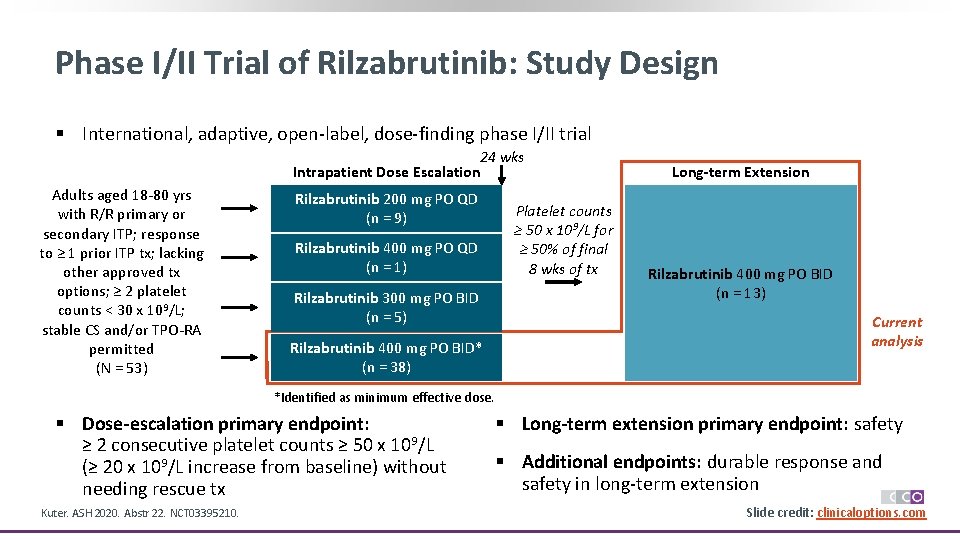
Phase I/II Trial of Rilzabrutinib: Study Design § International, adaptive, open-label, dose-finding phase I/II trial 24 wks Intrapatient Dose Escalation Adults aged 18 -80 yrs with R/R primary or secondary ITP; response to ≥ 1 prior ITP tx; lacking other approved tx options; ≥ 2 platelet counts < 30 x 109/L; stable CS and/or TPO-RA permitted (N = 53) Rilzabrutinib 200 mg PO QD (n = 9) Platelet counts ≥ 50 x 109/L for ≥ 50% of final 8 wks of tx Rilzabrutinib 400 mg PO QD (n = 1) Rilzabrutinib 300 mg PO BID (n = 5) Long-term Extension Rilzabrutinib 400 mg PO BID (n = 13) Current analysis Rilzabrutinib 400 mg PO BID* (n = 38) *Identified as minimum effective dose. § Dose-escalation primary endpoint: ≥ 2 consecutive platelet counts ≥ 50 x 109/L (≥ 20 x 109/L increase from baseline) without needing rescue tx Kuter. ASH 2020. Abstr 22. NCT 03395210. § Long-term extension primary endpoint: safety § Additional endpoints: durable response and safety in long-term extension Slide credit: clinicaloptions. com
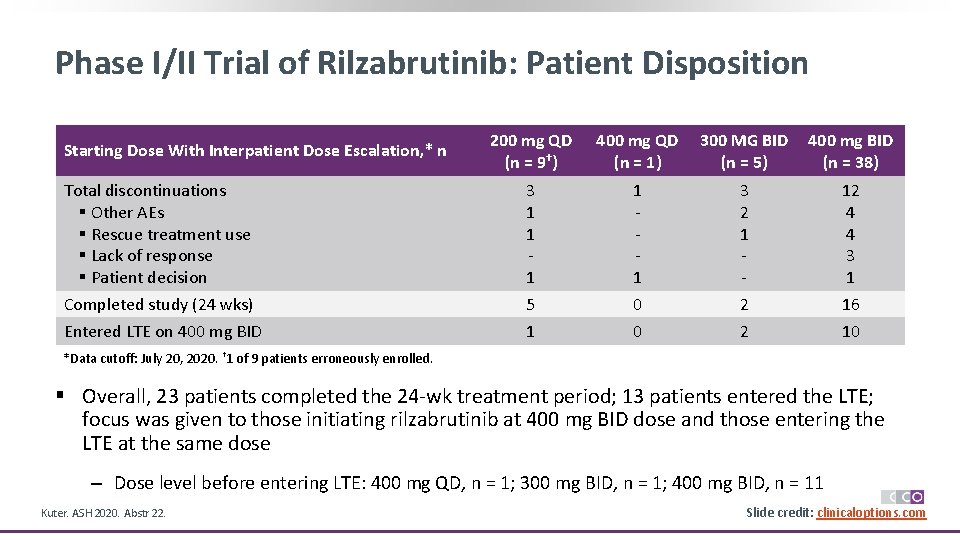
Phase I/II Trial of Rilzabrutinib: Patient Disposition 200 mg QD (n = 9†) 400 mg QD (n = 1) 300 MG BID (n = 5) 400 mg BID (n = 38) Total discontinuations § Other AEs § Rescue treatment use § Lack of response § Patient decision 3 1 1 1 3 2 1 - 12 4 4 3 1 Completed study (24 wks) Entered LTE on 400 mg BID 5 1 0 0 2 2 16 10 Starting Dose With Interpatient Dose Escalation, * n *Data cutoff: July 20, 2020. † 1 of 9 patients erroneously enrolled. § Overall, 23 patients completed the 24 -wk treatment period; 13 patients entered the LTE; focus was given to those initiating rilzabrutinib at 400 mg BID dose and those entering the LTE at the same dose ‒ Dose level before entering LTE: 400 mg QD, n = 1; 300 mg BID, n = 1; 400 mg BID, n = 11 Kuter. ASH 2020. Abstr 22. Slide credit: clinicaloptions. com
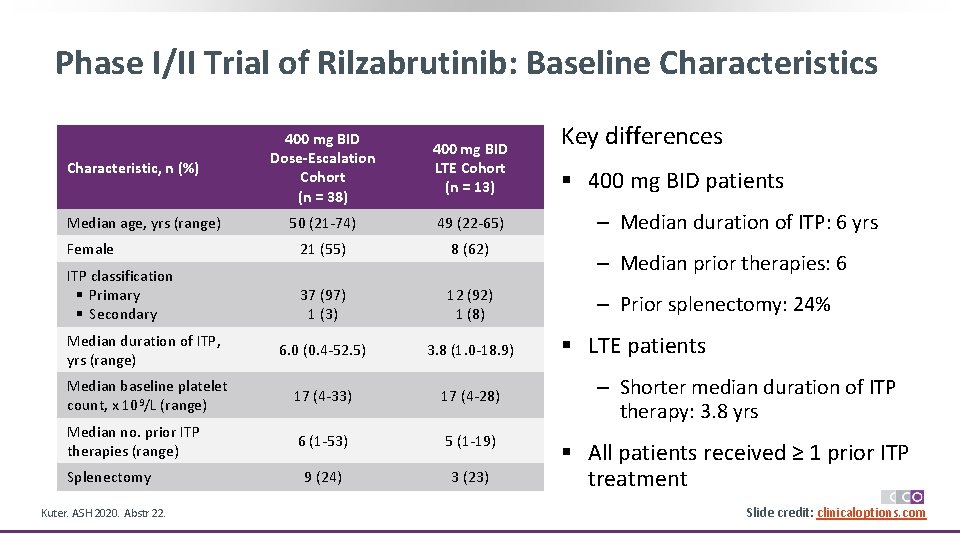
Phase I/II Trial of Rilzabrutinib: Baseline Characteristics 400 mg BID Dose-Escalation Cohort (n = 38) 400 mg BID LTE Cohort (n = 13) 50 (21 -74) 49 (22 -65) Female 21 (55) 8 (62) ITP classification § Primary § Secondary 37 (97) 1 (3) 12 (92) 1 (8) Median duration of ITP, yrs (range) 6. 0 (0. 4 -52. 5) 3. 8 (1. 0 -18. 9) Median baseline platelet count, x 109/L (range) 17 (4 -33) 17 (4 -28) Median no. prior ITP therapies (range) 6 (1 -53) 5 (1 -19) 9 (24) 3 (23) Characteristic, n (%) Median age, yrs (range) Splenectomy Kuter. ASH 2020. Abstr 22. Key differences § 400 mg BID patients ‒ Median duration of ITP: 6 yrs ‒ Median prior therapies: 6 ‒ Prior splenectomy: 24% § LTE patients ‒ Shorter median duration of ITP therapy: 3. 8 yrs § All patients received ≥ 1 prior ITP treatment Slide credit: clinicaloptions. com
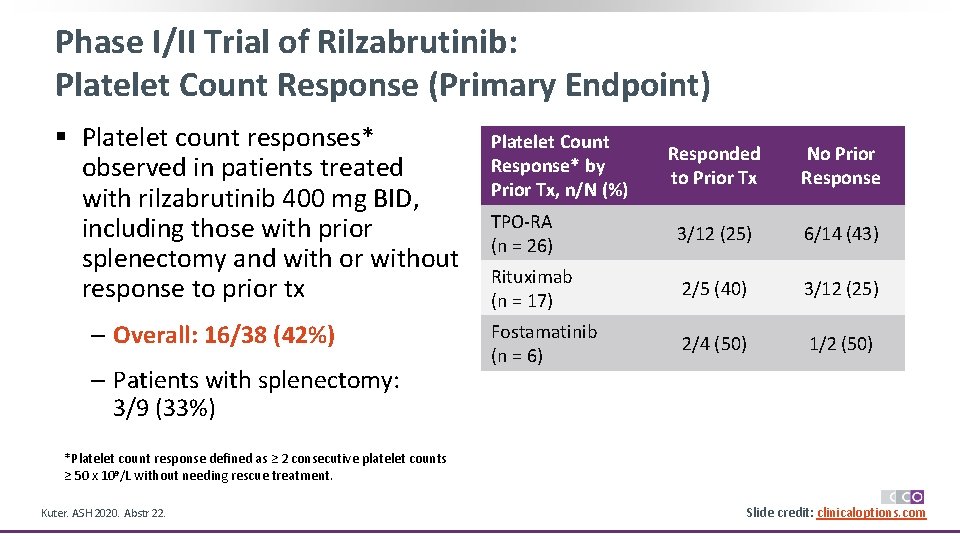
Phase I/II Trial of Rilzabrutinib: Platelet Count Response (Primary Endpoint) § Platelet count responses* observed in patients treated with rilzabrutinib 400 mg BID, including those with prior splenectomy and with or without response to prior tx ‒ Overall: 16/38 (42%) ‒ Patients with splenectomy: 3/9 (33%) Platelet Count Response* by Prior Tx, n/N (%) Responded to Prior Tx No Prior Response TPO-RA (n = 26) 3/12 (25) 6/14 (43) Rituximab (n = 17) 2/5 (40) 3/12 (25) Fostamatinib (n = 6) 2/4 (50) 1/2 (50) *Platelet count response defined as ≥ 2 consecutive platelet counts ≥ 50 x 109/L without needing rescue treatment. Kuter. ASH 2020. Abstr 22. Slide credit: clinicaloptions. com
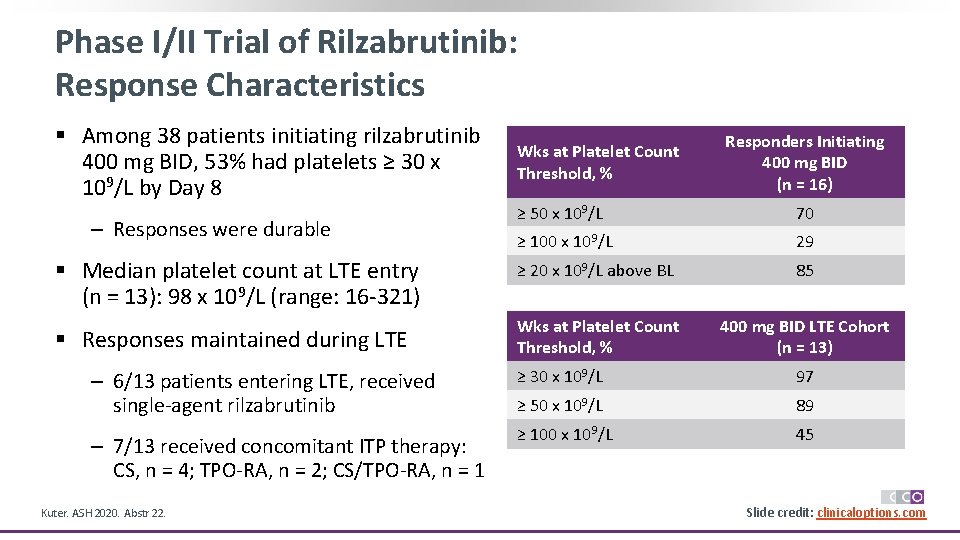
Phase I/II Trial of Rilzabrutinib: Response Characteristics § Among 38 patients initiating rilzabrutinib 400 mg BID, 53% had platelets ≥ 30 x 109/L by Day 8 ‒ Responses were durable § Median platelet count at LTE entry (n = 13): 98 x 109/L (range: 16 -321) § Responses maintained during LTE ‒ 6/13 patients entering LTE, received single-agent rilzabrutinib ‒ 7/13 received concomitant ITP therapy: CS, n = 4; TPO-RA, n = 2; CS/TPO-RA, n = 1 Kuter. ASH 2020. Abstr 22. Wks at Platelet Count Threshold, % Responders Initiating 400 mg BID (n = 16) ≥ 50 x 109/L 70 ≥ 100 x 109/L 29 ≥ 20 x 109/L above BL 85 Wks at Platelet Count Threshold, % 400 mg BID LTE Cohort (n = 13) ≥ 30 x 109/L 97 ≥ 50 x 109/L 89 ≥ 100 x 109/L 45 Slide credit: clinicaloptions. com
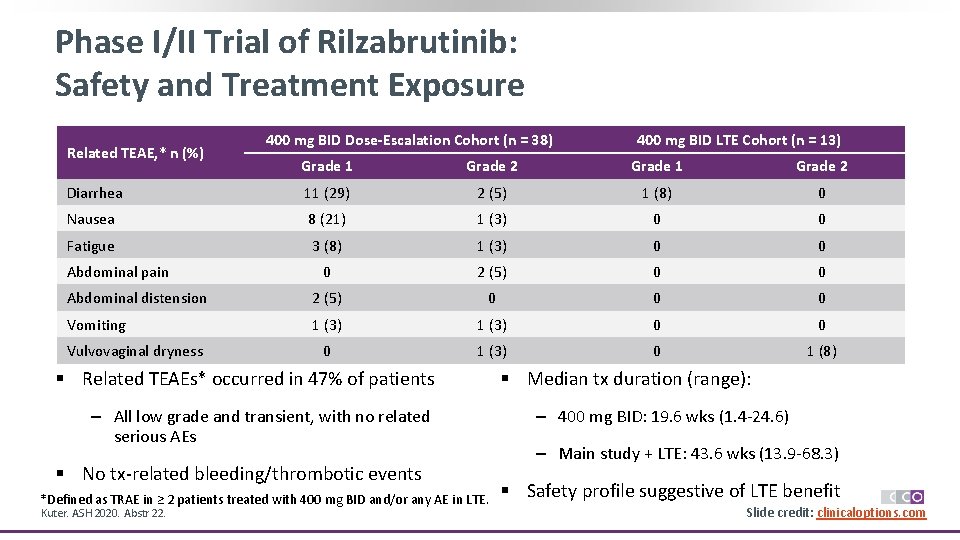
Phase I/II Trial of Rilzabrutinib: Safety and Treatment Exposure Related TEAE, * n (%) 400 mg BID Dose-Escalation Cohort (n = 38) 400 mg BID LTE Cohort (n = 13) Grade 1 Grade 2 Diarrhea 11 (29) 2 (5) 1 (8) 0 Nausea 8 (21) 1 (3) 0 0 Fatigue 3 (8) 1 (3) 0 0 0 2 (5) 0 0 Abdominal distension 2 (5) 0 0 0 Vomiting 1 (3) 0 0 0 1 (3) 0 1 (8) Abdominal pain Vulvovaginal dryness § Related TEAEs* occurred in 47% of patients ‒ All low grade and transient, with no related serious AEs § No tx-related bleeding/thrombotic events *Defined as TRAE in ≥ 2 patients treated with 400 mg BID and/or any AE in LTE. Kuter. ASH 2020. Abstr 22. § Median tx duration (range): ‒ 400 mg BID: 19. 6 wks (1. 4 -24. 6) ‒ Main study + LTE: 43. 6 wks (13. 9 -68. 3) § Safety profile suggestive of LTE benefit Slide credit: clinicaloptions. com
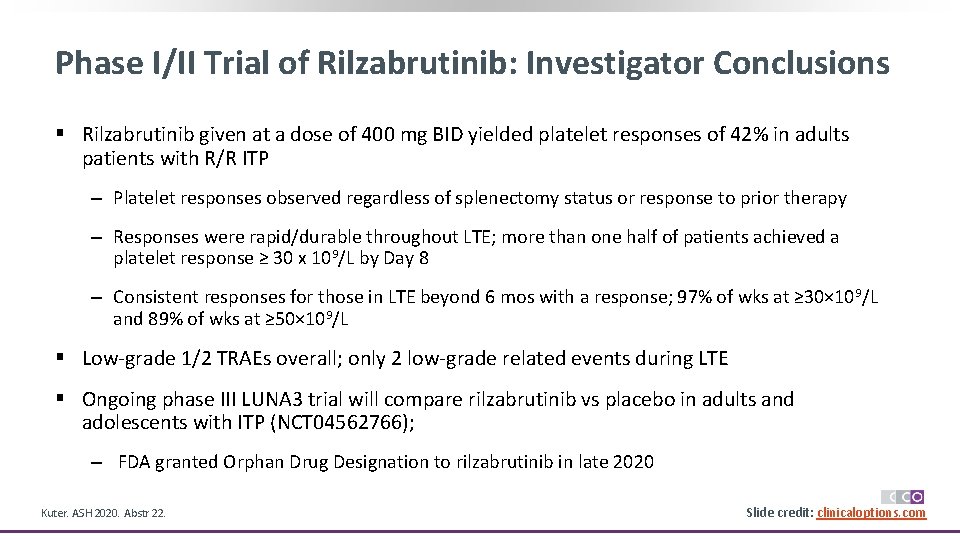
Phase I/II Trial of Rilzabrutinib: Investigator Conclusions § Rilzabrutinib given at a dose of 400 mg BID yielded platelet responses of 42% in adults patients with R/R ITP ‒ Platelet responses observed regardless of splenectomy status or response to prior therapy ‒ Responses were rapid/durable throughout LTE; more than one half of patients achieved a platelet response ≥ 30 x 109/L by Day 8 ‒ Consistent responses for those in LTE beyond 6 mos with a response; 97% of wks at ≥ 30× 10 9/L and 89% of wks at ≥ 50× 109/L § Low-grade 1/2 TRAEs overall; only 2 low-grade related events during LTE § Ongoing phase III LUNA 3 trial will compare rilzabrutinib vs placebo in adults and adolescents with ITP (NCT 04562766); ‒ FDA granted Orphan Drug Designation to rilzabrutinib in late 2020 Kuter. ASH 2020. Abstr 22. Slide credit: clinicaloptions. com
Go Online for More CCO Coverage of ASH 2020! Short slideset summaries and additional CME-certified analyses with expert commentary on key studies in: § § § Acute and chronic leukemias Lymphomas and chronic lymphocytic leukemia Myelodysplastic syndromes and myeloproliferative neoplasms Myeloma Nonmalignant hematology clinicaloptions. com/oncology
- Slides: 11