
Phase II Philology SLT 2017 Lecture 8 Philology


- Slides: 37
Phase II: Philology SLT 2017 Lecture 8
Philology of the XIXth century In 1786, Sir William Jones’ had reported to the Royal Asiatic Society in Calcutta his observation that Sanskrit, Greek, Latin, Celtic and Germanic all had striking structural similarities. He claimed that the commonalities between Latin, Greek, and Sanskrit were so numerous that ‘…no philologer could examine all three, without believing them to have sprung from some common source, which, perhaps, no longer exists. ’
A new dimension to linguistic enquiry: comparative linguistics ‘The Sanskrit language, whatever be its antiquity, is of a wonderful structure; more perfect than the Greek, more copious than the Latin, and more exquisitely refined than either, yet bearing to both of them a stronger affinity, both in the roots of verbs, and in the forms of grammar, than could possibly have been produced by accident. ’ Sir William Jones
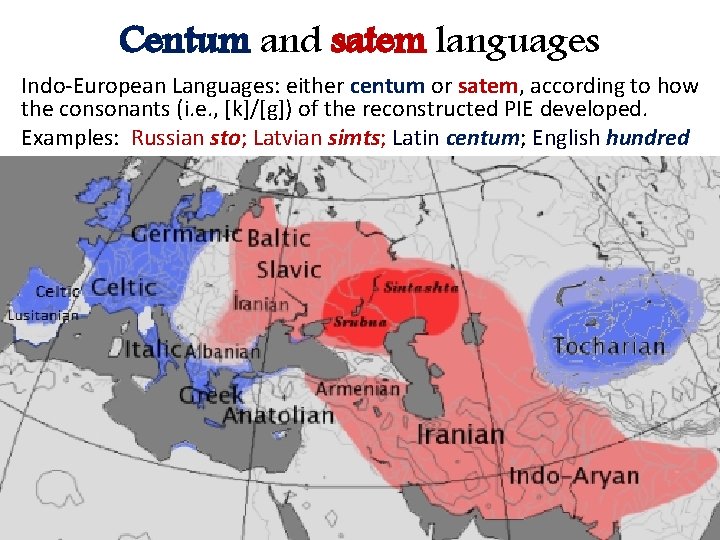
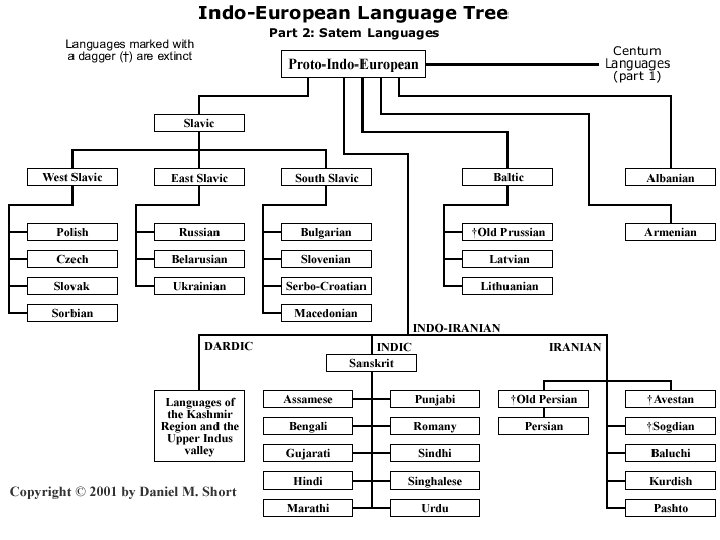
Centum and satem languages Indo-European Languages: either centum or satem, according to how the consonants (i. e. , [k]/[g]) of the reconstructed PIE developed. Examples: Russian sto; Latvian simts; Latin centum; English hundred
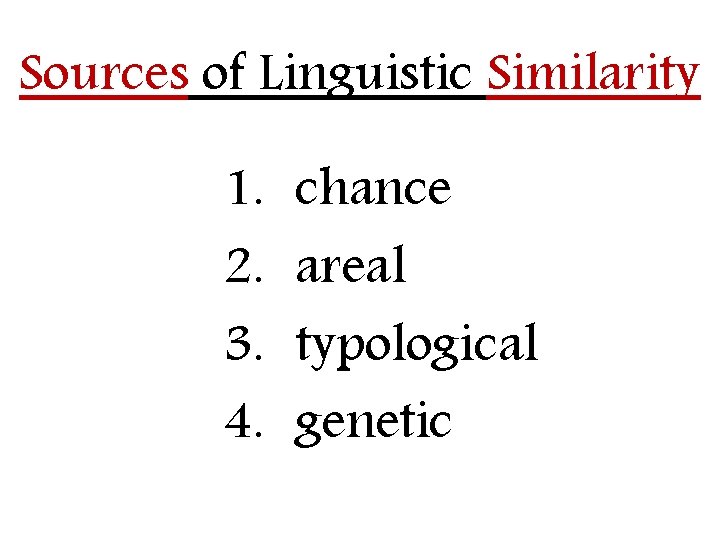
Sources of Linguistic Similarity 1. 2. 3. 4. chance areal typological genetic
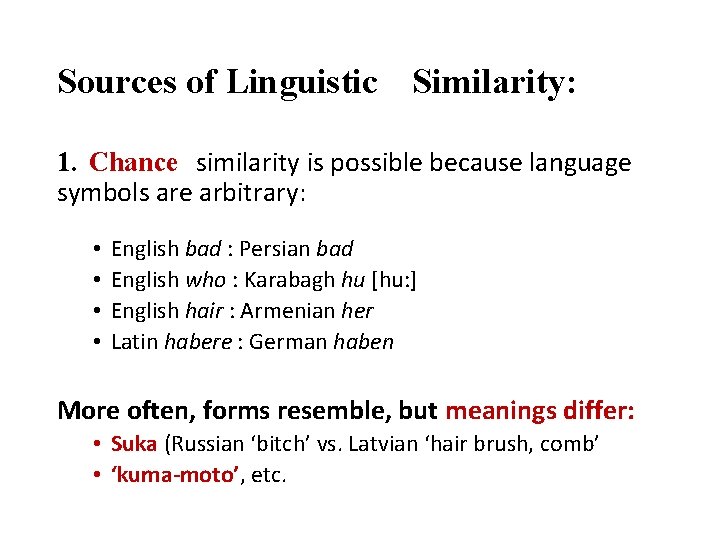
Sources of Linguistic Similarity: 1. Chance similarity is possible because language symbols are arbitrary: • • English bad : Persian bad English who : Karabagh hu [hu: ] English hair : Armenian her Latin habere : German haben More often, forms resemble, but meanings differ: • Suka (Russian ‘bitch’ vs. Latvian ‘hair brush, comb’ • ‘kuma-moto’, etc.
Chance similarities ‘Pula’ in Setswana : ‘rain’ blessing, life, water People use it when toasting: Pula! = To Life! During a high-level visit to Rumania, a Botswana diplomat raised a toast at an official banquet: Pula! A strangled gasp from the honorable guests made him turn to his interpreter, who whispered in his ear, “Errr… In Rumanian, ‘pula’ means ‘Gentleman Sausage’!” A Japanese student, introducing herself to a new class at the University of Dar es Salaam in Tanzania, smiled demurely: “I am Kumamoto…” (a common Japanese name) Shocked by her classmates’ reaction, she had to learn the hard way that, in Swahili, ‘kuma’ is a vulgar word for ‘vagina’, while ‘moto’ means ‘hot’!
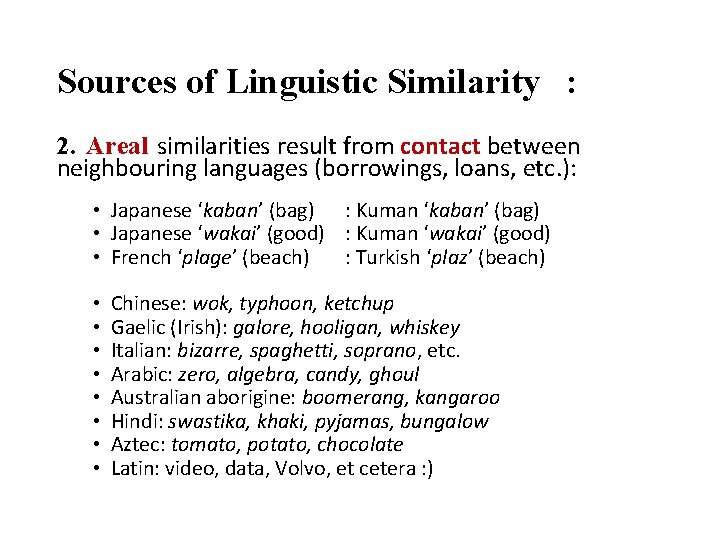
Sources of Linguistic Similarity : 2. Areal similarities result from contact between neighbouring languages (borrowings, loans, etc. ): • Japanese ‘kaban’ (bag) : Kuman ‘kaban’ (bag) • Japanese ‘wakai’ (good) : Kuman ‘wakai’ (good) • French ‘plage’ (beach) : Turkish ‘plaz’ (beach) • • Chinese: wok, typhoon, ketchup Gaelic (Irish): galore, hooligan, whiskey Italian: bizarre, spaghetti, soprano, etc. Arabic: zero, algebra, candy, ghoul Australian aborigine: boomerang, kangaroo Hindi: swastika, khaki, pyjamas, bungalow Aztec: tomato, potato, chocolate Latin: video, data, Volvo, et cetera : )
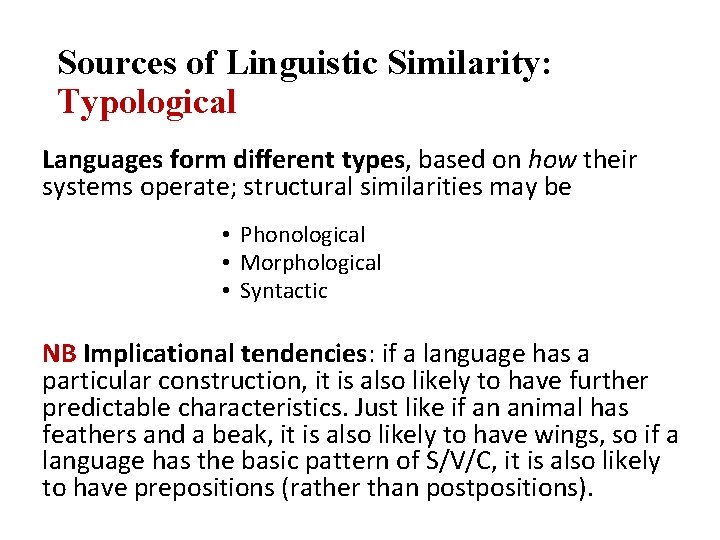
Sources of Linguistic Similarity: Typological Languages form different types, based on how their systems operate; structural similarities may be • Phonological • Morphological • Syntactic NB Implicational tendencies: if a language has a particular construction, it is also likely to have further predictable characteristics. Just like if an animal has feathers and a beak, it is also likely to have wings, so if a language has the basic pattern of S/V/C, it is also likely to have prepositions (rather than postpositions).
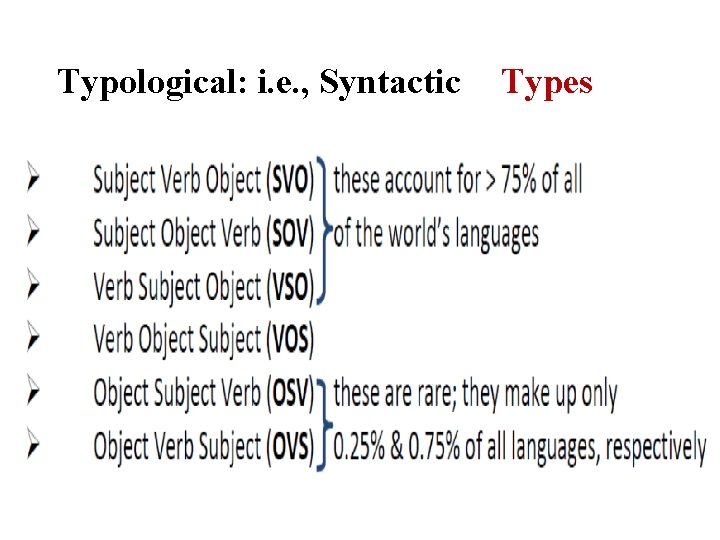
Typological: i. e. , Syntactic Types
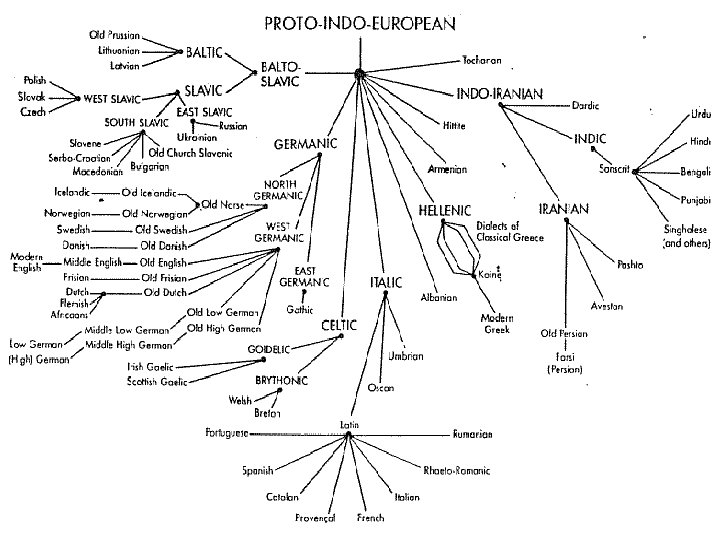
Development of the comparative method • The most outstanding achievement of linguistics in the 19 th century • It comprises a set of principles whereby languages could be systematically compared with respect to their sound systems, grammatical structure, and vocabulary and shown to be “genealogically” related.
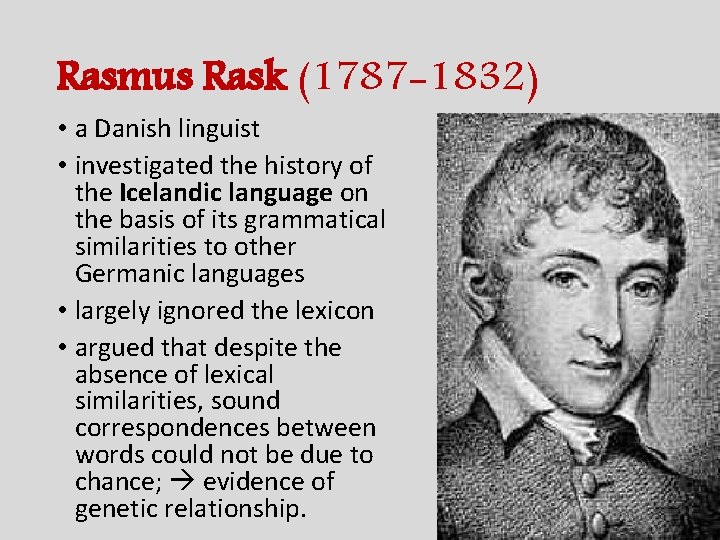
Rasmus Rask (1787 -1832) • a Danish linguist • investigated the history of the Icelandic language on the basis of its grammatical similarities to other Germanic languages • largely ignored the lexicon • argued that despite the absence of lexical similarities, sound correspondences between words could not be due to chance; evidence of genetic relationship.
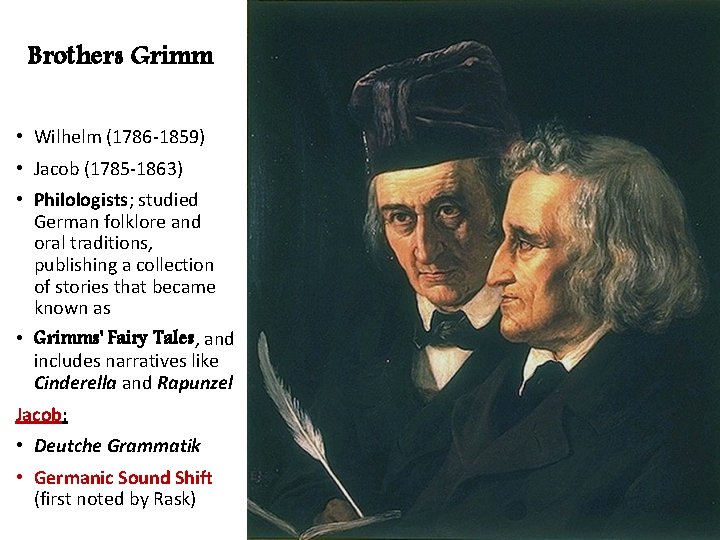
Brothers Grimm • Wilhelm (1786 -1859) • Jacob (1785 -1863) • Philologists; studied German folklore and oral traditions, publishing a collection of stories that became known as • Grimms' Fairy Tales, and includes narratives like Cinderella and Rapunzel Jacob: • Deutche Grammatik • Germanic Sound Shift (first noted by Rask)
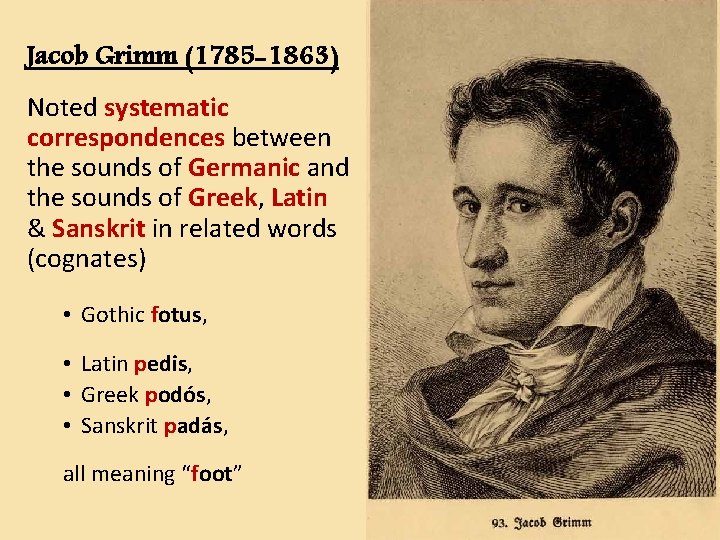
Jacob Grimm (1785 -1863) Noted systematic correspondences between the sounds of Germanic and the sounds of Greek, Latin & Sanskrit in related words (cognates) • Gothic fotus, • Latin pedis, • Greek podós, • Sanskrit padás, all meaning “foot”
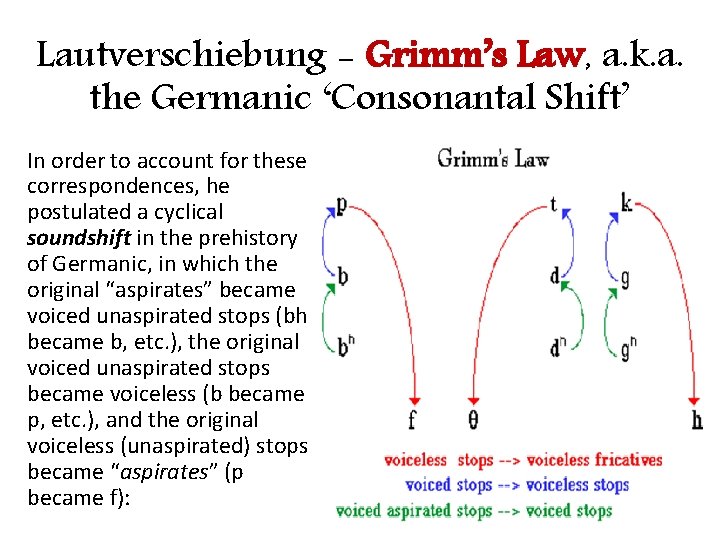
Lautverschiebung - Grimm’s Law, a. k. a. the Germanic ‘Consonantal Shift’ In order to account for these correspondences, he postulated a cyclical soundshift in the prehistory of Germanic, in which the original “aspirates” became voiced unaspirated stops (bh became b, etc. ), the original voiced unaspirated stops became voiceless (b became p, etc. ), and the original voiceless (unaspirated) stops became “aspirates” (p became f):
Grimm’s Law had many exceptions & inconsistencies: ‘…The sound shifts succeed in the main, but work out completely only in individual words, while others remain unchanged’ Karl Verner (1846 -1896), a Danish philologist, explained why: Verner’s Law (1875) stated that some consonant alternations in Germanic languages are the result of patterns of alternation in the position of word accent in PIE.
Verner’s Law: Example: the correspondences of t = d and t = Ө were in complementary distribution, with one correspondence showing up when the following vowel was stressed in PIE, and the other – when the following vowel was unstressed.
The ‘Young Grammarians’ ~ ‘Die Junggrammatiker’ ─ 1875 -1900 ─ Claimed that: • language change was ‘regular’ • phonetic laws operated without exception in a language, and that • the only conditioning factors that could determine the course of sound change were phonetic factors.
Neogrammarian Hypothesis: regularity of sound change • A diachronic sound change affects simultaneously all words in which its environment is met, without exception. • Verner's law – an example of the NH, because it resolved an apparent exception to Grimm's law. • The NH was the first hypothesis of sound change to attempt to follow the principle of falsifiability according to scientific method. • Subsequent researchers have questioned this hypothesis from two perspectives. 1. Lexical diffusion: a sound change affects only a few words at first and then gradually spreads to other words; 2. Sound changes observe grammatical conditioning. • Yet, both of these challenges to exceptionlessness remain controversial
Neogrammarians: • The object of linguistic investigation is not the language system, but rather the idiolect - language as it is localized in the individual (=directly observable) • the sound level, being the most observable aspect of language, is the most important level of description; its absolute autonomy from syntax and semantics • Historicism: the chief goal of linguistic investigation is the description of the historical change of a language. • Analogy: exceptions are (regular) adaptation to a related form.
NH: implications The assumption of regularity of sound change enabled the study of etymology (history of words, and by extension – languages). A sound correspondence must be systematic & regular* in order to prove a genetic relatedness/ linkage. *It is therefore very important to distinguish between a systematic (or regular) sound correspondence and an isolated correspondence.
NH: significance Although the Young Grammarians’ claims have been substantially modified, it was an important achievement then to realize that language changes were not just random tendencies, but definite and sometimes clearly defined ‘laws. ’ The work of all these linguists, their concern with reconstructing PIE, and making hypotheses about the way it split into the various daughter languages, reflected the general direction of 19 th century thought.
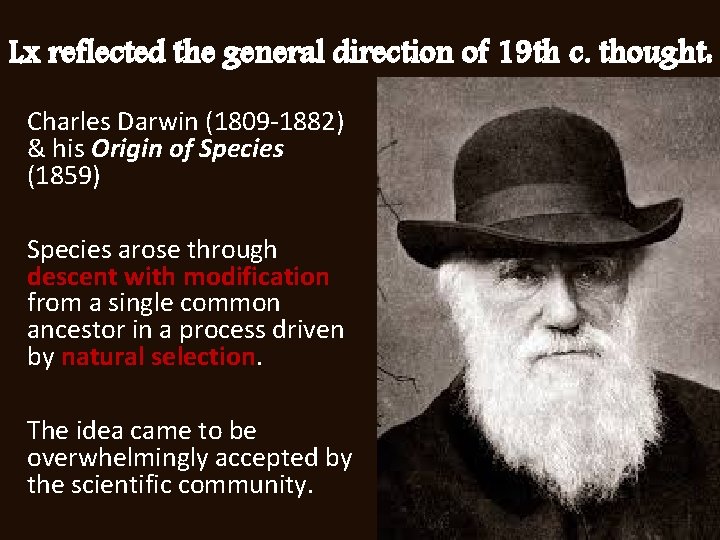
Lx reflected the general direction of 19 th c. thought: Charles Darwin (1809 -1882) & his Origin of Species (1859) Species arose through descent with modification from a single common ancestor in a process driven by natural selection. The idea came to be overwhelmingly accepted by the scientific community.
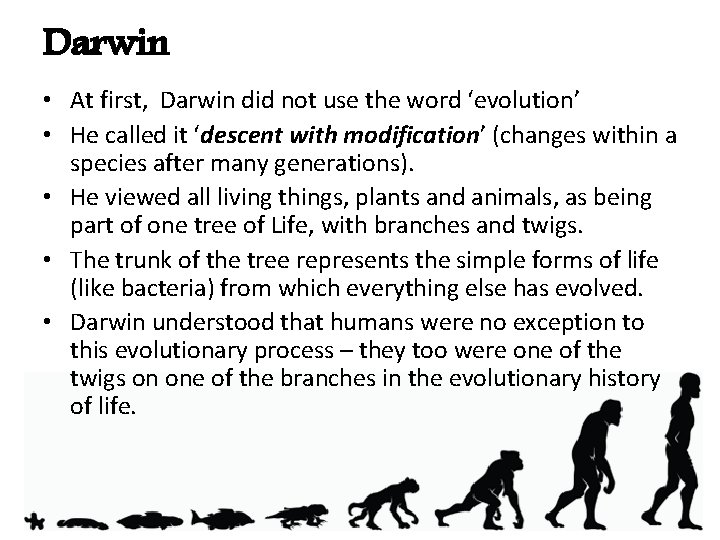
Darwin • At first, Darwin did not use the word ‘evolution’ • He called it ‘descent with modification’ (changes within a species after many generations). • He viewed all living things, plants and animals, as being part of one tree of Life, with branches and twigs. • The trunk of the tree represents the simple forms of life (like bacteria) from which everything else has evolved. • Darwin understood that humans were no exception to this evolutionary process – they too were one of the twigs on one of the branches in the evolutionary history of life.
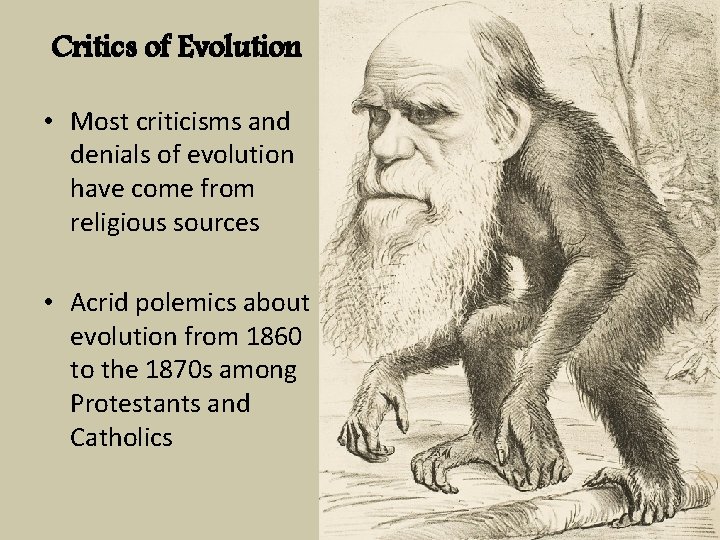
Critics of Evolution • Most criticisms and denials of evolution have come from religious sources • Acrid polemics about evolution from 1860 to the 1870 s among Protestants and Catholics
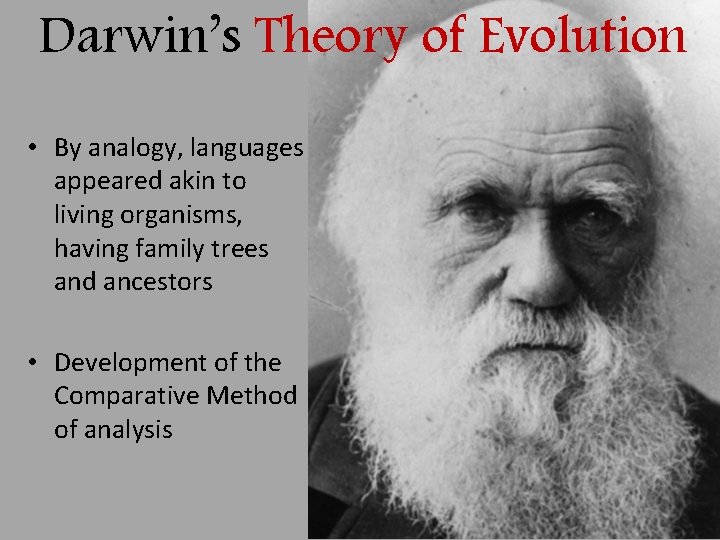
Darwin’s Theory of Evolution • By analogy, languages appeared akin to living organisms, having family trees and ancestors • Development of the Comparative Method of analysis
Impact of Darwinism on Linguistics Darwin’s theory of evolution strongly influenced the way linguists viewed languages. They began to see them as biological organisms, which had family trees and ancestors. They postulated that if two or more languages had many similar words with similar meanings, then they had evolved from the same parent language. This hypothesis was based on the assumption that languages change in regular, systematic ways. Differences between related languages were due to regular sound changes, which could become evident through careful study.
Comparative Linguistics For the first time in the long history of linguistics, people realized that languages change over time: their sounds, their syntax, and their meaning. We don’t usually notice this gradual change, just like we do notice ourselves changing from day to day.
Diachronic vs. Synchronic Lx Modern linguistics often separates the past and the present into different areas of enquiry. It has been a common assumption that synchronic linguistics, which concerns itself with the state of languages at any given point in time, in particular the present, has little or no relationship with historical or diachronic linguistics, which focuses on language change over time.
Need for a dialectical view of Language No strict division between the two aspects of the study of language can be made, however: while the synchronic study of linguistic systems can provide insights useful in reconstructing their past, we should remember that language never stops changing, which makes any ‘frozen, ’ static representation of language systems at any point in time superficial. All languages have numerous irregularities difficult to explain in synchronic terms - they can only be explained by reference to the past.
Other 19 th-century theories and developments One of the most original, if not one of the most immediately influential, linguists of the 19 th century was Wilhelm von Humboldt (he died 1835). His interests, unlike those of most of his contemporaries, were not exclusively historical. Following Johann Gottfried von Herder (1744– 1803), he stressed the connection between national languages and national character.
Wilhelm von Humboldt • Humboldt's theory of “inner” and “outer” form in language. – The outer form of language was the raw material (the sounds) from which different languages were fashioned; – The inner form was the pattern, or structure, of grammar and meaning that was imposed upon this raw material and differentiated one language from another. • This “structural” conception of language became dominant, for a time at least, by the middle of the 20 th century. He first described language as a rule-governed system which makes infinite use of finite means (Über den Dualis, 1827).
Discovery of Ancient Wisdom The development of phonetics in the West was also strongly influenced at this period, as were many of the details of the more philological analysis of the Indo-European languages, by the discovery of the works of the Indian grammarians who, from the time of the Sanskrit grammarian Panini (5 th or 6 th century BC), if not before, had arrived at a much more comprehensive and scientific theory of phonetics, phonology, and morphology than anything achieved in the West until the modern period.
Conclusion The development of linguistic thought in the 19 th century in the ‘historical’ direction reflected the general scientific thrust of the time (Darwin’s Theory of Evolution). Kick-started by the discovery of similarities between languages that could only be explained by their common origin, comparative and historical study of languages flourished in the 19 th century Europe. Among other influential ideas of the time were • Observations about the duality of language (which allows us to make infinite use of finite means), and • Panini’s study of linguistic sound system & the concept of ‘phoneme. ’