
Phase II of the French Revolution The Age




- Slides: 31
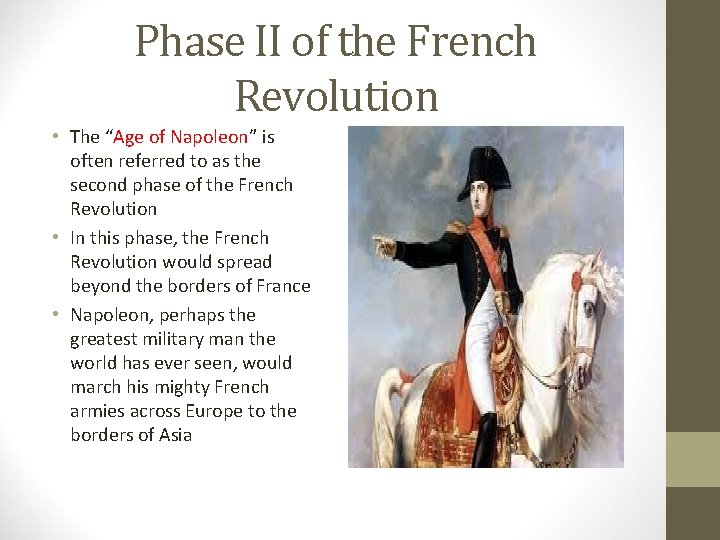
Phase II of the French Revolution • The “Age of Napoleon” is often referred to as the second phase of the French Revolution • In this phase, the French Revolution would spread beyond the borders of France • Napoleon, perhaps the greatest military man the world has ever seen, would march his mighty French armies across Europe to the borders of Asia
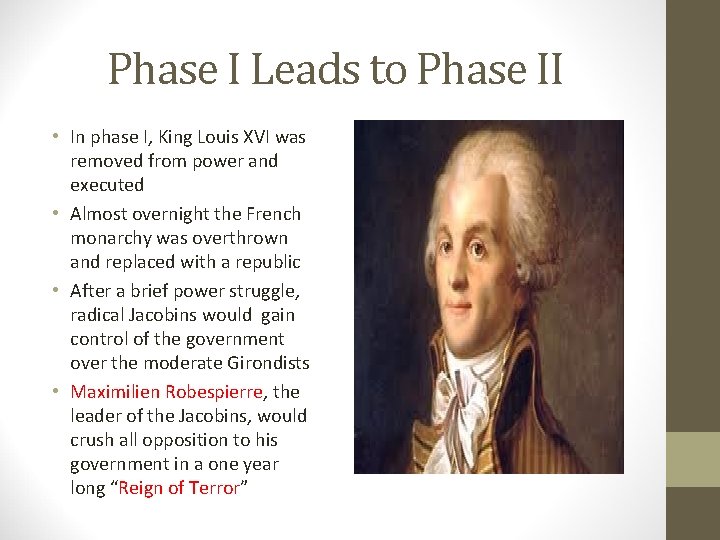
Phase I Leads to Phase II • In phase I, King Louis XVI was removed from power and executed • Almost overnight the French monarchy was overthrown and replaced with a republic • After a brief power struggle, radical Jacobins would gain control of the government over the moderate Girondists • Maximilien Robespierre, the leader of the Jacobins, would crush all opposition to his government in a one year long “Reign of Terror”
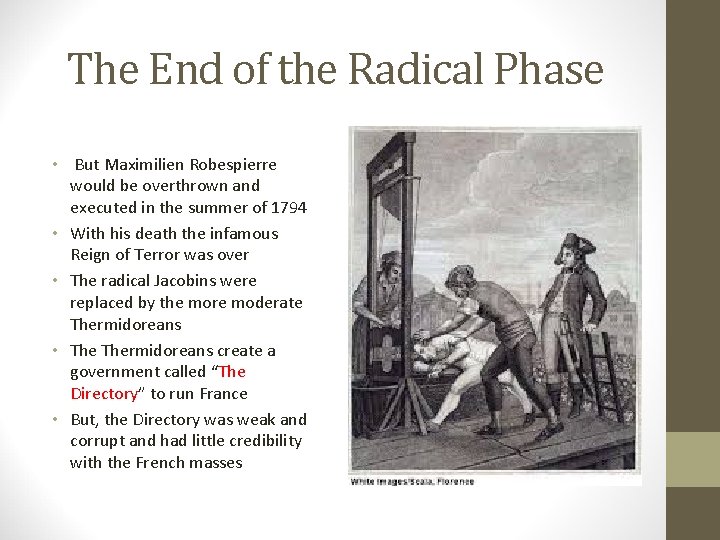
The End of the Radical Phase • But Maximilien Robespierre would be overthrown and executed in the summer of 1794 • With his death the infamous Reign of Terror was over • The radical Jacobins were replaced by the more moderate Thermidoreans • Thermidoreans create a government called “The Directory” to run France • But, the Directory was weak and corrupt and had little credibility with the French masses
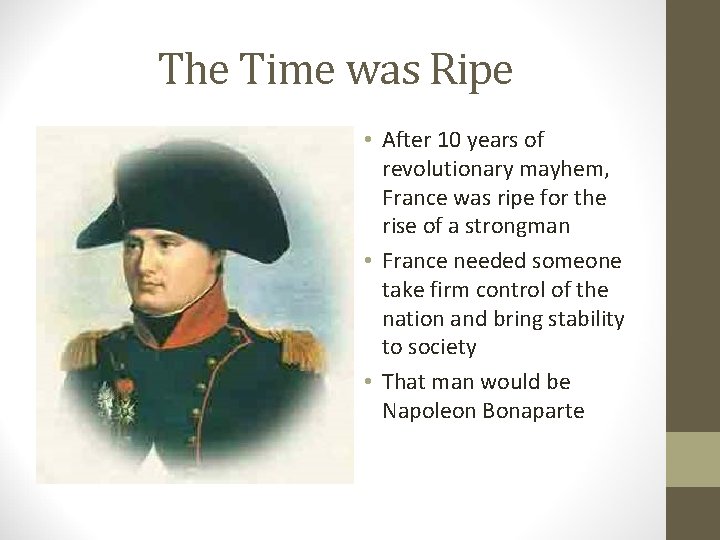
The Time was Ripe • After 10 years of revolutionary mayhem, France was ripe for the rise of a strongman • France needed someone take firm control of the nation and bring stability to society • That man would be Napoleon Bonaparte
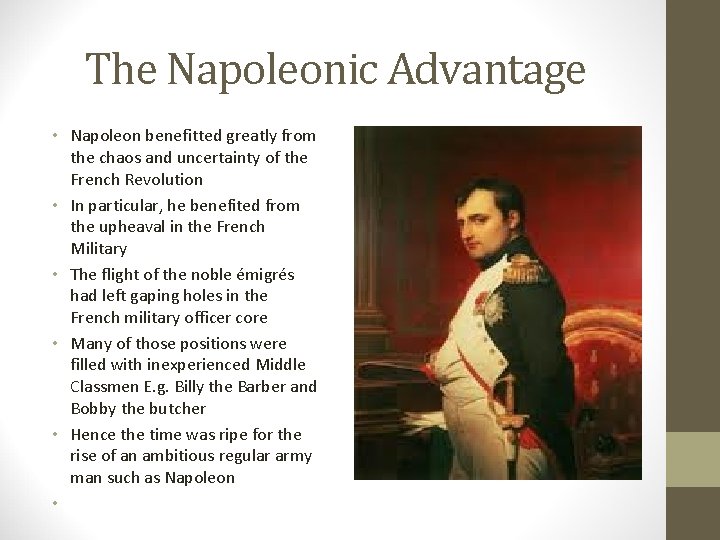
The Napoleonic Advantage • Napoleon benefitted greatly from the chaos and uncertainty of the French Revolution • In particular, he benefited from the upheaval in the French Military • The flight of the noble émigrés had left gaping holes in the French military officer core • Many of those positions were filled with inexperienced Middle Classmen E. g. Billy the Barber and Bobby the butcher • Hence the time was ripe for the rise of an ambitious regular army man such as Napoleon •
“I am no ordinary man” • One of Napoleon’s famous lines was “I am no ordinary man” • But at first he was “ordinary” or even less than ordinary • Born on the island of Corsica in 1769, he was part of a marginal and minor noble family • His father was a lawyer • He was the second of eight children • Corsica had recently been conquered by the French • His first language was Corsican and he spoke French with a heavy Corsican accent • Being Corsican he was looked down on by many in the French military ranks
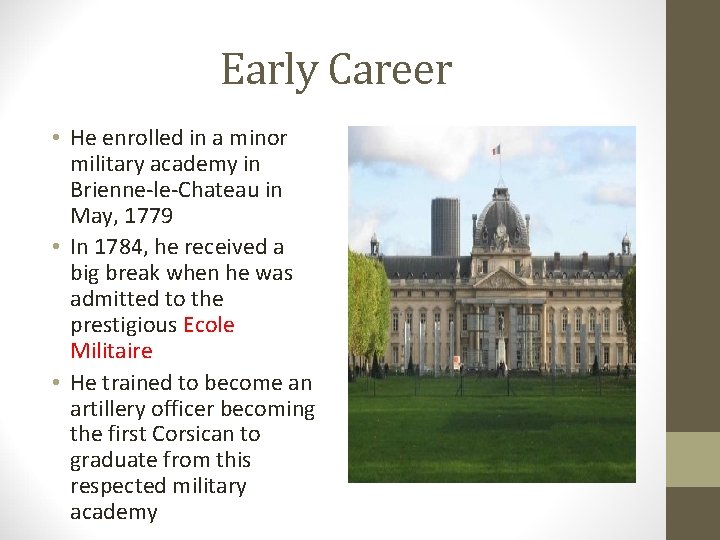
Early Career • He enrolled in a minor military academy in Brienne-le-Chateau in May, 1779 • In 1784, he received a big break when he was admitted to the prestigious Ecole Militaire • He trained to become an artillery officer becoming the first Corsican to graduate from this respected military academy
A Genius • Although he did not show it during his schooling, Napoleon may have been a genius • He had an unbelievable head for detail and a remarkable memory • He seemed to know even the smallest details about his army • He seemed to know exactly where every horse, soldier, and cannon was at any time
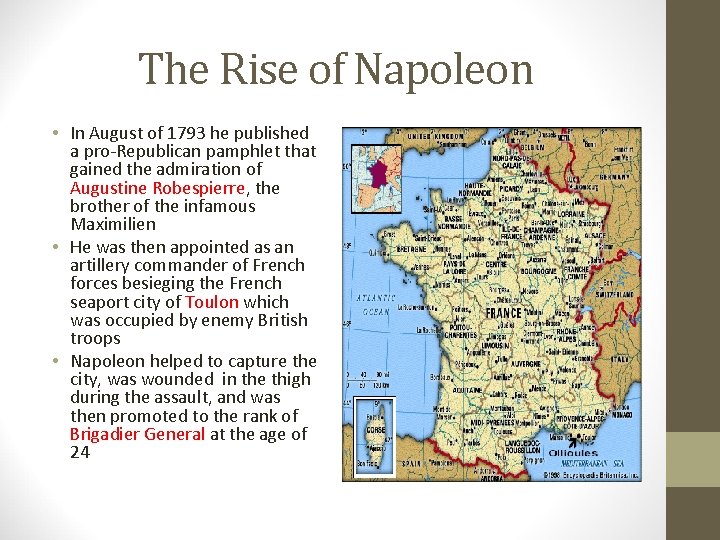
The Rise of Napoleon • In August of 1793 he published a pro-Republican pamphlet that gained the admiration of Augustine Robespierre, the brother of the infamous Maximilien • He was then appointed as an artillery commander of French forces besieging the French seaport city of Toulon which was occupied by enemy British troops • Napoleon helped to capture the city, was wounded in the thigh during the assault, and was then promoted to the rank of Brigadier General at the age of 24
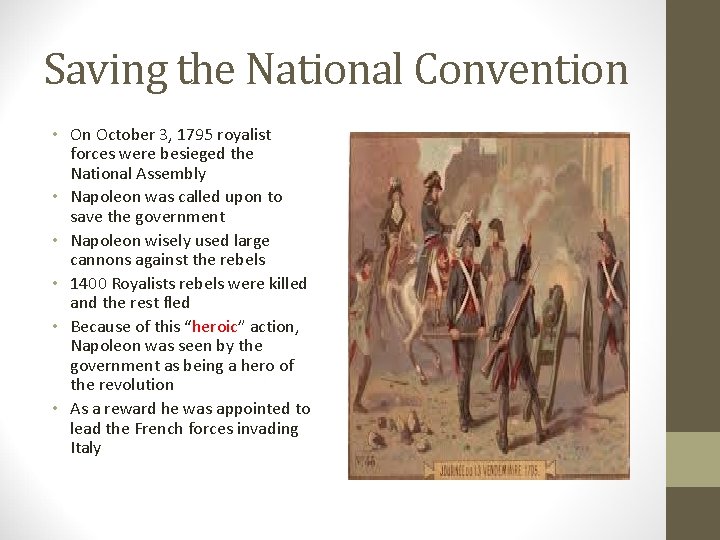
Saving the National Convention • On October 3, 1795 royalist forces were besieged the National Assembly • Napoleon was called upon to save the government • Napoleon wisely used large cannons against the rebels • 1400 Royalists rebels were killed and the rest fled • Because of this “heroic” action, Napoleon was seen by the government as being a hero of the revolution • As a reward he was appointed to lead the French forces invading Italy
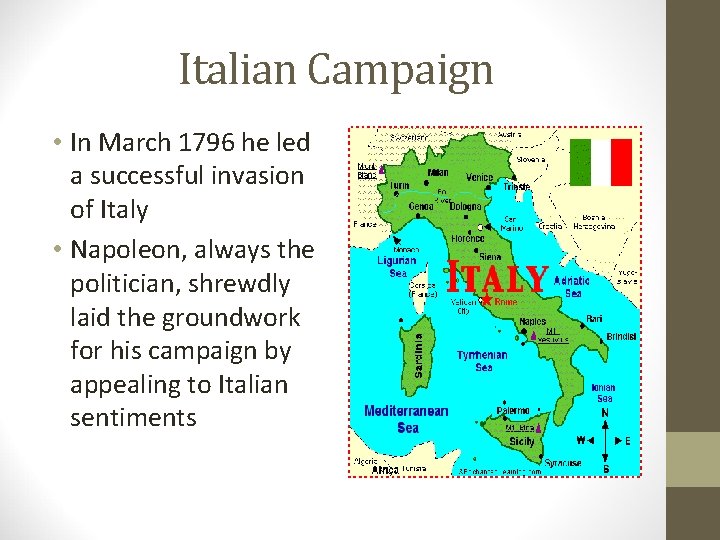
Italian Campaign • In March 1796 he led a successful invasion of Italy • Napoleon, always the politician, shrewdly laid the groundwork for his campaign by appealing to Italian sentiments
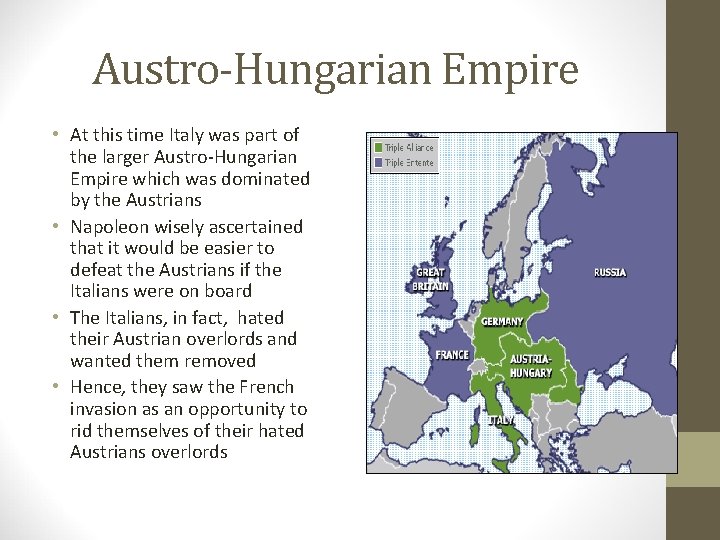
Austro-Hungarian Empire • At this time Italy was part of the larger Austro-Hungarian Empire which was dominated by the Austrians • Napoleon wisely ascertained that it would be easier to defeat the Austrians if the Italians were on board • The Italians, in fact, hated their Austrian overlords and wanted them removed • Hence, they saw the French invasion as an opportunity to rid themselves of their hated Austrians overlords
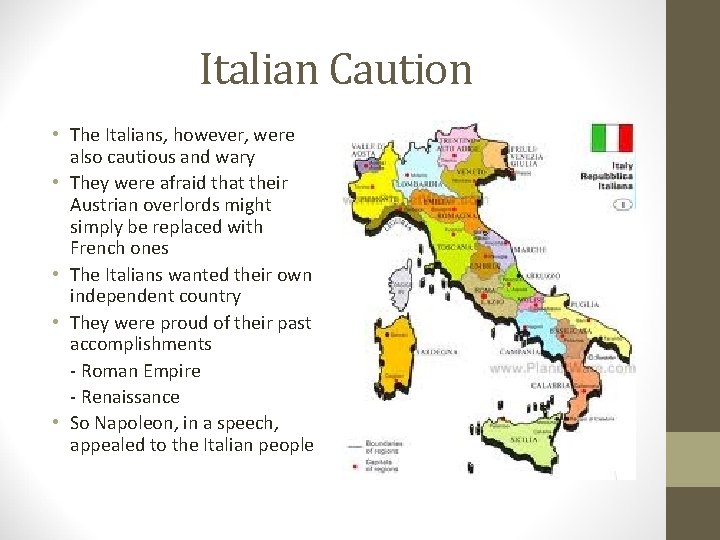
Italian Caution • The Italians, however, were also cautious and wary • They were afraid that their Austrian overlords might simply be replaced with French ones • The Italians wanted their own independent country • They were proud of their past accomplishments - Roman Empire - Renaissance • So Napoleon, in a speech, appealed to the Italian people
A Speech to the Italian people • “Peoples of Italy! The French army comes to break your chains. The French nation is the friend of all nations; receive us with trust! Your property, your religion, your customs will be respected. We shall wage war like generous enemies, for our only quarrel is with the tyrants (Austrians) who have enslaved you. ”
Liar, pants on … • Napoleon won brilliant victories against the Austrians at Lodi, Castigliogne, and Arcole • But the Italians worst fears were realized • Rather than being given their freedom, the Italians witnessed the rape of their land • Napoleon, in fact, paid his troops from the spoils of Italy • They stole Italian paintings, jewelry, and even valuables from ancient tombs
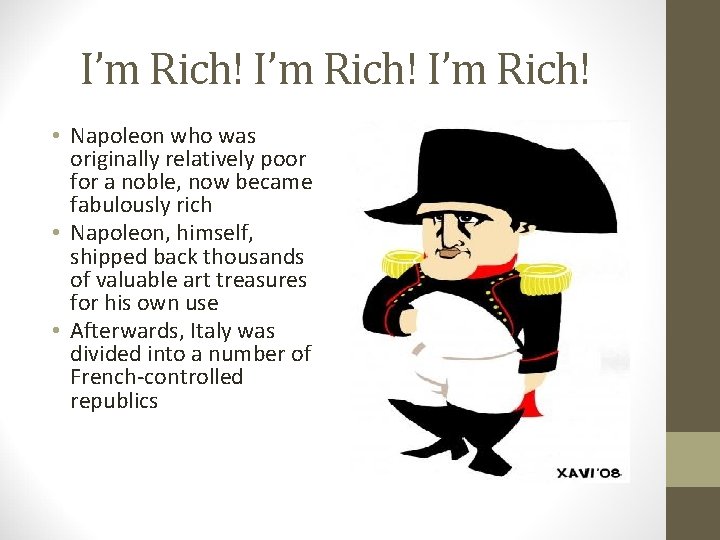
I’m Rich! • Napoleon who was originally relatively poor for a noble, now became fabulously rich • Napoleon, himself, shipped back thousands of valuable art treasures for his own use • Afterwards, Italy was divided into a number of French-controlled republics
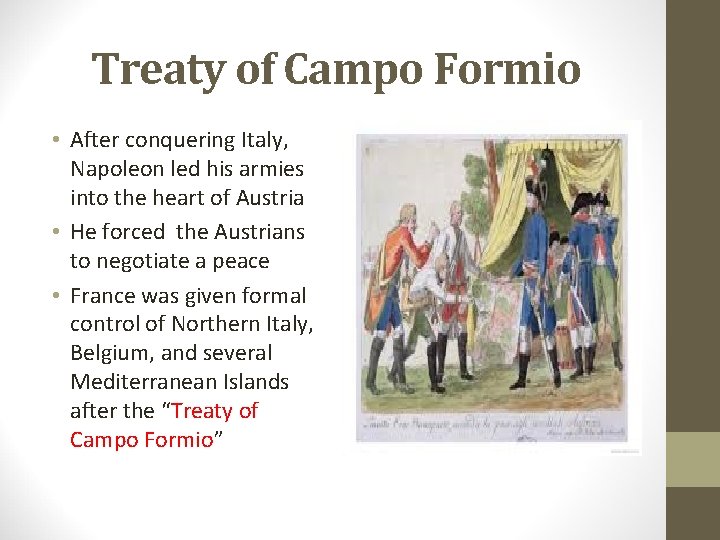
Treaty of Campo Formio • After conquering Italy, Napoleon led his armies into the heart of Austria • He forced the Austrians to negotiate a peace • France was given formal control of Northern Italy, Belgium, and several Mediterranean Islands after the “Treaty of Campo Formio”
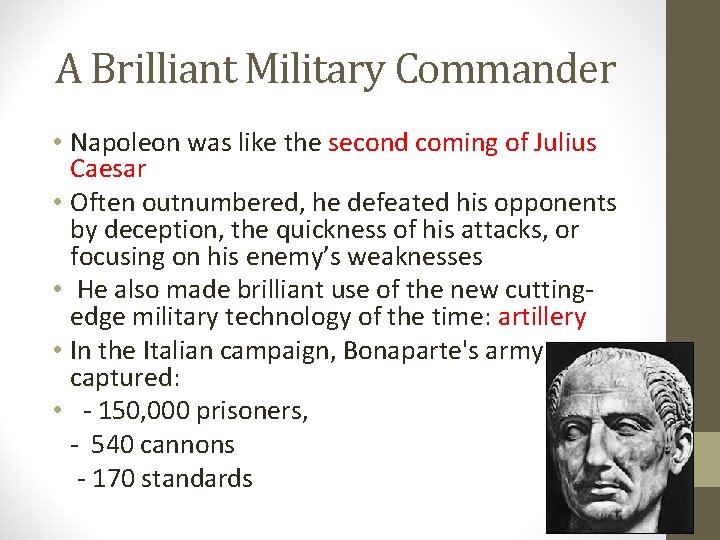
A Brilliant Military Commander • Napoleon was like the second coming of Julius Caesar • Often outnumbered, he defeated his opponents by deception, the quickness of his attacks, or focusing on his enemy’s weaknesses • He also made brilliant use of the new cuttingedge military technology of the time: artillery • In the Italian campaign, Bonaparte's army captured: • - 150, 000 prisoners, - 540 cannons - 170 standards
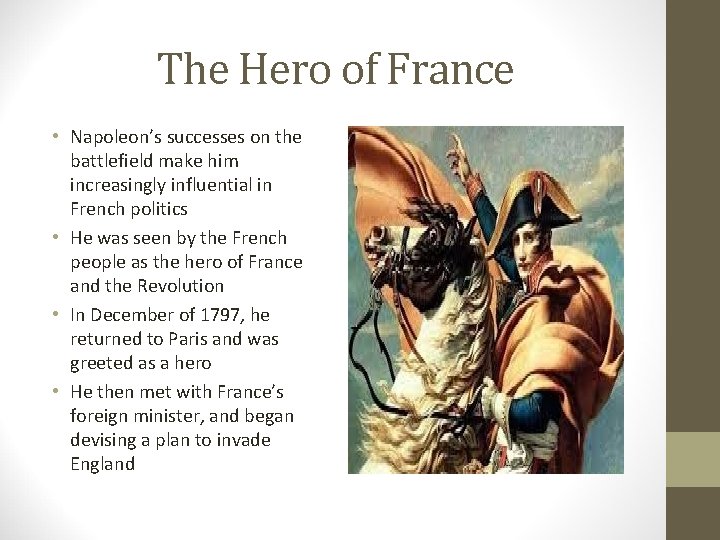
The Hero of France • Napoleon’s successes on the battlefield make him increasingly influential in French politics • He was seen by the French people as the hero of France and the Revolution • In December of 1797, he returned to Paris and was greeted as a hero • He then met with France’s foreign minister, and began devising a plan to invade England
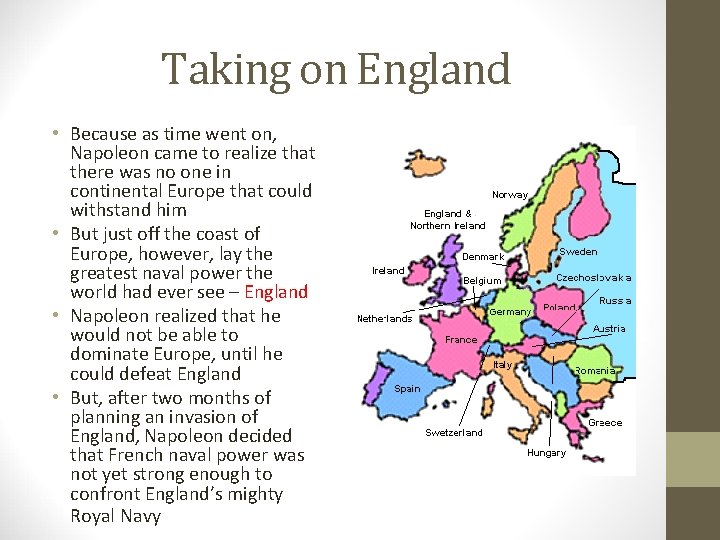
Taking on England • Because as time went on, Napoleon came to realize that there was no one in continental Europe that could withstand him • But just off the coast of Europe, however, lay the greatest naval power the world had ever see – England • Napoleon realized that he would not be able to dominate Europe, until he could defeat England • But, after two months of planning an invasion of England, Napoleon decided that French naval power was not yet strong enough to confront England’s mighty Royal Navy
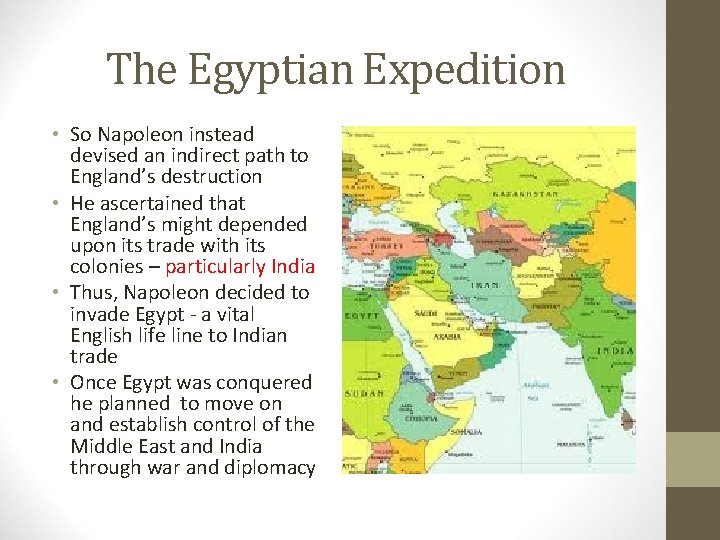
The Egyptian Expedition • So Napoleon instead devised an indirect path to England’s destruction • He ascertained that England’s might depended upon its trade with its colonies – particularly India • Thus, Napoleon decided to invade Egypt - a vital English life line to Indian trade • Once Egypt was conquered he planned to move on and establish control of the Middle East and India through war and diplomacy
Battle of the Pyramids • Napoleon easily defeated the Egyptians in two battles: - Battle of Chobrakit - Battle of the Pyramids
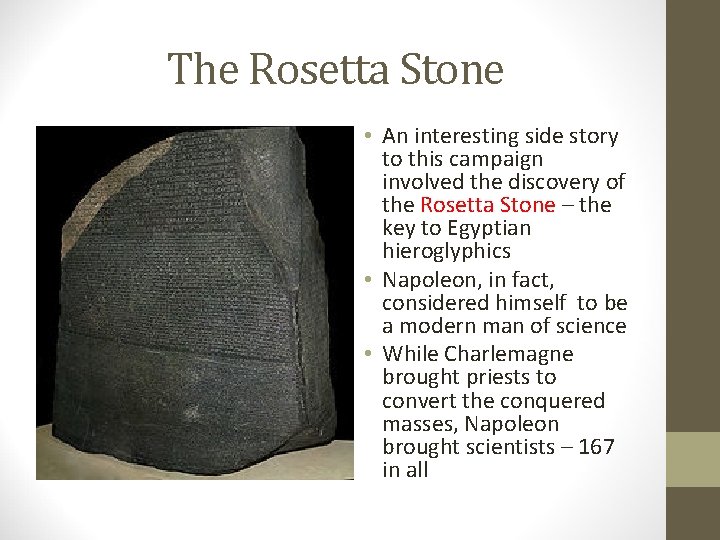
The Rosetta Stone • An interesting side story to this campaign involved the discovery of the Rosetta Stone – the key to Egyptian hieroglyphics • Napoleon, in fact, considered himself to be a modern man of science • While Charlemagne brought priests to convert the conquered masses, Napoleon brought scientists – 167 in all
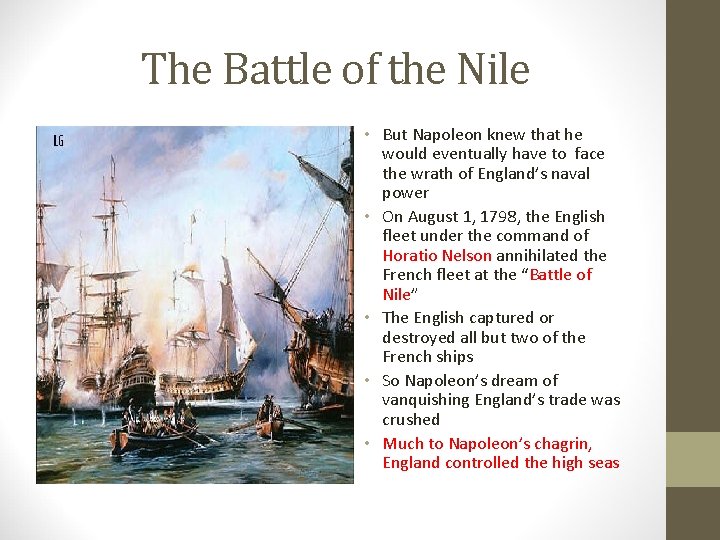
The Battle of the Nile • But Napoleon knew that he would eventually have to face the wrath of England’s naval power • On August 1, 1798, the English fleet under the command of Horatio Nelson annihilated the French fleet at the “Battle of Nile” • The English captured or destroyed all but two of the French ships • So Napoleon’s dream of vanquishing England’s trade was crushed • Much to Napoleon’s chagrin, England controlled the high seas
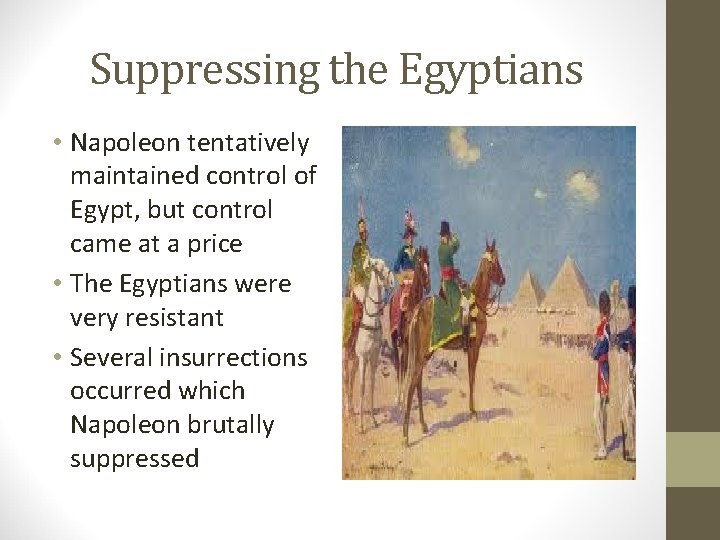
Suppressing the Egyptians • Napoleon tentatively maintained control of Egypt, but control came at a price • The Egyptians were very resistant • Several insurrections occurred which Napoleon brutally suppressed
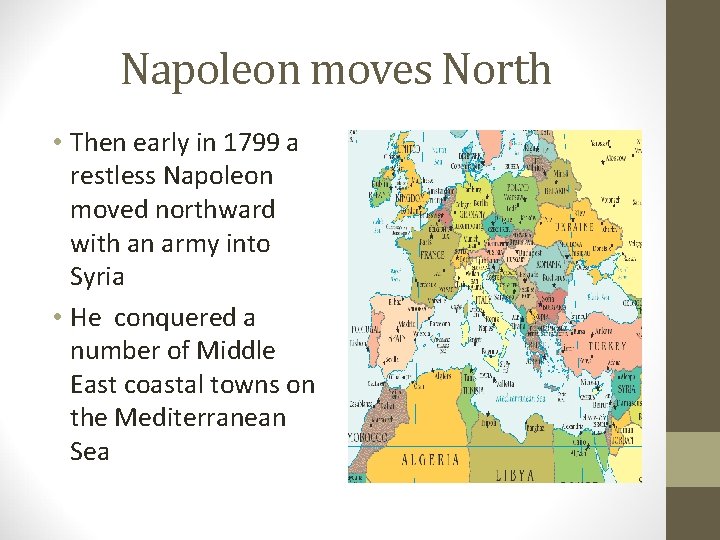
Napoleon moves North • Then early in 1799 a restless Napoleon moved northward with an army into Syria • He conquered a number of Middle East coastal towns on the Mediterranean Sea
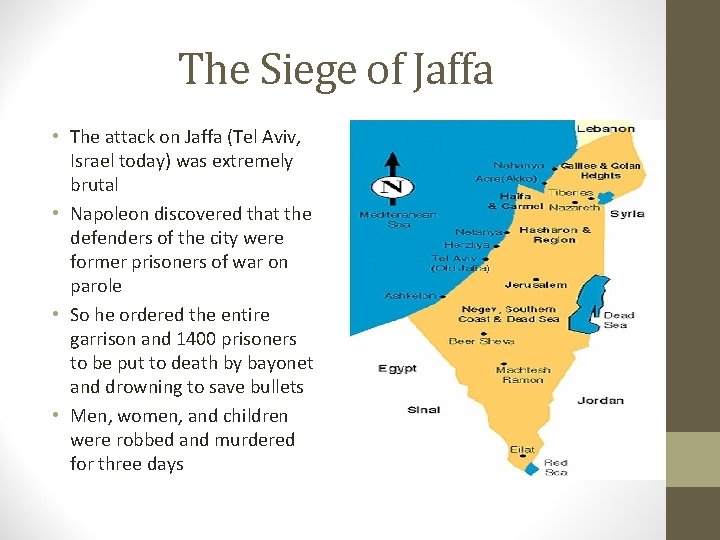
The Siege of Jaffa • The attack on Jaffa (Tel Aviv, Israel today) was extremely brutal • Napoleon discovered that the defenders of the city were former prisoners of war on parole • So he ordered the entire garrison and 1400 prisoners to be put to death by bayonet and drowning to save bullets • Men, women, and children were robbed and murdered for three days
Napoleon returns to Egypt • While trying to capture Acre, Napoleon’s army was weakened by disease (mainly bubonic plague) • Napoleon failed to capture Acre and returned to Egypt in May of 1799 • To speed up his retreat there is some suggestion that he may have poisoned his own plaguestricken men • This may have been true because those French soldiers that were left behind were tortured and beheaded by the returning Ottoman Turks
Napoleon Returns to France • Then Napoleon, against all orders, hopped a ship and headed back to France • Miraculously he was able to allude the English Royal Navy which was desperately searching for him • Upon arrival, the French people, unaware that Napoleon had suffered a number of setbacks, including the destruction of the French navy, was greeted as a hero
Napoleon Captures France • Upon arrival in France, Napoleon sensed the public’s dissatisfaction with France’s ruling Directory • Then, with the aid of two of the five directors and troops loyal to him, he overthrew the government • Napoleon then drew up yet another constitution, the fourth since the revolution had occurred
The Dictatorship of Napoleon The Big Kahuna of France • In the new Constitution Napoleon was named “First Consul” • Thus, the dictatorship of Napoleon officially began in November, 1799 • Napoleon, at the young age of 30 essentially became the …