
Phase I Trial Designs Jud Blatchford Ph D

Phase I Trial Designs Jud Blatchford, Ph. D Colorado School of Public Health January 30 th, 2013
Table of Contents 1. 2. 3. 4. Orientation Introduction Components of a Phase I Trial Designs A. Rule-Based Designs B. Statistical Designs 5. References Jud Blatchford, Ph. D Phase I Trial Designs 2

ORIENTATION Jud Blatchford, Ph. D Phase I Trial Designs 3
Orientation • Features of a Clinical Trial (CT) ◦ Study of human beings ◦ Prospective ◦ Uses an intervention (i. e. changes some aspect of the subjects) ◦ Protects the safety of the subjects ◦ Follows an approved protocol Jud Blatchford, Ph. D Phase I Trial Designs 4
Orientation • Phases of Clinical Trials ◦ Phase I – First time an experimental drug or treatment is tested in humans to examine how well the drug is tolerated ◦ Phase II – Trials designed to examine if the drug or treatment has a biological treatment effect ◦ Phase III – Trials designed to assess the treatment effect on a clinically meaningful endpoint ◦ Phase IV – Post-marketing studies to gain additional information regarding the safety of the drug or treatment Jud Blatchford, Ph. D Phase I Trial Designs 5

Orientation • Components of Study Design ◦ Rationale – Establishing a legitimate reason for the study ◦ Design – Detailed description of what treatments will be administered, including a timeline of administration ◦ Subjects – Determining the group to be studied and how they will be assigned to treatment groups ◦ Data – Outcome measure(s), obtaining data, and QA ◦ Sample Size Justification – Ensuring the study will be able to answer the scientific question with adequate power ◦ Study Closure – Archiving study data, analysis files Jud Blatchford, Ph. D Phase I Trial Designs 6

INTRODUCTION Jud Blatchford, Ph. D Phase I Trial Designs 7

Introduction • Phase I Clinical Trials ◦ An experimental drug, treatment, chemotherapeutic agent, cytotoxic agent, is studied—hereafter referred to as “drug” ◦ Primary Goal: Safety § Investigate whether the new drug or combination of drugs can be administered safely to subjects § Investigate optimal dosing and administration of drug ◦ Secondary Goal: Efficacy § Offer a treatment option to subjects who have failed other treatment regimens Jud Blatchford, Ph. D Phase I Trial Designs 8
Introduction • Underlying Assumptions ◦ The drug kills both cancer cells and other cells ◦ The effect is dose-dependent, therefore: 1. The efficacy of the drug increases with the dose 2. The toxicity of the drug increases with the dose ◦ Logically, it would be optimal to give the subjects the highest dose of a drug that can be administered without unacceptable toxicity ◦ Fundamental Question: What is this dose? Jud Blatchford, Ph. D Phase I Trial Designs 9
Maximum Tolerated Dose (MTD) • Definition of MTD: ◦ The highest dose without observing an unacceptable rate of toxicity • Aliases: ◦ Recommended Phase 2 Dose (RP 2 D) ◦ Phase 2 Recommended Dose (P 2 RD) Jud Blatchford, Ph. D Phase I Trial Designs 10
COMPONENTS OF A PHASE I TRIAL Jud Blatchford, Ph. D Phase I Trial Designs 11

Components of a Phase I Trial • Definition of a Dose-Limiting Toxicity (DLT) ◦ Clarify time-frame for experiencing a DLT • Dose Levels ◦ How many dose levels will be tested? ◦ What will the smallest dose be? ◦ What will the starting dose be? • Subjects ◦ How many subjects will be tested? ◦ Will single subjects or cohorts be tested at each dose? • What dose-escalation scheme will be employed? Jud Blatchford, Ph. D Phase I Trial Designs 12
Definition of a DLT • DLTs are typically defined • CTCAE Grades ◦ 0 – No AE using the National Cancer ◦ 1 – Mild Institute’s (NCI) Common ◦ 2 – Moderate Terminology Criteria for ◦ 3 – Severe Adverse Events (CTCAE). ◦ 4 – Life threatening • DLTs are often grade ≥ 3 non ◦ 5 – Death -hematological and grade ≥ 4 • Degrees of Related hematological toxicities, ◦ Unrelated which are definitely, ◦ Unlikely probably, or possibly related ◦ Possibly to the drug. ◦ Probably ◦ Definitely Jud Blatchford, Ph. D Phase I Trial Designs 13

Definition of a DLT • The length of observation within which a DLT occurrence is “counted” should be explicitly stated in the protocol • Typical lengths used are the first cycle of chemotherapy (often 3 weeks) • Weight the trade-off between observation time for a DLT and efficiency in enrolling subjects Jud Blatchford, Ph. D Phase I Trial Designs 14
Choosing the Starting Dose • Goals: ◦ Dose high enough to have chance of efficacy ◦ Dose low enough to avoid a DLT • Use data from animal pre-clinical studies • Scale dose by body surface area (mg/m 2) • Studies that aren’t “first-in-human” studies may be informed from previous studies using the same drug Jud Blatchford, Ph. D Phase I Trial Designs 15
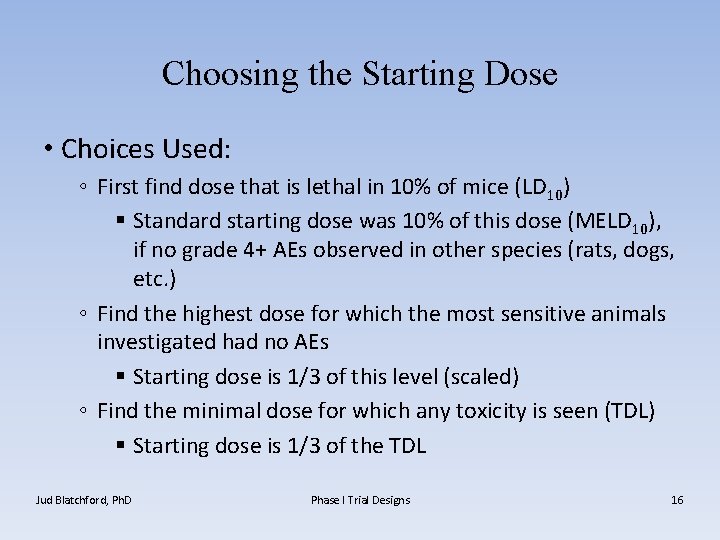
Choosing the Starting Dose • Choices Used: ◦ First find dose that is lethal in 10% of mice (LD 10) § Standard starting dose was 10% of this dose (MELD 10), if no grade 4+ AEs observed in other species (rats, dogs, etc. ) ◦ Find the highest dose for which the most sensitive animals investigated had no AEs § Starting dose is 1/3 of this level (scaled) ◦ Find the minimal dose for which any toxicity is seen (TDL) § Starting dose is 1/3 of the TDL Jud Blatchford, Ph. D Phase I Trial Designs 16
Choosing the Number of Dose Levels • Testing more dose levels to accurately estimate the MTD creates a more cumbersome trial, and may require more subjects • Common number of levels is 4 to 7 • Observed number has ranged from 3 to 14 Jud Blatchford, Ph. D Phase I Trial Designs 17
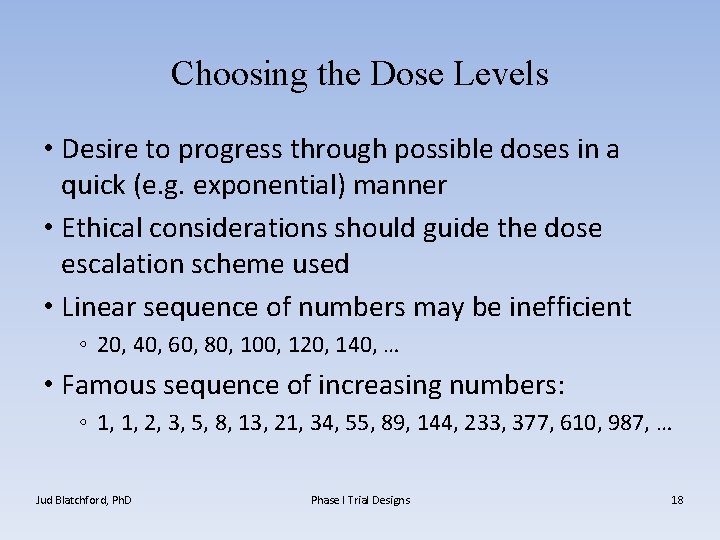
Choosing the Dose Levels • Desire to progress through possible doses in a quick (e. g. exponential) manner • Ethical considerations should guide the dose escalation scheme used • Linear sequence of numbers may be inefficient ◦ 20, 40, 60, 80, 100, 120, 140, … • Famous sequence of increasing numbers: ◦ 1, 1, 2, 3, 5, 8, 13, 21, 34, 55, 89, 144, 233, 377, 610, 987, … Jud Blatchford, Ph. D Phase I Trial Designs 18
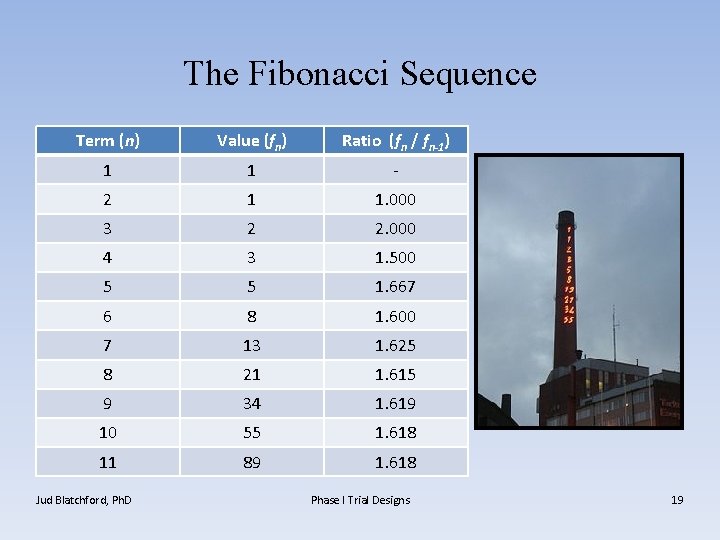
The Fibonacci Sequence Term (n) Value (fn) Ratio (fn / fn-1) 1 1 - 2 1 1. 000 3 2 2. 000 4 3 1. 500 5 5 1. 667 6 8 1. 600 7 13 1. 625 8 21 1. 615 9 34 1. 619 10 55 1. 618 11 89 1. 618 Jud Blatchford, Ph. D Phase I Trial Designs 19
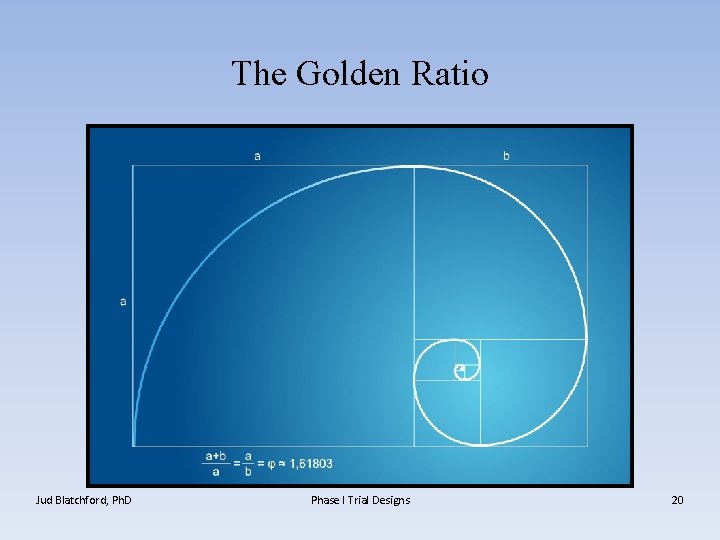
The Golden Ratio Jud Blatchford, Ph. D Phase I Trial Designs 20
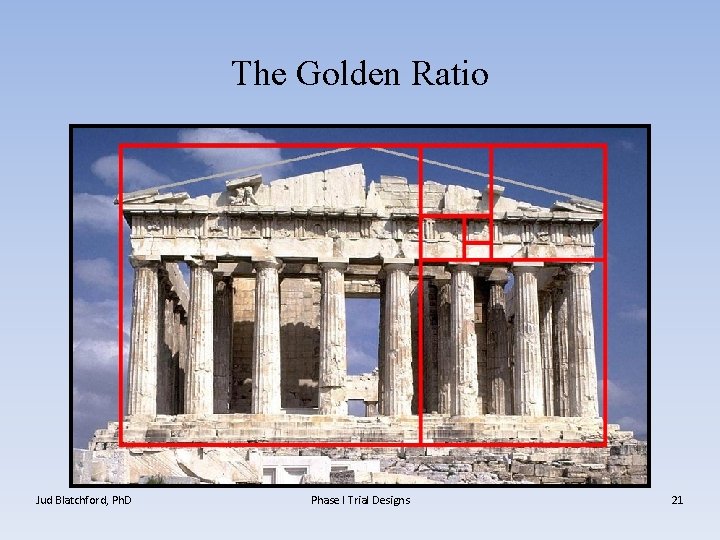
The Golden Ratio Jud Blatchford, Ph. D Phase I Trial Designs 21
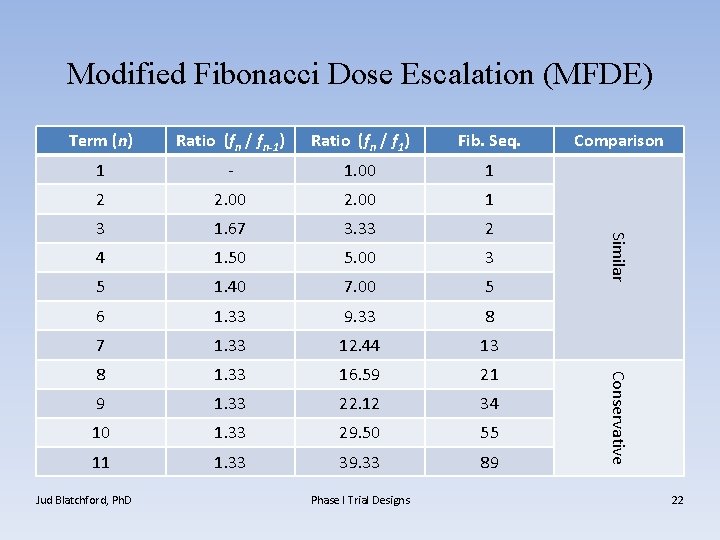
Modified Fibonacci Dose Escalation (MFDE) Ratio (fn / f 1) Fib. Seq. 1 - 1. 00 1 2 2. 00 1 3 1. 67 3. 33 2 4 1. 50 5. 00 3 5 1. 40 7. 00 5 6 1. 33 9. 33 8 7 1. 33 12. 44 13 8 1. 33 16. 59 21 9 1. 33 22. 12 34 10 1. 33 29. 50 55 11 1. 33 39. 33 89 Jud Blatchford, Ph. D Phase I Trial Designs Comparison Conservative Ratio (fn / fn-1) Similar Term (n) 22
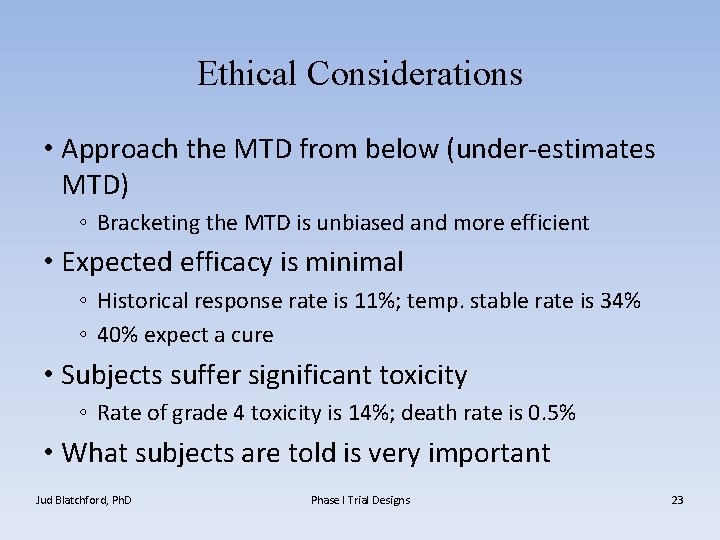
Ethical Considerations • Approach the MTD from below (under-estimates MTD) ◦ Bracketing the MTD is unbiased and more efficient • Expected efficacy is minimal ◦ Historical response rate is 11%; temp. stable rate is 34% ◦ 40% expect a cure • Subjects suffer significant toxicity ◦ Rate of grade 4 toxicity is 14%; death rate is 0. 5% • What subjects are told is very important Jud Blatchford, Ph. D Phase I Trial Designs 23
PHASE I TRIAL DESIGNS Jud Blatchford, Ph. D Phase I Trial Designs 24
Rule-Based Designs 1. 2. 3. 4. 5. Traditional Escalation Rule Variations of the Traditional Escalation Rule Best of 5 Rule Up-and-Down Designs 2 -Stage Designs Jud Blatchford, Ph. D Phase I Trial Designs 25
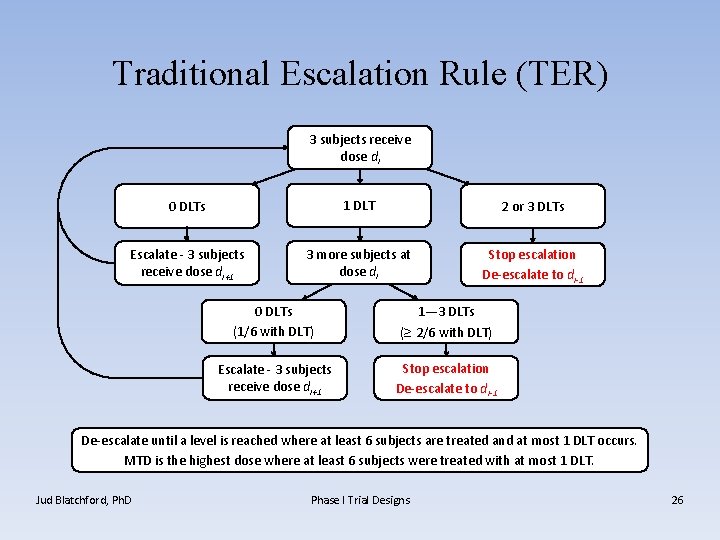
Traditional Escalation Rule (TER) 3 subjects receive dose di 0 DLTs 1 DLT 2 or 3 DLTs Escalate - 3 subjects receive dose di+1 3 more subjects at dose di Stop escalation De-escalate to di-1 0 DLTs (1/6 with DLT) 1— 3 DLTs (≥ 2/6 with DLT) Escalate - 3 subjects receive dose di+1 Stop escalation De-escalate to di-1 De-escalate until a level is reached where at least 6 subjects are treated and at most 1 DLT occurs. MTD is the highest dose where at least 6 subjects were treated with at most 1 DLT. Jud Blatchford, Ph. D Phase I Trial Designs 26
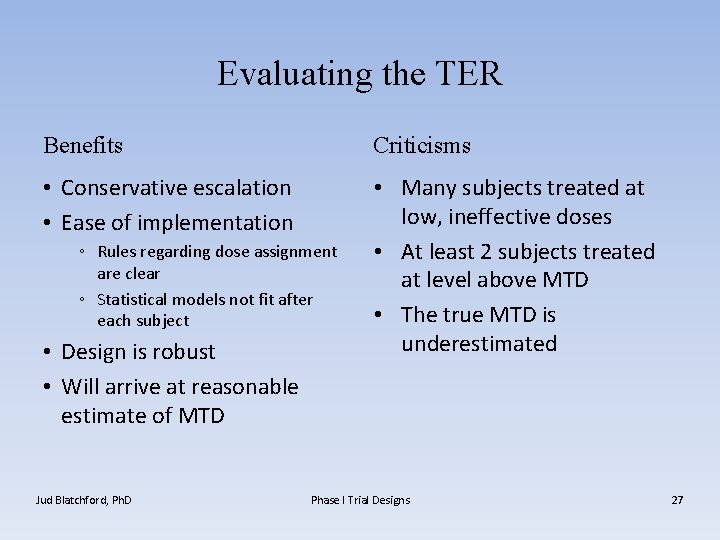
Evaluating the TER Benefits Criticisms • Conservative escalation • Ease of implementation • Many subjects treated at low, ineffective doses • At least 2 subjects treated at level above MTD • The true MTD is underestimated ◦ Rules regarding dose assignment are clear ◦ Statistical models not fit after each subject • Design is robust • Will arrive at reasonable estimate of MTD Jud Blatchford, Ph. D Phase I Trial Designs 27
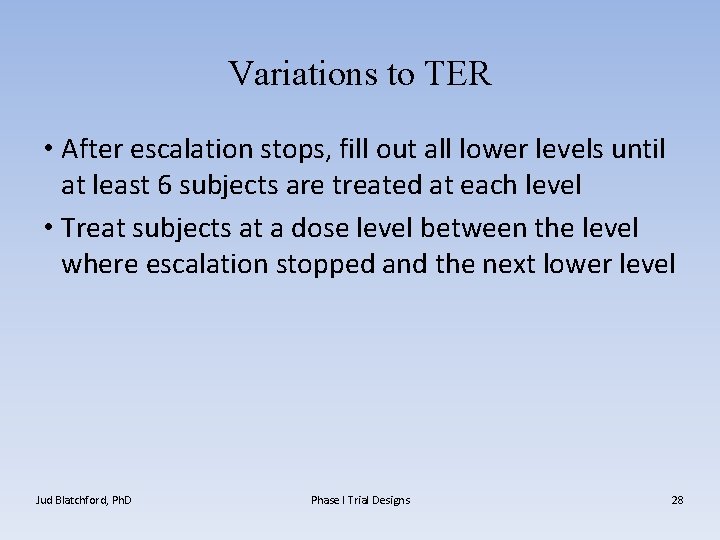
Variations to TER • After escalation stops, fill out all lower levels until at least 6 subjects are treated at each level • Treat subjects at a dose level between the level where escalation stopped and the next lower level Jud Blatchford, Ph. D Phase I Trial Designs 28
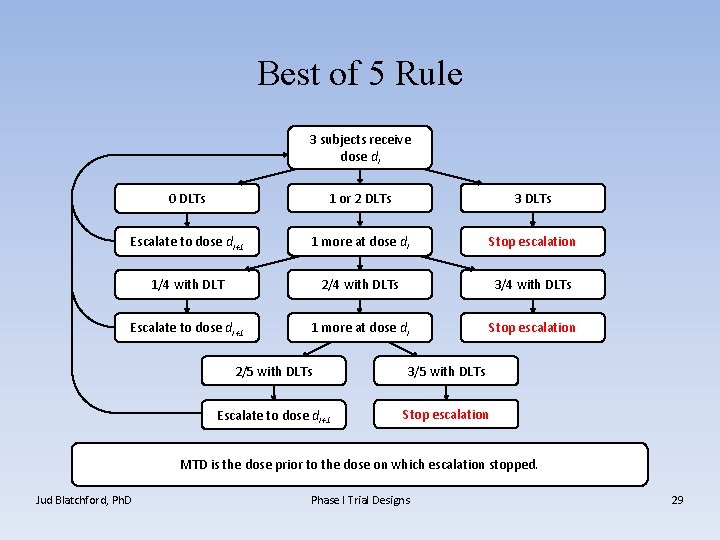
Best of 5 Rule 3 subjects receive dose di 0 DLTs 1 or 2 DLTs 3 DLTs Escalate to dose di+1 1 more at dose di Stop escalation 1/4 with DLT 2/4 with DLTs 3/4 with DLTs Escalate to dose di+1 1 more at dose di Stop escalation 2/5 with DLTs 3/5 with DLTs Escalate to dose di+1 Stop escalation MTD is the dose prior to the dose on which escalation stopped. Jud Blatchford, Ph. D Phase I Trial Designs 29
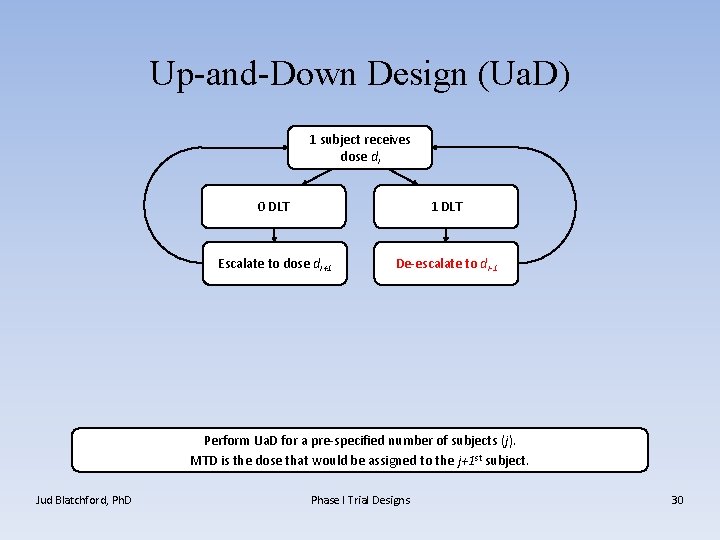
Up-and-Down Design (Ua. D) 1 subject receives dose di 0 DLT 1 DLT Escalate to dose di+1 De-escalate to di-1 Perform Ua. D for a pre-specified number of subjects (j). MTD is the dose that would be assigned to the j+1 st subject. Jud Blatchford, Ph. D Phase I Trial Designs 30
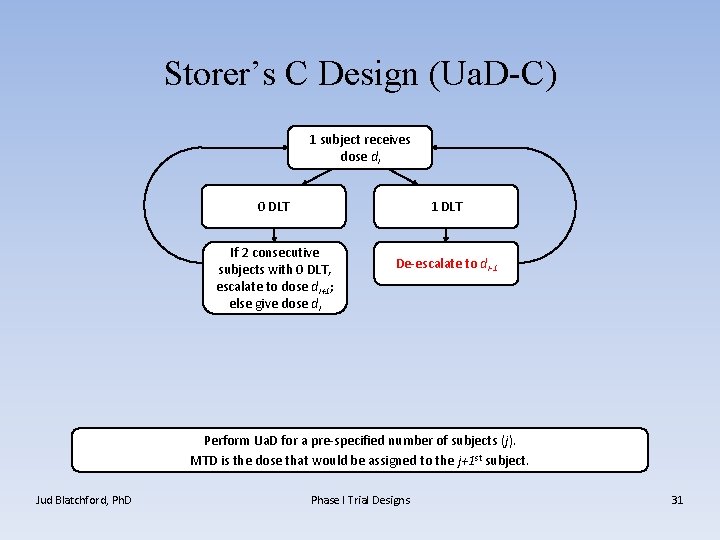
Storer’s C Design (Ua. D-C) 1 subject receives dose di 0 DLT 1 DLT If 2 consecutive subjects with 0 DLT, escalate to dose di+1; else give dose di De-escalate to di-1 Perform Ua. D for a pre-specified number of subjects (j). MTD is the dose that would be assigned to the j+1 st subject. Jud Blatchford, Ph. D Phase I Trial Designs 31
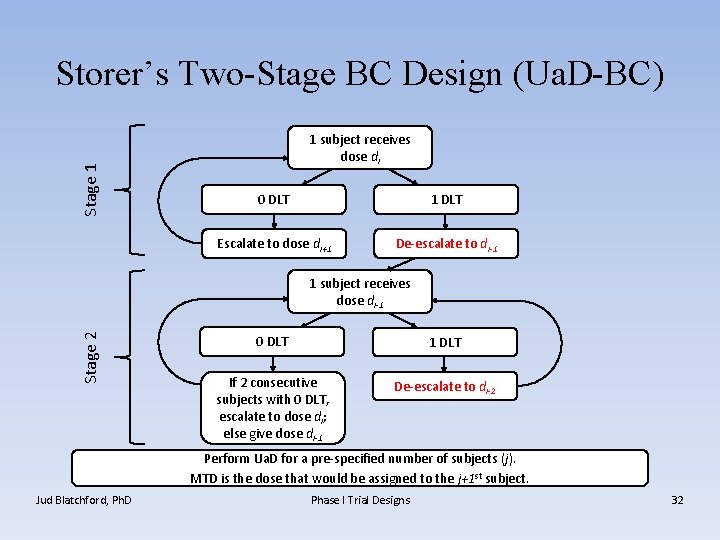
Stage 1 Storer’s Two-Stage BC Design (Ua. D-BC) 1 subject receives dose di 0 DLT 1 DLT Escalate to dose di+1 De-escalate to di-1 Stage 2 1 subject receives dose di-1 0 DLT 1 DLT If 2 consecutive subjects with 0 DLT, escalate to dose di; else give dose di-1 De-escalate to di-2 Perform Ua. D for a pre-specified number of subjects (j). MTD is the dose that would be assigned to the j+1 st subject. Jud Blatchford, Ph. D Phase I Trial Designs 32
Accelerated Titration Designs Extension by Simon of Storer’s work Design 1: TER Designs 2— 4 Stage 1: Single subjects until first DLT or second grade 2 AE Stage 2: TER Design 2: Toxicities observed in first cycle only Design 3: Toxicities may be observed in any cycle Design 4: Same as 3 except escalation factor is 2. 0 Jud Blatchford, Ph. D Phase I Trial Designs 33
Statistical Designs Dose escalation guided by a statistical model of the relationship between dose and toxic response 1. Continual Reassessment Method 2. Modifications to the CRM 3. 2 -Stage CRM Designs 4. TITE-CRM Jud Blatchford, Ph. D Phase I Trial Designs 34
Continual Reassessment Method (CRM) • First proposed by O’Quigley in 1990 • Subjects are enrolled individually • A dose-toxicity function is assumed ◦ f(d | α) = Pr{DLT | α} • After each patient completes observation, the estimate of α is updated • Strategy is to assign the dose closest to the estimated MTD to each subject Jud Blatchford, Ph. D Phase I Trial Designs 35
Considerations for the CRM • Number of dose levels • Initial estimates of toxicity rates at each dose level • Target rate of DLT (θ) • Dose-toxicity function • Escalation restrictions • Number of subjects to be treated Jud Blatchford, Ph. D Phase I Trial Designs 36
Considerations Number of Dose Levels Initial Estimates of Toxicity • Typically between 3 and 8 • In general, as the number of dose levels in the trial increases, the number of subjects needed to accurately estimate the MTD will increase • The estimates should bound the target rate (θ) Jud Blatchford, Ph. D Phase I Trial Designs ◦ The CRM is not robust when doses tested do not induce toxicity 37
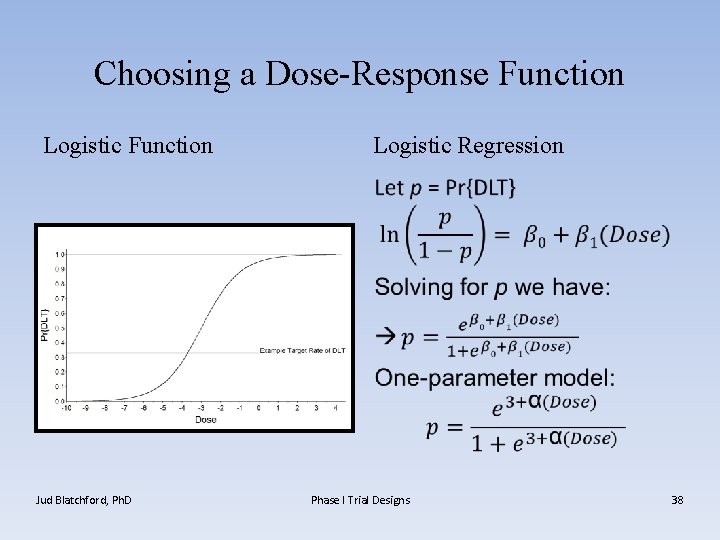
Choosing a Dose-Response Function Logistic Regression • Jud Blatchford, Ph. D Phase I Trial Designs 38
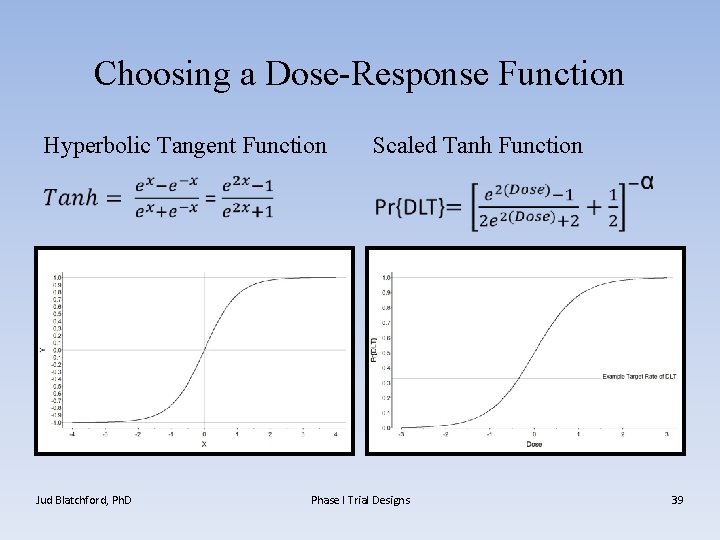
Choosing a Dose-Response Function Hyperbolic Tangent Function Scaled Tanh Function • • Jud Blatchford, Ph. D Phase I Trial Designs 39
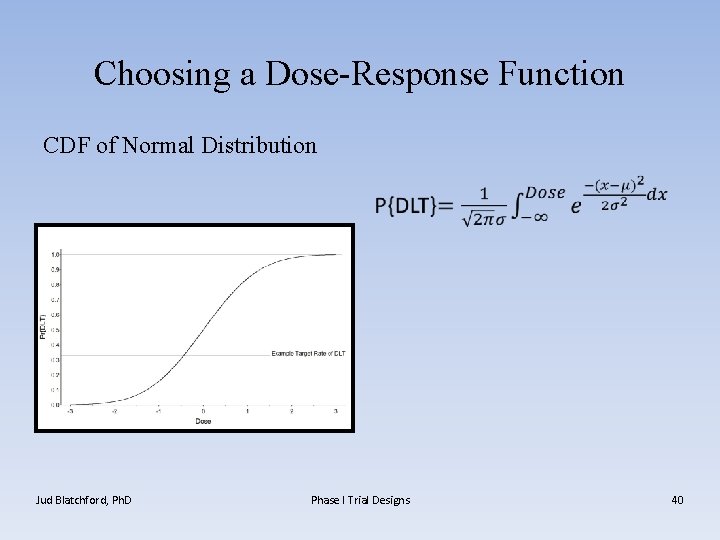
Choosing a Dose-Response Function CDF of Normal Distribution • Jud Blatchford, Ph. D Phase I Trial Designs 40
The Method of CRM • Dose-toxicity function and θ are chosen a-priori • Function is re-fit (i. e. new estimate of α is obtained) after each subject’s observed toxicity ◦ New function is determined from the a-priori function and the vector of observed toxicities ◦ Curve shifts to the right without toxicity; left with toxicity • Next subject is treated at the dose level whose Pr{DLT} is closest to θ Jud Blatchford, Ph. D Phase I Trial Designs 41
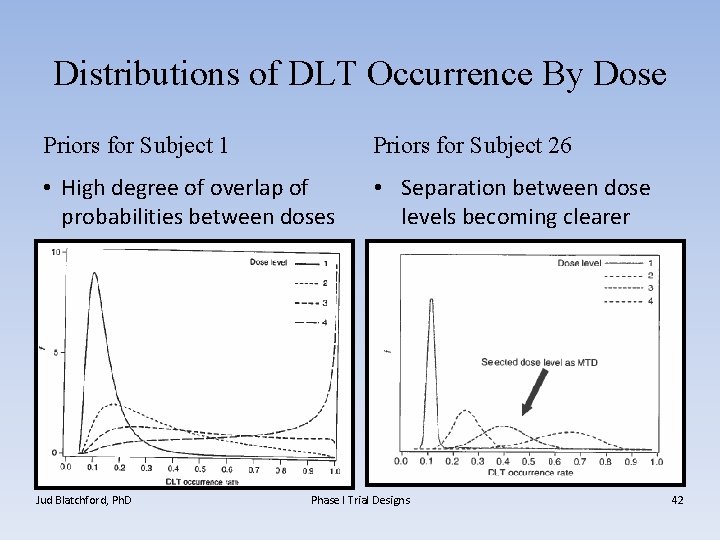
Distributions of DLT Occurrence By Dose Priors for Subject 1 Priors for Subject 26 • High degree of overlap of probabilities between doses • Separation between dose levels becoming clearer Jud Blatchford, Ph. D Phase I Trial Designs 42
Evaluating the CRM Benefits Criticisms • Few subjects are treated at low, ineffective doses • Subjects are treated at doses believed at the time to be the most efficacious, yet safe • Starting dose is too high • Dose escalation is too aggressive • Trial length is too long Jud Blatchford, Ph. D Phase I Trial Designs 43
Modified CRM • Start at the lowest dose level under consideration • Enroll two or three subjects at each cohort • Constrain dose escalation to increase by at most one dose level Jud Blatchford, Ph. D Phase I Trial Designs 44
“Practical” CRM • Proposed by Piantadosi • Based on pre-clinical toxicity data: ◦ Choose dose that would produce low (10%) rate of DLT ◦ Choose dose that would produce high (90%) rate of DLT ◦ Estimate dose/toxicity curve that fits these 2 points • Use the dose/toxicity curve to find dose for θ • Treat three subjects at this level, then re-estimate the dose-toxicity curve, dose for θ, and tx 3 more • Repeat until target dose changes by < 10% Jud Blatchford, Ph. D Phase I Trial Designs 45
2 -Stage CRM Designs • Stage 1: TER ◦ “ 2 + 2” is a more common first stage than “ 3 + 3” ◦ Continue until first toxicity is observed • Stage 2: CRM ◦ After first toxicity, fit the dose-response curve using the toxicity data accrued thus far ◦ Choose dose for next cohort of 2 as dose with estimated rate of DLT closest to θ Jud Blatchford, Ph. D Phase I Trial Designs 46
Time-to-Event CRM (TITE-CRM) • Builds on the CRM described thus far • Uses information from subjects accrued, even if they haven’t finished observation period ◦ Subjects with DLT are given full weight ◦ Subjects without DLT are given weight t/T. • Allows subjects to be enrolled without waiting for prior cohorts to finish ◦ Benefits studies with delayed toxicity (e. g. radiation studies) Jud Blatchford, Ph. D Phase I Trial Designs 47
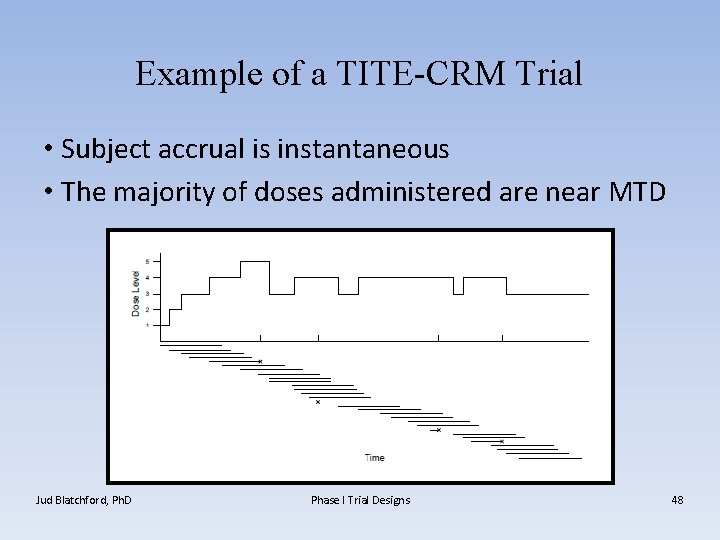
Example of a TITE-CRM Trial • Subject accrual is instantaneous • The majority of doses administered are near MTD Jud Blatchford, Ph. D Phase I Trial Designs 48
Additional TITE-CRM Considerations • Choice of weight function ◦ Uniform toxicities may use a linear function ◦ Expecting late toxicities may use a convex function ◦ Expecting early toxicities may use a concave function • Setting a Margin (i. e. upper limit) on toxicity ◦ If θ = 0. 20 and Margin = 0. 05, dose for next subject will be dose closest to 0. 20 and not greater than 0. 25 • Determine cumulative time exposure (B) before allowing escalation (e. g. B = 2) Jud Blatchford, Ph. D Phase I Trial Designs 49
Design Comparisons • Fitting a model to the data will improve the accuracy of the MTD found by rule-based designs • Model-guided designs only perform well if assumptions are met (θ in range of doses tested) • Conflicting results when designs compared • Few comparisons made on “level playing field” • Both rule-based and model-guided designs are in common use, for good reason Jud Blatchford, Ph. D Phase I Trial Designs 50
Important Future Work • “Individualized” Designs ◦ Development of designs allowing for within-subject dose escalation ◦ Development of designs for targeted agents • Designs for trials expecting minimal toxicity Jud Blatchford, Ph. D Phase I Trial Designs 51

REFERENCES Jud Blatchford, Ph. D Phase I Trial Designs 52
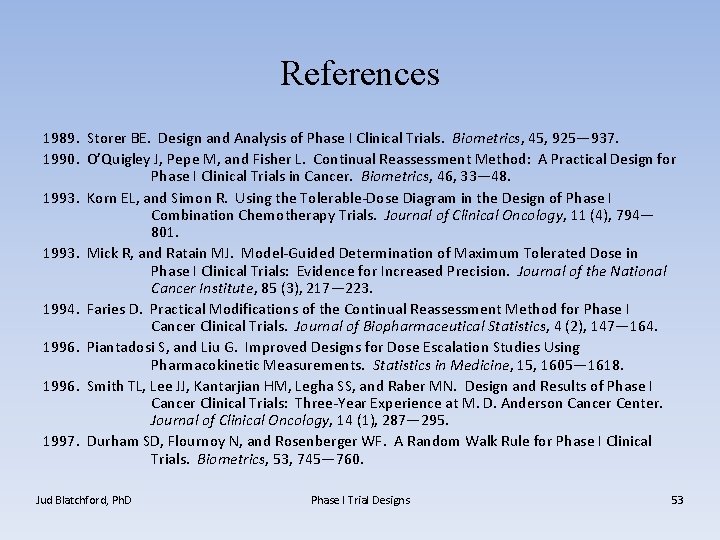
References 1989. Storer BE. Design and Analysis of Phase I Clinical Trials. Biometrics, 45, 925— 937. 1990. O’Quigley J, Pepe M, and Fisher L. Continual Reassessment Method: A Practical Design for Phase I Clinical Trials in Cancer. Biometrics, 46, 33— 48. 1993. Korn EL, and Simon R. Using the Tolerable-Dose Diagram in the Design of Phase I Combination Chemotherapy Trials. Journal of Clinical Oncology, 11 (4), 794— 801. 1993. Mick R, and Ratain MJ. Model-Guided Determination of Maximum Tolerated Dose in Phase I Clinical Trials: Evidence for Increased Precision. Journal of the National Cancer Institute, 85 (3), 217— 223. 1994. Faries D. Practical Modifications of the Continual Reassessment Method for Phase I Cancer Clinical Trials. Journal of Biopharmaceutical Statistics, 4 (2), 147— 164. 1996. Piantadosi S, and Liu G. Improved Designs for Dose Escalation Studies Using Pharmacokinetic Measurements. Statistics in Medicine, 15, 1605— 1618. 1996. Smith TL, Lee JJ, Kantarjian HM, Legha SS, and Raber MN. Design and Results of Phase I Cancer Clinical Trials: Three-Year Experience at M. D. Anderson Cancer Center. Journal of Clinical Oncology, 14 (1), 287— 295. 1997. Durham SD, Flournoy N, and Rosenberger WF. A Random Walk Rule for Phase I Clinical Trials. Biometrics, 53, 745— 760. Jud Blatchford, Ph. D Phase I Trial Designs 53
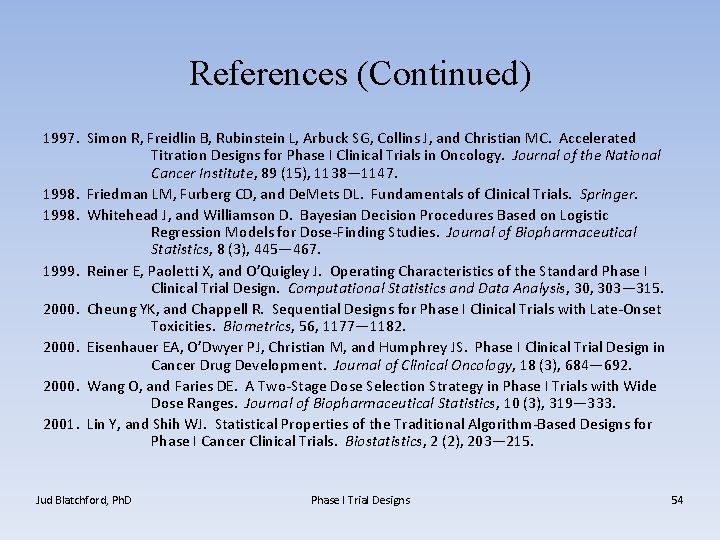
References (Continued) 1997. Simon R, Freidlin B, Rubinstein L, Arbuck SG, Collins J, and Christian MC. Accelerated Titration Designs for Phase I Clinical Trials in Oncology. Journal of the National Cancer Institute, 89 (15), 1138— 1147. 1998. Friedman LM, Furberg CD, and De. Mets DL. Fundamentals of Clinical Trials. Springer. 1998. Whitehead J, and Williamson D. Bayesian Decision Procedures Based on Logistic Regression Models for Dose-Finding Studies. Journal of Biopharmaceutical Statistics, 8 (3), 445— 467. 1999. Reiner E, Paoletti X, and O’Quigley J. Operating Characteristics of the Standard Phase I Clinical Trial Design. Computational Statistics and Data Analysis, 303— 315. 2000. Cheung YK, and Chappell R. Sequential Designs for Phase I Clinical Trials with Late-Onset Toxicities. Biometrics, 56, 1177— 1182. 2000. Eisenhauer EA, O’Dwyer PJ, Christian M, and Humphrey JS. Phase I Clinical Trial Design in Cancer Drug Development. Journal of Clinical Oncology, 18 (3), 684— 692. 2000. Wang O, and Faries DE. A Two-Stage Dose Selection Strategy in Phase I Trials with Wide Dose Ranges. Journal of Biopharmaceutical Statistics, 10 (3), 319— 333. 2001. Lin Y, and Shih WJ. Statistical Properties of the Traditional Algorithm-Based Designs for Phase I Cancer Clinical Trials. Biostatistics, 2 (2), 203— 215. Jud Blatchford, Ph. D Phase I Trial Designs 54
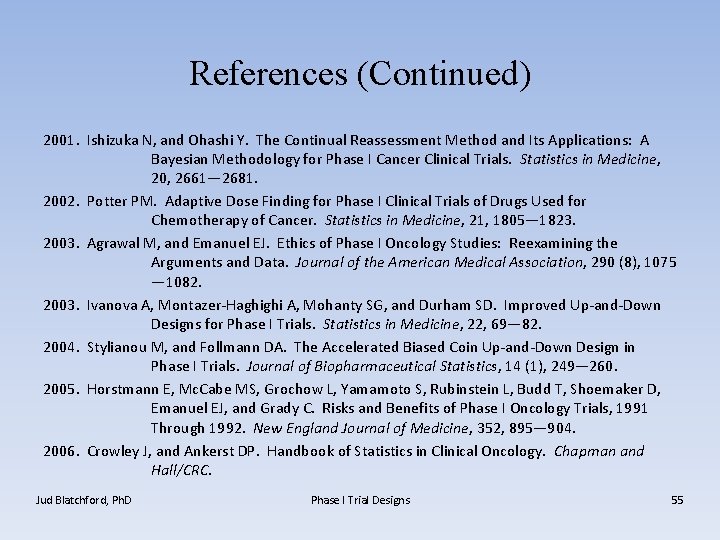
References (Continued) 2001. Ishizuka N, and Ohashi Y. The Continual Reassessment Method and Its Applications: A Bayesian Methodology for Phase I Cancer Clinical Trials. Statistics in Medicine, 20, 2661— 2681. 2002. Potter PM. Adaptive Dose Finding for Phase I Clinical Trials of Drugs Used for Chemotherapy of Cancer. Statistics in Medicine, 21, 1805— 1823. 2003. Agrawal M, and Emanuel EJ. Ethics of Phase I Oncology Studies: Reexamining the Arguments and Data. Journal of the American Medical Association, 290 (8), 1075 — 1082. 2003. Ivanova A, Montazer-Haghighi A, Mohanty SG, and Durham SD. Improved Up-and-Down Designs for Phase I Trials. Statistics in Medicine, 22, 69— 82. 2004. Stylianou M, and Follmann DA. The Accelerated Biased Coin Up-and-Down Design in Phase I Trials. Journal of Biopharmaceutical Statistics, 14 (1), 249— 260. 2005. Horstmann E, Mc. Cabe MS, Grochow L, Yamamoto S, Rubinstein L, Budd T, Shoemaker D, Emanuel EJ, and Grady C. Risks and Benefits of Phase I Oncology Trials, 1991 Through 1992. New England Journal of Medicine, 352, 895— 904. 2006. Crowley J, and Ankerst DP. Handbook of Statistics in Clinical Oncology. Chapman and Hall/CRC. Jud Blatchford, Ph. D Phase I Trial Designs 55
References (Continued) 2006. Potter DM. Phase I Studies of Chemotherapeutic Agents in Cancer Patients: A Review of the Designs. Journal of Biopharmaceutical Statistics, 16, 579— 604. DOI: 10. 1080/10543400600860295. Jud Blatchford, Ph. D Phase I Trial Designs 56
- Slides: 56