
Phase Field Modeling of Interdiffusion Microstructures K Wu

- Slides: 27
Phase Field Modeling of Interdiffusion Microstructures K. Wu, J. E. Morral and Y. Wang Department of Materials Science and Engineering The Ohio State University Work Supported by NSF NIST Diffusion Workshop September 16 -17, 2003, Gaithersburg, MD
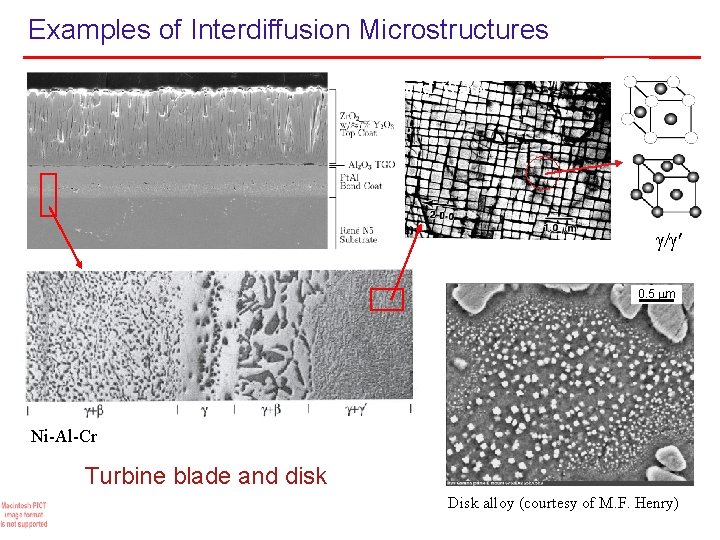
Examples of Interdiffusion Microstructures Courtesy of M. Walter / 0. 5 F-22 m Ni-Al-Cr Turbine blade and disk Disk alloy (courtesy of M. F. Henry)
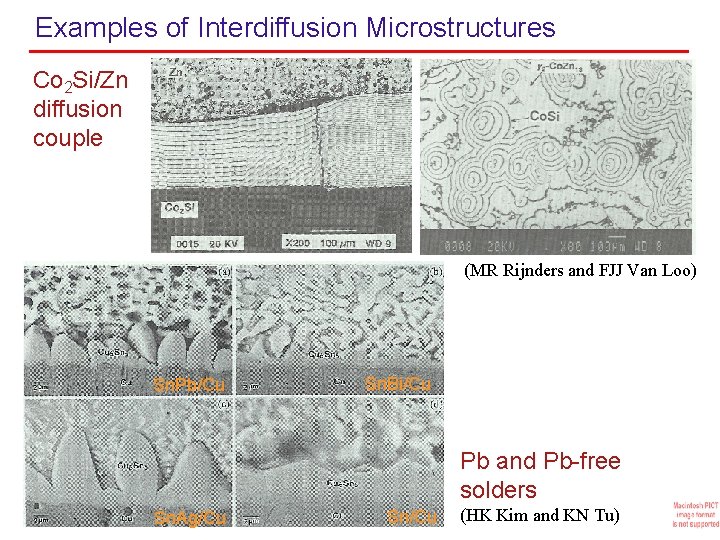
Examples of Interdiffusion Microstructures Co 2 Si/Zn diffusion couple (MR Rijnders and FJJ Van Loo) Sn. Pb/Cu Sn. Bi/Cu Pb and Pb-free solders Sn. Ag/Cu Sn/Cu (HK Kim and KN Tu)
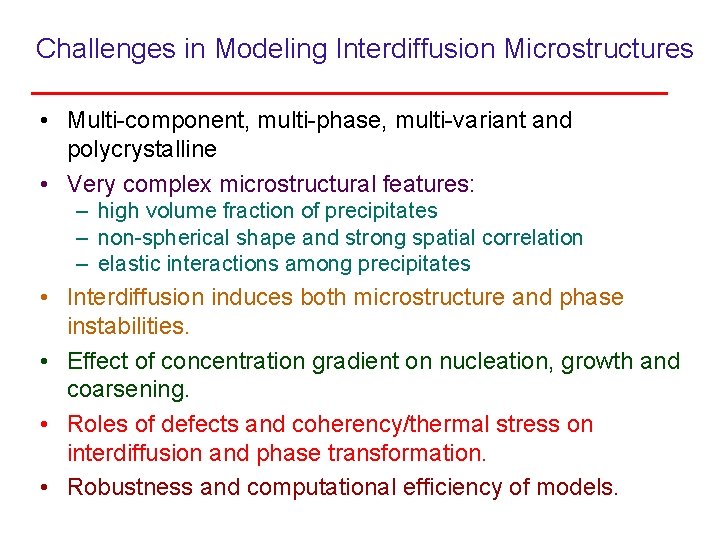
Challenges in Modeling Interdiffusion Microstructures • Multi-component, multi-phase, multi-variant and polycrystalline • Very complex microstructural features: – high volume fraction of precipitates – non-spherical shape and strong spatial correlation – elastic interactions among precipitates • Interdiffusion induces both microstructure and phase instabilities. • Effect of concentration gradient on nucleation, growth and coarsening. • Roles of defects and coherency/thermal stress on interdiffusion and phase transformation. • Robustness and computational efficiency of models.
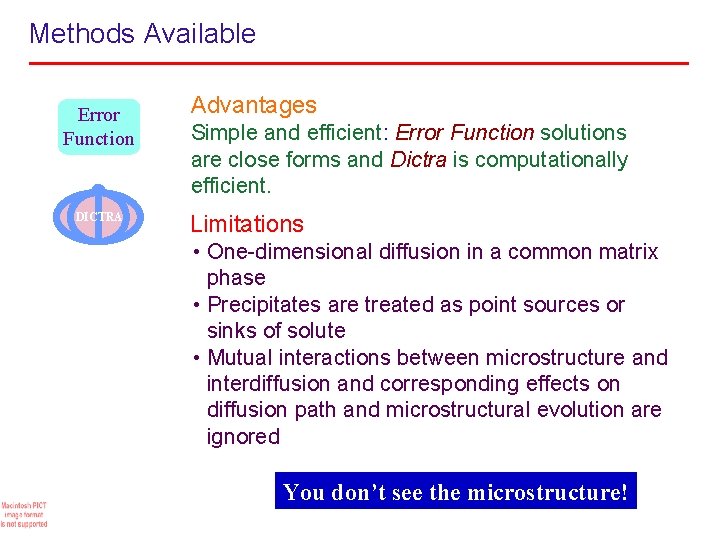
Methods Available Error Function DICTRA Advantages Simple and efficient: Error Function solutions are close forms and Dictra is computationally efficient. Limitations • One-dimensional diffusion in a common matrix phase • Precipitates are treated as point sources or sinks of solute • Mutual interactions between microstructure and interdiffusion and corresponding effects on diffusion path and microstructural evolution are ignored You don’t see the microstructure!
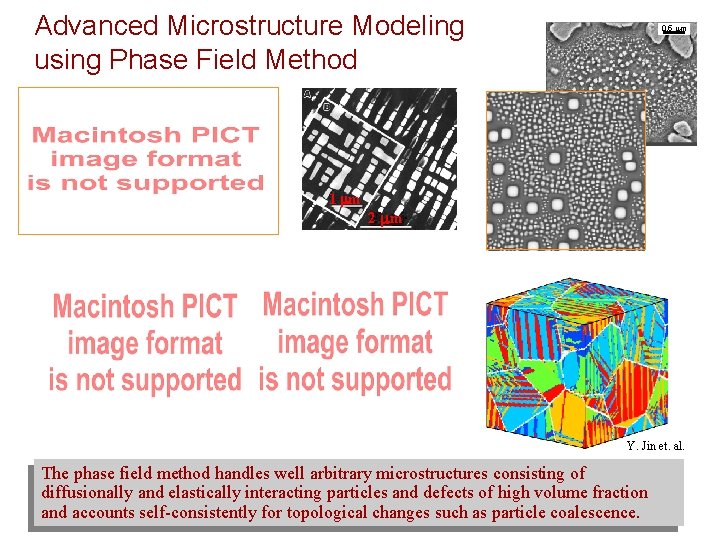
Advanced Microstructure Modeling using Phase Field Method 0. 5 m 1 mm 2 mm Y. Jin et. al. The phase field method handles well arbitrary microstructures consisting of diffusionally and elastically interacting particles and defects of high volume fraction and accounts self-consistently for topological changes such as particle coalescence.
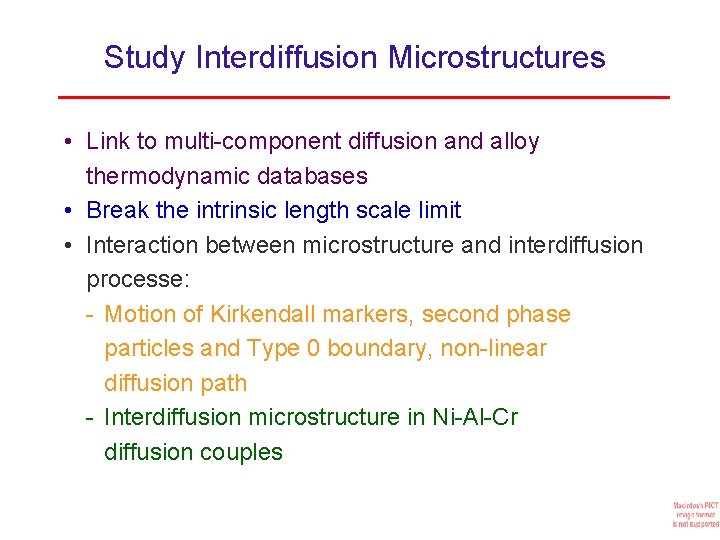
Study Interdiffusion Microstructures • Link to multi-component diffusion and alloy thermodynamic databases • Break the intrinsic length scale limit • Interaction between microstructure and interdiffusion processe: - Motion of Kirkendall markers, second phase particles and Type 0 boundary, non-linear diffusion path - Interdiffusion microstructure in Ni-Al-Cr diffusion couples
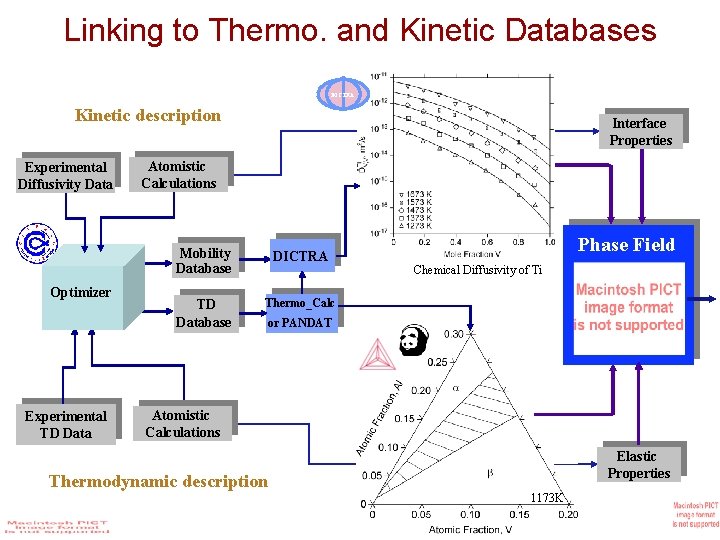
Linking to Thermo. and Kinetic Databases DICTRA Kinetic description Experimental Diffusivity Data Optimizer Experimental TD Data Interface Properties Atomistic Calculations Mobility Database DICTRA TD Database Thermo_Calc Phase Field Chemical Diffusivity of Ti or PANDAT Atomistic Calculations Elastic Properties Thermodynamic description 1173 K
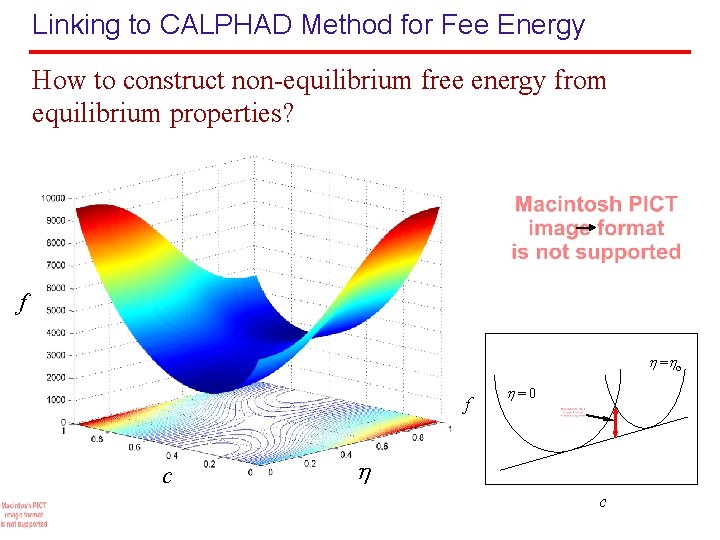
Linking to CALPHAD Method for Fee Energy How to construct non-equilibrium free energy from equilibrium properties? f h = ho f c h=0 h c
Construction of Non-Equilibrium Free Energy Indirect Coupling: Landau polynomial expansion for the free energy: Equilibrium free energy cannot be incorporated directly in the expression. A 1, A 2, and A 3 need to be fitted to thermodynamic data at different temperature in the whole composition range. It is difficult to do for multicomponent systems.
Construction of Non-Equilibrium Free Energy Direct Coupling: following the same approach as phase field modeling of solidification (e. g. , WBM or S-SK model) o Wang et. al, Physica D, 1993; 69: 189 Equilibrium free energy can be incorporated directly into the non-equilibrium free energy formulation for any multicomponent system without any extra effort.
Application I: Model System Free energy model C ’ • Elements A and B form ideal solution while elements A and C or B and C form regular solutions A Wu et. Mater. , al. Acta 49(2001), mater. 2001; 49: 3401 Acta 3401 -3408 Wu et. al. Acta mater, preprint. B
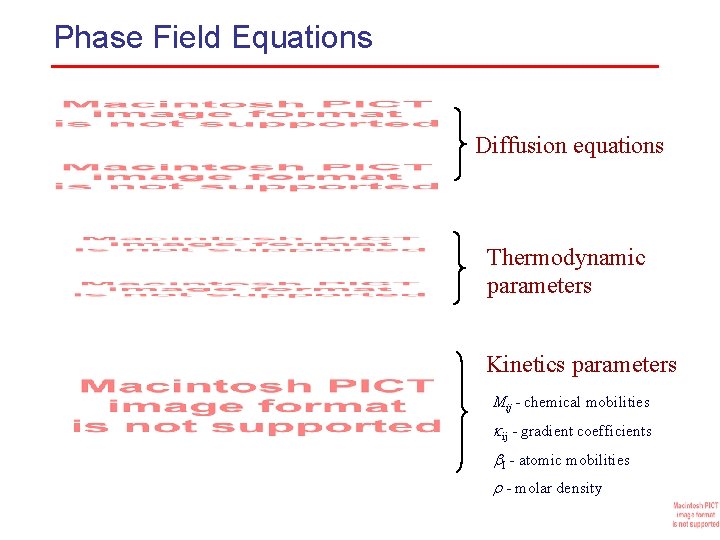
Phase Field Equations Diffusion equations Thermodynamic parameters Kinetics parameters Mij - chemical mobilities ij - gradient coefficients I - atomic mobilities - molar density
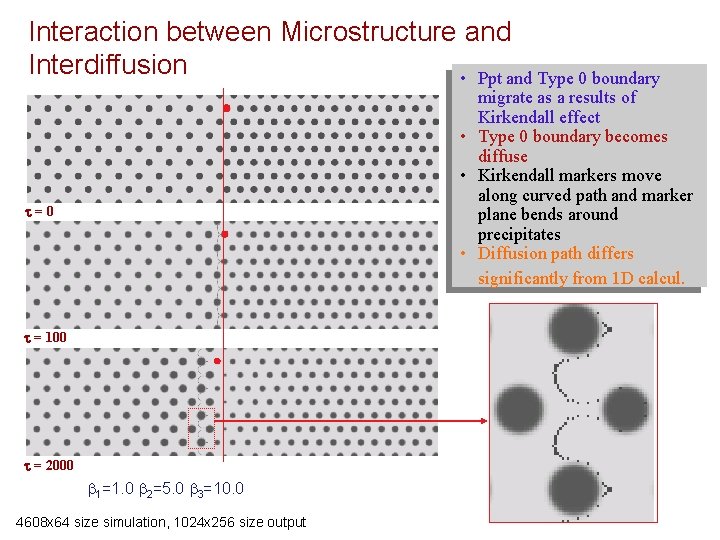
Interaction between Microstructure and Interdiffusion • Ppt and Type 0 boundary migrate as a results of Kirkendall effect • Type 0 boundary becomes diffuse • Kirkendall markers move along curved path and marker plane bends around precipitates • Diffusion path differs significantly from 1 D calcul. t = 0 t = 100 t = 2000 1=1. 0 2=5. 0 3=10. 0 4608 x 64 size simulation, 1024 x 256 size output
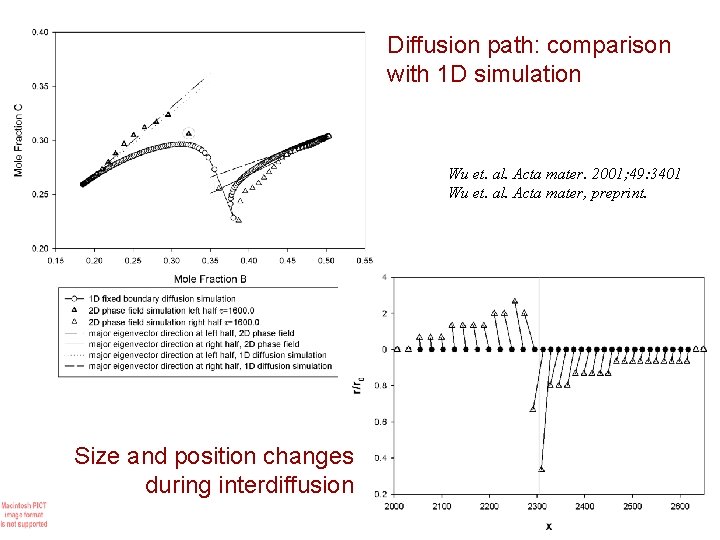
Diffusion path: comparison with 1 D simulation Wu et. al. Acta mater. 2001; 49: 3401 Wu et. al. Acta mater, preprint. Size and position changes during interdiffusion
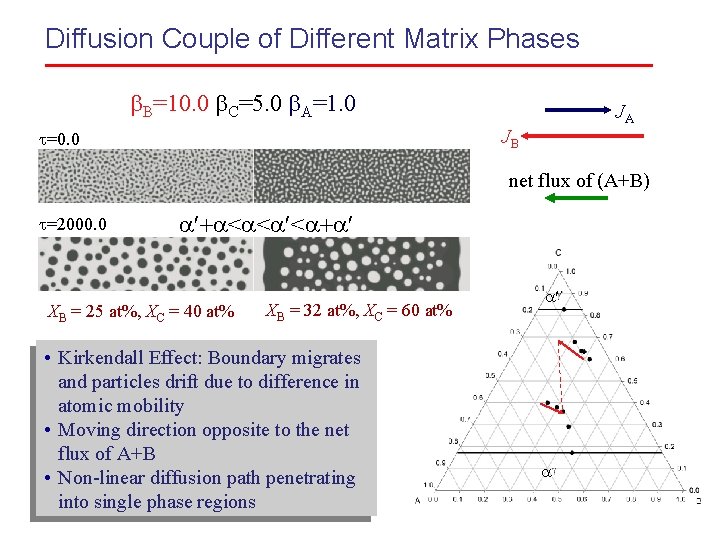
Diffusion Couple of Different Matrix Phases B=10. 0 C=5. 0 A=1. 0 JA JB t=0. 0 net flux of (A+B) t=2000. 0 < < < XB = 25 at%, XC = 40 at% XB = 32 at%, XC = 60 at% • Kirkendall Effect: Boundary migrates and particles drift due to difference in atomic mobility • Moving direction opposite to the net flux of A+B • Non-linear diffusion path penetrating into single phase regions
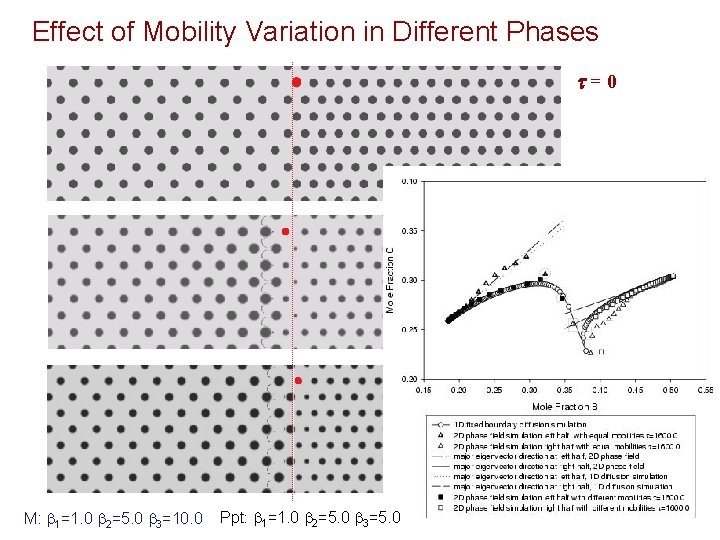
Effect of Mobility Variation in Different Phases t = 0 M: 1=1. 0 2=5. 0 3=10. 0 Ppt 1=1. 0 2=5. 0 3=5. 0
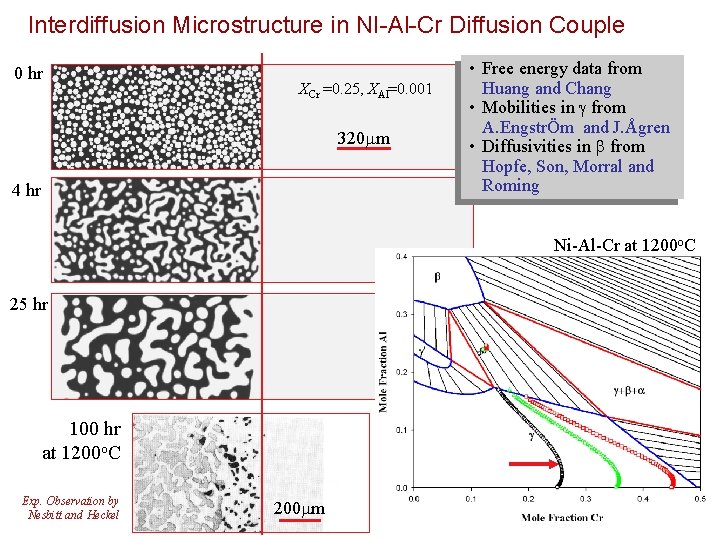
Interdiffusion Microstructure in NI-Al-Cr Diffusion Couple 0 hr XCr =0. 25, XAl=0. 001 320 m 4 hr • Free energy data from Huang and Chang • Mobilities in from A. EngstrÖm and J. Ågren • Diffusivities in from Hopfe, Son, Morral and Roming Ni-Al-Cr at 1200 o. C 25 hr 100 hr at 1200 o. C Exp. Observation by Nesbitt and Heckel 200 m
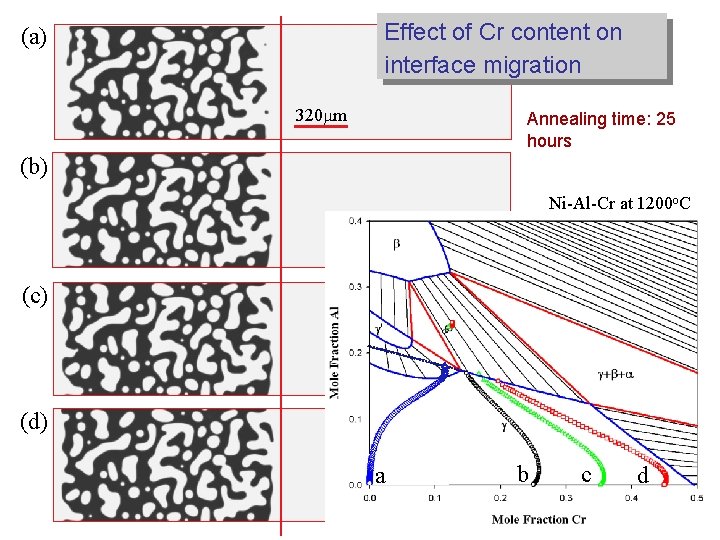
Effect of Cr content on interface migration (a) 320 m Annealing time: 25 hours (b) Ni-Al-Cr at 1200 o. C (c) (d) a b c d
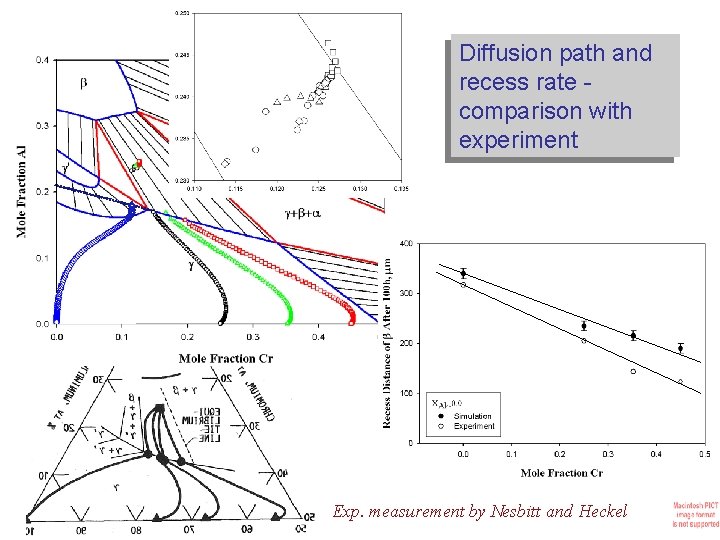
Diffusion path and recess rate comparison with experiment Exp. measurement by Nesbitt and Heckel
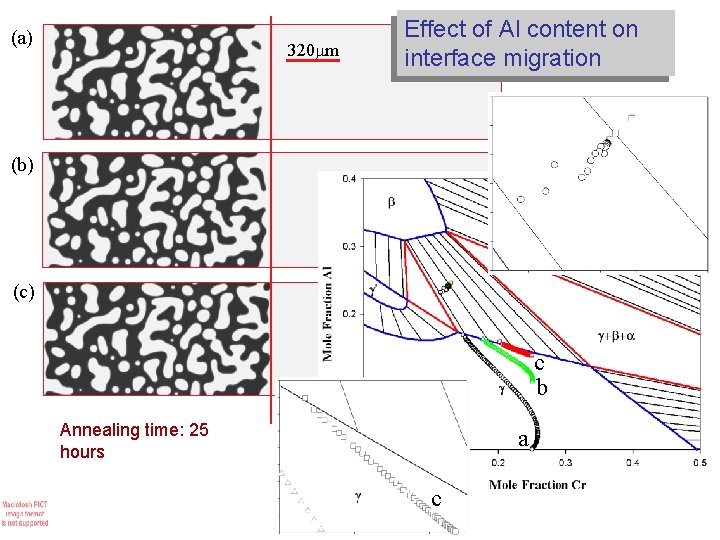
(a) 320 m Effect of Al content on interface migration (b) (c) c b Annealing time: 25 hours a c
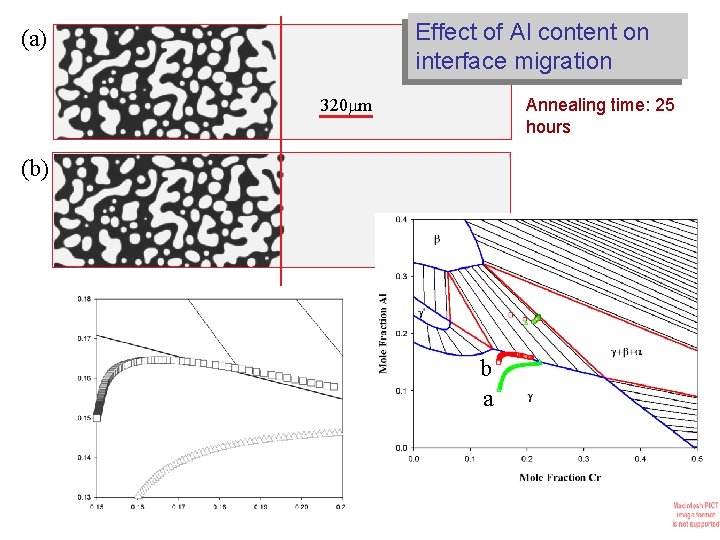
Effect of Al content on interface migration (a) Annealing time: 25 hours 320 m (b) b a
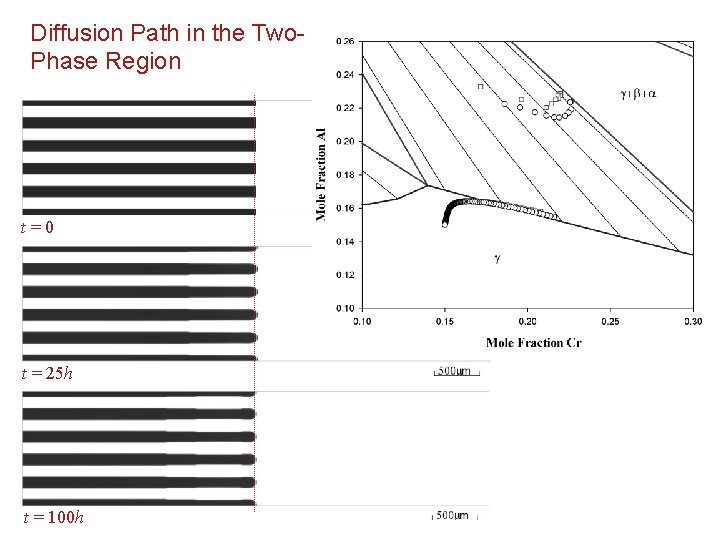
Diffusion Path in the Two. Phase Region t=0 t = 25 h t = 100 h
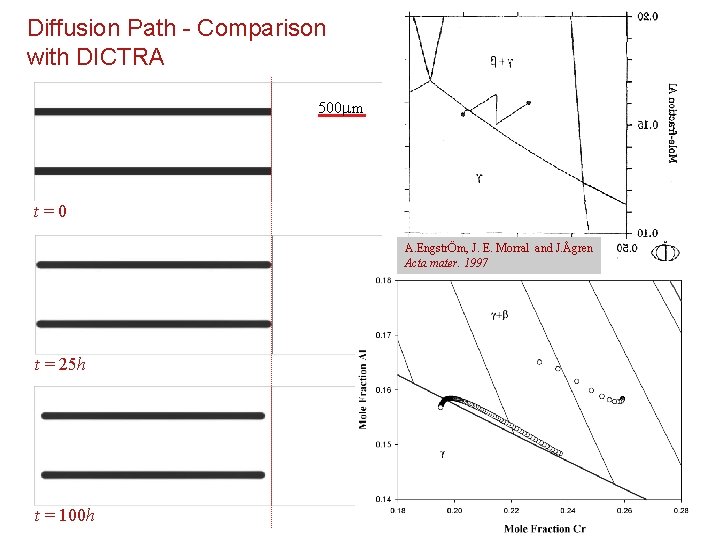
Diffusion Path - Comparison with DICTRA 500 m t=0 A. EngstrÖm, J. E. Morral and J. Ågren Acta mater. 1997 t = 25 h t = 100 h
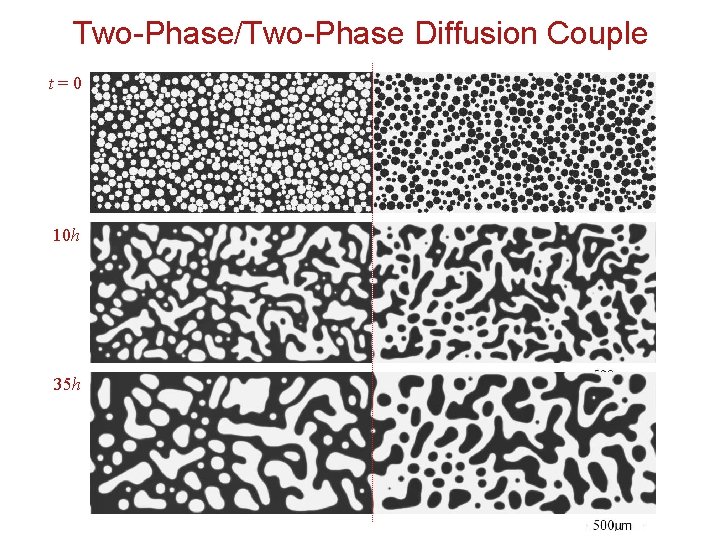
Two-Phase/Two-Phase Diffusion Couple t=0 10 h 35 h
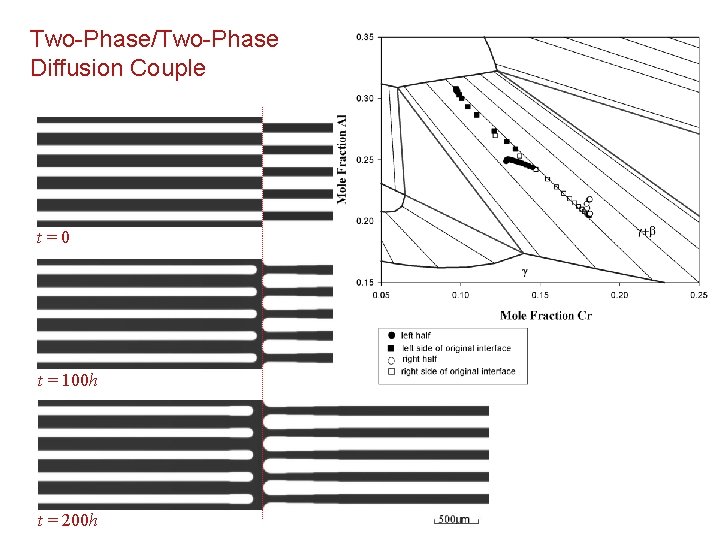
Two-Phase/Two-Phase Diffusion Couple t=0 t = 100 h t = 200 h
Summary • Computational methods based on phase field approach and linking to CALPHAD and DICTRA databases have been developed to investigate for the first time effects of microstructure on interdiffusion and interdiffusion on microstructural evolution in the interdiffusion zone. • Realistic simulations of complicated interdiffusion microstructures in multi-component and multi-phase diffusion couples have been demonstrated. • Many non-trivial results have been predicted, which are significantly different from earlier work based on 1 D models.