
Phase Classification Integrated Food Security Formation of Food


- Slides: 14
Phase Classification Integrated Food Security Formation of Food Security Working Groups FSTS Training on Food Security Integrated Phase Classification (IPC) 25 – 27 October 2010
Phase Classification Integrated Food Security 2
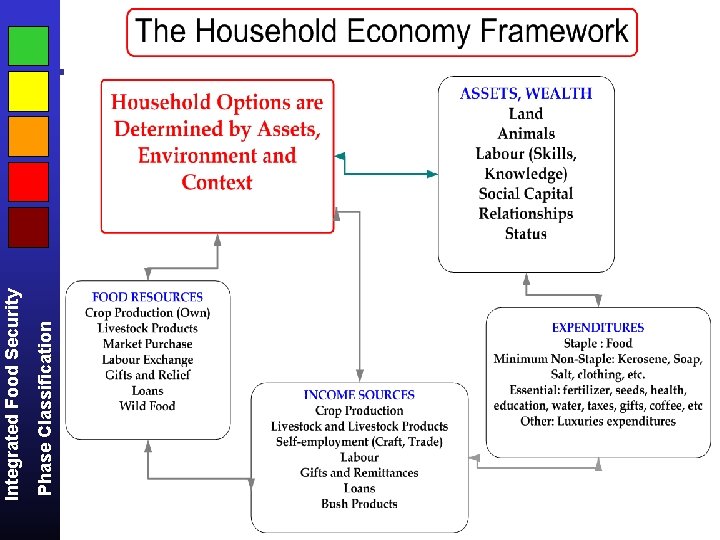
Food Insecurity – Multi-sectoral Dimension Phase Classification Integrated Food Security Successful strategies to eliminate food insecurity combines these diverse sectors 3
Formation of Food Security Working Group • One possible mechanism for generating an integrated food security analysis: Phase Classification Integrated Food Security o To establish independent structures dedicated to gathering and analyzing a wide range of food security data? ? • Two major disadvantages of independent structures: o They tend to be very costly to operate o They are often completely independent of national structure o Not Sustainable – heavy loaded institutional setup creates dependency… 4
Solution is Interdependent Coordination Group? Light weighted office structure- advantages of networking Phase Classification Integrated Food Security • Because of complex livelihood crises - requiring a range of strategies and responses that cut across mandates and institutions • Minimizes inadequate knowledge and helps to understand interlocking vulnerabilities and encourages multi-sectoral responses • Strengthens the capacity of the government by ensuring timely and accurate warning to initiate early and appropriate responses 5
Advantages … o Ensures continuous early warning information exchange between the EWS and different agencies o Aavoids duplication of data collection by decreasing establishment of parallel system – helps to keep costs at a minimum Phase Classification Integrated Food Security o Increase consensus between donors, humanitarian agencies and the Government on emergency needs and how to address them o Increase participation in and use of the results of the government-led working groups by other partners o Helps to develop an appropriate quantitative and standard methodology – creates the necessary platform for policy related discussions 6
Advantages … • Increases credibility when preceded by a consensus based planning process Phase Classification Integrated Food Security • Ensures a demand for routine data exchange network to facilitate a smooth information exchange • Improves connectivity between federal line ministries and states/localities • Helps to follow up on response, analyze gaps and update and circulate information to decision makers as required 7
Linkages b/n National & Sub-national FSIS • FSIS is increasingly needed to support decision making at the local level. Phase Classification Integrated Food Security – By building the capacity of the decentralized FSIS • Appropriate institutional relationships between national and sub-national information system activities – Mostly it is vertically integrated with data collected at lower administrative levels 8
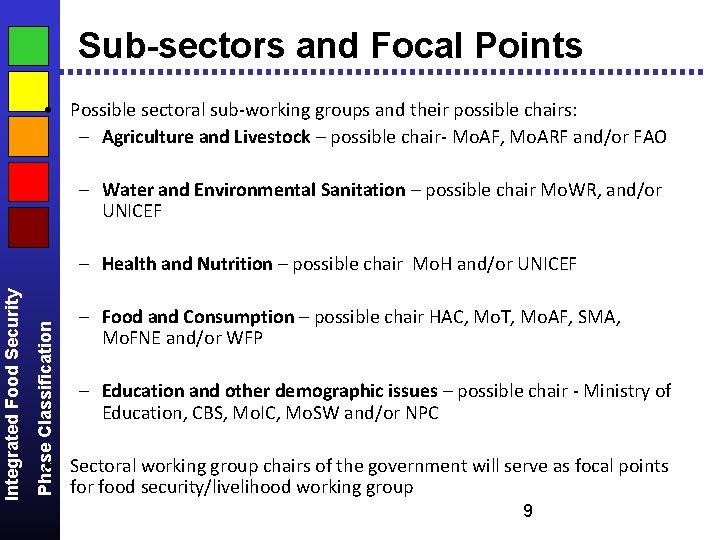
Sub-sectors and Focal Points • Possible sectoral sub-working groups and their possible chairs: – Agriculture and Livestock – possible chair- Mo. AF, Mo. ARF and/or FAO – Water and Environmental Sanitation – possible chair Mo. WR, and/or UNICEF Phase Classification Integrated Food Security – Health and Nutrition – possible chair Mo. H and/or UNICEF – Food and Consumption – possible chair HAC, Mo. T, Mo. AF, SMA, Mo. FNE and/or WFP – Education and other demographic issues – possible chair - Ministry of Education, CBS, Mo. IC, Mo. SW and/or NPC • Sectoral working group chairs of the government will serve as focal points for food security/livelihood working group 9
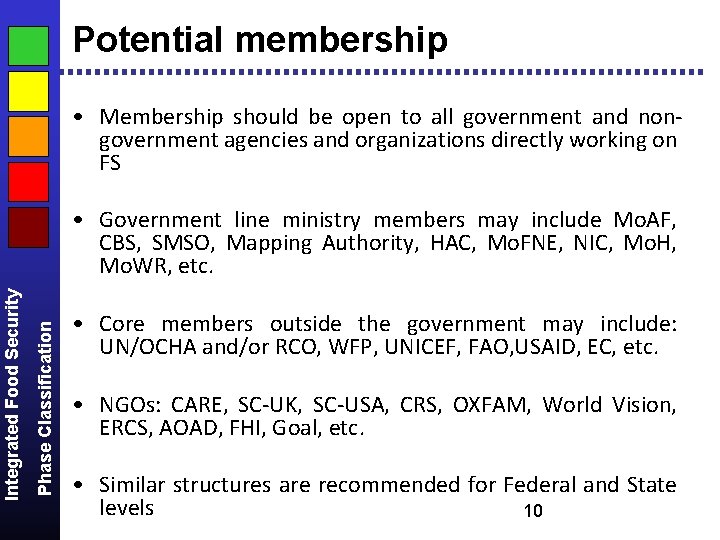
Potential membership • Membership should be open to all government and nongovernment agencies and organizations directly working on FS Phase Classification Integrated Food Security • Government line ministry members may include Mo. AF, CBS, SMSO, Mapping Authority, HAC, Mo. FNE, NIC, Mo. H, Mo. WR, etc. • Core members outside the government may include: UN/OCHA and/or RCO, WFP, UNICEF, FAO, USAID, EC, etc. • NGOs: CARE, SC-UK, SC-USA, CRS, OXFAM, World Vision, ERCS, AOAD, FHI, Goal, etc. • Similar structures are recommended for Federal and State levels 10
Phase Classification Integrated Food Security Major Activities of the working groups • The activities of the Food Security and/or livelihood Working Group can be defined via annual work-planning process. • Review of the Sudan food security monitoring system with the aim of developing a single standardized approach • Ensure coordination and coherence between the various information systems of the Government • Review, advise and develop a standing system of sectoral and cross-sectoral coordination at federal and state levels. • Providing technical advice and guidance on food security and drought mgt to the Government, donors and partners. 11
Sustainability • The leadership of the government should be ensured and well articulated Phase Classification Integrated Food Security • Without Government leadership, other agencies would continue to lead sectors to their own objectives. • This is now functioning in uncoordinated manner and has the potential to result in more debate and less consensus • Best example – Case of Kadugli – DG chairing FSLCG 12
Possible Constraints • Lack of sustained commitment and resource and capacity (human and financial resources) • Institutional agenda may sometimes set in Phase Classification Integrated Food Security – Hence strong support required, at least at its initial stages • Frequency of lengthy meetings may increase • Network partners may not always conform to deadlines 13
Phase Classification Integrated Food Security Thank You 14