
Phase and Amplitude in Fourier Transforms Meaning of
- Slides: 13
Phase and Amplitude in Fourier Transforms, Meaning of frequencies
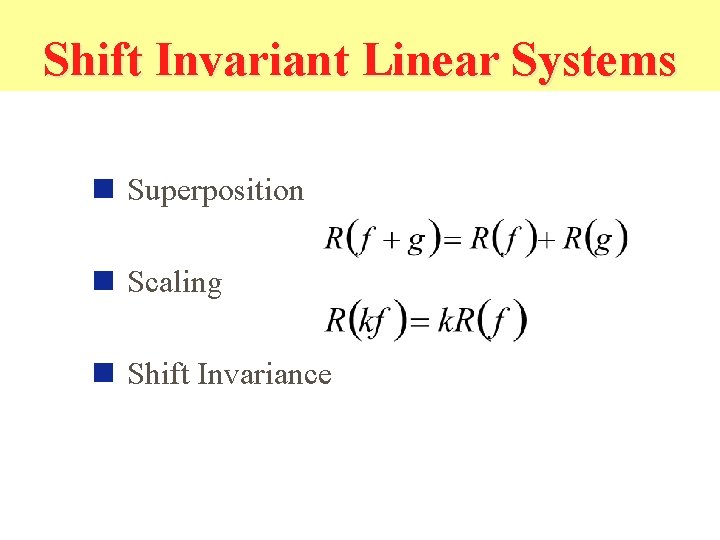
Shift Invariant Linear Systems n Superposition n Scaling n Shift Invariance
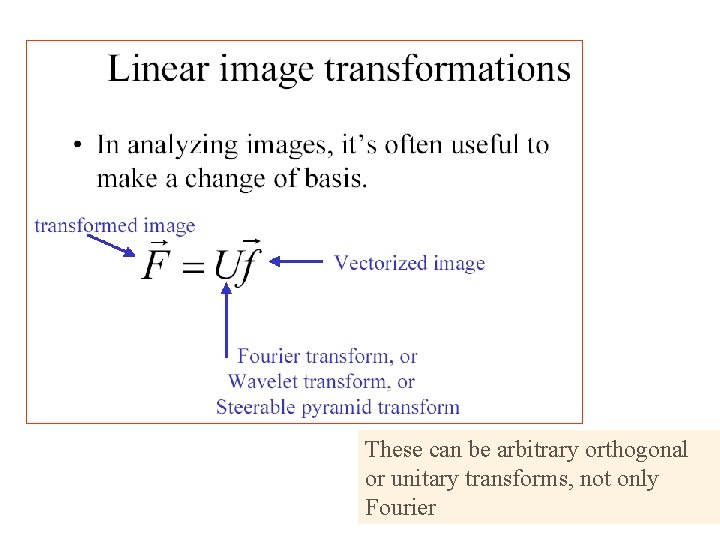
These can be arbitrary orthogonal or unitary transforms, not only Fourier
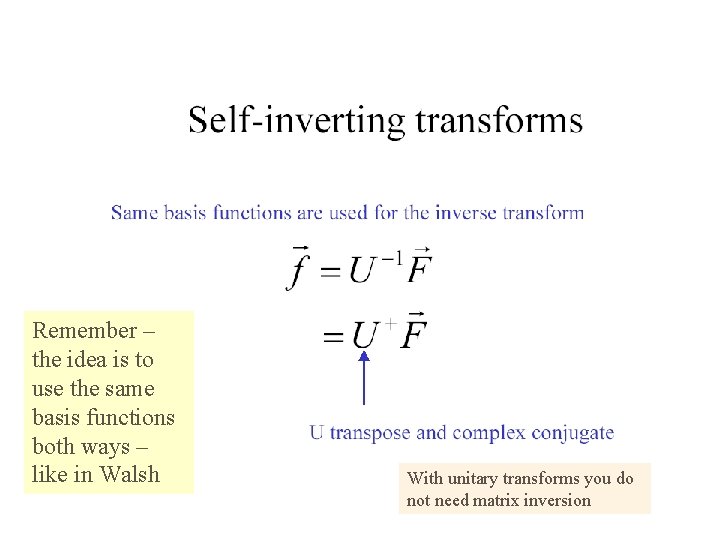
Remember – the idea is to use the same basis functions both ways – like in Walsh With unitary transforms you do not need matrix inversion
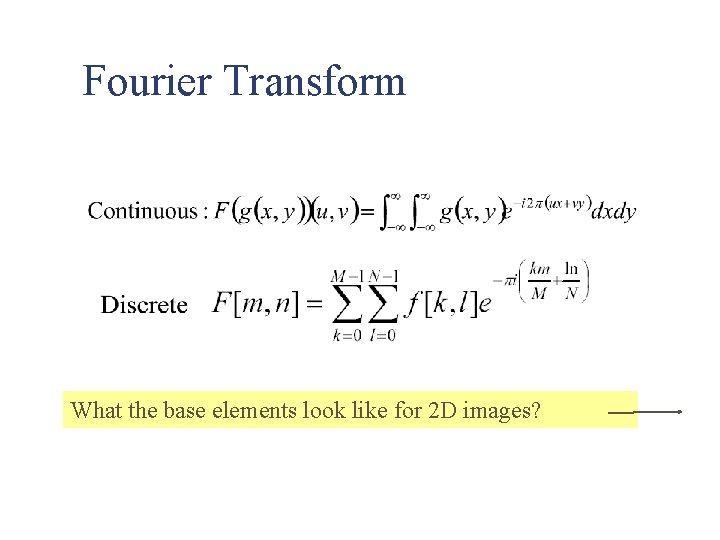
Fourier Transform What the base elements look like for 2 D images?
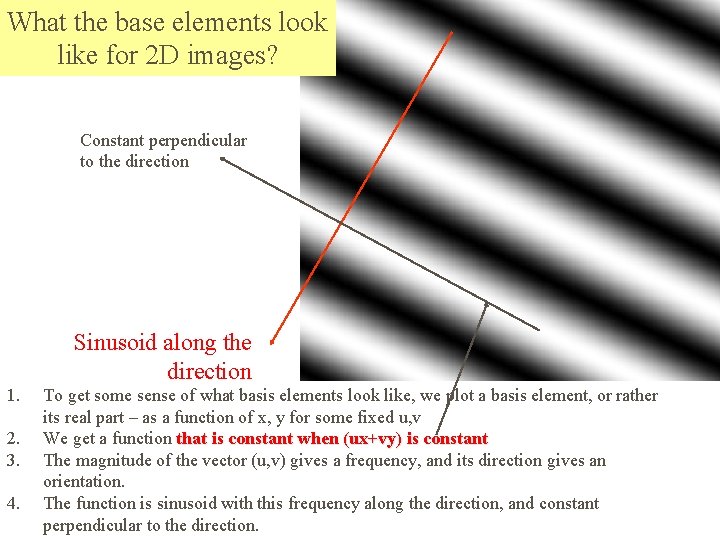
What the base elements look like for 2 D images? Constant perpendicular to the direction Sinusoid along the direction 1. 2. 3. 4. To get some sense of what basis elements look like, we plot a basis element, or rather its real part – as a function of x, y for some fixed u, v We get a function that is constant when (ux+vy) is constant The magnitude of the vector (u, v) gives a frequency, and its direction gives an orientation. The function is sinusoid with this frequency along the direction, and constant perpendicular to the direction.
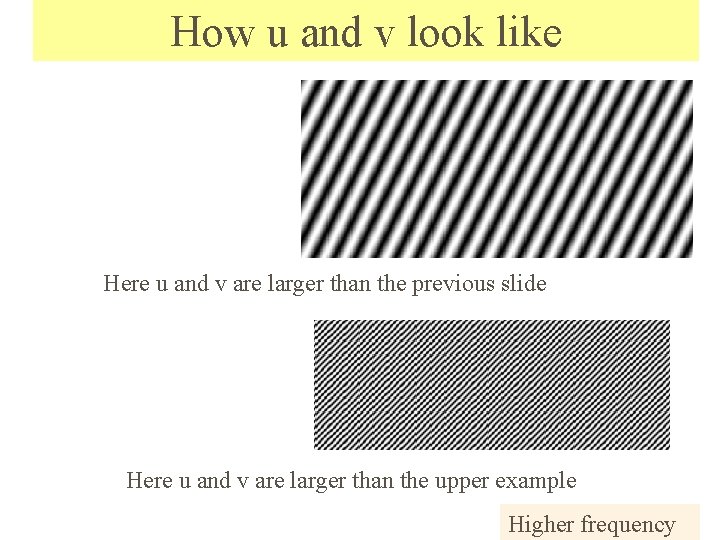
How u and v look like Here u and v are larger than the previous slide Here u and v are larger than the upper example Higher frequency
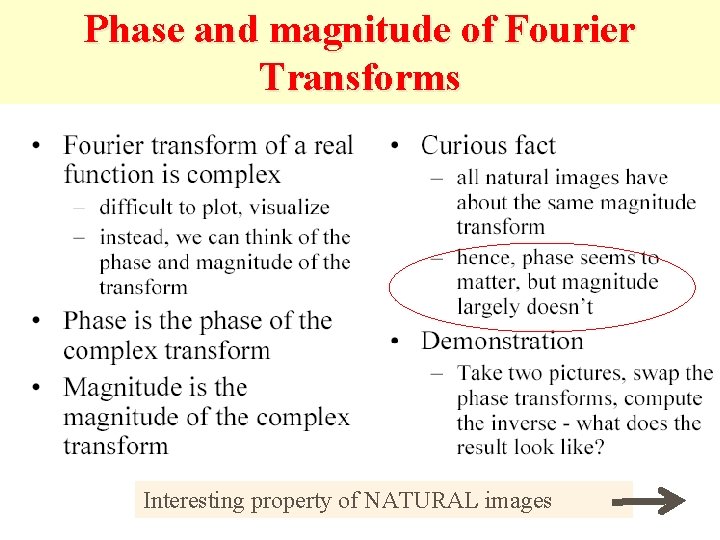
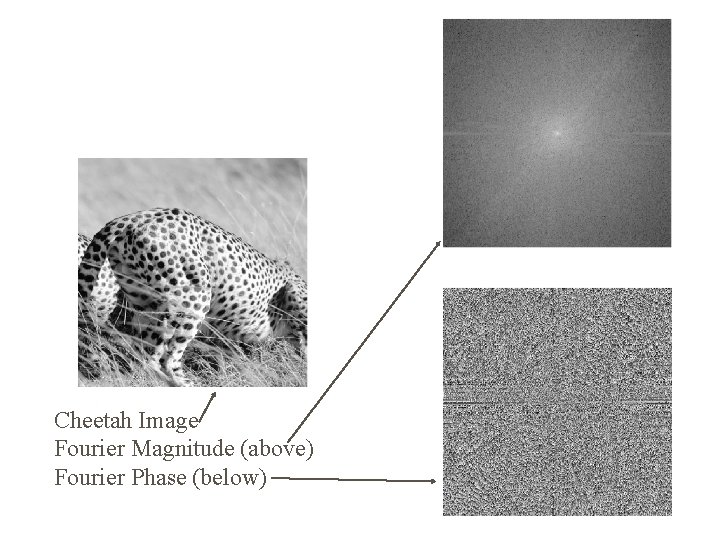
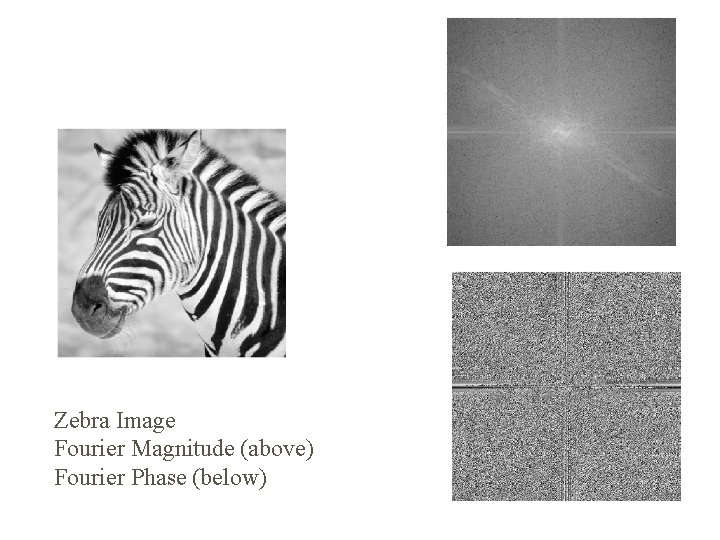
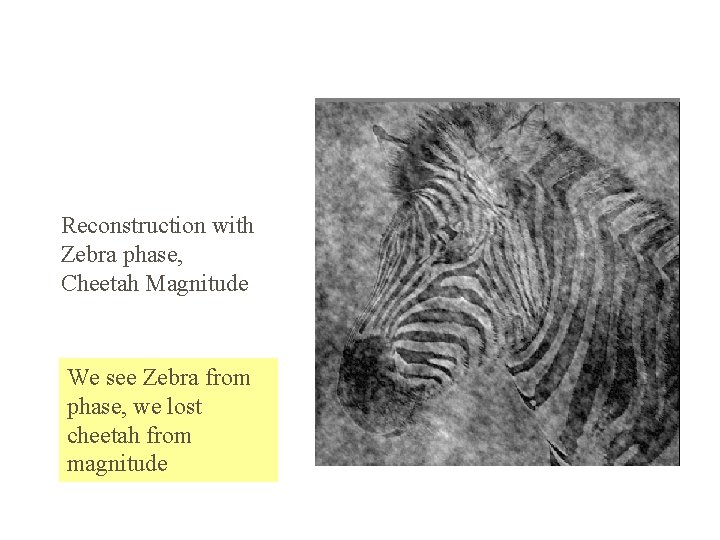
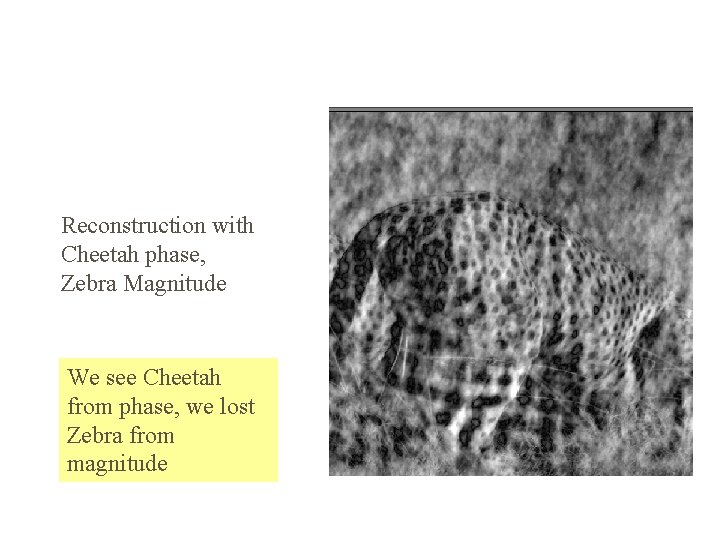
Phase and magnitude of Fourier Transforms Interesting property of NATURAL images
Cheetah Image Fourier Magnitude (above) Fourier Phase (below)
Zebra Image Fourier Magnitude (above) Fourier Phase (below)
Reconstruction with Zebra phase, Cheetah Magnitude We see Zebra from phase, we lost cheetah from magnitude
Reconstruction with Cheetah phase, Zebra Magnitude We see Cheetah from phase, we lost Zebra from magnitude
Suggested Reading n Chapter 7, David A. Forsyth and Jean Ponce, "Computer Vision: A Modern Approach"