
Phase 2 Multicenter Study Results of Ublituximab a
Phase 2 Multicenter Study Results of Ublituximab, a Novel Glycoengineered Anti-CD 20 Monoclonal Antibody (m. Ab), in Patients with Relapsing Forms of Multiple Sclerosis (RMS) Edward Fox, MD, Ph. D
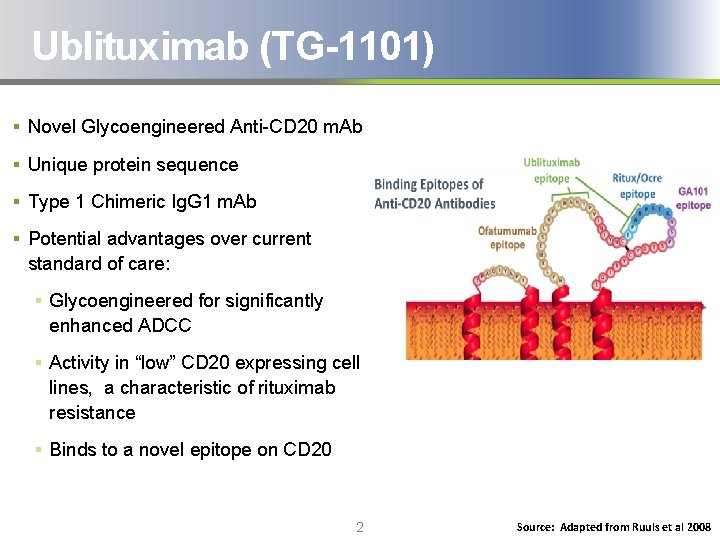
Ublituximab (TG-1101) § Novel Glycoengineered Anti-CD 20 m. Ab § Unique protein sequence § Type 1 Chimeric Ig. G 1 m. Ab § Potential advantages over current standard of care: § Glycoengineered for significantly enhanced ADCC § Activity in “low” CD 20 expressing cell lines, a characteristic of rituximab resistance § Binds to a novel epitope on CD 20 2 Source: Adapted from Ruuls et al 2008
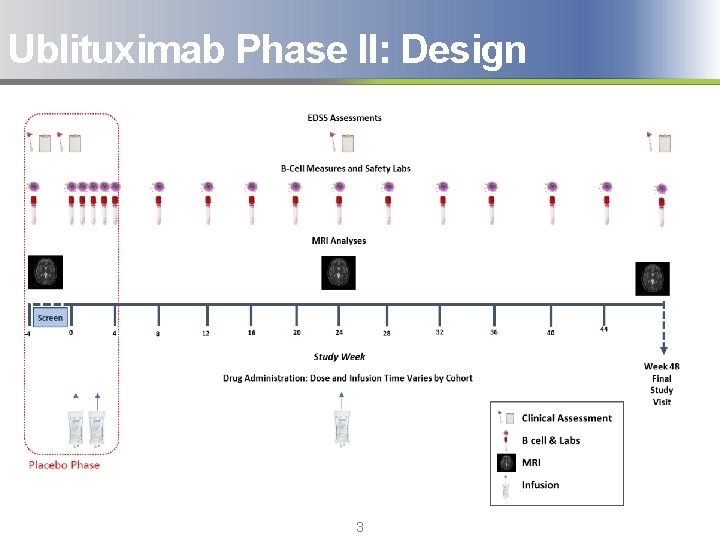
Ublituximab Phase II: Design 3
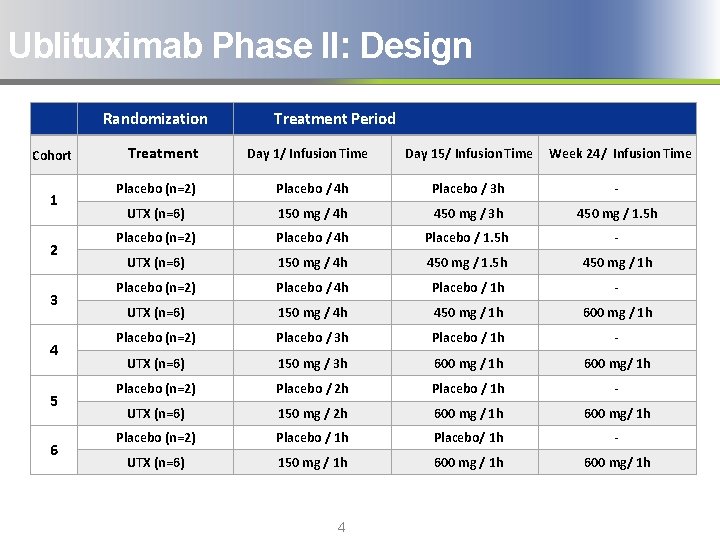
Ublituximab Phase II: Design Randomization Cohort 1 2 3 4 5 6 Treatment Period Day 1/ Infusion Time Day 15/ Infusion Time Week 24/ Infusion Time Placebo (n=2) Placebo / 4 h Placebo / 3 h - UTX (n=6) 150 mg / 4 h 450 mg / 3 h 450 mg / 1. 5 h Placebo (n=2) Placebo / 4 h Placebo / 1. 5 h - UTX (n=6) 150 mg / 4 h 450 mg / 1. 5 h 450 mg / 1 h Placebo (n=2) Placebo / 4 h Placebo / 1 h - UTX (n=6) 150 mg / 4 h 450 mg / 1 h 600 mg / 1 h Placebo (n=2) Placebo / 3 h Placebo / 1 h - UTX (n=6) 150 mg / 3 h 600 mg / 1 h 600 mg/ 1 h Placebo (n=2) Placebo / 2 h Placebo / 1 h - UTX (n=6) 150 mg / 2 h 600 mg / 1 h 600 mg/ 1 h Placebo (n=2) Placebo / 1 h Placebo/ 1 h - UTX (n=6) 150 mg / 1 h 600 mg/ 1 h 4
TG 1101 -RMS 201 PHASE II RESULTS Week 24 Results (48 Week Study)

Ublituximab Phase II Week 24 Results: Baseline Characteristics 6
Ublituximab Phase II Week 24 Results: Patient Disposition § 48 subjects were randomized to treatment in Cohort 1 through Cohort 6 § 46/48 subjects completed 6 months of ublituximab treatment; 12 (2 per cohort) received placebo infusions, before crossing over to the ublituximab arm § One subject in Cohort 2 withdrew from the study due to pregnancy, after having received 2 ublituximab infusions, but continued to be followed with safety lab monitoring and immunological analyses § One subject in Cohort 6 missed the week 24 infusion, and later withdrew 7
Ublituximab Phase II Week 24 Results: Safety & Tolerability 8
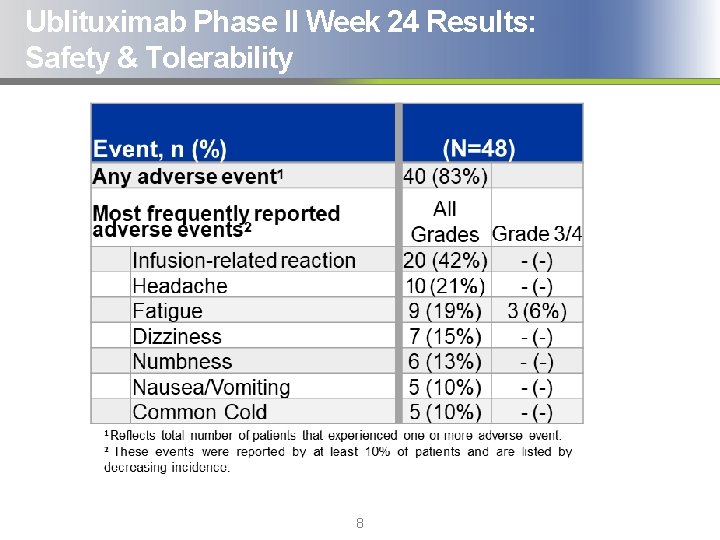
Ublituximab Phase II Week 24 Results: Safety & Tolerability § Ublituximab was well tolerated and no drug related discontinuations from study have occurred to date § No Grade 3/4 Adverse Events (AEs) were deemed possibly related to ublituximab § A total of 41 infusion related reactions (IRRs) were reported in 20 subjects. All were Grade 1 or Grade 2 § There were no events of death reported on study § The Data Safety Monitoring Board (DSMB) has reviewed safety labs and adverse events for all subjects to date, and has not found any lab abnormalities or safety signals that would warrant a change in protocol 9
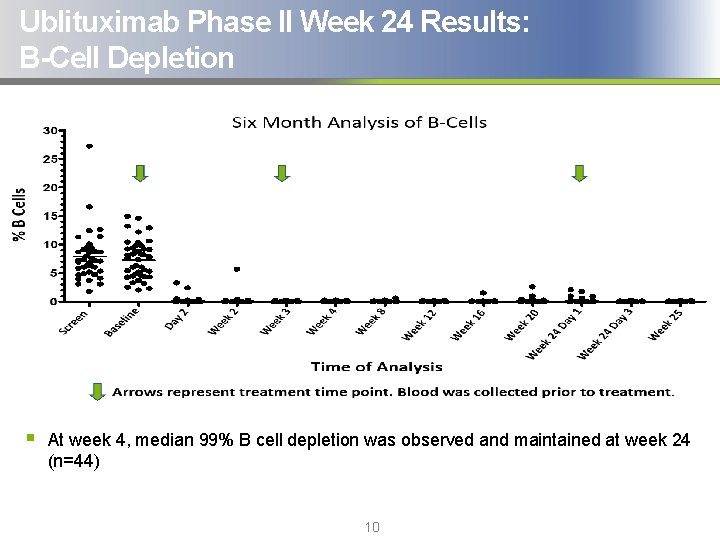
Ublituximab Phase II Week 24 Results: B-Cell Depletion § At week 4, median 99% B cell depletion was observed and maintained at week 24 (n=44) 10
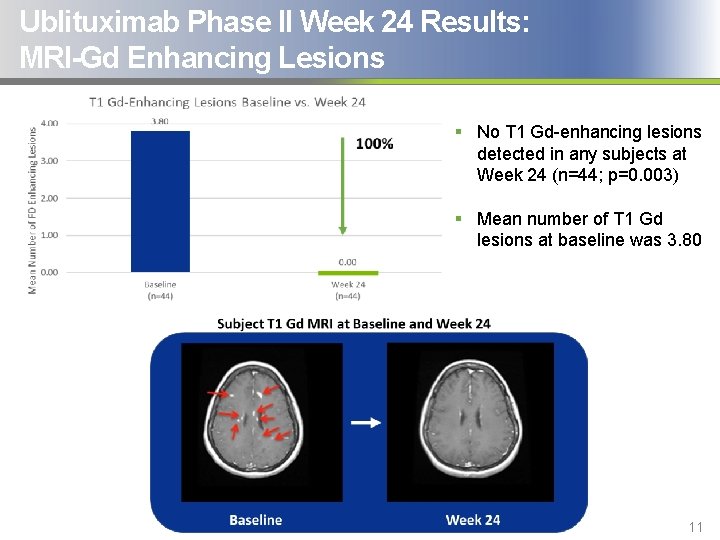
Ublituximab Phase II Week 24 Results: MRI-Gd Enhancing Lesions § No T 1 Gd-enhancing lesions detected in any subjects at Week 24 (n=44; p=0. 003) § Mean number of T 1 Gd lesions at baseline was 3. 80 11
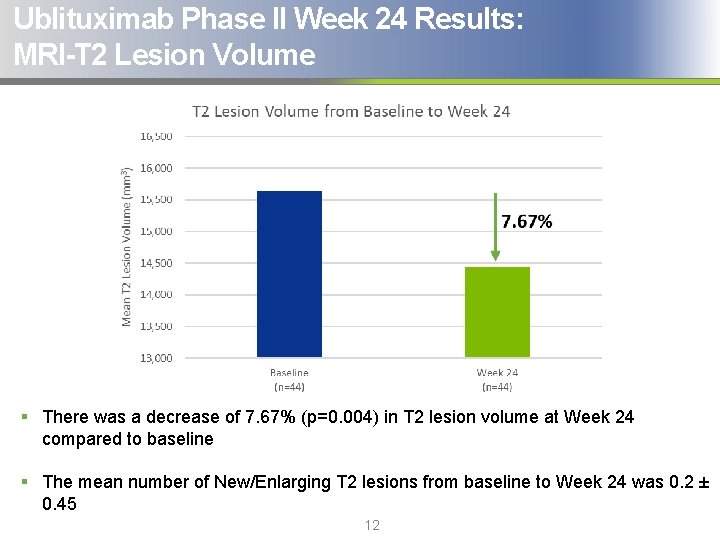
Ublituximab Phase II Week 24 Results: MRI-T 2 Lesion Volume § There was a decrease of 7. 67% (p=0. 004) in T 2 lesion volume at Week 24 compared to baseline § The mean number of New/Enlarging T 2 lesions from baseline to Week 24 was 0. 2 ± 0. 45 12
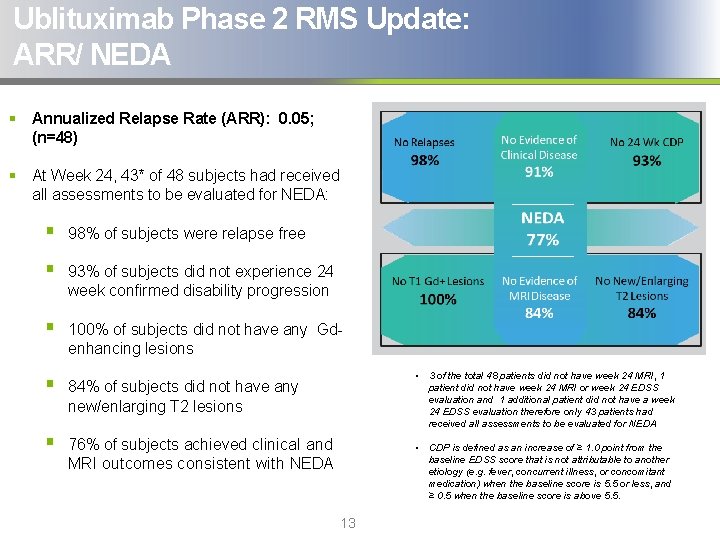
Ublituximab Phase 2 RMS Update: ARR/ NEDA § Annualized Relapse Rate (ARR): 0. 05; (n=48) § At Week 24, 43* of 48 subjects had received all assessments to be evaluated for NEDA: § 98% of subjects were relapse free § 93% of subjects did not experience 24 week confirmed disability progression § 100% of subjects did not have any Gdenhancing lesions § 84% of subjects did not have any new/enlarging T 2 lesions § 76% of subjects achieved clinical and MRI outcomes consistent with NEDA • 3 of the total 48 patients did not have week 24 MRI, 1 patient did not have week 24 MRI or week 24 EDSS evaluation and 1 additional patient did not have a week 24 EDSS evaluation therefore only 43 patients had received all assessments to be evaluated for NEDA • CDP is defined as an increase of ≥ 1. 0 point from the baseline EDSS score that is not attributable to another etiology (e. g. fever, concurrent illness, or concomitant medication) when the baseline score is 5. 5 or less, and ≥ 0. 5 when the baseline score is above 5. 5. 13
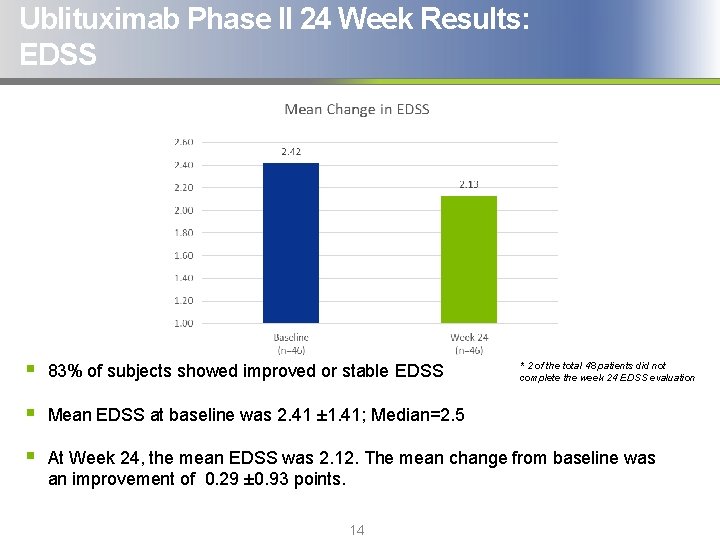
Ublituximab Phase II 24 Week Results: EDSS § 83% of subjects showed improved or stable EDSS § Mean EDSS at baseline was 2. 41 ± 1. 41; Median=2. 5 § At Week 24, the mean EDSS was 2. 12. The mean change from baseline was an improvement of 0. 29 ± 0. 93 points. 14 * 2 of the total 48 patients did not complete the week 24 EDSS evaluation
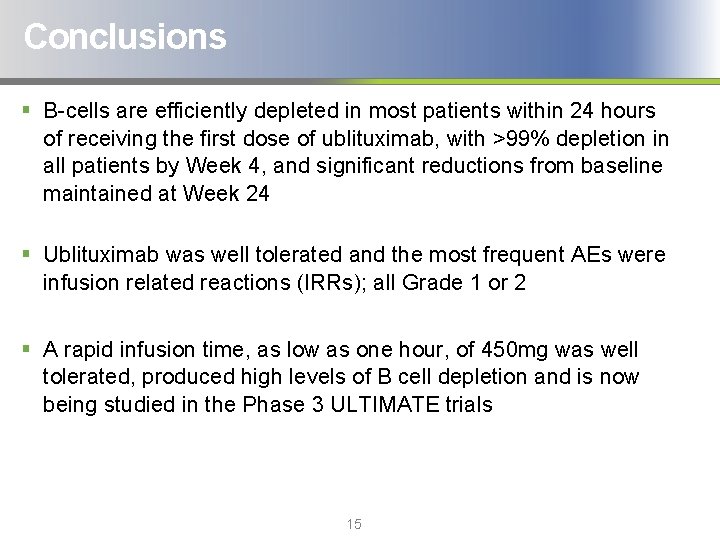
Conclusions § B-cells are efficiently depleted in most patients within 24 hours of receiving the first dose of ublituximab, with >99% depletion in all patients by Week 4, and significant reductions from baseline maintained at Week 24 § Ublituximab was well tolerated and the most frequent AEs were infusion related reactions (IRRs); all Grade 1 or 2 § A rapid infusion time, as low as one hour, of 450 mg was well tolerated, produced high levels of B cell depletion and is now being studied in the Phase 3 ULTIMATE trials 15
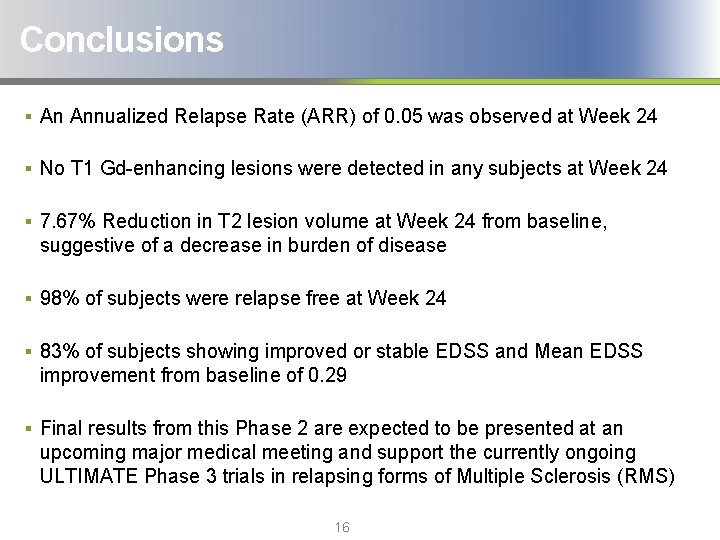
Conclusions § An Annualized Relapse Rate (ARR) of 0. 05 was observed at Week 24 § No T 1 Gd-enhancing lesions were detected in any subjects at Week 24 § 7. 67% Reduction in T 2 lesion volume at Week 24 from baseline, suggestive of a decrease in burden of disease § 98% of subjects were relapse free at Week 24 § 83% of subjects showing improved or stable EDSS and Mean EDSS improvement from baseline of 0. 29 § Final results from this Phase 2 are expected to be presented at an upcoming major medical meeting and support the currently ongoing ULTIMATE Phase 3 trials in relapsing forms of Multiple Sclerosis (RMS) 16
Thank You to Our Study Sites § Hope Neurology, Knoxville, TN: Sibyl Wray, MD § Coordinator: Brenda Whitehead, CCRP § SC 3 Research Group, Arcadia, CA: Richard Shubin, MD § Coordinator: Ngoc Nguyen § Ohio State University, Columbus, OH: Richard Kissel, MD § Coordinator: Misty Green § Associates in Neurology, Lexington, KY: Cary Twyman, MD § Coordinator: Laura Sanders, CCRC § Central Texas Neurology, Round Rock, TX: Edward Fox, MD, Ph. D § Coordinator: Lori Mayer, RN, Ph. D § University of Colorado, Aurora, CO: Timothy Vollmer, MD § Coordinator: Emil Diguilio § Neurology Center of San Antonio, TX: Ann Bass, MD § Coordinator: Tina Clements, RN, BSN § Holy Name Hospital, Teaneck, NJ: Mary Ann Picone, MD § Coordinator: Stacey Melvin, RN, BSN § Advanced Neurology, Fort Collins, CO: Tamara Miller, MD § Coordinator: Lillie Denny § Phoenix Neurological Associates: Barry Hendin, MD § Coordinator: Lynn Flynn 17
- Slides: 17