
Phase 1 Student Housing Feasibility Study Market Assessment
Phase 1 Student Housing Feasibility Study Market Assessment & Demand Analysis College Village Overlay District Yucaipa, California November 3, 2017
Brookhurst Development & Advisory Corporation • Established in 1996 - National development and advisory firm with offices in Newport Beach, Sacramento, Indianapolis and Houston • Experience in development and governmental advisory services with over $5 billion of higher education and various government projects • Recognized as a foremost expert in alternative delivery options for California government projects including P 3 s, DBFOM & Lease-Leaseback • Currently under contract to develop CSU’s first P 3 project in its 150 -year history – CSU San Marcos Extended Learning Complex

SBCCD Student Housing Objectives Phase I Feasibility Study • Market assessment and demand analysis to ascertain existing demand, and patterns and trends within community college student housing • Assessment of surrounding market conditions, demographic analysis, current enrollment, projected growth and rent obtainable for the new dorm units • Market study of existing off-campus housing • Review of peer benchmark projects (other California community colleges with student housing) • Comprehensive survey of faculty, staff and students
College Village Overlay District – Yucaipa, CA • A collaborative effort between the City of Yucaipa and San Bernardino Community College District/Crafton Hills Community College • 49. 1 acres of raw undeveloped land primarily comprised of two large parcels, each currently owned by two separate private owners • Primary goal is “to encourage the development of a vibrant, pedestrianfriendly college village that offers a range of housing and nonresidential opportunities, including commercial, public, and institutional uses, to serve the diverse needs of the college, Yucaipa community, and the region. " • Objectives include creating a sustainable mix of quasi-public/institutional and educational uses, housing – inclusive of student/faculty housing, and a range of commercial uses to provide economic vitality to the District
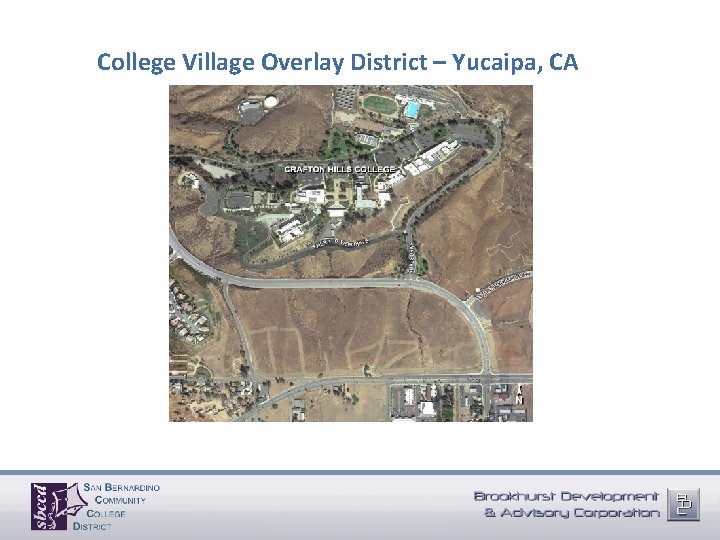
College Village Overlay District – Yucaipa, CA
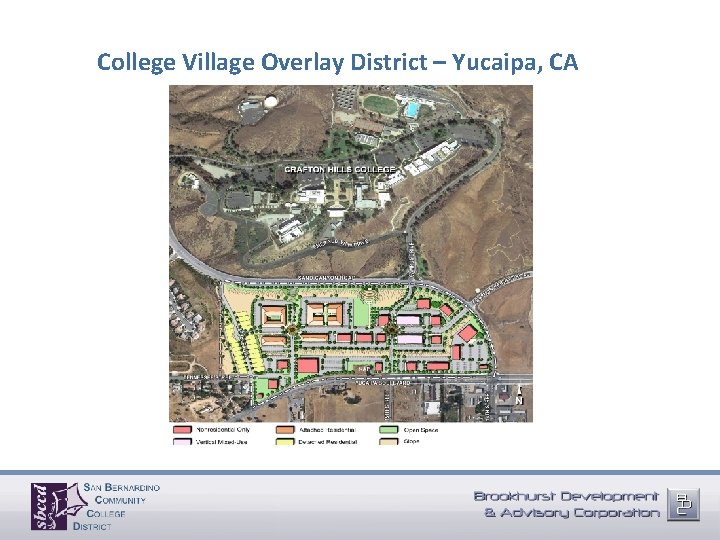
College Village Overlay District – Yucaipa, CA
College Village Overlay District – Yucaipa, CA Objectives also include: • Promoting infill, transit-oriented development, and other forms of sustainable development that facilitate a dynamic environment for both daytime and nighttime usage that serves the College and community. • Providing enhanced pedestrian amenities and improvements, including benches, special pedestrian-scale lighting, theme paving, sidewalk improvements, and fully accessible ramp improvements at intersections. • Improving transit, bicycle, and pedestrian access from the site to the College and to other local and regional destinations; internal pedestrian pathways should feed into proposed and existing trails at Crafton Hills College and other trails in the area. • Process will require partnerships with public and private entities, including Crafton Hills College and private property owners, to help facilitate development of the College Village site.

Example Case Study – Urban Village, CSU San Marcos North City - Urban Villages San Marcos (UVSM) is becoming one of the most dynamic college village districts in California North City/UVSM current success projects: • 846 -bed student housing development • 200 -unit market-rate apartment complex • PIMA office bldg. /medical school • Retail “Urge” micro-brewery, restaurant, bowling alley and activity center
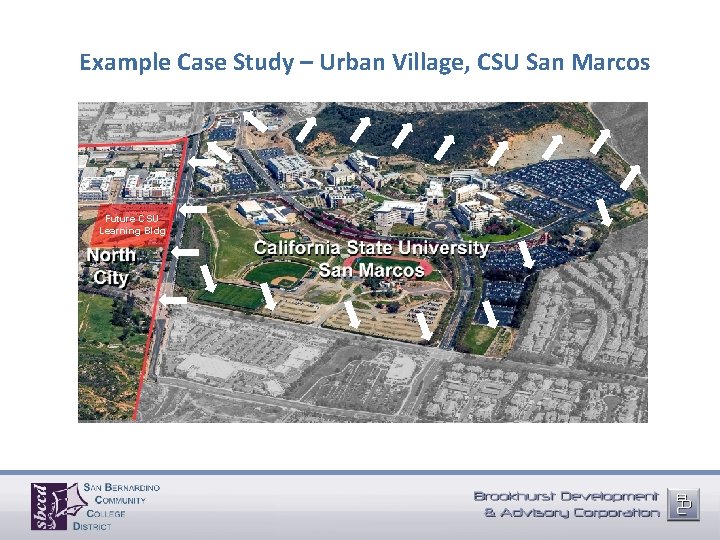
Example Case Study – Urban Village, CSU San Marcos Future CSU Learning Bldg
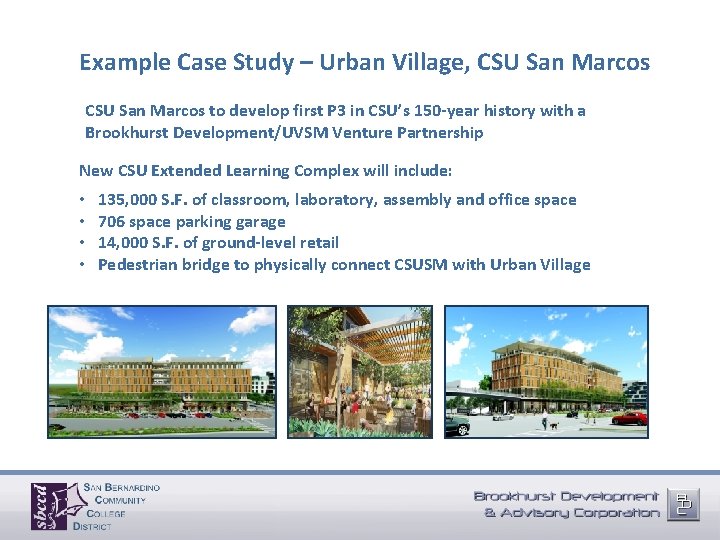
Example Case Study – Urban Village, CSU San Marcos to develop first P 3 in CSU’s 150 -year history with a Brookhurst Development/UVSM Venture Partnership New CSU Extended Learning Complex will include: • • 135, 000 S. F. of classroom, laboratory, assembly and office space 706 space parking garage 14, 000 S. F. of ground-level retail Pedestrian bridge to physically connect CSUSM with Urban Village
Existing Conditions Analysis Key Findings: • CHC’s participation rate of 8 per 1000 residents is substantially below the state average for community colleges of 54 per 1000 residents. • Enrollment decline and limited staffing continues to challenge CHC. Since 1992, full-term enrollment has only grown from 7, 725 to 8, 056 (4. 3%). • The City of Yucaipa is forecasted to see a further residential shift towards the elderly and retirees, more so than its surrounding communities. • The need for CHC to pursue opportunities to enhance enrollment by meeting curriculum and housing needs of the community will become increasingly more important in the future.
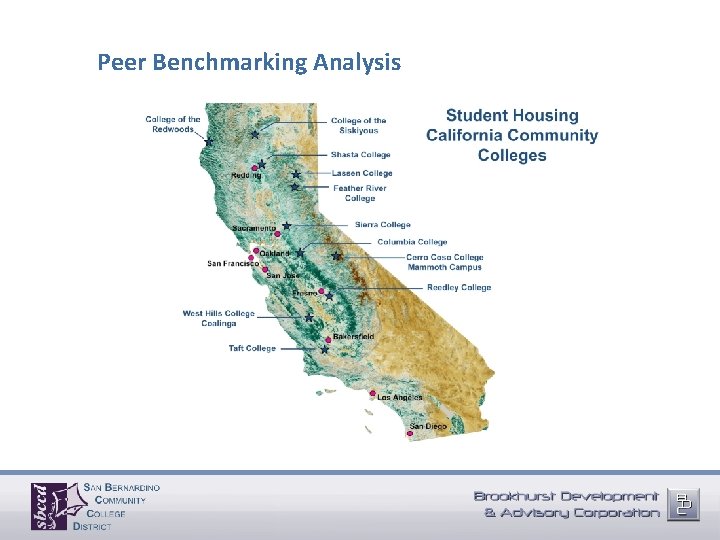
Peer Benchmarking Analysis Key Findings: • 10%, or 11 campuses, of California Community College offer student housing, less than 30% national average. • All CA community colleges with student housing are outside primary population centers. • Nine campuses are among the smallest quartile. Average student headcount is 8, 056; CHC headcount is 8, 860. • 60% have occupancy rates at full capacity, and half of those have waiting lists.
Peer Benchmarking Analysis
Peer Benchmarking Analysis Key Findings: • Apartment-style options include kitchenette and bathroom; Dormstyles include shared or communal bathrooms with some also including communal kitchens. • All require adequate electronic and Internet infrastructure, security, parking and are fully furnished. Online operational systems are highly recommended. • Determining food options/meal plans are integral to design and operation of student housing, impacting rental rates, selection of student housing vs. market-rate housing, staffing, and alternative onand off-campus dining options.
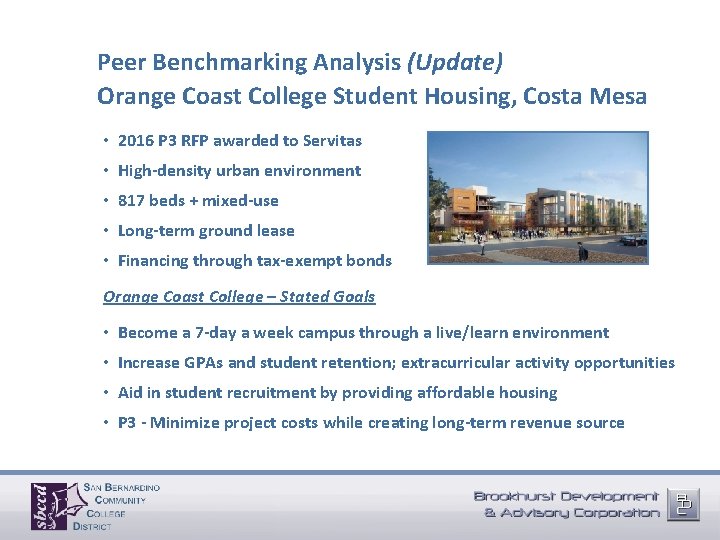
Peer Benchmarking Analysis (Update) Orange Coast College Student Housing, Costa Mesa • 2016 P 3 RFP awarded to Servitas • High-density urban environment • 817 beds + mixed-use • Long-term ground lease • Financing through tax-exempt bonds Orange Coast College – Stated Goals • Become a 7 -day a week campus through a live/learn environment • Increase GPAs and student retention; extracurricular activity opportunities • Aid in student recruitment by providing affordable housing • P 3 - Minimize project costs while creating long-term revenue source
Off-Campus Housing Supply Key Findings: • Less than 150 existing apartment units in the entire City of Yucaipa are applicable for student/faculty housing, most within only two complexes. • Only 20% of CHC students renting their housing live in Yucaipa; the remainder live in neighboring cities and commute to CHC. • Average rental rates are in the range of $1. 63 to $1. 89 per square foot per month; student housing costs should not exceed market rates. • Political climate provides favorable circumstances to support development of student housing in the College Village District as opposed to higher density market-rate apartment complexes.
Student/Faculty/Staff Survey • Highly collaborative endeavor between SBCCD and Brookhurst -- Thank you SBCCD!! • Survey sent to all SBCCD students, faculty and staff of both campuses with email requests coming from Presidents Zhou and Rodriguez. • Web-based survey included 52 multiple choice questions to gauge demographics, employment, demand, current housing costs, future academic plans, amenities desired and numerous other factors. • Survey was launched March 20, 2017 and closed June 12, 2017 with 3, 165 responses received. Responses are considered “statistically significant” at a 95% confidence level with a 3. 5% margin of error.
Student/Faculty/Staff Survey Key Findings: • 86% of CHC students attending CHC do so primarily because it is the closest college to where they live and/work. • 80% of CHC students indicated they would be interested in living in student housing adjacent to the campus. 77% of SBVC students also indicated a desire to live in student housing next to CHC, provided that SBCCD could provide shuttles/transportation to SBVC. • 81% of SBCCD students are single; 83% are under the age of 29 while 69% are under 24. • More than two-thirds of all SBVC and CHC students indicated they intended to transfer to a 4 -year university prior to or upon graduation.
Student/Faculty/Staff Survey Key Findings: • 52% of CHC students are full-time, which is significantly higher than the national average of 40%. • 55% of those interested in student housing indicated they would be interested in renting for two years or longer. • Faculty/staff were predictably much older, commuted from much further distances, more likely to have spouses/children, lived in larger dwellings and/or were home owners, and were significantly less interested in housing. • Domestic students showed a slightly higher interest in student housing than foreign students, which is contrary to the popular notion that a primary reason to have community college student housing is to attract foreign students.
Conclusion - Challenges • Land Acquisition: Who will negotiate and purchase the land – private developer, SBCCD, City of Yucaipa or a combination? • Site Development: Significant grading needed; Infrastructure – roads, sewers, utilities. • Entitlements: Who will take the lead on EIR/CEQA processes? • Phasing: How will the student housing project be sequenced in the development of College Village? • The current Yucaipa City Council is adverse to developing market-rate multi-family housing within the College Village District, which could be necessary for financial feasibility of the District’s overall development.
Conclusion - Challenges • Demographic projections for the City of Yucaipa show a decreasing population within the 20 to 29 age group, which currently comprises about 60% of CHC students • The survey revealed that faculty/staff require workforce housing more consistent with the single-family detached housing already in the region. This would require SBCCD to take on financial and market risks of development in which it has no experience • Financial feasibility of student housing currently uncertain
Conclusion - Opportunities Student housing provides educational benefits: • • Potential revenue generated through ground lease and/or dorm fees A sense of belonging to the college; 24/7 live-learn environment Increased retention of those outside commuting area Improved collaborative learning among students Higher level of student-faculty engagement Greater openness to diversity Close proximity allows greater access to campus resources (e. g. library, tutoring, faculty hours) • Removal of campus commuting increases time allocated to scholastics • Higher graduation percentages for under-served minority students
Conclusion - Opportunities Student housing provides educational benefits: • Improved level of academic and career advisory • Students living in campus student housing typically average higher GPAs compared to those that do not • Demand exists: Significant majority of students surveyed interested in student housing; Yucaipa lacks sufficient student housing near CHC • Environment exists: Favorable current political climate in City of Yucaipa to include student housing and supportive amenities in College Village development
Conclusion - Recommendations • Collaboration needed: Enhanced cooperation & communication among SBCCD, CHC and City of Yucaipa supports success. Recommend steering committee structure including stakeholders such as YCJUSD & CRY-ROP. • Phase I results significant enough to warrant Phase II Feasibility Study – financial analysis.
- Slides: 24