
Phase 1 a Prototype as model for injector
- Slides: 33
Phase 1 a Prototype as model for injector L 0 layout + experimental plan + results to date Ivan Bazarov
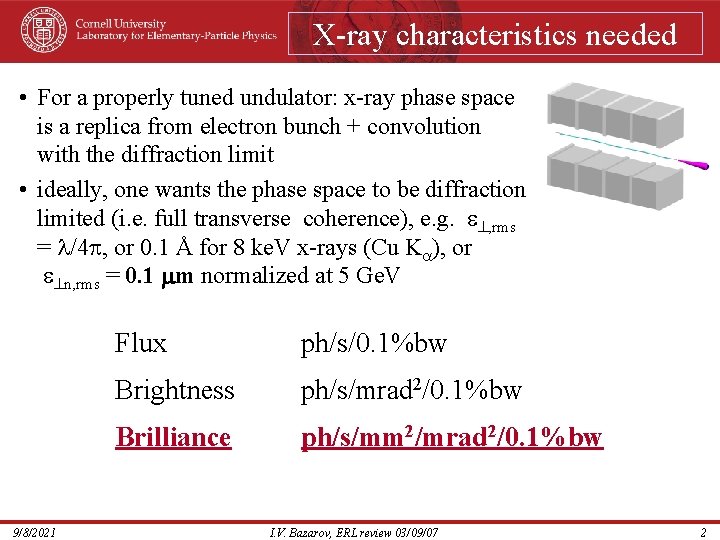
X-ray characteristics needed • For a properly tuned undulator: x-ray phase space is a replica from electron bunch + convolution with the diffraction limit • ideally, one wants the phase space to be diffraction limited (i. e. full transverse coherence), e. g. , rms = l/4 p, or 0. 1 Å for 8 ke. V x-rays (Cu Ka), or n, rms = 0. 1 mm normalized at 5 Ge. V 9/8/2021 Flux ph/s/0. 1%bw Brightness ph/s/mrad 2/0. 1%bw Brilliance ph/s/mm 2/mrad 2/0. 1%bw I. V. Bazarov, ERL review 03/09/07 2
Injector prototype beam goals • Demonstrate efficacy of achieving thermal emittance at the end of the injector at a bunch charge of 77 p. C/bunch or some large fraction thereof • Understand the limitations in the injector (both physics and technology) to allow for improved design in the future 9/8/2021 I. V. Bazarov, ERL review 03/09/07 3
Experimental plan: areas I. III. IV. V. VI. 9/8/2021 Photocathode phenomena Space charge dominated regime Longitudinal phase space control Emittance preservation in the merger High average current phenomena Achieving ultimate ‘tuned-up’ performance I. V. Bazarov, ERL review 03/09/07 4
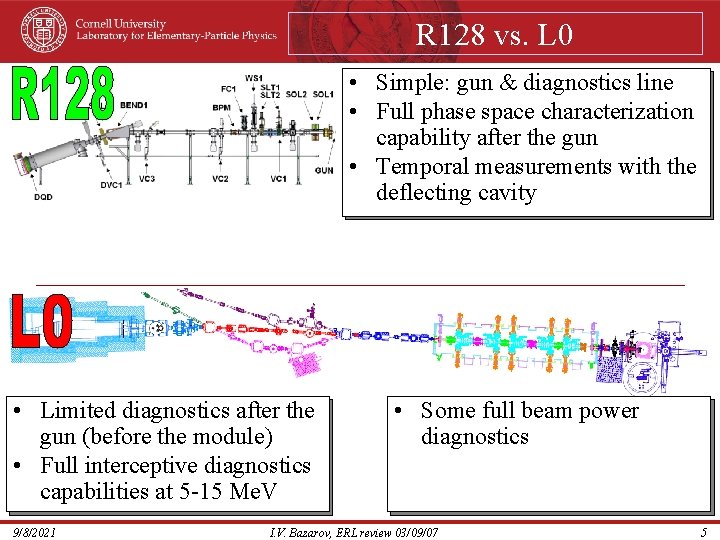
R 128 vs. L 0 • Simple: gun & diagnostics line • Full phase space characterization capability after the gun • Temporal measurements with the deflecting cavity • Limited diagnostics after the gun (before the module) • Full interceptive diagnostics capabilities at 5 -15 Me. V 9/8/2021 • Some full beam power diagnostics I. V. Bazarov, ERL review 03/09/07 5
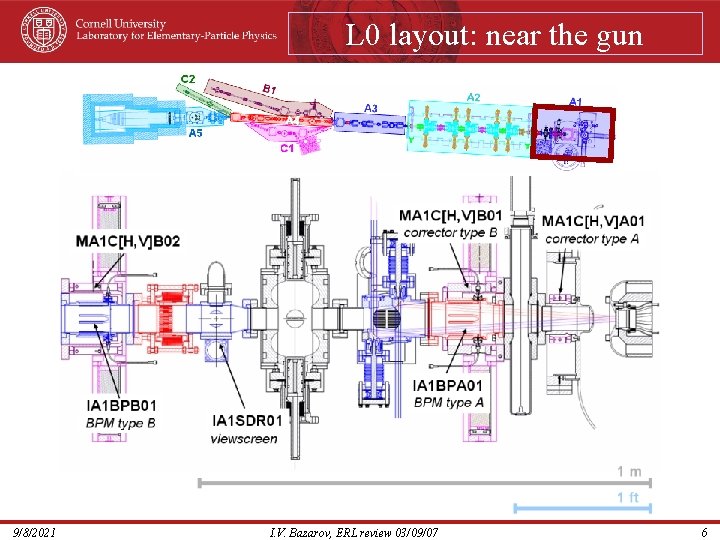
L 0 layout: near the gun 9/8/2021 I. V. Bazarov, ERL review 03/09/07 6
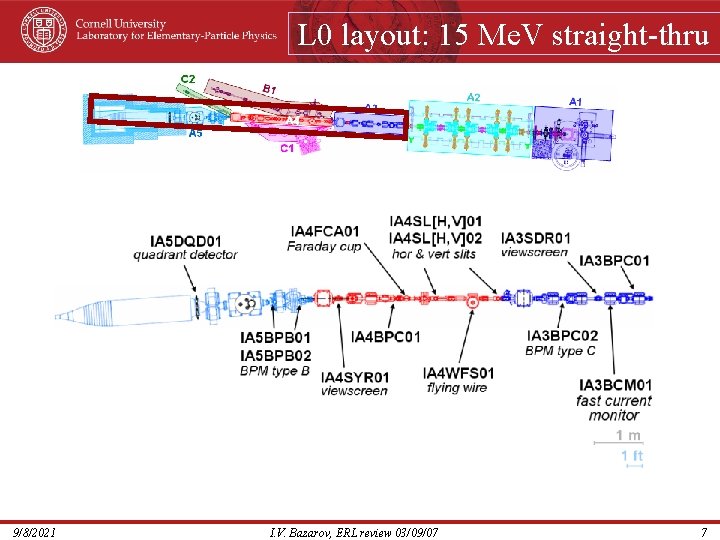
L 0 layout: 15 Me. V straight-thru 9/8/2021 I. V. Bazarov, ERL review 03/09/07 7
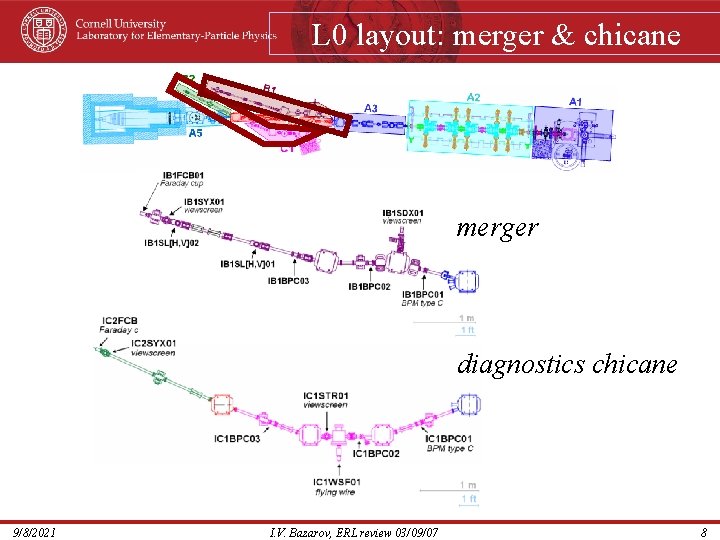
L 0 layout: merger & chicane merger diagnostics chicane 9/8/2021 I. V. Bazarov, ERL review 03/09/07 8
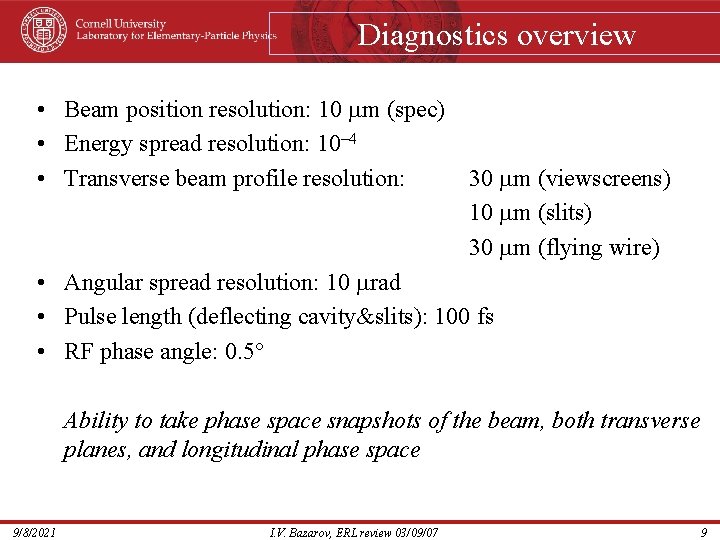
Diagnostics overview • Beam position resolution: 10 mm (spec) • Energy spread resolution: 10– 4 • Transverse beam profile resolution: 30 mm (viewscreens) 10 mm (slits) 30 mm (flying wire) • Angular spread resolution: 10 mrad • Pulse length (deflecting cavity&slits): 100 fs • RF phase angle: 0. 5 Ability to take phase space snapshots of the beam, both transverse planes, and longitudinal phase space 9/8/2021 I. V. Bazarov, ERL review 03/09/07 9
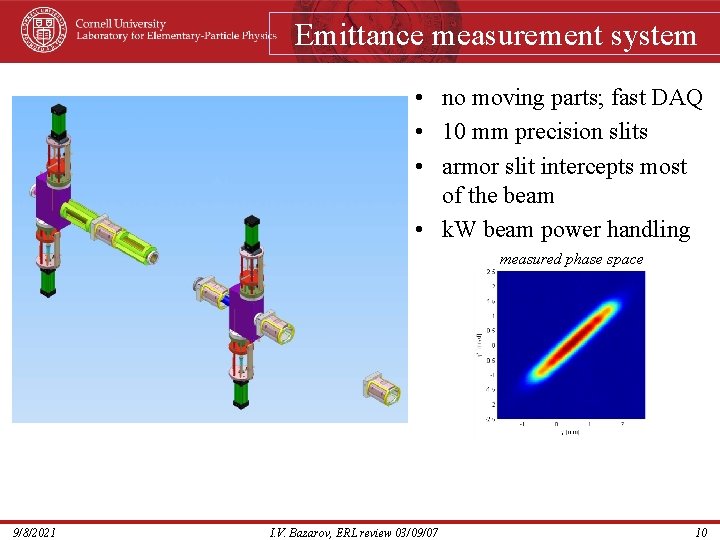
Emittance measurement system • no moving parts; fast DAQ • 10 mm precision slits • armor slit intercepts most of the beam • k. W beam power handling measured phase space 9/8/2021 I. V. Bazarov, ERL review 03/09/07 10
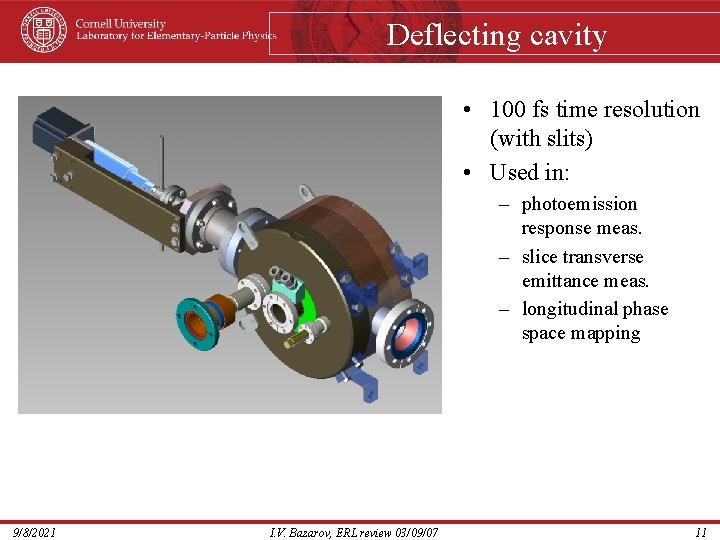
Deflecting cavity • 100 fs time resolution (with slits) • Used in: – photoemission response meas. – slice transverse emittance meas. – longitudinal phase space mapping 9/8/2021 I. V. Bazarov, ERL review 03/09/07 11
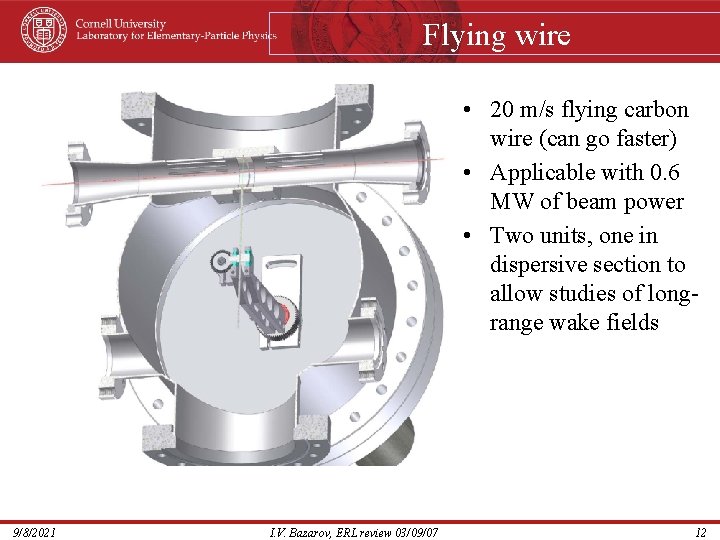
Flying wire • 20 m/s flying carbon wire (can go faster) • Applicable with 0. 6 MW of beam power • Two units, one in dispersive section to allow studies of longrange wake fields 9/8/2021 I. V. Bazarov, ERL review 03/09/07 12
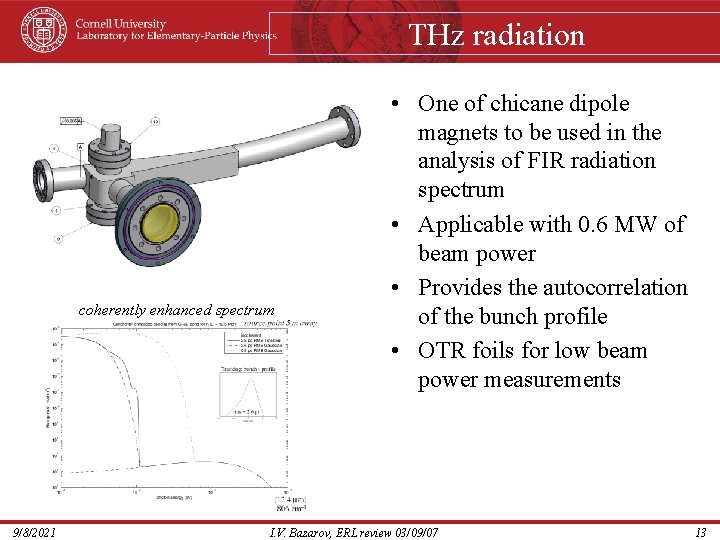
THz radiation coherently enhanced spectrum 9/8/2021 • One of chicane dipole magnets to be used in the analysis of FIR radiation spectrum • Applicable with 0. 6 MW of beam power • Provides the autocorrelation of the bunch profile • OTR foils for low beam power measurements I. V. Bazarov, ERL review 03/09/07 13
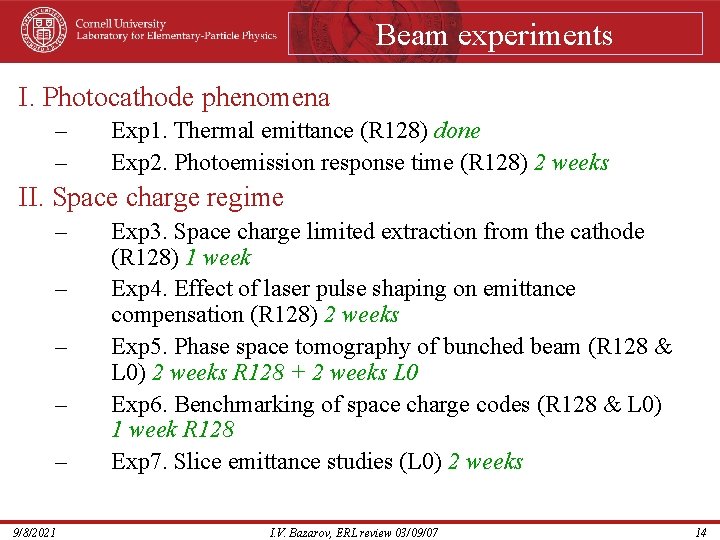
Beam experiments I. Photocathode phenomena – – Exp 1. Thermal emittance (R 128) done Exp 2. Photoemission response time (R 128) 2 weeks II. Space charge regime – – – 9/8/2021 Exp 3. Space charge limited extraction from the cathode (R 128) 1 week Exp 4. Effect of laser pulse shaping on emittance compensation (R 128) 2 weeks Exp 5. Phase space tomography of bunched beam (R 128 & L 0) 2 weeks R 128 + 2 weeks L 0 Exp 6. Benchmarking of space charge codes (R 128 & L 0) 1 week R 128 Exp 7. Slice emittance studies (L 0) 2 weeks I. V. Bazarov, ERL review 03/09/07 14
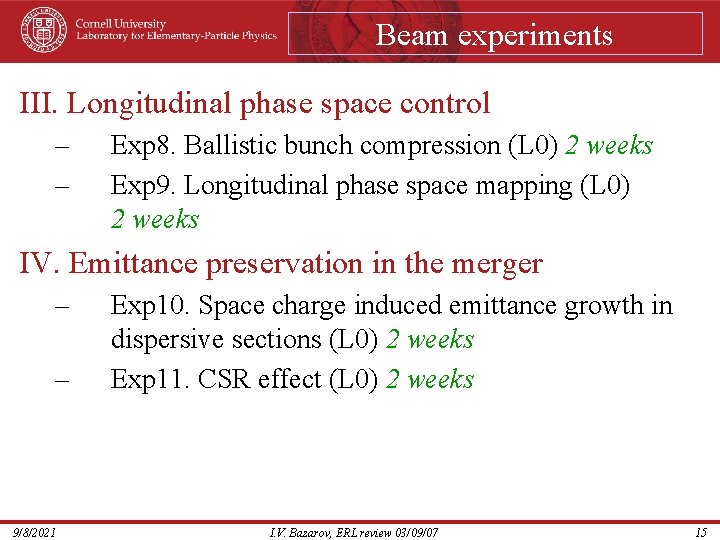
Beam experiments III. Longitudinal phase space control – – Exp 8. Ballistic bunch compression (L 0) 2 weeks Exp 9. Longitudinal phase space mapping (L 0) 2 weeks IV. Emittance preservation in the merger – – 9/8/2021 Exp 10. Space charge induced emittance growth in dispersive sections (L 0) 2 weeks Exp 11. CSR effect (L 0) 2 weeks I. V. Bazarov, ERL review 03/09/07 15
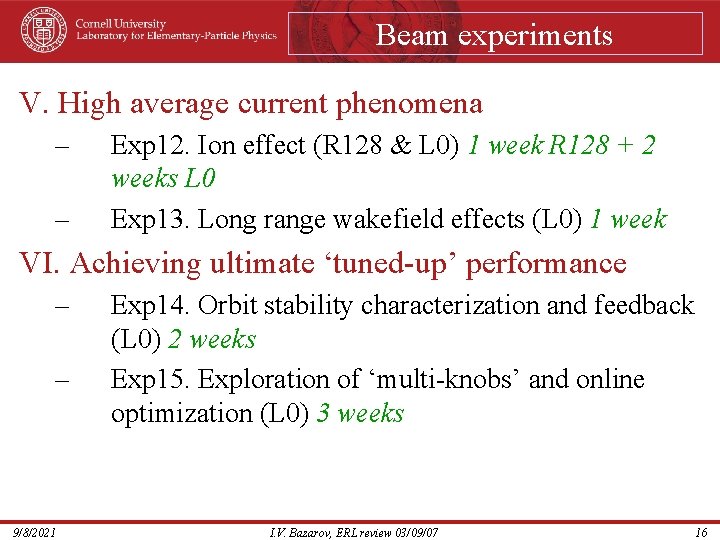
Beam experiments V. High average current phenomena – – Exp 12. Ion effect (R 128 & L 0) 1 week R 128 + 2 weeks L 0 Exp 13. Long range wakefield effects (L 0) 1 week VI. Achieving ultimate ‘tuned-up’ performance – – 9/8/2021 Exp 14. Orbit stability characterization and feedback (L 0) 2 weeks Exp 15. Exploration of ‘multi-knobs’ and online optimization (L 0) 3 weeks I. V. Bazarov, ERL review 03/09/07 16
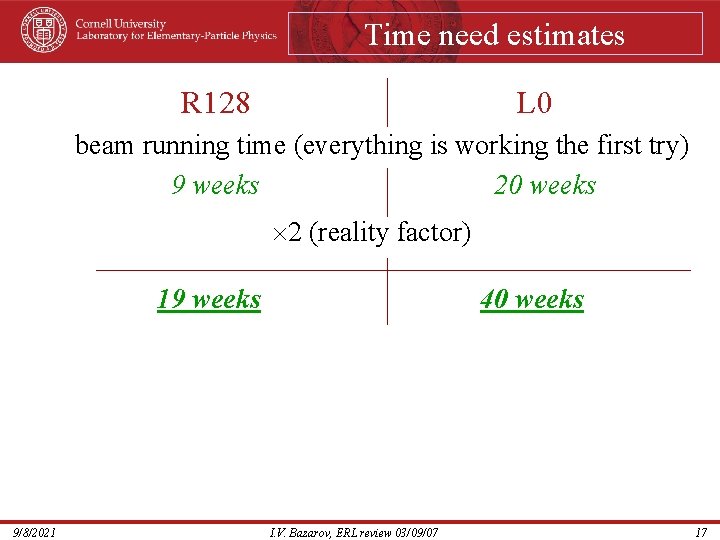
Time need estimates R 128 L 0 beam running time (everything is working the first try) 9 weeks 20 weeks 2 (reality factor) 19 weeks 9/8/2021 40 weeks I. V. Bazarov, ERL review 03/09/07 17
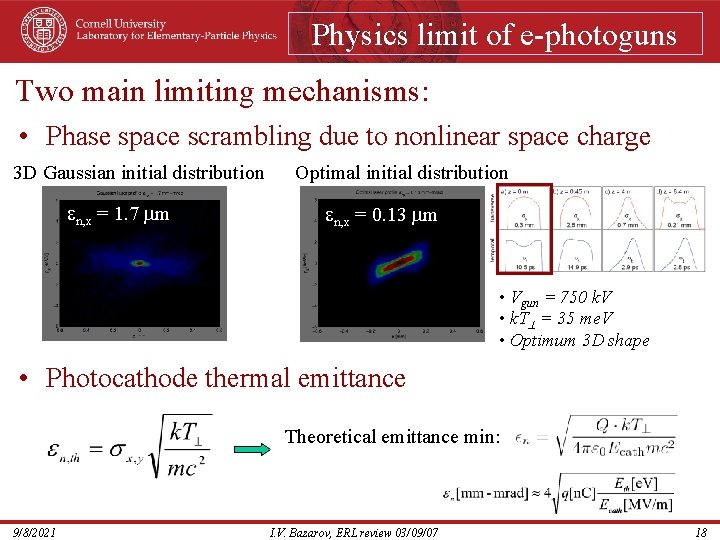
Physics limit of e-photoguns Two main limiting mechanisms: • Phase space scrambling due to nonlinear space charge 3 D Gaussian initial distribution n, x = 1. 7 mm Optimal initial distribution n, x = 0. 13 mm • Vgun = 750 k. V • k. T = 35 me. V • Optimum 3 D shape • Photocathode thermal emittance Theoretical emittance min: 9/8/2021 I. V. Bazarov, ERL review 03/09/07 18
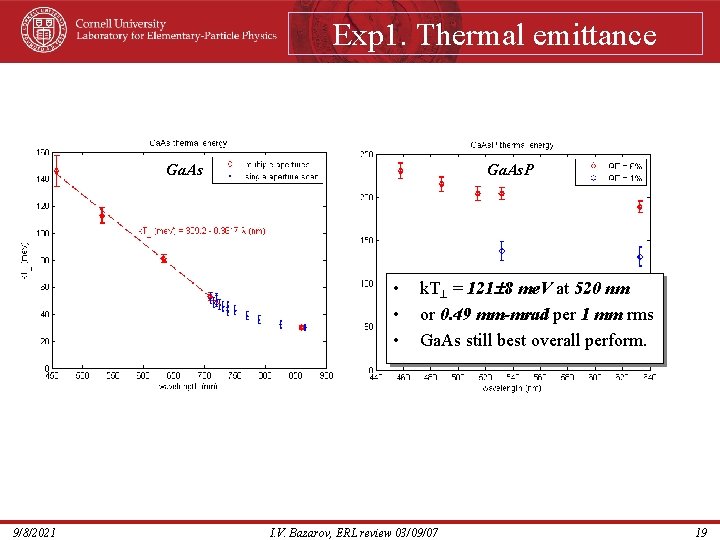
Exp 1. Thermal emittance Ga. As. P • • • 9/8/2021 k. T = 121 8 me. V at 520 nm or 0. 49 mm-mrad per 1 mm rms Ga. As still best overall perform. I. V. Bazarov, ERL review 03/09/07 19
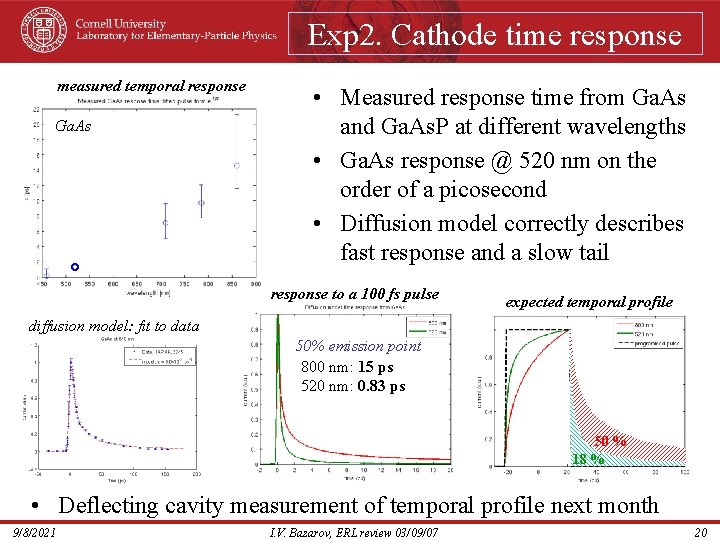
Exp 2. Cathode time response measured temporal response Ga. As • Measured response time from Ga. As and Ga. As. P at different wavelengths • Ga. As response @ 520 nm on the order of a picosecond • Diffusion model correctly describes fast response and a slow tail response to a 100 fs pulse expected temporal profile diffusion model: fit to data 50% emission point 800 nm: 15 ps 520 nm: 0. 83 ps 50 % 18 % • Deflecting cavity measurement of temporal profile next month 9/8/2021 I. V. Bazarov, ERL review 03/09/07 20
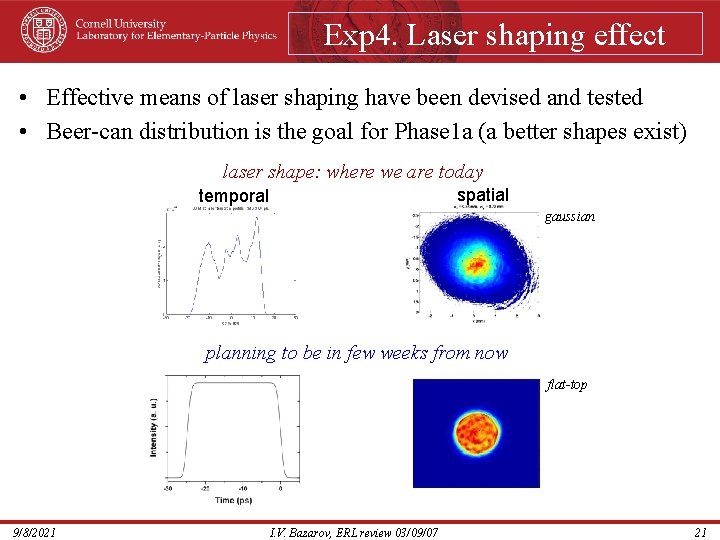
Exp 4. Laser shaping effect • Effective means of laser shaping have been devised and tested • Beer-can distribution is the goal for Phase 1 a (a better shapes exist) laser shape: where we are today spatial temporal gaussian planning to be in few weeks from now flat-top 9/8/2021 I. V. Bazarov, ERL review 03/09/07 21
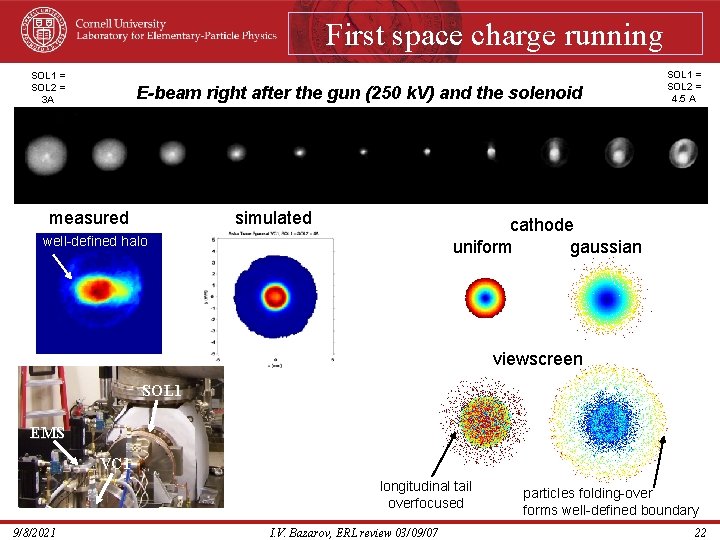
First space charge running SOL 1 = SOL 2 = 3 A E-beam right after the gun (250 k. V) and the solenoid measured simulated SOL 1 = SOL 2 = 4. 5 A cathode uniform gaussian well-defined halo viewscreen SOL 1 EMS VC 1 longitudinal tail overfocused 9/8/2021 I. V. Bazarov, ERL review 03/09/07 particles folding-over forms well-defined boundary 22
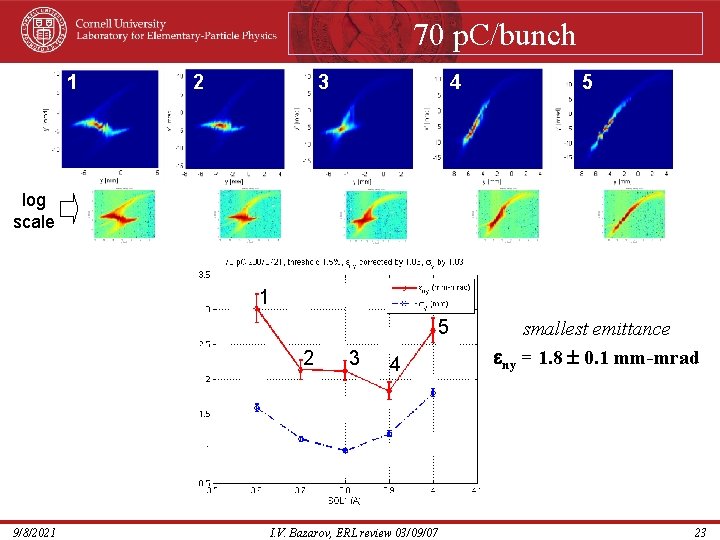
70 p. C/bunch 1 2 3 4 5 log scale 1 5 2 9/8/2021 3 4 I. V. Bazarov, ERL review 03/09/07 smallest emittance eny = 1. 8 0. 1 mm-mrad 23
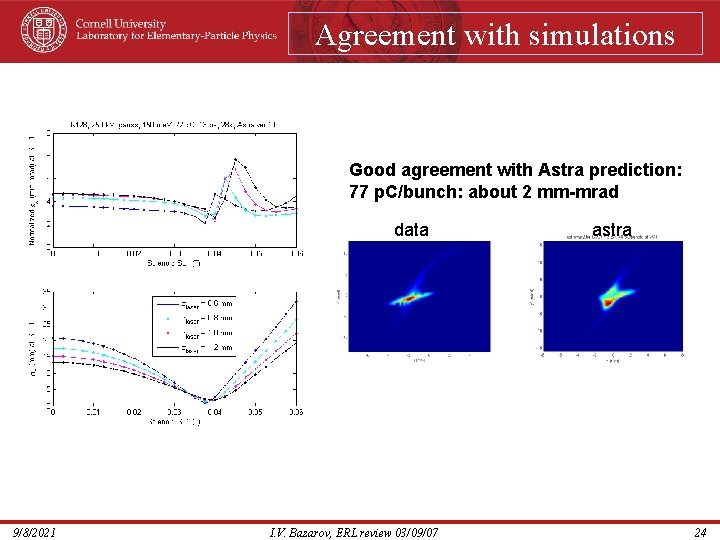
Agreement with simulations Good agreement with Astra prediction: 77 p. C/bunch: about 2 mm-mrad data 9/8/2021 I. V. Bazarov, ERL review 03/09/07 astra 24
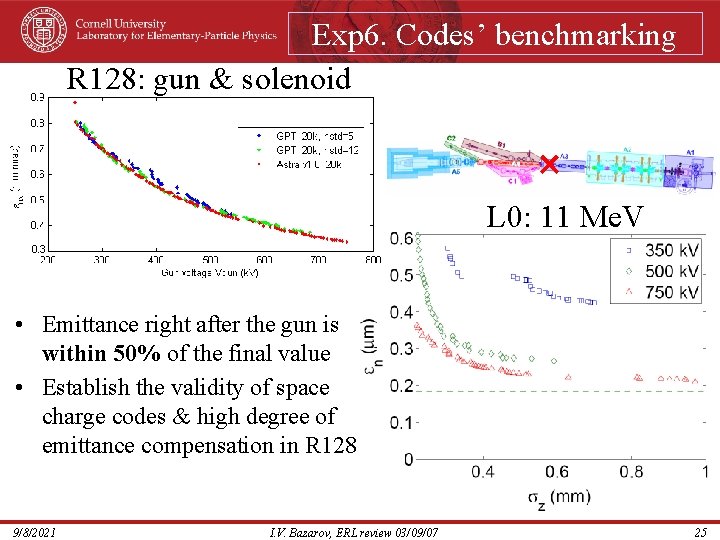
Exp 6. Codes’ benchmarking R 128: gun & solenoid L 0: 11 Me. V • Emittance right after the gun is within 50% of the final value • Establish the validity of space charge codes & high degree of emittance compensation in R 128 9/8/2021 I. V. Bazarov, ERL review 03/09/07 25
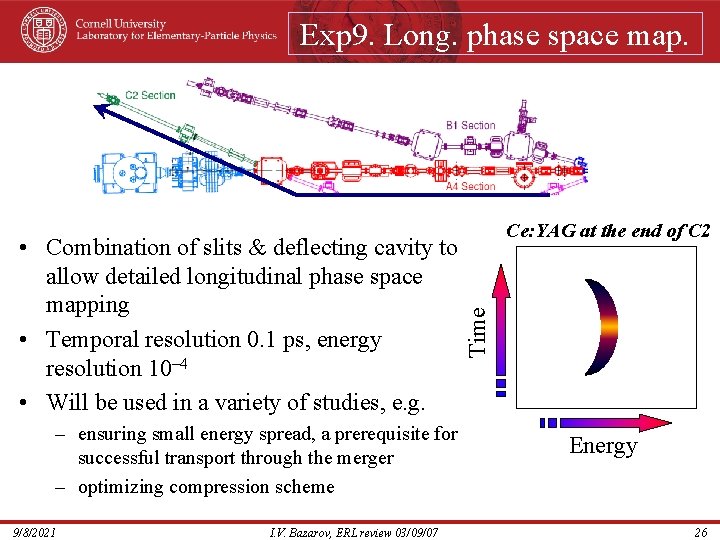
Exp 9. Long. phase space map. – ensuring small energy spread, a prerequisite for successful transport through the merger – optimizing compression scheme 9/8/2021 I. V. Bazarov, ERL review 03/09/07 Time • Combination of slits & deflecting cavity to allow detailed longitudinal phase space mapping • Temporal resolution 0. 1 ps, energy resolution 10– 4 • Will be used in a variety of studies, e. g. Ce: YAG at the end of C 2 Energy 26
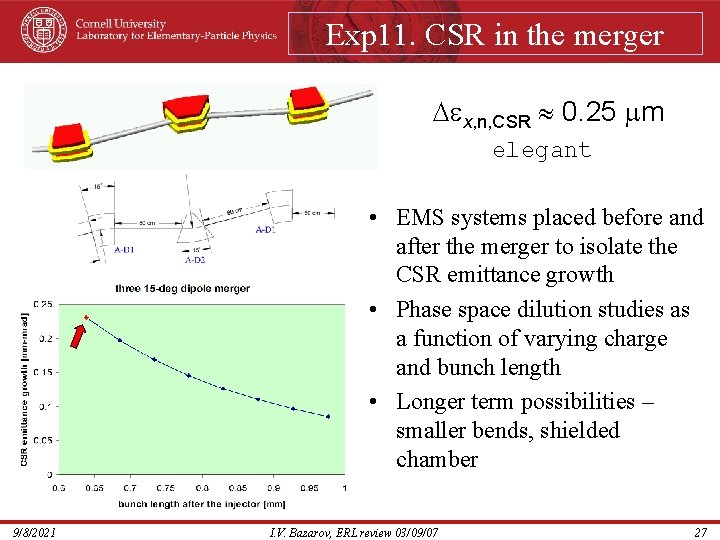
Exp 11. CSR in the merger D x, n, CSR 0. 25 mm elegant • EMS systems placed before and after the merger to isolate the CSR emittance growth • Phase space dilution studies as a function of varying charge and bunch length • Longer term possibilities – smaller bends, shielded chamber 9/8/2021 I. V. Bazarov, ERL review 03/09/07 27
Exp 12. Ions • Initial calculations show that running 100 m. A CW will cause problems with safe beam dump operation • Full beam neutralization over 4 s at 10– 9 Torr • Possible approaches: – develop the average-current dependant optics to account for the full beam neutralization and slowly ramp up the current (test in R 128) – introduce the ion gap, e. g. 6 ms every 60 ms (test in R 128) – the ion gap will cause large RF transients, it won’t work in L 0 Ø Energy stored in the gun: 15. 6 J 1% transient over 1. 5 ms Ø Energy stored in a cavity: 0. 5 -5 J 1% transient over 0. 1 ms – introduce clearing electrodes (non-trivial changes to the beamline, would rather avoid) 9/8/2021 I. V. Bazarov, ERL review 03/09/07 28
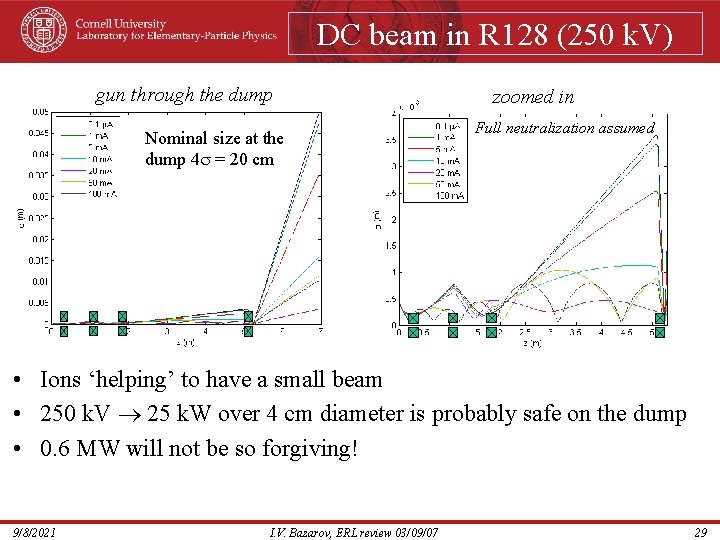
DC beam in R 128 (250 k. V) gun through the dump Nominal size at the dump 4 s = 20 cm zoomed in Full neutralization assumed • Ions ‘helping’ to have a small beam • 250 k. V 25 k. W over 4 cm diameter is probably safe on the dump • 0. 6 MW will not be so forgiving! 9/8/2021 I. V. Bazarov, ERL review 03/09/07 29
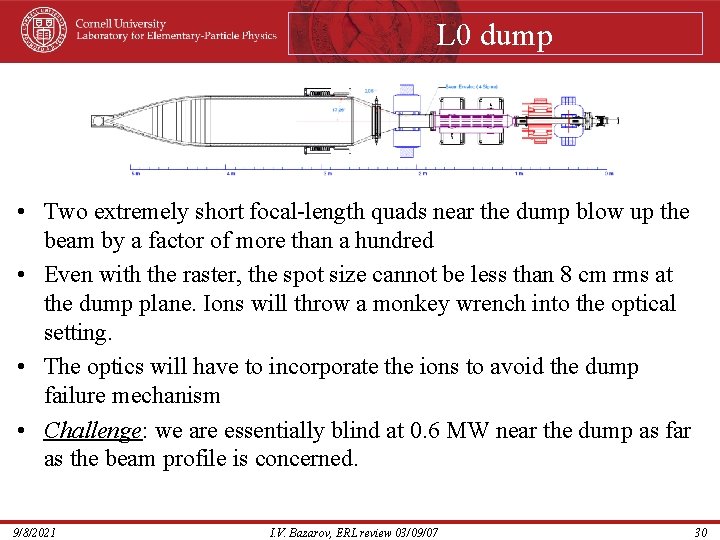
L 0 dump • Two extremely short focal-length quads near the dump blow up the beam by a factor of more than a hundred • Even with the raster, the spot size cannot be less than 8 cm rms at the dump plane. Ions will throw a monkey wrench into the optical setting. • The optics will have to incorporate the ions to avoid the dump failure mechanism • Challenge: we are essentially blind at 0. 6 MW near the dump as far as the beam profile is concerned. 9/8/2021 I. V. Bazarov, ERL review 03/09/07 30
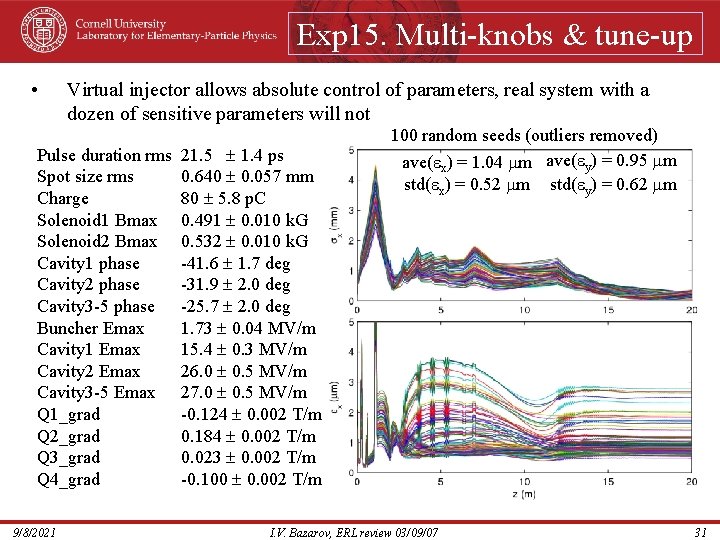
Exp 15. Multi-knobs & tune-up • Virtual injector allows absolute control of parameters, real system with a dozen of sensitive parameters will not Pulse duration rms Spot size rms Charge Solenoid 1 Bmax Solenoid 2 Bmax Cavity 1 phase Cavity 2 phase Cavity 3 -5 phase Buncher Emax Cavity 1 Emax Cavity 2 Emax Cavity 3 -5 Emax Q 1_grad Q 2_grad Q 3_grad Q 4_grad 9/8/2021 21. 5 1. 4 ps 0. 640 0. 057 mm 80 5. 8 p. C 0. 491 0. 010 k. G 0. 532 0. 010 k. G -41. 6 1. 7 deg -31. 9 2. 0 deg -25. 7 2. 0 deg 1. 73 0. 04 MV/m 15. 4 0. 3 MV/m 26. 0 0. 5 MV/m 27. 0 0. 5 MV/m -0. 124 0. 002 T/m 0. 184 0. 002 T/m 0. 023 0. 002 T/m -0. 100 0. 002 T/m 100 random seeds (outliers removed) ave( x) = 1. 04 mm ave( y) = 0. 95 mm std( x) = 0. 52 mm std( y) = 0. 62 mm I. V. Bazarov, ERL review 03/09/07 31
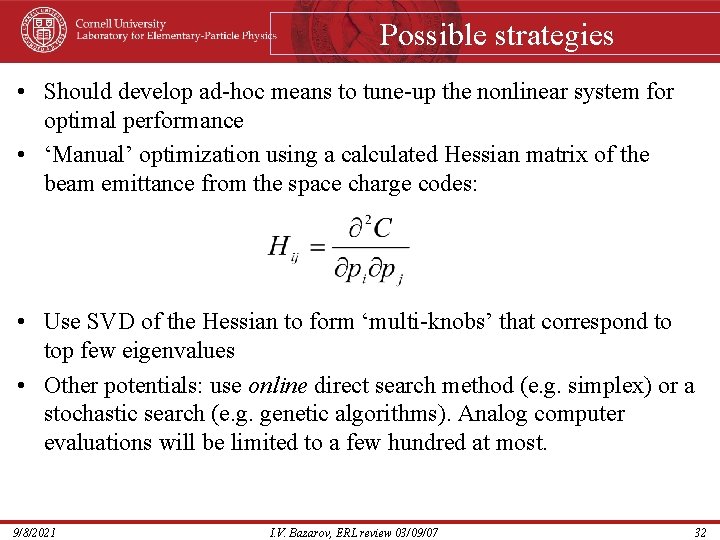
Possible strategies • Should develop ad-hoc means to tune-up the nonlinear system for optimal performance • ‘Manual’ optimization using a calculated Hessian matrix of the beam emittance from the space charge codes: • Use SVD of the Hessian to form ‘multi-knobs’ that correspond to top few eigenvalues • Other potentials: use online direct search method (e. g. simplex) or a stochastic search (e. g. genetic algorithms). Analog computer evaluations will be limited to a few hundred at most. 9/8/2021 I. V. Bazarov, ERL review 03/09/07 32
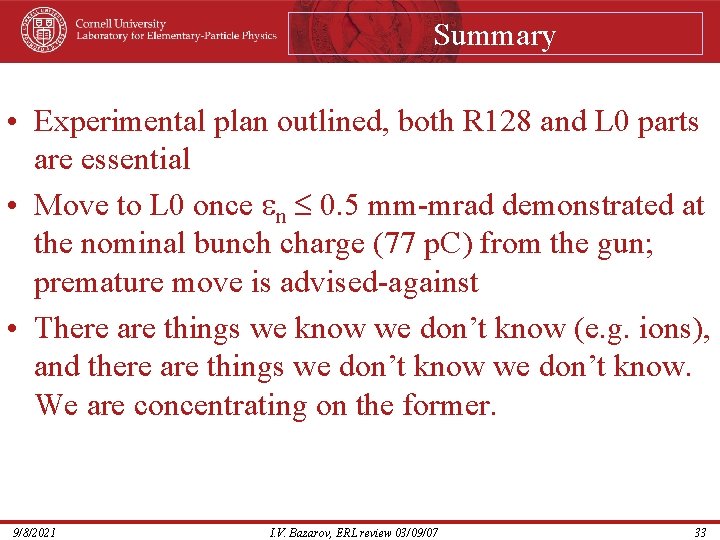
Summary • Experimental plan outlined, both R 128 and L 0 parts are essential • Move to L 0 once n 0. 5 mm-mrad demonstrated at the nominal bunch charge (77 p. C) from the gun; premature move is advised-against • There are things we know we don’t know (e. g. ions), and there are things we don’t know. We are concentrating on the former. 9/8/2021 I. V. Bazarov, ERL review 03/09/07 33