
Pharynx Muscular tube lying behind the nose oral
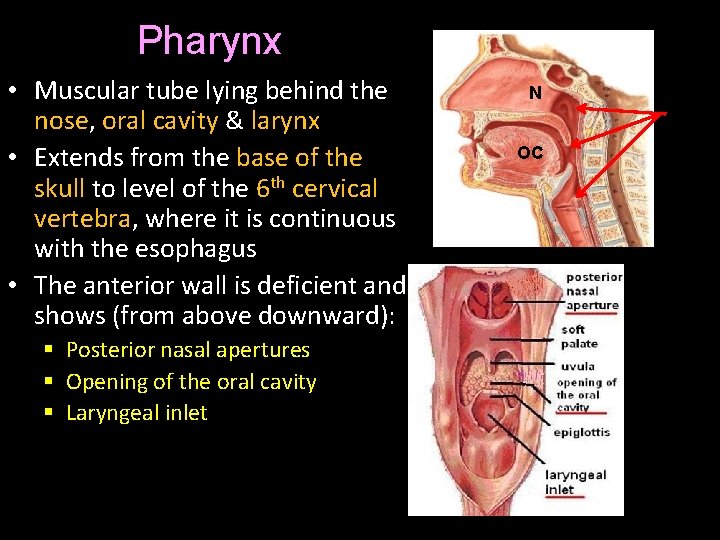
Pharynx • Muscular tube lying behind the nose, oral cavity & larynx • Extends from the base of the skull to level of the 6 th cervical vertebra, where it is continuous with the esophagus • The anterior wall is deficient and shows (from above downward): § Posterior nasal apertures § Opening of the oral cavity § Laryngeal inlet N OC L
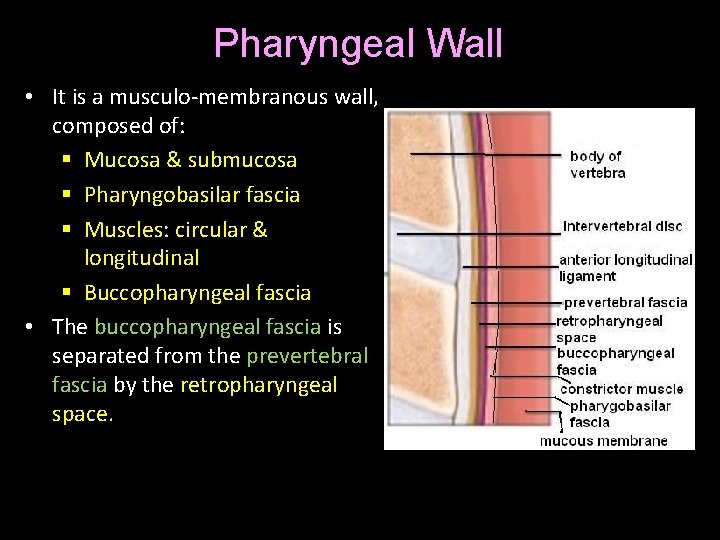
Pharyngeal Wall • It is a musculo-membranous wall, composed of: § Mucosa & submucosa § Pharyngobasilar fascia § Muscles: circular & longitudinal § Buccopharyngeal fascia • The buccopharyngeal fascia is separated from the prevertebral fascia by the retropharyngeal space.
Retropharyngeal Space • A potential space between the buccopharyngeal fascial lining of the pharynx and the prevertebral fascia • Contains loose areolar tissue • Closed: § Superiorly (by the base of the skull) and § Laterally (by the carotid sheath) • Open inferiorly into the superior mediastinum • Allows movement of pharynx, larynx, trachea and esophagus during swallowing

Circular (Constrictor) Muscles • Three in number: Superior, Middle & Inferior • Extend around the pharynx and M are inserted posteriorly into a fibrous raphe that extends from the pharyngeal tubercle on the I occipital bone to the esophagus • The three muscles overlap each other • The gap between the superior border of the superior constrictor and the occipital bone is filled by thickened pharyngobasilar fascia S
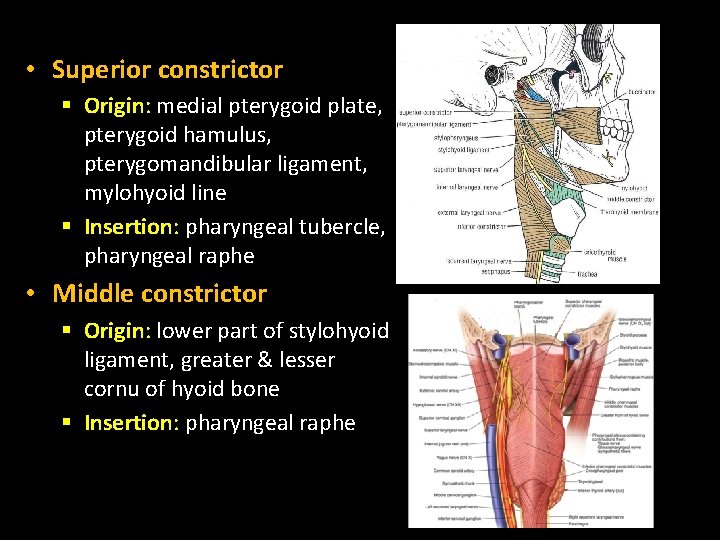
• Superior constrictor § Origin: medial pterygoid plate, pterygoid hamulus, pterygomandibular ligament, mylohyoid line § Insertion: pharyngeal tubercle, pharyngeal raphe • Middle constrictor § Origin: lower part of stylohyoid ligament, greater & lesser cornu of hyoid bone § Insertion: pharyngeal raphe
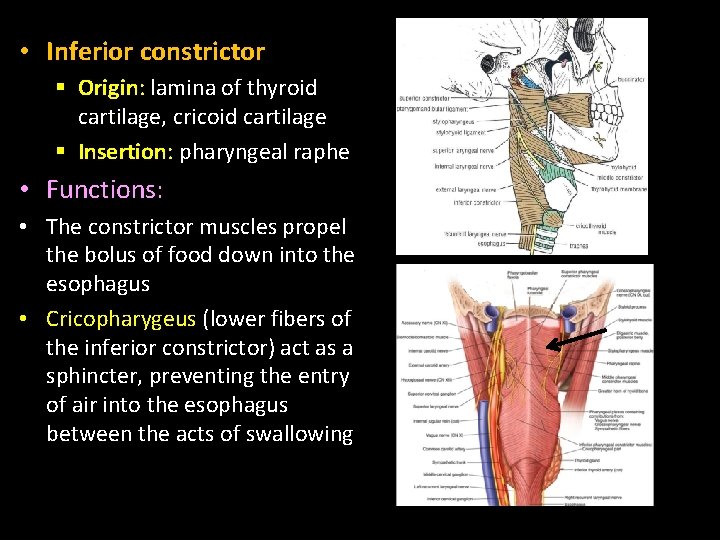
• Inferior constrictor § Origin: lamina of thyroid cartilage, cricoid cartilage § Insertion: pharyngeal raphe • Functions: • The constrictor muscles propel the bolus of food down into the esophagus • Cricopharygeus (lower fibers of the inferior constrictor) act as a sphincter, preventing the entry of air into the esophagus between the acts of swallowing
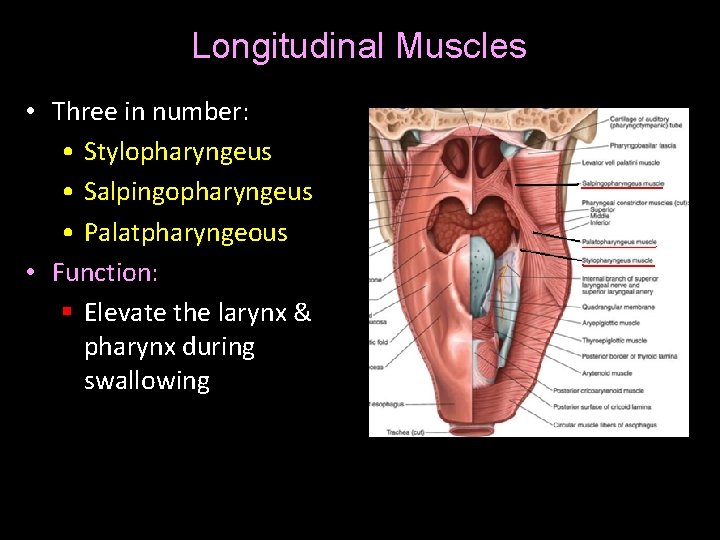
Longitudinal Muscles • Three in number: • Stylopharyngeus • Salpingopharyngeus • Palatpharyngeous • Function: § Elevate the larynx & pharynx during swallowing
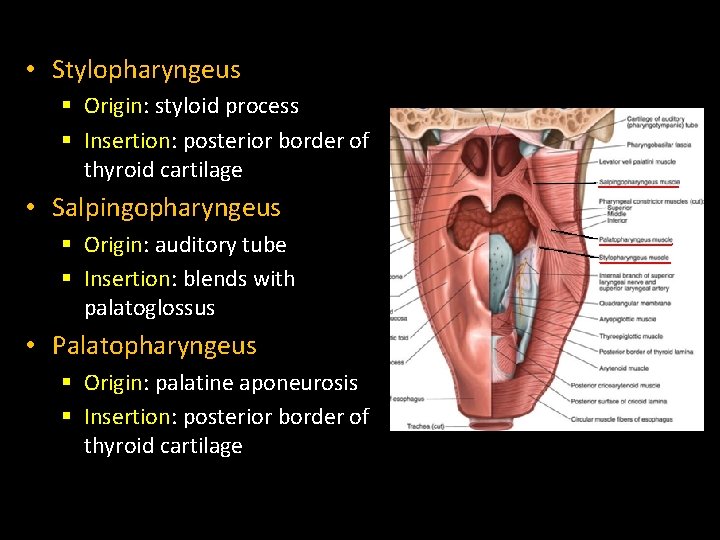
• Stylopharyngeus § Origin: styloid process § Insertion: posterior border of thyroid cartilage • Salpingopharyngeus § Origin: auditory tube § Insertion: blends with palatoglossus • Palatopharyngeus § Origin: palatine aponeurosis § Insertion: posterior border of thyroid cartilage
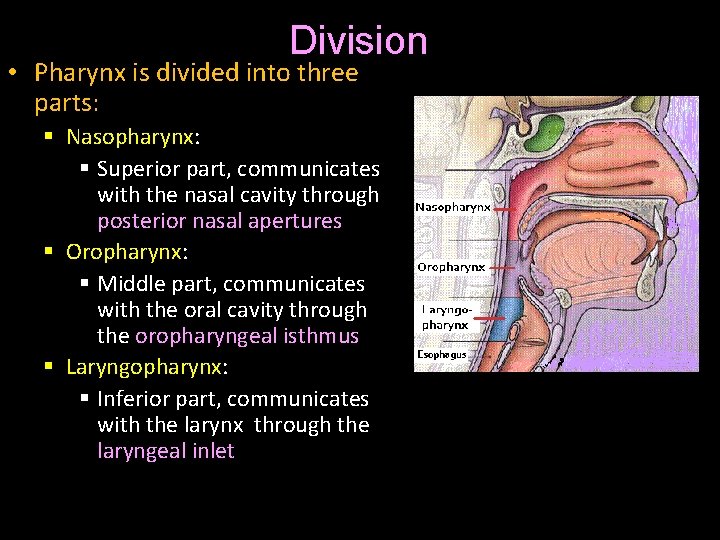
Division • Pharynx is divided into three parts: § Nasopharynx: § Superior part, communicates with the nasal cavity through posterior nasal apertures § Oropharynx: § Middle part, communicates with the oral cavity through the oropharyngeal isthmus § Laryngopharynx: § Inferior part, communicates with the larynx through the laryngeal inlet
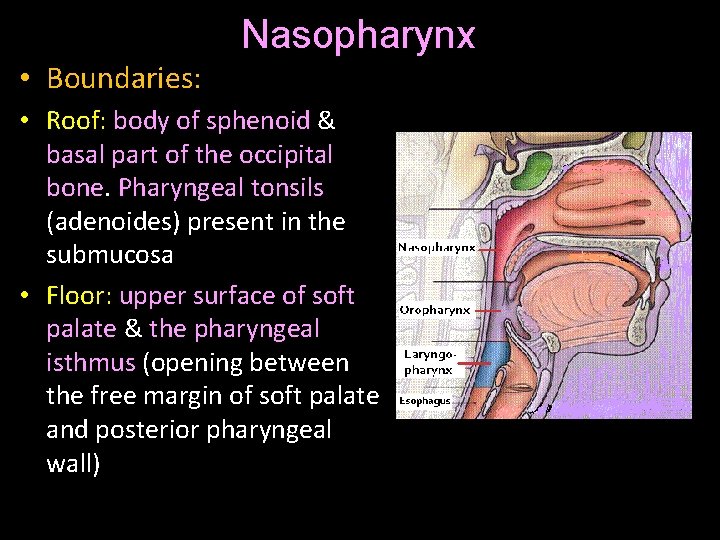
Nasopharynx • Boundaries: • Roof: body of sphenoid & basal part of the occipital bone. Pharyngeal tonsils (adenoides) present in the submucosa • Floor: upper surface of soft palate & the pharyngeal isthmus (opening between the free margin of soft palate and posterior pharyngeal wall)
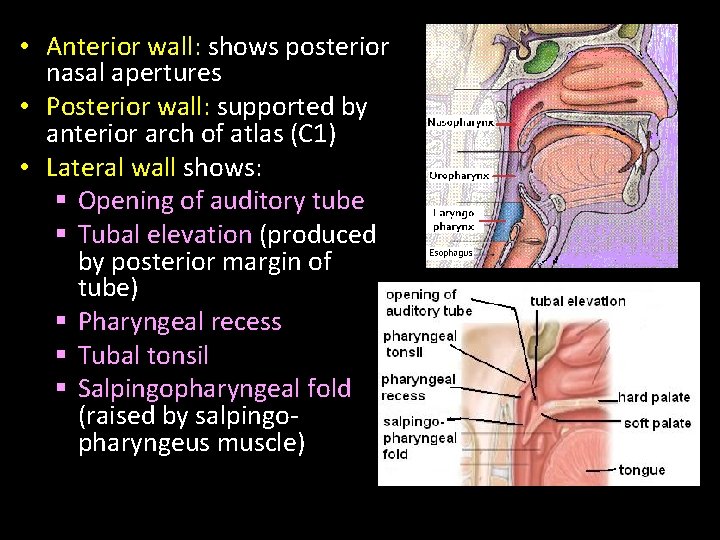
• Anterior wall: shows posterior nasal apertures • Posterior wall: supported by anterior arch of atlas (C 1) • Lateral wall shows: § Opening of auditory tube § Tubal elevation (produced by posterior margin of tube) § Pharyngeal recess § Tubal tonsil § Salpingopharyngeal fold (raised by salpingopharyngeus muscle)
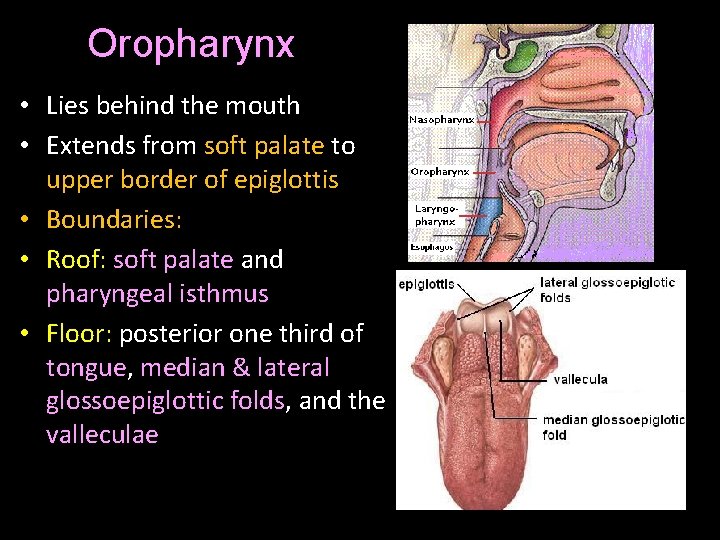
Oropharynx • Lies behind the mouth • Extends from soft palate to upper border of epiglottis • Boundaries: • Roof: soft palate and pharyngeal isthmus • Floor: posterior one third of tongue, median & lateral glossoepiglottic folds, and the valleculae
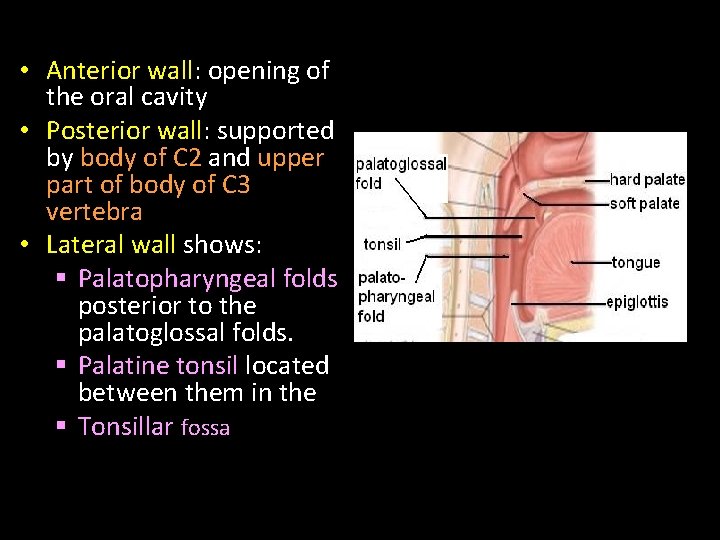
• Anterior wall: opening of the oral cavity • Posterior wall: supported by body of C 2 and upper part of body of C 3 vertebra • Lateral wall shows: § Palatopharyngeal folds posterior to the palatoglossal folds. § Palatine tonsil located between them in the § Tonsillar fossa
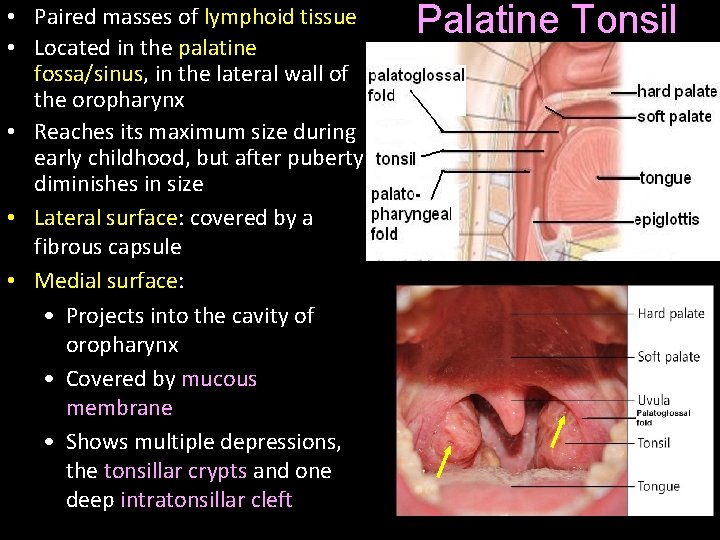
• Paired masses of lymphoid tissue • Located in the palatine fossa/sinus, in the lateral wall of the oropharynx • Reaches its maximum size during early childhood, but after puberty diminishes in size • Lateral surface: covered by a fibrous capsule • Medial surface: • Projects into the cavity of oropharynx • Covered by mucous membrane • Shows multiple depressions, the tonsillar crypts and one deep intratonsillar cleft Palatine Tonsil
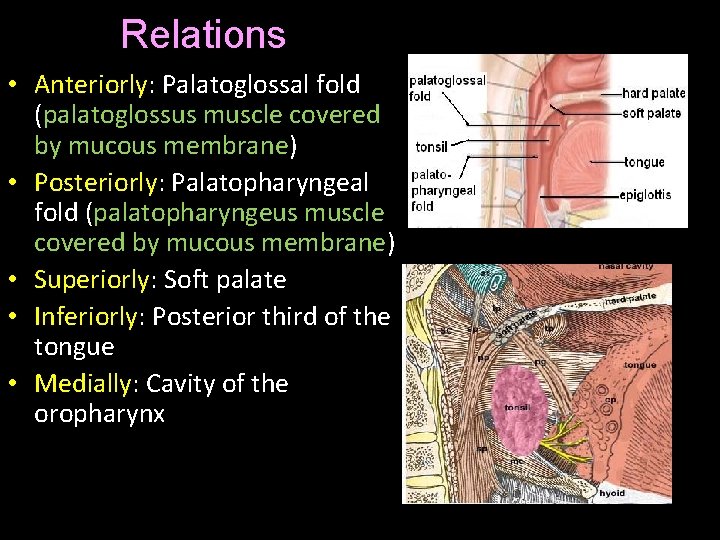
Relations • Anteriorly: Palatoglossal fold (palatoglossus muscle covered by mucous membrane) • Posteriorly: Palatopharyngeal fold (palatopharyngeus muscle covered by mucous membrane) • Superiorly: Soft palate • Inferiorly: Posterior third of the tongue • Medially: Cavity of the oropharynx
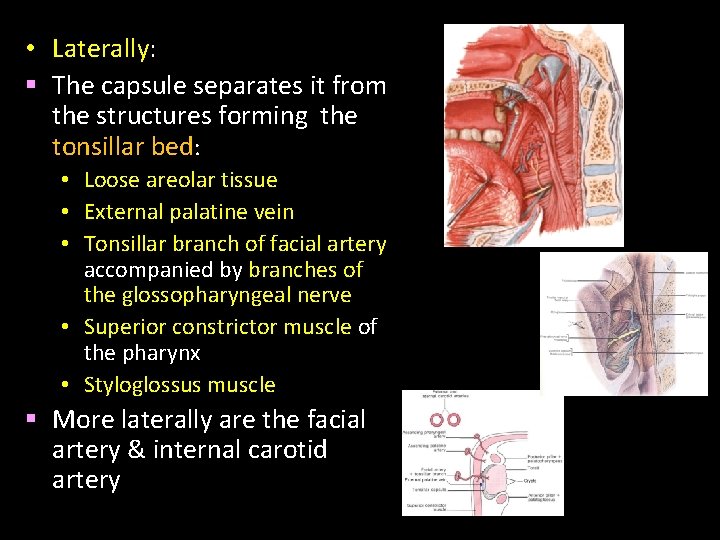
• Laterally: § The capsule separates it from the structures forming the tonsillar bed: • Loose areolar tissue • External palatine vein • Tonsillar branch of facial artery accompanied by branches of the glossopharyngeal nerve • Superior constrictor muscle of the pharynx • Styloglossus muscle § More laterally are the facial artery & internal carotid artery
Palatine Tonsil cont’d • Arterial supply: Tonsillar branch of facial artery (and twigs from ascending pharyngeal, palatine & lingual arteries) • Venous drainage: Veins pierce the superior constrictor muscle and join the external palatine, the pharyngeal or the facial veins • Lymphatics join the upper deep cervical lymph nodes (jugulodigastric node)
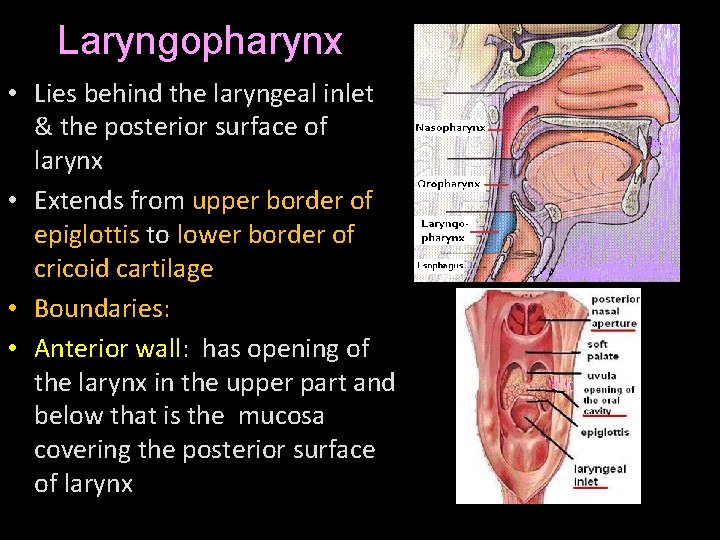
Laryngopharynx • Lies behind the laryngeal inlet & the posterior surface of larynx • Extends from upper border of epiglottis to lower border of cricoid cartilage • Boundaries: • Anterior wall: has opening of the larynx in the upper part and below that is the mucosa covering the posterior surface of larynx
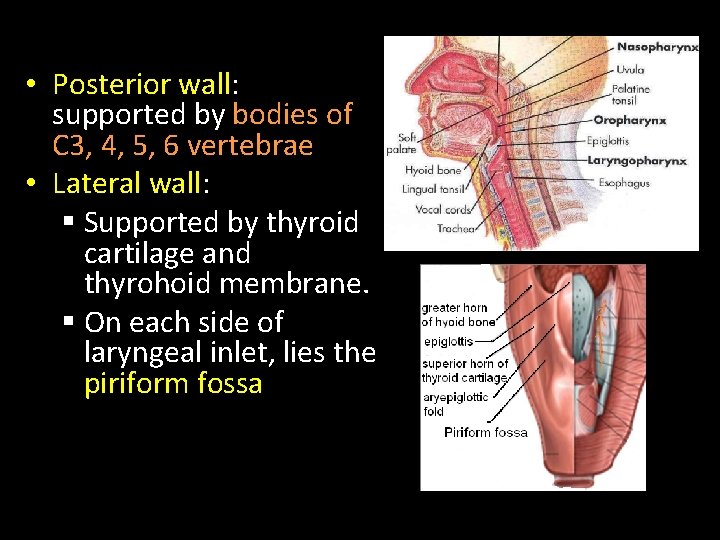
• Posterior wall: supported by bodies of C 3, 4, 5, 6 vertebrae • Lateral wall: § Supported by thyroid cartilage and thyrohoid membrane. § On each side of laryngeal inlet, lies the piriform fossa
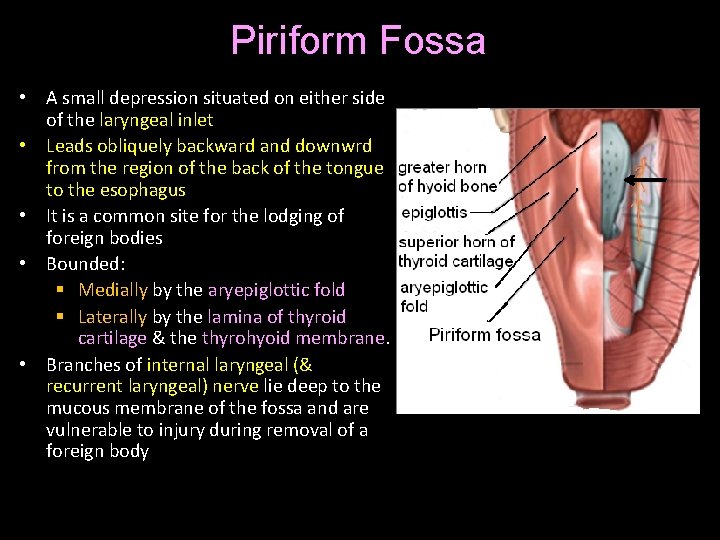
Piriform Fossa • A small depression situated on either side of the laryngeal inlet • Leads obliquely backward and downwrd from the region of the back of the tongue to the esophagus • It is a common site for the lodging of foreign bodies • Bounded: § Medially by the aryepiglottic fold § Laterally by the lamina of thyroid cartilage & the thyrohyoid membrane. • Branches of internal laryngeal (& recurrent laryngeal) nerve lie deep to the mucous membrane of the fossa and are vulnerable to injury during removal of a foreign body
Nerve Supply • Sensory Nerve Supply: § Nasopharynx: Maxillary nerve § Oropharynx: Glossopharyngeal nerve § Laryngopharynx: Internal laryngeal branch of the vagus nerve • Motor Nerve Supply: § All the muscles of pharynx, except the stylopharyngeus, supplied by the pharyngeal plexus § The stylopharyngeus is supplied by the glossopharyngeal nerve
Blood Supply & Lymphatics • Arterial supply is derived from branches of: • Ascending pharyngeal artery • Ascending palatine artery • Facial artery • Maxillary artery • Lingual artery • The Veins drain into pharyngeal venous plexus, which drains into the internal jugular vein • The lymphatics drain into the deep cervical lymph nodes either directly, or indirectly via the retropharyngeal or paratracheal lymph nodes
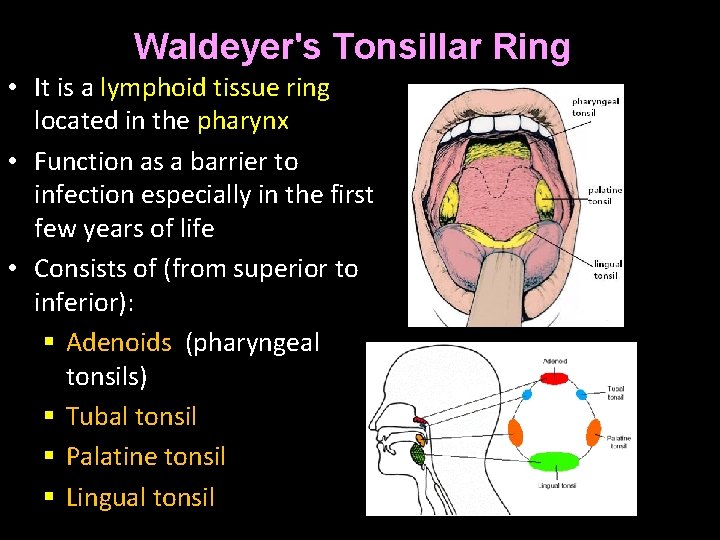
Waldeyer's Tonsillar Ring • It is a lymphoid tissue ring located in the pharynx • Function as a barrier to infection especially in the first few years of life • Consists of (from superior to inferior): § Adenoids (pharyngeal tonsils) § Tubal tonsil § Palatine tonsil § Lingual tonsil
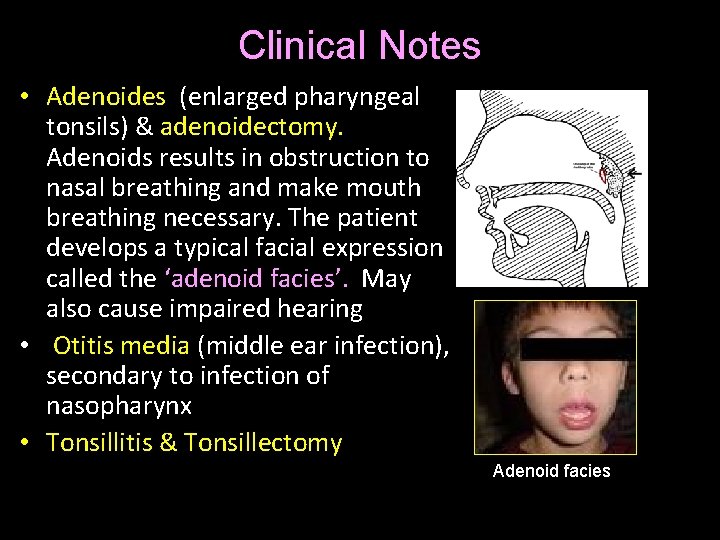
Clinical Notes • Adenoides (enlarged pharyngeal tonsils) & adenoidectomy. Adenoids results in obstruction to nasal breathing and make mouth breathing necessary. The patient develops a typical facial expression called the ‘adenoid facies’. May also cause impaired hearing • Otitis media (middle ear infection), secondary to infection of nasopharynx • Tonsillitis & Tonsillectomy Adenoid facies
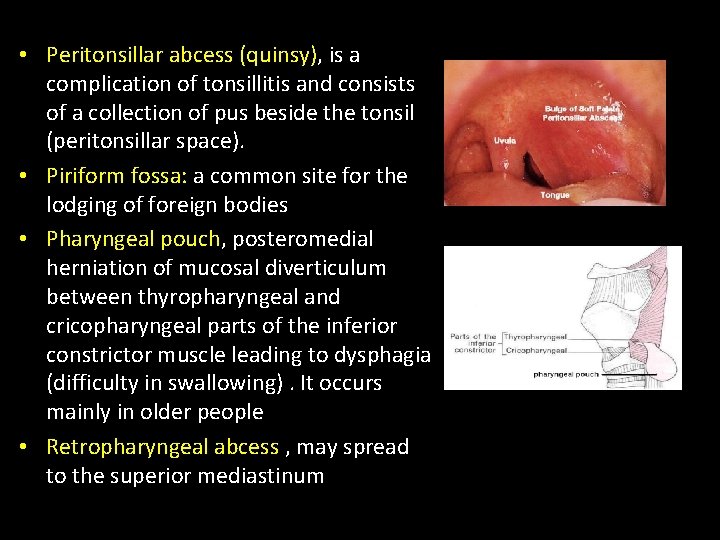
• Peritonsillar abcess (quinsy), is a complication of tonsillitis and consists of a collection of pus beside the tonsil (peritonsillar space). • Piriform fossa: a common site for the lodging of foreign bodies • Pharyngeal pouch, posteromedial herniation of mucosal diverticulum between thyropharyngeal and cricopharyngeal parts of the inferior constrictor muscle leading to dysphagia (difficulty in swallowing). It occurs mainly in older people • Retropharyngeal abcess , may spread to the superior mediastinum
- Slides: 25