
Pharynx Beginning Base of the skull Nose Mouth
Pharynx
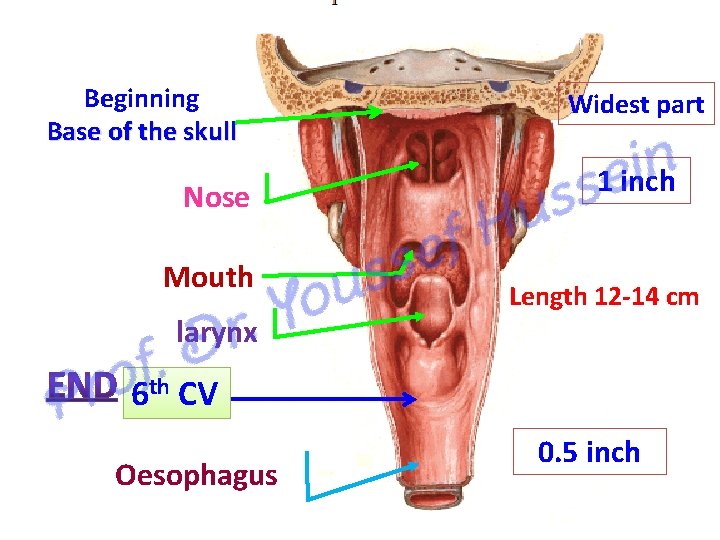
Beginning Base of the skull Nose Mouth larynx Widest part 1 inch Length 12 -14 cm 6 th CV Oesophagus 0. 5 inch
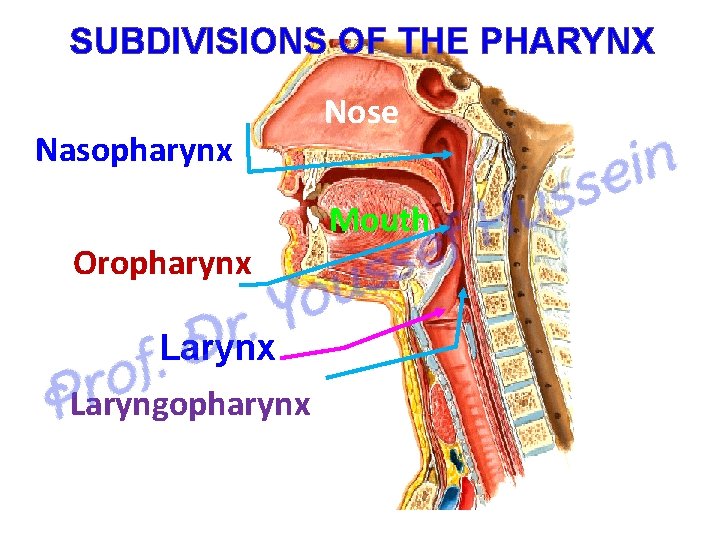
SUBDIVISIONS OF THE PHARYNX Nasopharynx Oropharynx Laryngopharynx Nose Mouth
Extension: It is a muscular tube extending from the base of skull to the lower border of C 6 vertebra and continues as esophagus. Shape: funnel shaped with base upwards. its diameter, upper part (one inch) and lower part (1/2 inch). Length: 12 14 cm long, Parts: it is divided into 3 parts From above downwards 1 Nasopharynx 2 Oropharynx 3 Laryngopharynx
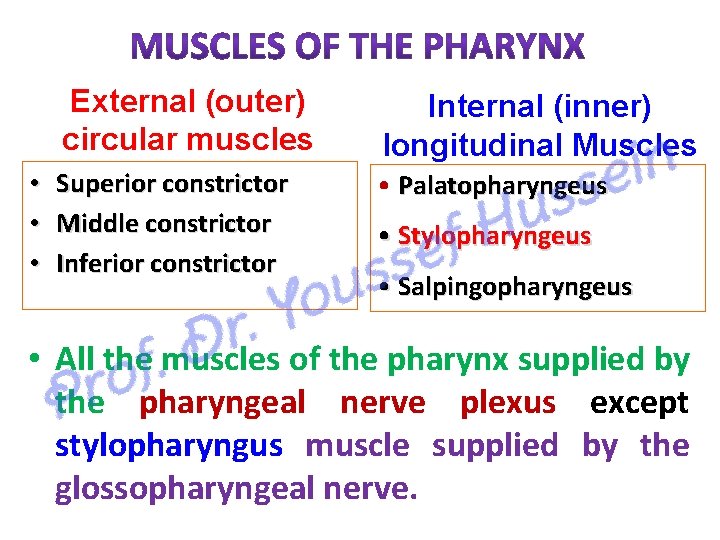
• • • External (outer) circular muscles Internal (inner) longitudinal Muscles Superior constrictor Middle constrictor Inferior constrictor • Palatopharyngeus • Stylopharyngeus • Salpingopharyngeus • All the muscles of the pharynx supplied by the pharyngeal nerve plexus except stylopharyngus muscle supplied by the glossopharyngeal nerve.

Constrictor muscles Superior Buccinator Middle Inferior
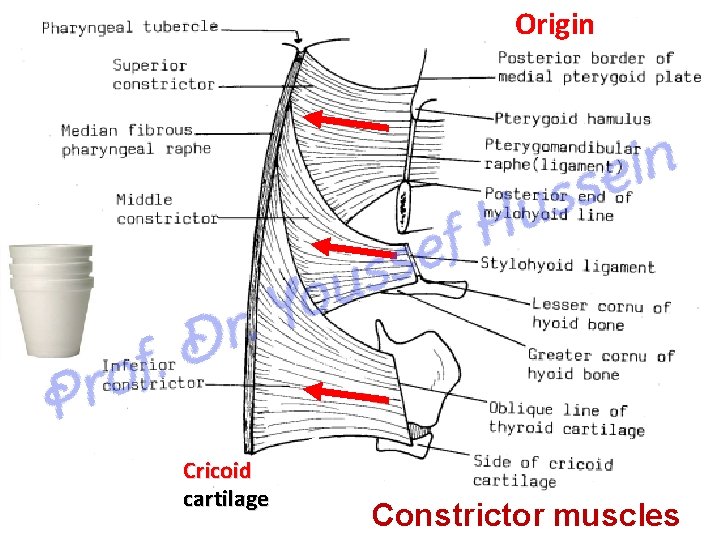
Origin Cricoid cartilage Constrictor muscles
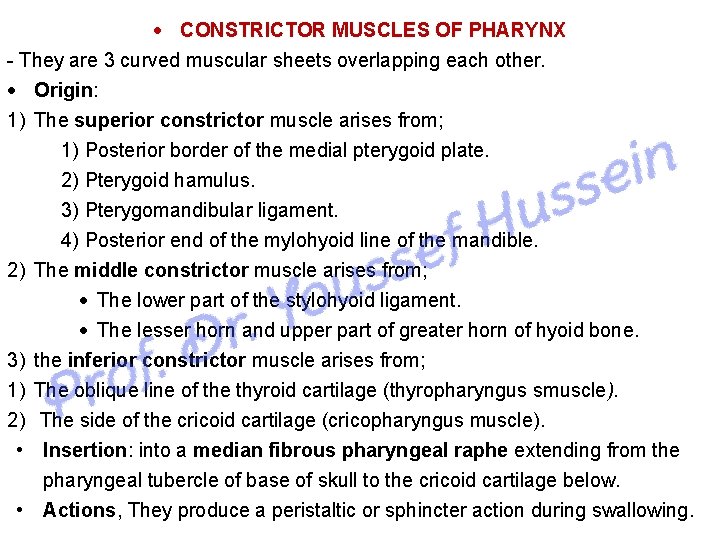
CONSTRICTOR MUSCLES OF PHARYNX They are 3 curved muscular sheets overlapping each other. Origin: 1) The superior constrictor muscle arises from; 1) Posterior border of the medial pterygoid plate. 2) Pterygoid hamulus. 3) Pterygomandibular ligament. 4) Posterior end of the mylohyoid line of the mandible. 2) The middle constrictor muscle arises from; The lower part of the stylohyoid ligament. The lesser horn and upper part of greater horn of hyoid bone. 3) the inferior constrictor muscle arises from; 1) The oblique line of the thyroid cartilage (thyropharyngus smuscle). 2) The side of the cricoid cartilage (cricopharyngus muscle). • Insertion: into a median fibrous pharyngeal raphe extending from the pharyngeal tubercle of base of skull to the cricoid cartilage below. • Actions, They produce a peristaltic or sphincter action during swallowing.
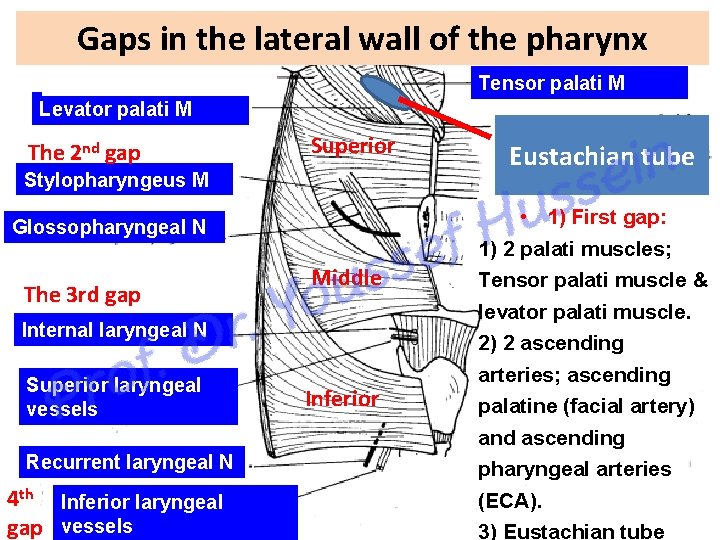
Gaps in the lateral wall of the pharynx Tensor palati M 1 Levator palati M The 2 nd gap Superior Stylopharyngeus M 2 Glossopharyngeal N The 3 rd gap Middle Internal laryngeal N 3 Superior laryngeal vessels Recurrent laryngeal N 4 th Inferior laryngeal 4 gap vessels Inferior Eustachian tube • 1) First gap: 1) 2 palati muscles; Tensor palati muscle & levator palati muscle. 2) 2 ascending arteries; ascending palatine (facial artery) and ascending pharyngeal arteries (ECA). 3) Eustachian tube
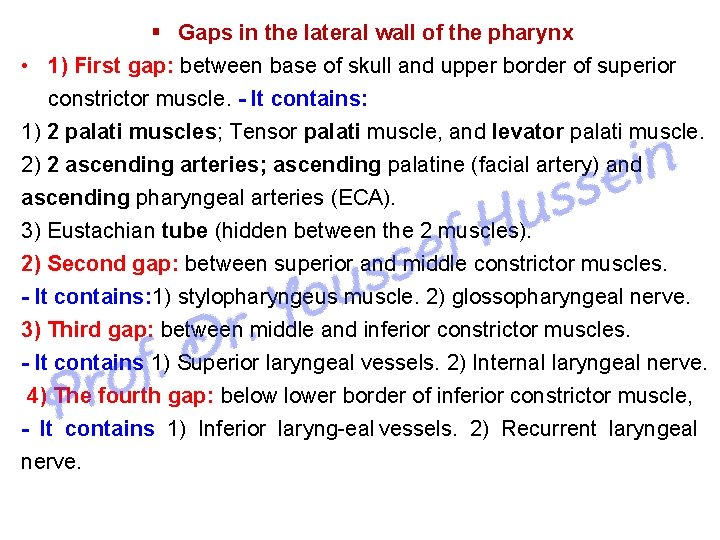
Gaps in the lateral wall of the pharynx • 1) First gap: between base of skull and upper border of superior constrictor muscle. It contains: 1) 2 palati muscles; Tensor palati muscle, and levator palati muscle. 2) 2 ascending arteries; ascending palatine (facial artery) and ascending pharyngeal arteries (ECA). 3) Eustachian tube (hidden between the 2 muscles). 2) Second gap: between superior and middle constrictor muscles. It contains: 1) stylopharyngeus muscle. 2) glossopharyngeal nerve. 3) Third gap: between middle and inferior constrictor muscles. It contains 1) Superior laryngeal vessels. 2) Internal laryngeal nerve. 4) The fourth gap: below lower border of inferior constrictor muscle, It contains 1) Inferior laryng eal vessels. 2) Recurrent laryngeal nerve.

INTERNAL (LONGITUDINAL) MUSCLES Salpingopharyngeus Palatopharygeus Stylopharyngeus

1 Stylopharyngeus muscle Origin; from the styloid process. Course, It descends obliquely downwards and forwards between internal and external carotid arteries with the glossopharyngeal nerve. Then, between superior and middle constrictors muscles. 2 Palatopharyngeus muscle Origin: from upper surface of the palatine aponeurosis. 3 Salpingopharyngeus muscle Origin, it arises from the cartilaginous part of auditory tube. Insertion: The three muscles end into the posterior border of the thyroid cartilage and wall of the pharynx. • Actions: They Elevation of the larynx & pharynx • Palatopharyngeus both muscles close oropharyngeal isthmus • Salpingopharyngeus Keep the Eustachian tube patent
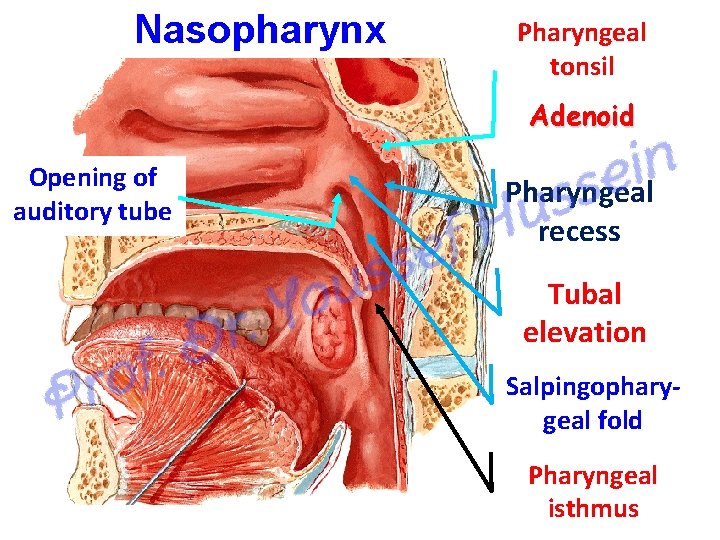
Nasopharynx Pharyngeal tonsil Adenoid Opening of auditory tube Pharyngeal recess Tubal elevation Salpingopharygeal fold Pharyngeal isthmus
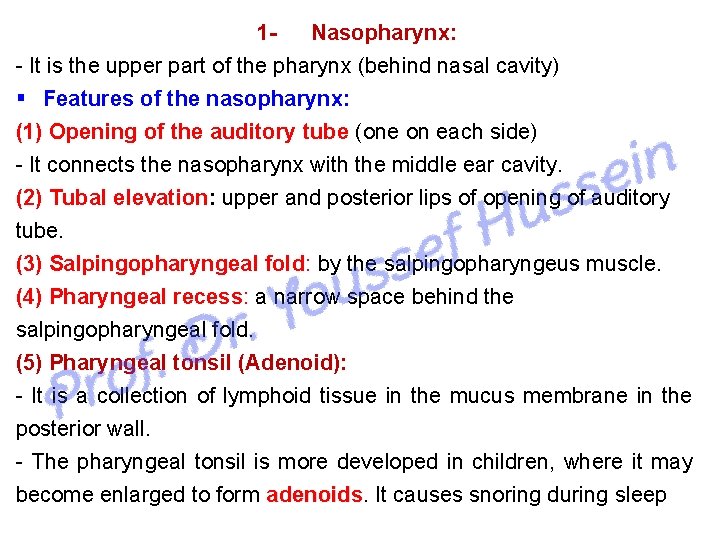
1 Nasopharynx: It is the upper part of the pharynx (behind nasal cavity) Features of the nasopharynx: (1) Opening of the auditory tube (one on each side) It connects the nasopharynx with the middle ear cavity. (2) Tubal elevation: upper and posterior lips of opening of auditory tube. (3) Salpingopharyngeal fold: by the salpingopharyngeus muscle. (4) Pharyngeal recess: a narrow space behind the salpingopharyngeal fold. (5) Pharyngeal tonsil (Adenoid): It is a collection of lymphoid tissue in the mucus membrane in the posterior wall. The pharyngeal tonsil is more developed in children, where it may become enlarged to form adenoids It causes snoring during sleep
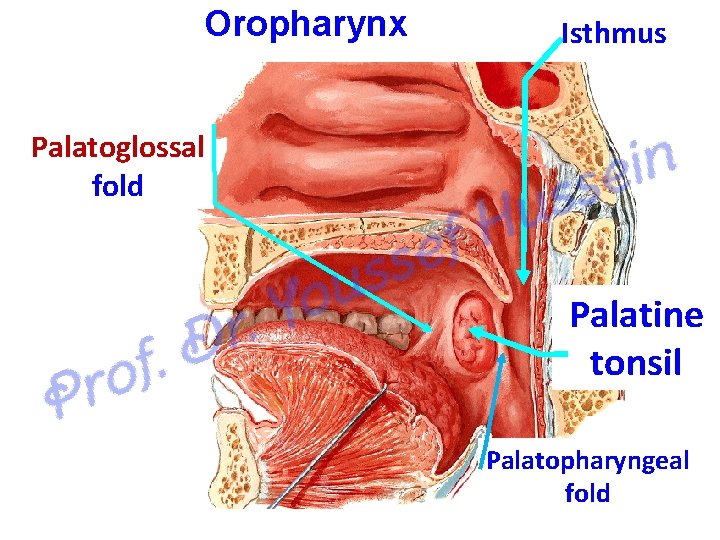
Oropharynx Isthmus Palatoglossal fold Palatine tonsil Palatopharyngeal fold
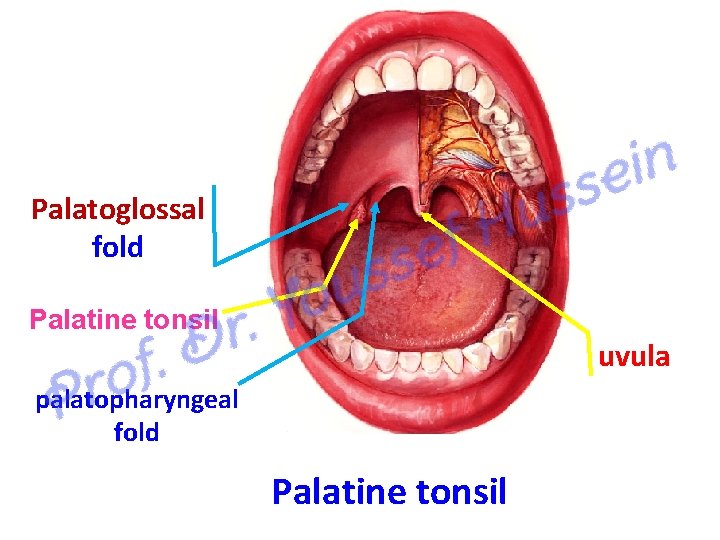
Palatoglossal fold Palatine tonsil uvula palatopharyngeal fold Palatine tonsil
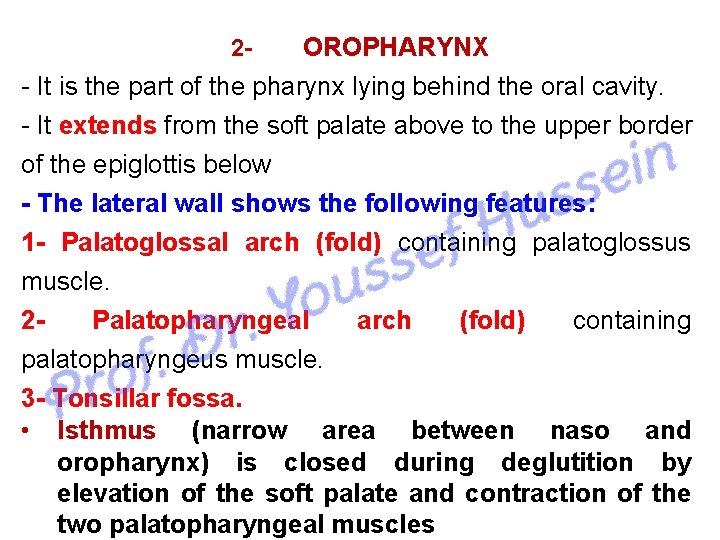
OROPHARYNX It is the part of the pharynx lying behind the oral cavity. It extends from the soft palate above to the upper border of the epiglottis below The lateral wall shows the following features: 1 Palatoglossal arch (fold) containing palatoglossus 2 muscle. 2 Palatopharyngeal arch (fold) containing palatopharyngeus muscle. 3 Tonsillar fossa. • Isthmus (narrow area between naso and oropharynx) is closed during deglutition by elevation of the soft palate and contraction of the two palatopharyngeal muscles
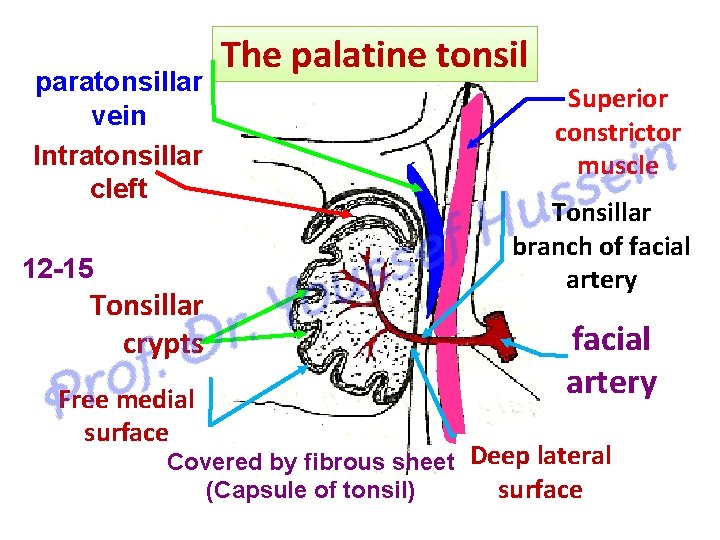
paratonsillar vein Intratonsillar cleft 12 15 Tonsillar crypts Free medial surface The palatine tonsil Superior constrictor muscle Tonsillar branch of facial artery Covered by fibrous sheet Deep lateral surface (Capsule of tonsil)

The palatine tonsil Structure: it is a mass of lymphoid tissue surrounded by capsule. Shape: almond shaped. Site: it lies in the tonsillar fossa on the lateral wall of oropharynx. Surfaces of the tonsil (Features) : it has 2 surfaces: 1. Medial (free) surface: presenting 12 15 tonsillar crypts. The upper part of the tonsil shows a deep cleft called the intratonsillar cleft (within the substance of the tonsil). 1. Lateral (deep) surf aceis covered by capsule which separates the tonsil from superior constrictor muscle. This surface is related to 1 Paratonsillar vein 2 Tonsillar artery (branch of facial artery).

Tonsil Nerve supply: Glossopharyngeal nerve. Arterial supply: tonsillar branch of 1 Facial artery (main blood supply). 2 Ascending palatine artery (facial artery). 3 Ascending pharyngeal artery (external carotid artery). 4 Greater palatine artery (the 3 rd part of maxillary artery). • Venous drainage: Paratonsillar vein to the pharyngeal plexus of veins or facial vein. • Lymphatic drainage, to upper deep cervical lymph nodes. • Surface anatomy, it represents by an oval fossa over the ramus of the mandible, a little above and in front the angle of the mandible.
1 Referred pain to the middle ear during tonsillitis or after tonsillectomy because the glossopharyngeal nerve supplies both tonsil and middle ear (through tympanic branch). 2 Profuse venous hemorrhage may follow tonsillectomy when the paratonsillar vein is injured during operation.
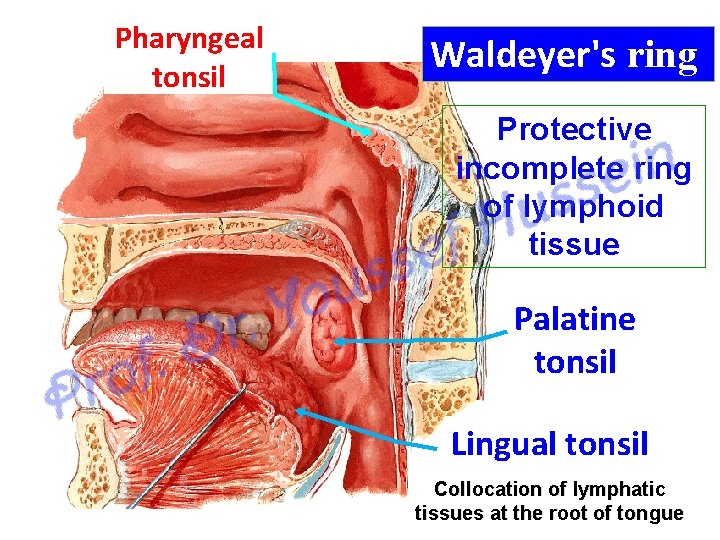
Pharyngeal tonsil Waldeyer's ring Protective incomplete ring of lymphoid tissue Palatine tonsil Lingual tonsil Collocation of lymphatic tissues at the root of tongue
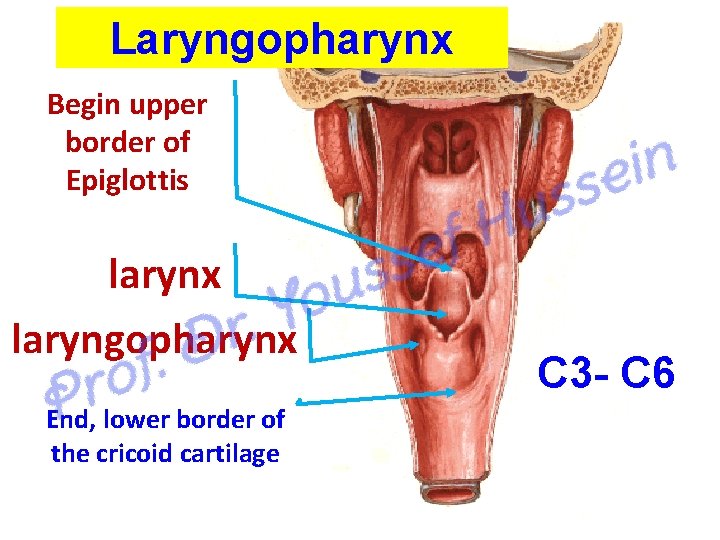
Laryngopharynx Begin upper border of Epiglottis larynx laryngopharynx End, lower border of the cricoid cartilage C 3 C 6
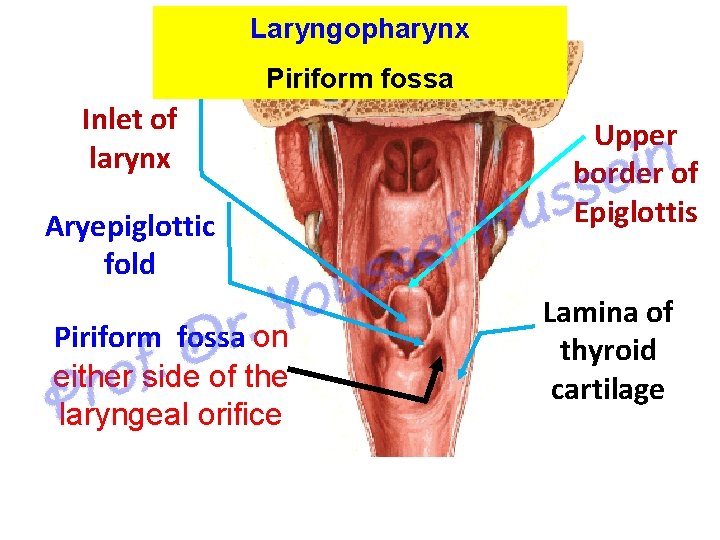
Laryngopharynx Piriform fossa Inlet of larynx Aryepiglottic fold Piriform fossa on either side of the laryngeal orifice Upper border of Epiglottis Lamina of thyroid cartilage

v Piriform fossa on either side of the laryngeal orifice. • Boundaries of the fossa; Medially, aryepiglottic fold. Laterally, lamina of the thyroid cartilage and thyrohyoid membrane. In the floor of the fossa, there is the internal laryngeal nerve. The nerve may be injured during removal of the foreign body.
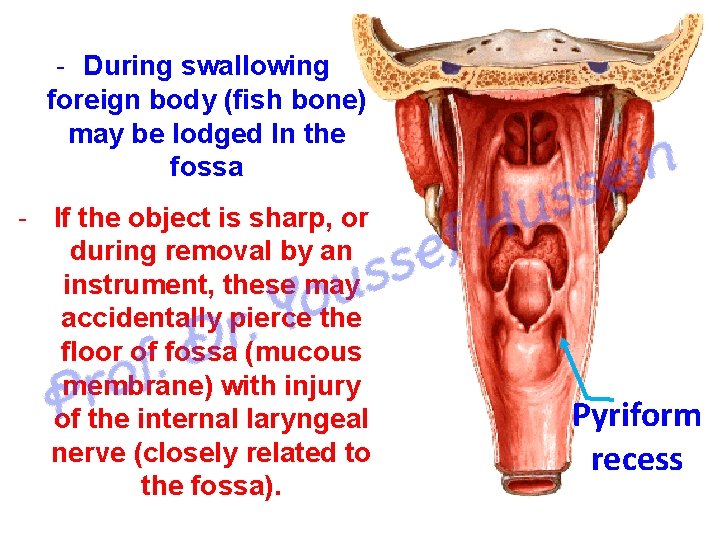
During swallowing foreign body (fish bone) may be lodged In the fossa If the object is sharp, or during removal by an instrument, these may accidentally pierce the floor of fossa (mucous membrane) with injury of the internal laryngeal nerve (closely related to the fossa). Pyriform recess
Esophagus
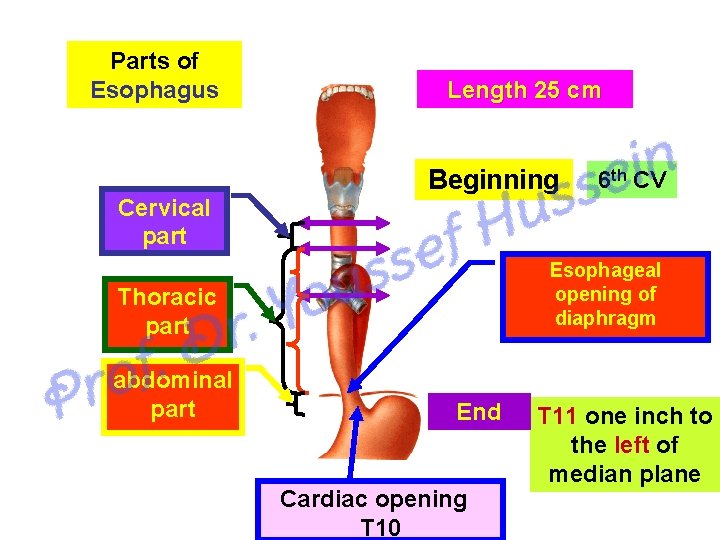
Parts of Esophagus Cervical part Length 25 cm Beginning Esophageal opening of diaphragm Thoracic part abdominal part 6 th CV End Cardiac opening T 10 T 11 one inch to the left of median plane
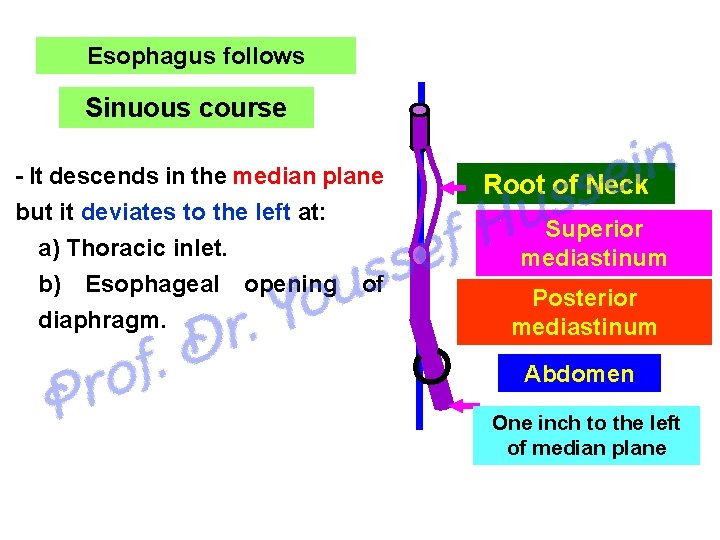
Esophagus follows Sinuous course It descends in the median plane but it deviates to the left at: a) Thoracic inlet. b) Esophageal opening of diaphragm. Root of Neck Superior mediastinum Posterior mediastinum Abdomen One inch to the left of median plane
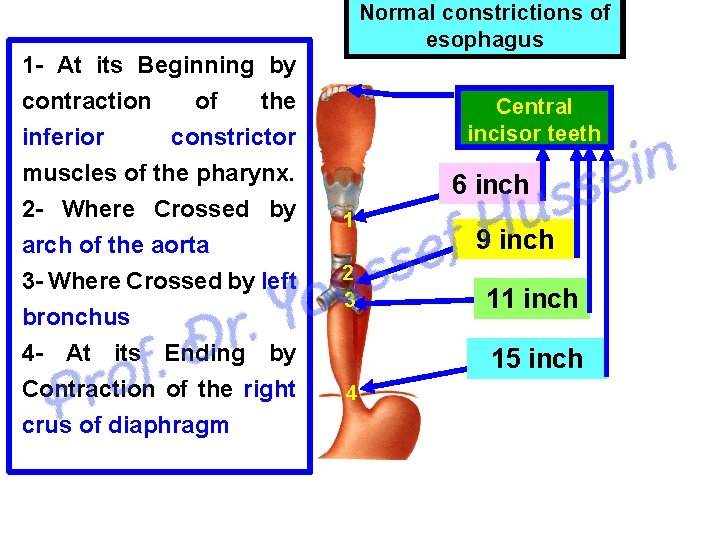
1 At its Beginning by contraction of the inferior constrictor muscles of the pharynx. 2 Where Crossed by arch of the aorta 3 Where Crossed by left bronchus 4 At its Ending by Contraction of the right crus of diaphragm Normal constrictions of esophagus Central incisor teeth 6 inch 1 2 3 9 inch 11 inch 15 inch 4
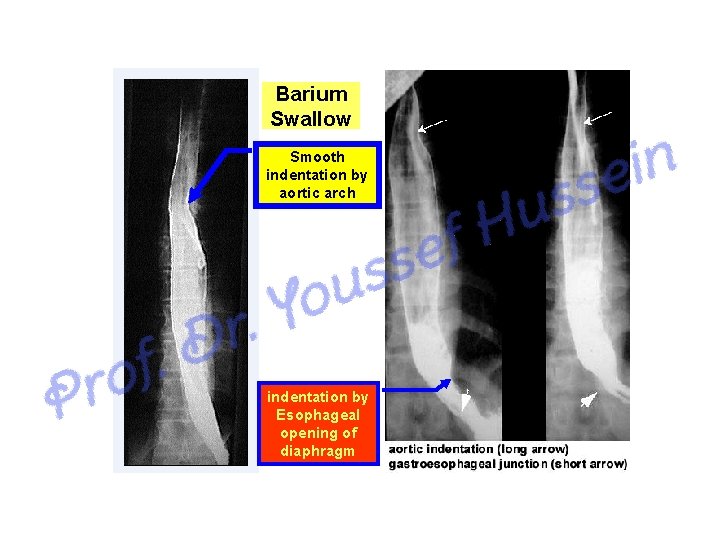
Barium Swallow Smooth indentation by aortic arch indentation by Esophageal opening of diaphragm
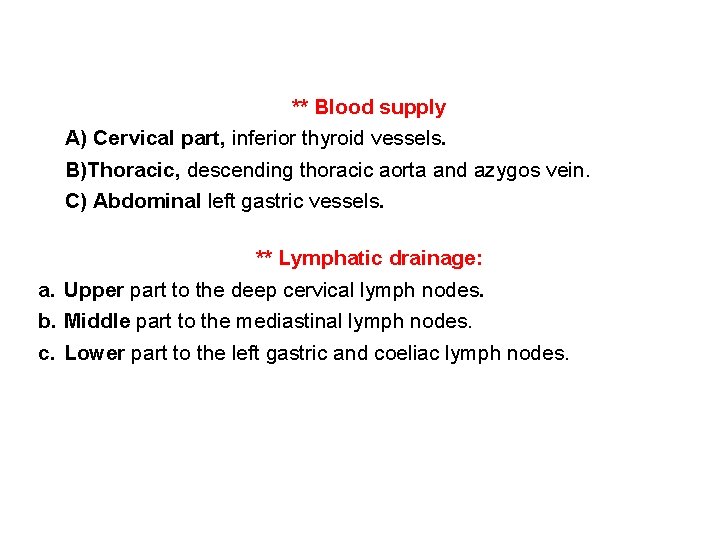
** Blood supply A) Cervical part, inferior thyroid vessels. B)Thoracic, descending thoracic aorta and azygos vein. C) Abdominal left gastric vessels. ** Lymphatic drainage: a. Upper part to the deep cervical lymph nodes. b. Middle part to the mediastinal lymph nodes. c. Lower part to the left gastric and coeliac lymph nodes.
- Slides: 34