
PHARMACONOMY DR RAMYA S S ASSISTANT PROFESSOR DEPT
- Slides: 29
PHARMACONOMY DR. RAMYA S. S ASSISTANT PROFESSOR DEPT OF HOMOEOPATHIC PHARMACY
Pharmaconomy � As Homoeopathy bears a speciality and originality in the field of medicine, it’s route and mode of administration also bears a speciality � DEFINITION : The subject dealing with the route or channel of administration of drugs and medicine is termed as PHARMACONOMY
VARIOUS ROUTES ORAL ROUTE; (INGESTION THROUGH MOUTH) � BY OLFACTION: (INHALATION THROUGH NOSE OR MOUTH) BY APPLICATION TO THE SKIN: v Rubbing or Friction(epidermic) v Enepidermic OTHERS: EYE, EAR etc �
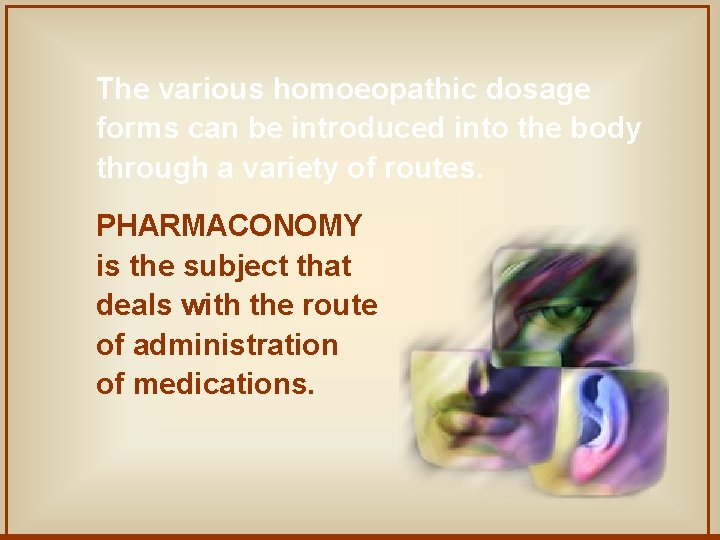
The various homoeopathic dosage forms can be introduced into the body through a variety of routes. PHARMACONOMY is the subject that deals with the route of administration of medications.
In 6 th edition of Organon of Medicine, § 284, § 285, Hahnemann clarifies about the various routes of administration of Homoeopathic Similimum.
Besides the tongue, mouth and stomach which are most commonly affected by the administration of the medicine. . . the nose and respiratory organs are receptive of the action of medicines in fluid form by means of olfaction and inhalation through mouth.
But the whole remaining skin of the body clothed with epidermis is adapted to the action of medicinal substances, especially if the inunction is connected with simultaneous internal administration.
In this way, the cure of very old diseases maybe furthered by applying externally, rubbing it in the back, arms, extremities, the same medicine he gives internally and which showed itself curatively. In doing so, he must avoid parts subject to pain, spasm and skin eruption.
The nature of the dosage form must be in consonance with the intended route of administration for maximum effectiveness and convenience of handling and administration. There are various routes or channels through which the homoeopathic medicine can be introduced into the human system.
ORAL ROUTE Oral route is the most important of all the routes of administration. Homoeopathic medicines act via oral route on the entire human organism, not by a process of digestion, but via nervous syste
‘… A similar globule, crushed with some sugar of milk and dissolved in a good deal of water and stirred well before every administration will produce a far more powerful medicine for the use of several days. Every dose, no matter how minute, touches, on the contrary, many nerves. ’ (Aphorism 272)
� Sub-lingual administration of medicines may also be adopted. � Gurgles are aqueous solutions intended to be used after dilution with warm water. The gargle is kept in throat and air from lungs is forced through for the solution to come in contact with the above membranes.
OLFACTION AND INHALATION The olfactory nerve is directly connected to the brain (bypassing digestive system) and is an interesting avenue for the Here the remedies. remedy administration of dynamic reaches the brain and higher centres directly.
OLFACTION � A method of administering medicine through the nose and mouth by act of smelling. � Globule is moistened with medicinal fluid. The patient holds the open mouth of phial first in one nostril, and in the act of inspiration draw the air out of it into himself. (Footnote to § 288, 5 th edition of Organon of Medicine)
• In children it is applied close to the nostrils while they are asleep. This method is usually applied for idiosyncratic patients and when it is not possible to administer the medication orally as in cases of epilepsy, hysteria, lock-jaw, etc.
INHALATION Inhalations are solutions of medicaments administered by nasal or respiratory route, intended for local or systemic effects. Inhalations are applied in form of vapors that are to be inhaled along with breath from the surface of hot water. Vehicles preferred are normal saline and other water based liquids. 1 tsp of medicine is poured to 1 pint of hot water, not boiling water.
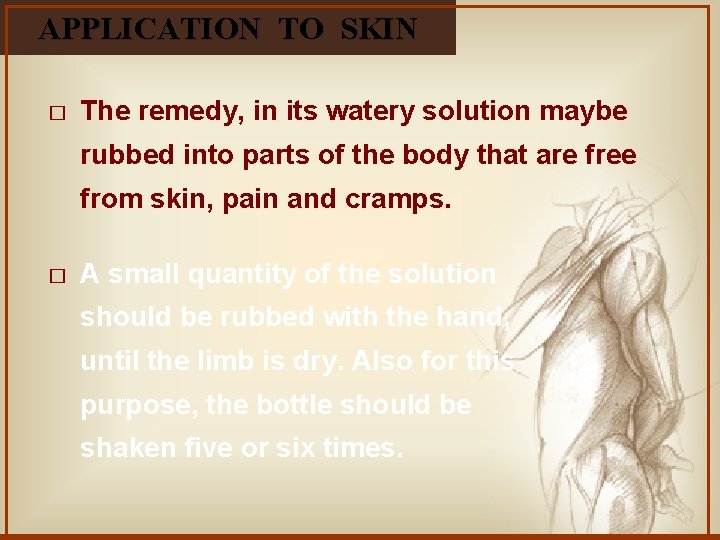
APPLICATION TO SKIN � The remedy, in its watery solution maybe rubbed into parts of the body that are free from skin, pain and cramps. � A small quantity of the solution should be rubbed with the hand, until the limb is dry. Also for this purpose, the bottle should be shaken five or six times.
• The drugs applied to the skin in the form of lotions, liniments, ointments, poultices, plasters, are meant to exercise local action in adynamic diseases and expedite cure in chronic dynamic derangement.
Rubbing or friction (Inunction or Epidermic) � Friction through the whole cutaneous surface of the body, wherever the epidermis is sound as epigastrium, inner parts of the thighs, lower part of the abdomen, back, arms, etc. � E. g. application of lotions, ointments, liniments
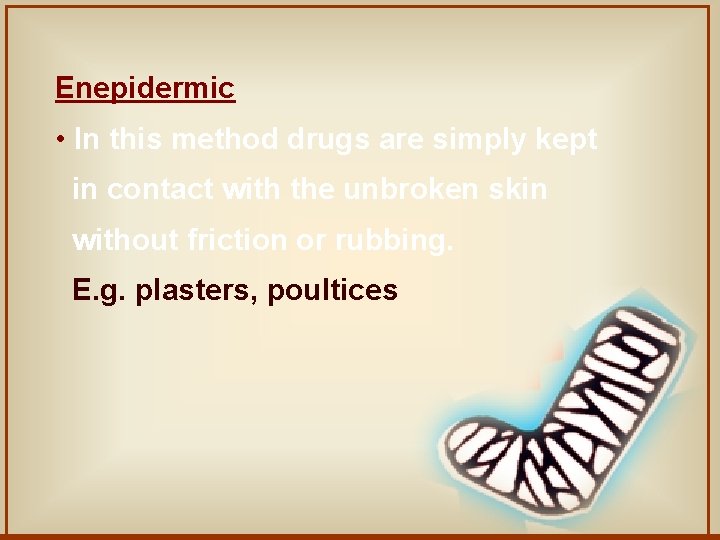
Enepidermic • In this method drugs are simply kept in contact with the unbroken skin without friction or rubbing. E. g. plasters, poultices
OTHER ORIFICES OF THE BODY Ear drops are often aqueous solutions, sometimes glycerin or alcoholic, intended for instillation into ear e. g. Mullein oil
Eye drops which are aqueous or oily solutions of drugs and eye ointments are intended for instillation into eye. E. g. Cineraria eye drops The ophthalmic products are generally meant for instillation into the space between the eyelids and the eyeballs.
Rectal route The forms of rectal administration are solutions, ointments and suppositories. Consistency of rectal ointments has to be thinner and softer than skin ointment to easily pass through the fine holes of rectal nozzle. Vagina, Urethra Medications intended to be delivered locally may be injected into the vagina or the urethra, as per the need.
PARENTERAL ROUTES The parenteral placement of the homoeopathic medicines into various tissues at various depths including the blood stream is a field that has not been explored and studied.
Since all studies of the action of homoeopathic medicines on healthy humans is done by oral or olfactory route, sufficient literature to lay down the guidelines for parenteral introduction remains unavailable.
PLACENTAL ROUTE AND VIA MILK OF MOTHER The power of medicines acting upon an infant through milk of mother or wet nurse is helpful. Every disease in a child yields to the rightly chosen homoeopathic medicines given in moderate doses to the nursing mother and so administered, is more easily and certainly utilized than is possible in later years.
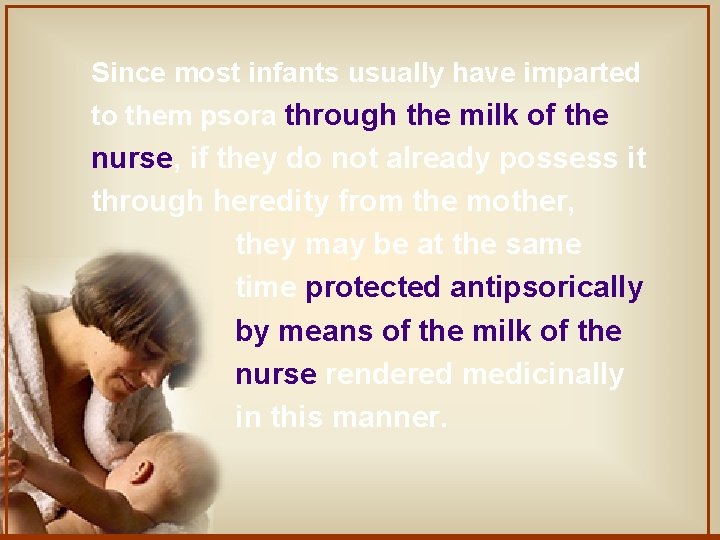
Since most infants usually have imparted to them psora through the milk of the nurse, if they do not already possess it through heredity from the mother, they may be at the same time protected antipsorically by means of the milk of the nurse rendered medicinally in this manner.
But the case of mothers in their pregnancy by means of a mild antipsoric treatment, especially with sulphur dynamizations, prepared according to the directions (§ 270), is indispensable in order to destroy the psora - which is given them hereditarily; destroy it both within themselves and in the fetus, thereby protecting posterity in advance.
This is true of pregnant women thus treated; they have given birth to children usually more healthy and stronger, to the astonishment of everybody. A new confirmation of the great truth of psora theory discovered by me. (Footnote no. 164, § 284)