
Pharmacology in Cystic Fibrosis Denise Kwong Pharm D
Pharmacology in Cystic Fibrosis Denise Kwong, Pharm. D, BCPS March 10, 2018
OBJECTIVES } Review pulmonary exacerbations and importance of treatment } Understand microbiology in cystic fibrosis and common pathogens in adults } Focus on Pseudomonas aeruginosa infections } Discuss pharmacokinetics of antibiotics and the importance of medication adherence } Review chronic medications for maintenance of lung health } Understand different respiratory therapies and sequence of administration Confidential – For Discussion Purposes Only 2
PULMONARY EXACERBATIONS } Characterized by: − ↓ Lung function by 10% − Upper respiratory tract infection symptoms: } ↑ cough, ↑ purulent sputum, shortness of breath, difficulty breathing } ↓ exercise tolerance } ↓ appetite and/or weight loss } Caused by: − Inflammation − Infection } Goal of treatment: − Return to previous pulmonary and functional status − Prolong time period to next pulmonary exacerbation } Repeat exacerbations have a NEGATIVE impact on lung function and lifespan Budev MM, Mehta AC. Cystic Fibrosis. Cleveland Clinic: current Clinical Medicine. 2 nd ed. Philadelphia: Elsevier; 2010. p. 1037 -44. Gibson RL, et al. Am J Respir Crit Care Med 2003; 168: 918 -51. Giusti R. Cystic Fibrosis. Conn’s Current Therapy. 1 st ed. Philadelphia: Elsevier; 2012. p. 350 -353. Goss CH, Burns JL. Thorax 2007; 62: 360 -67. Confidential – For Discussion Purposes Only 3
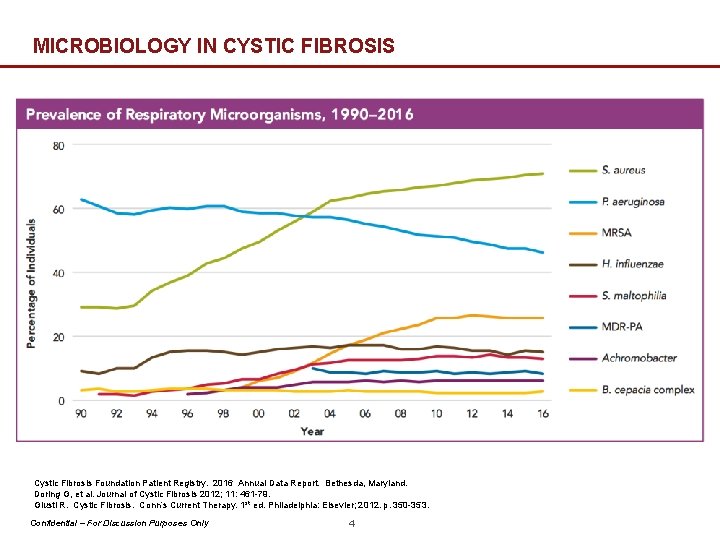
MICROBIOLOGY IN CYSTIC FIBROSIS Cystic Fibrosis Foundation Patient Registry. 2016 Annual Data Report. Bethesda, Maryland. Doring G, et al. Journal of Cystic Fibrosis 2012; 11: 461 -79. Giusti R. Cystic Fibrosis. Conn’s Current Therapy. 1 st ed. Philadelphia: Elsevier; 2012. p. 350 -353. Confidential – For Discussion Purposes Only 4
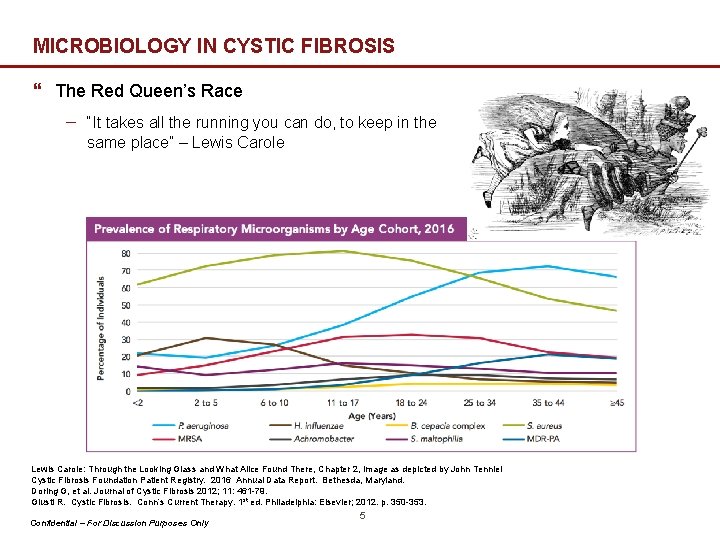
MICROBIOLOGY IN CYSTIC FIBROSIS } The Red Queen’s Race − “It takes all the running you can do, to keep in the same place” – Lewis Carole: Through the Looking Glass and What Alice Found There, Chapter 2, Image as depicted by John Tenniel Cystic Fibrosis Foundation Patient Registry. 2016 Annual Data Report. Bethesda, Maryland. Doring G, et al. Journal of Cystic Fibrosis 2012; 11: 461 -79. Giusti R. Cystic Fibrosis. Conn’s Current Therapy. 1 st ed. Philadelphia: Elsevier; 2012. p. 350 -353. Confidential – For Discussion Purposes Only 5
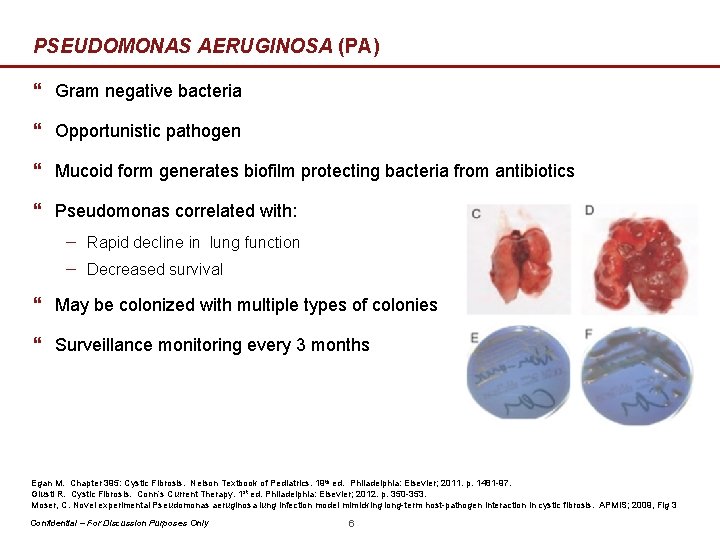
PSEUDOMONAS AERUGINOSA (PA) } Gram negative bacteria } Opportunistic pathogen } Mucoid form generates biofilm protecting bacteria from antibiotics } Pseudomonas correlated with: − Rapid decline in lung function − Decreased survival } May be colonized with multiple types of colonies } Surveillance monitoring every 3 months Egan M. Chapter 395: Cystic Fibrosis. Nelson Textbook of Pediatrics. 19 th ed. Philadelphia: Elsevier; 2011. p. 1481 -97. Giusti R. Cystic Fibrosis. Conn’s Current Therapy. 1 st ed. Philadelphia: Elsevier; 2012. p. 350 -353. Moser, C. Novel experimental Pseudomonas aeruginosa lung infection model mimicking long-term host-pathogen interaction in cystic fibrosis. APMIS; 2009, Fig 3 Confidential – For Discussion Purposes Only 6
ANTIBIOTIC SELECTION } 2009 Cystic Fibrosis Guidelines for Treatment of Pulmonary Exacerbations − “There is insufficient evidence to recommend the use of a single antibiotic as being equivalent to the use of more than one antibiotic class for treatment of Pseudomonas infection during an acute pulmonary exacerbation” } In practice we use 2 antibiotics to cover Pseudomonas aeruginosa − ** Regimen based on recent culture sensitivities** − Try to pick different drug classes for different mechanisms of action } Intravenous (IV) antibiotics +/- Inhaled antibiotics Doring G, et al. Journal of Cystic Fibrosis 2012; 11: 461 -79. Flume PA, et al. Am J Respir Crit Care Med 2009; 180: 802 -8. Giusti R. Cystic Fibrosis. Conn’s Current Therapy. 1 st ed. Philadelphia: Elsevier; 2012. p. 350353. Confidential – For Discussion Purposes Only 7
ANTIBIOTICS EFFECTIVE AGAINST PSEUDOMONAS } β-lactams − − − − − } Aminoglycosides Piperacillin/Tazobactam (Zosyn™) Ceftazidime (Fortaz™) Ceftazidime/Tazobactam (Avycaz™) Cefepime (Maxipime™) Ceftolozane/Tazobactam (Zerbaxa™) Imipenem/cilastatin (Primaxin™) Meropenem (Merrem™) Doripenem (Doribax™) Aztreonam (Azactam™) − Gentamicin − Tobramycin − Amikacin } Fluoroquinolones − Ciprofloxacin (Cipro™) − Levofloxacin (Levaquin™) Double coverage combinations: } Two IV antibiotics with different MOA } Polymixins − Polymixin b (Aerosporin™) − Colistin (Coly-Mycin M™) − β-lactam + Aminoglycoside − β-lactam + Colistin − β-lactam + Fluoroquinolone Simon RH. Cystic fibrosis: Antibiotic therapy for lung disease. In: Up. To. Date, Hoppin, AG (Ed), Up. To. Date, Wellesley, MA, 2012. Confidential – For Discussion Purposes Only 8
HOW LONG TO TREAT? } Treat exacerbations until symptoms resolve and lung function recovers } Standard therapy: − Combination of two IV antibiotics for 14 – 21 days } Multi-drug resistant Pseudomonas aeruginosa may require longer therapy Doring G, et al. Journal of Cystic Fibrosis 2012; 11: 461 -79. Gibson RL, et al. Am J Respir Crit Care Med 2003; 168: 918 -51. Confidential – For Discussion Purposes Only 9
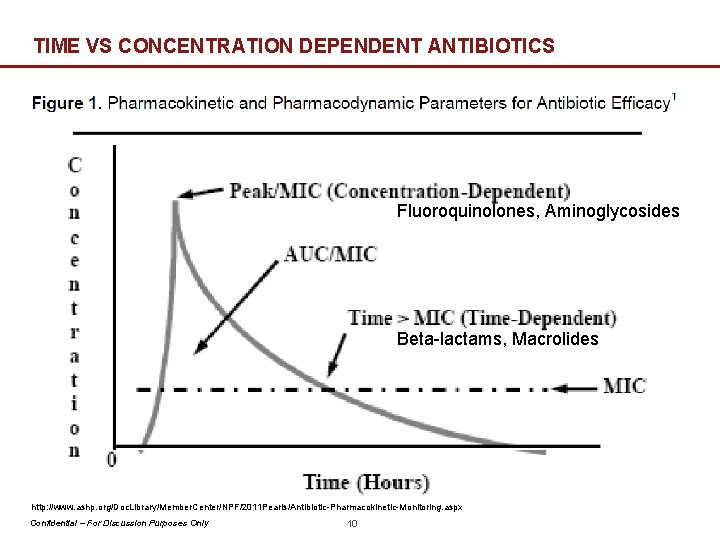
TIME VS CONCENTRATION DEPENDENT ANTIBIOTICS Fluoroquinolones, Aminoglycosides Beta-lactams, Macrolides http: //www. ashp. org/Doc. Library/Member. Center/NPF/2011 Pearls/Antibiotic-Pharmacokinetic-Monitoring. aspx Confidential – For Discussion Purposes Only 10
ANTIBIOTIC DOSING AND MONITORING } Patient Adherence is the most important parameter } Time Dependent: Lower Doses + Frequent Dosing + Extended Infusion − Beta-Lactams (Piperacillin-Tazobactam, Cefepime, Meropenem, Aztreonam) } Concentration Dependent: Higher Doses + Infrequent Dosing − Aminoglycosides (Amikacin, Gentamicin, Tobramycin) } Bonus post-antibiotic effect } Therapeutic Drug Monitoring − Important to balance efficacy with toxicity − Drug levels usually timed for peaks and/or troughs } Peak: monitor efficacy } Trough: monitor toxicity } Most common toxicity = Kidney Damage − Look out for ↓ urine output, fluid retention (leg swelling), confusion, fatigue, nausea Wu B. , Sy S. K. B. , Derendorf H. (2014) Principles of Applied Pharmacokinetic–Pharmacodynamic Modeling. In: Vinks A. , Derendorf H. , Mouton J. (eds) Fundamentals of Antimicrobial Pharmacokinetics and Pharmacodynamics. Springer, New York, NY Confidential – For Discussion Purposes Only 11
CHRONIC USE OF AZITHROMYCIN TO REDUCE EXACERBATIONS } Recommended for use in patients > 6 years old − High Evidence for patients WITH chronic PA colonization − Moderate Evidence for patients WITHOUT chronic PA colonization } Does NOT treat PA infection } Benefits: − ↓ PA biofilm formation − Relative improvement of FEV 1 − Fewer courses of IV antibiotic − Fewer hospital days − Weight gain } AFB smear prior to starting, then check culture & smear every 6 -12 months } Dose: ≥ 40 kg: 500 mg three times a week Doring G, et al. Journal of Cystic Fibrosis 2012; 11: 461 -79. Flume PA. Am J Respir Crit Care Med 2007; 176: 957 -69. Yankaskas JR, et al. Chest 2004; 125: 1 S-39 S. Mogayzel, P et al. Cystic Fibrosis Pulmonary Guidelines Chronic Medications. Am J Respir Crit Care Med. 2013; 680 -689 Confidential – For Discussion Purposes Only 12
NO EVIDENCE FOR ANTI-INFLAMMATORY AGENTS IN ADULTS } Excessive inflammatory response in airways may be major cause of destruction } Inhaled corticosteroid: − No improvement in lung function − CFF does not recommend } Systemic corticosteroid: − Showed benefit of pulmonary function − Risks outweigh: cataracts, glucose intolerance, bone density decrease − CFF does not recommend } Ibuprofen: − Slowed progression of pulmonary disease in mildly affected patients − Recommended in 6 -17 year old with FEV 1 >60% 13 Mogayzel, P et al. Cystic Fibrosis Pulmonary Guidelines Chronic Medications. Am J Respir Crit Care Med. 2013; 680 -689 Confidential – For Discussion Purposes Only
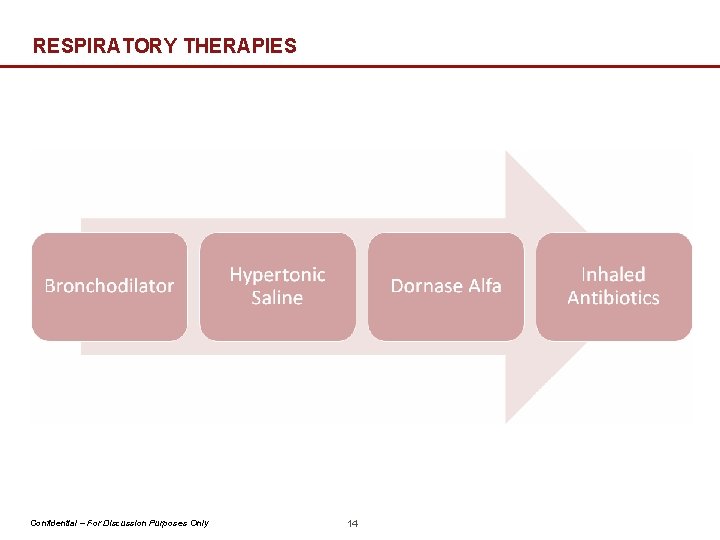
RESPIRATORY THERAPIES Confidential – For Discussion Purposes Only 14
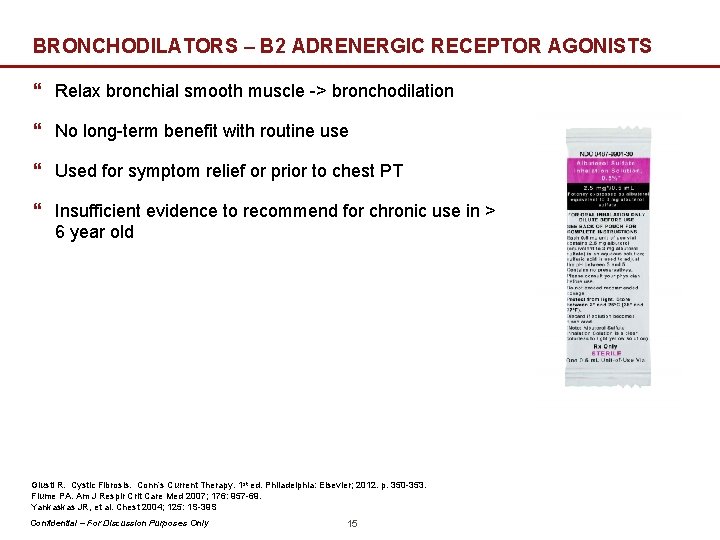
BRONCHODILATORS – B 2 ADRENERGIC RECEPTOR AGONISTS } Relax bronchial smooth muscle -> bronchodilation } No long-term benefit with routine use } Used for symptom relief or prior to chest PT } Insufficient evidence to recommend for chronic use in > 6 year old Giusti R. Cystic Fibrosis. Conn’s Current Therapy. 1 st ed. Philadelphia: Elsevier; 2012. p. 350 -353. Flume PA. Am J Respir Crit Care Med 2007; 176: 957 -69. Yankaskas JR, et al. Chest 2004; 125: 1 S-39 S Confidential – For Discussion Purposes Only 15

HYDRATION OF AIRWAY SURFACE FLUID } 7% hypertonic saline (Hyper-sal®) increases hydration of airway surface fluid − − Administered via nebulizer 2 -4 times daily Facilitate clearance of airway mucus ↑ pulmonary function ↓ frequency of pulmonary exacerbations 16 Egan M. Chapter 395: Cystic Fibrosis. Nelson Textbook of Pediatrics. 19 th ed. Philadelphia: Elsevier; 2011. p. 1481 -97. Confidential – For Discussion Purposes Only
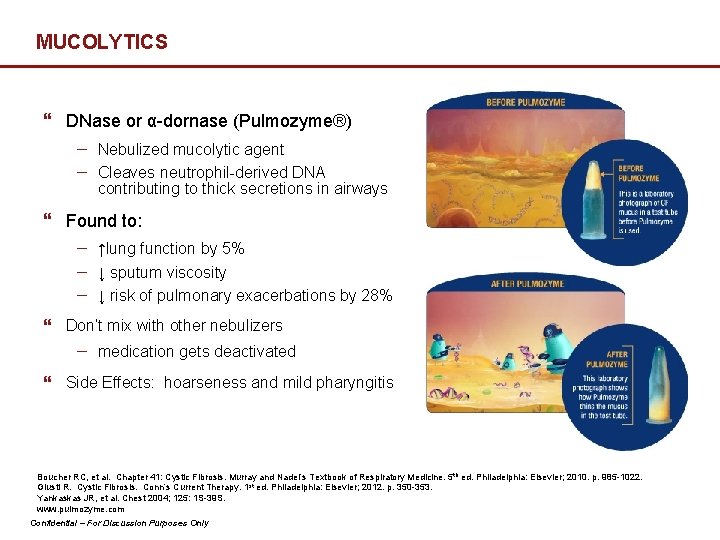
MUCOLYTICS } DNase or α-dornase (Pulmozyme®) − Nebulized mucolytic agent − Cleaves neutrophil-derived DNA contributing to thick secretions in airways } Found to: − ↑lung function by 5% − ↓ sputum viscosity − ↓ risk of pulmonary exacerbations by 28% } Don’t mix with other nebulizers − medication gets deactivated } Side Effects: hoarseness and mild pharyngitis 17 Boucher RC, et al. Chapter 41: Cystic Fibrosis. Murray and Nadel’s Textbook of Respiratory Medicine. 5 th ed. Philadelphia: Elsevier; 2010. p. 985 -1022. Giusti R. Cystic Fibrosis. Conn’s Current Therapy. 1 st ed. Philadelphia: Elsevier; 2012. p. 350 -353. Yankaskas JR, et al. Chest 2004; 125: 1 S-39 S. www. pulmozyme. com Confidential – For Discussion Purposes Only
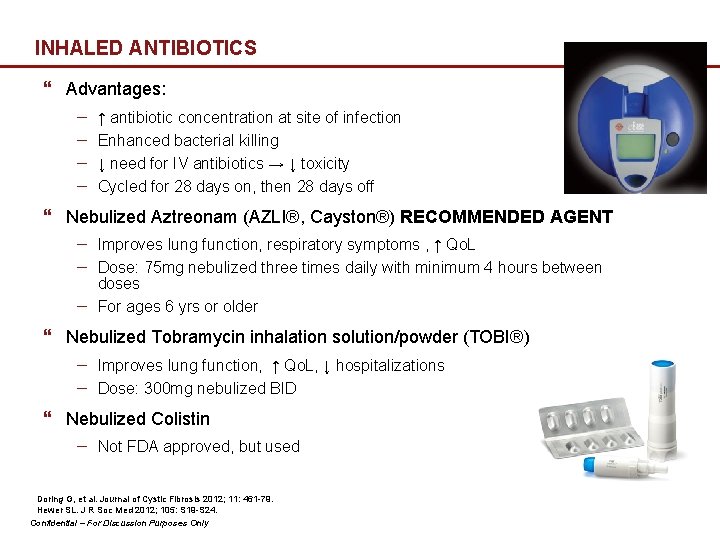
INHALED ANTIBIOTICS } Advantages: − − ↑ antibiotic concentration at site of infection Enhanced bacterial killing ↓ need for IV antibiotics → ↓ toxicity Cycled for 28 days on, then 28 days off } Nebulized Aztreonam (AZLI®, Cayston®) RECOMMENDED AGENT − Improves lung function, respiratory symptoms , ↑ Qo. L − Dose: 75 mg nebulized three times daily with minimum 4 hours between doses − For ages 6 yrs or older } Nebulized Tobramycin inhalation solution/powder (TOBI®) − Improves lung function, ↑ Qo. L, ↓ hospitalizations − Dose: 300 mg nebulized BID } Nebulized Colistin − Not FDA approved, but used Doring G, et al. Journal of Cystic Fibrosis 2012; 11: 461 -79. Hewer SL. J R Soc Med 2012; 105: S 19 -S 24. Confidential – For Discussion Purposes Only 18
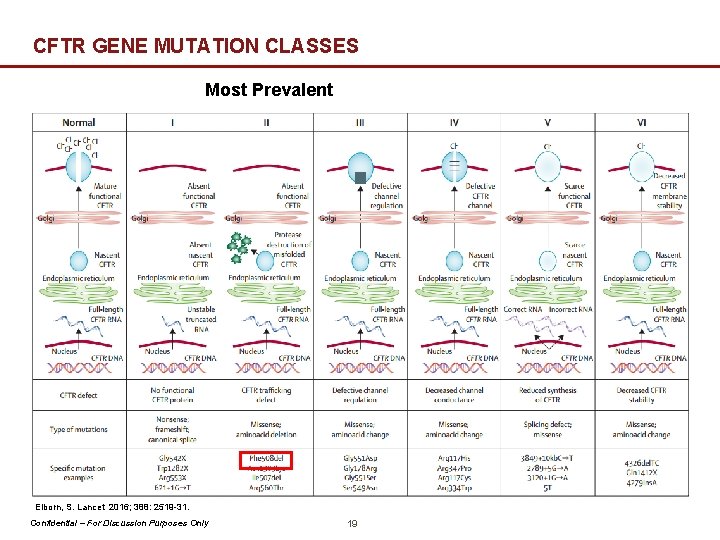
CFTR GENE MUTATION CLASSES Most Prevalent Elborn, S. Lancet 2016; 388: 2519 -31. Confidential – For Discussion Purposes Only 19
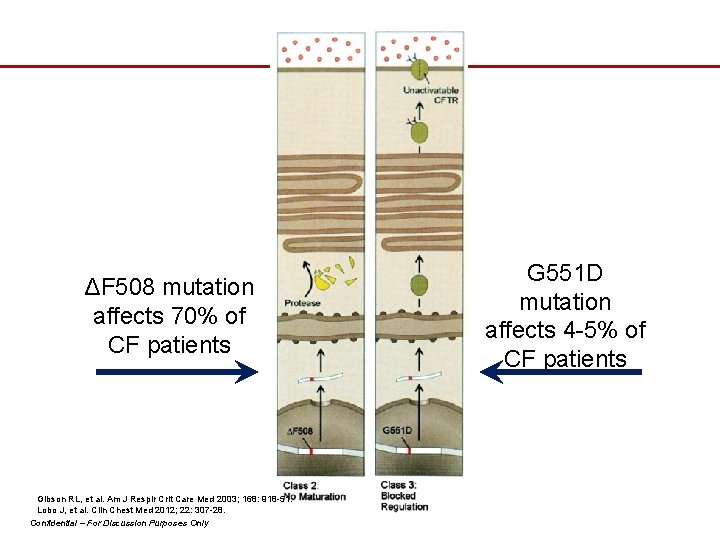
ΔF 508 mutation affects 70% of CF patients G 551 D mutation affects 4 -5% of CF patients 20 Gibson RL, et al. Am J Respir Crit Care Med 2003; 168: 918 -51. Lobo J, et al. Clin Chest Med 2012; 22: 307 -28. Confidential – For Discussion Purposes Only
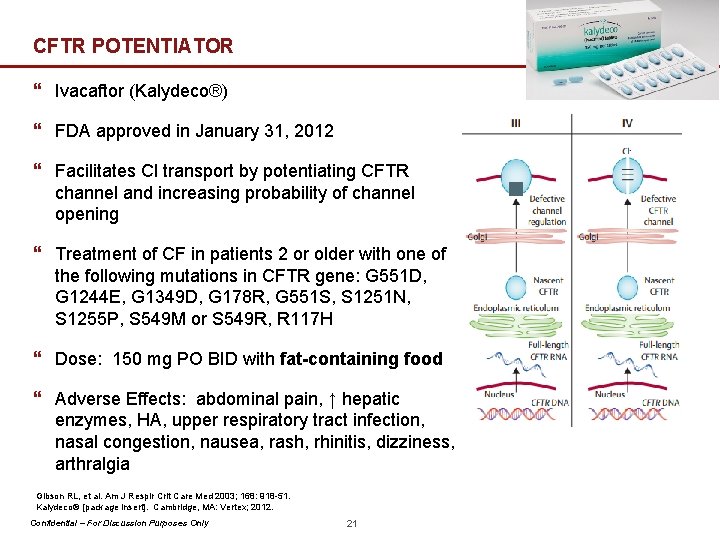
CFTR POTENTIATOR } Ivacaftor (Kalydeco®) } FDA approved in January 31, 2012 } Facilitates Cl transport by potentiating CFTR channel and increasing probability of channel opening } Treatment of CF in patients 2 or older with one of the following mutations in CFTR gene: G 551 D, G 1244 E, G 1349 D, G 178 R, G 551 S, S 1251 N, S 1255 P, S 549 M or S 549 R, R 117 H } Dose: 150 mg PO BID with fat-containing food } Adverse Effects: abdominal pain, ↑ hepatic enzymes, HA, upper respiratory tract infection, nasal congestion, nausea, rash, rhinitis, dizziness, arthralgia Gibson RL, et al. Am J Respir Crit Care Med 2003; 168: 918 -51. Kalydeco® [package insert]. Cambridge, MA: Vertex; 2012. Confidential – For Discussion Purposes Only 21
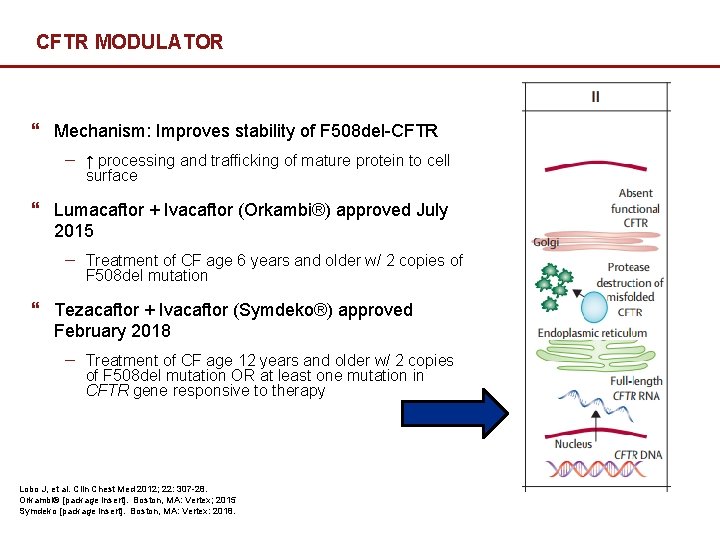
CFTR MODULATOR } Mechanism: Improves stability of F 508 del-CFTR − ↑ processing and trafficking of mature protein to cell surface } Lumacaftor + Ivacaftor (Orkambi®) approved July 2015 − Treatment of CF age 6 years and older w/ 2 copies of F 508 del mutation } Tezacaftor + Ivacaftor (Symdeko®) approved February 2018 − Treatment of CF age 12 years and older w/ 2 copies of F 508 del mutation OR at least one mutation in CFTR gene responsive to therapy 22 Lobo J, et al. Clin Chest Med 2012; 22: 307 -28. Orkambi® [package insert]. Boston, MA: Vertex; 2015 Symdeko [package insert]. Boston, MA: Vertex: 2018. Confidential – For Discussion Purposes Only

LUACAFTOR + IVACAFTOR (ORKAMBI®) } Each tablet contains lumacaftor 200 mg/ivacaftor 150 mg } Dose: 2 tablets orally every 12 hours with fat-containing food } Adverse Effects: chest discomfort, dyspnea, respiratory discomfort } Monitor for liver toxicity − Yellowing of skin and eyes, itching, abdominal pain, nausea, fatigue Lobo J, et al. Clin Chest Med 2012; 22: 307 -28. Orkambi® [package insert]. Boston, MA: Vertex; 2015. Confidential – For Discussion Purposes Only 23
TEZACAFTOR + IVACAFTOR (SYMDEKO®) } Each tablet contains tezacaftor 100 mg/ivacaftor 150 mg } Dose: 1 tablets orally every 12 hours with fat-containing food } Adverse Effects: nausea, headache, sinus congestion, DIOS } Monitor for liver toxicity − Yellowing of skin and eyes, itching, abdominal pain, nausea, fatigue } Monitor for blurred vision (cataracts) Symdeko [package insert]. Boston, MA: Vertex: 2018. Confidential – For Discussion Purposes Only 24
QUESTIONS? 25 Confidential – For Discussion Purposes Only
- Slides: 25