
Pharmacology Application in Athletic Training History of Drugs
- Slides: 111
Pharmacology Application in Athletic Training
History of Drugs and Pharmacy � Around 2100 BC: Recorded references to drug therapy �~250 vegetables, 120 mineral drugs � 1500 BC Egyptians: Ebers Papyrus � 22 yrd document: 700+ drugs listed � 600 -330 BC Greeks: developed pharmacopeias �Defined preparation, action of drug, etc � Middle Ages: Pharmacy recognized as a separate profession from medicine
Early 20 th Century - History of Drugs � Virtually no laws to govern the sale of drugs � Coca Cola: �A tonic that contained cocaine �Aid respiration and digestion � Paregoric acid: �Contained opium �Given to teething babies
U. S. History of Pharmacology � 1646: 1 st American Pharmacy � 1821: Philadelphia College of Pharmacy � 1852: American Pharmaceutical Association Begins � 1870: American Pharmaceutical Assoc developed regulations
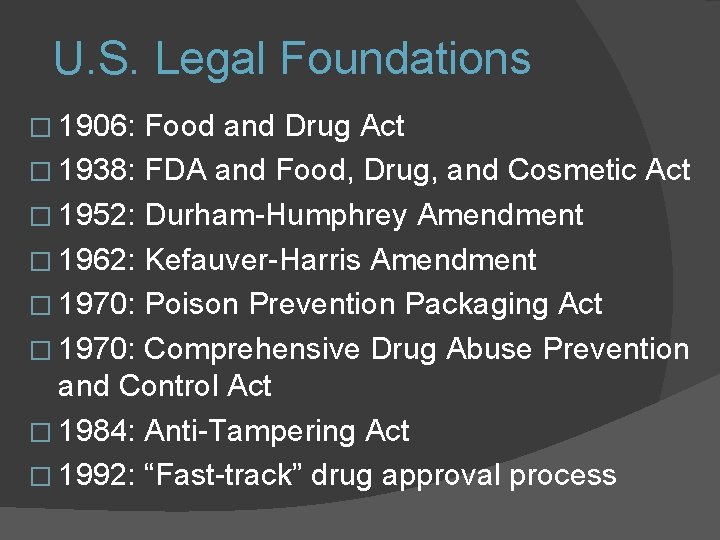
U. S. Legal Foundations � 1906: Food and Drug Act � 1938: FDA and Food, Drug, and Cosmetic Act � 1952: Durham-Humphrey Amendment � 1962: Kefauver-Harris Amendment � 1970: Poison Prevention Packaging Act � 1970: Comprehensive Drug Abuse Prevention and Control Act � 1984: Anti-Tampering Act � 1992: “Fast-track” drug approval process
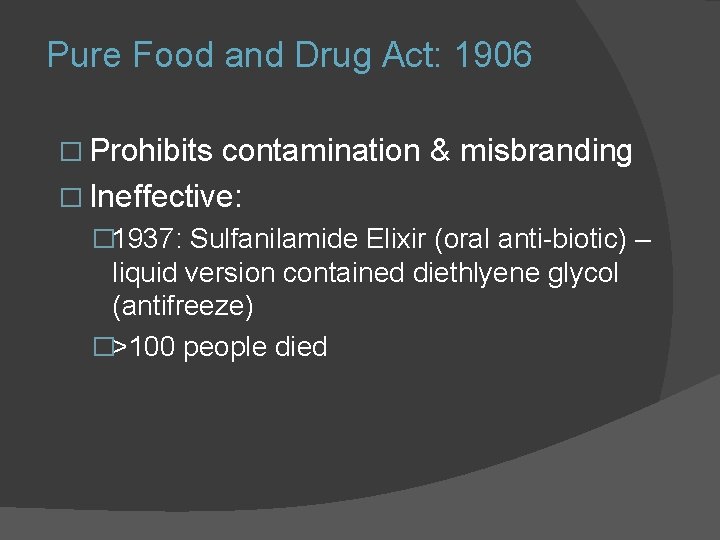
Pure Food and Drug Act: 1906 � Prohibits contamination & misbranding � Ineffective: � 1937: Sulfanilamide Elixir (oral anti-biotic) – liquid version contained diethlyene glycol (antifreeze) �>100 people died
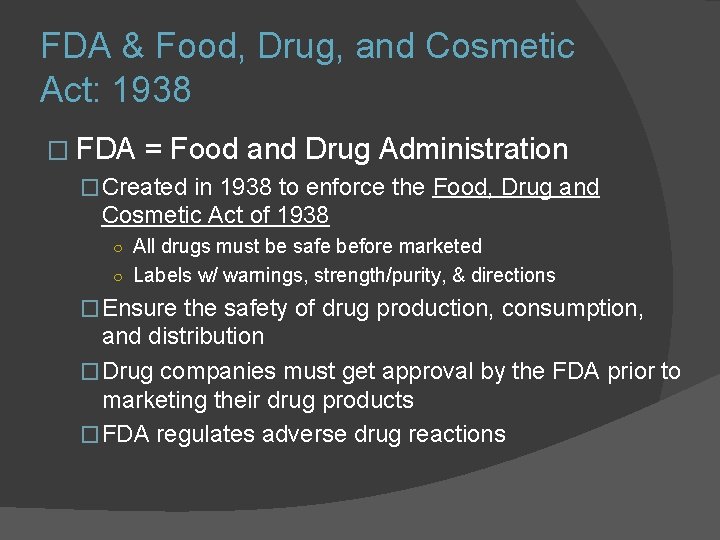
FDA & Food, Drug, and Cosmetic Act: 1938 � FDA = Food and Drug Administration �Created in 1938 to enforce the Food, Drug and Cosmetic Act of 1938 ○ All drugs must be safe before marketed ○ Labels w/ warnings, strength/purity, & directions �Ensure the safety of drug production, consumption, and distribution �Drug companies must get approval by the FDA prior to marketing their drug products �FDA regulates adverse drug reactions
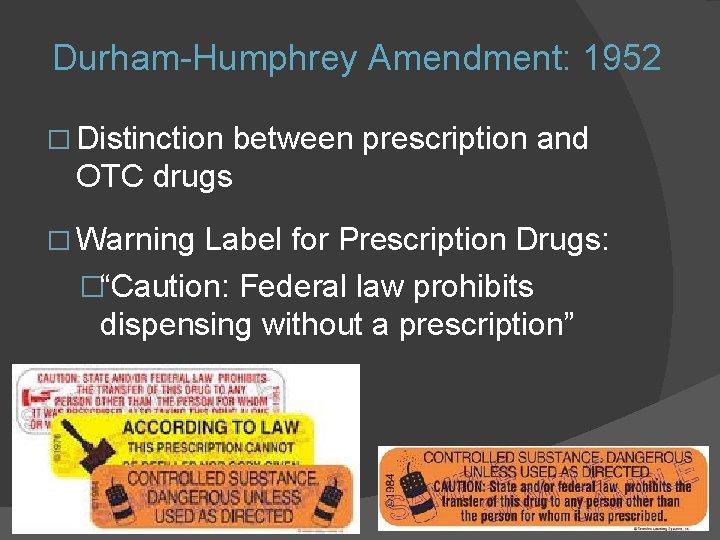
Durham-Humphrey Amendment: 1952 � Distinction between prescription and OTC drugs � Warning Label for Prescription Drugs: �“Caution: Federal law prohibits dispensing without a prescription”
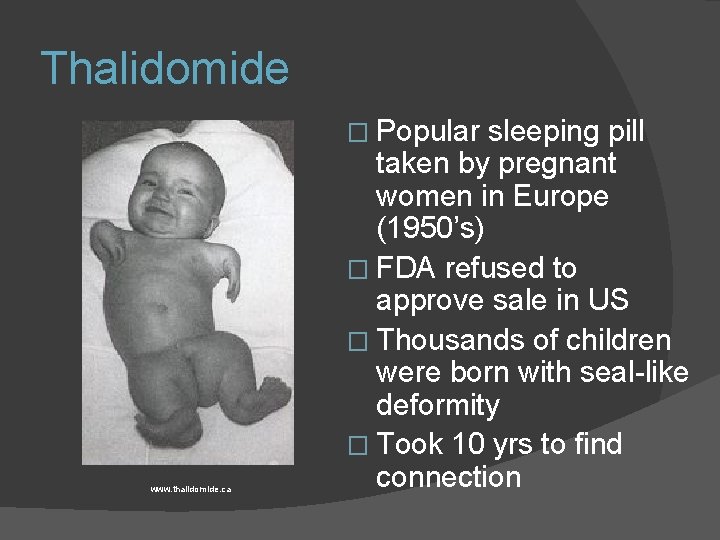
Thalidomide � Popular www. thalidomide. ca sleeping pill taken by pregnant women in Europe (1950’s) � FDA refused to approve sale in US � Thousands of children were born with seal-like deformity � Took 10 yrs to find connection
Kefauver-Harris Amendment: 1962 � In response to the Thalidomide tragedy � Requires manufactures to test products for safety and efficacy � Also required testing of drugs manufactured between 1938 -1962 �As a result, many were withdrawn from market
Poison Prevention Packaging Act: 1970 � Prevent the accidental poisoning of children � Prescription drugs must be dispensed in child-resistant containers � 80% of children under 5 must not be able to open the container � 90% of the adults must be able to open the container
Controlled Substance Act - 1970 Schedule I: Heroin, LSD distribution of drugs � Schedule II: Morphine, Dexedrine, Adderall, w/ potential for Oxy. Contin, Demerol, addiction/abuse Percocet, Ritalin � Schedule III: Tylenol w/ � Schedule: I – V Codeine, Vicodin � Schedule I – most � Schedule IV: Darvocet, abuse potential Valium, Ativan, Xanax, Ambien � Schedule V – least � Schedule V: Robitussin abuse potential A-C � Regulates �
Anti-Tampering Act: 1984 �A number of people died in the 80’s after taking Tylenol laced with cyanide � All OTC products must be sold with tamper-resistant packaging �Plastic seal over cap or aluminum seal over opening
FDA Drug Approval Process �~1/5000 drugs tested get to the �Around 12 yrs, costs millions of market dollars Other countries may last 1 yr and have lower standards � 1992: FDA created “fast track” to decrease approval time for important therapeutic drugs Allows marketing before the last phase of clinical trials (safety and efficacy portion) Follow-up studies must be performed Unknown risks are balanced by urgent need for drug
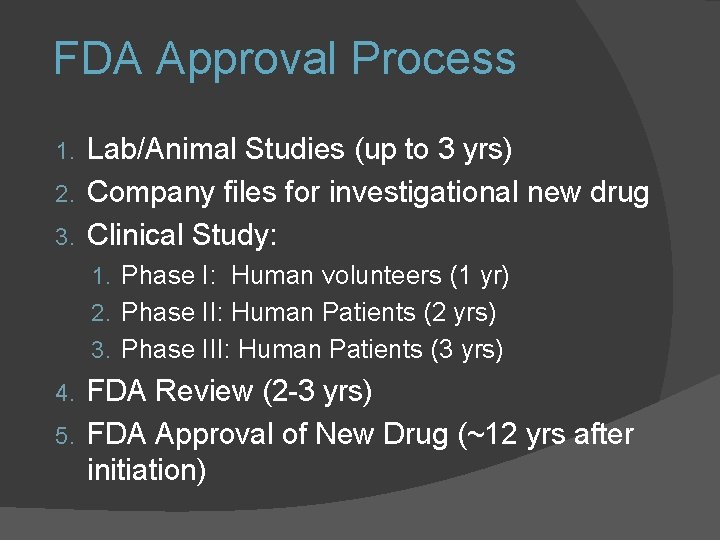
FDA Approval Process Lab/Animal Studies (up to 3 yrs) 2. Company files for investigational new drug 3. Clinical Study: 1. Phase I: Human volunteers (1 yr) 2. Phase II: Human Patients (2 yrs) 3. Phase III: Human Patients (3 yrs) FDA Review (2 -3 yrs) 5. FDA Approval of New Drug (~12 yrs after initiation) 4.
Name of Drugs � Chemical name � N-acetyl-para- aminophenol � Generic � Brand name � Acetaminophen � Tylenol®
Brand vs Generic � Brand-name drugs usually have a patent, granted by FDA, for 17 years �After 17 yrs, other companies can make generic equivalent � Generic drugs must have the same active ingredient, strength, & dosage as the brand name drug � Generic drugs must be tested for safety & efficacy & produce the same therapeutic effects as the brand name drug
PHARMACOKINETICS AND PHARMACODYNAMIC S
�Pharmacodynamics: how drugs affect the body �Pharmacokinetics: does to the drugs what the body
What is a Drug? �A chemical that alters physiological functions by replacing, interrupting, or potentiating (enhancing) existing cellular functions � Exp: Caffeine can produce a stimulating effect on the CNS by attaching to CNS receptors and overriding fatigue messages
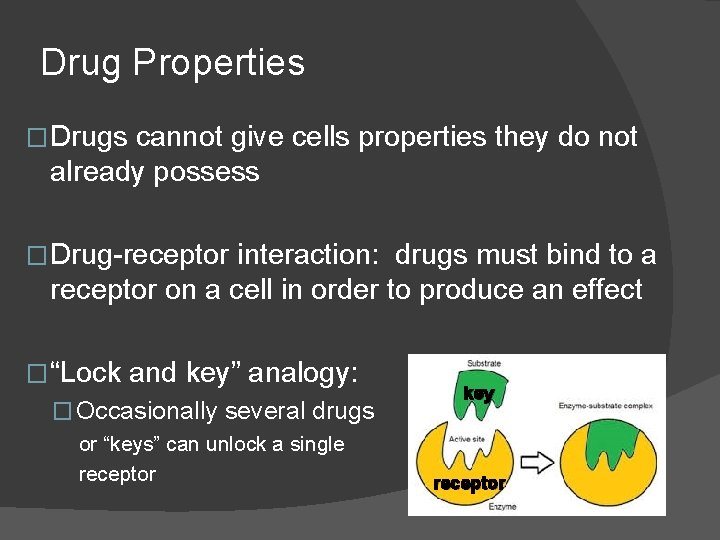
Drug Properties � Drugs cannot give cells properties they do not already possess � Drug-receptor interaction: drugs must bind to a receptor on a cell in order to produce an effect � “Lock and key” analogy: � Occasionally several drugs or “keys” can unlock a single receptor key receptor
Definitions � Agonist – a drug that binds to a receptor and produces an effect � Antagonist – a drug that binds to a receptor but does not produce an effect (blocker) � Threshold – lowest dose capable of producing an effect � Max effect – greatest response produced regardless of the dose (efficacy will not increase) � Efficacy - the capacity to illicit a response � Potency – amount of drug needed to produce an effect
Definitions �Affinity – the force that makes two agents bind together �Latency – “onset of action” – time required for a drug to produce an observable effect �Therapeutic Index – range in which desired effects are produced (narrow therapeutic index drugs have more potential to cause toxicities) �Duration of Action – period of a single dose drug response
Half-life (T ½) �The time required to reduce the amount of drug concentration in the body by 50% �Helps to determine how frequently a drug should be administered �Motrin ~ 4 hours �Claritin ~ 15 hours �Vicodin ~ 3 -4 hrs
Pharmacokinetics What does the body do to the drug? � Absorption � Distribution � Metabolism � Excretion
Absorption �Most drugs must be absorbed into the blood stream in order to get to the site of action �Methods of administration: �Sublingual �Oral �Intravenous �Transdermal (topical) �Inhalation
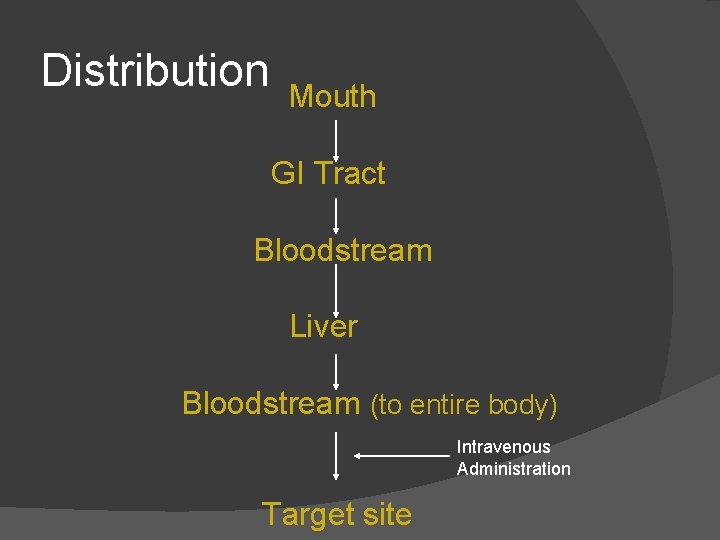
Distribution Mouth GI Tract Bloodstream Liver Bloodstream (to entire body) Intravenous Administration Target site
Metabolism � Process of breaking down drugs to be eliminated from the body � First pass metabolism: Oral drugs get absorbed in the gut, then travel to liver – part of the drug gets broken down � Primary organ of metabolism = Liver �Produces enzymes that break down drugs � Not all active drugs will reach their target site �Exp: Lidocaine, if given orally, will be completely broken down by the liver
Excretion � Primary organ of excretion = Kidney � Water-soluble drugs easily excreted �Too much vitamin C…flushed down the toilet � Lipid-soluble drugs are reabsorbed �Vitamins D, E, A, K: Fat-soluble, stored in liver, toxic in large quantities
Factors that affect drug response � Infants/Children �Enzymes do not fully develop until 12 y/o � Older Adults �Elderly have decreased kidney function � Timing of Food �Before, during, after meal � Person’s weight (fat distribution)
ANTI-INFLAMMATORY MEDICATIONS
Anti-Inflammatory Meds � Billion Dollar Industry � Approximately 1% of US population uses NSAID’s daily � 14, 000 cases each year of GI toxicity based on 70 million NSAID prescriptions filled (1991) � HS FB Study: � 75% used NSAID’s in previous 3 mo
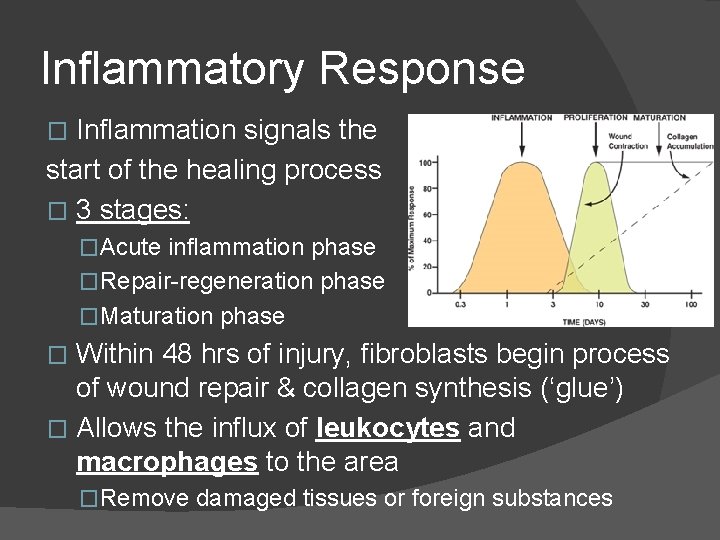
Inflammatory Response Inflammation signals the start of the healing process � 3 stages: � �Acute inflammation phase �Repair-regeneration phase �Maturation phase Within 48 hrs of injury, fibroblasts begin process of wound repair & collagen synthesis (‘glue’) � Allows the influx of leukocytes and macrophages to the area � �Remove damaged tissues or foreign substances
Acute vs Chronic Inflammation � The initial inflammatory response is essential for the resolution of an injury � Excessive edema and vascular damage can disrupt oxygen flow, which can lead to further tissue damage
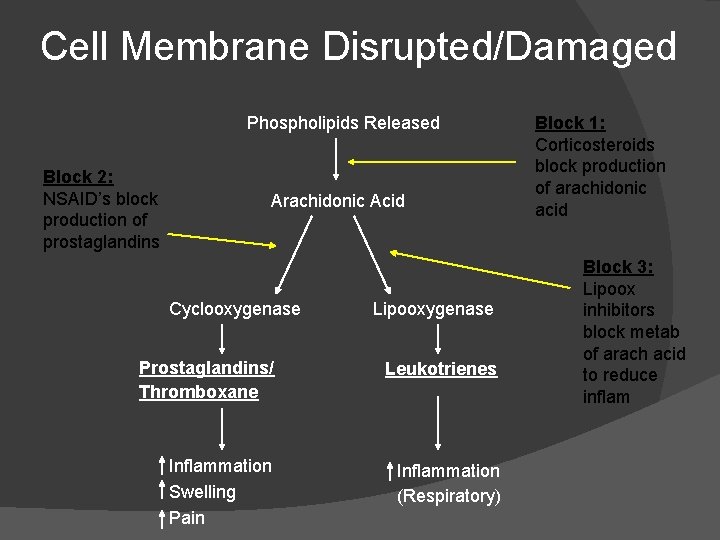
Injury Cycle � Cellular injury signals the release of chemical mediators, which (mostly) cause vasodilation: �Histamine �Serotonin �Leukotrienes �Prostaglandins �Thromboxanes (causes vasoconstriction and promotes clotting)
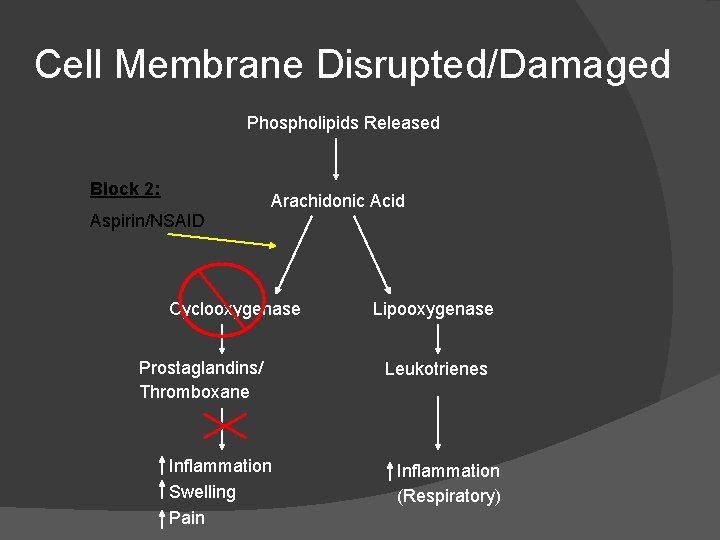
Cell Membrane Disrupted/Damaged Phospholipids Released Block 2: NSAID’s block production of prostaglandins Arachidonic Acid Cyclooxygenase Lipooxygenase Prostaglandins/ Thromboxane Leukotrienes Inflammation Swelling Pain Inflammation (Respiratory) Block 1: Corticosteroids block production of arachidonic acid Block 3: Lipoox inhibitors block metab of arach acid to reduce inflam
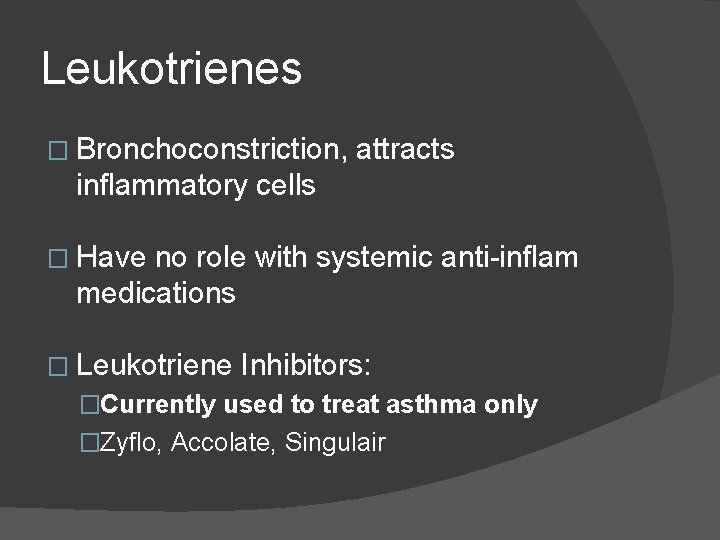
Leukotrienes � Bronchoconstriction, attracts inflammatory cells � Have no role with systemic anti-inflam medications � Leukotriene Inhibitors: �Currently used to treat asthma only �Zyflo, Accolate, Singulair
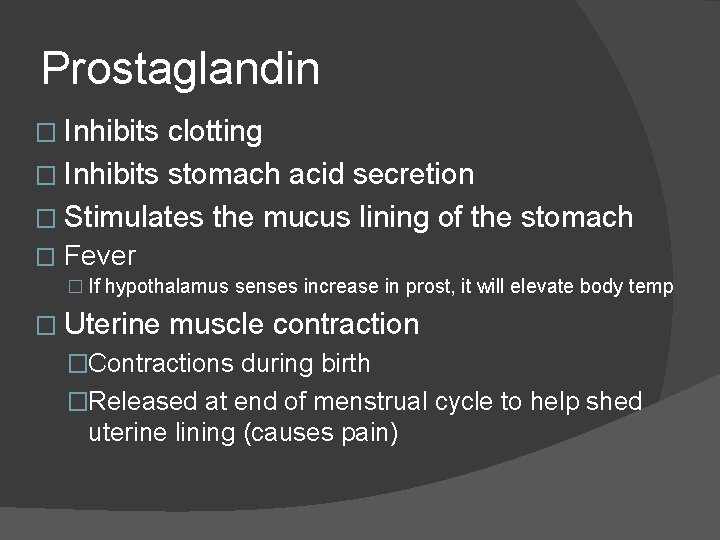
Prostaglandin � Inhibits clotting � Inhibits stomach acid secretion � Stimulates the mucus lining of the stomach � Fever � If hypothalamus senses increase in prost, it will elevate body temp � Uterine muscle contraction �Contractions during birth �Released at end of menstrual cycle to help shed uterine lining (causes pain)
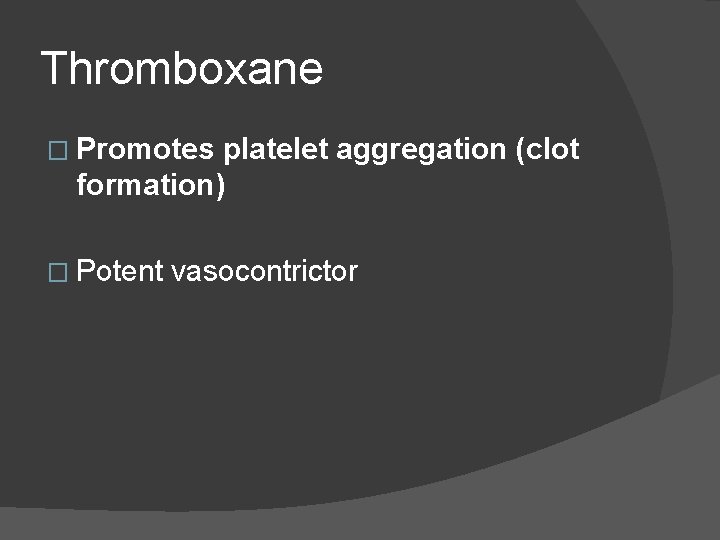
Thromboxane � Promotes platelet aggregation (clot formation) � Potent vasocontrictor
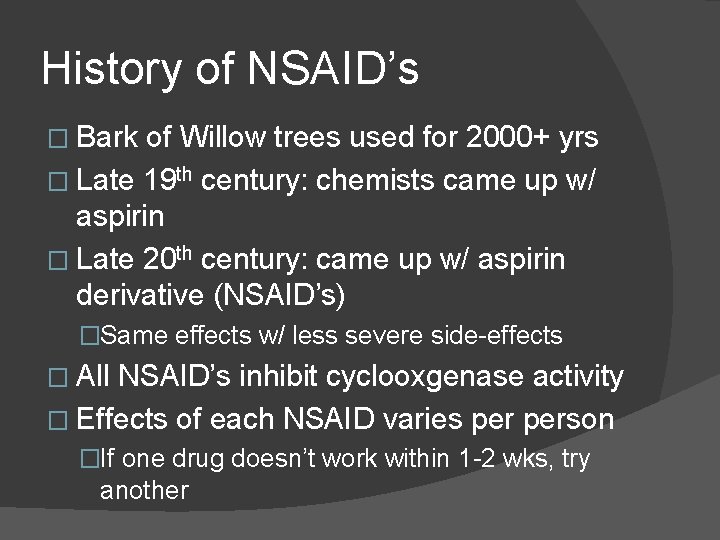
History of NSAID’s � Bark of Willow trees used for 2000+ yrs � Late 19 th century: chemists came up w/ aspirin � Late 20 th century: came up w/ aspirin derivative (NSAID’s) �Same effects w/ less severe side-effects � All NSAID’s inhibit cyclooxgenase activity � Effects of each NSAID varies person �If one drug doesn’t work within 1 -2 wks, try another
Effects of NSAID’s � All NSAID’s inhibit cyclooxgenase activity � Effects of each NSAID varies person �If one drug doesn’t work within 1 -2 wks, try another
Cell Membrane Disrupted/Damaged Phospholipids Released Block 2: Arachidonic Acid Aspirin/NSAID Cyclooxygenase Prostaglandins/ Thromboxane Inflammation Swelling Pain Lipooxygenase Leukotrienes Inflammation (Respiratory)
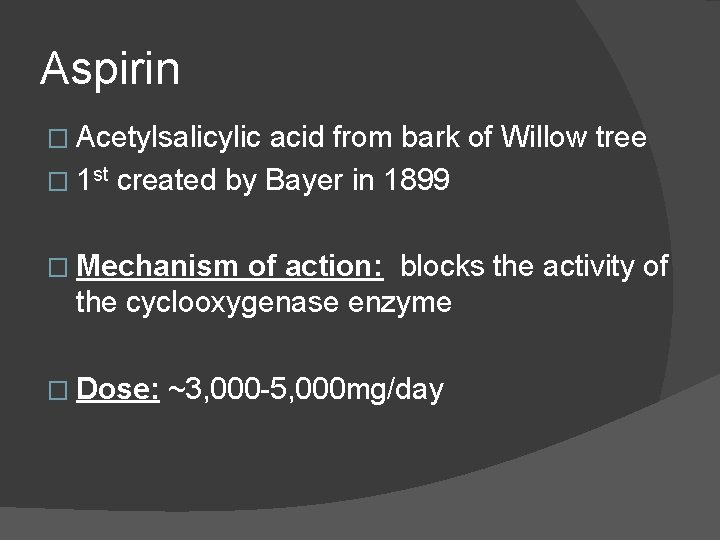
Aspirin � Acetylsalicylic acid from bark of Willow tree � 1 st created by Bayer in 1899 � Mechanism of action: blocks the activity of the cyclooxygenase enzyme � Dose: ~3, 000 -5, 000 mg/day
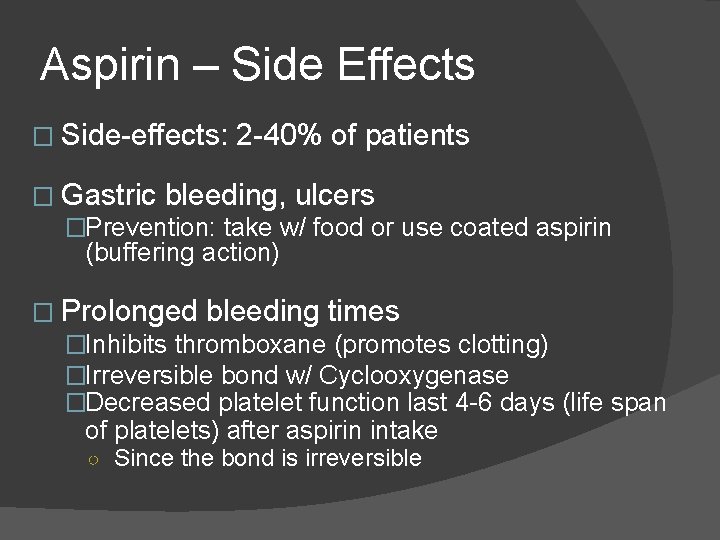
Aspirin – Side Effects � Side-effects: 2 -40% of patients � Gastric bleeding, ulcers �Prevention: take w/ food or use coated aspirin (buffering action) � Prolonged bleeding times �Inhibits thromboxane (promotes clotting) �Irreversible bond w/ Cyclooxygenase �Decreased platelet function last 4 -6 days (life span of platelets) after aspirin intake ○ Since the bond is irreversible
Aspirin – Reye’s Syndrome � Rare condition: impairs mitochondrial function, leads to liver & brain damage � Sx’s & Sy’s: vomiting, lethargy, delirium, hyperventilation, coma, seizures � No definitive cause & effect �Linked to aspirin intake in children w/ viral infections � Prudent to DC aspirin in patients <18 y/o w/ a viral infection
NSAID’s � Motrin ®, Advil ® = ibuprofen � Aleve®, Naprosyn® = naproxen � Relafen® = nabumetone � Indocin® = indomethacin � Mechanism of action: reversibly bind to COX (cyclooxgenase)
Ibuprofen � Most frequently used NSAID �Includes advil, motrin, and nuprin � Introduced OTC in 1985 � Among the most beneficial NSAID in relieving pain assoc w/ dsymennorhea (~400 mg every 6 hrs) � Still see decreased clotting due to thromboxane inhibition
Ibuprofen � Analgesic, antipyretic, anti-inflammatory � Most popular NSAID/Lowest risk of GI sy 15% DC) � T 1/2 = 2 hours � Onset = 15 -30 minutes � Dose: (10 - � 200 -400 mg every 4 -6 hours � 600 mg every 6 hours � 800 mg every 8 hours �Anti-inflam: 800 -1000 mg t. i. d (2, 400 -3, 200/day) �Should not exceed 3, 200 mg/day
Naproxen � Chemically � similar to ibuprofen Better @ decreasing jt inflam �Naproxen sodium concentrates in joint synovium 20% more potent than aspirin � 2 x’s more cases of GI bleeding than Ibuprofen � Avail Doses: OTC: 220 mg/Rx: 250, 375, 500 mg � T 1/2: 12 hours � Onset: 2 -4 hours � Dose: 375 -500 mg b. i. d � �Maximum daily dose = 1, 000 mg
Ketorolac Only NSAID that can be used for IM, IV or oral use � Has antipyretic & anti-inflam effects, but typically used as an analgesic � 2002: 28/30 NFL teams used IM on game days for pain relief � Pain relief potency similar to opiats w/o dependency issues � Onset: 30 -50 min � Dose: 15 -60 mg � Side-effects limit its’ use (< 5 days) � �Renal failure, gastric lining damage, GI bleeding
COX-2 Inhibitors � 2001: Bextra came onto the market, followed by Vioxx & Celebrex � 2004: FDA recalled Bextra - higher incidence of heart attack & stroke � Vioxx was voluntarily withdrawn soon after �Linked w/ increased risk of myocardial infarction by 300% � Only Celebrex remains on the market w/ warning
Side-Effects of NSAIDS � GI = #1 - nausea, vomiting, stomach cramping, ulcers, intestinal bleeding � Renal toxicity � Hepatic failure � CNS – headache, confusion, tinnitus � Hypersensitivity reactions � Decrease side-effects: �Take w/ food and avoid abuse!!!
NSAID Drug Interactions � Taking NSAID’s w/ anti-coagulants, aspirin, corticosteroids, or ALCOHOL: �Increase risk of serious GI pathology � NSAID’s will diminish effects of antihypertensive meds
Allergy Note � Patient’s that have a known allergy to aspirin should avoid other NSAID’s � They share a common chemical structure � Recommend: Tylenol (acetaminophen)
Acetaminophen � Effective fever and pain reducer �Anti-pyretic and analgesic �Not an anti-inflam because it cannot inhibit cyclooxygenase � No GI issues or prolonged bleeding time � Abreviation: APAP �Sometimes combined w/ other meds �Percocet = oxycodone + APAP � Mechanism CNS of Action: acts directly onto the
Acetaminophen � Dose: 325 -650 mg every 4 �Regular strength: 325 mg �Extra strength: 500 mg �Maximum strength: 650 mg hrs � Toxicity: 5, 000 mg/day � 5, 000 -8, 000 mg/day for several days = severe liver damage/death � Onset: < 1 hr � T ½ = 2 hours � Duration: 4 -6 hours
Question �A basketball player goes up for a rebound and gets his feet cut out from underneath him and hits his head on the court. He has a mild headache and no other symptoms. � What would you give him for pain? �Acetaminophen (Tylenol) or �Ibuprofen (Motrin)
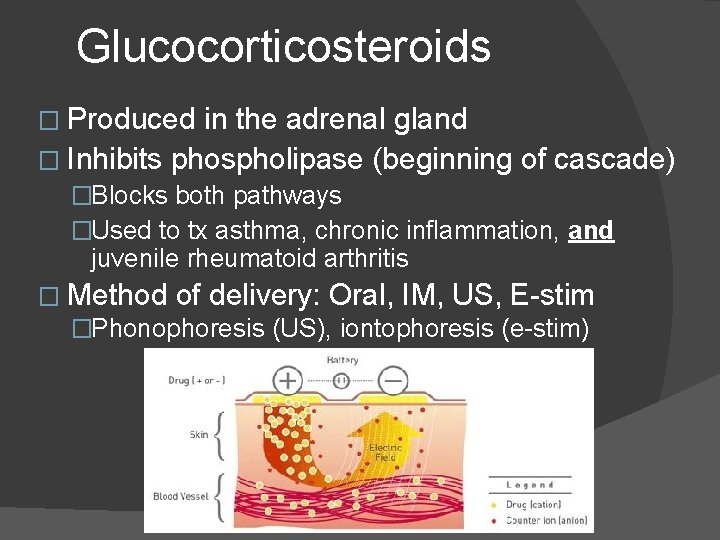
Glucocorticosteroids � Produced in the adrenal gland � Inhibits phospholipase (beginning of cascade) �Blocks both pathways �Used to tx asthma, chronic inflammation, and juvenile rheumatoid arthritis � Method of delivery: Oral, IM, US, E-stim �Phonophoresis (US), iontophoresis (e-stim)
Use of Corticosteroids in Sports Medicine No controlled studies to validate practices surrounding use � Use in reducing inflam is controversial, but widely practiced by physicians � Recommended: 2 wks between injections & no more than 3 injections @ each site � �Linked to collagen breakdown � 10 -14 days of “relative rest” after injection �’ 85 & ’ 08 articles � Typically it’s 1 -3 days of rest before full RTP
Complications � GI upset (oral) � Immune system suppression � Risk of infection � Fat necrosis � Tendon Rupture: most feared � 1999 study found irreversible damage to muscle when used to tx muscle contusions �Atrophy and decrease force generation �Due to inhibition of inflammatory phase of healing
Indications � Bursitis � Rheumatoid Arthritis � Severe Osteoarthritis � Elbow epiconylitis (tennis elbow) � Plantar fasciitis � De Quervain’s tenosynovitis � Trigger finger
SKELETAL MUSCLE RELAXANTS Chapter 4
Muscle Spasm vs Spasticity � Spasm: �Loss of range of motion, increased pain, & involuntary tension �Athlete is unable to completely relax muscle �Typically result of trauma � Pain-spasm-pain cycle: �Increase in pain from muscle sent to CNS = increase in tension = pain
Central-Acting Drugs � Central-acting – works on the CNS �Mechanism: Depression of CNS/Reduce CNS nerve impulses ○ Results in overall relaxation �Sedative effect allows athlete to rest & the muscle to repair = decreased muscle spasm � Typically combined w/ an analgesic (aspirin, Tylenol) � Onset: 30 -60 min � Duration: Most 4 -6 hrs, some 12 -24 hrs � Does not cure muscle injury, just relieves symptoms!
Side-effects � Drowsiness, Confusion, Lack of muscle coordination �Will be unable to practice/compete while taking relaxants! �Encourage athletes to DC as soon as they can function without them Headache, Dizziness, Blurry vision, Nausea, Vomiting � Allergic reactions � Addiction � � Watch for signs of abuse � Most commonly abused drug by health-care professionals � In combination with alcohol = death � Increased sedative effect
Chapter 5 DIABETES
Type II Oral Agents �Stimulate insulin release or help the body with glucose uptake �Taken �Most once a day or just a. c. popular: Glucophage (Metformin) �Beware of hypoglycemia �Need to eat regular meals when on medication
Insulin �Subcutaneous injection �Upper arm, thigh, abdomen, buttocks �Insulin pump �More precise �College & HS athletes have played sports w/ pump ○ Precautions must be taken to protect pump for contact sports �Doses are individualized to the person �Four types of insulin: �Rapid acting: <15 min a meals �Short acting: 30 -60 min a meals �Intermediate: b. i. d �Long acting: once daily
Chapter 7 RESPIRATORY DRUGS
Asthma Medications � “Rescue inhalers” – broncodilators �Rescue or control � Corticosteroids – controls inflammation �Controlling Agent � Athletes should have a controlling agent for inflam & a rescue inhaler for broncoconstriction
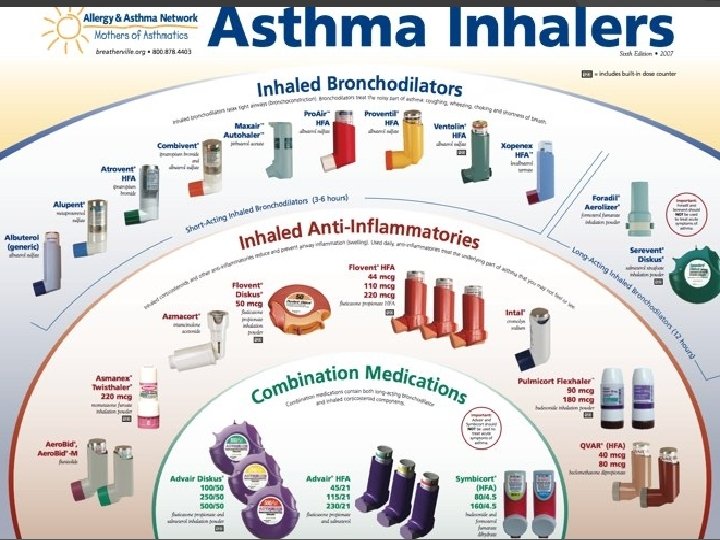
Albuterol Inhaler � Bronchodilators �Target Beta-2 agonists in bronchial smooth muscle specifically, causing them to relax � Works within minutes, � Most commonly used only lasts ~4 hrs � Brand Names: �Ventolin HFA® �Proventil HFA® �Proair HFA® � 2 puffs: 30 min a exercise to prevent onset of sx � Used as “rescue” inhaler, as needed
Proper Inhaler Use 1) 2) 3) 4) 5) 6) Shake the albuterol inhaler Breath out deeply Place mouth piece to your mouth Press the canister down at the same time you breath in Hold breath for about 10 sec, or as long as you can Wait 1 min before repeating
Anti-inflammatory Medications � Corticosteroids: used to prevent inflammation associated w/ chronic asthma � Not used as rescue therapy � Advair®: Combine corticosteroids w/ long acting beta-2 agonist � Must be taken everyday to work properly & prevent asthma attacks
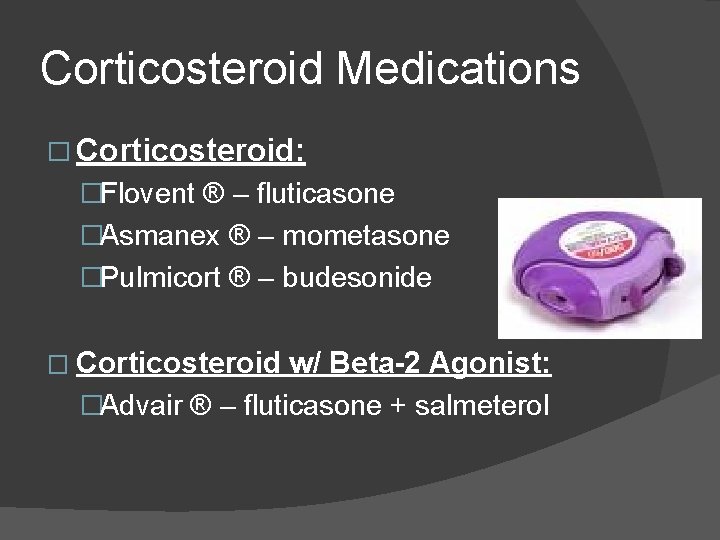
Corticosteroid Medications � Corticosteroid: �Flovent ® – fluticasone �Asmanex ® – mometasone �Pulmicort ® – budesonide � Corticosteroid w/ Beta-2 Agonist: �Advair ® – fluticasone + salmeterol
Other Types � Prednisone: �Tablets or liquid �Short tx course to reduce inflam p an attack ○ ~ 5 days � Singulair: �Disrupt the ability of leukocytes to increase inflammation �Oral tablets
Treatment for Asthma Attack 1) 2) 3) 4) 5) Stay calm Have them in a sitting position Let them use their inhaler: 3 -4 puffs Talk to them, encourage them to control their breathing If no improvement in ~ 30 min, call 911 1) Only call 911 if sy’s don’t respond to medicine Keep using the albuterol inhaler every 20 min for up to 1 hr 7) If they pass out, use mouth to mouth 6)
Antihistamine - Allergies � 1 st Generation: Benadryl � 4 -6 hrs sx relief �Cause drowsiness �Dry mouth (Night time) � 2 nd Generation: Claritin, Zyrtec, Allegra (Day time) �Up to 12 hrs sx relief �Less drowsiness �Nasal Decongestant (+ psuedoephedrine): ○ Claritin-D & Allegra-D
Steroidal Nasal Sprays (RX only) � Used specifically for allergic rhinitis � Not effective for viral conditions (common cold) � Effective for decreasing nasal congestion, sneezing, & rhinorrhea � Few side effects due to their direct action �Epistaxis, nasal irritation, dryness � Flonase � Nasonex
Expectorants vs Antitussives � Ingredients in cough syrups � Expectorant: from airway Promotes removal of mucus �Productive cough: Guaifenesin �Exp: Mucinex, Robitussin Chest Congestion � Antitussive: Suppress action of coughing �Dry cough: Dextomethorphan (DM) ○ DM is most common ingredient in cough syrup OTC’s �Exp: Robitussin, Tylenol Cold products, & Ny. Quil
Chapter 9
Antibiotics � Used to treat bacterial infections � Choice of antibiotic is based on type of bacteria � Narrow-spectrum: target specific microorganisms � Broad-sprectrum: active against many categories of bacterial microorganisms � Bacteriocidal: kills bacteria � Bacteriostatic: prevents multiplication
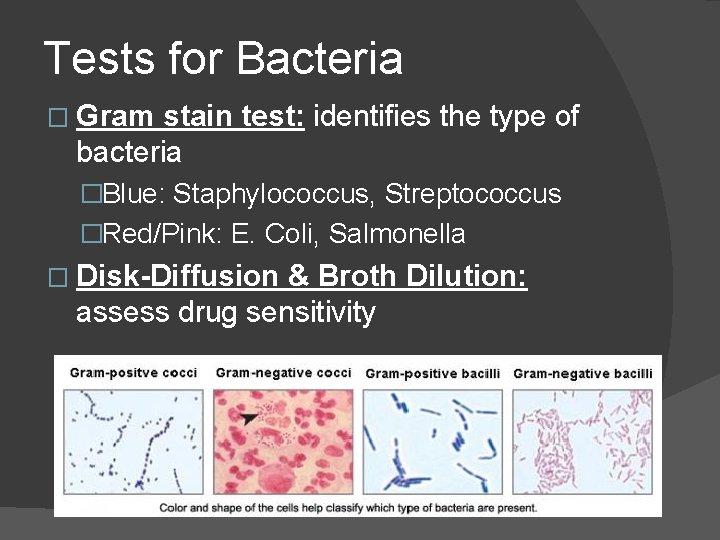
Tests for Bacteria � Gram stain test: identifies the type of bacteria �Blue: Staphylococcus, Streptococcus �Red/Pink: E. Coli, Salmonella � Disk-Diffusion & Broth Dilution: assess drug sensitivity
Antibacterial Drugs � Mechanisms of action: �Inhibit cell wall synthesis �Inhibit protein synthesis �Inhibit DNA synthesis �Inhibit folic acid synthesis
Penicillin � Inhibits � 1928 cell wall synthesis – discovered by Alexander Fleming � He noticed mold growing in a petri dish of bacteria � The bacteria were dying as they came in contact with the mold � Thus, penicillin was discovered
Penicillin � Passes through small pores in the bacteria’s cell membrane & binds to penicillin-binding proteins (PBP) � Penicillin inhibits enzymes needed to construct the bacteria’s cell wall � Without the cell wall, the bacteria loses its’ protection & gets broken down � Since human cells do not have a cell wall, the penicillin does not affect our own cells
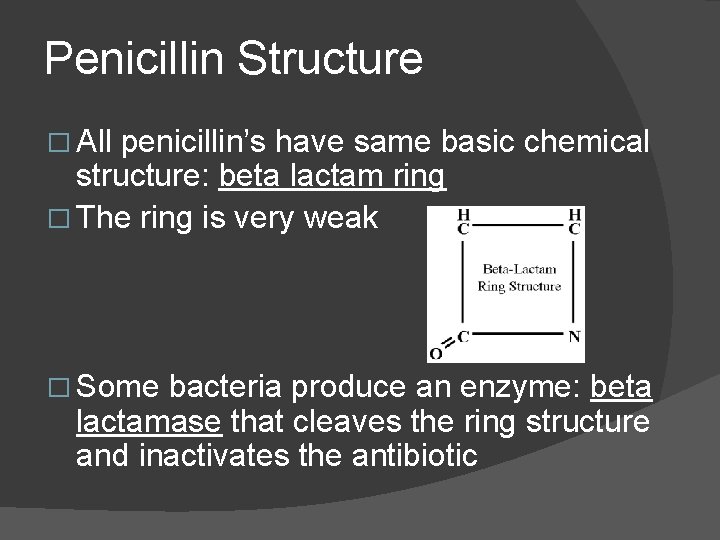
Penicillin Structure � All penicillin’s have same basic chemical structure: beta lactam ring � The ring is very weak � Some bacteria produce an enzyme: beta lactamase that cleaves the ring structure and inactivates the antibiotic
Penicillin Drugs � Penicillin VK � Amoxicillin � Methicillin � Used primarily to �Strep throat �Pneumonia �Skin infections �Ear infections tx:
Penicillin Allergy � One of the most commonly reported drug allergy is penicillin � Mild reactions: �Rash, itching, hives, swelling � Severe reactions: �Bronchospasm, laryngeal edema
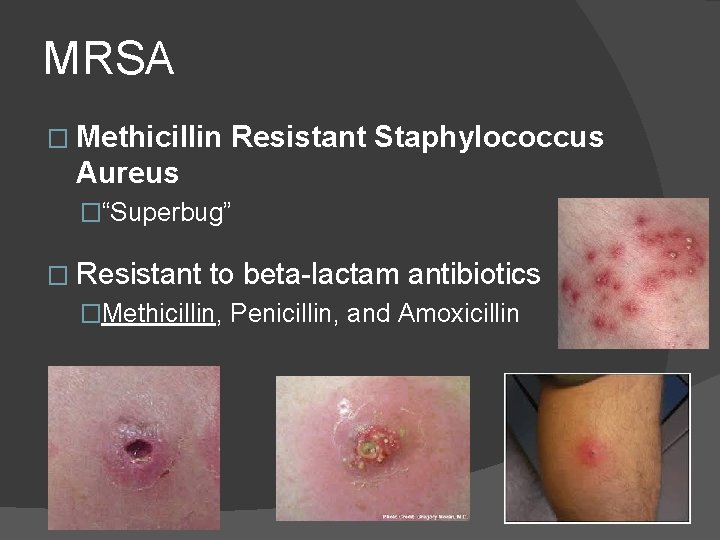
MRSA � Methicillin Resistant Staphylococcus Aureus �“Superbug” � Resistant to beta-lactam antibiotics �Methicillin, Penicillin, and Amoxicillin
Cephalosporins – Exp: Keflex (Cephalexin) – 1 st Gen. � Four generations: tx different types of bacteria � Inhibits bacteria cellular wall synthesis � Have a beta lactam ring, similar to penicillin �Also susceptible to beta-lactamase producing bacteria �Many pt’s w/ pen. allergy can take cephalosporins � Used to tx: �Skin & soft tissue infections, respiratory tract infections, & meningitis
Inhibit Protein Synthesis Binds to bacterial ribosomes & block production of amino acids � Suppress bacteria growth � � Classes: 1. Tetracyclines 2. Macrolides 3. Clindamycin 4. Aminoglycosides
Tetracyclines � Broad spectrum antibiotic � Effective against wide variety of conditions: �Lyme disease �Acne �Tooth infections �Pneumonia, respiratory infections �Chlamydia, gonorrhea, syphilis
Macrolides � Similar coverage as penicillins: �Pneumonia, strep, skin infections, chlamydia, syphilis � Can be used in patients w/ penicillin allergy � Exp: �Erythromycin �Clarithromycin �Azithromycin (Z-Pak)
Clindamycin � Only agent in its class � Used to treat wide variety of infections: �Pneumonia, respiratory track infections, skin infections, acne
Inhibit Folic Acid Synthesis � “Sulfa” drugs � Bactrim (sulfamethoxazole) � Suppress � Mostly used for UTI’s � Caution � Most bacteria growth in patients w/ sulfa allergy common side effect is hypersensitivity
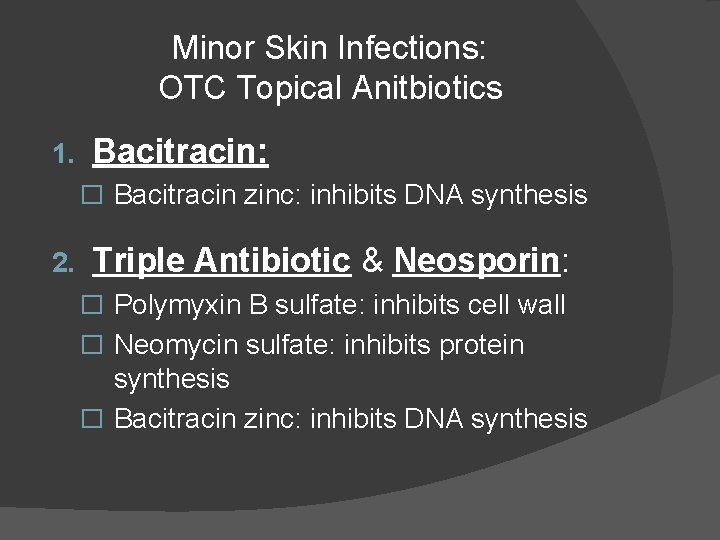
Minor Skin Infections: OTC Topical Anitbiotics 1. Bacitracin: � Bacitracin zinc: inhibits DNA synthesis 2. Triple Antibiotic & Neosporin: � Polymyxin B sulfate: inhibits cell wall � Neomycin sulfate: inhibits protein synthesis � Bacitracin zinc: inhibits DNA synthesis
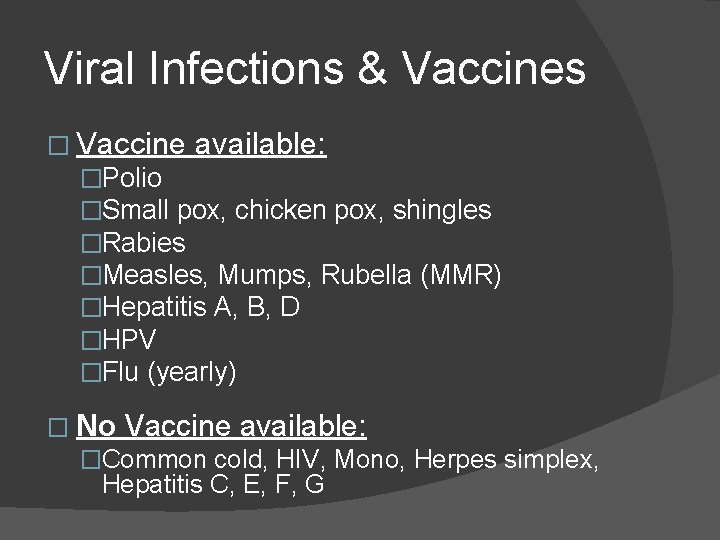
Viral Infections & Vaccines � Vaccine available: �Polio �Small pox, chicken pox, shingles �Rabies �Measles, Mumps, Rubella (MMR) �Hepatitis A, B, D �HPV �Flu (yearly) � No Vaccine available: �Common cold, HIV, Mono, Herpes simplex, Hepatitis C, E, F, G
Chapter 10 ANALGESICS & LOCAL ANESTHETICS
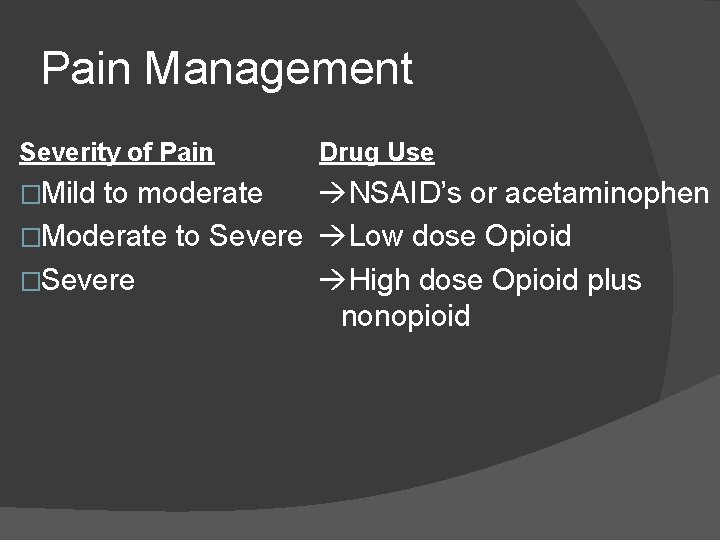
Pain Management Severity of Pain Drug Use NSAID’s or acetaminophen to moderate �Moderate to Severe Low dose Opioid High dose Opioid plus �Severe nonopioid �Mild
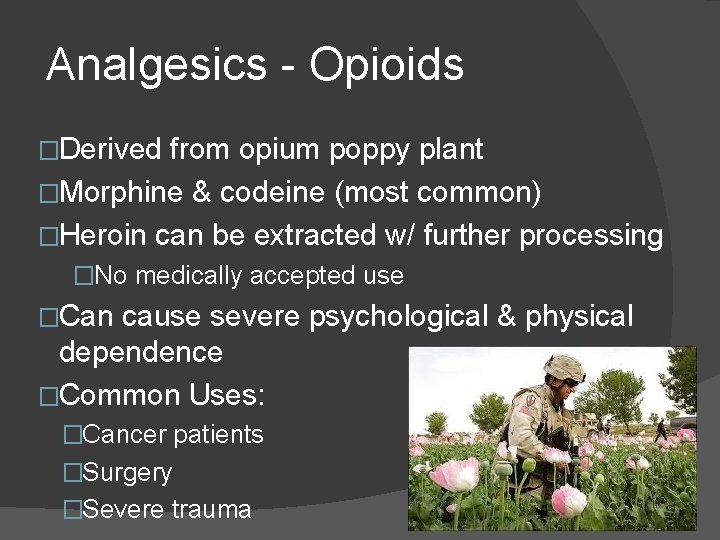
Analgesics - Opioids �Derived from opium poppy plant �Morphine & codeine (most common) �Heroin can be extracted w/ further processing �No medically accepted use �Can cause severe psychological & physical dependence �Common Uses: �Cancer patients �Surgery �Severe trauma
Opioid Mechanism of Action �Decreases neurotransmitter activity �Which produces analgesic effect �All opioid drugs are considered controlled substances �Class I (Street drug): �Heroin �Class II (Highest level of abuse): �Morphine, Oxycodone (Percocet®) �Class III (Moderate potential for abuse): �Hydrocodone ○ Vicodin®, Lortab®
Hydrocodone � Hydrocodone c acetaminophen �Most commonly prescribed pain medicine in 2000 � Vicodin � Time & Lortab to Onset: 10 -30 min � Duration: 4 -6 hrs
Oxycodone � Typical Brand Names: �Oxycontin �Percocet �Percodan �Oxycodone � Time to Onset: 15 -30 min � Duration: 4 -6 hrs
Percocet: Oxycodon + Acet �Doses: � 5/325 mg (5 mg oxycodone + 325 mg APAP) � 7. 5/325 � 10/650 �Take pain 1 tablet every 4 -6 hours as needed for �Can be taken c or w/o food �Don’t exceed 4 g/day (4000 mg) limit for acetaminophen
Codeine �Exp: �Tylenol #3: 3 mg codeine + 300 mg APAP �Uses: �Mild to moderate pain or dental use �Sometimes used as an antitussive for individuals w/ a severe cough �Time to Onset: 10 -30 min �Duration: 4 -6 hrs �Codeine can be further processed into morphine
Morphine �One of the most effective drugs known for pain relief �Used to treat moderate to severe pain �Can also be used to alleviate severe coughing �Morphine may be used to ease pain before, during & after surgery �Can cause psychological & physical dependence �With the same addiction potential as heroin �Time to Onset: 15 -60 min �Duration: 3 -7 hrs
Side Effects �Addiction �Sedation �Nausea/Vomiting �Constipation �CNS/Respiratory Depression �Combined c alcohol can be lethal!
Local Anesthetics �To induce a partial or complete loss of sensation �Ice, injection of drug, topical (skin irritants) �Action of Drug: �Diminishes ability of the nerve fiber to conduct an action potential �Inhibits number of nerve endings that can transmit impulses to CNS
Commonly Used Local Anesthetics �Novocaine: �Onset: 10 -30 min �Duration: 30 -60 min �Lidocaine: �Onset: <10 min �Duration: 1 -3 hrs �Cocaine: �Still used (rarely) during nasal surgeries
Warning �Using pain relievers or local anesthetics during sports participation may cause further injury!