
Pharmacognosy 3 rd Class 1 st Semester CHEMICAL


- Slides: 12
Pharmacognosy 3 rd Class, 1 st Semester CHEMICAL TESTS OF ANTHRAQUNIONE Lab. 5
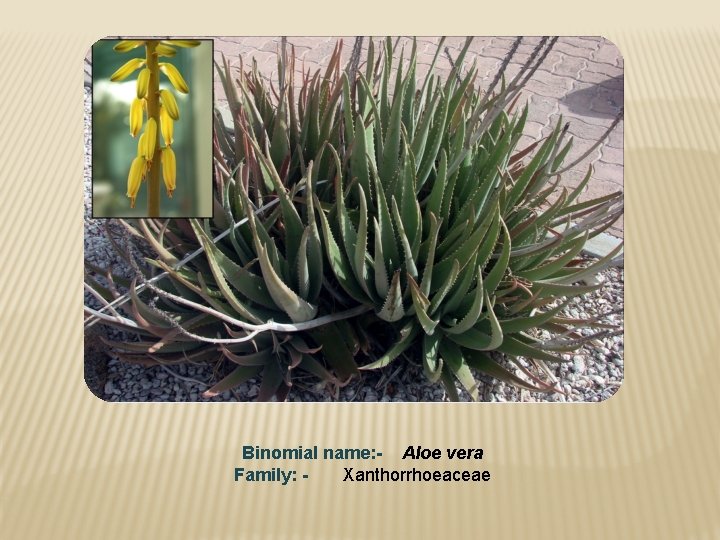
Binomial name: - Aloe vera Family: - Xanthorrhoeaceae
A- GENERAL REACTION 1) 2) Boil 1 gm of the crude drugs (aloe) with 100 ml of water. Filter the solution and use this solution for the following tests: 1) SCHONTETENS REACTION (BORAX TEST) 2) BROMINE TEST FOR ALOIN
1) SCHONTETENS REACTION (BORAX TEST) AIM To identify the Anthraquinone glycosides in general v Equipment and reagents 1) Test tube 2) Small beaker 3) Water bath 4) Borax v Procedure 1) Take 5 ml of the extract. 2) Add 0. 2 gm of the borax and heat until dissolved. 3) Pour a few drops of the liquid into a test tube nearly full in water. v Results A green fluorescence is produced. v Discussion This green fluorescence is due to barbaloin which is obtained from hydrolysis of aloe emodin anthranol with borax giving this reaction. v
2) BROMINE TEST FOR ALOIN AIM To identify the Anthraquinone glycosides in general v v 1) 2) 3) Equipment and reagents Test tube Bromine solution Procedure Take 2 ml of the extract Add an equal volume or an excess of freshly prepared solution of the bromine. Record the color Results Pale Yellow precipitates. v
B- SPECAL REAGENTS 1) Nitric acid test Aim Specific identification of the Anthraquinone glycosides. v v 1) 2) 3) Equipment and reagents Test tube Concentrated nitric acid Procedure Take 5 ml of solution. Add 2 ml of concentrated nitric acid. Record the results pale brown.
2 -NITROUS ACID TEST (SPECIFIC FOR ISOBARBALOIN) Aim Specific identification of the Anthraquinone glycosides(isobarbaloin ) v v 1) 2) 3) Equipment and reagents Test tube Sodium nitrite Glacial acetic acid Procedure Take a few mills from an aqueous solution Add a few crystals of sodium nitric acid and a drop of glacial acetic acid , shake well. Record the results brown.
3) CUPRALOIN TEST FOR ISOBARBALOIN (KLUNG’S REACTION) AIM To identity test for Curacao aloe. v Equipment and reagents 1) Small beaker 2) Water bath 3) 10%coppersulphate solution 4) Sodium chloride v Procedure 1) Mix 5 ml of the filtrate with 5 ml of the water 2) Add: A. A drop of 10% copper sulphate solution B. 0. 5 gm of sodium chloride C. 1 ml of alcohol, warm gently. 3) Record the results dark brown. v
4 )BORNTRAGERS TEST Aim To identity test for Anthraquinone. v Equipment and reagents 1) Separatory funnel 2) Test tube 3) Dilute acid 4) Benzene 5) Dilute ammonia 10% v Procedure 1) Take 10 ml of the solution extract (fraction A) 2) Add few drops of dilute acid 3) Place the mixture in a separatory funnel and extract with 10 ml of benzene for 1 minute. 4) Separate the upper layer and place in a test tube (aqueous glycoside layer fraction B). 5) Take the lower benzene layer (fraction C) and shake it with dilute ammonia (10%). v Results Pink color will be produced which is very clear with fraction C v Discussion The benzene extracts the aglycone, and with ammonia, forms Anthraquinone salts, which have, pink color. v
RHUBARB TEST FOR IDENTITY 1) The Anthraquinone may readily be separated from powdered rhubarb by micro-sublimation. 2) Borntragers test (is carried out as above procedure) TEST FOR PURITY: Test A) 1) Extract a small amount of the powdered rhubarb with ether 2) Add a few drops of this extract on a piece of filter paper. 3) When dry, add a few drops of boric acid solution and one drop of dilute HCL, a red color develops which after treating with ammonia becomes blue to bluish- black. Test B) v Moisten a small amount of the powdered drug with a cooled mixture of equal parts of concentrated H 2 SO 4 and alcohol. A reddish-violet color should develop.
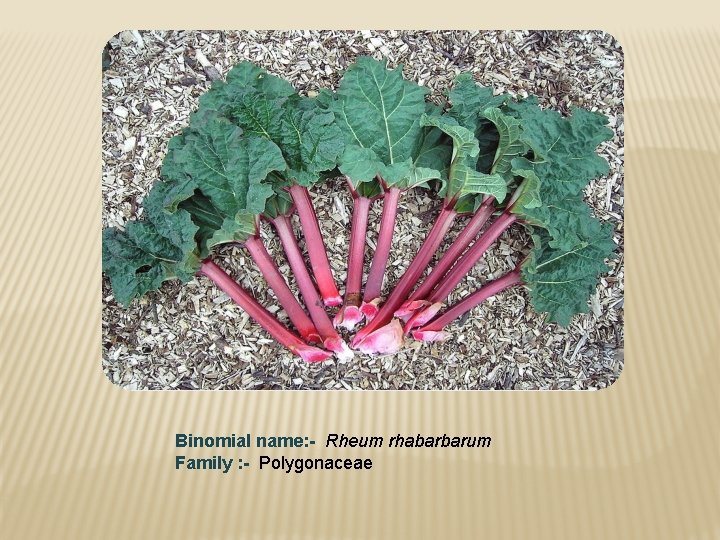
Binomial name: - Rheum rhabarbarum Family : - Polygonaceae
THANK YOU