
Pharmacogenetics Dr Mohammed AlSbou Professor of Clinical Pharmacology
Pharmacogenetics Dr. Mohammed Al-Sbou Professor of Clinical Pharmacology Faculty of Medicine-Mutah Uni 1
n n Human beings are 99, 9% genetically identical The human genome project has led to an explosion of genetic information that is freely available to identify polymorphisms that may determine drug response 2
n Advances in molecular genetics and genotyping technologies during the last two decades have led to identification of many polymorphisms in phase I and phase II drug metabolising enzymes, drug targets, and in drug transporters 3
Individual Variation in Response to Drugs How individuals in a population are expected to respond to a fixed dose of drug? n Inter-individual variability: - Some show less than usual response - Most show usual response - Others show more than usual response n 4
Factors Determine Response to Drugs q Environmental (age, sex, race, concomitant diseases, diet, smoking, alcohol) q Genetic (polymorphisms drug metabolising enzymes, receptors, drug targets) 5
Pharmacogenetics/Pharmacogeno mics Pharmacogenetics: is study of variation in drug response due to heredity & is used in relation to genes determining drug metabolism n Pharmacogenomics is a more general term; it refers to research area that comprises all genes in the human genome that may determine drug response n 6
Benefits of Pharmacogenetics/Pharmacogenomi cs The concept “The right medicine to the right patient” is the basis of pharmacogenetics (personalised or individualised medicine) n Ultimate goals are to improve clinical therapeutic outcome by: - Increasing drug efficacy - Increasing safety of drugs e. g. reducing incidence of ADRs n 7
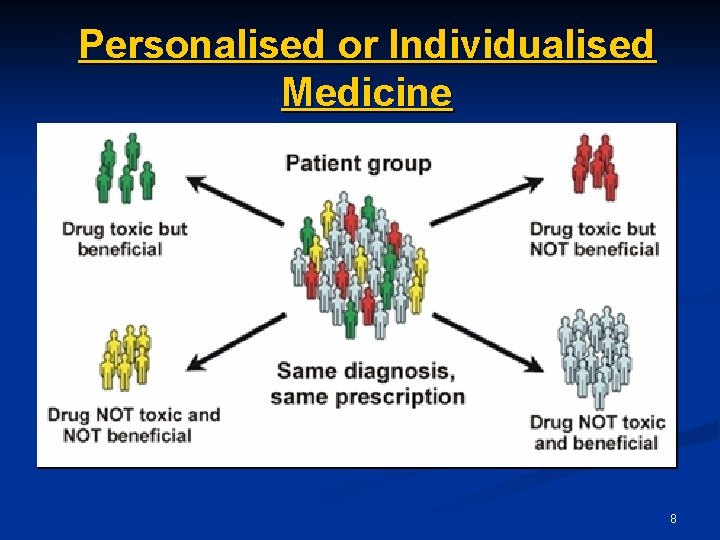
Personalised or Individualised Medicine 8
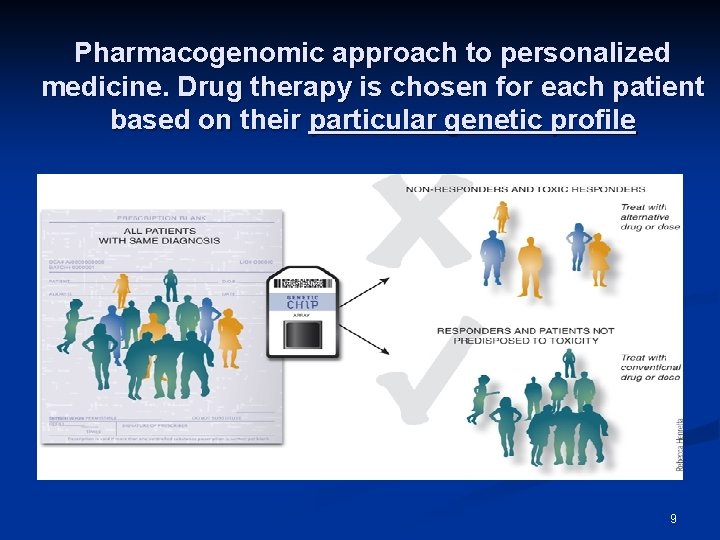
Pharmacogenomic approach to personalized medicine. Drug therapy is chosen for each patient based on their particular genetic profile 9
n Polymorphisms can occur in any gene that encode: - Drug metabolising enzymes - Drug transporters - Drug targets and receptors 10
Genetic polymorphisms of drug metabolising enzyme genes n n n The majority of phase I and phase II drug metabolising enzymes are polymorphic The cytochrome P 450 (CYP) enzymes are the most important group of phase I enzymes Polymorphisms in cytochrome P 450 genes can cause enzyme products with abolished or increased enzyme activity 11
Cytochrome P 450 enzymes n All genes that encode for families 1 -3 are polymorphic & their capacity to metabolise drugs depends on the functional importance and frequency of variant alleles 12
CYP 450 Enzymes CYP 2 D 6 n CYP 2 C 9 n CYP 2 C 19 n 13
CYP 2 D 6 n CYP 2 D 6 contributes to metabolism of large of medications about 25% of all drugs, including: n Antidepressants (TCAs, SSRIs) n Antiarrythmics n Analgesics 14
CYP 2 D 6 Phenotypes - Poor metabolisers( PM): lack functional enzyme - Intermediate metabolisers (IM): carry two alleles that cause reduce activity - Extensive metabolisers ( EM): have two normal alleles - Ultra-rapid metabolisers (UM): multiple gene copies 15
Poor metabolisers can experience adverse effects when treated with standard dose n Ultra-rapid metabolisers require high doses of drugs n 16
Depression Tricyclic antidepressants are metabolised by CYP 2 D 6 n Disposition of nortriptyline is related to number of active CYP 2 D 6 alleles and n Dose required to obtain same plasma drug concentrations varies between subjects with different CYP 2 D 6 phenotypes - 17
Ultra-rapid metabolisers needed a 10 fold larger dose of nortriptyline than poor metabolisers to achieve the same plasma concentration n Ultra-rapid metabolisers require 500 mg of doses compared to 50 mg in poor metabolisers n 18
n n n Genetic polymorphisms of CYP 2 D 6 gene may be associated with ADRs and clinical response to antidepressants 30% of patients with ADRs to antidepressants were PMs High incidence of UMs among nonresponders (20%) 19
CYP 2 C 9 n n CYP 2 C 9 metabolises a wide range of drugs Including drugs with narrow therapeutic indices such as S-warfarin, phenytoin and various non-steroidal antiinflammatory drugs (NSAIDs) including ibuprofen, diclofenac and celecoxib 20
Warfarin and Bleeding n n Warfarin is one of the most widely prescribed oral anticoagulant drugs It is used for: Prophylaxis and treatment of venous thromboemolism n Treatment of deep vein thrombosis (DVT) n Atrial fibrillation (AF) n In patients with prosthetic heart valves n 21
Warfarin and bleeding n n n The main complication of warfarin therapy is haemorrhage Genetic polymorphisms in CYP 2 C 9 gives rise to variants with altered enzymes activity Two allelic variants CYP 2 C 9*2 (Arg 144 Cys) and CYP 2 C 9*3 (Ile 359 Leu) show 12% and 5% of enzyme activity of the wild type CYP 2 C 9*1 allele, respectively, and are associated with decreased warfarin dose requirements & an increased risk of bleeding 22
Peptic Ulcer: Proton pump inhibitors (PPIs) are used for treatment of gastric acid related diseases such as peptic ulcers, gastro-esophageal reflux disease (GERD) & in combination with antibiotics (amoxicillin & clarithromycin) for eradication of Helicobacter pylori (Hp) - CYP 2 C 19 metabolises several PPIs including omeprazole and lanzoprazole - Plasma concentrations of omeprazole, depend on patient’s CYP 2 C 19 phenotype - 23
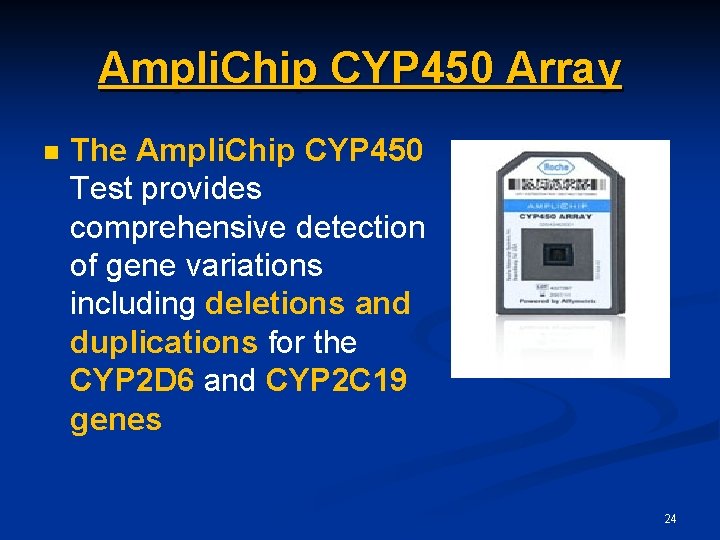
Ampli. Chip CYP 450 Array n The Ampli. Chip CYP 450 Test provides comprehensive detection of gene variations including deletions and duplications for the CYP 2 D 6 and CYP 2 C 19 genes 24
Genetic polymorphisms of drug metabolising enzyme genes n n With respect to phase II enzymes, the most important polymorphisms occur in Nacetyltransferase-2 (NAT-2) and thiopurine methyltransferase (TPMT) NAT-2 is involved in the metabolism of isoniazid and sulphamethoxazole 25
Acetylation - - Most individuals are either rapid or slow acetylators, but proportion varies between races The percentage of slow acetylators: § 90% in North African § 50% in Caucasian § 10% in Asian populations 26
Thiopurine S-methyltransferase (TPMT) TPMT catalyzes methylation of thiopurine drugs such as 6 -mercaptopurine & azathioprine n These drugs are commonly used in treatment of acute lymphoblastic leukaemia (ALL), autoimmune diseases, inflammatory bowel diseases, in organ & tissue transplantation n Clinical testing for TPMT genetic polymorphisms is available n 27
It has been shown that: - 90% of population exhibit high TPMT activity - 10% show intermediate activity - 0. 3% have low or absent enzyme activity n 28
Genetic Polymorphisms in Drug Transporters n n Transporters are membrane proteins that play crucial role in absorption, distribution & elimination of drugs Genetic polymorphisms can occur in transport proteins & may contribute to interindividual variation in drug response MDR 1 (multi-drug resistant) Pglycoprotein-Digoxin Serotonin transporter-antidepressant response 29
Genetic polymorphisms in Drug targets and receptors n n Drug target genes including those coding for receptors, ion channels and specific enzymes are subject to genetic polymorphisms B 2 -adrenergic receptor- B 2 agonist (salbutamol) Angiotensin converting enzyme (ACE)ACE inhibitors (lisinopril) Vitamin K epoxide reductase complex (VKORC)- Warfarin 30
Practical Points Genetic is an important factor responsible for failure to therapy & occurrence of adverse drug reactions n The goal of PGx is to maximize efficacy & minimize toxicity, based on individual’s genetic composition n Individual variation in response to drug (some may benefit, other fail to respond to treatment, others may develop adverse effects) n 31
- Slides: 31